
PowerBlock vs FLYBIRD vs BowFlex: Which Adjustable Dumbbell for a UK Home Gym?
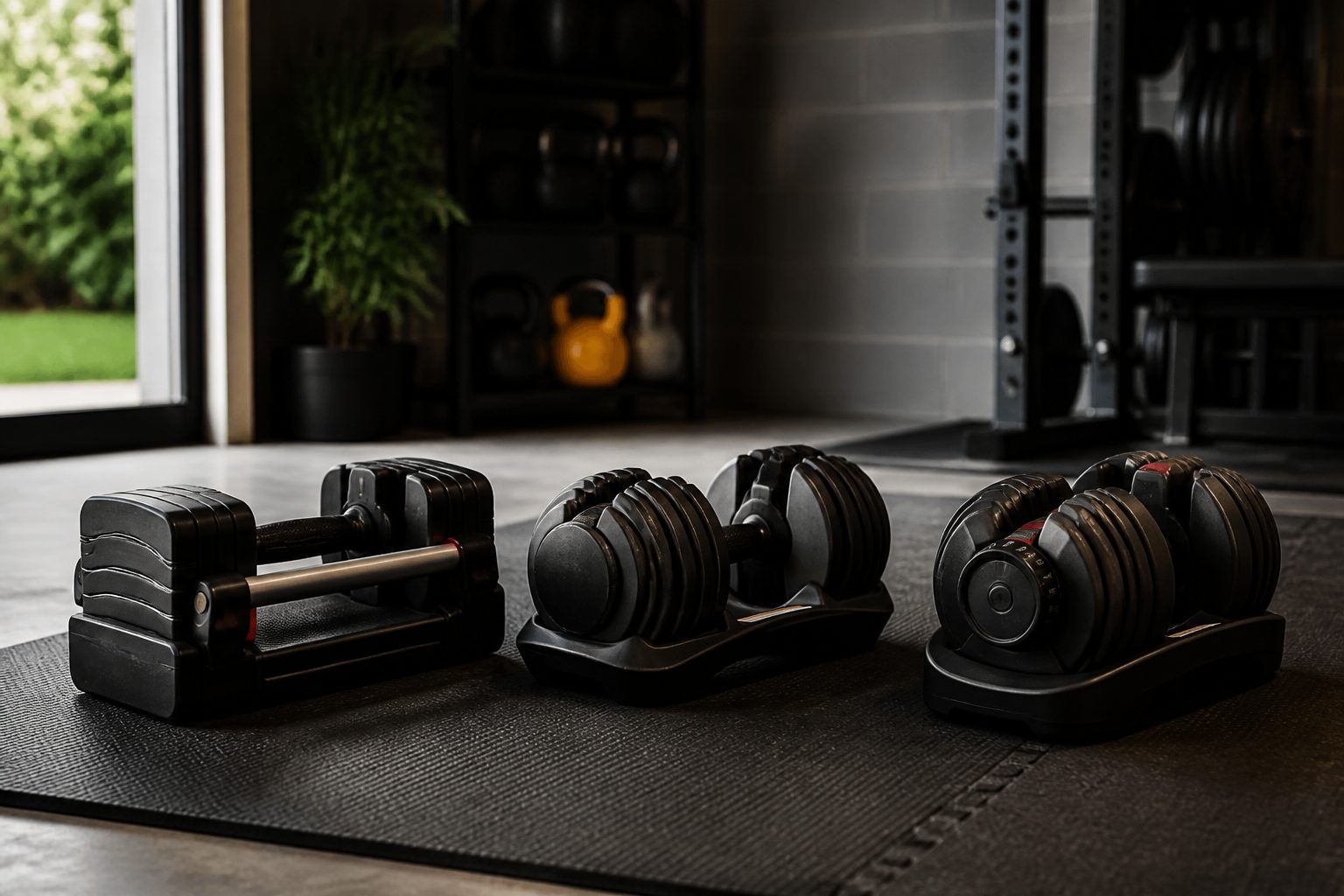
Adjustable dumbbells save an impressive amount of floor space, but the way they select and secure their plates matters far more than a tidy-looking cradle.
PowerBlock, FLYBIRD and BowFlex all promised a rack's worth of resistance in a compact home-gym footprint. They went about it rather differently. Here is the useful comparison for UK buyers in 2026, including why the recalled BowFlex SelectTech models should be left out of any serious shopping list.
 By James Oduya · Staff Writer & Home Gym Columnist · Updated September 07, 2026
The short version: three very different ways to solve the same problem
Adjustable dumbbells are one of those home-gym purchases that sound almost suspiciously sensible. Instead of collecting a procession of fixed dumbbells, each with its own patch of floor and an uncanny ability to migrate under the sofa, you buy one pair that changes weight. For a flat, spare room or corner of the garage, that is a genuinely compelling idea.
But "adjustable dumbbell" covers a lot of ground. PowerBlock used a stackable selector-pin system and a distinctive squared-off shape. FLYBIRD used a twist-lock approach built around a cradle and a rotating handle. BowFlex used side selection dials, then had to revise its direction after the SelectTech 552 and SelectTech 1090 were recalled because plates could dislodge in use.
That safety history made this a less casual comparison than it once was. The recalled SelectTech models were not merely older versions to consider at a tempting discount. They had been recalled after 349 customer reports of plates dislodging, with 111 reported injuries including concussions, abrasions, broken toes and contusions. A bargain dumbbell should not require a risk assessment and steel-capped boots.
So the proper BowFlex comparison in 2026 is the newer Results Series 552 and Results Series 1090, which used upgraded metal components and a secure locking mechanism. Against them, PowerBlock remained the most established selector-pin concept here, whilst FLYBIRD offered the straightforward Amazon-friendly twist-lock option. Your best choice depended on weight ambition, tolerance for larger increments, hand clearance and how much reassurance you wanted from the locking system.
Important safety note: the recalled BowFlex SelectTech 552 and SelectTech 1090 should not be treated as normal second-hand options. Their plate-disconnection issue was the reason for the recall. For a BowFlex purchase, focus on the Results Series replacements with their revised metal plate-attachment components.
At-a-glance comparison: ranges, increments and physical format
The table below puts the meaningful numbers in one place. Notice that there was no single "PowerBlock", "FLYBIRD" or "BowFlex" answer: each brand had light, middle and heavier routes. The key is to buy the range that matches the exercises you will actually do in six months, not just the curls you can picture doing on delivery day.
| Model | Weight range per hand | Stated increment | Adjustment system | Notable design detail |
|---|---|---|---|---|
| PowerBlock Sport 24 | 3–24lb | 3lb | Selector pin | Padded handle; welded solid steel construction |
| PowerBlock Pro 50 | 5–50lb | 2.5lb | Magnetic selector pin | 12.5 × 7 × 7.25in; rubber grip |
| PowerBlock Pro 90 | 5–90lb | 5lb, with 2.5lb micro-adjustment | Selector system with Auto-Lock lever | Open-draft handle and knurled steel grip |
| FLYBIRD 25lb | 5–25lb | 5lb | Twist-lock in cradle | 14.6 × 7.9 × 6.7in; aluminium alloy grip |
| FLYBIRD 55lb | 11–55lb | 11lb | Rotating handle in cradle | Fixed-length handle; powder-coated steel plates |
| BowFlex Results Series 552 | 5–52.5lb | 2.5lb to 25lb | Selection dials | Metal plate components and secure lock |
| BowFlex Results Series 1090 | 10–90lb | 5lb | Selection dials | Knurled grips; metal plate components and secure lock |
The figures immediately reveal two important things. First, FLYBIRD's lighter model and PowerBlock Sport 24 served the same broad beginner-to-intermediate territory, although PowerBlock started at 3lb and moved in 3lb steps, while FLYBIRD began at 5lb and moved in 5lb jumps. Secondly, the heavy-duty contest was really PowerBlock Pro 90 versus BowFlex Results Series 1090. Both reached 90lb per hand, but their feel and route to that load were not alike.
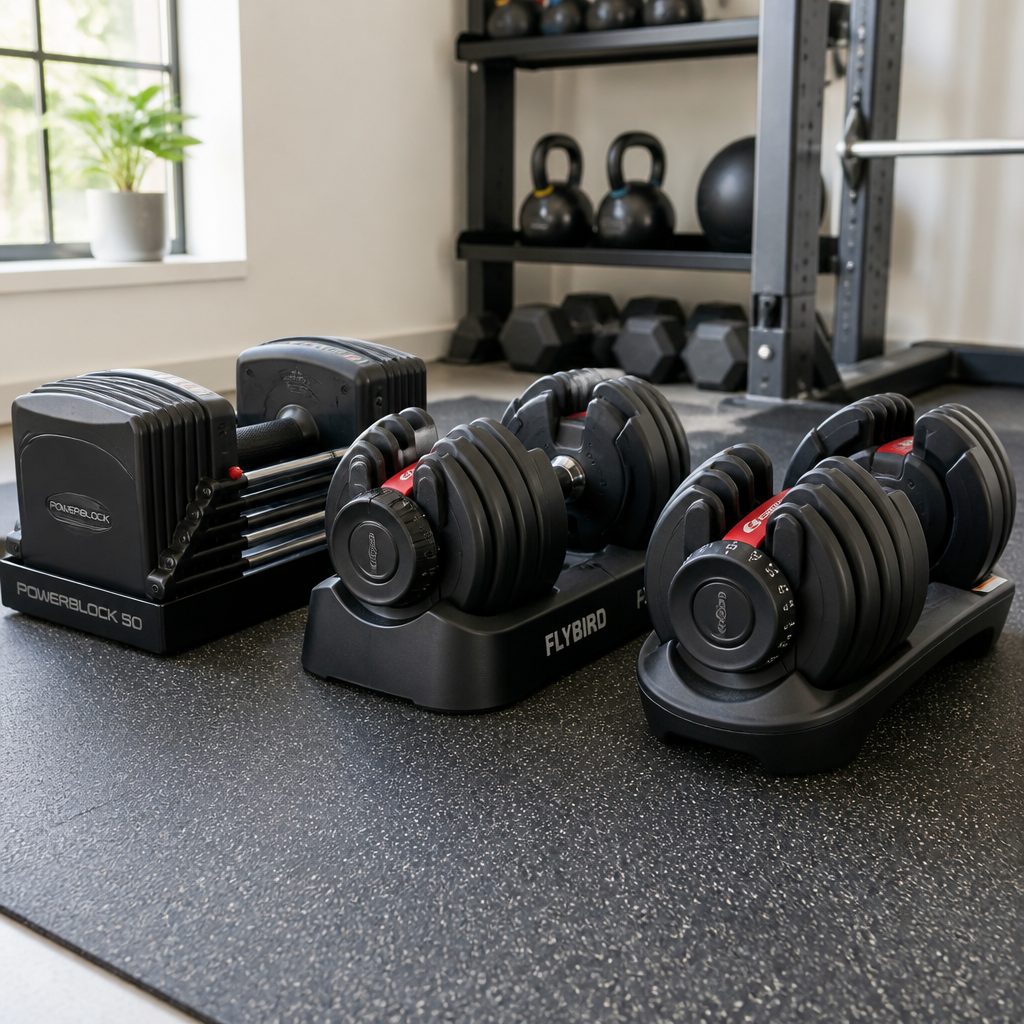
The selector-pin PowerBlock layout looks unusual beside conventional round dumbbells, yet it is built around fast changes without a row of loose plates.
PowerBlock Sport 24, Pro 50 and Pro 90: the selector-pin case
Shop PowerBlock Sport 24, Pro 50 and Pro 90 on Amazon UK
PowerBlock's shape divided opinion before anyone lifted a rep. The nested, rectangular arrangement looked more like compact gym equipment than a traditional dumbbell. That was not an accident. The design stacked weight blocks around the handle, with a selector pin choosing how much of the stack came away with you.
For circuit work, the attraction was obvious. You set the pin, lift the handle and begin. There was no need to rotate a dial at both ends, line it up, then pause to check whether everything had properly settled. The Sport 24 was the compact entry point, moving from 3lb to 24lb in 3lb increments and replacing eight pairs of fixed dumbbells, or 216lb of free weights. That is a lot of clutter removed for someone doing presses, rows, shoulder raises and light leg work at home.
The Pro 50 made the strongest all-round case in the range. It covered 5lb to 50lb per hand in notably fine 2.5lb increments. Those smaller changes mattered more than many shoppers expected. A 2.5lb increase per dumbbell is a manageable progression on presses, rows and arm work. It lets you add load without turning a productive set into an ugly wrestling match with gravity.
Its magnetic polypropylene selector pin was rated to a maximum 500lb load, and the dumbbell measured 12.5 inches long, 7 inches wide and 7.25 inches high. The pin was a small component doing a serious job, so it was reassuring that PowerBlock put a clear load rating behind it. The rubber grip also gave the Pro 50 a more conventional contact point than the Sport 24's padded handle.
The Pro 90 was for people who had outgrown entry-level home equipment and knew it. It reached 90lb per hand, replaced 18 pairs of dumbbells, and used a more open-draft handle with 50% more space. That extra room mattered if you had larger hands or simply disliked feeling hemmed into a handle cage during rows and presses. The knurled steel grip was another welcome move towards a familiar free-weight feel. Its Auto-Lock lever also allowed 2.5lb micro-adjustments, even though the primary weight steps increased by 5lb.
PowerBlock strengths
- Very broad route from a 3lb Sport 24 starting point to a 90lb Pro 90 ceiling.
- Pro 50 offered especially useful 2.5lb increments across its full 5–50lb range.
- Selector-pin changes were quick and easy to understand once you had used them once.
- Pro 90 added 50% more handle space and a knurled steel grip for heavier training.
- Sport 24 had welded solid steel construction and a limited 10-year warranty.
PowerBlock limitations
- The blocky form did not mimic the balance or silhouette of a conventional dumbbell.
- Sport 24's 3lb jumps were not as fine as the Pro 50's 2.5lb progression.
- Choosing the right model mattered: the compact Sport 24 was not a substitute for a 90lb-capable set.
- The enclosed-style handle feel may not suit everybody, even with the Pro 90's roomier redesign.
FLYBIRD 25lb and 55lb: the twist-lock alternative
Shop FLYBIRD 25lb and 55lb on Amazon UK
FLYBIRD approached the category in a more familiar-looking way. Rather than a selector pin passing through a block stack, you placed the dumbbell in its cradle, rotated the handle and lifted it out with the selected plates. It was simple, quick and intuitively understandable. Someone who had never used an adjustable dumbbell could usually grasp the basic routine without consulting a manual or summoning the household teenager.
The FLYBIRD 25lb model ran from 5lb to 25lb per hand in 5lb increments. It measured 14.6 inches long, 7.9 inches wide and 6.7 inches high, came with cradles, and replaced five sets of fixed-weight dumbbells. Its contoured aluminium alloy grip was a notable positive. Aluminium gave it a more premium-feeling hand contact than a basic plastic-coated handle, and the contour could be comfortable for general training.
There was also no plastic casing surrounding the weight plates. That is worth mentioning because it gave the design a less enclosed, less bulky appearance than some selector systems. The trade-off was that you were still working with a mechanism that needed the cradle for every change. You could not casually twist your way to another setting mid-room. The dumbbell had to return home first.
The FLYBIRD 55lb went much heavier, from 11lb to 55lb per hand in 11lb increments. Its powder-coated steel plates and fixed-length handle were the central design points. Fixed-length meant the handle stayed the same length whether you lifted at the low or high end of the range. That could be welcome for users who disliked a changing dumbbell footprint, particularly when moving from curls to rows or presses.
However, 11lb jumps were large. Very large, really. For lower-body exercises or experienced lifters progressing through rows and presses, that may be acceptable. For shoulder work, triceps extensions, lateral raises or the long middle period where you are building strength but are not yet a heavyweight, an 11lb increase per hand can be quite the leap. It is the difference between "right, one more clean rep" and "why has the dumbbell suddenly developed opinions?"
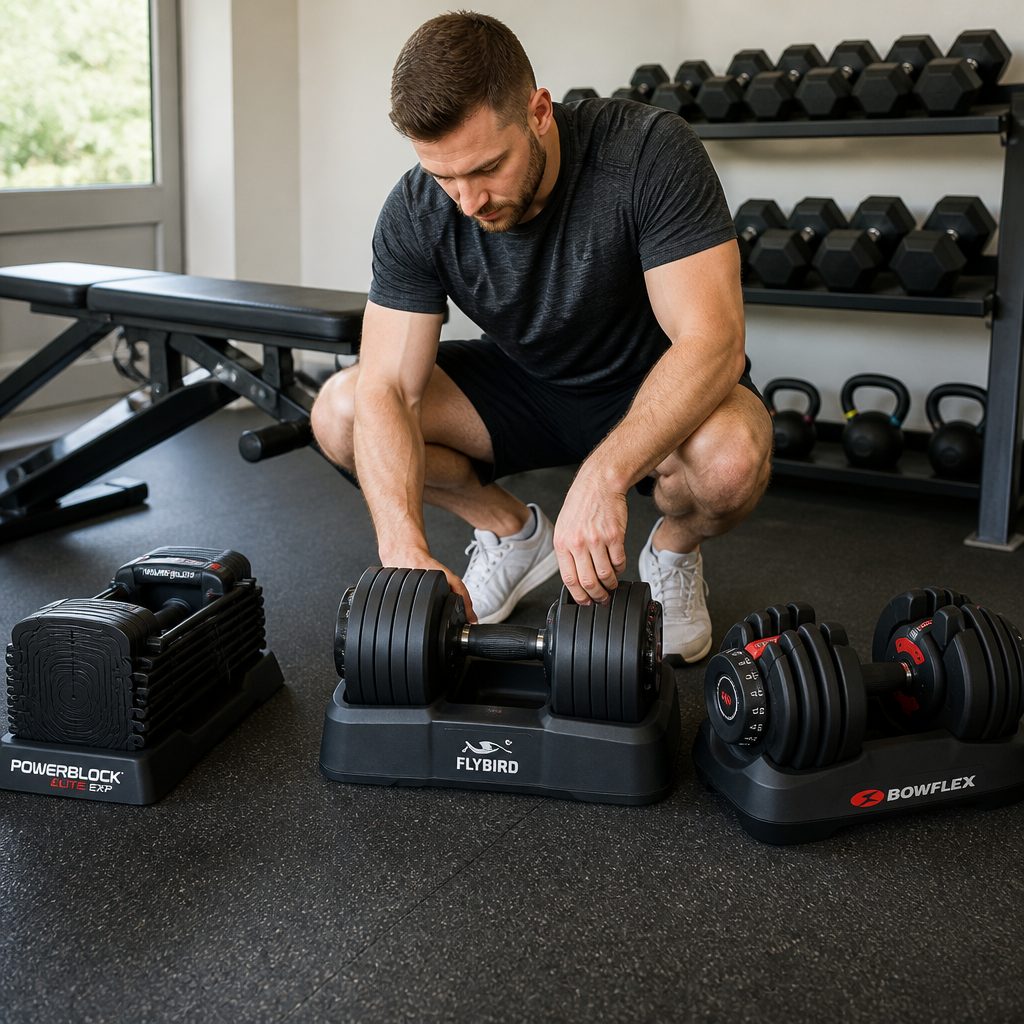
FLYBIRD's cradle-based twist-lock system kept adjustments simple, but every weight change still began with returning the dumbbell to its base.
Fast adjustment, with one condition
FLYBIRD's twist-lock concept was designed for quick changes, but both the 25lb and 55lb systems required the dumbbell to be in its cradle when changing weight. That was sensible from a safety perspective and should be treated as part of the normal workout rhythm.
Grip and handle priorities differed by model
The lighter FLYBIRD used a contoured aluminium alloy grip. The heavier 55lb model focused on a fixed-length handle, so its overall handling stayed consistent from 11lb through to 55lb.
Consider the size of the jumps, not only the top weight
The 25lb model changed in 5lb steps, while the 55lb version moved in 11lb steps. For steady progressive overload, the increment can be as important as the maximum weight printed on the listing.
BowFlex Results Series 552 and 1090: the post-recall choice
Shop BowFlex Results Series 552 and 1090 on Amazon UK
BowFlex was the brand most people associated with dial-adjustable dumbbells, which made the SelectTech recall especially significant. The older SelectTech 552 and SelectTech 1090 used manual adjustment knobs while nested in their bases. The issue was that weight plates could dislodge from the handle during use. That was an impact hazard, not an aesthetic complaint or a bit of internet grumbling about a wobbly tray.
The replacement products were the BowFlex Results Series 552 and Results Series 1090. Their defining update was premium, durable metal components attaching the plates to the handle, combined with a secure locking mechanism. That was the point of comparison. BowFlex did not merely alter the badge and hope nobody noticed; it changed the safety-critical plate-attachment approach.
The Results Series 552 covered 5lb to 52.5lb per dumbbell. It adjusted in 2.5lb increments up to the first 25lb and replaced 15 sets of weights. That made it a compelling range on paper for the typical home gym: light enough for raises and rehab-style movements, heavy enough for many presses, rows, goblet squats and Romanian deadlifts. The small steps at the lighter end were particularly useful, because that is where a 5lb jump can be disproportionately difficult.
The Results Series 1090 started at 10lb and finished at 90lb, moving in 5lb increments. It replaced up to 17 pairs of dumbbells and added knurled hand grips. This was the BowFlex for experienced lifters who wanted a proper top-end range without assembling an entire dumbbell rack. Starting at 10lb did make it less flexible for very light shoulder work, beginners or anyone returning cautiously after a lay-off. But that was not really its job. The 1090 was a heavier training tool.
The recall changed the buying advice
Do not let a familiar BowFlex name blur an important distinction. The SelectTech 552 and 1090 were recalled because plates could detach in use. The Results Series models were the relevant modern comparison because their metal plate components and secure locking mechanism addressed the failure point that made the older models unsuitable.
In everyday use, BowFlex's dial system had an easy appeal. You selected the target weight while the dumbbell was seated in the base, then lifted it. It was less visually alien than PowerBlock and less handle-centric than FLYBIRD's twist-lock approach. The concern for any buyer should not be whether it felt clever. All three did. It should be whether the selected weight felt secure enough that you could focus on the lift rather than quietly monitoring the equipment between reps.
Mechanism and safety: where the three brands really separated
Every adjustable dumbbell involved a compromise. Fixed dumbbells were bluntly simple: a solid handle joined to a fixed amount of weight. Adjustable models added moving interfaces, selected plates and storage cradles in exchange for enormous space savings. That made mechanism quality central rather than a footnote.
PowerBlock's selector pin was arguably the easiest mechanism to inspect mentally. The chosen pin determined which nested blocks lifted with the handle. In the Pro 50, the magnetic polypropylene pin carried a maximum 500lb load rating. The pin itself was easy to see and the act of selecting a weight was direct. You were not asking a rotating dial to invisibly coordinate multiple plates at either end. That does not mean a selector system was impossible to misuse, of course. It means its core logic was reassuringly plain.
FLYBIRD's method had a different strength: the handle rotation and cradle were part of one clear workflow. Place it back, rotate, lift. The requirement to change in the cradle was not a weakness so much as a rule worth respecting. In a rushed circuit, it introduced a small pause. In a controlled strength session, it was barely an inconvenience. Crucially, the cradles were not optional tidying accessories; they were integral to adjustment.
BowFlex had the most complicated history because of the SelectTech recall. That did not automatically make the Results Series unsafe by association. It did, however, mean buyers should be more exacting. The Results Series metal component upgrades and secure locking mechanism were meaningful features, not decorative marketing language. The proper question was whether you were buying the replacement model, not whether you had found a used SelectTech that looked nearly identical in a listing photograph.
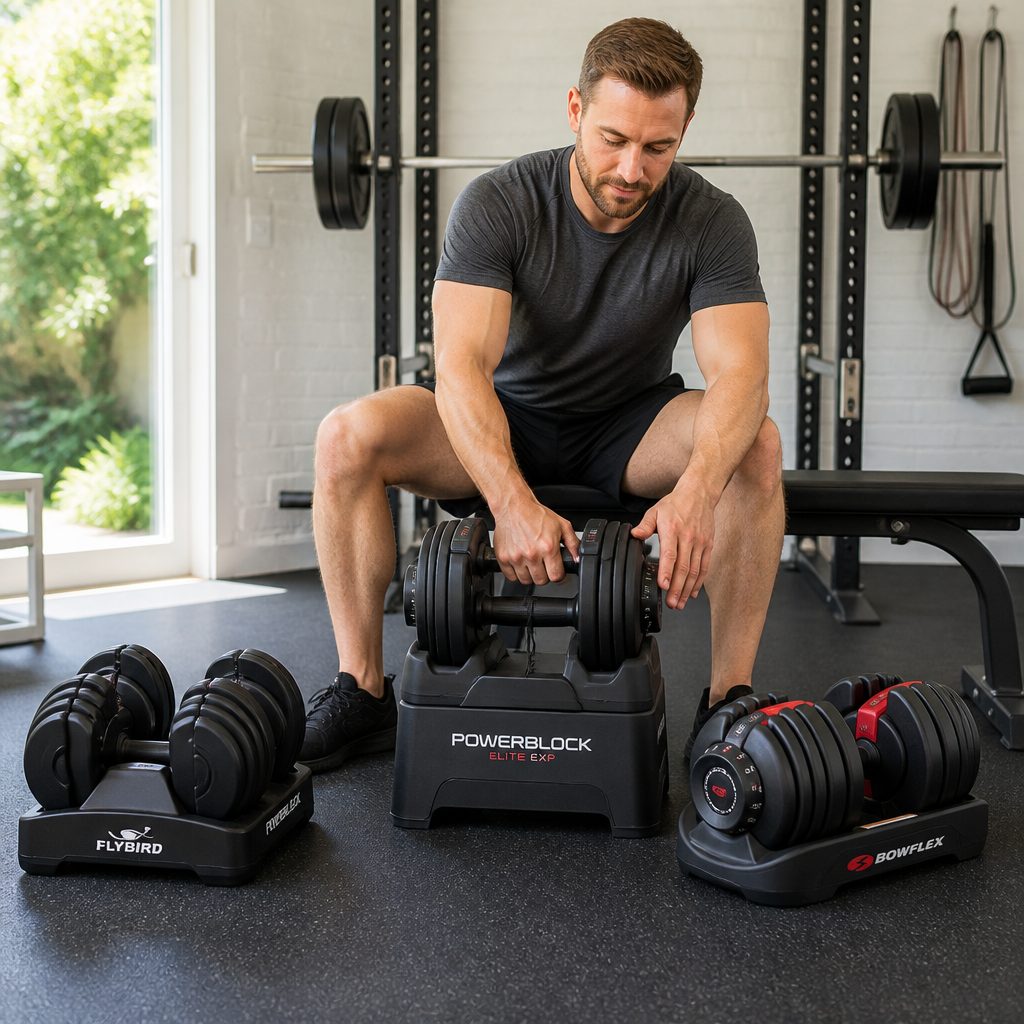
The safest adjustable dumbbell is the one used as intended: seated fully in its cradle or stand before every weight change, then checked before the next set begins.
This chart is not a performance score. It simply puts the headline maximums against the heaviest 90lb models. Top weight was useful, but it was not the whole story. A 50lb pair with 2.5lb increments could be more productive for a great many people than a 55lb set with 11lb jumps. The right dumbbell was not always the one that could most impressively threaten your flooring.
How the weight steps affect progressive overload
Weight increments sounded like a boring specification until you tried to progress a movement that was already near your limit. Then they became surprisingly important. Progressive overload did not always mean adding a vast chunk of weight. Often it meant adding the smallest practical amount whilst keeping technique, range of motion and confidence intact.
PowerBlock Pro 50 was the standout here. Its 2.5lb increments from 5lb to 50lb were fine enough for most home strength programmes. If you could press 35lb cleanly but 40lb was not there yet, a 37.5lb setting gave you a bridge. That was useful on single-arm rows, floor presses, curls and overhead work. The Pro 90's Auto-Lock lever also created 2.5lb micro-adjustments around its 5lb progression, preserving a degree of finesse even at its much heavier ceiling.
BowFlex Results Series 552 matched that fine-grained appeal where many people needed it most: 2.5lb increments up to 25lb. That suited beginners, smaller lifters and anyone doing high-rep upper-body accessory work. Above that first 25lb portion, the important thing was still that it provided a broad 5lb to 52.5lb range. For a general-purpose home gym, it was a very practical spread.
BowFlex Results Series 1090 used 5lb increments from 10lb to 90lb. That was a sensible step size for a product aimed squarely at heavier work. FLYBIRD 25lb also used 5lb increments, which was workable but could feel abrupt around shoulder raises and arm isolation. FLYBIRD 55lb's 11lb increments were the least accommodating of the group. It could be fine if your programme and current strength happened to fit the available settings. It could be frustrating if they did not.
Do not dismiss that point as gym-nerd fussiness. If your dumbbell choices force you to jump too far, you may compensate with shortened range, a swing, a twist or a very creative facial expression. None is a particularly reliable training strategy.
Size, handle feel and exercise choice in a UK home gym
Numbers on a product page only went so far. Dumbbells also needed to behave during the movements you actually did. A shape that felt stable for rows could bump into your forearm during curls. A handle that felt secure for presses might feel crowded on a larger hand. These were personal details, but the stated designs gave us useful clues.
The PowerBlock Pro 90 was best placed for larger hands because its open-draft handle supplied 50% more space. Combined with a knurled steel grip, it was the most traditional-feeling heavy option in this comparison. The Pro 50's rubber grip was a more comfortable general-purpose approach, while the Sport 24's padded handle had the welcome aim of protecting the wrist.
FLYBIRD's 25lb model used a contoured aluminium alloy grip. That was likely to appeal to users who wanted the hand contact to feel shaped rather than purely utilitarian. Its 14.6-inch overall length was worth keeping in mind if you trained in a tight flat or regularly performed exercises where dumbbell ends passed close to the torso. The FLYBIRD 55lb was considerably larger at 19.5 × 11.5 × 11.3 inches, which made sense for its heavier steel plate arrangement but was not something to ignore in a compact room.
BowFlex's Results Series 1090 included knurled grips, again signalling a heavier-training focus. The Results Series 552 was the more obvious general household model because its range began at 5lb. For floor presses, rows, goblet squats and lunges, either could make sense within its load range. For high-rep lateral raises or very light corrective exercises, starting weight and increment size mattered more than maximum load.
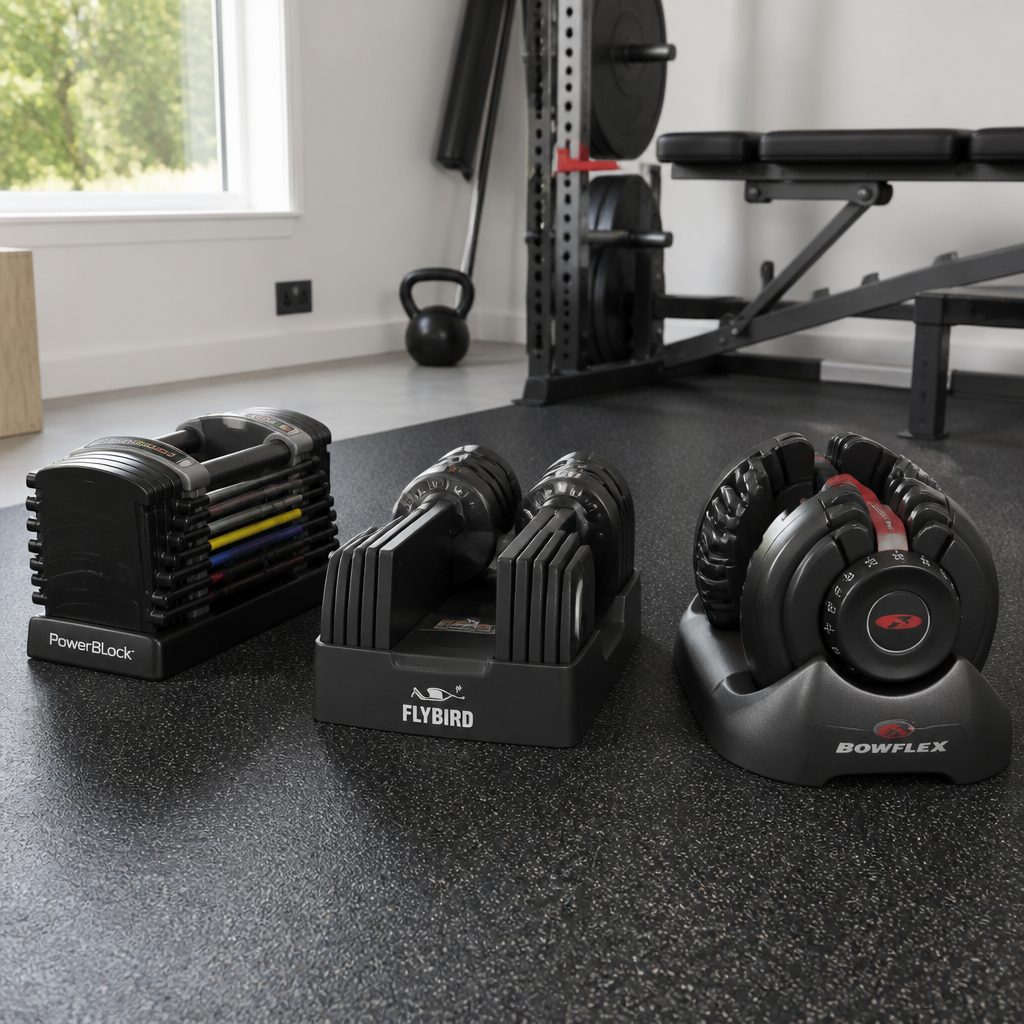
A compact training corner benefits most from adjustable dumbbells when the chosen range matches the exercises, progression and hand comfort you actually need.
Durability, warranties and ownership confidence
PowerBlock had the strongest stated warranty story in this group. Sport 24 came with a limited 10-year warranty, whilst Pro 50 carried a five-year warranty. Those periods reflected a degree of confidence in a simple steel-and-pin concept. The Sport 24's welded solid steel construction was especially appealing for a lighter model likely to see frequent use in circuits or shared household workouts.
The Pro 50's magnetic polypropylene pin had its 500lb maximum load rating, which added useful context to the part that governed the selected weight. It was still an adjustable dumbbell, so it deserved care. You would not throw it around like a fixed commercial hex dumbbell, and no sensible adjustable-dumbbell owner should. But the selector concept was built around sturdy components rather than a shell concealing everything from view.
FLYBIRD's visible powder-coated steel plates on the 55lb model were a practical feature. Powder coating was a familiar choice for gym equipment because it helped provide a durable finish. The absence of plastic casing around the lighter model's plates also meant there was less cosmetic casing around the load itself. Still, the adjustment action relied on correct cradle use. Treat the base as part of the dumbbell system, keep it on stable flooring, and do not rush the selection process because the kettle has just clicked off.
For BowFlex, ownership confidence began with model identification. The Results Series upgrades used metal components to attach plates to the handle and a secure locking mechanism. That was the relevant engineering improvement. With the older SelectTech products, the recall record outweighed any apparent value. With Results Series, the purchase case rested on the redesigned attachment system and the unusually broad replacement of many fixed sets in one pair.
This score was an editorial judgement rather than a laboratory durability test. It reflected the Pro 50's unusually useful 2.5lb increments, 50lb ceiling, compact stated dimensions and clear selector-pin system. A stronger lifter would reasonably score its heavy-lift potential much higher by moving to the Pro 90 instead.
Value without the false economy
There was a temptation to judge adjustable dumbbells purely by how many nominal fixed pairs they replaced. PowerBlock Sport 24 replaced eight pairs, PowerBlock Pro 50 replaced 19 sets, PowerBlock Pro 90 replaced 18 pairs, FLYBIRD 25lb replaced five sets, FLYBIRD 55lb gave access to five dumbbells in one, BowFlex Results Series 552 replaced 15 sets, and Results Series 1090 replaced up to 17 pairs.
Those figures were helpful, but they were not identical measures of value. A model that replaced more dumbbells on paper was only worthwhile if its increments landed where you needed them. A 90lb pair was brilliant if you trained rows, presses and lower-body movements at serious loads. It was excessive if your main goal was gentle strength training in a box room. Equally, a light pair was not cheap value if you outgrew it quickly and had to buy a second system.
For UK buyers, the strongest value proposition was usually the one that prevented future duplication. If you knew 25lb per hand was enough for your training, FLYBIRD 25lb or PowerBlock Sport 24 made practical sense. If you wanted a long-term general set, PowerBlock Pro 50 and BowFlex Results Series 552 covered much more useful ground. If you already trained seriously, the Pro 90 and Results Series 1090 spared you from pretending a modest maximum was somehow a strength-building challenge forever.
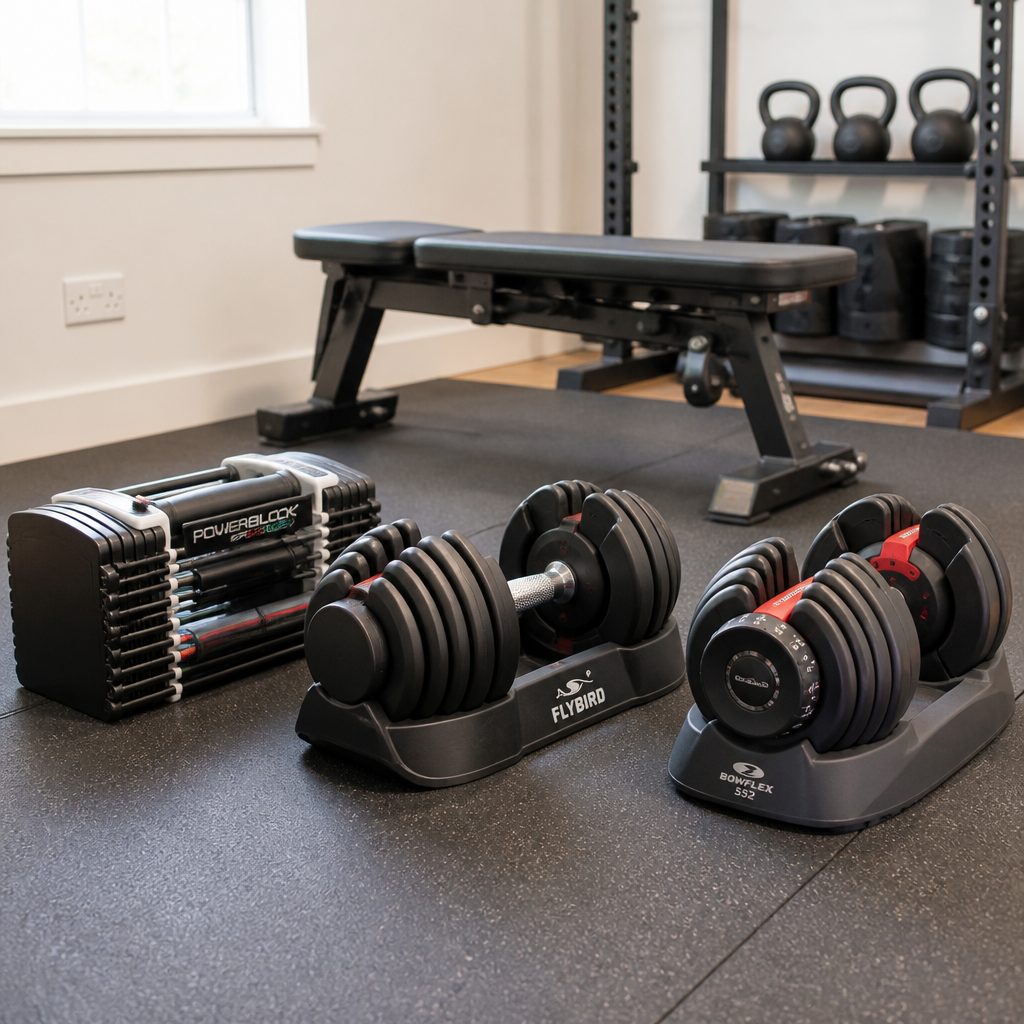
The best value is not always the heaviest model; fine increments can make an adjustable pair more useful for far longer than a dramatic maximum weight alone.
Best picks for different home-gym buyers
There was no honest overall winner for every person. That is not fence-sitting; it is simply how adjustable dumbbells worked. A first-time buyer doing rows and presses twice a week had very different needs from someone building a garage gym around heavy compound lifts. Here is where each model made the most sense.
Best for beginners: PowerBlock Sport 24
Its 3–24lb range, 3lb steps, padded handle and compact selector-pin system made it the sensible entry route for light-to-moderate home training. It also replaced eight pairs of fixed dumbbells.
Best all-rounder: PowerBlock Pro 50
The 5–50lb range and 2.5lb increments were exceptionally well judged for most people wanting one long-term pair. Its rubber grip and compact stated dimensions added to the appeal.
Best simple twist-lock: FLYBIRD 25lb
Shop FLYBIRD 25lb on Amazon UK
Choose it if a straightforward cradle-and-rotation system and contoured aluminium alloy grip appeal more than a selector-pin shape, and if 25lb per hand is genuinely enough.
Best BowFlex replacement: Results Series 552
For buyers who liked dial selection, this was the relevant post-recall model: 5–52.5lb, fine 2.5lb changes up to 25lb, and upgraded metal plate components.
Best for heavy training: PowerBlock Pro 90
It reached 90lb per hand, offered 2.5lb micro-adjustments, and used a roomier open-draft handle with knurled steel grip. It was the strongest PowerBlock choice for serious progression.
Best BowFlex for high maximum weight: Results Series 1090
The 10–90lb range, 5lb increments, knurled grips and upgraded metal attachment components made it the BowFlex answer for experienced lifters.
Who should avoid each option?
It can be just as useful to know what not to buy. PowerBlock Sport 24 was not the choice for someone already pressing or rowing beyond 24lb per hand. It would be compact, well built and pleasant for lighter training, but it would not magically gain extra plates through optimism. PowerBlock Pro 50 was similarly not ideal if 50lb per hand was already a routine working weight for your main lifts.
FLYBIRD 25lb was best avoided by anyone who wanted light, tiny progression steps or planned to train heavy lower body movements with dumbbells. Its 5lb jumps and 25lb maximum were sensible within a narrow use case, not universal. FLYBIRD 55lb was not ideal for beginners or anyone whose programme relied on incremental strength gains. The 11lb steps could be too blunt for many upper-body lifts, despite the appealing 55lb maximum.
BowFlex Results Series 552 was not the first pick for a lifter who needed 90lb per hand, and Results Series 1090 was not the first pick for a person who needed very light resistance. The 1090 began at 10lb. That was perfectly fine for a confident lifter, but it left no room for genuinely light exercises. And, to say it one final time because it mattered: avoid recalled SelectTech 552 and SelectTech 1090 units. The risk record was clear.
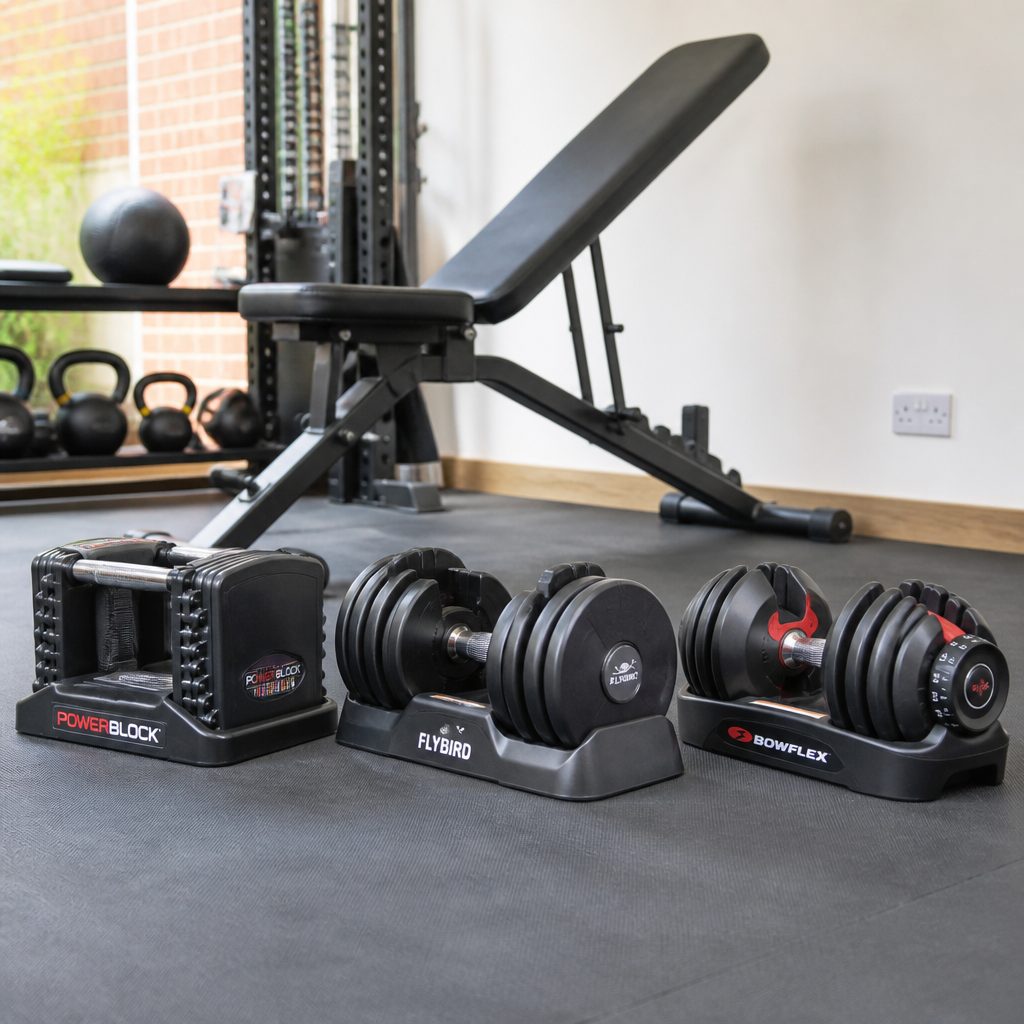
Heavy adjustable dumbbells are brilliant for rows, presses and lower-body training, but the right top weight depends on your current programme rather than your ambitions after a motivational video.
Practical buying checklist before choosing a pair
Before picking a model, write down the heaviest dumbbell exercises you already did. Include rows, floor presses, split squats, goblet squats, Romanian deadlifts and overhead presses. Then look at your lighter exercises too: curls, lateral raises, rear-delt work, triceps work and warm-up movements. The best adjustable range had to cover both ends, or at least the work you valued most.
Next, consider progression. If you liked gradual loading, PowerBlock Pro 50's 2.5lb increments were hard to ignore. If you wanted heavy maximum capacity, PowerBlock Pro 90 and BowFlex Results Series 1090 were the proper contenders. If you valued a simple rotating-handle routine and knew your required loads fitted the settings, FLYBIRD was attractive.
Finally, think about where the cradles or stands would live. Adjustable dumbbells saved space compared with a full rack, but they still needed a stable home. Do not store them on a wobbly coffee table or a shelf that was already displaying signs of emotional fatigue. A firm, level surface made weight changes easier and reduced the chance of poor seating in the cradle.
Frequently asked questions
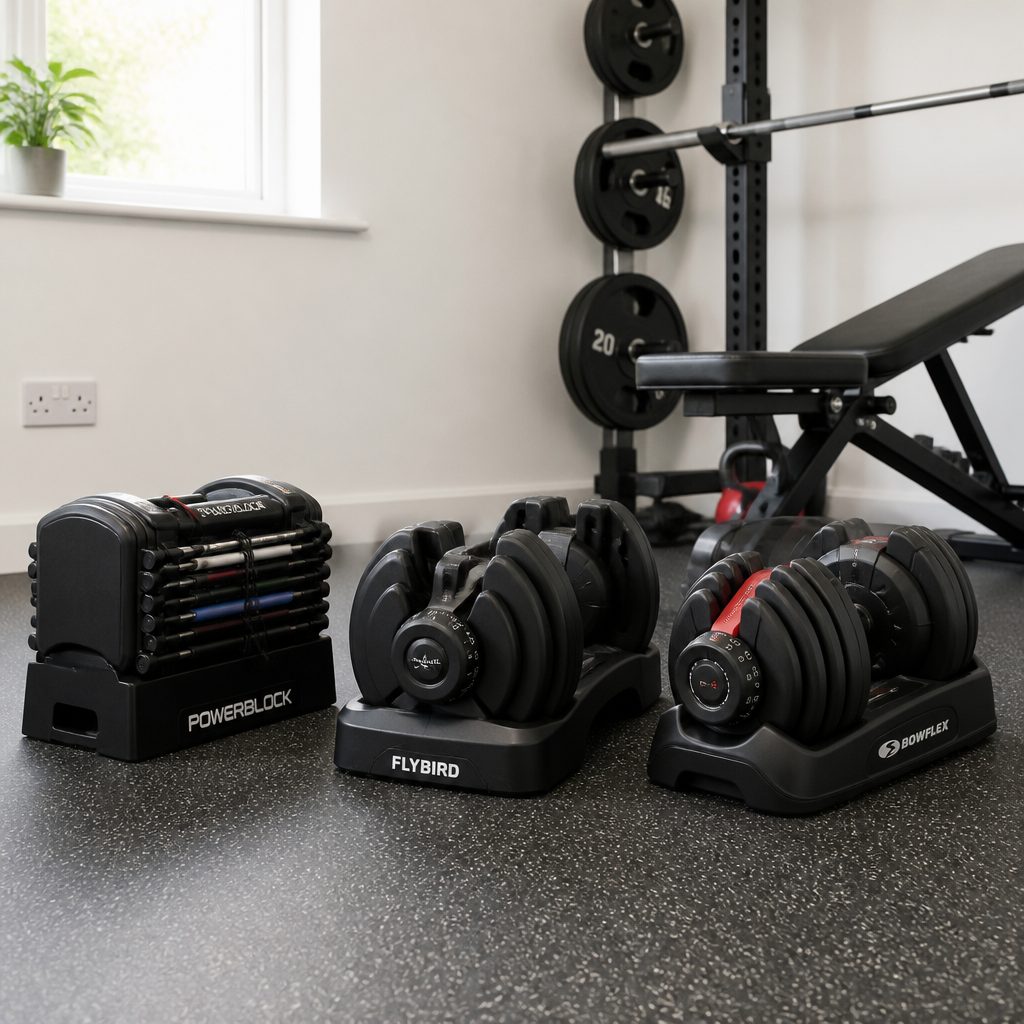
For a long-term home gym, choose the dumbbell system that makes the next year of training easier, safer and less cluttered—not merely the one with the flashiest adjustment trick.
Final verdict: PowerBlock for progression, FLYBIRD for simplicity, BowFlex Results for dial users
PowerBlock Pro 50 was the best all-round adjustable dumbbell for most UK home gyms. Its 5–50lb range, genuinely useful 2.5lb increments, magnetic pin rated to a maximum 500lb load and compact 12.5 × 7 × 7.25-inch format gave it the strongest balance of progression, practicality and mechanism confidence.
PowerBlock Sport 24 was the better pick for lighter training and smaller spaces, while PowerBlock Pro 90 was the premium choice for serious lifters who needed 90lb per hand and appreciated the larger open-draft handle, knurled grip and micro-adjustment option.
FLYBIRD was worth choosing when its twist-lock workflow and grip design suited you, especially the 25lb model for modest home workouts. The 55lb version made more sense for users comfortable with its substantial 11lb jumps. It was not the best route for fine progression, but it was a straightforward system with powder-coated steel plates and a fixed-length handle.
BowFlex Results Series 552 and 1090 were the BowFlex models to consider in 2026. Their revised metal plate components and secure locking mechanisms set them apart from the recalled SelectTech products. Choose the 552 for broad everyday training and lighter progression; choose the 1090 if you needed a 90lb ceiling and could live with a 10lb starting point.
In short: buy PowerBlock for the most rounded training progression, FLYBIRD for uncomplicated twist-lock convenience within a defined range, and BowFlex Results Series only if the dial format is your preferred route and you are certain you are buying the redesigned replacement models rather than recalled SelectTech stock.