
BowFlex SelectTech 52 Review: Has the New Metal-Plate Dumbbell Fixed the 552's Flaws?
The BowFlex SelectTech 52 arrived in the UK in July 2026 with a deceptively simple mission: preserve the brilliantly quick 5–52.5lb dial system, then deal with the rattly, plastic-heavy baggage that had followed the long-running 552. After time with a demo pair, the short answer is largely yes. The longer answer, naturally, involves wobble, noise, a rather serious £530 asking price and the awkward fact that metal is not automatically better at everything.
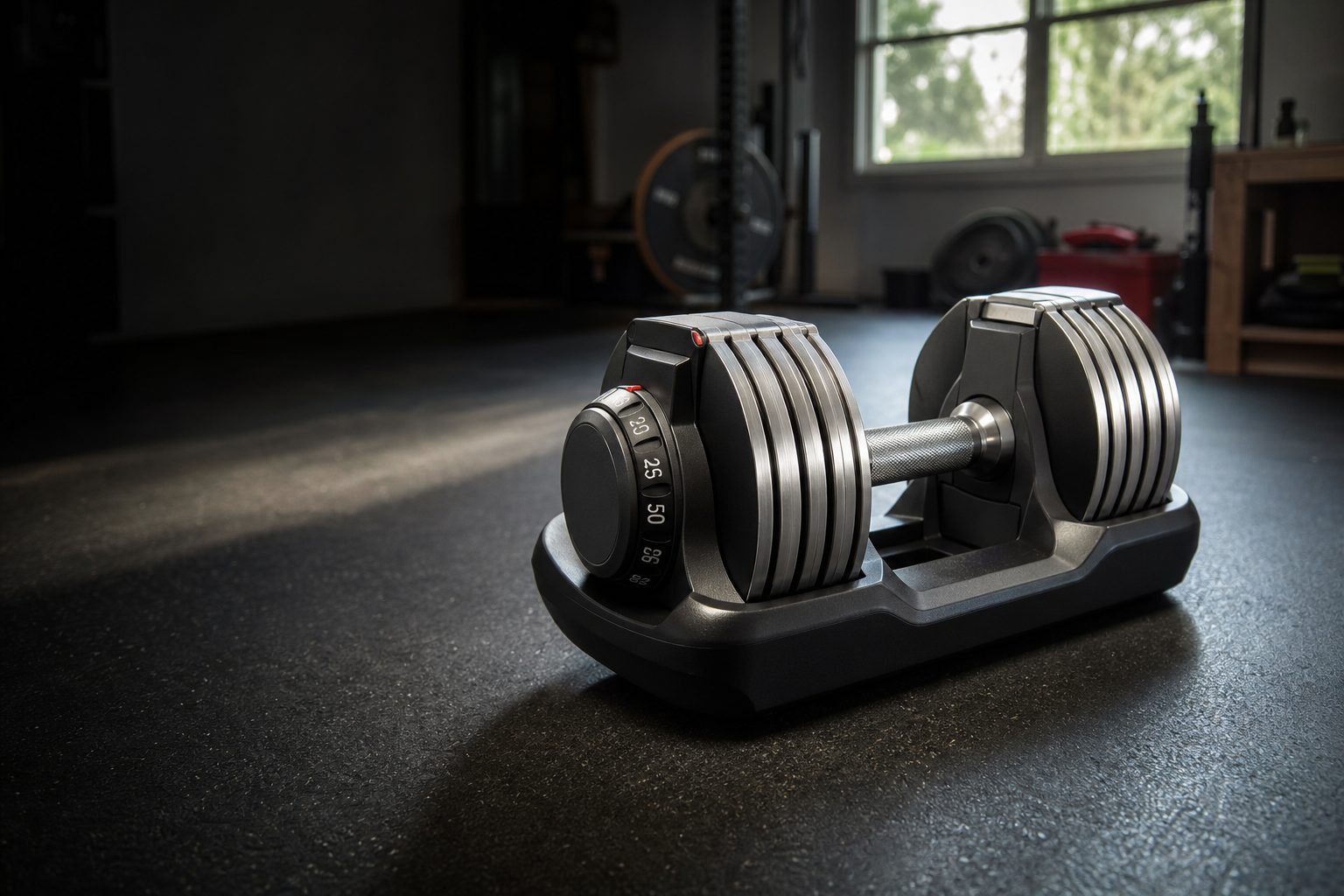
The BowFlex SelectTech 52 retained the familiar dial-adjustable idea, but its uniform exposed metal plates and revised hardware made it a notably more confidence-inspiring dumbbell than the older 552.
 By James Oduya · Staff Writer & Home Gym Columnist · Updated August 04, 2026
1. The short version: a proper redesign, not a paint job
Adjustable dumbbells are one of those gym purchases that sound wonderfully sensible until they arrive. You save space. You avoid filling a spare room with fifteen pairs of cast-iron hex bells. You switch from warm-up weight to working weight without the ceremonial walk across the garage. Everyone wins, including the floorboards.
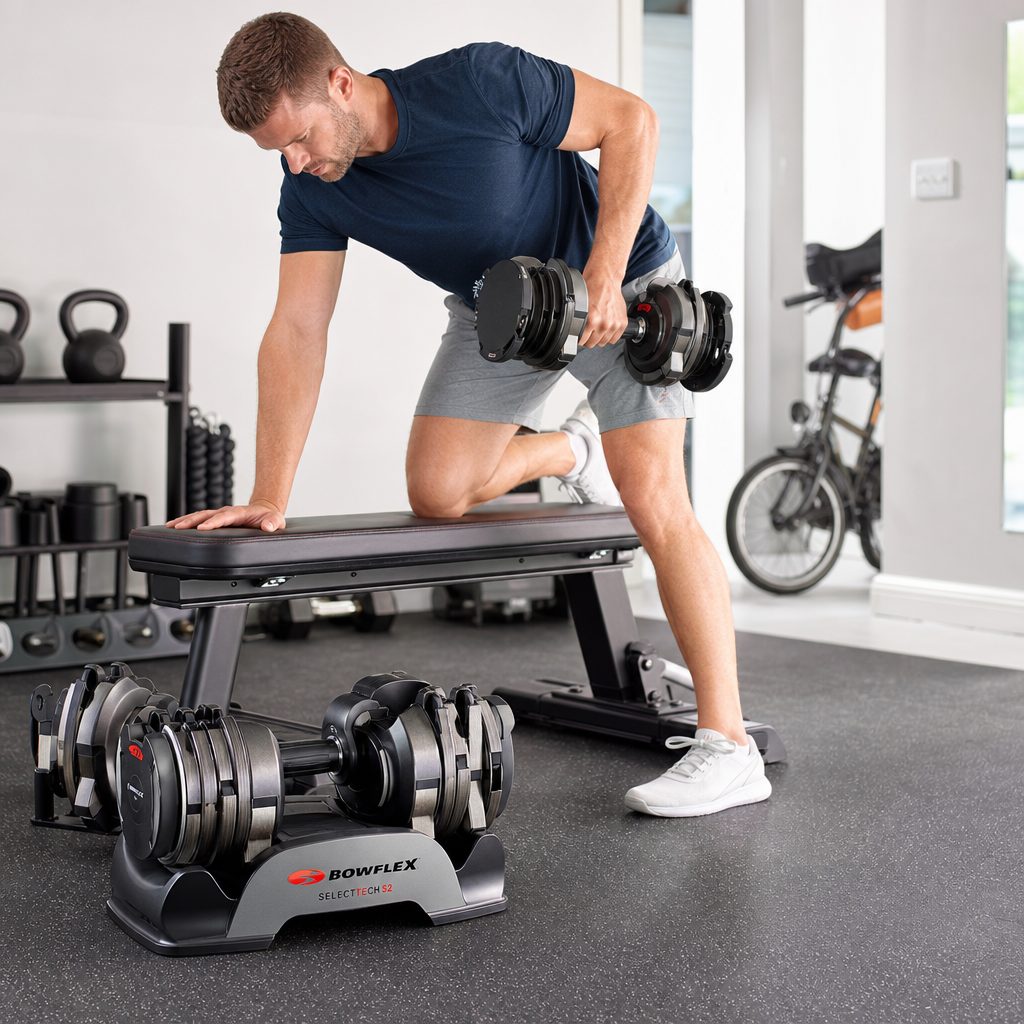
The SelectTech 52 was best understood as a refined home-gym system: expensive, certainly, but markedly more settled and confidence-inspiring than the older 552 under real exercise movement.
Then there is the bit nobody puts on the front of the box. Adjustable dumbbells are mechanical things. They are picked up, put down, lifted overhead, held above your face and occasionally subjected to the sort of impatient handling that happens halfway through a tiring set of presses. If the selection system feels vague, if the plates shuffle around, or if the handle does not inspire trust, all the space saving in the world begins to feel slightly academic.
That was the SelectTech 552 story in miniature. It had been popular for years because it delivered a very useful range and rapid adjustment in a compact system. Yet it also developed a reputation for plate movement and clinking. The moulded outer surfaces reduced noise, which was genuinely helpful in flats, but the plate stack could have roughly 2mm of clearance between plates. That allowed movement. It was not necessarily a catastrophe in every curl, but it could become an irritating little soundtrack during longer sets and dynamic training.
BowFlex's SelectTech 52 was the company's answer. It replaced the 552 as the current model, retained the same 15-setting, dial-selected concept and covered the same 5lb to 52.5lb range. The meaningful changes were premium metal plates, a redesigned locking mechanism and a new ergonomic non-slip handle. Put plainly: this was intended to feel less like a clever domestic appliance that happened to have weights attached, and more like a serious pair of dumbbells that happened to be adjustable.
It did. The improved feeling of solidity is the first and most important thing to understand about it. During hands-on use, the selected plates stayed put through curls, presses and lunges. The locking mechanism held firm in heavier compound work. There was no familiar sensation of the plates lagging behind the handle or softly arguing with one another at the top of a rep. That alone changes the character of the product.
That overall score needs context. The SelectTech 52 is not a budget solution. Nor does it magically turn a 52.5lb maximum into enough weight for every strong lifter's rowing, pressing and leg work. What it does is make the original BowFlex formula much easier to recommend to someone who wants a tidy, versatile home setup and who had previously looked at the 552 with a slightly raised eyebrow. Quite right too. Eyebrows are useful consumer-protection devices.
2. BowFlex SelectTech 52 specifications at a glance
The fundamental proposition had not changed. Each dumbbell went from 5lb to 52.5lb, or approximately 2kg to 24kg, through 15 available settings. The smaller end adjusted in 2.5lb increments up to the first 25lb. That matters more than it may initially sound. Small jumps are useful for shoulder work, triceps extensions, chest flyes, lateral raises and rehabilitation-minded training, where a sudden big leap can turn a smooth progression into an ugly heave.
At the heavier end, the 52 remained a practical all-rounder rather than a specialist strength implement. It could cover a huge proportion of a beginner's programme and much of an intermediate lifter's upper-body work. It could also make a very decent travelling companion within the house: a compact setup for a spare room one week, the lounge the next, and perhaps an outdoor session when the British weather briefly remembered how to behave.
There is no battery to charge, no app pairing required to choose a load and no display that decides it needs a software update just before your workout. I mention this because fitness equipment has developed a strange habit of trying to become consumer electronics. The SelectTech 52 was refreshingly mechanical in the ways that mattered. Turn the dials, lift the handle, train. The included two-month JRNY trial was there for those who wanted guided workouts and adaptive plans, but the dumbbells themselves were not dependent on it.
The design language was visibly different from the Results Series 552 too. The 552 used a black-and-grey look with tapered plates, whereas the 52 used black and white and employed uniform plates. That visual change is not merely cosmetic. Uniform metal plates gave the 52 a more purposeful, simplified appearance. More importantly, their relationship with the revised lock was what changed the workout experience.
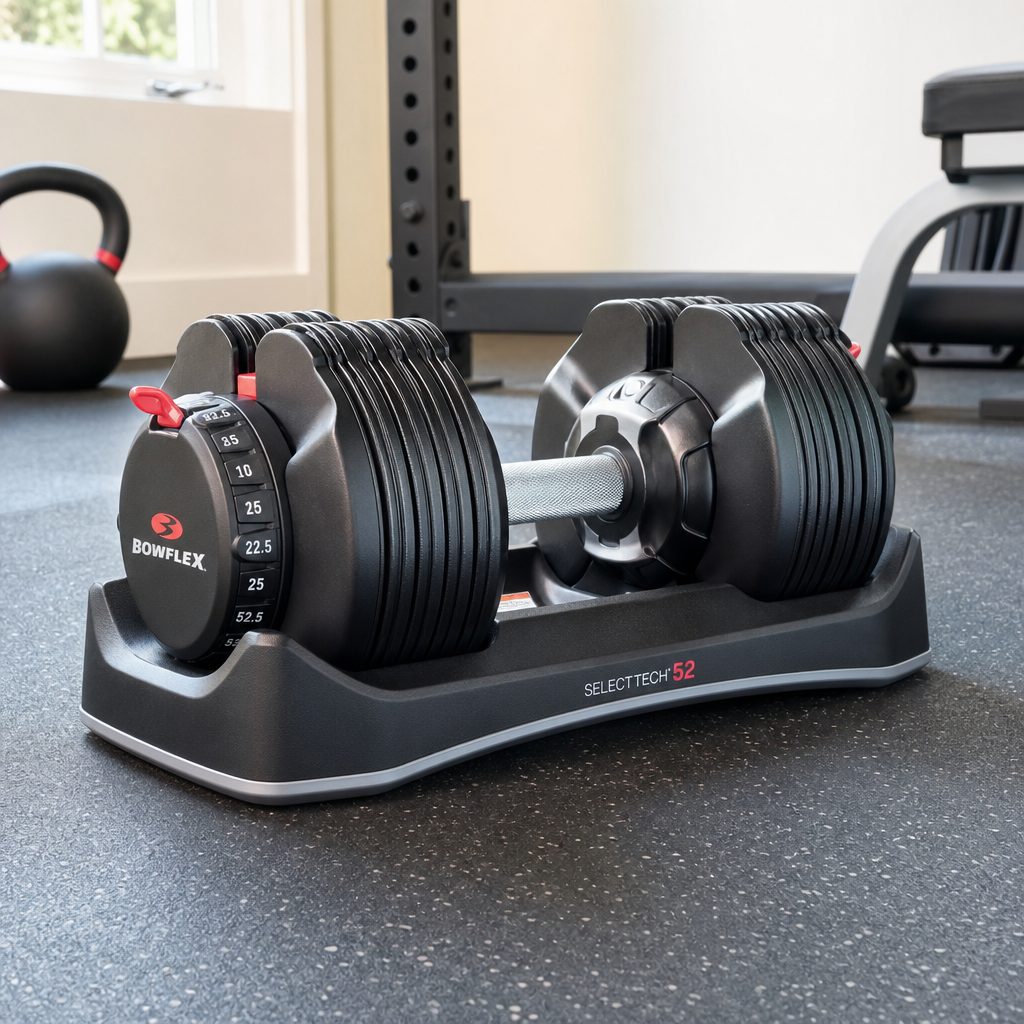
The SelectTech 52 covered 15 settings from 5lb to 52.5lb, with 2.5lb jumps through the lower 25lb range where smaller progressions matter most for accessory work.
A useful distinction: the SelectTech 52 was sold as a pair at £530 in the UK, though individual dumbbells were also listed at £270. For normal bilateral training, price the pair. Buying one makes sense only if you specifically train unilaterally or need to replace a single unit.
3. What the BowFlex SelectTech 52 changed from the 552
It is tempting to see exposed metal plates and conclude that BowFlex had simply removed some plastic. That would undersell the change. The core issue with the older 552 was not that it contained plastic in some moral sense. Plenty of excellent gym equipment uses polymer parts. The issue was how the system behaved when it was loaded, moved and repeatedly asked to stay coherent.
The old 552 had metal plates covered in plastic moulding, partly to lower the sound of metal meeting metal. That was a thoughtful aim. Anyone who has trained early in a flat with thin ceilings will appreciate the ambition. But the familiar downside was the potential for plate wobble. With around 2mm separating each plate, there was enough room for selected plates to shift a little. A dumbbell can be technically secure and still feel less planted than you want when your arm is extended above your chest.
The SelectTech 52 addressed that with premium metal plates and a redesigned lock. In practice, that meant the selected stack felt much more unified. Curls did not bring that irritating side-to-side tick. Presses did not create a little delayed clink when changing direction. Lunges, which ask more of a dumbbell than people sometimes give them credit for because the load is moving through space as your body accelerates and stops, did not expose a loose-feeling plate assembly either.
That is why I would characterise the upgrade as an improvement in confidence rather than a feature checklist exercise. The 552 could be very convenient. The 52 was convenient and calmer to use. You stop thinking about the device and get on with the set. That is exactly what a good piece of training kit ought to achieve.
Uniform metal plate architecture
The newer plates looked more purposeful than the tapered, moulded 552 arrangement and, crucially, formed a more stable-feeling selected stack under movement.
Reworked locking mechanism
The lock was the real story. It held selected plates firmly through curls, presses, lunges and heavier compound movements, reducing the sense of movement that could distract on the 552.
New ergonomic non-slip handle
The handle was designed for a steadier, more secure hold during harder lifting. It complemented the solid plate feel rather than leaving the grip as an afterthought.
The same speedy dial adjustment
BowFlex kept the part people already liked. Changing weight took around two seconds, versus roughly three to four seconds for PowerBlock's pin-based selection system.
There is also a slightly subtler benefit to reduced movement: concentration. When a dumbbell feels settled, you are more likely to control tempo rather than rush through a rep because the equipment feels a fraction unpredictable. That matters in unilateral work especially. A controlled single-arm press, row or split squat has enough going on already. Your brain is busy keeping the torso honest and the shoulder organised. It does not need a quiet enquiry from the dumbbell asking whether you noticed the plate stack shuffle.
None of that means the 552 instantly became unusable or that every existing owner needs to panic-buy the 52. Far from it. Many people trained productively with 552s for years. But if you were deciding between an older second-hand 552 and the newer SelectTech 52, the revised hardware was not a trivial refinement. It was the principal reason to choose the newer model.
4. Design and build: metal brought confidence, but also consequences
The SelectTech 52 looked considerably more grown-up than its predecessor. The black-and-white finish, uniform plates and cleaner overall geometry made it feel less like a space-saving novelty and more like a deliberate home-gym tool. That may sound superficial. It is not entirely. If a piece of equipment looks robust, you still need it to behave robustly, but visual clarity helps you understand what is happening mechanically.
The key practical design difference was that the metal plates did not shift during dynamic movements in the demo testing. This was the point I kept returning to because it was the thing a prospective buyer would notice in the first ten minutes. Pick up a set of adjustable dumbbells, perform a few curls, then a few presses, and your hands tell you an awful lot. The 52 felt solid. Not indestructible in the way a single-piece cast iron dumbbell feels solid, because no selector dumbbell should be treated like a lump of gym-floor hardware. But solid enough that the system faded into the background.
The non-slip ergonomic handle contributed to that impression. A handle is a fairly intimate bit of gym equipment. It sits between you and the load. If it is too slick, oddly shaped or unpleasantly wide, the advertised maximum weight becomes less useful because you do not enjoy gripping it. The 52's handle was designed to offer a secure purchase under heavier lifting, and that was borne out by its composed feel through pressing and lunging.
There is a trade-off, though. The old 552's moulded plate covering helped muffle noise. The newer SelectTech 52 made a noticeable difference in sound compared with the standard SelectTech demo unit, but exposed metal was never going to have exactly the same damped character as plastic-covered plates. The new lock stopped the unwanted plate movement that created much of the old clinking annoyance. That was a win. Still, metal is metal. Put it down carelessly and it will sound like you put metal down carelessly. Physics remains stubbornly uncooperative.
The sensible home-gym rule
Use the SelectTech 52 on a stable, forgiving training surface and return it to its tray under control. The improved locking system made it feel far more secure in use, but a selector dumbbell is still a precision mechanism rather than something to drop after a final set of deadlifts.
That advice is not an attempt to wrap the product in cotton wool. It is simply good ownership. The appeal of an adjustable dumbbell is that it replaces a rack of fixed weights; the cost is that the adjustment hardware deserves a bit more respect than an ordinary hex dumbbell. The 52 appeared to have closed the gap in feel. It did not repeal the basic reality that several moving components are involved.
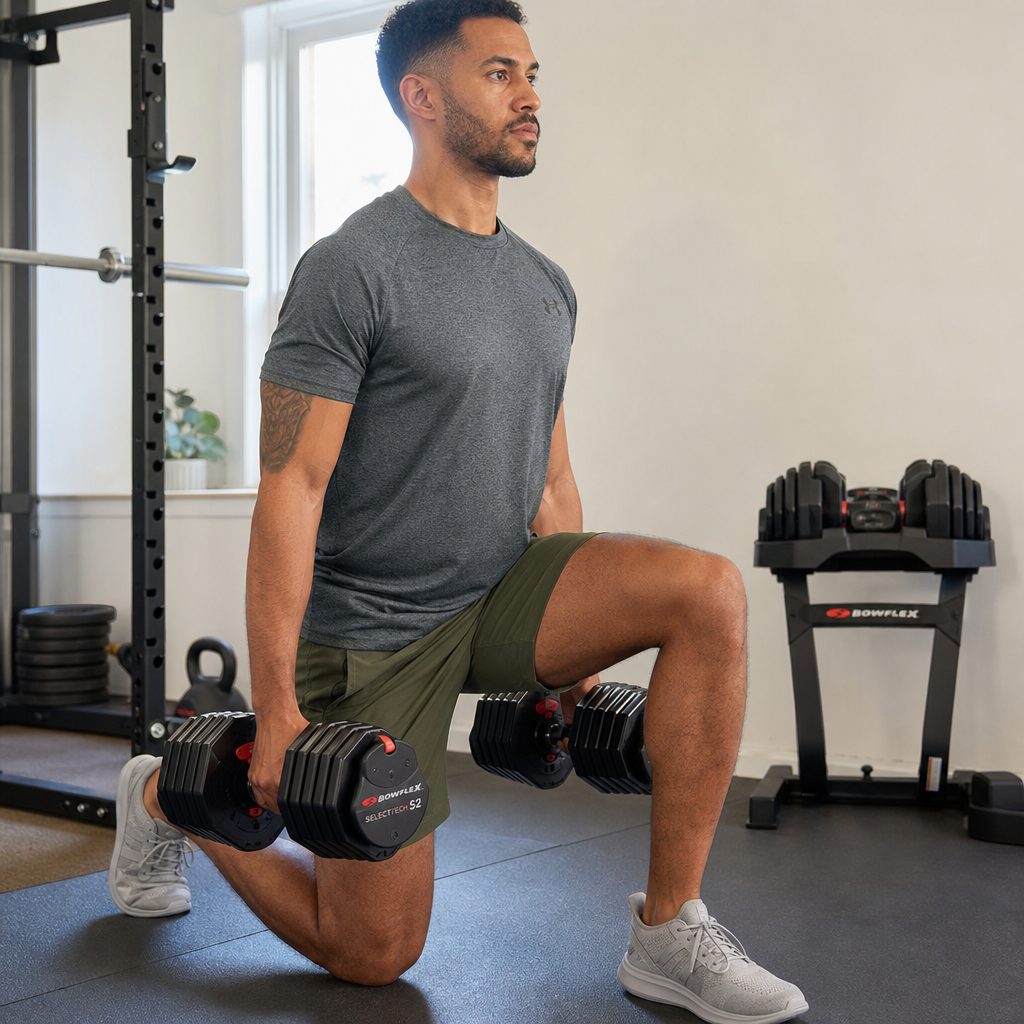
The redesigned mechanism was the important upgrade: selected plates remained settled through presses, curls and lunges rather than developing the distracting wobble associated with the 552.
5. Using the BowFlex SelectTech 52 day to day
The joy of a dial-based dumbbell is that a properly structured workout becomes much less of a logistical faff. You can move from lighter warm-up curls to heavier rows, then back down for lateral raises, without arranging a pile of bells around your feet like a tiny, hazardous Stonehenge. The SelectTech 52 did exactly what the SelectTech concept had always done well: it made changing load fast enough that you were unlikely to skip it.
Weight adjustment took around two seconds. Compared with PowerBlock's pin system at roughly three to four seconds, that is hardly a chasm in isolation. Nobody is making a cup of tea in the extra second or two. But across a circuit, a superset or a session with several exercises, dials are pleasantly immediate. You select the desired weight, lift the dumbbell out of its storage tray and continue.
It also encouraged sensible programming. At a traditional gym, you might be tempted to make do with a too-heavy dumbbell because the correct pair is halfway across the room and someone is doing hip thrusts in front of the rack. At home, it is much easier to use the weight that actually suits the movement. That is useful for keeping shoulders happy, for controlled hypertrophy work and for anyone trying to progress without allowing every accessory lift to turn into a full-body interpretive dance.
The lower 2.5lb increments up to 25lb were particularly useful. If you are doing lateral raises, a jump of 5lb can be enormous. For a novice, the move from 10lb to 15lb is not a gentle nudge; it can be the difference between clean sets and the sort of swinging that makes nearby furniture nervous. Similarly, small increases help when rebuilding strength, training after a lay-off or trying to progress triceps work without irritating elbows.
Once you reached the heavier settings, the 52 was good for the obvious staples: floor pressing, dumbbell bench pressing, one-arm rows, goblet squats, Romanian deadlifts, split squats, lunges and overhead pressing. The selected stack held firm during heavier compound lifting in the hands-on assessment, which was exactly where the revised hardware needed to prove itself. A dumbbell that feels fine for a 12lb curl but unsettles at the hard end of the range has missed the point.
I would still be realistic about the maximum. Two 52.5lb dumbbells are substantial for a home setup. They are more than enough for plenty of people's pressing, arm work and controlled lower-body training. Yet stronger, experienced lifters may outgrow them for bilateral rows, deadlifts, loaded carries or pressing work. That is not an indictment. It is simply the inherent compromise of a compact 15-setting product. The SelectTech 1090 existed for buyers whose priority was a much heavier 90lb maximum, but it was a different proposition.
The bar chart is not pretending that a two-second adjustment is a scientific performance score. It is a practical illustration of the workflow. The BowFlex system was quick. The new model kept that convenience whilst improving the thing that had made some people wary: the feel once the dumbbell left the tray.
As for battery and daily maintenance, the answer was wonderfully boring. There was no battery. There was no charging cable to lose behind the sofa. JRNY was optional, and some people will find guided sessions a useful way to begin a programme. But the dumbbells themselves worked as dumbbells should. You did not need to log in, update firmware or explain to an app why you had decided to do three sets of rows instead of two.
6. Training performance: where the revised lock earned its keep
A product like this needs judging not by how it feels when you pick it up once, but by what happens when fatigue arrives. Early reps are flattering. Most pieces of kit feel decent when you are fresh, patient and only using the lighter settings. The useful questions come later: does the handle remain secure as palms warm up? Does the selected weight feel coherent when your tempo changes? Does the mechanism add distraction when your final set gets hard?
The SelectTech 52 made a strong case for itself here. Plates did not shift during curls, presses or lunges, and the locking mechanism held firmly during heavier compound lifts. That reduced the mental friction of using an adjustable system. You could focus on the actual job: keeping the wrist stacked in a press, controlling the eccentric in a curl, or maintaining balance through a lunge.
Curls were perhaps the clearest test because the movement is simple and repetitive. With the older 552, plate wobble could become a nuisance over extended reps. A little click or change in feel is not necessarily unsafe, but it is distracting. The 52 felt more settled. That gave the movement the natural rhythm of a conventional dumbbell rather than the occasional sense of lifting a small case of carefully packed cutlery.
Pressing was the more important test. On a floor press or dumbbell bench press, the load changes direction at the bottom and top of each rep. If the plates are going to complain, that is a likely moment. The 52 stayed composed. The redesigned lock made the dumbbell feel like one object rather than a handle carrying several politely attached objects.
Lunges were a useful real-world check too. Many home users will use adjustable dumbbells for lower-body work because the compact format makes it easier to create a full-body programme in limited space. A pair of bells held at the sides move with your gait, and any looseness can become more noticeable than it is on a static curl. Again, the 52 stayed secure. It was a small but telling validation of the new mechanism.
The grip deserves a mention in this context. An ergonomic non-slip handle will not make you stronger, sadly. If it did, gyms would be full of people shopping for grips instead of training. But a secure handle helps transfer the strength you have into the exercise. It matters most near the top of the range, when hand position and confidence influence whether you choose a sensible working load or instinctively back off because the implement feels awkward.
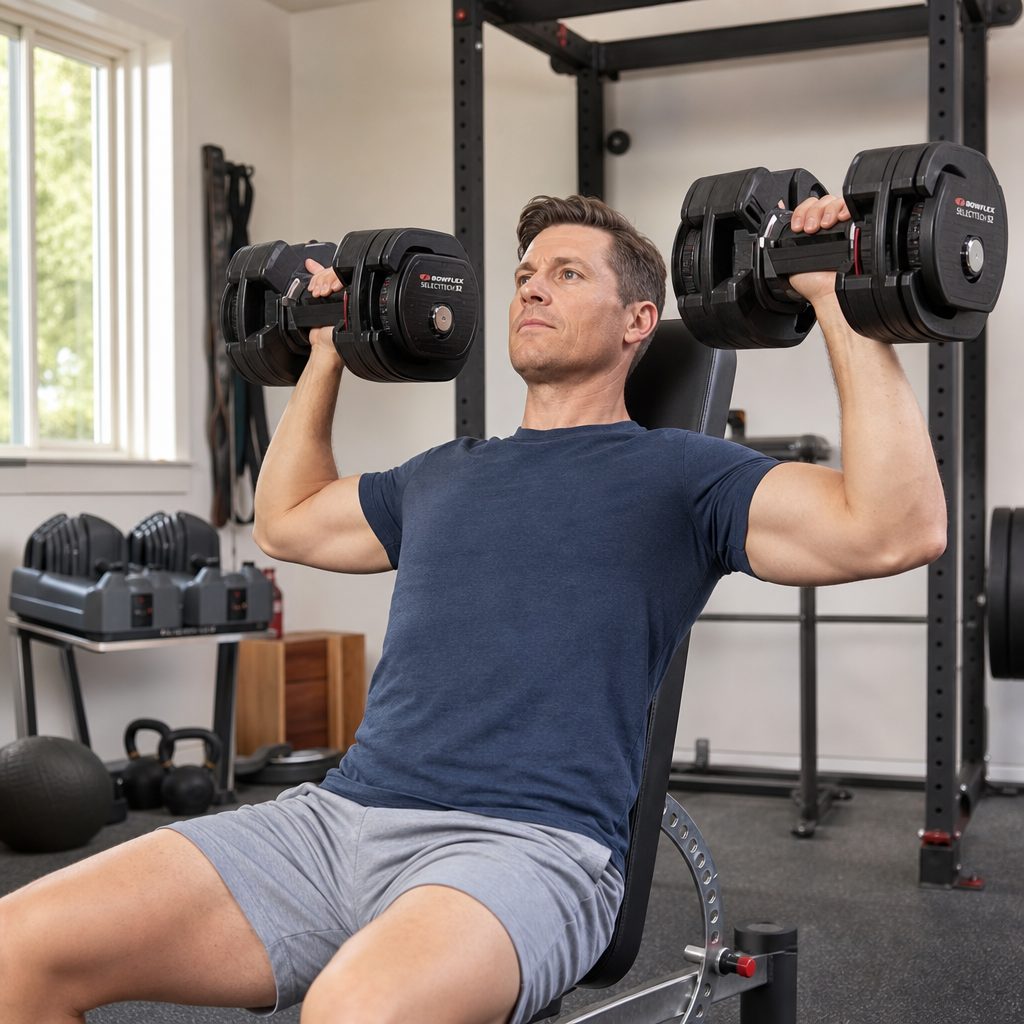
For compound work such as presses and lunges, the SelectTech 52's revised lock kept the selected load feeling unified, which was the most meaningful difference from the older 552 experience.
Pros
- Premium metal plates and the revised lock produced a noticeably steadier feel in motion.
- The 5–52.5lb range covered a vast amount of beginner and intermediate home training.
- Fifteen settings replaced the clutter of multiple traditional dumbbell pairs.
- Two-second dial changes were superb for supersets, circuits and changing exercises quickly.
- The ergonomic non-slip handle made heavier work feel more assured.
- No battery, charging or compulsory app use complicated the daily routine.
Cons
- £530 for the UK pair was a serious investment, even with the space saving.
- 52.5lb per hand will not satisfy every experienced strength-focused lifter.
- Metal plates did not invite careless handling or drops.
- The older 552's moulded covering had a sound-damping advantage in some situations.
- Anyone who already owned a fully functional 552 needed to decide whether improved stability justified replacing it.
7. Noise, wobble and the old 552 problem
This is the section most prospective upgraders will care about, so let us avoid dancing around it. Yes, the SelectTech 52 addressed the most commonly felt flaw of the old 552: the sense that the plates had a little too much freedom to move. The approximately 2mm gaps between 552 plates left room for shifting, and that could create wobble and clinking during movement.
The 52 was appreciably different. In the demo assessment, selected plates did not shift through dynamic work. That is a clear improvement. It made the dumbbell feel more secure and more conventional in the hand, particularly once exercises became faster, heavier or simply more tiring.
However, the sound story is not a one-line victory. The 552's plastic moulding was there partly to minimise noise and reduce metal-on-metal clanging. That was a genuine benefit. If your only concern was making as little sound as possible while carefully lifting in a flat, that older material choice had some merit. The SelectTech 52's metal construction changed the acoustic character of the product.
What it removed was the unwanted clink caused by plates shifting in use. What it could not remove was the basic sound of metal equipment if it was knocked together or put down abruptly. Those are different things. For most users, I think the trade was sensible. Secure, non-shifting plates are worth more than a softly muffled but slightly mobile stack. But if you train at 5am in a converted flat above someone who regards a closing cupboard as a personal attack, you should still be thoughtful about flooring and how you return the dumbbells to their trays.
It is worth separating sensible equipment noise from bad mechanical feedback. A dull, controlled contact sound when a dumbbell is put down is normal. A repetitive clink during a curl is a sign that the implement is intruding on the workout. The SelectTech 52's improvement was that it stopped intruding.
For flat dwellers: the SelectTech 52 solved the more annoying in-motion clinking associated with plate movement, but it was still metal gym equipment. A protective floor surface, controlled set-downs and avoiding dropped reps were more important than expecting silence.
The revised lock also mattered psychologically. Most people can tolerate a little gym noise. What they do not enjoy is hearing a sound that suggests something is moving when it ought to be fixed. The new system felt firm through the range of tested movements. That was the reassurance buyers had wanted from a BowFlex redesign.
8. BowFlex SelectTech 52 vs BowFlex SelectTech 552 vs PowerBlock
The most useful comparison is not really a fight to the death between brands. It is a question of priorities. The older BowFlex SelectTech 552 had long been the convenient, familiar choice. PowerBlock's system had its own committed audience and used a pin-based adjustment method. The SelectTech 52 made the BowFlex route more compelling by retaining its speed and addressing the stability complaint.
There are some things that cannot be declared universally better. A person who likes the visual compactness and system logic of PowerBlock may still prefer it. A person who already owns a 552 and trains carefully may see no need to replace it. But if your experience of the 552 was defined by plate wobble and clinking, the 52 was the more satisfying version of the same broad idea.
| Feature | BowFlex SelectTech 52 | BowFlex SelectTech 552 | PowerBlock pin system |
|---|---|---|---|
| Weight range | 5–52.5lb per dumbbell | 5–52.5lb per dumbbell | Varied by model |
| Available settings | 15 | 15 | Varied by model |
| Lower-range increments | 2.5lb up to 25lb | 2.5lb up to 25lb | Varied by model |
| Adjustment method | Dual dial selection | Dual dial selection | Pin selection |
| Typical adjustment speed | About 2 seconds | About 2 seconds | About 3–4 seconds |
| Plate approach | Premium metal plates | Metal plates with plastic moulding | Selector weight-stack system |
| In-motion plate feel | Plates stayed firm in tested dynamic movements | Some wobble and clinking could occur | Different system; no direct like-for-like finding |
| UK pair price | £530 | Not treated as the current model | Varied by model and retailer |
That adjustment-speed advantage might seem minor, but it was meaningful for how a home workout flowed. A dial offered a direct, tactile routine: set both ends, lift, go. A pin required a little more handling. Again, we are discussing seconds, not geological time. But when you are trying to maintain momentum between sets, small frictions compound.
BowFlex also had the SelectTech 1090 in its wider range for the person whose main objection to the 52 was simply that 52.5lb was not enough. With a 90lb maximum, it was clearly aimed at heavier-duty use. That extra capacity would matter to stronger lifters. It would not automatically make it the better choice for someone prioritising a compact, broadly useful pair for regular home sessions. More weight is useful only if you will use it. Otherwise, it is just a more expensive way to feel guilty about your deadlift numbers.
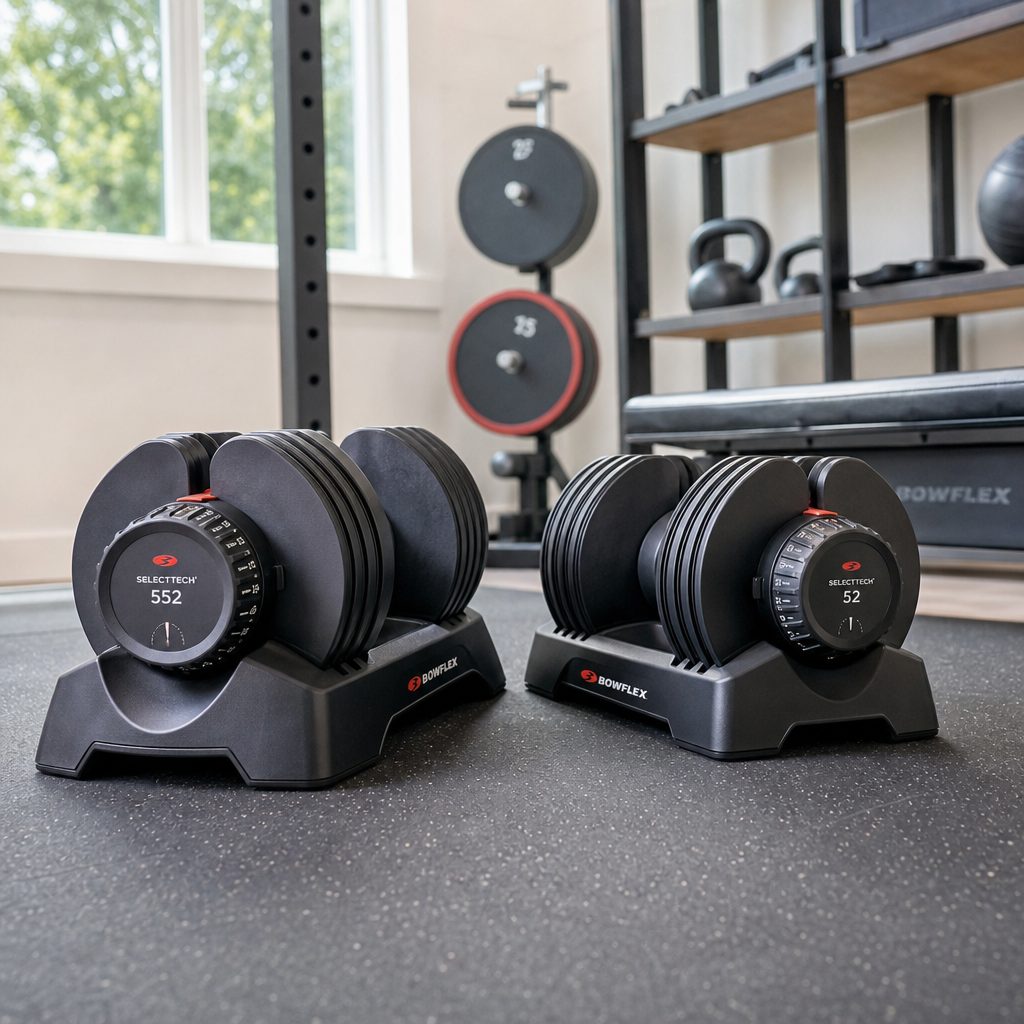
The key buying comparison was between the established 552's fast but occasionally mobile plate stack and the SelectTech 52's similarly quick dials paired with a firmer new locking system.
9. Is the £530 UK pair price justified?
At £530 for a pair, the SelectTech 52 occupied the premium end of the practical home-gym market. That is a substantial amount of money for two dumbbells, no matter how many conventional pairs they replaced. It is worth saying plainly because clever space-saving claims can make us briefly forget that a sizeable bank transfer remains a sizeable bank transfer.
There are two ways to assess the value. The first is raw purchase price. On that basis, a conventional set of fixed dumbbells can be cheaper, particularly if you buy second-hand and have space for a rack. The old 552 could also look attractive on the used market because it had been around for years. The second assessment is whether the SelectTech 52 could replace enough equipment, friction and storage needs to make that higher upfront cost reasonable.
For the right buyer, it could. Fifteen selectable settings in each hand covered a serious amount of training variety without turning a room into a mini commercial gym. You could train arms, shoulders, chest, back and legs using just the pair and perhaps a bench or sturdy floor space. You could make small progression changes in the low range. You could switch quickly for a circuit. You could put the system away rather than permanently sacrificing a corner of the house to a dumbbell rack.
The more important value question was whether BowFlex had actually earned the premium over the 552. I think it mostly had. The old model's defining advantage was convenience, but its plate movement could undermine the confidence you wanted from expensive adjustable kit. The 52 retained the convenience and improved the hardware where it counted. If you had hesitated over the 552 because you did not like the thought of wobble and clinking, the 52 gave you a more credible reason to spend the money.
BowFlex SelectTech 52 single dumbbell
A niche option for unilateral work, replacement needs or buyers building gradually.
BowFlex SelectTech 52 pair
The sensible purchase for most home programmes, allowing bilateral pressing, rowing and lower-body work.
There was an important caveat. If you already had a good collection of fixed dumbbells, the SelectTech 52 was a luxury of convenience rather than a necessity. Fixed dumbbells remain wonderfully simple, robust and ready for a careless set-down. If you had room for them, their lack of cleverness was their great strength.
Likewise, if you were a strength athlete who already knew 52.5lb per hand would be too light for main lifts, spending £530 on a ceiling you would rapidly hit made little sense. You would be better served by a system that extended further, whether that meant the heavier SelectTech 1090 or a more traditional loading setup. Buy for your likely training in six months, not the first week of enthusiasm when any dumbbell feels like an instrument of destiny.
For beginners and intermediate trainees in a space-limited UK home, though, the price was defensible. Not cheap. Defensible. There is a difference, and it is an important one.
10. Who should buy the BowFlex SelectTech 52?
The SelectTech 52 was not for everyone, but it was unusually easy to place once you understood its strengths. It was a polished, practical choice for the person who wanted to train frequently at home, valued neatness and wanted a more robust alternative to the old 552 without moving into commercial-gym bulk.
Best for small-space home gyms: BowFlex SelectTech 52
It replaced 15 traditional weight sets in one pair, making it an excellent match for flats, spare rooms and multipurpose living spaces where a full rack would be impractical.
Best for fast-changing workouts: BowFlex SelectTech 52
Two-second dial changes suited circuits, supersets and full-body plans where constantly walking to a rack would kill momentum.
Best upgrade from a BowFlex SelectTech 552: BowFlex SelectTech 52
The redesigned locking system and stable-feeling metal plates directly tackled the wobble and clinking that had put some 552 owners off.
Best for heavier strength goals: BowFlex SelectTech 1090
Shop BowFlex SelectTech 1090 on Amazon UK
With a 90lb maximum, the heavier BowFlex model made more sense for lifters who would outgrow a 52.5lb per-hand cap.
Beginners were arguably the clearest audience. A beginner often needs modest increments, straightforward setup and equipment that does not require them to understand an entire ecosystem before they can do a squat. The SelectTech 52 delivered that. Start light, turn the dials as confidence grows, and keep the home gym from becoming a storage puzzle.
Intermediate lifters who trained primarily for general fitness, hypertrophy and muscular endurance were also well served. The range was enough to create challenging sessions when exercises were chosen intelligently. A 52.5lb dumbbell row may not trouble every experienced back-training enthusiast, but slower tempo, unilateral variations, longer sets and strategically selected movements can keep the work meaningful.
People who should hesitate included those who drop weights as part of normal training behaviour, people building a serious heavy-strength home gym and buyers who already had fixed dumbbells with no storage problem. The SelectTech 52 was excellent at being a refined adjustable dumbbell. It was not a substitute for every possible dumbbell in every possible training environment.
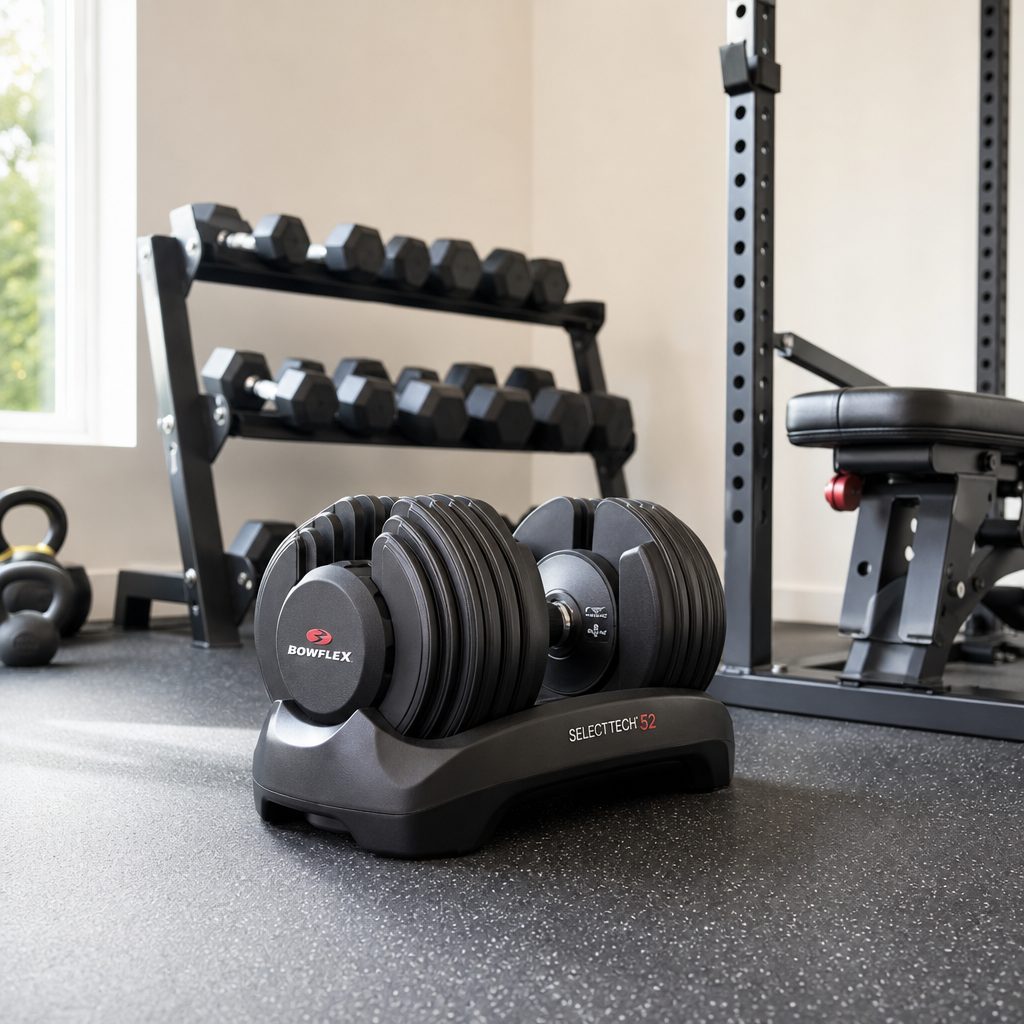
For a compact spare-room gym, the SelectTech 52's ability to replace numerous fixed dumbbell pairs was its strongest practical argument, provided the 52.5lb ceiling suited your programme.
11. The JRNY trial and the blissful absence of batteries
The SelectTech 52 included a two-month trial of JRNY, BowFlex's digital fitness platform. For some buyers, that will be a genuinely useful extra. A guided workout can lower the barrier to starting, particularly if your previous training routine consisted of doing a few curls, checking your phone and then deciding you had probably earned a biscuit.
JRNY could provide structure, guided sessions and adaptive training plans. That can be helpful for people who want their equipment purchase to become an actual habit rather than an unusually expensive clothes airer. The dumbbells' adjustable range made them appropriate for a broad selection of guided resistance sessions, and the quick dial changes fitted a class-led style of workout reasonably well.
But I would not make the JRNY trial the reason to buy the product. It was a bonus, not the core value. The core value was mechanical: metal plates, the revised lock, a secure handle and quick selection. The dumbbells remained useful after any trial had ended because their basic operation did not depend on a subscription or screen.
That brings us to batteries. Or, more accurately, the lack of them. There was no battery life to rate because the SelectTech 52 did not use one. That is a positive in my book. Adjustable dumbbells are a category where reliability should come from physical engineering, not from whether a lithium cell happens to be charged.
There was no charging routine to remember, no connection issue to troubleshoot and no moment when a workout had to be postponed because an app had decided the dumbbells required attention. The dials remained the interface. It was an old-fashioned idea, perhaps, but one that worked extremely well here. Turn. Select. Lift. It has a certain elegance.
No charging ritual required
The SelectTech 52's daily usability came from mechanical simplicity. JRNY was optional for guided training, but the dumbbells required neither batteries nor a connected device to adjust weight and complete a full workout.
12. Ownership advice: how to get the best from them
Buying a good adjustable dumbbell is only half the job. The other half is using it in a way that suits both your training goals and the equipment. Fortunately, the SelectTech 52 did not require a special ceremony. It just benefited from a little common sense.
First, build your programme around the range rather than pretending the range does not exist. The 5lb to 52.5lb span was broad, but your exercise selection should make the most of it. For chest and shoulders, presses, floor presses, flyes, lateral raises and rear-delt work can all fit comfortably within that envelope. For back, one-arm rows, rear-delt rows and higher-repetition pullovers can work well. For legs, split squats, reverse lunges, goblet squats, Romanian deadlifts and calf raises make better use of a limited maximum than expecting a pair of adjustable dumbbells to replace a barbell for every heavy squat variation.
Second, use the small increments strategically. The 2.5lb steps through 25lb gave you a very useful way to progress upper-body accessory work. You do not need to increase every lift at the same pace. You might add a small amount to curls after completing all target reps cleanly, while keeping lateral raises at the same load and improving control. That is not timid training. That is how sustainable progression tends to work when nobody is watching and no one needs to impress the imaginary gym committee.
Third, keep the tray area clear and develop a controlled set-down habit. The redesigned lock was firm in use, but this was still selector equipment. Treat it with the respect you would give any item containing moving locking components. Avoid dropping it. Avoid forcing it into the tray at an angle. Avoid turning the dials while the dumbbell is not properly seated. These are not burdensome rules; they are just the cost of having fifteen pairs of weights condensed into a very small footprint.
Fourth, choose a suitable surface. A stable floor and protective mat are sensible for your home and for the equipment. You do not need a commercial facility. You do need somewhere you can stand securely and lower the dumbbells without turning every final rep into a domestic insurance claim.
Finally, do not overthink whether a dumbbell workout has to be complicated. With an adjustable pair, a bench if you have one, and a clear plan, you can cover a great deal. A full-body session might include Romanian deadlifts, floor presses, one-arm rows, split squats, overhead presses and curls. That is not glamorous. It is also extremely effective when done consistently.
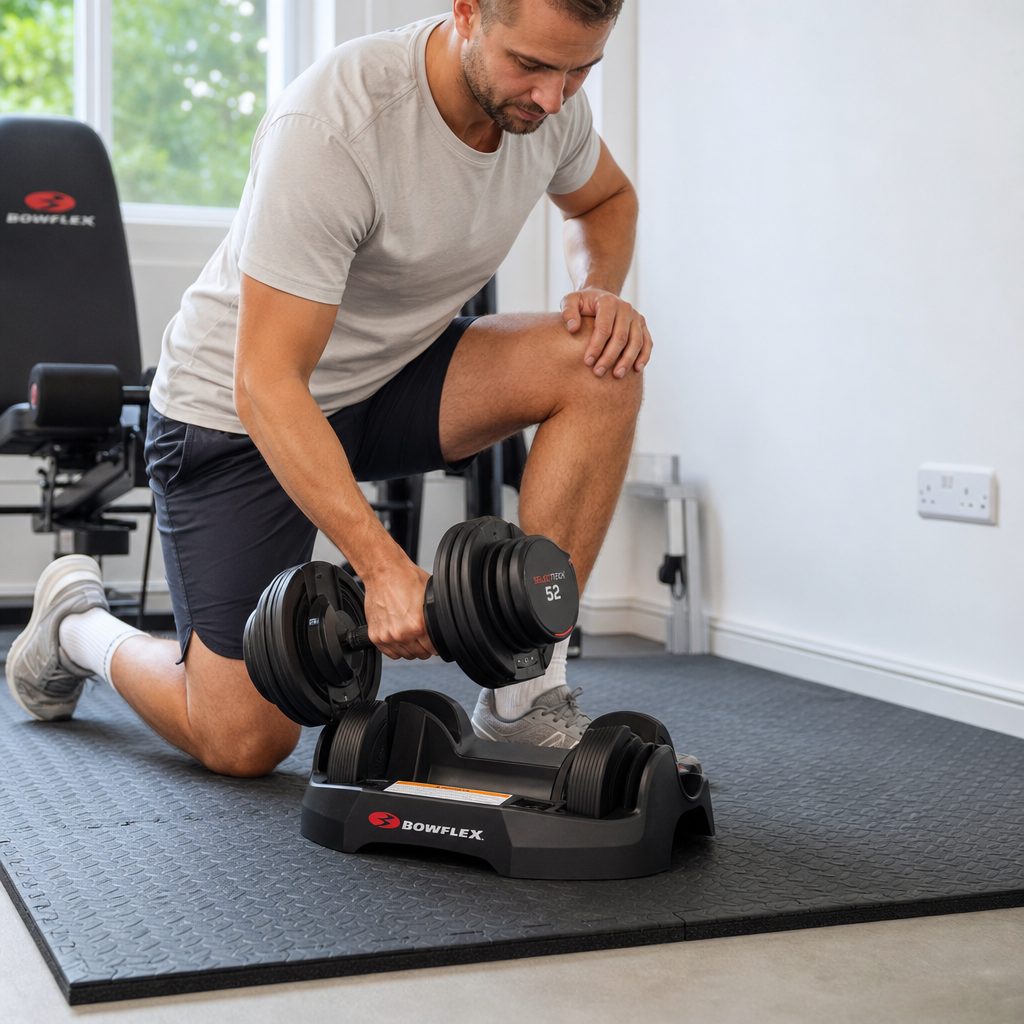
A controlled return to the storage tray and sensible protective flooring helped preserve the benefits of the new locking mechanism while keeping a compact home setup civilised.
13. BowFlex SelectTech 52 review: the final buying calculation
Shop BowFlex SelectTech 52 on Amazon UK
The SelectTech 52 was a more convincing product than the 552 because it fixed the thing that most needed fixing without giving up the thing BowFlex had always done well. It retained rapid dial adjustment, a practical 15-setting range and impressive space efficiency. Then it added premium metal plates, a more secure locking mechanism and a non-slip ergonomic handle that made the whole package feel more credible under load.
The biggest improvement was not visual, although the uniform metal plates looked better. It was behavioural. The plates did not shift in dynamic movements. The lock held firm in curls, presses, lunges and heavier compound work. That meant the dumbbells felt like training equipment rather than a clever system you needed to excuse every now and again.
The decision still came down to your circumstances. At £530 per pair, this was an investment. It made sense when storage was limited, when a broad range of resistance mattered and when you wanted quick changes within one session. It made less sense if you had ample space, already owned fixed weights or knew you needed more than 52.5lb in each hand for the training you actually enjoyed.
For former 552 shoppers, though, the answer to the headline question was fairly straightforward. Yes, the metal-plate SelectTech 52 had fixed the 552's most frustrating practical flaw. It did not make every trade-off disappear. It did make the BowFlex concept feel much more finished.
14. Frequently asked questions
Verdict: BowFlex SelectTech 52
The BowFlex SelectTech 52 was the 552 redesign buyers had been waiting for. It kept the brilliantly convenient two-second dial adjustment and useful 5–52.5lb, 15-setting range, then made the selected load feel far more secure with premium metal plates and a redesigned locking mechanism.
The old 552's plate wobble and clinking had not made it useless, but they had made it feel less polished than its price suggested. The 52 changed that. In curls, presses, lunges and heavier compound work, the plates stayed settled and the lock held firm. The upgraded non-slip handle completed a much more confidence-inspiring package.
At £530 for the UK pair, it was not a casual purchase. But for a beginner or intermediate lifter building a compact, tidy and genuinely versatile home gym, it was a strong premium choice. Buy it for space efficiency, fast session flow and improved mechanical confidence. Skip it if you need heavier than 52.5lb per hand or simply prefer the no-compromise simplicity of fixed dumbbells. For everyone else, this was a meaningful BowFlex evolution rather than a superficial refresh.