
Mirafit M150 Adjustable Bench Review: Is This the Best Budget Bench for a UK Home Gym?
The M150 had spent years occupying a particularly useful middle ground: heavier, more adjustable and more confidence-inspiring than the typical cheap bench, without wandering into premium commercial-bench money. Here is how its steel frame, incline range and day-to-day practicality stacked up in a small British home gym.
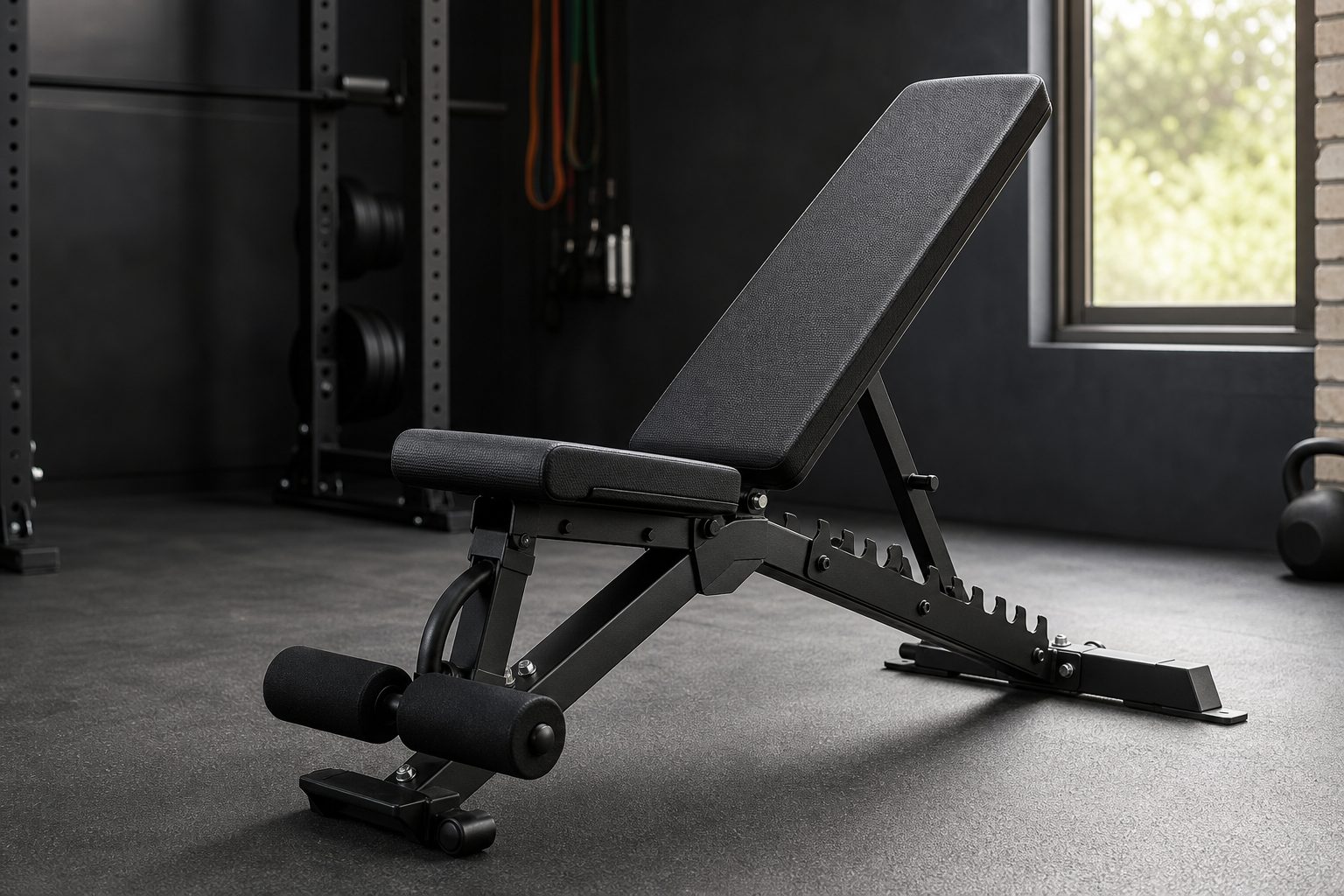
The Mirafit M150 is a properly substantial adjustable bench rather than a featherweight accessory that happens to have a pad attached.
 By James Oduya · Staff Writer & Home Gym Columnist · Updated July 15, 2026
Quick verdict: a serious bench at a sensible price
The Mirafit M150 Adjustable Bench made a compelling case for itself because it got the important, rather unglamorous things right. It was heavy enough not to skate about when you pressed hard. Its pad was firm enough to support pressing rather than swallow you into a little upholstered crater. Its backrest adjusted from flat up to an upright position, and the seat adjusted separately, which was the detail that turned it from "a bench with a hinge" into something you could actually use for incline dumbbell work.
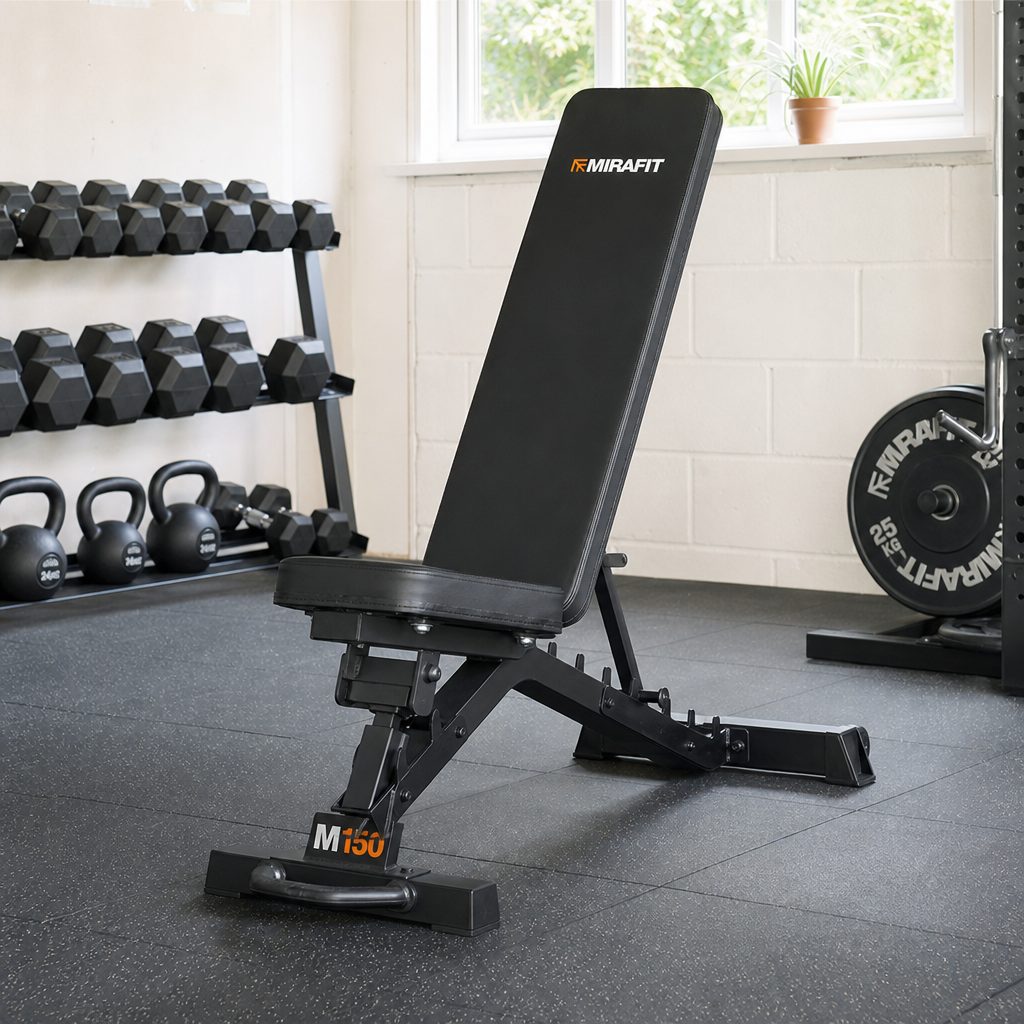
The M150's strongest case was straightforward: a stable flat-and-incline foundation that could serve a beginner well and still make sense once the dumbbells became properly heavy.
That sounds basic. It is basic. But basic gym equipment is often where brands cut the wrong corners. A bench can look perfectly adequate in a product photo and still feel distinctly silly when you pick up two dumbbells, lie back and notice that the whole thing shifts before you have done a single repetition. The M150's 28kg construction weight and 260kg maximum total load gave it much more credibility than the price suggested.
It was not perfect. The seat adjustment was slower than it needed to be, there was no decline setting, and it required your own spanners for assembly. A few owners also encountered a small amount of side-to-side play after tightening the frame. None of those issues made it a bad bench. They did, however, matter if you expected a fast-adjusting, fully featured FID design or wanted the finish and mechanism refinement of a much dearer commercial model.
My short answer, then: for a lifter building a sensible UK home gym around dumbbells, a rack or both, the M150 was one of the better-value places to spend about £150. It did not try to be a folding bench, a decline bench and a commercial studio bench at the same time. It concentrated on flat and incline training, and it was generally much better for it.
Mirafit M150 Adjustable Bench: key specifications
Prefer to buy on Amazon? Mirafit sell direct rather than through Amazon UK, so there is no Amazon listing for the M150. The closest equivalent currently stocked on Amazon is the FLYBIRD Adjustable Weight Bench — similar budget bracket, rated to 363 kg, with a folding frame and a comparable spread of incline, flat and decline positions.
Before getting into how it felt to live with, it is worth putting the M150's core numbers in one place. Benches are awkward products to assess from a specification sheet alone, but dimensions, load rating and pad thickness tell you a surprising amount about the sort of equipment you are considering.
The frame used 7cm by 5cm steel tubing. That is one reason the bench did not feel like an afterthought beneath the lifter. It was a substantial rectangle of steel designed to stay put, rather than a lightweight compromise designed primarily to disappear behind the sofa. For many people, especially those training in a spare room or garage, that was the right compromise. You can move it when needed, but it did not behave as though movement was its main job.
Its 44cm flat height also deserves a mention. Bench height affects your setup more than most first-time buyers expect. Too high and shorter lifters may struggle to place their feet securely. Too low and the movement can feel odd, particularly when you are used to a standard gym bench. At 44cm, the M150 sat in a familiar, sensible zone for general pressing, chest-supported work, rows and seated dumbbell exercises.
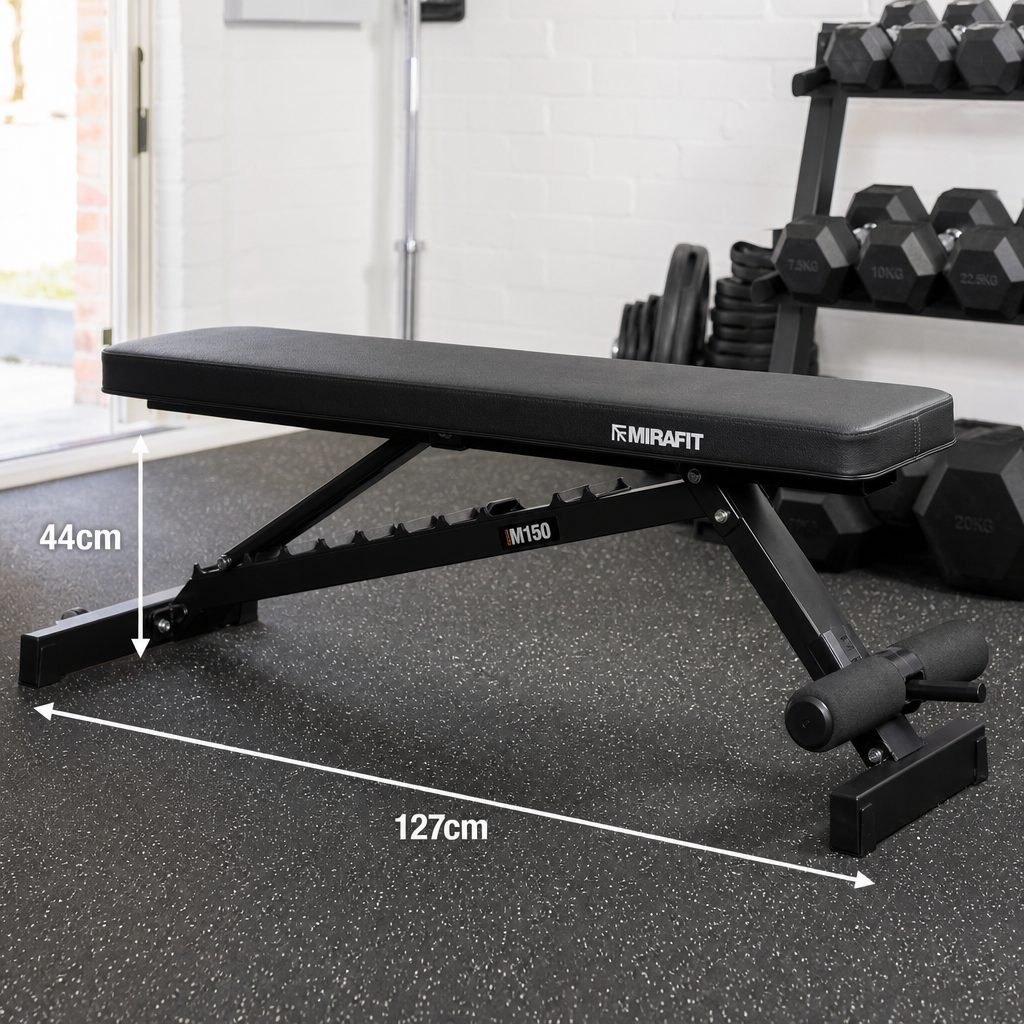
A 44cm flat bench height and a 127cm-long frame made the M150 feel like gym equipment, not a temporary flat-pack substitute.
The M150's design: built for training, not for pretending
The M150's appeal was not visual theatre. There was no screen, no app, no subscription, no battery to charge and no Bluetooth symbol waiting to disappoint you. It was a manually adjusted bench. You carried it, wheeled it or left it in place. You set the angle. You trained. On an ordinary Tuesday evening, that simplicity was quite refreshing.
Its proportions were the first thing to understand. At 127cm long and 60cm wide, the M150 was not a tiny bench. Nor should it have been. A bench that has to support a person, their body position and potentially a large amount of external load needs a decent footprint. The important distinction was that it remained manageable in a British home setup. You could wheel it across a garage, rotate it within a compact rack area, or park it against a wall after training without needing a logistics plan and a clipboard.
The handle and built-in transport wheels were practical rather than flashy. A 28kg bench is not something you want to deadlift repeatedly just to clear floor space. The wheels meant that the bench's weight worked for you during training but did not become a punishment at the end of it. Anyone who has owned a heavy bench with no wheels will appreciate this immediately. Everyone else will appreciate it after about three sessions.
The cushions were extra-thick, with anti-slip fabric and 6cm of padding. More padding is not always better. A sofa-like bench can feel pleasant while you are sitting on it, but compression under load changes your position and can make a press less stable. The M150's firmer pad density was a sensible choice for lifting. It supported the shoulders and upper back without allowing you to sink through the surface. For chest presses, dumbbell shoulder presses and incline rows, that firmer feel was a feature rather than a cost-saving oversight.
Substantial steel structure
The 7cm by 5cm tubing and 28kg overall weight gave the M150 the planted character that a proper lifting bench needs. It was designed to support effort, not merely to look convincing beside a pair of 5kg dumbbells.
Separate backrest and seat adjustment
Six backrest positions and four seat settings created far more useful setup options than a simple flat-or-upright bench. The seat angle mattered most when pressing on an incline.
Firm, anti-slip contact surface
The thick cushion was intentionally firm. That gave your upper back a more consistent base while still offering enough support for regular sessions.
Easy enough to reposition
Wheels and a handle helped make a heavy bench livable in shared spaces, where equipment often has to move before the room can return to being a room.
The main design compromise was that the M150 did not offer decline. That was not hidden; it was simply the product's focus. If decline pressing, decline sit-ups or a traditional decline dumbbell fly were essential parts of your programme, this was not the bench to force into that role. You could improvise, of course. Home gym owners are an inventive species. But buying a bench that does the movement properly is always better than building a small engineering project out of bumper plates and towels.
Assembly and first-week ownership
The M150 required assembly, with a typical build taking around 30 to 60 minutes. That was not unusual for a bench of this weight and construction, and the instructions were generally regarded as clear. Parts were packaged and labelled sensibly, which is the sort of small mercy that makes a garage-floor assembly job considerably less irritating.
You did need your own tools: 14mm, 17mm and 19mm spanners, plus an adjustable spanner. They were not included. I would not call that a deal-breaker, because these are ordinary tools and a bench built with substantial bolts is preferable to one held together by optimism. Still, it was worth knowing before the box arrived. If your household tool collection consisted of one screwdriver and a butter knife, a quick trip to the hardware shop was sensible.
Take the time to tighten everything evenly and check the bench once it is assembled. This is not glamorous advice, but it is good advice. A bench is subjected to repeated loading from slightly different angles: your bodyweight when you lie down, the force generated as you brace, dumbbells coming into position, and the odd slightly ungainly set-up when one hand has found the dumbbell before the other has. Starting with all hardware properly tightened helped the bench show its best side.
Some owners reported rust dust inside the packaging or on metal components when the bench arrived. Inspect the frame during assembly, wipe away any residue and make sure the bench is clean and dry before bringing it into a finished indoor room.
A small number of owners also noted slight side-to-side rocking after tightening the bolts. This was worth acknowledging because a bench should never feel like it is dancing beneath you. The more useful context is that reports did not suggest it became unstable during actual training. The M150's 28kg mass and broad structure meant that, under normal loaded pressing, it remained reassuringly planted. Still, if your particular unit had a noticeable issue, it was sensible to check every connection carefully rather than accepting wobble as an inevitable feature of home gym life.
There was also an evolution in the backrest fixing. Earlier versions were criticised for a backrest held by smaller screws and a thin backing bar, while newer versions used four bolts. That newer arrangement was a welcome improvement. It addressed one of the few parts of the design that had looked less robust than the rest of the bench. A product can have a very strong frame, but the places where moving parts meet still deserve attention.
Flat bench performance: where the M150 earned its keep
A good adjustable bench must first be a good flat bench. That point is easy to miss because adjustability sells products, whilst flat pressing is where many benches spend the bulk of their working life. The M150 did well here because it was heavy, firm and close to a traditional gym height.
At 28kg, it was heavy enough not to shift around during loaded pressing. In practical terms, that mattered when setting up dumbbells. You could sit at the front edge, bring the weights to your knees, lean back and settle into position without the frame feeling as though it wanted to travel with you. That familiar sequence can be surprisingly stressful on a cheaper bench. The M150 removed much of that uncertainty.
Reports of training with a 95kg user benching 50kg dumbbells were particularly useful context. That represented a serious real-world combination of bodyweight and training load, and the bench remained stable. It did not prove that every lifter should immediately attempt 50kg dumbbells, obviously. It did show that the 260kg stated total-load limit was not merely a decorative number printed in a listing.
Flat dumbbell press was the obvious beneficiary, but the stable platform carried into several other movements. Dumbbell flyes benefit from a pad that does not flex or shift while the shoulders are in an extended position. Chest-supported dumbbell rows benefit from a backrest that does not wobble when you brace your torso into it. Hip thrusts need a bench that stays where it was put rather than trying to migrate as the load rises. Owners also reported excellent stability for hip thrusts and reverse flyes, which backed up the broader sense that the M150 handled awkward, off-centre loading well.
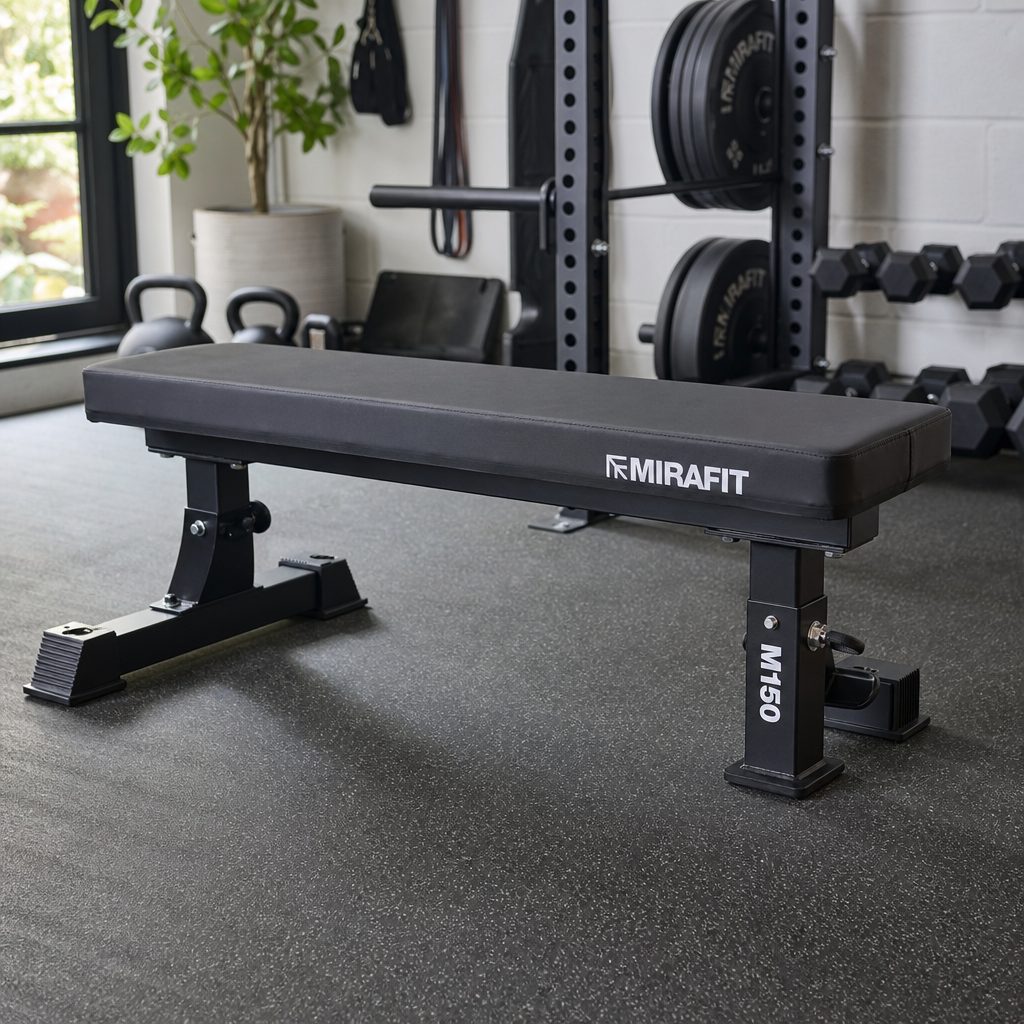
The flat setting was the M150's foundation: firm enough for pressing, stable enough for hip thrusts, and practical for the everyday dumbbell work most home gyms actually see.
The pad firmness deserves repeating because it was central to this behaviour. A very soft cushion can feel luxurious for ten seconds, then prove unhelpful when you are trying to create a repeatable pressing position. The M150 was not plush. It was supportive. For a training bench, supportive won.
There was another, quieter benefit to the bench's weight: confidence. A home gym does not need to recreate every detail of a commercial facility, but it should allow you to concentrate on the lift rather than the equipment. When a bench is stable, you can focus on your shoulder position, brace, range of motion and rep quality. When it moves, squeaks or feels flimsy, part of your brain starts negotiating with the furniture. That is not a useful training stimulus.
Incline and upright positions: the M150's real advantage
The M150 had six backrest positions, ranging from flat to 90 degrees. That was a broad enough range to cover the movements most lifters wanted: low incline dumbbell presses, steeper incline presses, seated shoulder presses, supported rows, reverse flyes and general upper-body accessory work. The exact number of positions mattered less than whether the chosen angles felt useful. Here, they largely did.
A low incline is often the sweet spot for chest-focused pressing, whilst a higher incline shifts more demand towards the shoulders. The M150 gave enough adjustment steps to find an angle that suited your training and your shoulders, rather than forcing everyone into one vague "incline" setting. If one position felt too upright or too close to flat, there was another nearby. That is the practical advantage of a six-position backrest.
The upright setting also made the bench a far more versatile dumbbell station. Seated shoulder presses, lateral raises, curls with back support, triceps work and rear-delt movements all became more comfortable when you could brace against a solid backrest. It was not a replacement for every specialised machine in a commercial gym, but it was a very efficient use of floor space.
The separate seat adjustment was the star feature. Four seat positions meant you could raise the seat to support yourself during incline pressing. Without that, it is easy to slide down the bench as the set progresses, especially with heavier dumbbells or a steeper angle. Sliding changes your body position, interrupts the set and can leave you fighting the bench rather than the weights. The M150's adjustable seat helped maintain a proper angle and a more secure lower-body position.
The small feature that mattered most
For incline dumbbell pressing, set the seat before you settle in with the weights. A modest seat rise gave your hips a secure stop point, reducing the tendency to slide forward. It was a simple adjustment, but it made the M150 feel markedly more capable than cheap benches with a fixed seat.
The catch was the seat mechanism itself. Adjusting it could be tedious: unscrewing the fitting, lifting the seat to the desired height, aligning the hole accurately, then screwing it back in. If you tended to leave the bench at one or two favourite settings, this was not much of a problem. Set it for incline press, do your pressing, then move on. If your training style involved changing between angles every few minutes, it became a mild nuisance.
This distinction is important. "Adjustable" did not automatically mean "fast-adjusting." The M150 was a bench for a structured session, not necessarily a circuit where you wanted to flip from flat presses to seated curls to reverse flyes to upright shoulder presses with no interruption. For most home lifters, that was acceptable. We tend to work through a few sets of an exercise before changing setup. But it was a clear area where a pricier bench could feel more polished.
Daily use: no batteries, no fuss, a few practical habits
There was no battery life to discuss because the M150 did not need one. No charging, no firmware updates, no app pairing and no cheerful little notification informing you that your bench wanted a software update halfway through leg day. It was steel, padding, bolts and moving mechanisms. That was not old-fashioned in a negative sense. For a bench, it was exactly what you wanted.
Daily care was correspondingly simple. Keep the upholstery clean, wipe off sweat, check the adjustment hardware periodically and make sure the wheels and handle were not being asked to drag the bench over a cluttered floor. If you trained in a garage, avoid leaving damp towels on the cushion and do not let condensation become a permanent house guest. A well-kept bench should remain a stable bit of equipment for a long time because there is very little electronic or mechanical complexity waiting to fail.
The anti-slip material was useful for routine training. You still needed to position yourself carefully, particularly when getting into a steep incline dumbbell press, but the surface helped you remain planted once you were there. That mattered more than a soft, glamorous finish. A bench pad's purpose was not to impress the palm of your hand in a showroom; it was to create a reliable contact point between you and the frame.
Storage was sensible rather than miraculous. The M150's wheels and handle helped you shift it, but its 127cm by 60cm footprint remained real. In a dedicated garage gym or spare bedroom, that was manageable. In a small living room where every item had to justify its existence by bedtime, it was still a sizeable bench. It did not fold away, and that was one reason it felt so stable. You had to decide which mattered more in your space: a bench that vanished, or a bench that behaved properly under load.
For many UK home gyms, the answer was obvious. A garage corner, shed, box room or spare bedroom could accommodate a 127cm bench far more easily than it could accommodate a raft of individual machines. The M150 effectively created a usable pressing station, an incline station, a seated station and a support platform for lower-body and back work. One good bench can save you from buying several less useful pieces of equipment.
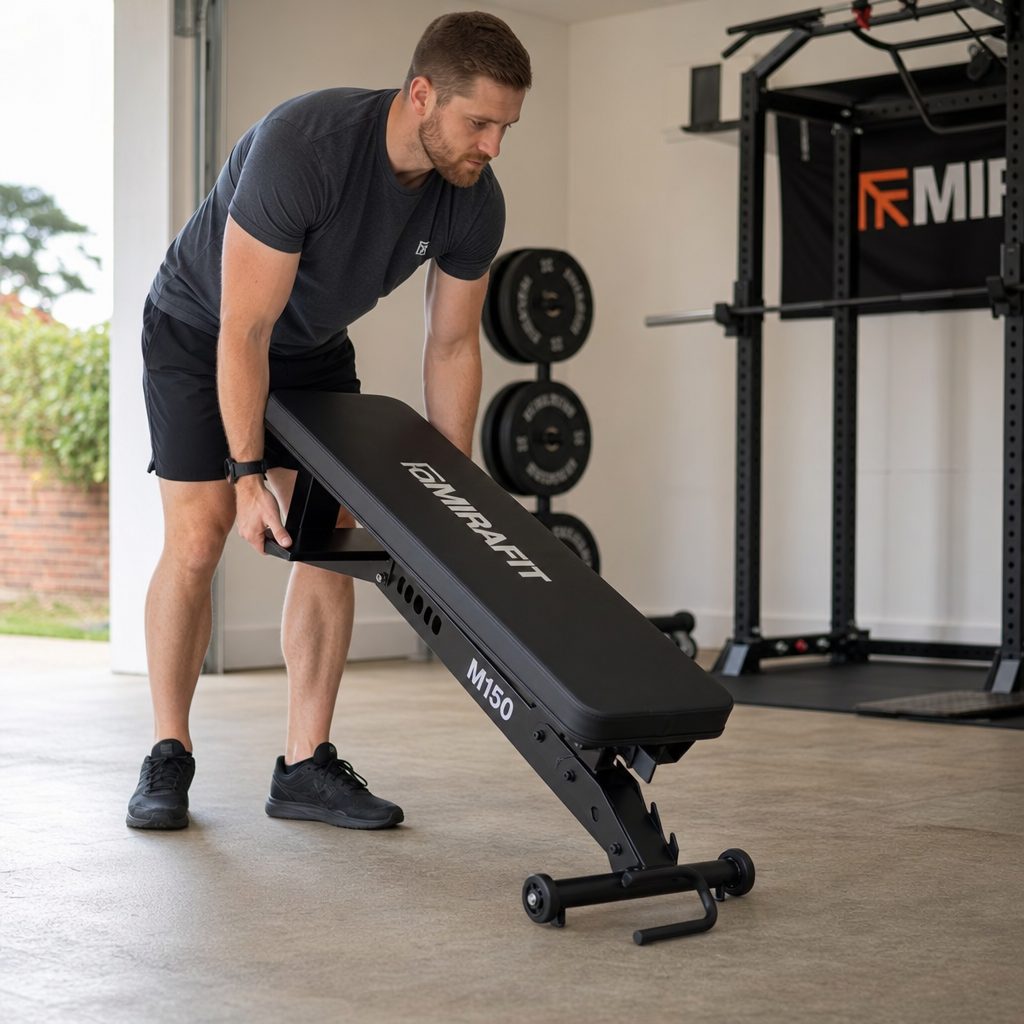
Transport wheels and a handle made the M150 realistic for shared garage and spare-room gyms, even though it was deliberately too substantial to be a folding bench.
Exercises the Mirafit M150 handled especially well
Bench reviews can become rather abstract if we only talk about hinges, bolts and steel tubing. The more useful question is what you could do with the thing once it was in your training space. The M150 was at its best when used as the centre of a dumbbell-led programme, or as a flexible accessory bench beside a rack.
Flat dumbbell presses were the obvious starting point. The 44cm height, firm pad and planted frame made it a comfortable base for regular chest work. Whether you were building strength with controlled sets or chasing higher-repetition hypertrophy work, the bench was stable enough to let the dumbbells be the difficult part.
Incline dumbbell presses showed why the dual adjustment mattered. You could select a sensible backrest angle, raise the seat to prevent forward sliding and concentrate on pressing. This was arguably the M150's defining exercise. Cheaper benches often offered an incline setting but not a practical way to stay in position once the dumbbells became challenging.
Seated shoulder presses benefited from the near-upright setting. A 90-degree option made it possible to train shoulders without needing a separate chair or balancing against a wall. The practical limitation was head support for taller users. At around 6ft 3in, you might not receive full head support from the backrest in its highest configuration. That did not stop the exercise being possible, but it was worth considering if you particularly wanted a tall, supportive upright bench.
Chest-supported rows and reverse flyes were another strong fit. The adjustable backrest let you use an incline angle to support your chest, reducing the temptation to turn every row into a small lower-back endurance contest. The bench's stable frame mattered here because the load was often pulling at an angle rather than simply pressing straight down.
Hip thrusts also suited the M150. This movement can expose a flimsy bench very quickly because your upper back is braced against the edge whilst the loading is dynamic and concentrated. The M150's mass and stability were reassuring, and user feedback specifically described it as excellent for hip thrusts. As ever, position it on a stable floor and make sure the pad contact point worked for your upper back rather than your neck.
Single-arm dumbbell rows, Bulgarian split squats, step-ups and supported curls were all simple, useful additions. A quality adjustable bench earns its keep not only through headline lifts but also through the small exercises that make a programme complete. The M150 was sturdy enough to be leaned on, sat on, pressed against and generally used without feeling precious.
What worked well
- 28kg construction weight created a stable, planted feel during loaded pressing.
- 260kg total load capacity was substantial for a bench in this price bracket.
- Six backrest and four seat positions offered genuinely useful training flexibility.
- Firm 6cm padding supported pressing stability rather than compressing excessively.
- Transport wheels and handle made a heavy bench easier to live with in a small gym.
- Flat, incline and near-upright work were all covered without unnecessary complication.
What to consider
- The seat adjustment took longer than a quick-release system and could be fiddly.
- There was no decline setting for decline-specific training.
- Assembly required 14mm, 17mm and 19mm spanners plus an adjustable spanner.
- Some owners found minor side-to-side play, even after tightening hardware.
- Rust dust in packaging had been reported on some deliveries.
- Taller users around 6ft 3in may not get full head support upright.
How stable was it under serious dumbbell work?
Stability is the category in which the M150 separated itself most clearly from bargain-basement adjustable benches. The numbers helped: 28kg was not trivial, and the stated 260kg maximum total load included both your bodyweight and the weights you lifted. But the more meaningful point was how those figures translated into actual use.
Feedback consistently described the bench as solid, with no meaningful wobble during training. The 95kg lifter using 50kg dumbbells was a particularly persuasive example because the setup demanded a great deal from the bench. You had a 95kg body settling onto the pad, then 100kg of dumbbells being manoeuvred into position and pressed. That was exactly the type of use where a light bench can feel unstable, especially as you kick the dumbbells up or return them to your knees at the end of a set.
The M150 stayed put. That was the point.
It is worth being precise about what a 260kg total-load rating meant. It did not mean you could add 260kg of plates to a bar and call it a day. The user's bodyweight counted towards the total. A 90kg lifter, for example, had a theoretical remaining allowance of 170kg within the stated total load, before taking any other practical considerations into account. For normal home dumbbell training, that was ample headroom. It also meant the bench was not restricted to beginners simply because it was relatively affordable.
The slight rocking some users noticed needed separating from actual instability. A tiny degree of lateral play in an assembled adjustable bench is not ideal, but it was not necessarily the same as a bench shifting under a press. In real use, the M150's mass and construction were enough to keep it confidence-inspiring. If you were very sensitive to any movement at all, or wanted the absolutely most refined fit and finish, spending more on a premium bench might be worthwhile. For the majority of home lifters, the M150's practical stability was the far more relevant result.
Value in July 2026: where the M150 sat in the market
As of July 2026, the M150 sat at approximately £150, with a £159.99 listing seen at YPC in January 2026. UK delivery was £4.95. That pricing was the heart of the product's argument. It was not the cheapest bench you could buy, and that was exactly why it was interesting. The cheapest benches often economised on weight, frame strength, adjustment quality or seat support. The M150 spent a little more in the places that affected training.
Mirafit M150 Adjustable Bench
Typical UK benchmark price in 2026, plus £4.95 UK delivery.
YPC listing recorded in January 2026
A useful reference point for the M150's established UK pricing.
There was also an M150 Bench, Dumbbell & Kettlebell Kit containing five pairs of dumbbells, two kettlebells and a dumbbell rack. Bundles can make sense if you were starting almost from scratch, but I would not buy a package simply because it looked tidy in a product image. Add up what you actually needed. If you already owned adjustable dumbbells, a barbell setup or a collection of kettlebells, the bench on its own was usually the more logical purchase.
At around £150, the M150 occupied a useful category: budget-conscious, but not disposable. That distinction mattered. Cheap gym gear can be a false economy when it limits how you train or makes you reluctant to use it. A slightly dearer bench that remains stable through years of dumbbell presses, rows, split squats and hip thrusts is usually the better value purchase than a bargain model you outgrow in six months.
It was also a better use of money than buying too many single-purpose accessories at once. A home gym does not need to be assembled in one enormous online order. A sturdy adjustable bench, a sensible set of dumbbells and enough floor space to move safely can create a remarkably complete training setup. The M150 was the sort of central item around which that kind of modest, useful gym could be built.
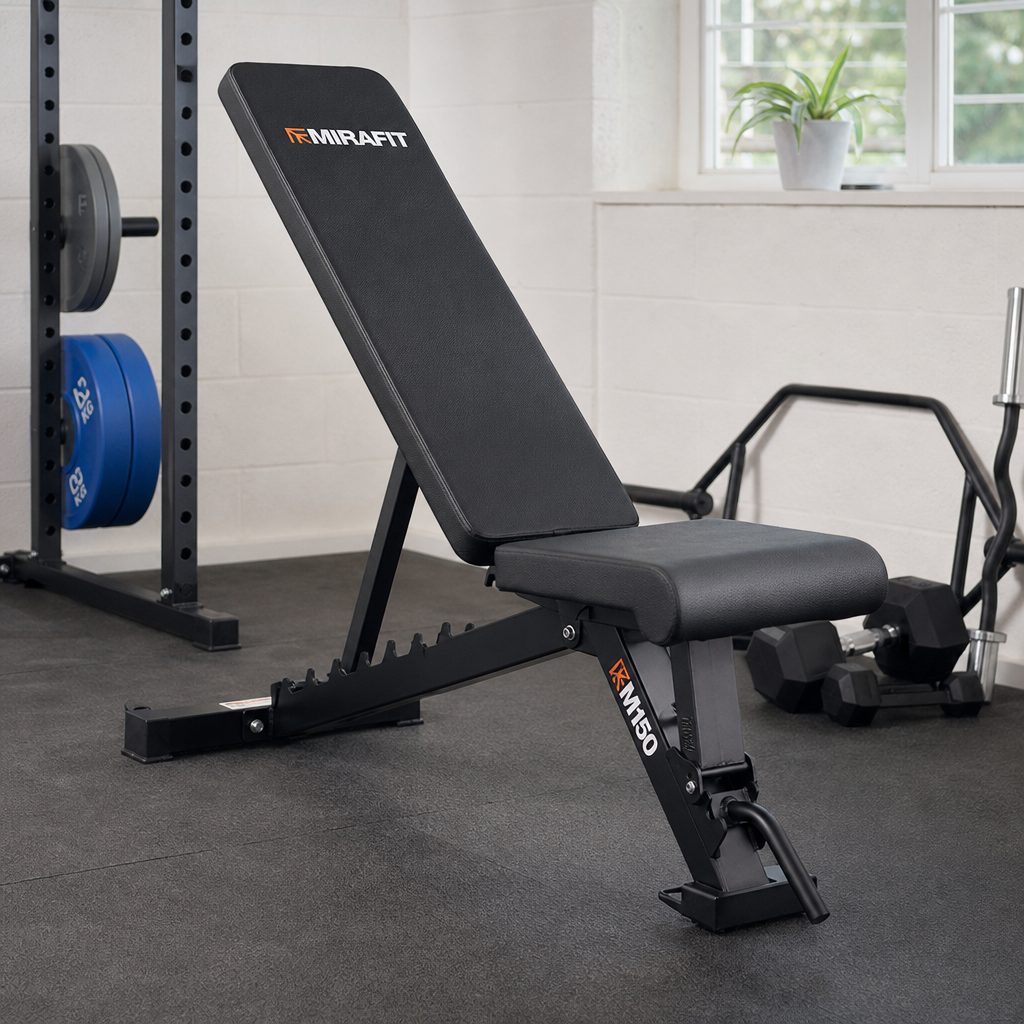
At roughly £150, the M150's value came from buying stability and useful adjustment rather than paying for features that looked impressive but added little to day-to-day training.
Mirafit M150 Adjustable Bench compared by training need
It is tempting to treat every adjustable bench as the same product with a different logo. They were not. The M150's own design made clear choices: flat and incline rather than decline, substantial weight rather than fold-flat portability, and seat support rather than the simplest possible adjustment system. The table below is not a claim that every other bench followed the same specification; it shows what the M150 delivered across the setups people most commonly wanted in a home gym.
| Training need | Mirafit M150 setup | What the specification delivered | Who benefited most |
|---|---|---|---|
| Flat dumbbell pressing | Flat backrest | 44cm flat height, 6cm firm cushion and 260kg total load rating | Anyone building a primary chest-press station at home |
| Incline chest work | One of six backrest positions plus raised seat | Four seat positions helped prevent forward sliding | Dumbbell press users who wanted a secure incline position |
| Seated shoulder training | High incline through to 90 degrees | Upright support for presses and supported isolation work | Lifters who trained shoulders with dumbbells |
| Chest-supported back work | Mid-to-high incline | Stable 28kg frame resisted movement under angled loading | Rows, rear-delt flyes and upper-back accessories |
| Hip thrusts and single-leg work | Flat configuration | Heavy frame and broad 60cm width supported stable positioning | Home lifters wanting one bench for upper and lower body work |
| Decline-specific exercises | Not available | No decline setting | Better served by a purpose-built FID bench |
The closest products within Mirafit's wider bench range included the M1, M160 FID, M250 and M350. The key point was not that a higher-numbered model was automatically a better purchase. It was that the M150 had a very clear place. It was the straightforward, robust flat-to-incline choice for someone who valued stability and did not need decline functionality.
If decline movements were important to you, the Mirafit M160 FID was the more naturally relevant type of bench because its FID designation pointed to flat, incline and decline functionality. If your priority was simply getting the most stable, conventional setup for dumbbell work within a restrained budget, the M150 remained the cleaner proposition. A larger or more feature-heavy bench can be the right answer, but only if you will use those extra features often enough to justify the extra complexity and space.
Best pick for different UK home gym buyers
The M150 was not universally perfect, because no bench was. The best one depended on what you trained, how much room you had and whether you wanted simple reliability or maximum adjustment flexibility. This was the practical shortlist logic I would use.
Best budget all-rounder: Mirafit M150
Best for home lifters who wanted a serious flat-and-incline bench around the £150 mark, with a 260kg total load limit and enough weight to remain planted.
Best for dumbbell pressing: Mirafit M150
The combination of a firm pad, six backrest positions and four seat positions made it especially useful for flat and incline dumbbell work.
Best for decline training: Mirafit M160 FID
Choose an FID-style bench instead if decline movements were a non-negotiable part of your programme. The M150 did not provide them.
Best for compact storage: a folding bench
The M150 was moveable, not foldable. If your overriding priority was reclaiming the room after every workout, a lighter folding design may suit you better.
For a beginner, the M150 could be more bench than you strictly needed on day one, but that was not a criticism. A beginner often benefits from equipment that does not become limiting as their confidence improves. You might start with light dumbbell presses, goblet squat variations and supported rows. A year later, the same bench could still handle heavier dumbbells, more deliberate incline work and a fuller programme.
For an intermediate lifter, it made even more sense. This was the user most likely to appreciate the seat adjustment, the stable frame and the ability to use the bench several times a week without babying it. It offered enough capacity and adjustment to grow alongside a normal home training plan.
For a very tall lifter, the answer was slightly more conditional. If you were around 6ft 3in and relied on full head support in an upright position, the M150's top setting may not feel ideal. You could still use it for many exercises, but this was one area where trying a bench in person, if possible, or choosing a longer backrest design could be worthwhile.
For a serious powerlifter using very heavy barbell benching as the centre of training, I would think carefully about whether an adjustable bench was the right primary tool at all. A dedicated flat competition-style bench can make more sense for repeated heavy barbell work. The M150 could still be an excellent secondary bench for dumbbell and accessory training, but its greatest strength was versatility rather than single-lift specialisation.
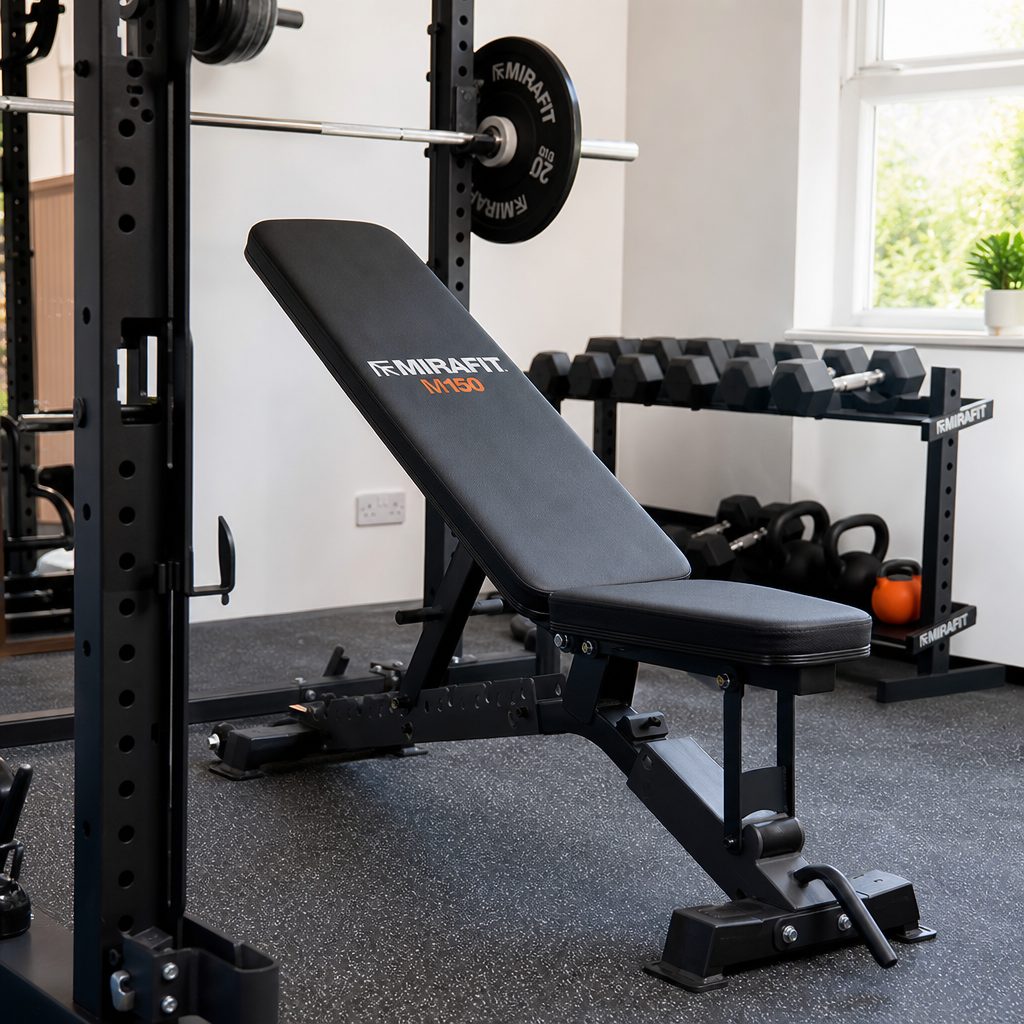
The M150 made the most sense as the all-round bench in a dumbbell-led setup or beside a rack, where flat pressing, incline work and supported accessories all shared the same floor space.
Who should skip the Mirafit M150?
Being positive about a product is more useful when you are equally clear about who should not buy it. The M150 was a good fit for plenty of home gyms, but it was not the automatic answer for every training style.
Skip it if decline is essential. There was no decline setting, and no amount of enthusiasm changes that. If you regularly programme decline presses, decline sit-ups or anything requiring a securely declined body angle, buy a bench designed for the job. Trying to create a decline setup from household objects is the kind of thing that sounds inventive until you are halfway through a set wondering why your choices led here.
Skip it if you need genuinely rapid transitions. The seat adjustment was effective but not quick. If your sessions involved rapid supersets at different angles, or you trained several people in succession who all wanted different settings, a bench with a faster mechanism would be easier to live with.
Skip it if your home gym had almost no permanent floor space. The wheels helped, but the M150 remained a 28kg, 127cm-long bench. It was easy enough to reposition, not easy to hide. A foldable model may make more sense in a one-room flat, even if you accepted some compromises in stability.
Skip it if you were unusually particular about zero movement and premium finishing. A few reports of side-to-side rocking and packaging rust dust were reminders that this was a value-focused product, not a luxury commercial bench. The M150 performed very well where it counted, but it was not pretending to offer the immaculate refinement of equipment costing considerably more.
A sensible buying rule
Buy the M150 if you will mostly leave it flat or use two or three favourite incline settings. Spend more only when you can name the specific feature you need: decline, faster adjustment, greater head support or a specialist barbell-focused design.
Long-term ownership: why simple equipment often wins
There was something reassuring about the M150's lack of gimmicks. In a period when plenty of fitness products had tried to become entertainment systems, the adjustable bench remained gloriously direct. It did not ask to be connected to Wi-Fi. It did not need a subscription to unlock the incline setting. It did not decide that your hardware was obsolete because an app had changed its logo.
Long-term ownership of a bench was mostly about physical durability and consistent use. The M150's heavy frame, firm padding and straightforward adjustment architecture gave it a good foundation. A bench used for regular dumbbell training receives a lot of repetitive pressure, but it is not a complicated machine. Keep the fasteners checked, protect the upholstery from unnecessary abuse and move it using the handle and wheels rather than dragging it sideways across rough flooring.
The generous total-load capacity also helped future-proof it for ordinary progression. Many beginners underestimate how quickly their dumbbell weights can rise once they train consistently. A bench that feels adequate at 10kg per hand but uneasy at 25kg per hand is not a great saving. The M150's demonstrated stability with serious dumbbell loading made it a more sensible long-term purchase.
It also worked well as an anchor item in a gradually expanding gym. Begin with adjustable dumbbells and the bench. Add a rack later if you had the room. Introduce kettlebells, a barbell or a cable attachment as your training developed. The M150 did not become redundant as your setup improved; it became the versatile bench you used for the movements that did not fit neatly into a rack or machine.
This was the understated value of a good bench. It was not exciting in the way a new barbell or cardio machine can be exciting. But it quietly increased the number of exercises you could do well, the loads you could use confidently and the likelihood that you would keep training at home. Those are much better measures of value than a novelty feature you use twice.
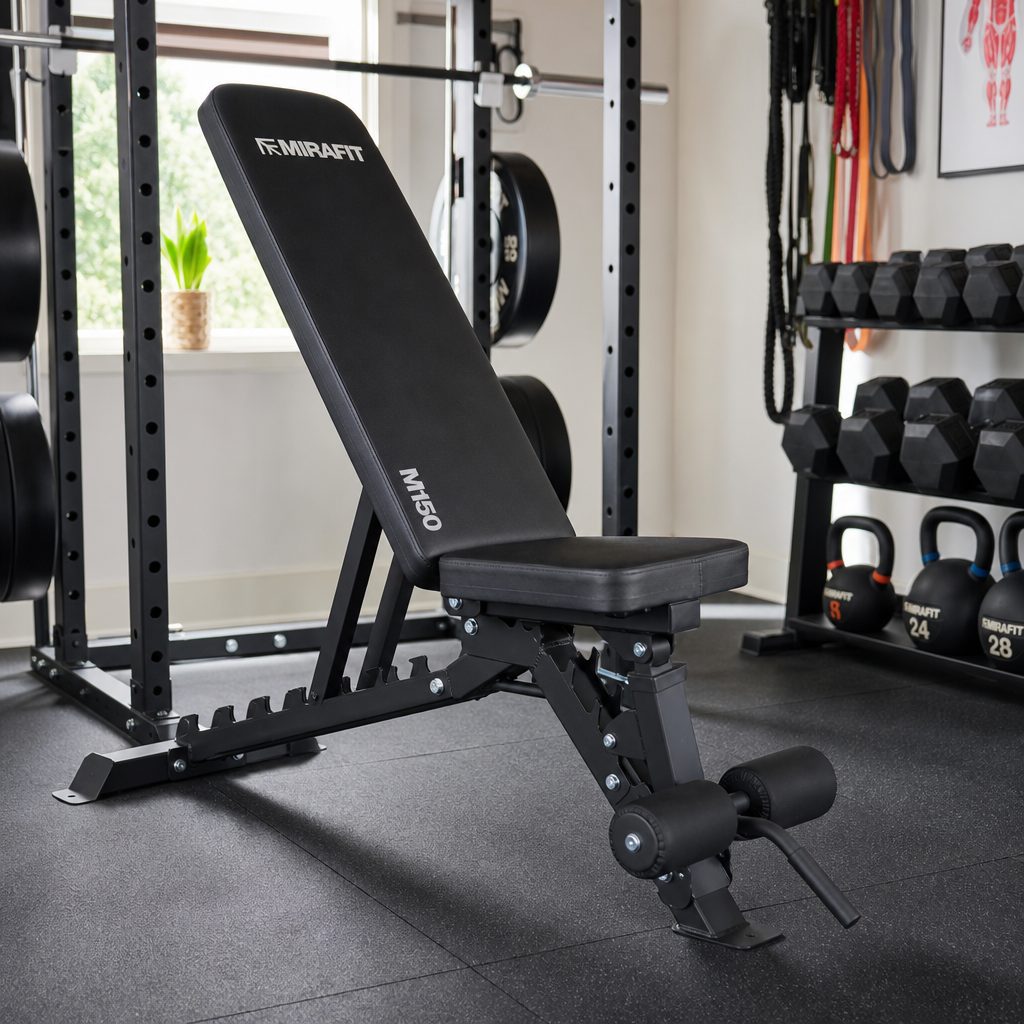
A simple steel bench had no battery or subscription to manage; long-term ownership came down to keeping the upholstery clean, checking hardware and using its sturdy frame as intended.
Frequently asked questions about the Mirafit M150 Adjustable Bench
Yes, for normal serious home use it was a very capable bench. The stated maximum total load was 260kg, including your bodyweight and the weights being lifted. Reports included a 95kg user benching 50kg dumbbells with stable performance, which was a useful real-world indication of how planted the 28kg frame felt.
No. The M150 adjusted from flat through multiple incline positions up to 90 degrees, but it did not have a decline setting. If decline pressing or decline abdominal work was important to your programme, choose a bench designed with flat, incline and decline functionality instead.
The adjustable seat helped keep you securely positioned during incline pressing. Raising it created a better stop point for the hips and reduced the tendency to slide down the bench during a set. That was particularly valuable with dumbbells, where getting into and holding position can be more demanding than with a barbell.
It was effective rather than especially quick. Changing the seat could involve unscrewing the adjustment, lifting the seat, aligning the holes and fastening it again. That was fine if you used a few preferred settings for full blocks of exercises, but less convenient for fast-moving circuits with frequent angle changes.
The bench measured 127cm long and 60cm wide. It was compact enough for many garage gyms, spare rooms and larger sheds, but it was not a folding model designed to vanish after every workout. Its wheels and handle made it straightforward to move around a room.
The 6cm cushion was firm rather than soft, and that was appropriate for a lifting bench. Firm padding gave a more stable surface for pressing because it did not compress excessively under your upper back and shoulders. It was supportive for training rather than sofa-like, which was exactly the point.
You needed 14mm, 17mm and 19mm spanners, plus an adjustable spanner. The tools were not included. Assembly generally took around 30 to 60 minutes, and the instructions and labelled parts were regarded as clear enough for a straightforward home build.
It worked for many tall lifters, but those around 6ft 3in may not receive full head support with the backrest fully upright. If head support at a 90-degree angle was important for your shoulder pressing setup, that was worth considering before buying.
Final verdict: one of the most sensible benches for a UK home gym
The Mirafit M150 Adjustable Bench was not the cheapest bench available, nor the most feature-packed. It did not decline, the seat setting was a little fiddly, and it asked you to provide your own spanners. Those were fair compromises, not hidden flaws.
What you received was a 28kg adjustable bench with 7cm by 5cm steel tubing, a 260kg maximum total load, six backrest positions, four seat positions, firm 6cm padding and useful transport wheels. More importantly, it behaved like a proper training bench when loaded. For flat pressing, incline dumbbell work, shoulder training, chest-supported rows, reverse flyes and hip thrusts, it offered the stability and versatility that many home gym owners actually needed.
At roughly £150 in July 2026, the M150 remained an excellent budget all-rounder for lifters who wanted quality without paying premium-bench money. If you wanted decline functionality, ultrafast adjustments or a folding design, look elsewhere. If you wanted a dependable bench that let you train hard in a small British garage, spare room or shed, the M150 was very easy to recommend.