
Rubber tiles vs foam mats: which garage gym flooring suits your setup?
Rubber tiles and EVA foam mats were both easy DIY routes to a more usable garage gym, but they served very different training lives. Rubber was the long-haul, weight-room choice; foam was the softer, friendlier option for bodyweight work and lighter equipment. The right answer depended less on what looked nicest in the product photos and much more on what actually happened in your garage.
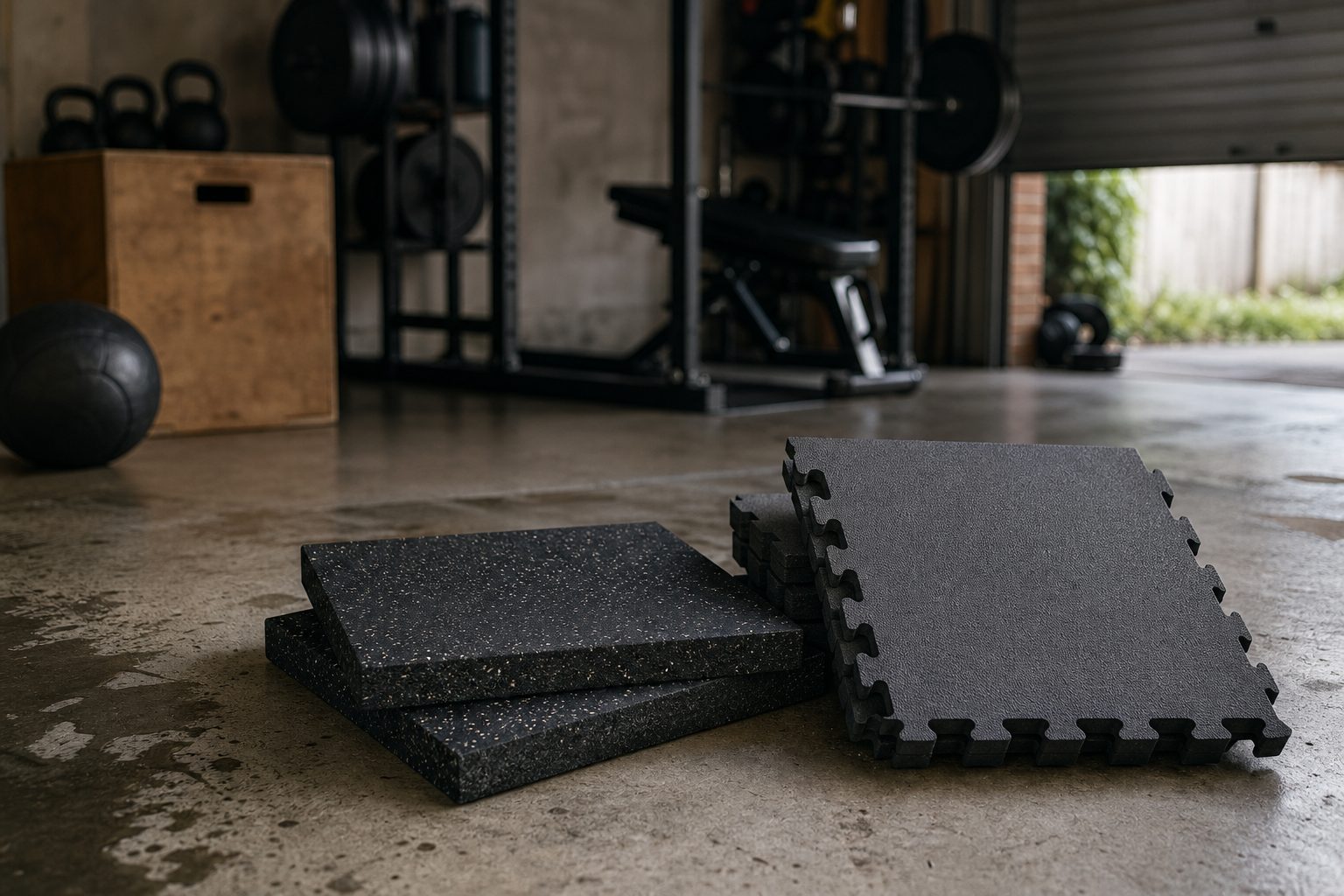
A garage gym floor has to deal with far more than workouts: weight, heat, damp, dirty shoes and the occasional argument with a rogue dumbbell all come with the territory.
 By James Oduya · Staff Writer & Home Gym Columnist · Updated August 14, 2026
1. The short answer: choose for the workout you actually do
Garage gym flooring was one of those purchases that seemed wonderfully straightforward until you started looking. They were tiles. They interlocked. They covered concrete. How complicated could it be?
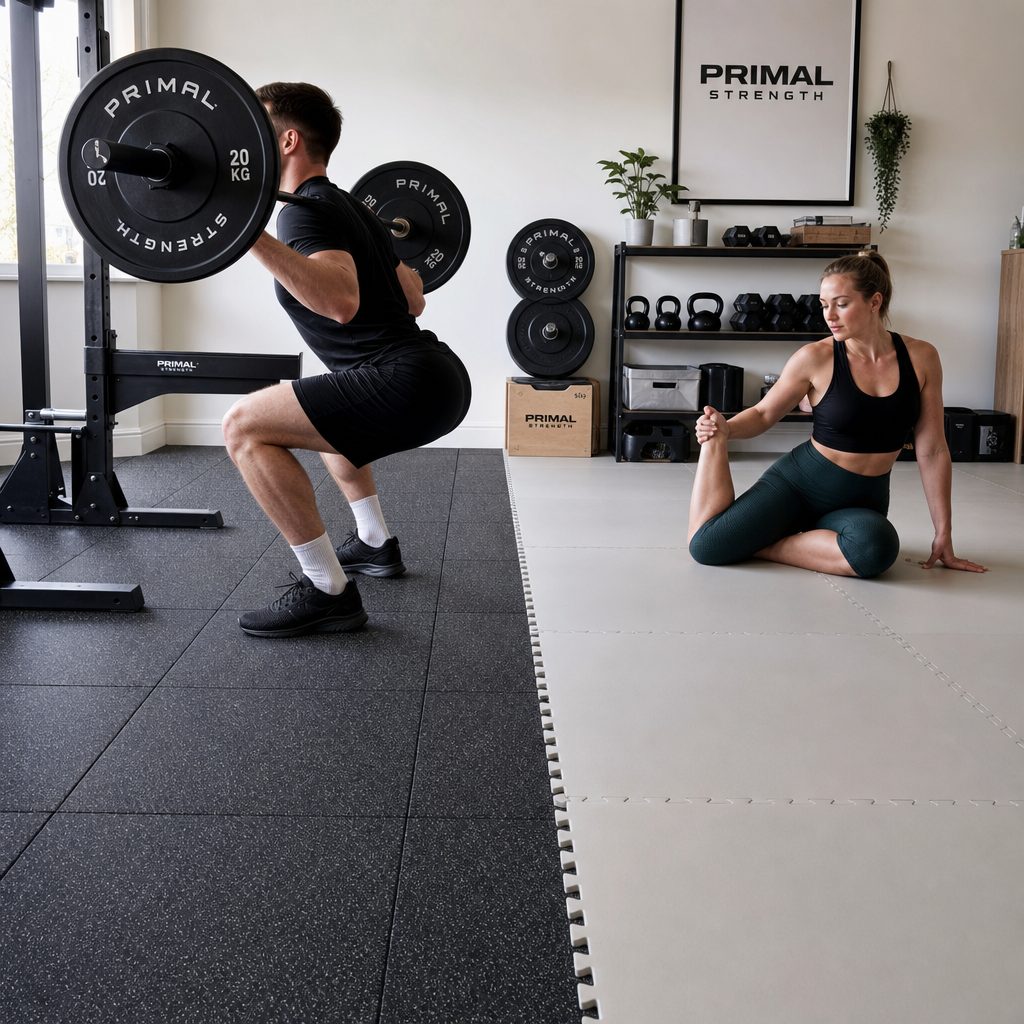
The best garage gym floor is not necessarily one uniform surface. A durable rubber lifting zone alongside a cushioned foam mobility area can make a shared space work much harder.
Quite complicated, as it turned out. Not in an intimidating technical way, thankfully, but in a practical one. A soft floor that felt lovely for stretching could be a terrible place to park a heavy rack. A dense floor that shrugged off repeated impacts could feel rather unforgiving for floor mobility. And a cheap-looking foam pack might not actually be cheaper once you had replaced it after a busy year or two.
For most garage gyms with barbells, dumbbells, kettlebells, a squat rack or any intention of dropping weight, rubber tiles made more sense. They were dense, heavy, resilient and designed to tolerate repeated impact. Depending on thickness, rubber gym flooring commonly lasted around seven to 15 years or longer. That was the big reason it remained the default recommendation for serious lifting spaces. It did not need to be glamorous. It simply needed to stay put and keep doing its job.
Foam mats had a different, entirely legitimate appeal. Closed-cell EVA foam tiles were lightweight, waterproof, insulating and notably more cushioned underfoot. They suited yoga, calisthenics, mobility sessions, light dumbbell training, children sharing the space and anyone who wanted a warmer, more forgiving surface over bare concrete. If your gym was mostly a place to move, rather than a place to load a barbell heavily, foam could make it feel much nicer.
The trap was assuming that "gym flooring" meant every gym activity. It did not. A foam tile under a skipping rope session and a foam tile under a loaded exercise machine lived very different lives. The latter tended to compress, mark and wear far sooner. Rubber did not offer the same plush feel, but it was much more comfortable with machinery, concentrated load and the sort of training where things occasionally landed harder than intended. We have all had a final rep that was supposedly controlled. The floor often knew better.
My blunt starting point is this: buy rubber if the garage is a lifting gym first and a general exercise room second. Buy foam if the garage is a movement space first and you are not asking the floor to manage heavy, regularly loaded equipment. If your use was genuinely mixed, rubber in the equipment zone and foam in a separate mobility area was often the most sensible compromise. It was not overthinking. It was simply refusing to make one material do a job it was not built for.
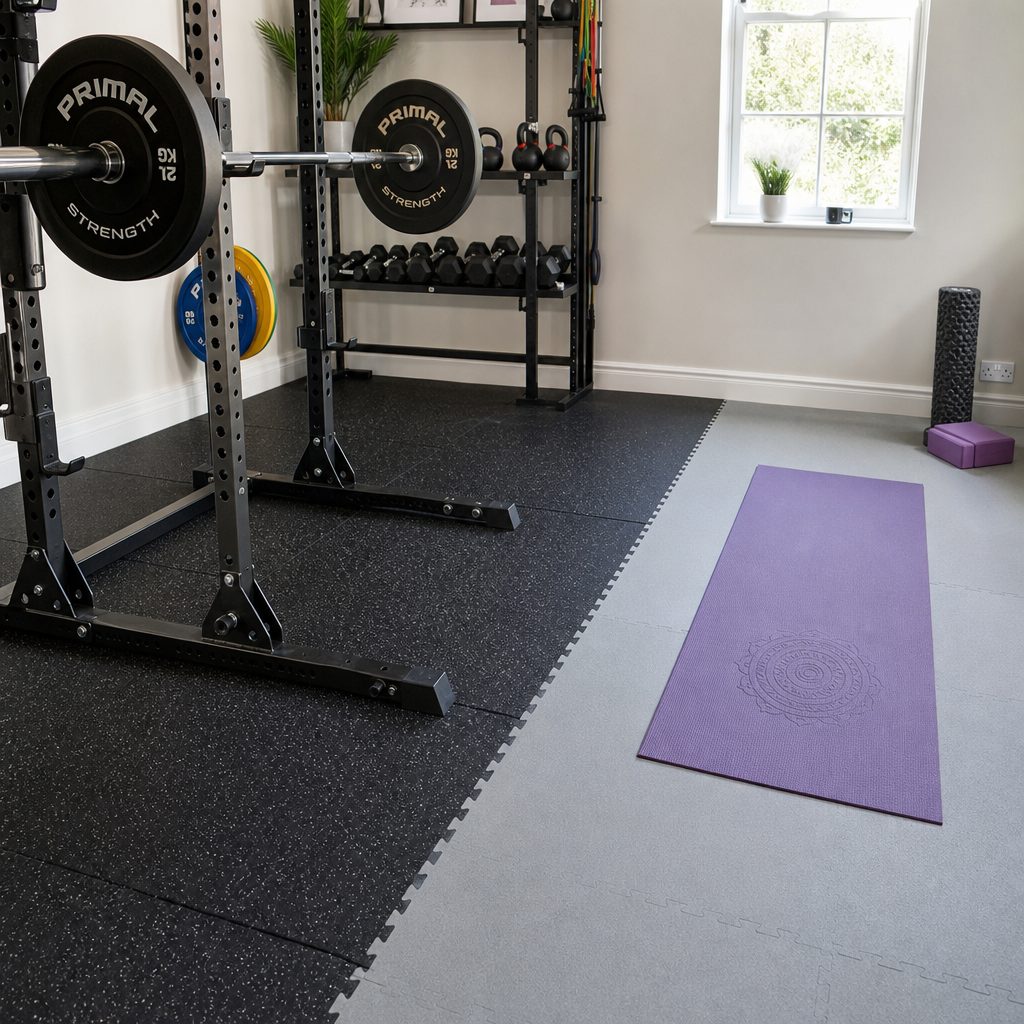
Interlocking flooring makes a garage conversion manageable as a weekend project, but the material beneath your rack and lifting area deserves more thought than the material beneath a yoga mat.
2. Rubber tiles vs EVA foam mats: the numbers that matter
There was no single universal rubber tile or foam mat, so product specifications varied. Still, the common sizes and thicknesses told a clear story. Rubber tiles were offered in 1/4in, 8mm, 3/8in, 1/2in and 3/4in formats. Interlocking tile sizes included 28.5in x 28.5in, 30in x 30in and 48in x 48in, with 2ft x 2ft tiles also very common. You could also find 4ft x 6ft interlocking rubber mats.
Foam tiles were usually much simpler: 24in x 24in or 2ft x 2ft interlocking pieces, commonly in 1/2in or 3/4in thicknesses, with some ranges offered in 3/8in and 1in formats. A 2ft x 2ft tile covered four square feet, which made planning a rectangular floor reassuringly painless. Count your usable area, add a few spare tiles if the range allowed it, and you were most of the way there.
Weight was one of the less glamorous specifications, but it mattered in a garage. Rubber was not merely denser in theory. At 1/4in thick it weighed around 1.6lb per square foot; 8mm rubber was around 2.2lb per square foot; 3/8in was around 2.35lb; 1/2in was around 3lb; and 3/4in was around 4lb per square foot. That bulk helped tiles lie flat and resist shifting, but it also meant a large rubber project was a proper delivery and handling job rather than something you casually carried upstairs after work.
Foam was light enough for one person to move around easily. That was excellent when you wanted a temporary training corner, needed to access storage, or rented a property and wanted to remove the floor later. It also explained a key difference in day-to-day feel: foam had more give, whilst rubber had more mass and stability.
| Specification | Rubber tiles and mats | EVA foam mats | Why it matters in a garage |
|---|---|---|---|
| Typical thickness range | 1/4in to 3/4in | Typically 1/2in to 3/4in | Thickness changes protection, stability and how much the floor compresses. |
| Common modular size | 2ft x 2ft; larger formats also available | 24in x 24in / 2ft x 2ft | Small tiles are easier to fit around awkward garage edges and equipment. |
| Weight at 1/4in | 1.6lb per sq ft | Lightweight, easily handled by one person | Heavier flooring tends to feel more planted; lighter flooring is easier to move. |
| Weight at 3/8in | 2.35lb per sq ft | Lightweight, easily handled by one person | Rubber's density is part of its advantage under equipment and impact. |
| Weight at 3/4in | 4lb per sq ft | Lightweight, easily handled by one person | The thickest rubber options demand more effort to position, but are exceptionally substantial. |
| Expected lifespan | 7 to 15+ years, depending on density, thickness and use | 1 to 3 years with light use; less under heavy machines or frequent lifting | This is often more important than the initial basket total. |
| Water resistance | Waterproof | Closed-cell foam is waterproof | Both cope well with a garage that sees wet shoes, condensation or cleaning. |
| Heat and sun | More UV-resistant and better in hot garages | Can become brittle after prolonged sun exposure | Sun through an open door or window is not a trivial detail. |
Numbers alone could not choose the floor for you, but they did prevent a few bad assumptions. Foam could be thicker than a basic rubber tile and still be the less appropriate option for lifting because softness was not the same thing as load tolerance. Likewise, thinner rubber was not automatically useless. A 1/4in or 8mm rubber surface could make sense for general gym coverage, whereas thicker 1/2in and 3/4in options moved toward more demanding weight-training duties.
Thickness should be matched to the activity, not chosen as a blanket badge of quality. A thicker floor was not automatically better if it made a machine less stable, raised a door clearance issue or spent its life supporting only bodyweight sessions.
3. Installation, layout and the reality of a garage floor
Both materials earned their popularity because they were practical DIY flooring. Interlocking edges meant no adhesive was required for a basic loose-lay installation. You could fit the tiles together, rearrange them later and replace a damaged piece without turning the project into a small construction site. This was a major advantage for garage gyms, where the layout often changed after a few months of actual training. The exercise bike moved. The rack grew attachments. The once-neat storage plan became optimistic fiction.
Rubber tiles fitted securely together and had enough weight to feel settled once installed. That did not mean the installation was physically effortless. Thick rubber was heavy. A 3/4in rubber surface at around 4lb per square foot added up quickly across a full garage. The upside was that this mass was useful once the floor was down: it contributed to a solid, grounded feel beneath a rack, bench or lifting station.
Foam made the opposite argument. It was very light, simple to carry and straightforward to cut into a small or oddly shaped training zone. If you only needed a 2m x 2m bodyweight square, or if the gym shared space with bikes, bins and the family car, that convenience was compelling. You could lay it before a session and stack it away when needed. Rubber could be rearranged too, but nobody would describe moving a large area of dense flooring as the fun part of Sunday.
The modular nature of both materials was valuable around garage quirks. Most garages had them: an up-and-over door threshold, walls that were not quite square, a boiler cupboard, shelving legs or a drain. Smaller tiles created more seams but also gave you more control. Larger tiles reduced joins and sped up coverage in an open rectangle. Neither approach was universally better. It depended on whether your room resembled a clean architectural drawing or the sort of garage that had accumulated three decades of useful things.
Interlocking edges keep the project accessible
Both rubber and foam systems could be installed without adhesive. That made them suitable for homeowners, renters and anyone who preferred a reversible gym upgrade.
Rubber brings weight and stability
Dense rubber tiles were more work to carry into place, but that heft helped them sit securely in a permanent equipment area.
Foam suits flexible, temporary zones
Lightweight EVA tiles were easy for one person to lift, move and store, which was useful in a multi-purpose garage.
Tile size changes the fitting experience
2ft x 2ft and 24in x 24in tiles were common in both categories. Larger rubber formats reduced the number of joins across an open space.
Before buying anything, I would map the room according to function rather than simply covering every inch of concrete. Mark where you would stand to squat, where the bench would travel, where a machine would sit, where you would stretch and where you needed to walk. If the rack and lifting platform occupied one side whilst the other side was clear for warm-ups, there was no rule saying both had to receive the same flooring.
This zone-first approach often saved money and improved the result. Rubber could go beneath the loaded equipment and active lifting area. Foam could cover a separate mobility, yoga or bodyweight zone. The threshold between them might not win an interior-design award, but garage gyms were working rooms. A sensible floor plan beat a perfectly uniform one every time.
Pro tip: start with your heaviest, least movable item
Plan flooring from the squat rack, lifting station or heavy machine outward. Those items dictate the material choice far more than an open area used for warm-ups. It is much easier to add a foam stretching square later than it is to replace compressed foam under a machine.
4. Weight training, dropped kit and impact protection
This was the category that separated the two materials most clearly. Rubber flooring was made from natural rubber, synthetic SBR rubber or recycled rubber materials such as tyres. Its vulcanised construction cross-linked rubber molecules for strength and resilience. The jargon was not especially romantic, but the result was useful: dense rubber could withstand repeated impact from dropped weights in a way foam simply was not intended to match.
For a garage gym used for barbell work, dumbbells, kettlebells, CrossFit-style sessions or regular heavy lifting, rubber had the stronger case. It was built to take a beating. That did not mean it made every dropped weight harmless to every subfloor, and it did not absolve anyone from sensible lifting practice. It did mean the flooring itself was much better placed to absorb the repeated stresses of weight training than a soft EVA tile.
Foam also absorbed shock extremely well, but in a different sense. It was pleasant under jumping, spinning and fast bodyweight movement because it compressed softly and gave the joints a more forgiving landing surface. For an aerobics-style session, a conditioning circuit or a jump-heavy workout without heavy external loads, that could feel excellent. The difference was that foam's softness became a liability when a barbell, dumbbell or machine leg concentrated force in one small area.
Repeated loading was the issue. Foam could compress under heavy machines and frequent lifting, and its expected lifespan fell below the one-to-three-year light-use range in that scenario. Rubber was not immune to wear, but its seven-to-15-plus-year life expectancy gave it a different ownership profile altogether. You paid for density and durability because density and durability were what the task demanded.
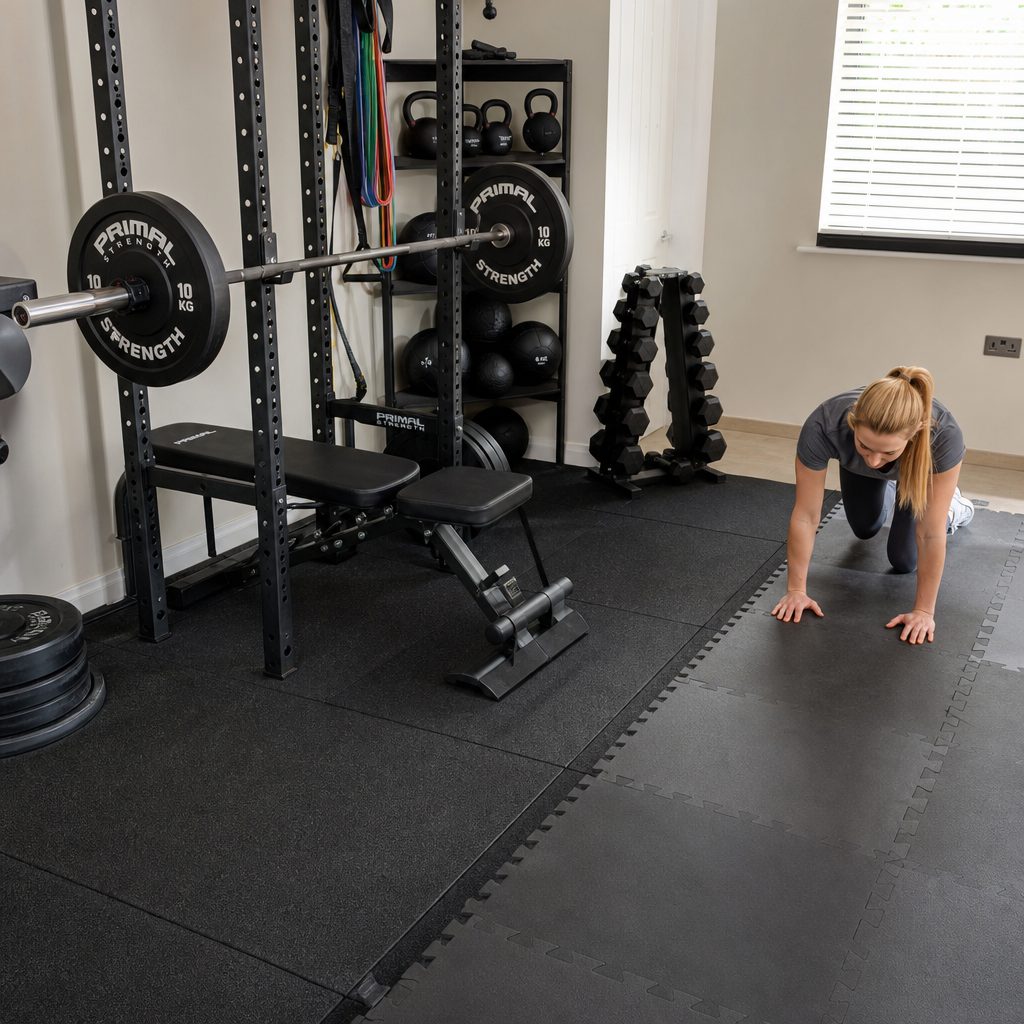
A dedicated lifting area benefits from dense rubber beneath the barbell, rack and bench. Soft foam is more at home where the work involves moving your body rather than repeatedly loading the floor.
It is worth pausing on that last point, because it caught people out. A 1in foam tile sounded deeply protective. It was certainly soft. But the ability to cushion a knee during a floor exercise was not the same as the ability to manage a loaded rack or the repeated impact of dropped iron. Material density mattered alongside thickness. A tall sponge was still a sponge when you put a wardrobe on it.
If you lifted with fixed dumbbells but never dropped them, the decision was less absolute. Light dumbbell work, controlled kettlebell movements and carefully managed resistance training could coexist with foam, especially in a low-traffic, light-use space. Yet anyone setting up a gym for future progression should think ahead. Training plans changed. A set of modest dumbbells often became a barbell, a bench, a rack and a fairly determined desire to pull something heavier off the floor.
Rubber for lifting: strengths
- Dense construction was designed to withstand repeated impacts from dropped weights.
- Suitable for rack, bench, barbell and heavy dumbbell areas.
- Available through 3/4in thickness for more demanding garage gym use.
- Longer expected lifespan of seven to 15 years or more.
- Heavy tiles tended to feel stable and settled beneath equipment.
Foam for lifting: limitations
- Heavy machines and frequent lifting could compress the material.
- Softness could reduce stability under a loaded bench or rack.
- It wore faster when used outside its light-duty comfort zone.
- It was not the sensible default for regularly dropped weights.
- Replacing a whole floor early erased some of the attraction of a low initial outlay.
There was a middle ground, of course. Some people used foam in the open area and created a compact rubber lifting island. That was a genuinely sensible setup for a garage that hosted both family exercise and serious training. Just make the rubber zone big enough. A lifting surface should account for where the bar landed, where plates rolled, where you stepped back to brace, and where you set a dumbbell down after the sort of final set that leaves you briefly reconsidering every decision that led you there.
5. Comfort, mobility work and everyday movement
Foam's best case was very good indeed. EVA was closed-cell foam, waterproof, insulating, mould and mildew resistant, latex-free, allergen-free and described as non-toxic and kid-safe. More importantly in actual use, it was comfortable. If you spent time doing yoga, Pilates, mobility, stretching, core training, floor drills or bodyweight conditioning, foam took the hard edge off a cold concrete garage.
That insulation was particularly welcome in a British garage. Concrete had a remarkable ability to feel unpleasantly cold, even when the air temperature seemed reasonable. Foam created a more hospitable layer between you and that slab. Knee work, hip mobility, burpees, sit-ups and floor-based strength sessions all became less austere. You did not have to turn every plank into an argument with your elbows.
Rubber offered cushioning too, but it felt firmer and more stable. That was a virtue for lifting and standing work. It was also perfectly usable for bodyweight training. Plenty of people completed mobility work on rubber every day without drama. But if the aim was maximum comfort for long sessions close to the floor, foam won. It was the softer option by design.
Foam could also work nicely for activities involving quick movement. It absorbed shock very effectively and had sufficient firmness for jumping and spinning. The balance was important. It was not so soft that every movement felt boggy, but it had noticeably more give than rubber. For a home workout corner where trainers rarely saw more than bodyweight, bands and a few light accessories, that could be exactly what you wanted.
There was one caveat: comfort and stability sometimes pulled in opposite directions. A very cushioned floor could feel lovely during a cooldown but less reassuring during a loaded standing press. If your training blended a lot of floor work with a little light strength training, foam was still viable. If it blended a lot of heavy standing strength work with a little stretching, rubber remained the more sensible base, with an exercise mat added for kneeling movements.
Foam was the kinder option for floor sessions
EVA's extra cushion made it the stronger choice for mobility, yoga, stretching, core work and bodyweight training carried out close to the floor.
Foam handled dynamic bodyweight movement well
Its shock absorption and workable firmness suited jumping and spinning when heavy loads were not part of the routine.
Rubber felt more planted underfoot
Dense rubber was the steadier choice for loaded movement, standing work and equipment-based training.
Foam added useful insulation over concrete
That extra separation from a cold garage slab was a real quality-of-life benefit, especially for longer mobility sessions.
If several people used the space, foam became more attractive. It was friendly for children, easy to move, and more forgiving for a beginner who might be doing a mixture of exercise videos, light dumbbells and stretches. That did not make it the "less serious" material. It simply made it the material for a different sort of gym. A garage gym did not have to become a blacked-out powerlifting cave to count as a proper training space. Sometimes the best floor was the one that encouraged people to use it.
6. Heavy machines, racks and long-term durability
The durability conversation became much clearer once heavy equipment entered the room. A squat rack, power rack, bench, cable station, cardio machine or loaded storage unit did not merely occupy floor space. It concentrated force at feet, legs and contact points, often for years. That asked a lot from interlocking flooring.
Rubber was better prepared for it. The material was dense and heavy, and thicker rubber options reached 3/4in. Depending on thickness, density and use, rubber flooring commonly lasted seven to 15 years or more. That did not mean every rubber tile automatically performed identically, but it did mean rubber had a realistic long-term case for permanent garage gym infrastructure.
Foam was not generally the material I would choose beneath heavy machines. The research was quite direct here: EVA foam could last one to three years with light use, and less if it sat under heavy machines or was used for frequent lifting. A stationary machine might not look destructive, but static compression could be relentless. A rack did not need to move around to leave its mark.
This was where spending a little more on the right material could become cheaper over time. It was tempting to compare only the initial square-metre price. But a lower upfront cost was not a bargain if you needed to remove and replace the floor because tiles had compressed or deteriorated under the very equipment the gym was built around. Flooring was not exciting kit. Nobody posted a triumphant progress photo beside a fresh edge piece. Yet it was supporting every single session.
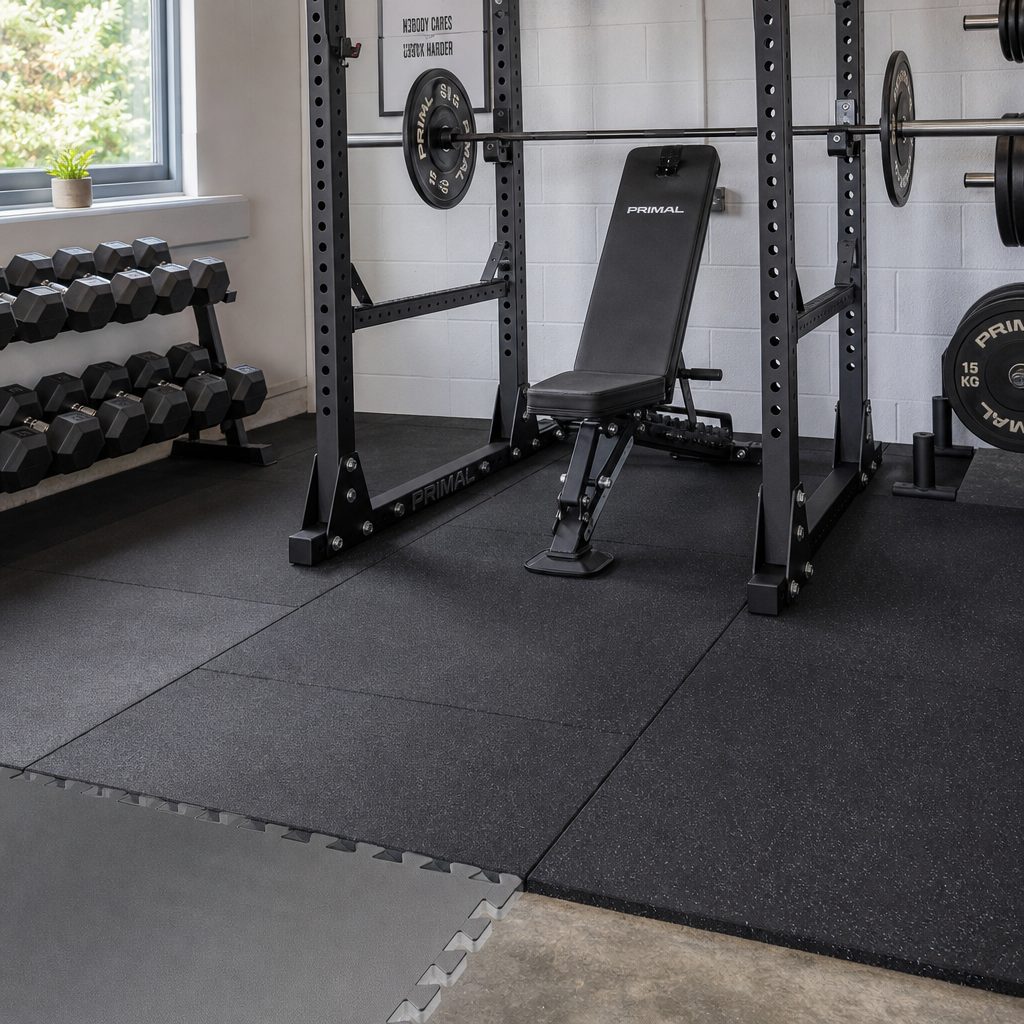
Dense rubber is the calmer long-term choice beneath fixed equipment. Once a rack, bench or machine has a permanent home, the floor beneath it stops being a temporary exercise surface.
Think about the gym's likely future, not just its first month. A garage set up today for resistance bands and a spin bike might still remain foam-friendly. But if the plan was to add a rack, heavier dumbbells, a barbell or a more substantial machine, rubber was usually worth laying from the beginning in the relevant zone. Lifting equipment rarely became lighter as a hobby developed.
Rubber also carried the practical advantage of replaceable modular pieces. If a particular tile became damaged, the interlocking design meant you could replace or rearrange it without lifting an entire glued-down floor. Foam offered the same modular convenience, but rubber's longer lifespan made that repairability more meaningful for a long-term installation.
Buy for the gym you expect to own next year
If a heavy rack or machine was even a likely future purchase, reserve rubber for that footprint now. Foam was excellent for light work, but it was not a cost-effective foundation for an equipment plan that had already outgrown it in your head.
7. Water, damp, heat and sunlight in a British garage
A garage was not a spare bedroom with worse lighting. It was an outbuilding. It might have condensation, wet trainers, muddy shoes, a slightly leaky door, a cold slab, hot days when the door stood open, and a patch of direct sun that behaved as though it had a personal grievance against your belongings. Flooring needed to be selected with that in mind.
The good news was that both material categories coped well with moisture. Vulcanised rubber was waterproof, making it useful in garages prone to leaks or flooding and convenient if you wanted to wash the surface down. Closed-cell EVA foam was also waterproof, and its closed-cell composition gave it resistance to mould and mildew. For normal garage dampness, sweat, water bottles and shoes that came in from the rain, neither material should be dismissed.
Rubber had the stronger case in heat and sunlight. It was more UV-resistant and tolerated hot garages better. Foam could become brittle after prolonged sun exposure. If a large part of your floor sat in strong sunlight day after day, or if the open garage door left the same area exposed for long periods, that was a meaningful reason to lean toward rubber.
It is easy to overlook this because garage flooring is normally bought to protect the concrete. But the flooring itself also needed protection from its environment. Foam in a fully enclosed, shaded, low-impact garage could give years of comfortable use. Foam beside a sunny open doorway whilst supporting frequent movement and equipment was a much less happy prospect.
| Garage condition | Rubber tiles and mats | EVA foam mats | Better match |
|---|---|---|---|
| Wet shoes, sweat and routine cleaning | Waterproof and suitable for washing down | Closed-cell, waterproof construction | Either material |
| Garage prone to leaks or flooding | Waterproof vulcanised rubber suited to the job | Waterproof, but best kept for lighter-duty use | Rubber for a lifting gym |
| Long, regular direct sun exposure | More UV-resistant | May become brittle with prolonged exposure | Rubber |
| Cold concrete beneath floor exercises | Firm surface over the slab | Insulating and more cushioned | Foam |
| Warm, busy garage with heavy equipment | Better hot-garage tolerance | Less suited to heat plus concentrated loads | Rubber |
Cleaning was therefore less about one material being fragile and more about treating the floor sensibly. Both were waterproof, which made a garage far easier to maintain than an uncovered concrete slab that seemed to absorb every spill and hold onto dust. Rubber could be hosed off and washed. Foam tiles could be wiped down and lifted if needed. In either case, keeping grit off the surface was sensible: grit was unpleasant underfoot, worked into seams, and had a talent for appearing precisely when you were doing a floor exercise.
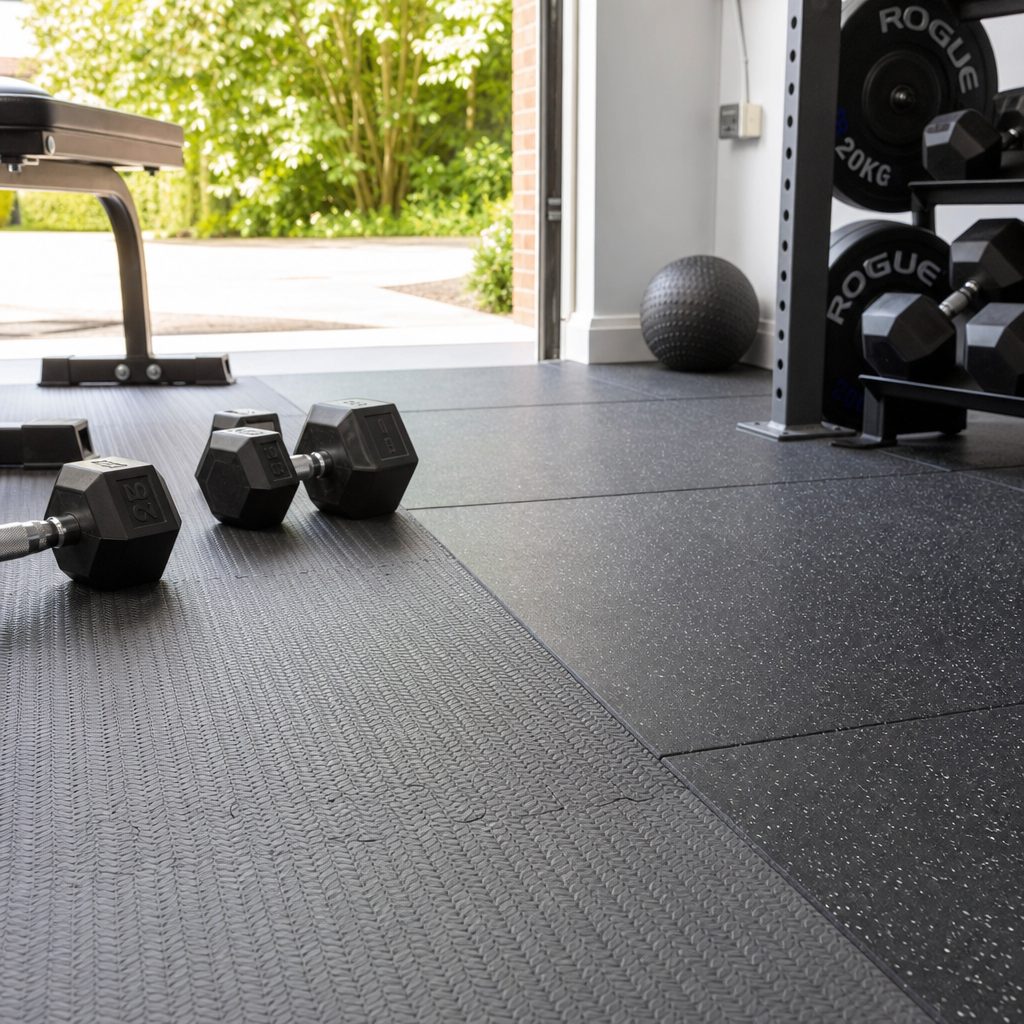
Both closed-cell foam and vulcanised rubber resist water, but rubber has the edge in a hot or sun-exposed garage where prolonged UV exposure can be harder on EVA.
8. Thickness, noise and choosing the right floor zone
Thickness choices could look bewildering at first, especially in rubber. The range stretched from 1/4in through 8mm, 3/8in, 1/2in and 3/4in. The easiest way to approach it was not to hunt for a magic number, but to decide what the area needed to tolerate.
A lighter-use gym zone did not automatically need the thickest floor available. General exercise, controlled dumbbell use and equipment that remained stable could make good use of thinner rubber. The attraction was obvious: you received rubber's density, durability and water resistance without committing to the weight and cost of the thickest tile. At 1/4in, rubber weighed around 1.6lb per square foot. At 8mm it rose to around 2.2lb per square foot, and at 3/8in to around 2.35lb per square foot.
For lifting areas with more impact, thicker rubber became more compelling. A 1/2in rubber tile weighed around 3lb per square foot, and 3/4in rubber reached around 4lb per square foot. Again, that weight was a feature, not merely an inconvenience. It reflected a denser, more substantial surface intended for demanding spaces.
Foam's common 1/2in and 3/4in thicknesses made it naturally appealing for comfort zones. Some foam tiles reached 1in, and it was hard not to be drawn to that generous cushioning if you did lots of floor work. Just do not use the thickness figure in isolation. A thick foam tile could be a superb yoga, play or calisthenics surface, whilst a thinner rubber tile could be the better piece of lifting infrastructure.
Noise was another reason people considered flooring. Rubber's resilience helped manage the impact of weights landing on the surface, and foam absorbed shock well during jumping and movement. Neither one turned a garage into a silent room, and it would be unrealistic to expect flooring alone to do that. But both were a far more considerate proposition than bare concrete, particularly when your training involved repeated foot strikes or equipment being set down.
For a mixed-use room, zoned flooring remained the answer I came back to most often. Put rubber where the force was: beneath racks, benches, weights and fixed equipment. Put foam where softness was useful: mobility work, floor exercises, children's activity or a clear space used for bodyweight training. This avoided the all-or-nothing decision and allowed each material to do its best work.
You could also make the zones visually obvious. Even if the tiles were not identical in texture, that could be helpful. It gave the garage a natural training layout: this is where you lift; this is where you warm up; this is where you stretch. A small visual cue did more than you might expect when you were trying to train efficiently before work and not spend ten minutes moving equipment around.
9. Price comparison: what rubber and foam cost in the UK and US
Flooring prices varied sharply by thickness, density and intended use, so comparing like for like mattered. In the UK, gym flooring broadly sat between £9.99 and £45 per square metre depending on material and thickness. Standard 20mm rubber interlocking tiles, a popular home-gym format, were typically priced at £14.99 to £18 per square metre. EVA foam gym tiles in 15mm to 20mm thickness were typically £6.99 to £10 per square metre.
That made foam the lower-cost route in many standard UK comparisons, especially for a light-duty training area. Rubber rolls in 4mm to 6mm could be £4.50 to £8 per square metre, whilst 15mm rubber interlocking tiles were around £9.99 to £12 per square metre. As rubber became thicker and more heavy-duty, the price increased: 30mm interlocking rubber tiles were around £22.99 to £32 per square metre, while commercial heavy-duty rubber tiles at 30mm and above reached roughly £28 to £45 per square metre.
A typical 20m² home gym was quoted at around £160 to £440 for rubber tiles, while quality 20mm rubber tiles for a 20m² gym could run roughly £400 to £800. Those figures did not contradict each other so much as show the breadth of the category. Rubber was not one uniform product. Thickness, density and quality changed the bill significantly.
UK rubber rolls
Typical 4mm to 6mm rubber roll pricing.
UK EVA foam tiles
Typical 15mm to 20mm foam tile pricing.
UK 15mm rubber tiles
Interlocking rubber tile range.
UK 20mm rubber tiles
Popular standard home-gym thickness.
UK 30mm rubber tiles
Heavier-duty interlocking rubber.
Commercial rubber, 30mm+
Heavy-duty commercial category.
In the US, representative rubber tiles for home or garage gyms generally sat around $3 per square foot. Specific examples included 9.5mm Fit-Lock Rubber Tiles from $2.44 per square foot, 8mm Sport Rubber Tiles from $2.51 per square foot, and 18in x 18in, 8mm rubber gym tiles at $2.93 per square foot. At the more premium end, 37in x 37in x 12mm Domination Rubber Gym Flooring interlocking tiles were roughly $175 per tile, or around $18 per square foot.
Foam was not always the cheap option in US examples. Premium 5/8in foam tiles started from $2.69 per square foot. A 24in x 24in x 0.5in EVA interlocking mat was listed at $5.37 per square foot, and a 24in x 24in x 0.75in EVA mat at $7.92 per square foot. That was a useful reminder not to assume material type alone determined value. Premium foam could cost more than entry-level rubber, while thick commercial rubber could cost dramatically more than either.
| Representative pricing | Material and format | Price | What it suggests |
|---|---|---|---|
| UK | EVA foam gym tiles, 15mm–20mm | £6.99–£10/m² | An accessible route for light-duty, cushioned coverage. |
| UK | Rubber interlocking tiles, 15mm | £9.99–£12/m² | A modest step up for a more durable rubber surface. |
| UK | Rubber interlocking tiles, 20mm | £14.99–£18/m² | A common home-gym rubber thickness and price band. |
| UK | Rubber interlocking tiles, 30mm | £22.99–£32/m² | More substantial protection for serious training zones. |
| USA | Fit-Lock rubber tiles, 9.5mm | From $2.44/sq ft | Rubber could begin close to budget foam pricing. |
| USA | Premium foam tiles, 5/8in | From $2.69/sq ft | Foam was not automatically the least costly option. |
| USA | EVA foam tiles, 24in x 24in x 0.75in | $7.92/sq ft | Thicker foam could command a substantial premium. |
The more useful value calculation was cost per year of appropriate service. Foam at a lower price could be superb value for a bodyweight zone used lightly for one to three years. Rubber at a higher price could be better value beneath a lifting setup if it continued performing for seven to 15 years or more. Neither material won that argument universally. The poor-value option was simply the one used for the wrong workload.
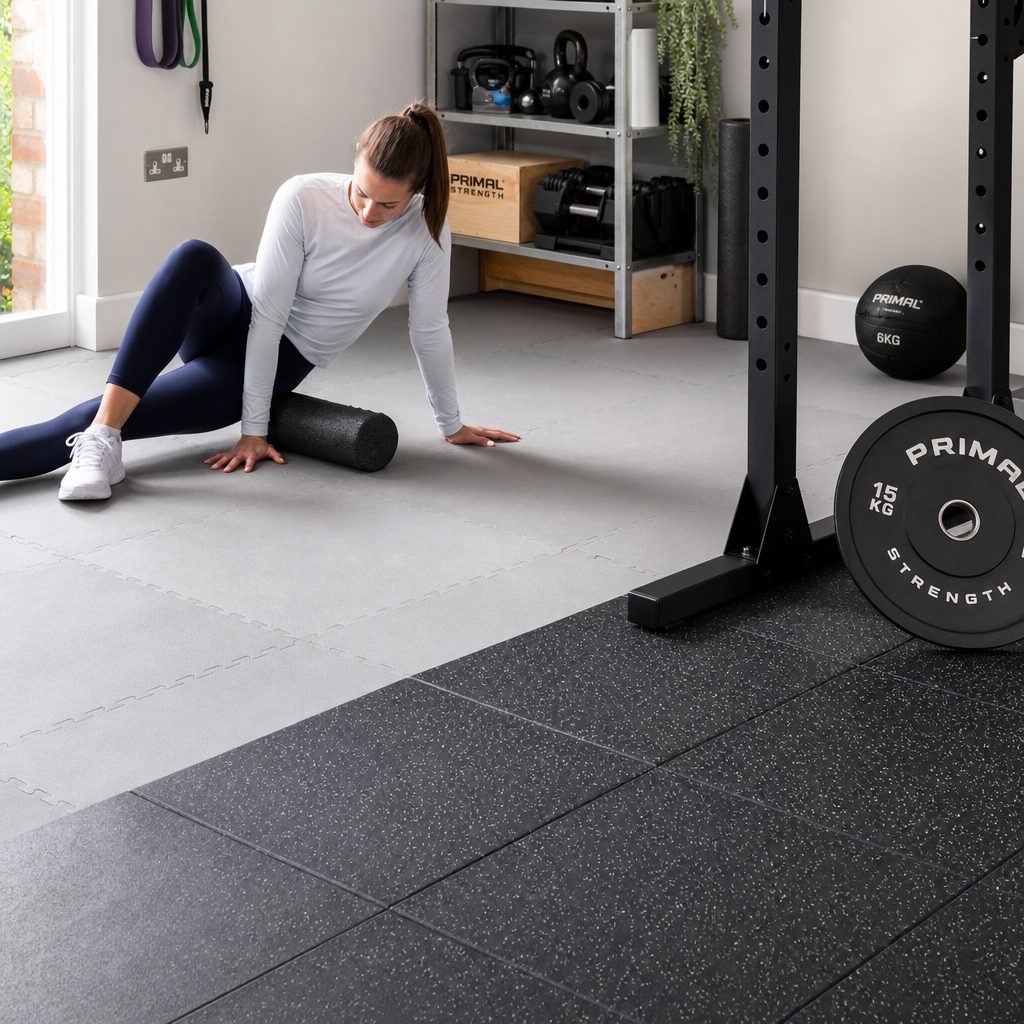
Cost should be judged alongside lifespan and workload. A lower-cost foam floor can be excellent value for mobility work, while durable rubber makes more sense when equipment and weights are part of the plan.
10. Best rubber tiles or foam mats for different garage gym buyers
There was no one absolute winner, because "garage gym" covered everything from a yoga mat beside a rowing machine to a fully loaded lifting room. The best choice changed with the person, the equipment and the garage itself. These were the clearest buying calls.
Best on a tight UK budget: EVA foam tiles
At roughly £6.99 to £10 per square metre for 15mm to 20mm tiles, foam was the natural value pick for light-duty workouts, mobility and bodyweight exercise.
Best all-round lifting choice: 20mm rubber tiles
Standard 20mm rubber tiles at around £14.99 to £18 per square metre balanced modular installation with the durability expected in a serious home gym.
Best for heavy equipment: thick rubber tiles
For racks, frequent lifting and demanding impact, thicker rubber through 3/4in was the more appropriate flooring category.
Best for mobility and calisthenics: EVA foam
Foam's cushion, insulation and suitability for jumping and spinning made it the happier choice for bodyweight-focused training.
Best for a sunny garage: rubber
Rubber's stronger UV resistance and hot-garage tolerance gave it the edge where direct sun was a regular fact of life.
Best mixed family space: zoned rubber and foam
Use rubber below weights and machines, then foam in the clear exercise area. It gave each user a better surface without asking one material to do everything.
If you wanted one material across the whole space and the gym contained substantial weights, I would choose rubber. It was the safer all-round bet because it could still support mobility work, whereas foam was much less comfortable as a foundation for serious lifting. You could always place a dedicated exercise mat on rubber when you wanted extra knee comfort. You could not easily make foam behave like dense, long-lasting rubber beneath a loaded rack.
If you knew the space would remain light-duty, foam was a very good buy. Do not let lifting-focused gym culture convince you that every training floor needed to be industrial. A comfortable surface you used for stretching, bodyweight circuits and regular exercise was more valuable than a bombproof floor you found intimidating or unpleasant. Consistency beat theatre.
Choose rubber if you need
- A durable foundation for barbells, dumbbells, kettlebells, racks or fixed machines.
- Flooring that could reasonably last seven to 15 years or longer.
- Better tolerance of hot garages and prolonged sunlight.
- A dense, stable surface beneath loaded training equipment.
- A waterproof floor you could wash down after dirty garage use.
Choose foam if you need
- The softest, most cushioned surface for floor exercise.
- Lightweight tiles that one person could move and store easily.
- Insulation from cold concrete during yoga, mobility and bodyweight work.
- A waterproof, mould- and mildew-resistant material for low-impact training.
- A more economical route for a light-use, non-machine workout area.
11. Common garage gym flooring mistakes to avoid
The first mistake was buying by appearance alone. Interlocking foam tiles often looked inviting in photographs, especially in bright colours and thick profiles. Rubber looked more utilitarian. But flooring was not wallpaper. It was a piece of training equipment in its own right. The question was never simply, "Which one looks more like a gym?" It was, "What will be happening on it three times a week, every week?"
The second was treating all loads as equal. A person doing a burpee, a light dumbbell being set down, a bench foot and a loaded barbell landing were not remotely the same demand. Foam could manage the first two in the right context and could feel wonderful doing it. Rubber was much better placed for the latter two. This distinction became especially important when a gym included a machine that barely moved but placed a high, permanent load on the same spots.
The third was forgetting the garage environment. If foam sat in prolonged sunlight, it could become brittle. If the garage was hot, rubber tolerated the conditions better. If damp or wet footwear was the concern, both materials had a solid case because both were waterproof. These environmental details were not minor extras. They affected how long the floor stayed pleasant and functional.
The fourth was covering too much of the garage with an unsuitable material simply because a full-room finish looked neat. A smaller, properly specified rubber lifting area plus a foam mobility zone was often more useful and potentially better value than a large expanse of foam that had to manage equipment it did not suit. It also made replacement easier later. You could refresh the foam area without disturbing the entire gym.
The fifth was ignoring height. Thick flooring changed the height of the finished surface. That could matter at garage doors, storage doors and areas where equipment had to roll in or out. It also changed the relative position of a rack or machine. Measure before ordering. It was a tiny bit of boring preparation that saved a great deal of much more boring rework.
The sensible order of operations
Measure the usable area, locate the heaviest equipment, note sunlight and damp spots, then choose the material by zone. Only after that should you compare tile pattern, edge pieces and whether you want wall-to-wall coverage. It is less glamorous, but it gets the important decision right first.
Finally, do not underestimate how quickly a garage gym evolves. The first version was rarely the final version. People bought a few dumbbells, then wanted a bench. They bought a bench, then found a rack. They found a rack, then somehow acquired enough plates to make lifting them from the floor an activity in its own right. Flooring that allowed reconfiguration and replacement was valuable because it made the room adaptable rather than fixed in the past.
12. Rubber tiles vs foam mats FAQ
13. Final verdict: the better flooring depends on your training
Rubber tiles for lifting; foam mats for comfort-led training
Choose rubber tiles or rubber mats if your garage gym included a barbell, rack, bench, heavy dumbbells, kettlebells, fixed machines or regular high-impact lifting. Rubber was denser, more UV-resistant, better suited to hot garages, waterproof and built for repeated impact. Most importantly, its expected lifespan of around seven to 15 years or more made it the better long-term foundation for a serious equipment-based gym.
Choose EVA foam mats if your setup focused on yoga, mobility, calisthenics, stretching, light dumbbells, jumping and general home exercise. Foam was lighter, softer, insulating, waterproof and easy for one person to install or move. It was the friendlier floor for bodyweight work, but its one-to-three-year light-use lifespan and weakness under heavy machines meant it should not be treated as a budget substitute for lifting-grade rubber.
For many garages, the smartest buy was both: rubber where you lifted and foam where you moved. It was a practical, unspectacularly sensible solution. Which, in a garage full of expensive equipment and ambitious training plans, was exactly what flooring ought to be.