
Curved Manual Treadmills vs Motorised: Which Belongs in Your Home Gym?
Self-powered slat-belt runners such as the Curve LTG promise an unfussy, demanding run with no motor setting the pace. Traditional motorised treadmills bring controlled speed, familiar walking sessions and structured training. Neither is automatically better. The right answer depends on your joints, your goals, your household and, rather importantly, whether you actually enjoy using it.
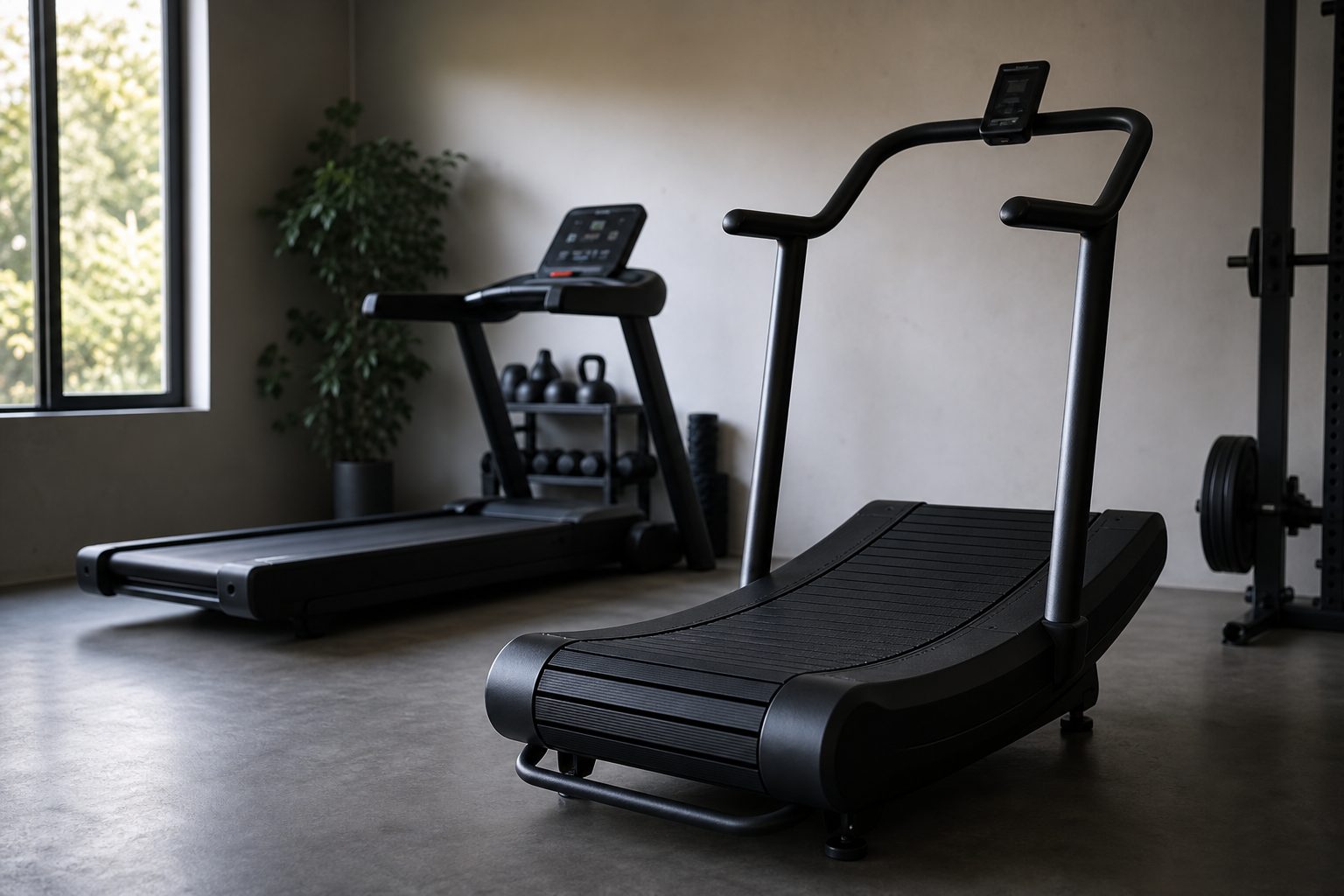
A curved manual runner uses a concave slat belt that moves only when the runner moves; a conventional motorised treadmill drives its belt at the speed selected on the console.
 By James Oduya · Staff Writer & Home Gym Columnist · Updated July 21, 2026
1. The short answer: these are different training tools
There is a temptation to treat a curved manual treadmill as a motorised treadmill with a more dramatic silhouette. That is understandable. They both sit in a room, occupy a substantial patch of floor and ask you to put one foot in front of the other until you question your life choices. But they behave very differently once you start running.
A self-powered curved runner such as the Curve LTG has a concave surface made up of slats rather than the usual continuous belt. Your movement drives it. Run faster and it rolls faster. Ease off and it slows. Stop and it stops immediately. There is no motor dragging the surface beneath you, no preset speed to catch up with and no need to reach for a control when an interval goes a little sideways.
A traditional motorised treadmill reverses that relationship. You choose a speed, the electric motor drives the belt, and you keep up with it. That arrangement is not inferior. In many homes it is precisely what makes a treadmill useful. It gives a beginner a stable walking pace, lets a runner repeat a prescribed interval accurately and makes long, steady sessions feel calmer and more predictable. It is the machine equivalent of a patient metronome.
The Curve LTG-style approach asks more from the runner. That is its appeal and its warning label, even if the warning label is not literally printed on the frame. You generate every bit of propulsion yourself. The curved geometry puts the belt's natural running area around the middle, whilst stepping farther forward encourages it to roll more quickly. A short movement adjustment can produce a meaningful change in effort. For sprint work, mixed-pace running and athletic conditioning, that immediacy is excellent. For someone who simply wants to walk at the same gentle pace whilst watching a programme, it can be unnecessarily demanding.
The broadest conclusion is simple. Choose a curved manual treadmill because you want the treadmill itself to be part of the challenge. Choose a motorised treadmill because you want the machine to deliver a repeatable environment in which to walk, jog or run. One is a more reactive training partner. The other is a more accommodating platform.
That distinction matters especially in a home gym. Commercial facilities can justify several cardio stations, each with a narrow job. At home, one machine often has to serve the enthusiastic runner, the partner who wants a gentle walk, the teenager doing intervals and the person who bought it during a burst of optimism in January. A motorised treadmill usually covers more of those use cases. A curved treadmill can be the better machine for a more specific, more athletic user.
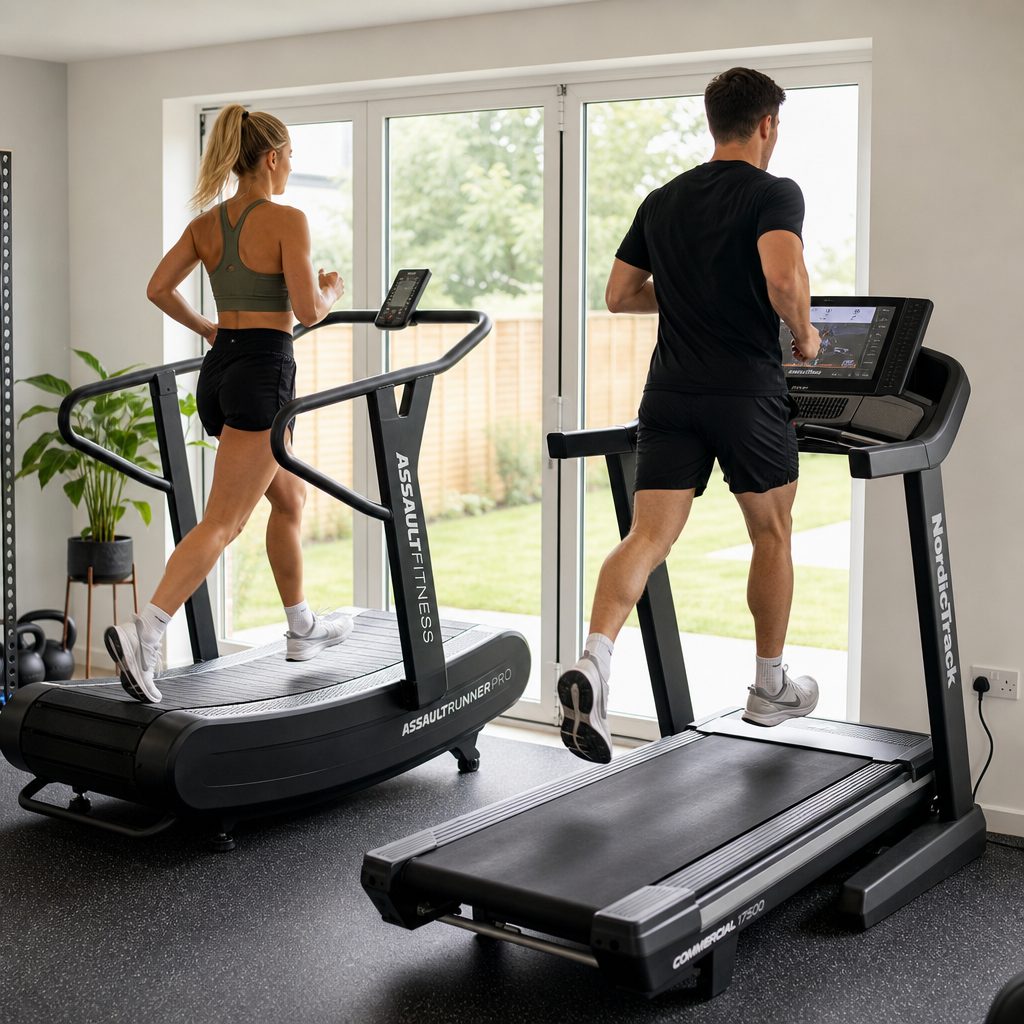
The key practical difference is pace control: on a curved runner the athlete controls the belt with foot placement and force, while on a motorised treadmill the console controls the moving belt.
2. Curve LTG-style slat runners versus motorised treadmills at a glance
Before disappearing into the weeds of biomechanics, displays and the surprisingly emotional subject of treadmill noise, it helps to put the two formats side by side. The table below compares the operating principles that separate a Curve LTG-type manual curved runner from a conventional motorised treadmill. These are category differences, not a claim that every machine within either camp feels identical. Build quality, deck construction, service support and console design still vary considerably from model to model.
| Feature | Curved manual slat treadmill | Traditional motorised treadmill |
|---|---|---|
| Drive motor | 0 motors: the runner moves the belt | 1 electric drive motor moves the belt |
| Speed selection | Set continuously by the runner's movement | Set at the console as a preset belt speed |
| Stopping response | Stops immediately when the runner stops | The belt continues until slowed or stopped through its controls |
| Running surface | Concave surface with individual slats | Conventional belt driven beneath the runner |
| Power during use | Runner-generated movement | Electricity drives the belt |
| Natural strength | Fast pace changes, self-regulated work and demanding running | Controlled walking, prescribed speed work and steady sessions |
The one-number comparison is worth pausing on. A curved manual runner has zero drive motors. A motorised treadmill has one job-defining drive motor. That sounds obvious, but it shapes virtually every ownership experience. It affects how the machine begins, how it responds, what can go wrong, how you train and how naturally the pace feels to you.
On a motorised machine, there is a short but real negotiation at the start of a session. You step on, choose a pace, wait for the belt and settle into it. On a curved runner, there is no negotiation. Start walking and the deck responds. Take a bigger, more purposeful step and it responds more. It can feel wonderfully direct after years of pressing buttons, although the first few sessions often involve a period of slightly awkward speed hunting. Your body is learning the machine as much as the machine is responding to your body.
That learning period should not be dismissed as a flaw, but it should not be romanticised either. The unusual feeling can be more challenging than expected, even for a competent road runner. A motorised belt supplies a consistent moving surface. A curved manual belt requires the runner to create and manage that movement. For some people it feels like freedom. For others it feels like the treadmill has developed opinions.
"Manual treadmill" can describe very basic flat-belt walking machines as well as premium curved slat runners. This comparison concerns the latter: self-powered, concave slat-belt runners such as the Curve LTG, not the lightweight foldaway manual walkers often sold for occasional use.
3. How the running feel changes from the first step
The most persuasive case for a curved treadmill is not a spreadsheet feature. It is the sensation of running on one. A good curved slat treadmill feels responsive in a way a motorised deck generally does not. The belt is not moving until you move it, so every acceleration feels connected to what your feet, hips and arms are doing at that exact moment.
When you run on a conventional treadmill, the belt travels backwards at a fixed speed. You do not have to create the belt's motion; you have to maintain your position over it. This is useful. It removes one variable and lets you concentrate on cadence, breathing, stride or simply finishing the session. It can also be reassuringly boring in the best sense. You know what you are getting for the next block of time.
On a curved manual deck, the runner becomes the speed control. The forward area of the curve encourages the belt to roll more quickly; returning towards the centre reduces that effect. You do not need a console button to accelerate, and you do not have to wait for a motor to respond. That makes a curved machine particularly well suited to short, sharp intervals. You can surge, settle, surge again and stop without the tiny administrative chores of changing a setting.
For athletes who dislike the gap between intention and action, this is a big deal. Think of a field-sport player doing hard bursts, a runner practising changes of pace, or someone fitting conditioning work around a busy home gym session. The Curve LTG format can make intervals feel more like free running and less like a laboratory protocol. There is a rawness to it. You either produce the speed or you do not.
Yet a motorised treadmill has its own version of honesty. Set a pace and it will tell you if you can maintain it. There is nowhere to subtly drift toward a more comfortable speed without touching the controls. For structured sessions, that removes ambiguity. If your plan says sustained running at a particular belt speed, the machine will hold you to it. Sometimes that is exactly the nudge required.
Curved manual: pace comes from foot placement
The runner controls acceleration and deceleration directly. This can make repeated surges feel immediate and instinctive, but it also means each easy section still asks you to manage the belt.
Motorised: pace comes from the console
The treadmill supplies a selected, repeatable belt speed. It is easier to reproduce a planned session and easier for a new user to find a stable walking rhythm.
Curved manual: transitions are as quick as you are
There is no waiting for a drive motor to move from one effort level to another. That is excellent for reactive conditioning and genuinely quick changes of pace.
Motorised: repeatability is the advantage
A selected pace stays selected until you change it. This is valuable when your programme calls for controlled repetitions rather than self-regulated efforts.
I would be cautious about declaring one feel "more natural" for everybody. That phrase gets thrown around whenever fitness equipment has an expensive curve or a minimalist console. Running outdoors is natural. Running on any treadmill is a distinct task. A curved treadmill may feel more self-directed and more reactive, but it still requires adaptation. A motorised treadmill may feel less free, but its consistency can be exactly what allows a novice to build confidence safely.
The sensible approach is to match the running feel to the training you already enjoy. If your favourite part of exercise is setting out for a relaxed, predictable walk while listening to a podcast, a motorised treadmill has a clear advantage. If you enjoy being able to push hard, reduce pace by feel and finish a sprint without fiddling with a screen, curved manual running has a very real appeal.
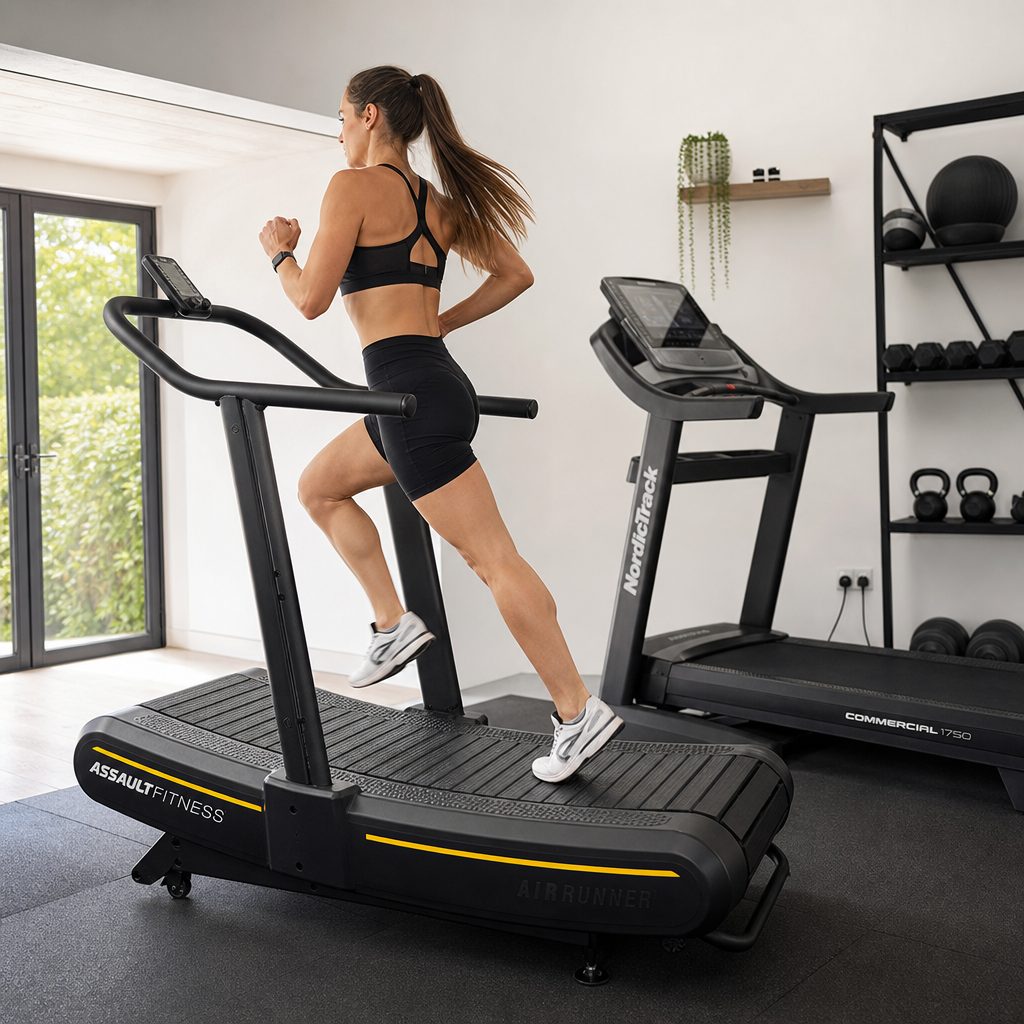
Curved slat-belt running rewards deliberate changes of position and effort, making it particularly appealing for sessions built around rapid accelerations and recoveries.
4. Joint impact: softer is not the same as easier
Joint impact is where the conversation becomes muddled quickly. Curved treadmills are often discussed as though the slatted surface and curved profile automatically make them a gentle option. Motorised treadmills, meanwhile, are sometimes treated as the hard-deck villain of the piece. Reality is less tidy.
The slats on a curved runner can create a different underfoot sensation from a conventional motorised belt. The surface is built from separate moving slats and the curve changes how you engage with it. Many runners find this more comfortable than a basic, flat-belt machine, particularly during harder, faster work. There is a sense that the deck responds beneath the foot rather than simply moving beneath it.
But comfort is not a universal measurement. The same self-powered design that makes a curved treadmill feel lively also asks you to generate more effort. You are not being carried along by a motor. That can shift the workload into the calves, posterior chain and general running mechanics. A runner who is used to cruising on a motorised belt may find the curved format more demanding at first, even when their joints do not object to the slats themselves.
That is why I would separate impact from total stress. A surface may feel forgiving underfoot while the session as a whole is still more taxing because every stride is doing more work. Conversely, a motorised treadmill may have a conventional belt but allow a user to walk at a very manageable fixed pace, which can be far more appropriate for someone returning to activity, managing fatigue or simply not interested in turning a Tuesday evening walk into an athletic event.
For runners with an existing injury, persistent pain or a clinician-directed rehabilitation plan, neither category deserves an automatic prescription. The best machine is the one compatible with the advice you have been given and with a pace you can tolerate. A self-powered slat runner is not a medical device. A motorised treadmill with a controlled belt speed is not inherently harsh. The right choice is often more about the intensity and gait it encourages than a marketing description of the deck.
A useful way to think about joint comfort
Ask two separate questions: "How does the surface feel beneath my feet?" and "How hard does this machine make me work?" A curved slat deck may feel pleasant underfoot whilst still creating a more muscular, more demanding session. Those are not contradictory findings. They are the point.
Motorised treadmills deserve credit here for control. If you need to keep your walking speed deliberately calm, the console can hold it there. There is no accidental surge because you landed a little farther forward on a curve. This controlled environment can reduce the mental load for a user who is rebuilding fitness. It can also make it easier to compare one session with another. Consistency is not glamorous, but it is useful.
Curved runners have a compelling safety characteristic too: the belt stops when you stop. There is no moving deck continuing beneath you while you reach for a stop button. That does not remove the need for basic care, sensible footwear or a clear space around the machine, but it can make the format feel less intimidating for high-intensity efforts. When the effort ends, it ends.
For healthy, experienced runners, the decision often comes down to preference rather than a universal impact winner. If you love a springy, self-driven feel and tolerate the increased muscular demand well, a curved treadmill can be excellent. If you value an even, predictable surface and the ability to dial efforts down precisely, motorised remains the more versatile choice.
5. Walking, jogging and running: where each format earns its place
There is a blunt but helpful truth here: motorised treadmills are generally better walking machines. Curved manual treadmills are generally better at making running feel like a deliberate effort. That does not mean you cannot walk on a curve or run hard on a motorised deck. Of course you can. It means the machines' natural behaviours favour different things.
Walking on a motorised treadmill is straightforward. Select a comfortable speed, hold the rails only if genuinely necessary, and get into a rhythm. The belt moves predictably. This suits daily step goals, work-from-home walking, gentle warm-ups and longer low-intensity sessions. It also makes the machine easier to share across a household. The person who runs intervals and the person who wants a quiet walk after dinner can use the same equipment without either feeling that it was made for somebody else.
Walking on a curved runner can be perfectly possible, but it is not always as relaxed. Because you must move the belt yourself, extremely slow walking can take a little more attention. The curve gives the deck character, and character is not always what you want at 6.30 in the morning before tea. Some people will love the engaged feeling. Others will wish the machine would simply pick a pace and leave them alone.
At an easy jog, the comparison becomes closer. A motorised treadmill makes it easy to sit at a chosen effort and accumulate time. This is valuable for steady aerobic work, especially if you are following a programme that uses consistent paces. The curved option makes that same jog more interactive. You are responsible for keeping it smooth. This can improve awareness of your rhythm, but it can also make recovery running less recoverable.
For fast running, repeated efforts and sprint-style training, the curved manual format becomes genuinely compelling. No button pressing. No delay while a belt ramps. No concern that you have set the wrong speed for the next rep. You can attack the curve, step back to reduce pace and immediately go again. It is an elegant system once your coordination catches up.
These bars are not laboratory scores and should not be mistaken for them. They are a visual summary of where each design's operating principle is most useful. The more important point is that you should not buy a curved treadmill merely because it looks like the serious option. Serious training can happen on either platform. The best serious machine is the one that supports your actual programme instead of quietly derailing it.
If you do a lot of structured running, a motorised treadmill's pace control may be the feature you value most. If you perform short bursts as part of strength and conditioning, a Curve LTG-type runner can fit beautifully beside a rack, rower or sled. It becomes an effort tool rather than a miles tool. That is a meaningful difference in how it belongs in a home gym.
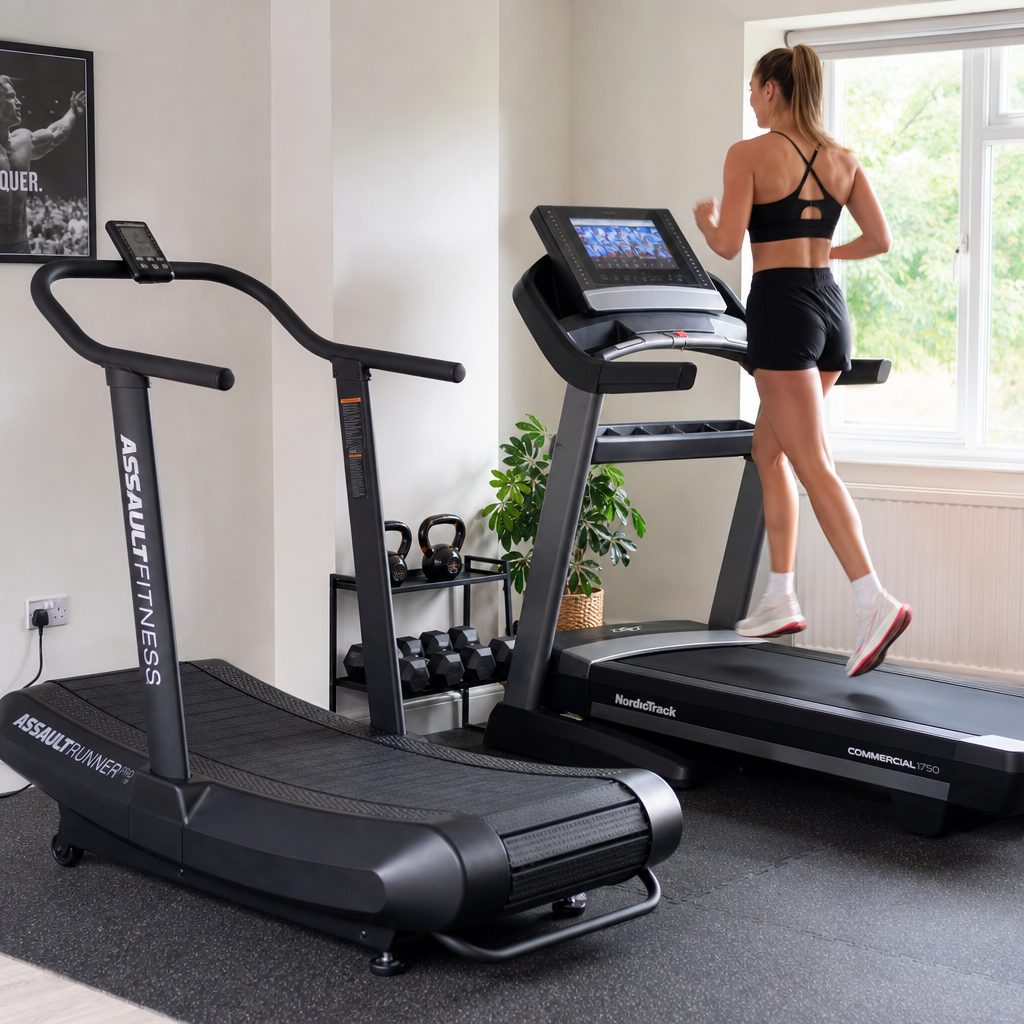
A motorised treadmill's controlled belt speed is often the simpler choice for daily walking, relaxed jogging and repeatable steady-state sessions shared by several people.
6. Intervals and performance training: the curved runner's strongest case
If I were explaining the curved manual treadmill in one sentence to an experienced athlete, I would say this: it removes the gap between deciding to accelerate and actually accelerating. That is the magic. It is also why the format is so often found in higher-end training environments and why it makes sense for a home gym built around performance rather than passive cardio.
On a motorised treadmill, an interval session can be excellent, but it requires planning. You select a work speed, choose a recovery speed and use the controls to move between them. Good motorised treadmills make this process straightforward, but it remains a machine-led transition. There is usually some ramping. That is entirely manageable for conventional interval running, particularly longer reps. For truly spontaneous bursts, however, it can feel a little formal.
The curved runner lets the athlete set the intensity in real time. A hard drive into the belt increases speed. A step back and softer stride allows it to settle. This is useful for sessions where the goal is not "hold an exact pace for a fixed time" but "produce repeated high-quality accelerations." It also works well when effort is meant to respond to how you feel. You can push when you are fresh and trim the intensity when your form starts to become questionable.
That said, self-regulation is not always the same as accuracy. If your programme requires tightly controlled pace targets, a motorised treadmill provides a clearer reference. A curved runner can encourage you to chase sensation rather than a number, which is wonderful for some sessions and unhelpful for others. The athlete who needs repeatability for a training block may prefer the motorised belt's stubborn consistency.
Curved manual strengths for training
- Acceleration begins when you accelerate, without waiting for a motor-driven belt to change pace.
- The belt stops immediately when you stop, which suits short bursts and hard finishing efforts.
- The self-powered deck rewards purposeful running mechanics and active propulsion.
- It can make a compact conditioning session feel focused rather than button-heavy.
Curved manual limits for training
- Maintaining a precisely repeatable easy or moderate pace takes more attention.
- The added demand can make recovery work feel less genuinely easy.
- Beginners may spend their first sessions learning the deck rather than concentrating on technique.
- It is less suited to users whose priority is calm, low-effort walking.
The motorised treadmill's interval strengths deserve the same clarity. A selected pace is a selected pace. If you are training for a run and your plan asks for a controlled progression, exact work blocks or a sustained effort, that certainty is useful. You can pay attention to posture, cadence and breathing without constantly making micro-adjustments to the belt. For many runners, especially those with a coach or a specific event programme, that is worth more than instant responsiveness.
There is also a practical advantage in having the machine do some of the decision-making. Training after a difficult day can be a negotiation. A motorised treadmill lets you set a pace and commit. On a curved runner, it is very easy to settle into whatever feels comfortable. Again, that can be a benefit. But if your goal is to complete a defined session, the traditional machine can be the firmer training partner.
My own view is that the Curve LTG category shines when the treadmill is one station within a broader athletic set-up. Think hard runs between strength movements, brief conditioning finishers, rapid pace changes and no-fuss warm-ups that can become no-fuss hard efforts. A motorised treadmill shines when it is the central cardio machine. That is not a criticism of either. It is a reason to buy with your routine in mind.
7. Displays, controls and the question of how much technology you want
Curved manual treadmills often appear reassuringly simple because they do not need a motor-speed control system. Their central experience is mechanical: step, drive, respond. Traditional motorised treadmills tend to put more emphasis on the console because the console is how you set the pace and manage the session.
Neither approach is automatically more modern. A basic display can be exactly right on a self-powered runner if your focus is effort, time and the feel of the session. Less technology can mean less distraction. You are not scrolling through menus while standing on a moving belt. You are running. Novel concept, I know.
On the other hand, motorised treadmills benefit greatly from good controls. Speed adjustments, programme selection and any incline functions live there. A clear console can make a treadmill friendlier for every member of the household. You do not need to understand curved-belt positioning or how hard to push; you can select a pace and begin.
This difference has implications for data-minded users. If you are someone who wants every run to fit a structured plan, the motorised category's console-led nature is appealing. It creates an obvious relationship between the number you select and the session you complete. Curved runners can report workout information where equipped, but their central value is not the promise of perfectly motor-held speed. It is the freedom to respond in the moment.
Motorised consoles are functional, not merely decorative
Because the motorised belt needs user-selected pace, a good console is part of the training experience. Clear controls can make walking, jogging and planned intervals much less intimidating.
Curved manual running reduces button dependence
The runner does not need to adjust an electric drive setting to change pace. This is refreshing for hard efforts, but it gives you less machine-enforced consistency.
Choose the feedback style that helps you train
Some people train better with clear settings and repeatable targets. Others train better when they can focus on body awareness, effort and immediate changes of pace.
Do not let a sparse curved-treadmill interface persuade you that it is automatically easier to use. Mechanically, it is straightforward. Physiologically, it may be harder. Likewise, do not dismiss a motorised treadmill console as needless clutter. For a beginner, an older user or somebody who wants a daily walking habit, those controls can be the reason the treadmill is used rather than admired.
The better display is therefore the one that matches how much structure you want. A motorised treadmill makes sense for the person who wants the equipment to provide a framework. A Curve LTG-type machine makes sense for the person who wants to be the framework.
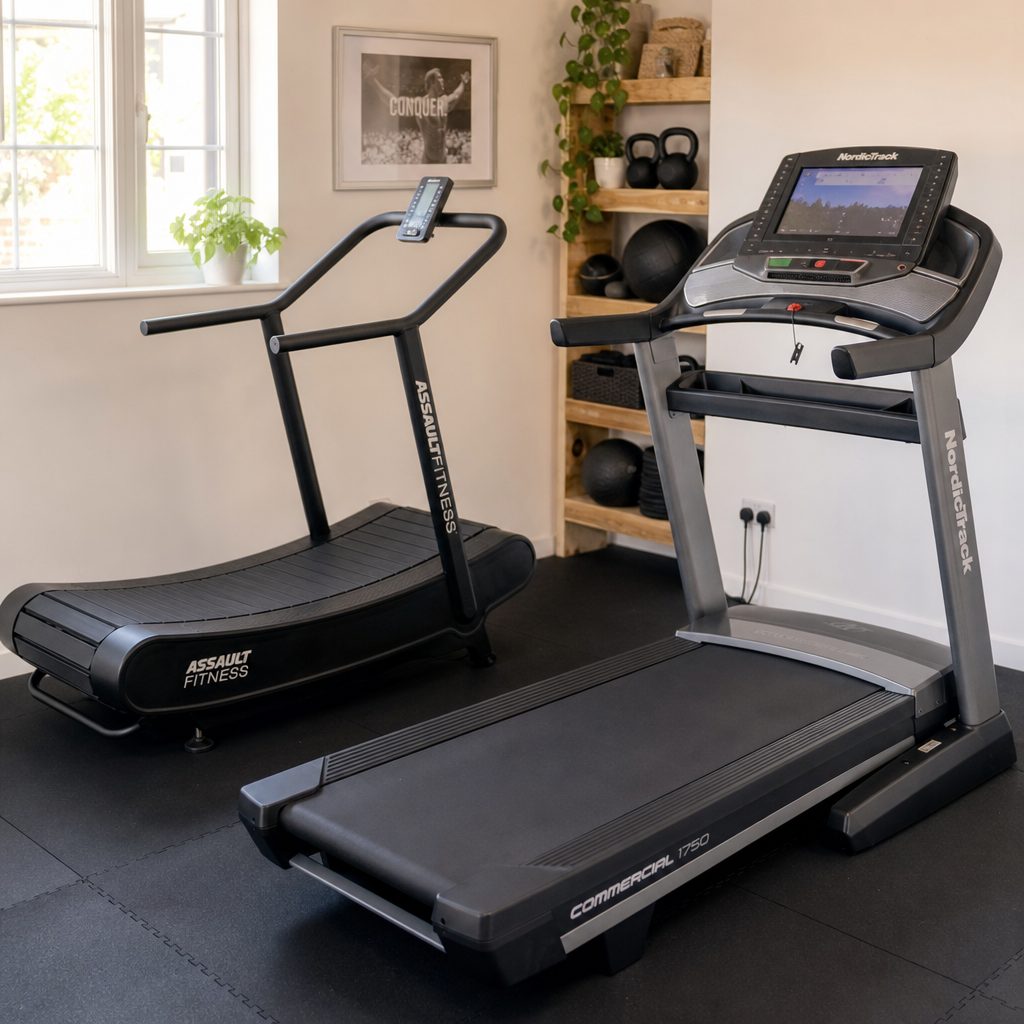
Controls change the relationship between runner and treadmill: motorised machines place speed selection at the console, while curved manual designs put it under your feet.
8. Noise, power and home-gym practicality
Home-gym equipment is never experienced in isolation. It exists with your flooring, your neighbours, your partner's tolerance for early-morning training and that one room which somehow contains every charger in the house. Practicality matters.
The curved manual concept has a straightforward advantage: there is no electric motor driving the belt. You supply the movement. That reduces the category's dependence on powered belt operation and removes the motor as a central part of the experience. It also means the machine is not waiting for you to choose a speed before it can begin.
That does not mean curved runners are silent. Slats move, feet strike, and hard running is hard running. At speed, any treadmill can create a surprising amount of sound and vibration. A self-powered runner may avoid motor noise, but it does not exempt the household from the sound of a determined person sprinting indoors. If you live in an upstairs flat, the relationship with your floor and your neighbours remains important.
Motorised treadmills bring the sound of a moving belt and drive system in addition to footfall. In exchange, they offer controlled pace. For a user who walks gently at a fixed speed, this may actually be a better domestic experience than a curved machine that encourages a more forceful, more active stride. Noise is not just about motors; it is about how the machine makes you move.
Placement is another consideration. A curved slat treadmill is a statement piece. Its upright curve makes its purpose obvious. Some people will love that gym-floor look. Others will prefer a more conventional treadmill that blends into the corner of a spare room. There is no correct answer, but you should be honest about the room. If the equipment has to coexist with work calls, laundry and a guest bed, visual bulk can matter almost as much as training quality.
Before choosing either style, think beyond the machine itself. Consider floor protection, clearance around the running area, the way vibration carries through your property and who else needs to use the equipment. The most impressive treadmill is poor value if it becomes an expensive clothes rail because it is too disruptive to use.
Maintenance conversations also need a little restraint. It is fair to say that a motorised treadmill's powered drive is a major functional system, whilst a curved manual runner does not rely on a motor to move the belt. It is not fair to leap from that fact to a promise that any individual curved treadmill will be maintenance-free or that any motorised unit will be troublesome. Moving slats, bearings, belts, decks and electronics all deserve sensible care according to the manufacturer's instructions.
The useful buying insight is simpler: decide whether you value mechanical directness or electronically controlled convenience. A curved runner offers the former. A motorised machine offers the latter. Neither is a free lunch. Fitness equipment, sadly, still expects you to exercise.
9. Value is about use, not just the machine in front of you
The sensible way to judge value here is not to ask which category looks more impressive in a gym photo. It is to ask what kind of training will happen after the novelty fades. A curved treadmill can be a superb purchase if it becomes your preferred tool for hard conditioning, intervals and athletic running. It can be a frustrating purchase if what you really wanted was a reliable place to walk while listening to the radio.
Motorised treadmills have broad appeal because their pace can be selected and held. That makes them useful to a wider range of people in the same household. A beginner can walk. An experienced runner can follow a structured session. Someone returning from a lay-off can start slowly. This flexibility is a major part of their value, even before you think about any additional features a particular model may offer.
Curved manual treadmills offer value in a different way. Their strength is not being all things to all people. Their strength is delivering a distinctive, self-powered training experience that can make short, hard sessions exceptionally engaging. If that is your preferred style, the machine is not a compromise. It is the point.
For a home gym built around free weights and conditioning, the curved format can make more sense than a feature-packed motorised treadmill. It complements a training space where you already choose your own loads, manage your own intensity and favour sessions that move quickly from one station to another. The runner becomes another simple, demanding tool.
For a household gym, the motorised option usually has the better case. It is easier to explain, easier to share and better suited to walking. You can set a speed for one user without asking them to learn where on a curved deck their feet should go. This may sound like a tiny thing, but small barriers are often what separate equipment that gets used from equipment that gathers dust with great dignity.
Best for daily walkers
Motorised treadmill. A preset belt speed is calmer, easier to regulate and more suitable for long, low-intensity walking sessions.
Best for fast intervals
Curved manual treadmill. The belt reacts to the runner immediately, making accelerations, decelerations and short hard efforts feel direct.
Best all-round household pick
Motorised treadmill. Its selected pace is more approachable for mixed abilities, from tentative walkers to structured runners.
Best for a performance gym
Curve LTG-style curved runner. It suits a training area centred on athletic conditioning, forceful running and self-directed effort.
Best for prescribed sessions
Motorised treadmill. Fixed belt speed gives a dependable framework for repeatable pace-based workouts.
Best for reactive running
Curved manual treadmill. There is no motor setting to change when you want to surge, slow or stop.
There is no honest "best on a budget" recommendation between these categories without considering specific models, prices and condition. What can be said confidently is that the best value treadmill is the one with a job you will actually give it. Do not buy a curved runner for a sophisticated-looking warm-up if you mostly want easy walks. Do not buy a conventional motorised treadmill for sprint conditioning if you resent every second spent pressing speed controls.
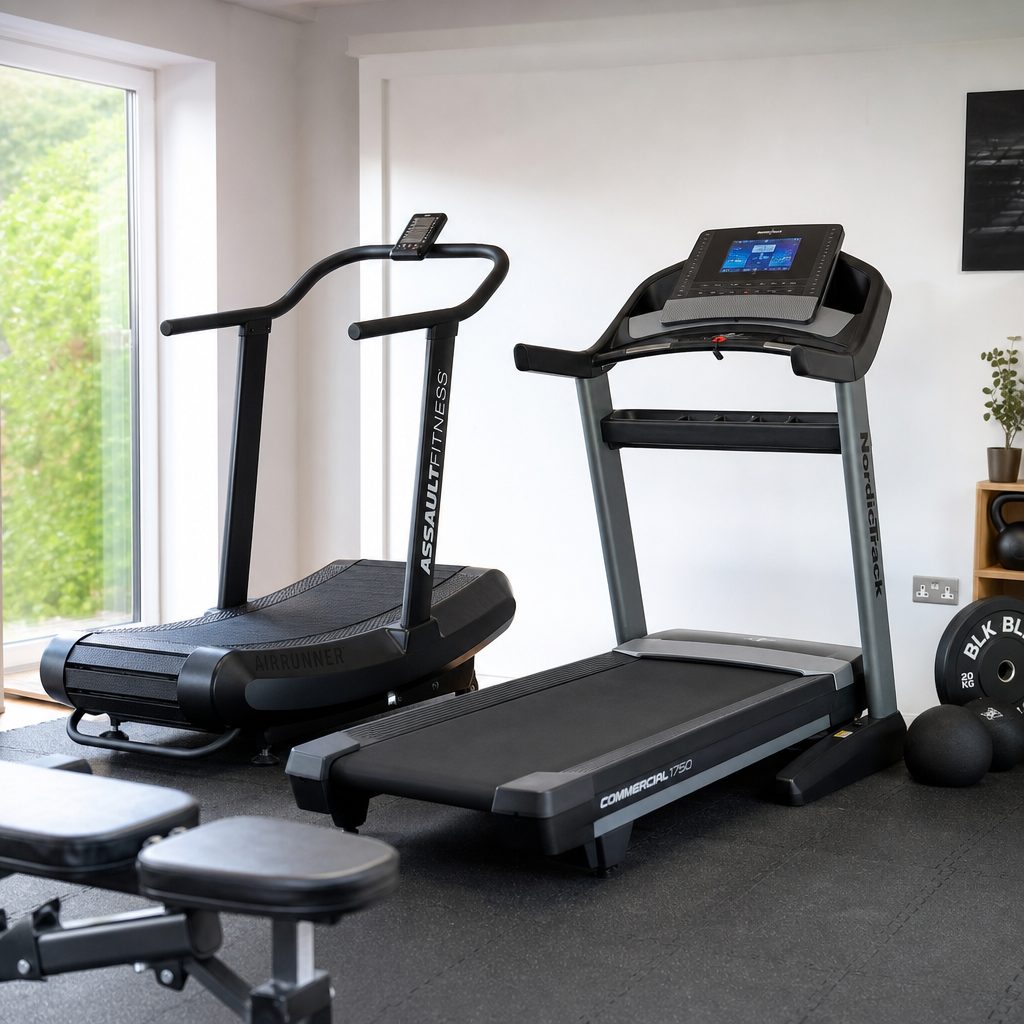
A treadmill earns its place in a home gym when it fits the way you already train, whether that means repeatable walking and running or reactive conditioning between strength sessions.
10. A realistic buying checklist before choosing either type
Before committing to a curved manual treadmill or a motorised one, write down what you expect to do on it in an ordinary week. Not your heroic ideal week. The ordinary one: tired after work, rain outside, limited time, motivation somewhere behind the sofa. That is the version of you the machine needs to serve.
If your list says walking, gentle jogging, longer steady mileage, shared use and predictable pace, the traditional motorised treadmill is probably the sensible answer. It will not feel as exotic as a curved slat runner, but your knees do not care how exotic the silhouette is. They care whether you use the machine consistently and sensibly.
If your list says sprints, intervals, conditioning, varied pace, athletic running and minimal dependence on buttons, a Curve LTG-style machine deserves serious consideration. The self-powered format can make training feel immediate in a way a conventional belt cannot fully replicate. You are not waiting for the equipment to catch up with you.
Buy a curved manual runner if...
- You want to control pace through your own movement rather than a motor setting.
- Short, punchy intervals and sprint-style efforts are central to your training.
- You prefer a concave slatted running surface and enjoy a more demanding running feel.
- Your home gym is primarily a performance space rather than a shared walking room.
- You value a belt that stops immediately when your movement stops.
Buy a motorised treadmill if...
- You want steady, controlled walking and jogging at a selected pace.
- Several people with different fitness levels will use the machine.
- Your programme relies on repeatable, prescribed belt speeds.
- You want an easy entry point into treadmill training with familiar controls.
- You prefer the machine to set the rhythm while you concentrate on the session.
It is also worth being honest about ego. Curved treadmills look purposeful, and plenty of people are drawn to them because they signal serious training. There is nothing wrong with wanting equipment you find motivating. Just make sure the motivation survives the first few sessions. The curved format can be genuinely demanding, and demanding is only useful when it matches your goal.
Likewise, do not overlook the humble usefulness of a conventional motorised treadmill. It may be less visually dramatic, but it can provide hundreds of ordinary, repeatable sessions. Those are the sessions that build habits. A machine that makes you move regularly is generally more valuable than a machine that makes an excellent talking point when friends visit.
For experienced runners, the choice may be more nuanced. You may already have outdoor mileage covered and want an indoor option for weather-proof hard efforts. In that case, the curved manual machine offers a compelling specialist role. Or you may need an indoor platform for pace work where conditions are controlled. Then the motorised treadmill remains the sharper tool. Both can sit within a serious running plan. They simply solve different problems.
11. The honest verdict for UK home gyms
Curved manual treadmills and motorised treadmills should not be judged as if one replaced the other in every circumstance. They are not two versions of the same decision. They represent two different ideas about what a treadmill should do for you.
The Curve LTG-style curved runner is the better choice for the person who wants a self-powered, reactive, athletic training tool. Its concave slat belt responds to your movement. It lets you accelerate without waiting for a motor and stop immediately when you stop. That makes it particularly appealing for hard intervals, short conditioning sessions and runners who enjoy controlling effort by feel.
The traditional motorised treadmill is the better choice for most mixed-use homes. It gives you a controlled belt speed, easier walking, repeatable running sessions and a friendlier experience for people who do not want every step to be a technical lesson in belt propulsion. That is not less serious. It is simply more versatile.
If you are still torn, use this tie-breaker: imagine the machine on the day you are least excited to train. If you would appreciate selecting an easy pace and letting the belt carry the rhythm, buy motorised. If you would rather step on, create the effort yourself and get straight into a sharp session, buy curved. It is not profound. It is just very likely to be right.
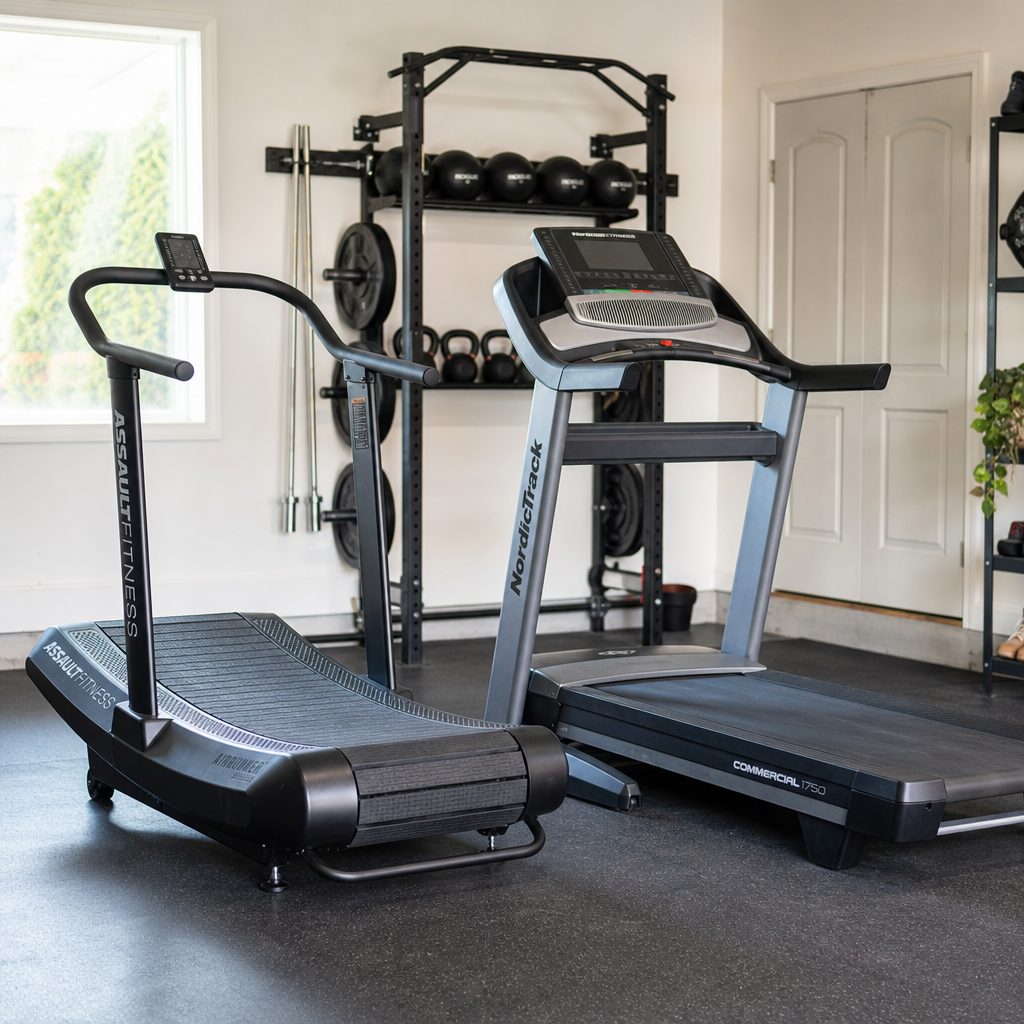
The best choice is not the treadmill with the boldest design; it is the one whose pace control, running feel and training purpose suit the sessions you will genuinely repeat at home.
Bottom line
Choose a curved manual treadmill for reactive, self-powered performance work.
A Curve LTG-style slat-belt runner is the standout choice for runners and athletes who want immediate pace changes, demanding conditioning and a belt that responds directly to their movement. It is a specialist tool in the best sense: focused, physical and rewarding when used for the right work.
Choose a motorised treadmill for the broadest home-gym usefulness.
A conventional motorised treadmill remains the better all-round buy for walking, steady running, prescribed pace sessions and households with more than one user. It may be less dramatic, but controlled speed is a genuinely useful feature, not a compromise. Buy the curved machine when you want the treadmill to challenge you. Buy the motorised one when you want it to support almost everyone.
12. Frequently asked questions
They can feel harder because you supply the force that moves the belt. A motorised treadmill drives its belt at a selected speed, whereas a curved slat runner asks you to create and control the speed through your own movement. That additional responsibility can make the curved format feel more demanding, particularly during the first few sessions. "Harder" is not automatically better, though. It is useful if you want a challenging conditioning tool and less useful if your main aim is comfortable daily walking.
A curved slat surface may feel different and more comfortable underfoot than a conventional belt for some runners, but it is not automatically the right choice for every joint concern. The total stress of a session matters as much as the deck feel. A self-powered curved runner can ask more of your muscles and running mechanics, while a motorised treadmill can hold a gentle pace very consistently. If you are managing pain, injury or rehabilitation, choose according to professional guidance and your own tolerance rather than assuming one category is universally safer.
You can walk on a curved manual treadmill, but it is not always as effortless as walking on a motorised model. On the curved deck, you must keep the belt moving through your own stride. A conventional motorised treadmill allows you to select a gentle speed and settle into it. For regular steps, easy recovery walks and users who want a relaxed experience, motorised treadmills are generally the more natural fit.
They react directly to the runner. When you push harder, the belt moves faster; when you reduce effort, it slows; when you stop, it stops immediately. There is no need to select a new motor speed or wait for the belt to ramp from one pace to another. This makes curved manual runners particularly effective for short bursts, rapid accelerations, sprint-style conditioning and sessions where pace changes are guided by feel rather than a fixed numerical target.
They can be, depending on the runner's objective. A serious runner following prescribed pace work, steady efforts or repeatable interval sessions may value the fixed belt speed of a motorised treadmill. It provides a consistent training environment and makes it easier to follow a structured plan. A serious athlete focused on explosive efforts, conditioning and self-regulated running may prefer a curved manual runner. Serious training is not defined by whether the belt has a motor; it is defined by whether the machine suits the work.
The core running action is self-powered. Your movement drives the curved slat belt rather than an electric motor driving it at a preset speed. That is the defining difference between this type of curved manual runner and a traditional motorised treadmill. Specific consoles or optional features can vary by machine, but the belt itself moves because the runner moves it.
A motorised treadmill is usually the safer all-round recommendation. Its preset speed makes it approachable for people with very different confidence levels and goals, from gentle walking to planned running. A curved manual treadmill can be shared, but every user needs to be comfortable controlling the belt through their movement. For a household where one person loves hard training and another simply wants easy cardio, the motorised format is more likely to satisfy both.
It can be a useful training tool because it encourages active propulsion, self-regulated pace and quick changes of effort. However, no treadmill format automatically makes someone a better runner. Improvement still depends on sensible training, adequate recovery, appropriate technique and consistency. A curved runner is valuable when its demanding, reactive nature helps you perform sessions you would otherwise struggle to replicate. A motorised treadmill is valuable when its controlled pace helps you complete structured work consistently.