
Concept2 SkiErg vs BikeErg: Which Air Machine Belongs in Your Home Gym?
Same no-subscription philosophy, same PM5 monitor and the same satisfyingly honest air resistance. The SkiErg and BikeErg are close relatives on paper, yet they suit very different bodies, rooms and training habits.
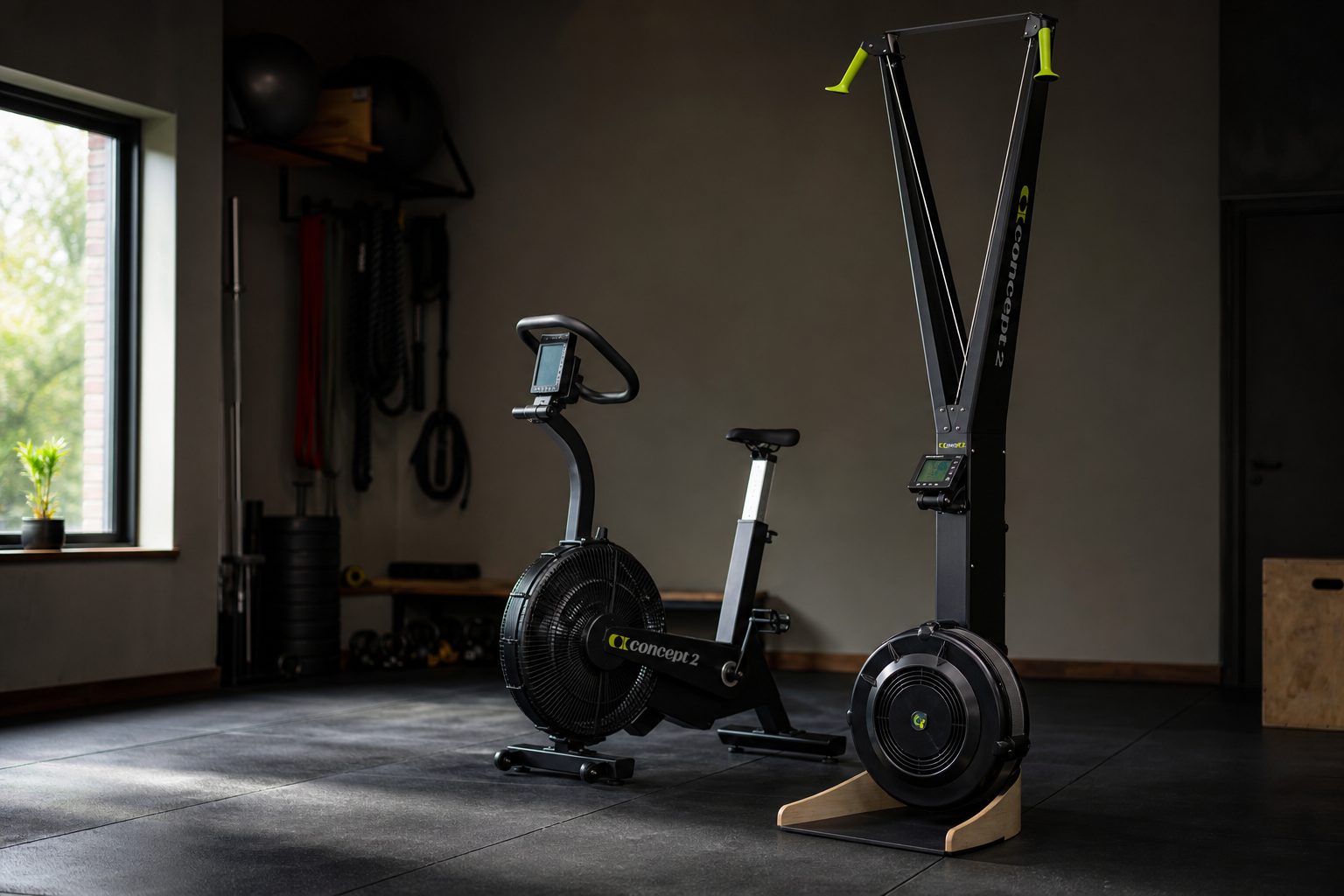
Concept2's upright air machines share the PM5 monitor and a fan-driven flywheel, but the way they occupy your room and work your body is very different.
 By James Oduya · Staff Writer & Home Gym Columnist · Updated July 17, 2026
The short answer: choose the movement you will repeat
It is tempting to treat this as a fight between two versions of the same machine. They both wear the Concept2 badge. They both use a fan-based flywheel. They both let you change the feel of the resistance with a damper. Both use the PM5 Performance Monitor, connect wirelessly through Bluetooth and ANT+, and can send workouts to ErgData and the Concept2 Online Logbook. Neither attempts to sell you a glossy screen, a monthly membership or a virtual instructor shouting at you before breakfast.
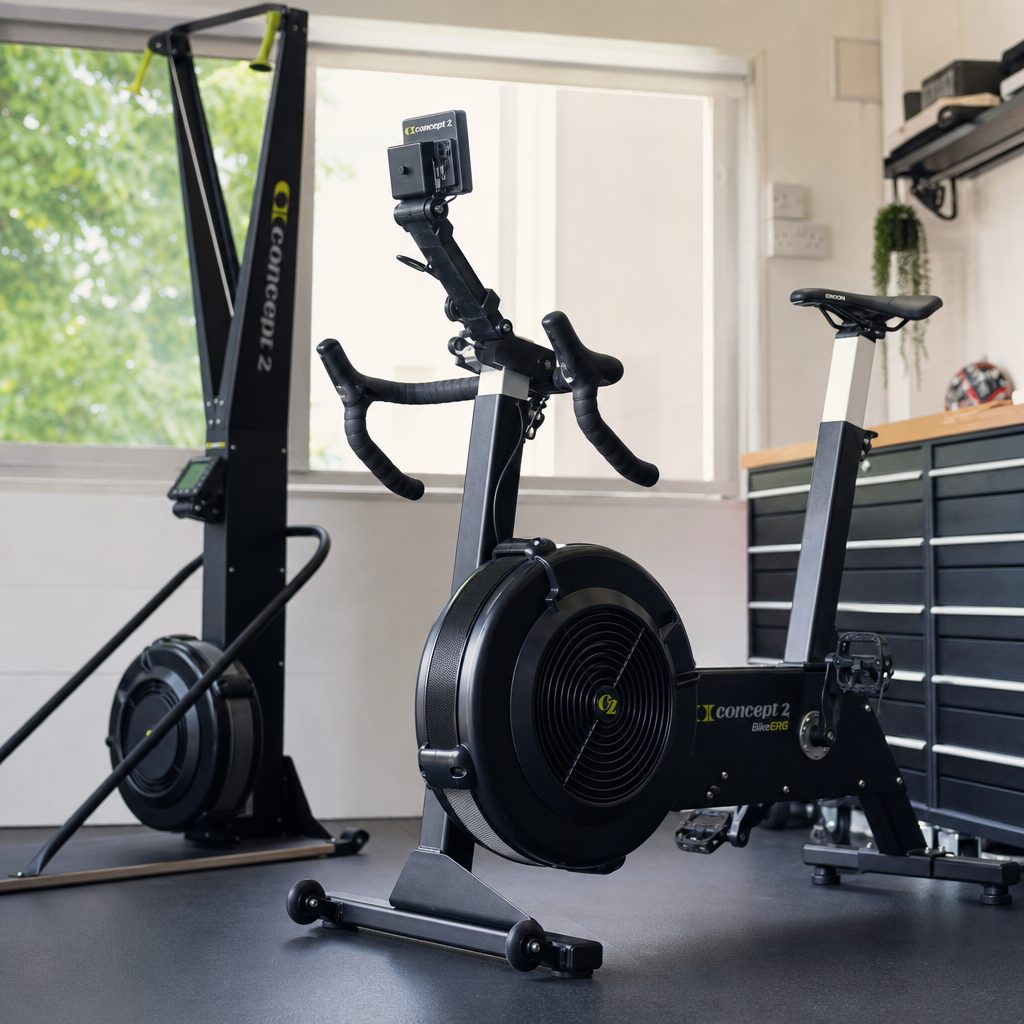
The BikeErg's compatibility with standard bike saddles, handlebars and pedals gives cyclists a useful degree of personal setup freedom.
But the similarity ends rather quickly once you begin exercising. The Concept2 SkiErg is a standing or seated pulling machine built around a double-pole skiing motion. Your arms travel from overhead to down by your sides, with your lats, triceps, core, hips, glutes and hamstrings contributing to each drive. The Concept2 BikeErg is a cycling machine. Your legs do the purposeful work, your upper body provides stability, and the movement will feel immediately legible to almost anyone who has pedalled a bicycle.
That makes the sensible answer rather less dramatic than some comparison articles would have you believe. Buy the SkiErg if you want upper-body and trunk involvement, have a specific reason to train the ski-pulling movement, or need a machine that can be used standing, seated, kneeling or from a wheelchair with the appropriate wide floor stand. Buy the BikeErg if cycling is the kind of cardio you naturally return to, if you want to settle in for longer rides, or if a compact 48-inch-long footprint is the difference between a machine being used and becoming an expensive clothes rack.
For HYROX-minded training, the SkiErg has the more obvious relevance because its movement is the one you will want to become technically comfortable with. For general home cardio, joint-friendly leg conditioning and repeatable routine, the BikeErg makes a remarkably persuasive case. The better machine is not the one that makes the tougher-looking Instagram clip. It is the one that still looks appealing on a damp Tuesday evening when motivation is a little bit thin.
A useful reality check: both machines use air resistance, so effort is self-regulating. Push or pull harder and the flywheel responds. The damper changes the feel of the stroke or pedal action; it does not turn either machine into a fixed-resistance exercise bike or a motorised trainer.
Concept2 SkiErg vs Concept2 BikeErg at a glance
Before getting into muscle recruitment, technique and the small domestic realities that tend to decide these purchases, here are the concrete numbers. This is the section worth returning to with a tape measure in one hand and a slightly sceptical partner in the other.
| Specification | Concept2 SkiErg | Concept2 BikeErg |
|---|---|---|
| Primary movement | Double-pole skiing pull | Air-resistance cycling |
| Resistance system | Air resistance with 10-level damper | Air-resistance flywheel with damper "gearing" |
| Monitor | PM5 | PM5 |
| Wireless connectivity | Bluetooth and ANT+ | Bluetooth and ANT+ |
| Machine weight | 46 lb / 20.9 kg | 68 lb |
| Installed footprint | Wall mounted: 19in bottom width, 20.5in top width, 16in deep, 85in high | 48in x 24in assembled |
| Floor-stand footprint | 23.5in x 50in standard stand; 32in x 52in wide stand | 60in x 48in recommended clearance for use |
| Maximum user weight | 500 lb | 300 lb |
| Measured fan noise at setting 5 | 75 dB | 67 dB |
| Power | Two D-cell batteries; flywheel supports monitor during use | Two D-cell batteries; flywheel supports monitor during use |
| Warranty | Five years frame; two years monitor and moving parts | Five years frame; two years parts |
The first important point is that "compact" means different things here. The wall-mounted SkiErg occupies very little floor depth, but it needs 85 inches of vertical clearance and secure wall mounting. The BikeErg is low and self-contained, but it permanently claims a rectangle of floor. A home gym is not an abstract spreadsheet. A narrow utility room, garage alcove or spare bedroom may strongly favour one layout over the other.
The second point is that the SkiErg's 500 lb maximum user weight and its optional extra-wide floor stand make it unusually flexible as an accessible training tool. The BikeErg's 300 lb limit is perfectly typical for an exercise bike, but it is not the same proposition. If the machine will be shared between several people with different needs, those figures deserve more attention than the colour of the monitor arm or the shape of the handlebars.
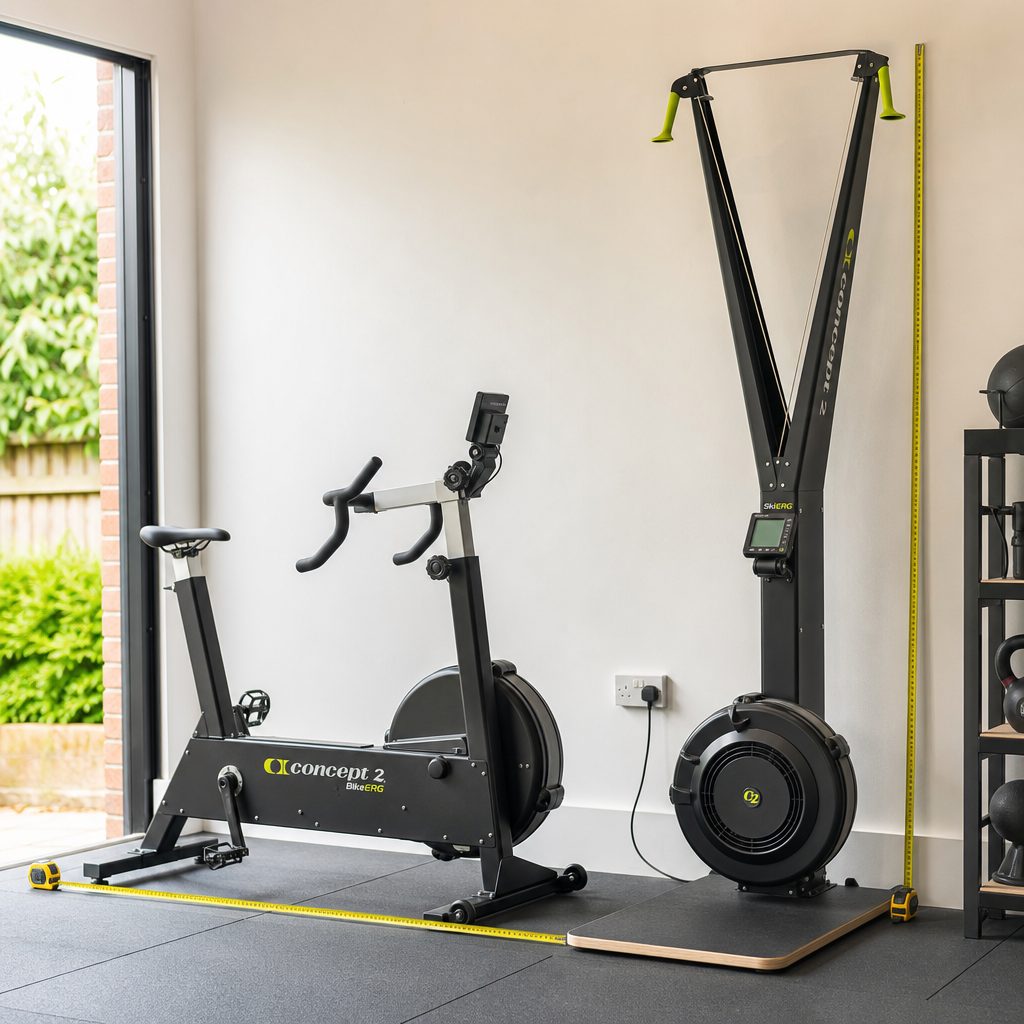
A tape measure is more useful than an inspirational quote here: the BikeErg needs floor clearance, while the SkiErg asks for height and either wall mounting or a floor stand.
Muscle recruitment: the biggest difference by miles
If you are choosing between these machines because you want "full-body cardio", the SkiErg is the clearer answer. That does not mean it turns every session into a strength workout or that you will somehow avoid using your legs on the BikeErg. It means the movement pattern demands more obvious contribution from your upper body and trunk.
On a good SkiErg pull, the hands begin above the head. The handles travel downwards as the torso hinges and the hips contribute to the drive. The lats and triceps are prominent; the shoulders help control the overhead start and finish; the core works to keep the movement organised rather than floppy; and the hips, glutes and hamstrings help create a powerful, connected stroke. There is a useful lesson in that word: connected. Trying to make the SkiErg an arm-only machine is tiring, inefficient and likely to make the session feel worse than it needs to.
The BikeErg asks a more familiar question. Can you pedal with enough consistency to keep the flywheel moving at your intended pace? The legs are naturally central, while the torso and arms stabilise your position on the saddle. This is not a criticism. It is precisely why many people will use a BikeErg more often. Cycling does not require learning an overhead pull, a hinge, a return phase and a rhythm all at once. You sit down, set the damper to a sensible starting point, and ride.
That simplicity has practical benefits for people who already do strength training. If your programme includes presses, rows, pull-ups, carries or a sizeable amount of upper-body work, adding more repeated pulling via the SkiErg may not always be what your shoulders want. The BikeErg offers a way to add cardio volume whilst leaving those areas comparatively fresh. Conversely, if you train mainly with lower-body lifts and walking, the SkiErg can introduce a refreshing different movement pattern without requiring another leg-dominant machine.
Concept2 SkiErg: upper body meets hip drive
The SkiErg brings the lats, triceps, shoulders, core, hips, glutes and hamstrings into the same repeated motion. It rewards a coordinated downward pull rather than frantic arm work.
Concept2 BikeErg: familiar leg-led cardio
The BikeErg centres on cycling. Your legs create the propulsion, while your torso and arms support your riding position. That makes it especially easy to use for steady sessions.
Both can become brutally hard
Air resistance does not care whether you are standing at a SkiErg or seated on a BikeErg. Higher output means a more demanding session, and both can support short intervals or longer aerobic work.
For people managing an injury or changing physical circumstances, the SkiErg's range of positions is a major advantage. It can be used seated, standing or from a wheelchair when paired with the optional extra-wide floor stand. Athletes who need to sit or kneel can still train their upper body and core at a meaningful intensity. That degree of adaptability is not a minor accessory detail; it changes who can use the machine and how it can fit into a rehabilitation-led or inclusive training space.
There is, however, a small warning worth stating plainly. More muscles involved does not automatically equal better training. A SkiErg interval can feel tremendously productive because so much of the body is contributing, but it can also be more fatiguing and technically demanding. A BikeErg ride may look less dramatic, but there is genuine value in a machine that lets you accumulate easy, moderate or hard aerobic work without needing much mental preparation. Boring consistency beats heroic novelty in the long run. It always has.
SkiErg muscle advantages
- Uses a distinctive upper-body pull involving lats, triceps, shoulders and core.
- Brings hips, glutes and hamstrings into a coordinated whole-body drive.
- Offers standing, seated and kneeling use, with wheelchair suitability on the optional wide stand.
- Useful for athletes who want practice with the double-pole skiing pattern.
SkiErg considerations
- The movement is less immediately intuitive than pedalling.
- Arm-only pulling can make sessions feel unnecessarily harsh and less efficient.
- Upper-body fatigue may matter if your week already contains lots of pressing, pulling and carrying.
- The overhead start position requires enough room and confidence with the pattern.
Resistance, output and how each machine feels at pace
Both machines use a fan-driven flywheel, which is the heart of the Concept2 experience. The resistance responds to how much energy you put in. If you pull the SkiErg handles with more force and speed, the fan moves faster and the task becomes more demanding. If you pedal the BikeErg harder, the same principle applies. There is no motor quietly adding difficulty in the background and no electronically controlled incline to disguise what is happening. It is direct, legible and pleasantly free from theatre.
Each machine has a damper. On the SkiErg it is a ten-level damper. On the BikeErg, the damper acts rather like gearing, allowing you to make quick changes to the feel of the ride. This is often misunderstood. A higher damper setting does not simply mean "harder equals better". It changes how the flywheel behaves and the sensation of each pull or pedal stroke. The best setting is the one that lets you produce the kind of output your session calls for with a movement you can control.
For a short interval session, either machine can deliver a sharp and immediate challenge. The SkiErg tends to make that effort feel very whole-body: arms pulling, trunk braced, hips working, breathing becoming noisy rather quickly. The BikeErg makes hard work feel more like a sustained leg drive. You can stand on the pedals if you wish, but most home users will spend the bulk of their time seated and settling into a rhythm. Neither sensation is superior. They are simply different kinds of discomfort, which is a very gym-equipment way of saying both can make you regret having clicked "start workout".
There is one useful performance equivalence within the PM5 system: the power required to achieve a 2:00/1000m pace on the BikeErg is the same as the power required to achieve a 2:00/500m pace on a RowErg or SkiErg. That does not mean a BikeErg 2:00/1000m pace and a SkiErg 2:00/500m pace feel identical in the body. They do not. It means the monitor's pacing framework is designed around equivalent power, which makes the numbers more meaningful when you move between Concept2 machines.
The practical takeaway is that the BikeErg offers a somewhat calmer sensory experience at the stated measured setting, while the SkiErg gives you a larger upper-body and core component. If you love hard interval work but find cycling mentally easier to sustain, the BikeErg is a fine choice. If traditional bike intervals leave you feeling as though your upper body has been on tea break, the SkiErg solves that particular problem very efficiently.
Do not buy either solely because it looks like a shortcut to fitness. Air machines are wonderfully honest, but they are not magic. Your fitness will be shaped by how consistently you use the machine, how sensibly you progress intensity and whether the movement agrees with your body. A BikeErg ridden four times a week is more useful than a SkiErg admired from the corner twice a month. The reverse is equally true.
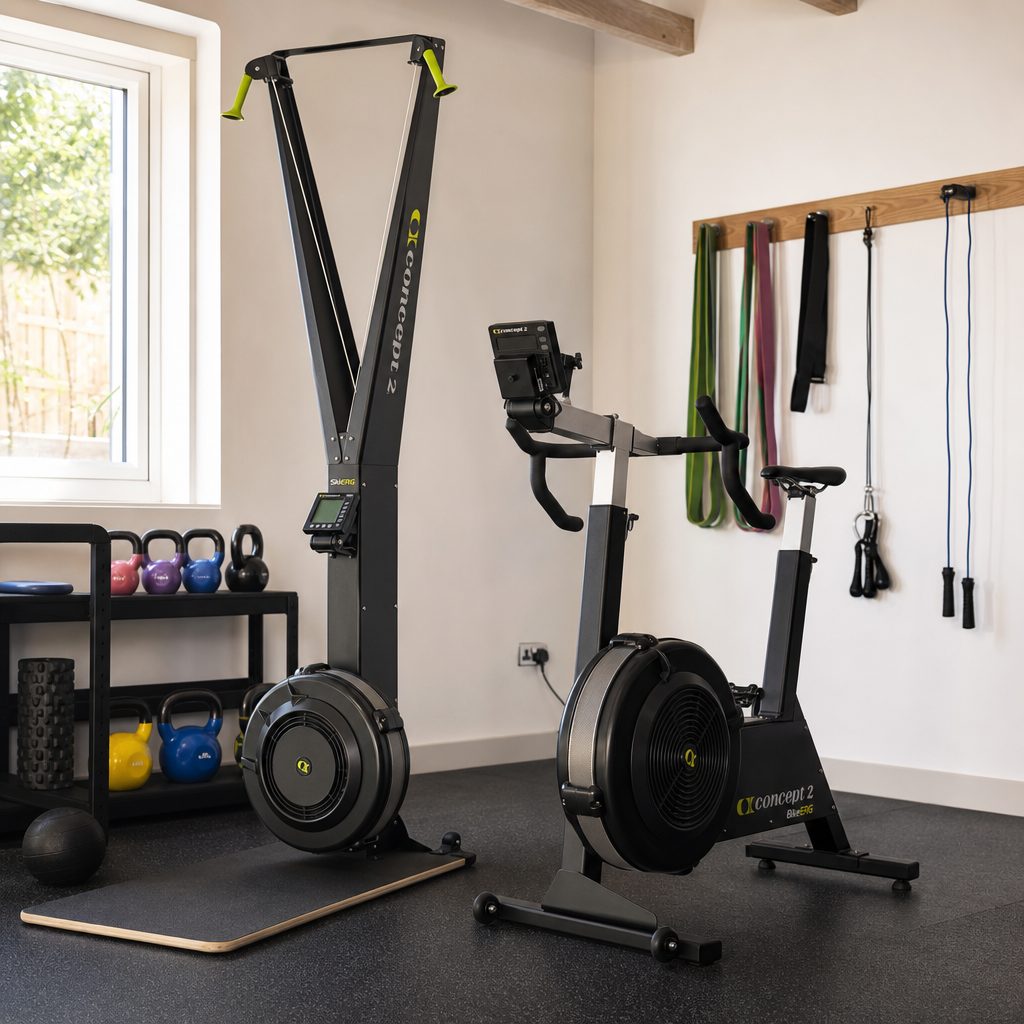
Air resistance rises with effort: on both machines, the fan gives you immediate feedback without relying on a subscription-led resistance system.
Concept2 SkiErg and HYROX-style preparation
The SkiErg has a particularly clear place for anyone building confidence in a ski-pulling movement for fitness racing or conditioning sessions that include it. Technique matters. A machine that seems simple from across the gym becomes much less simple when you are trying to maintain an efficient rhythm after running, lifting, carrying or performing other demanding work. The most useful home advantage is not that a SkiErg somehow removes the need to train. It is that it lets you practise the exact broad pattern repeatedly and learn how to settle into it.
A sensible SkiErg-focused session can take several forms. You might use controlled intervals where the priority is maintaining a repeatable stroke shape. You might use a steady session to develop the ability to keep moving without turning every pull into a desperate arm yank. Or you might pair short bouts with other movements, learning how your breathing and posture change when you come to the handles already tired. The machine gives you a reliable environment for that work: same fan, same PM5 pacing logic, same damper position if you choose to keep it there.
The BikeErg is not irrelevant to this kind of conditioning. Far from it. It is excellent for building general aerobic capacity through low-impact cycling and for adding leg-led intervals without repeatedly loading the upper body. If you are preparing for a demanding event, that can be useful support work. The BikeErg can help you spend time at a controlled effort, recover between harder sessions and develop the habit of working continuously. It simply does not teach the SkiErg pull.
This distinction matters because sport-specific training and general fitness are not the same thing. The SkiErg is the more specific machine where double-pole skiing performance is relevant. The BikeErg may be the better tool for many people's overall weekly programme because it is easier to use frequently and can be kinder on an upper body that already has plenty going on. There is no rule saying the person who needs the most specific tool should use it for every cardio session.
A practical HYROX-minded split
Use the SkiErg when you need to practise the SkiErg movement itself, especially pacing and rhythm under fatigue. Use cycling sessions for aerobic volume when you want to train without adding more repeated overhead pulling. Specificity and recovery can happily live in the same programme.
For the home-gym buyer who has no event on the calendar, the SkiErg still makes sense if the movement genuinely appeals. Plenty of people enjoy the feeling of a powerful pull and hinge more than sitting on a saddle. The question is whether you are attracted to the SkiErg because you like how it trains, or because it looks impressively difficult. Only the first reason tends to survive a few months of ownership.
There is also an accessibility point that can be overlooked in discussions obsessed with race training. The SkiErg can be used seated, standing or from a wheelchair with the optional extra-wide stand. That flexibility makes it relevant beyond any one competitive trend. It is a machine with a very specific movement, yes, but it can be adapted to several different positions and training contexts.
PM5 monitor, ErgData and connected training
Here, at last, the comparison becomes almost a draw. The SkiErg and BikeErg both use the PM5 Performance Monitor, Concept2's straightforward, information-led console. It displays workout data including watts, pace, distance, speed and calories. It includes several built-in workouts. It also supports Bluetooth and ANT+ wireless connectivity, allowing it to connect with apps including ErgData. The BikeErg can also connect to Zwift.
The PM5 is not trying to be a tablet. You will not get a huge cinematic display or a library of glossy destination rides built into the machine. For some buyers, that will feel old-fashioned. For others, it is the point. The monitor gives you a clear target, a repeatable record and a way to log training without asking you to make a lifestyle commitment to a content platform.
ErgData's connection to the Online Logbook is particularly useful if you like seeing training accumulate over time. A single hard session can be satisfying, but consistent data gives you a better picture of what you are actually doing. Are you riding regularly? Are your interval paces becoming more controlled? Are you using the SkiErg often enough to improve technique rather than simply rediscovering soreness? The numbers do not tell the whole story, but they are considerably more reliable than memory after a busy month.
Clear workout metrics
Both PM5-equipped machines can display pace, watts, distance, speed and calories, giving you useful ways to structure steady rides, intervals and pacing work.
Bluetooth and ANT+ compatibility
Wireless connectivity means you can pair the monitor with compatible training apps rather than relying on the console alone.
Online Logbook support through ErgData
ErgData can sync training to the Concept2 Online Logbook, which is handy for people who prefer a simple record of repeatable work.
Which one wins on display? Neither, because the hardware is the same. Which one wins on the way you use that display? That depends on your training. The BikeErg may be easier for long, steady pacing because riding at a chosen output feels familiar. The SkiErg can be more useful when you want to watch pace closely whilst refining stroke discipline. In both cases, the PM5 makes the machine feel more purposeful than a basic exercise bike console that merely guesses at calories and offers a mysterious "level 12".
The monitor is battery powered by two D-cell batteries, and the flywheel provides power to extend battery life during workouts. That is another quietly sensible bit of engineering. You are not arranging charging cables across the floor, nor are you reliant on a mains socket being exactly where the machine needs to live. In a garage gym, a spare room or a modest flat where plugs are already doing heroic work, that convenience matters.
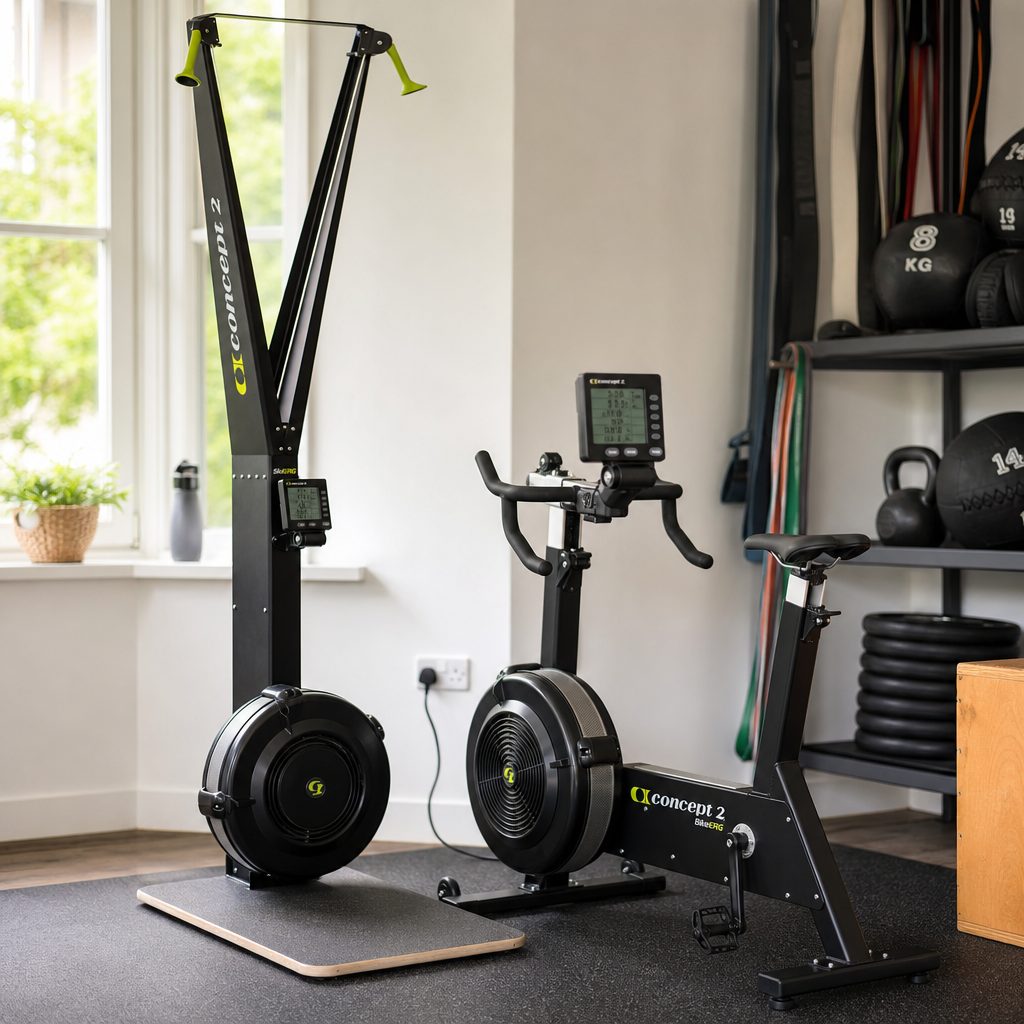
The PM5 gives both machines the same data-led training personality: pace, watts, distance and repeatable workouts rather than a screen full of distractions.
Footprint, ceiling height and the ordinary realities of home gyms
The BikeErg looks like the obvious compact winner because it measures 48 inches long by 24 inches wide when assembled and weighs 68 lb. Those are manageable dimensions for a home exercise bike. Concept2 recommends 60 inches by 48 inches of clearance for use, which is worth respecting rather than pretending that the handlebars and pedals stop at the edge of the frame. You need room to mount, dismount and move naturally.
The SkiErg is more complicated, but often more space-efficient than it first appears. Mounted on a wall, it measures 19 inches wide at the bottom, 20.5 inches wide at the top, 16 inches deep and 85 inches high. In other words, it uses very little floor depth. For a narrow garage wall, a training studio or a room where the central floor needs to stay clear, that can be brilliant. It is almost architectural: vertical, neat and out of the way when not in use.
The catch is height. Eighty-five inches is not a small request, especially in older British homes, converted lofts, low-ceilinged garages or rooms with awkward beams. You also need a wall suitable for mounting. That should be a serious part of the decision, not a cheerful weekend assumption. The SkiErg can instead be fitted to a standard floor stand, where the footprint becomes 23.5 inches wide by 50 inches long. The optional wide floor stand increases that to 32 inches by 52 inches and is intended to suit most wheelchair users.
That means the floor-stand SkiErg is no longer the tiny wall-mounted object you may have pictured. It is still a sensible footprint, but it takes room comparable to a piece of exercise equipment rather than disappearing against a wall. This is where the BikeErg can win for renters or anyone who does not want to mount hardware permanently. It is freestanding from the start. Position it, level it, ride it. There is a lot to be said for boringly simple setup.
| Home-gym question | Concept2 SkiErg | Concept2 BikeErg |
|---|---|---|
| I have very little floor depth | Strong choice when wall mounted: 16in deep. | Needs 48in machine length and 60in recommended use clearance. |
| I have a low ceiling | Check carefully: wall-mounted height is 85in. | More likely to suit because it does not require vertical machine clearance. |
| I cannot or do not want to mount equipment to a wall | Use a standard or wide floor stand. | Freestanding by design. |
| I want wheelchair-friendly use | Optional extra-wide stand can suit most wheelchair users. | Not the comparable option for this use case. |
| I want a machine I can move around more easily | 46 lb machine weight. | 68 lb assembled weight. |
It is worth thinking through the whole room, not merely the machine outline. Where will your phone go? Can you open the door once you are on the BikeErg? Is the SkiErg wall also where you need shelves, a radiator or access to a fuse box? Will the fan noise project into a bedroom or through a party wall? Can you leave enough circulation space that using the machine does not feel like negotiating an obstacle course?
These questions are not glamorous, but they are exactly why some owners adore a machine and others quietly stop using it. The best home gym is not the one that looks like a commercial facility. It is the one that makes starting a session feel low-friction. If you need to shift furniture every time, you will eventually find a reason not to bother.
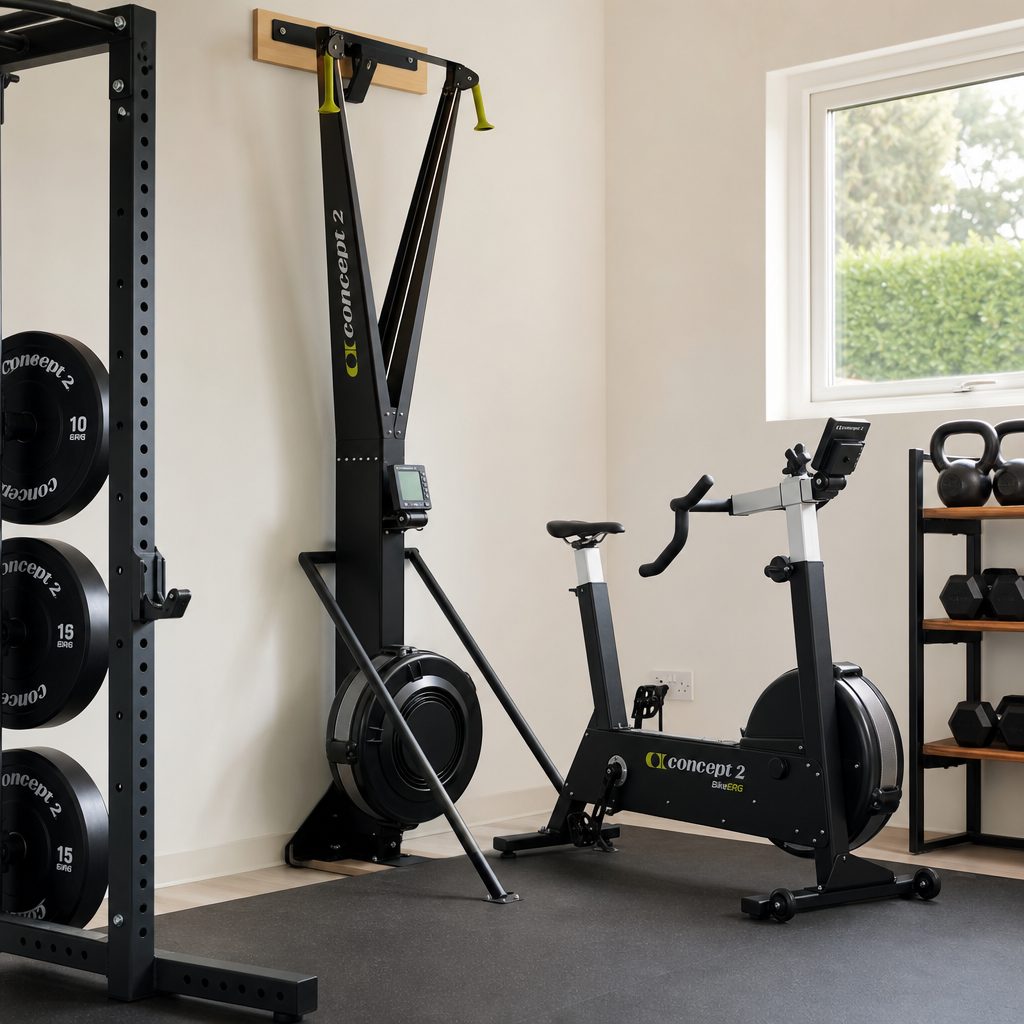
The wall-mounted SkiErg can preserve valuable floor space, but its 85-inch installed height makes ceiling clearance the first measurement to check.
Noise: neither is silent, but one is friendlier
Air resistance comes with a soundtrack. That soft rush of the fan is part of the appeal for plenty of users; it gives immediate physical feedback and feels refreshingly mechanical. But if your home gym shares walls with neighbours, children sleeping upstairs or a partner on a video call, noise is not a decorative concern. It is a buying criterion.
At fan housing setting 5 and a maintained pace of 2 minutes per 500 or 1,000 metres, the SkiErg measured 75 dB and the BikeErg measured 67 dB. The BikeErg is therefore the quieter measured option in this comparison. It remains an air machine, so it is not silent in the way some indoor cycling bikes may be, but it is less noisy than an AssaultBike and its polygroove belt drive is designed to help deliver a quiet ride.
The SkiErg's 75 dB figure is not an argument against it. Many people find it no louder than a dishwasher and quieter than a treadmill. Still, the type of sound matters as much as the number. SkiErg work involves a repeated overhead pull and a moving cord system, so the rhythm can be more noticeable in a quiet room. The BikeErg produces the fan sound of pedalling and benefits from its belt-based drive rather than a chain.
In practical terms, if you train in a detached garage, either is likely to be straightforward. If you are in a flat with thin floors and are trying to fit sessions around family life, the BikeErg has the advantage. You can also make sensible choices with either machine: place it on a stable surface, avoid late-night maximum-effort sprints if your household is sensitive to noise, and understand that harder work drives more air through the fan. The machine cannot be silent precisely because that fan is how it creates resistance.
The quiet-home pick
The BikeErg is the more considerate choice where fan noise is a genuine concern. Its measured 67 dB result at the stated test setting sat below the SkiErg's 75 dB, and its belt drive was designed with quiet operation in mind.
Comfort, adjustability and the question of technique
Comfort is not just about padding. It is about whether the machine lets your body settle into a repeatable position that you can tolerate for the sessions you want to do. The BikeErg has the more familiar comfort conversation because it has a saddle, pedals and handlebars. The standard BikeErg's seat-to-pedal range is 30.75 to 41 inches, while the low-seat version provides a 28.75 to 38-inch range. That gives prospective owners a useful indication of fit before they buy.
One of the BikeErg's particularly appealing details is that it accepts most standard bike parts. You can swap saddles, handlebars and pedals to personalise the setup. For anyone who cycles outdoors, has a favourite saddle or simply knows that standard bike contact points matter to them, that flexibility is valuable. It makes the machine feel less like a sealed appliance and more like a training platform you can make your own.
The BikeErg also has a clutch, so the flywheel continues spinning when you stop pedalling, much like a real bicycle. That may sound like a technical footnote, but it helps preserve a familiar cycling feel. You can ease off briefly without the flywheel instantly behaving as though somebody has applied the brakes. Again, it is not dramatic. It is just sensible.
The SkiErg's comfort is more about movement quality and setup than it is about contact-point customisation. You grip the handles, stand at a workable distance and learn to coordinate the pull with your hips and trunk. The return phase matters. Rushing back into the overhead position can make you feel frantic. Letting the arms and body return with control gives the next pull somewhere to go. The more you use your trunk and hips rather than yanking solely with the arms, the more comfortable and sustainable the motion tends to feel.
This is why beginners should not be intimidated by the SkiErg, but should respect it. Start with a manageable effort. Learn what an organised stroke feels like. Give yourself time to develop a rhythm before judging whether you like the machine. The BikeErg can feel more welcoming on day one, which is a real strength, not a shallow one. Yet some people who initially find the SkiErg unusual come to enjoy its distinctive full-body cadence enormously.
BikeErg comfort strengths
- Familiar cycling position and pedal action for most users.
- Seat-to-pedal range of 30.75–41in on the standard model.
- Low-seat version offers a 28.75–38in seat-to-pedal range.
- Most standard saddles, handlebars and pedals can be swapped in.
BikeErg comfort considerations
- A saddle is still a saddle; not everyone enjoys long seated sessions.
- The movement focuses more heavily on the legs than the SkiErg's whole-body pull.
- Personalising parts can be helpful, but it also means you may discover preferences you did not know you had.
- Its lower overall profile does not remove the need for sensible floor clearance around the machine.
Ownership, maintenance and power without fuss
Concept2's reputation rests heavily on straightforward engineering, and these two machines follow that same general logic. The SkiErg uses an air-resistance flywheel and a 10-level damper. The BikeErg uses air resistance too, but its drive uses high-strength polygroove belts rather than a chain. Those belts are self-tensioning, designed to extend life and reduce maintenance. For a home user who wants to train rather than continually tinker, that is exactly the sort of detail that matters.
The BikeErg's belt drive is especially attractive if you have lived with a chain-driven indoor machine and found the cleaning, lubrication or noise less charming than the marketing brochure suggested. The belt arrangement supports the BikeErg's smoother and quieter character. It also suits the machine's role as the everyday cardio option: get on, ride, wipe down, get on with your life.
The SkiErg has a different physical arrangement, but the ownership philosophy is similar. There is no giant touch display to become obsolete, no dependency on a subscription for basic workout functionality and no requirement to locate a wall socket just to see your pace. Both PM5 monitors take two D-cell batteries and draw power from the spinning flywheel during a workout, extending battery life. That arrangement is wonderfully practical in a garage gym where electrical outlets can be scarce or inconvenient.
Warranty coverage is equally reassuring. Concept2 provides a five-year warranty on the frame and a two-year warranty on the SkiErg monitor and moving parts. The BikeErg has a five-year frame warranty and a two-year warranty on parts. At this level of investment, it is good to see the fundamental structure covered for a substantial period rather than treating the frame as a disposable part of the purchase.
Neither machine asks you to become a technician, but neither is immune to the realities of ownership. You will want a clean, stable training area. You will want to use the machine with reasonable technique rather than slamming through every interval. You will want to give yourself enough room around it that it is not constantly knocked, dragged or pressed against other kit. The good news is that the central system is refreshingly uncomplicated. Fans spin. You work. The monitor records it. There is a certain beauty in that.
Concept2 SkiErg vs BikeErg price and value in the UK
Both machines occupied the premium end of the home cardio market, but the pricing comparison is unusually straightforward because their official US prices were the same: $1,100 plus applicable tax and shipping. In the UK, the SkiErg with the optional wide floor stand was listed at £1,080 plus applicable tax and shipping, while the BikeErg was listed at £1,160.
It would be easy to declare the SkiErg the bargain from those UK figures, but that would be too simplistic. The SkiErg price quoted here included the optional wide floor stand, while a wall-mounted installation is a different arrangement altogether. The BikeErg arrives as a self-contained bike platform with its own particular strengths: a compact assembled 48in by 24in footprint, a belt drive, a clutch and the ability to accept most standard bike components.
Concept2 SkiErg with optional wide floor stand
Plus applicable tax and shipping; wide stand can suit most wheelchair users.
Concept2 BikeErg
UK listed price; a freestanding air-resistance cycling machine with PM5.
Value, then, should be judged through use rather than a bare price gap. The SkiErg offers a very unusual training motion, a high 500 lb user weight limit and several usable positions. If you need those things, its value can be excellent because there are not many alternatives that occupy the same niche. If you do not need them, the very feature that makes it special may make it less compelling.
The BikeErg's value lies in routine friendliness. It is a familiar movement, has a lower measured sound level than the SkiErg in the stated test, fits standard bike parts and supports low-impact cycling sessions with a proper air-resistance feel. For a household where more than one person may use it, that recognisability can matter. People are more likely to ride something they understand immediately.
Neither is a budget purchase. That is exactly why it is worth resisting the urge to buy based on a single specification. A few centimetres of clearance, the ability to wall mount, the preference for standing versus sitting, or whether you need a machine that supports a particular form of accessibility can outweigh a modest price difference very quickly.
Think in years, not weeks: the value case is strongest when the machine suits your normal training behaviour. A premium cardio machine that is comfortable, accessible and easy to start will usually earn its place more convincingly than one bought for an aspirational version of your routine.
Which Concept2 machine is best for each type of home-gym buyer?
There is no meaningful overall winner because the two machines are trying to solve different problems. Still, most shoppers do not want an essay ending with "it depends" and a vague wave of the hand. Here is the useful version: a clear recommendation based on the kind of buyer you are and the room you actually have.
Best for ski-pull specificity: Concept2 SkiErg
View Concept2 SkiErg on Amazon UK
Choose it if you want to practise a double-pole skiing motion, develop rhythm on the handles and add upper-body and core work to your conditioning.
Best all-round routine machine: Concept2 BikeErg
View Concept2 BikeErg on Amazon UK
Choose it if cycling feels natural, you want frequent cardio sessions and you value a straightforward seated format that is easy to repeat.
Best for minimal floor depth: Concept2 SkiErg
Wall mounted, it is only 16in deep. Check the 85in height and wall suitability carefully before deciding it is the tidy-room solution.
Best for shared homes: Concept2 BikeErg
Its measured 67 dB result at the stated setting was lower than the SkiErg's 75 dB, making it the more neighbour-friendly option.
Best for adaptable access: Concept2 SkiErg
The optional extra-wide floor stand can suit most wheelchair users, and the machine can be used standing, seated or from a wheelchair.
Best for a higher user limit: Concept2 SkiErg
The SkiErg supports a maximum user weight of 500 lb, compared with the BikeErg's 300 lb maximum user weight.
For a first home cardio machine, I would generally lean towards the BikeErg if you have no strong preference. Cycling is easy to understand, the footprint is predictable, and the ability to change saddle, handlebar and pedal components is a welcome bonus. It is the machine most likely to slot into an ordinary weekly routine without asking you to learn much before you begin.
I would lean towards the SkiErg when the training goal is deliberate. You want that pulling pattern. You enjoy full-body conditioning. You need a machine that does not consume central floor space when wall mounted. You are training around an injury and appreciate seated or kneeling possibilities. Or you need the versatility of the wide stand. In these cases, the SkiErg is not merely a quirky alternative to cycling. It is the more appropriate tool.
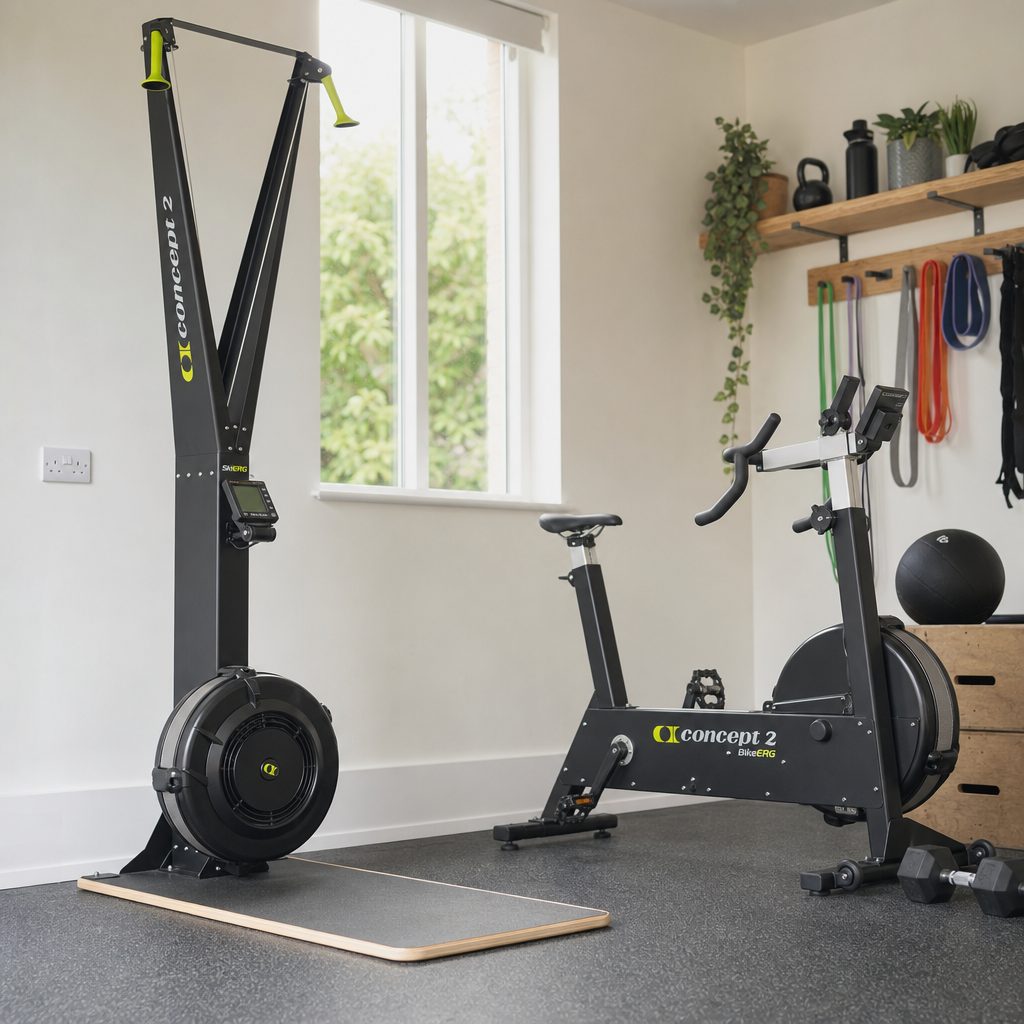
The right choice is less about which machine looks harder and more about which movement, footprint and training role will fit your real week.
Frequently asked questions
Yes, in the sense that the SkiErg's double-pole skiing movement involves far more than the arms. The lats, triceps, shoulders and core all contribute, while the hips, glutes and hamstrings help create a connected drive. It is not a substitute for every strength exercise, but it is a notably whole-body form of cardio compared with seated cycling.
For most people, yes. Pedalling is familiar and the BikeErg's basic movement requires less learning than the SkiErg's overhead pull, hinge and return. That does not mean the BikeErg is easy once you raise the effort. It simply means the technique barrier is lower, which can be valuable when you want a machine the whole household can understand quickly.
The SkiErg is the more specific choice if you need to become comfortable with the SkiErg movement itself. It lets you practise rhythm, pacing and technique on the double-pole pull. The BikeErg remains useful for general aerobic conditioning and leg-led interval work, but it does not replace movement-specific time on a SkiErg.
It depends on the shape of your room. A wall-mounted SkiErg is just 16 inches deep and 19 to 20.5 inches wide, but it stands 85 inches high. The BikeErg measures 48 inches by 24 inches assembled and has a recommended use clearance of 60 inches by 48 inches. For very little floor depth, the wall-mounted SkiErg wins. For rooms with limited ceiling height or no suitable wall, the BikeErg is often simpler.
In the stated measurement at fan housing setting 5 and a maintained 2-minute pace, the BikeErg measured 67 dB and the SkiErg measured 75 dB. Both are air-resistance machines, so both make fan noise, especially during hard work. The BikeErg is the quieter choice on those measured figures and uses a belt drive designed for quiet running.
Yes. Both use the PM5 Performance Monitor. It can display pace, watts, distance, speed and calories, includes built-in workouts, and connects through Bluetooth and ANT+. Both can sync through ErgData to the Concept2 Online Logbook. The BikeErg can also connect with Zwift.
No. The PM5 monitor on both machines uses two D-cell batteries. During workouts, the spinning flywheel provides power to help extend battery life. That makes either machine especially convenient for garage gyms and spaces where a convenient plug socket is not available.
Yes. The BikeErg fits most standard bike parts, allowing owners to swap saddles, handlebars and pedals. That is a real advantage for cyclists who already know what contact points work for them, or for households where the stock setup is not the ideal fit for every rider.
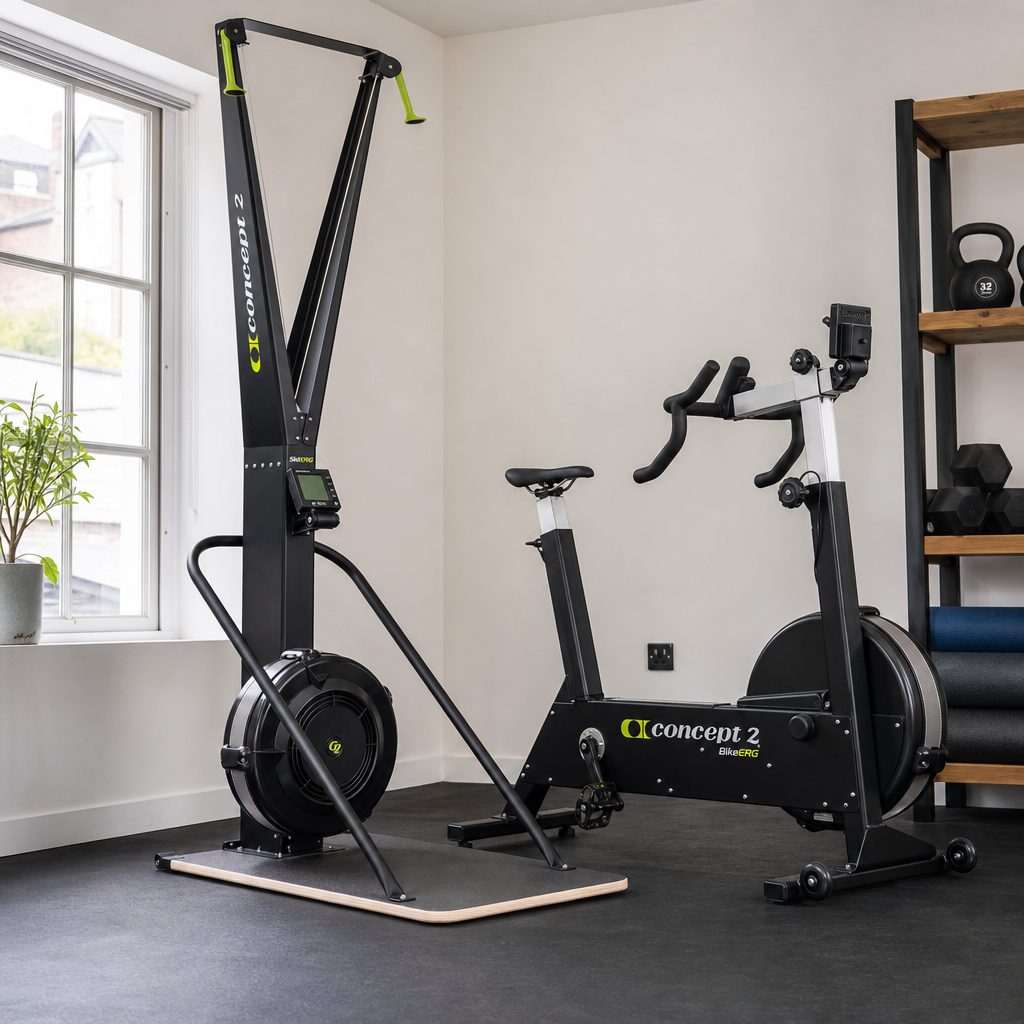
The final choice comes down to your training reality: a full-body pulling pattern and vertical storage, or familiar cycling in a compact freestanding format.
Final verdict: SkiErg for specificity, BikeErg for everyday cycling
The Concept2 SkiErg is the better buy for the person who wants a genuinely different full-body cardio movement, needs to train the double-pole skiing pattern, values the 500 lb maximum user weight, or can make good use of standing, seated, kneeling or wheelchair-compatible training with the optional wide stand. Wall mounted, it is also the smart answer for a room where floor depth is precious but 85 inches of height is available.
The Concept2 BikeErg is the better buy for the broadest group of home users. It offers familiar cycling, a 48in by 24in assembled footprint, a lower measured noise figure of 67 dB at the stated test setting, a self-tensioning belt drive, a clutch and the option to fit most standard saddles, handlebars and pedals. It is the machine I would favour if the priority is frequent, low-fuss cardio that several people are likely to use.
Both deliver the same clear PM5 data, battery-supported monitor power, Bluetooth and ANT+ connectivity, air-resistance honesty and five-year frame warranty. So do not choose by badge, monitor or marketing. Choose by movement. If you want to pull, hinge and practise SkiErg-specific conditioning, buy the SkiErg. If you want to pedal consistently for years, buy the BikeErg. That is the whole answer, and thankfully it is a useful one.