Best Recovery Percussion Guns for Under £300
The sensible massage-gun shortlist for UK gym-goers: genuinely useful Hyperice and Therabody options, quieter choices for flats and evening use, and value picks that focus on recovery rather than trying to win a meaningless spec-sheet arm wrestle.
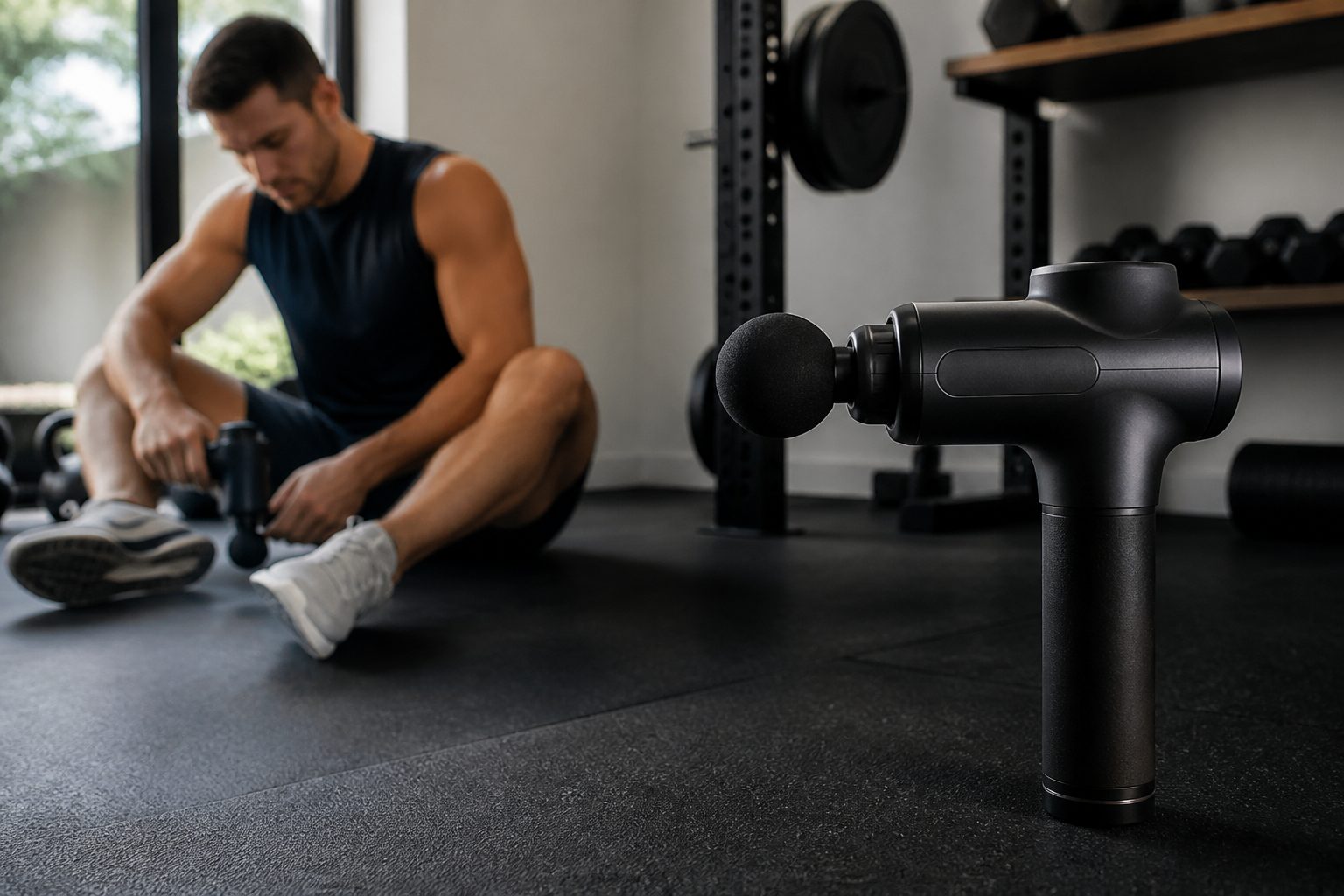
A percussion gun is most useful when it earns a place in your ordinary recovery routine: after training, before a warm-up, or during the familiar next-day stiffness shuffle.
 By James Oduya · Staff Writer & Home Gym Columnist · Updated October 30, 2026
Why the best recovery gun is not automatically the most brutal one
Percussion guns became one of fitness's more enthusiastic categories. For a while, every new model seemed to promise a bigger motor, a more heroic stall-force figure and enough attachments to open a small plastic-head museum. The reality is pleasantly less dramatic. A good percussion gun should be easy to pick up, comfortable to hold at an awkward angle, quiet enough that you actually use it, and controlled enough that your calf does not feel as though it has been introduced to industrial machinery.
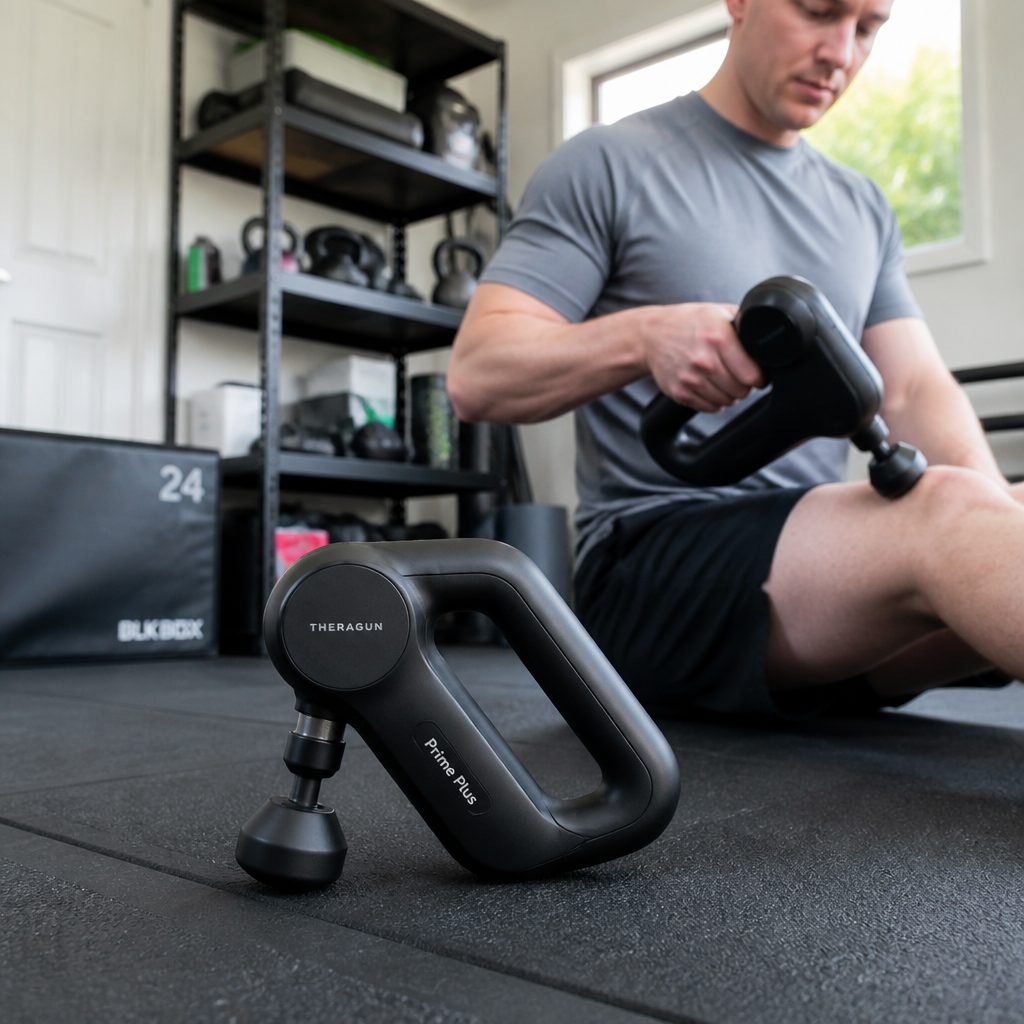
Noise changes the ownership experience more than raw specifications suggest, especially if recovery tends to happen after work, after children are asleep, or in a flat with enthusiastic acoustics.
For most people training in a commercial gym, home gym or local club, the useful job is straightforward: use short bouts of percussion around a warm-up, after lifting, following a long ride, or when your shoulders have spent the day impersonating coat hooks over a laptop. It is a recovery and comfort tool, not a medical cure, a substitute for sleep, or a licence to ignore a proper injury. That sounds stern. It is merely the bit worth remembering.
This guide prioritises models that make sense in normal life. Hyperice and Therabody remain here because their better-known guns bring useful ergonomics, app support or deeper travel without straying into professional-tier excess. Alongside them are Bob and Brad, RENPHO and TOLOCO options that are less intimidating to buy, easier on a shared living space and often more than adequate for everyday muscle care.
A quick safety note: avoid using percussion directly over bones, the front of the neck, fresh bruising, numb areas or an acute injury. If you have a circulatory condition, neuropathy, are pregnant, take blood-thinning medication or are dealing with persistent pain, get advice from an appropriate clinician before making a massage gun part of your routine.
What matters when choosing a percussion gun
It helps to separate the numbers that affect the experience from the numbers that merely look impressive on a product page. Amplitude is the distance the head travels in and is usually the clearest shorthand for whether a gun feels surface-level or reaches deeper into a large muscle group. The Theragun Prime's 16mm amplitude is properly deep for this category; the Hypervolt 2's 12mm is still substantial; and the Bob and Brad C2's 8mm is a gentler, more everyday proposition.
Speed matters too, but it is not a contest to use maximum speed. Lower settings can be excellent for easing into a warm-up or treating a sensitive area. Faster percussion has its place on dense muscles such as glutes and quads, particularly after training, but it is not automatically better. If you are gripping your teeth and calling it recovery, you have probably overshot the brief.
Noise is more important than it first appears. A slightly louder massage gun does not make it bad, but it changes when you will reach for it. The difference between a tool that can run beside a sleeping child, a phone call in the next room or a quiet evening and one that feels like a power drill is enormous in practice. That is why the RENPHO Active and TOLOCO deserve attention despite their more modest positioning.
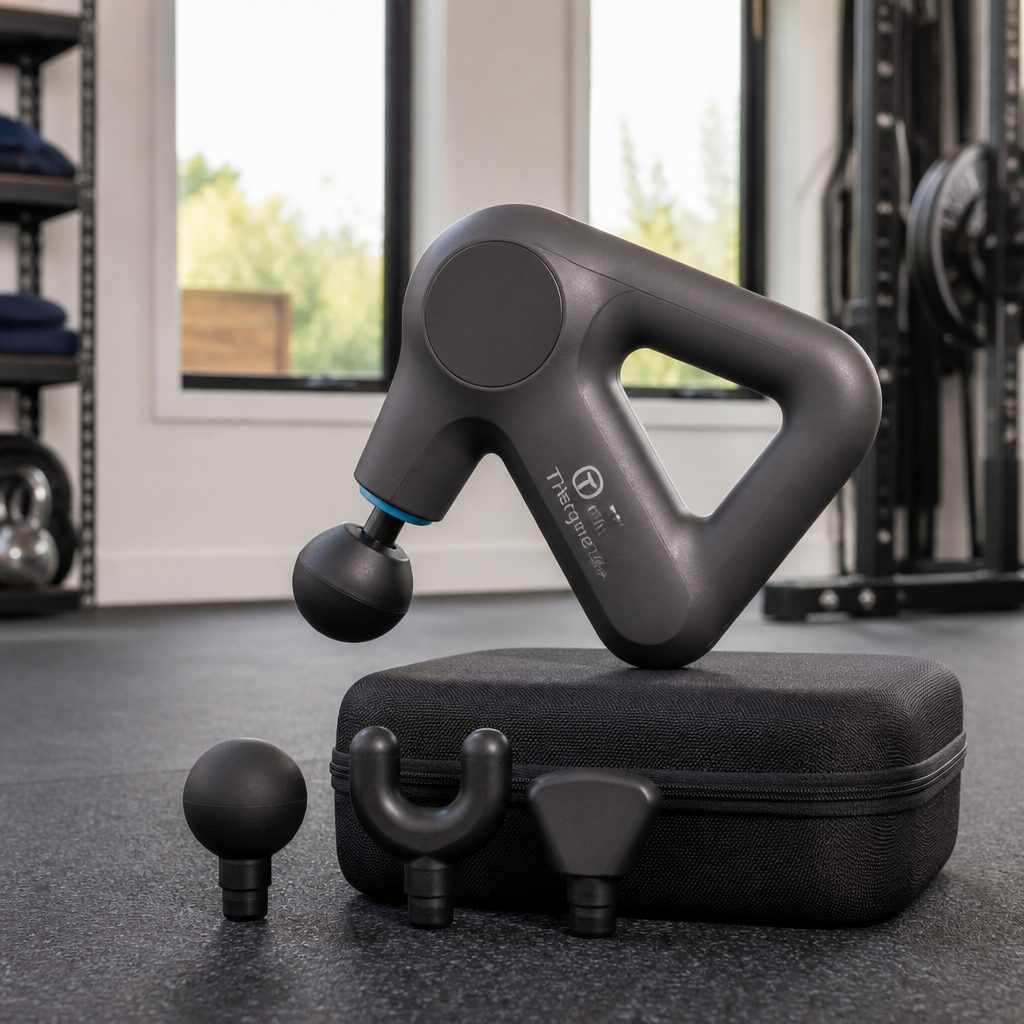
Attachments should solve ordinary problems rather than clutter a drawer: a ball for large muscles, a fork for either side of the spine, and a softer head for more sensitive areas cover most people nicely.
At-a-glance: the recovery guns in this roundup
The table below deliberately avoids pretending that one figure tells the full story. These are tools with different personalities. Some suit deeper, deliberate post-leg-day work; others are better for a quick, quiet five minutes after sitting all day or before you head out for a run.
| Model | Best use | Amplitude | Speed range | Noise figure | Positioning |
|---|---|---|---|---|---|
| Hyperice Hypervolt 2 | Balanced app-led recovery | 12mm | 2,000–2,700 PPM | 53–64 dB | Premium mid-range |
| Theragun Prime | Deep-tissue work | 16mm | 1,750–2,400 PPM | QuietForce technology | Premium |
| Bob and Brad C2 | Everyday all-round use | 8mm | 2,000–3,200 RPM | 58–64 dB | Budget-friendly |
| Bob and Brad Q2 Mini | Travel and desk drawer use | Compact format | Five speeds | Not confirmed | Compact budget |
| RENPHO Active | Low-noise home recovery | 10mm | Up to 3,200 RPM | Below 40 dB | Budget-friendly |
| TOLOCO Massage Gun | Attachment variety | 12mm | Up to 3,200 RPM | 40–50 dB | Entry-level |
The ranked picks
These rankings are use-case led rather than a simplistic "most powerful wins" list. That is intentional. A large-amplitude Theragun can be the right answer for one lifter and a needlessly hefty answer for another. Meanwhile, a quieter RENPHO may be the one that actually gets used four times a week. Consistency has a habit of beating bravado.
1. Bob and Brad C2 — Best for everyday all-round recovery
The Bob and Brad C2 is the sensible default for most people who want a proper percussion gun without buying into the premium end of the market. Its 8mm amplitude does not claim deep-tissue supremacy, but that is part of why it works so well as an all-rounder. It is approachable on calves, shoulders, forearms and post-session quads, and less likely to persuade a first-time user that recovery equipment is a punishment device.
Five speeds span 2,000 to 3,200 RPM, there are five attachments, and the brushless motor is backed by a quoted 35lb stall force. It weighs 1.5lb, has a compact 6.8 by 5.1 by 2.4-inch body, and its USB-C charging is a genuinely practical touch. The claimed three-to-four-hour battery life is also ample for normal personal use. You should not need to charge a massage gun every other session unless you are running a very busy changing-room sideline.
Pros
- Compact, light 1.5lb design is easy to control one-handed.
- Five attachments and five speeds cover the normal recovery basics.
- USB-C charging is much more convenient than a proprietary cable.
Cons
- Its 8mm amplitude is gentler than the premium deep-tissue picks.
- The 58–64 dB operating range is not especially discreet in a quiet room.
2. Hyperice Hypervolt 2 — Best for polished guided recovery
The Hyperice Hypervolt 2 is the pick for someone who values a refined, easy-going recovery tool and will make use of app guidance rather than treating Bluetooth as a badge of modernity. Its three settings run at 2,000, 2,350 and 2,700 PPM, corresponding to 33Hz, 40Hz and 45Hz. That is a restrained, useful range rather than a scattergun list of levels you will never meaningfully distinguish.
With 12mm of amplitude, the Hypervolt 2 sits in a happy middle ground: deeper and more purposeful than many affordable compact models, but not quite as forceful in character as the 16mm Theragun Prime. It includes five heads — fork, bullet, flat, cushion and round — and its three-level pressure sensor is excellent feedback for the user who tends to press too hard. We have all met that person. Sometimes it is us.
The 1.8lb weight and approximately three-hour battery life make it practical for regular use, whilst the compact proportions help when working around the upper back and hips. Third-party testing has put it in the 53–64 dB bracket. It is not silent, but lower settings are the more civilised choice for late-evening use.
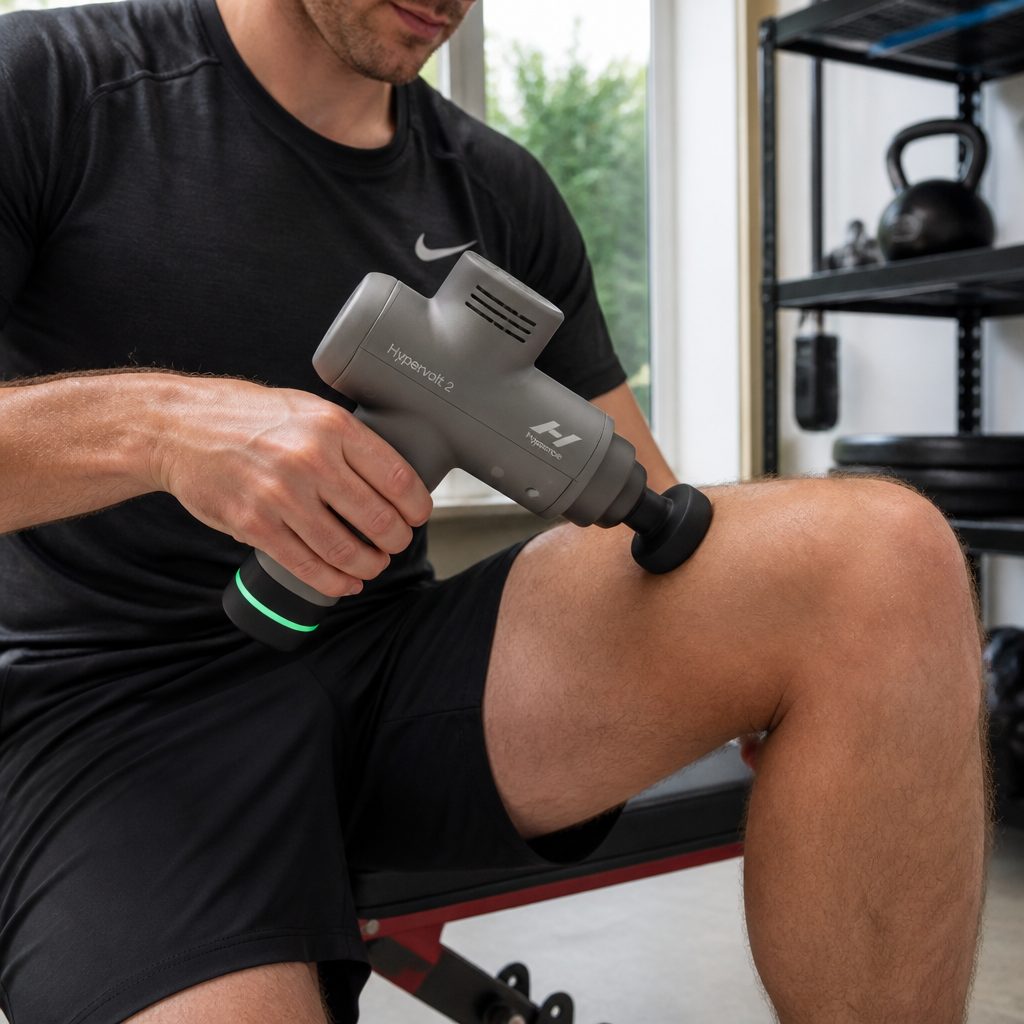
The Hyperice Hypervolt 2's pressure indicator is more useful than it sounds: it encourages measured pressure instead of turning every session into a contest with your own hamstring.
Pros
- 12mm amplitude suits a broad mix of warm-up and recovery work.
- Pressure-sensor lights provide useful real-time feedback.
- Hyperice App support adds structure for users who like guidance.
Cons
- Only three physical speed settings.
- Noise rises into the mid-60 dB region at the harder end of use.
3. Theragun Prime — Best for deeper post-training work
The Theragun Prime is the heavyweight recovery choice here, not because it is automatically right for everyone, but because its 16mm amplitude gives it a notably different feel. If your training revolves around heavy lower-body sessions, longer runs, hard cycling blocks or simply dense, stubborn-feeling glutes and quads, that extra stroke length is meaningful. It delivers slower, deeper percussion rather than merely buzzing at the surface.
There are five speeds from 1,750 to 2,400 PPM, 30lb of stall force, four attachments and Bluetooth connection to the Therabody app. The included Dampener, Standard Ball, Thumb and Micro-point are sensibly curated rather than excessive. The 120-minute runtime is less expansive than the Hypervolt 2 or Bob and Brad C2 on paper, but it remains plenty for individual recovery use. It also has an approximately 80-minute charging time, a two-year UK warranty and a 10-foot drop rating.
At 990g, the Prime is not a featherweight. That weight can feel reassuring over bigger muscles, but it is less relaxed to manoeuvre around your own traps or reach behind the shoulder after an upper-body session. QuietForce technology helps keep the experience more civilised than old-school Theraguns, although a manufacturer sound figure was not published. Buy it for depth and build confidence, not because you want the smallest object in your gym bag.
The deeper-gun reality check
More amplitude gives you a different tool, not a universal upgrade. A 16mm gun can feel excellent on glutes and thighs, but a softer, shallower model may be preferable around tender shoulders, forearms or an already irritated calf. Start lower than you think, then adjust.
4. Bob and Brad Q2 Mini — Best for travel, work bags and quick sessions
Shop Bob and Brad Q2 Mini on Amazon UK
The Bob and Brad Q2 Mini is for the person who will never pack a full-size massage gun, no matter how admirable its stall force may be. It is a pocket-sized model with five speed settings, a carry case and a two-to-four-hour battery life. Those are exactly the features that make it realistic for a weekend away, a work bag, a race-day kit list or the drawer beside your desk.
The smaller format naturally asks you to reset expectations: it is best for targeted calves, forearms, shoulders, feet and brief warm-up work rather than trying to replicate a large, deep-stroke gun on tired quads.
For runners and travellers, compactness is not a compromise if it means the tool comes with you. A heavy recovery gun left at home has a very poor attendance record.
5. RENPHO Active — Best for genuinely quiet home use
The RENPHO Active makes a very clear argument: practical percussion without filling the room with motor noise. Its claimed output below 40 dB is quieter than normal conversation, which is remarkable beside the more conventional 50–60 dB figures elsewhere in this guide. If you want to use a massage gun whilst watching television, winding down in the evening or sharing a room with somebody who has not volunteered to hear your recovery routine, that matters.
It offers 10mm amplitude, five speeds up to 3,200 RPM, five interchangeable heads and a brushless motor. Battery life is stated at more than three hours, and USB charging keeps ownership simple. This is not the machine to choose if you specifically want the deep 16mm travel of the Theragun Prime, but it does not need to be. Its charm is that it makes a small, regular recovery ritual feel easy rather than disruptive.
Pros
- Below-40 dB claim makes it the quiet-use standout.
- 10mm amplitude is respectable for general gym recovery.
- Five heads and USB charging make it straightforward to live with.
Cons
- Not the choice for buyers who specifically want the deepest possible stroke.
- Its appeal is refinement and quietness rather than premium ecosystem features.
6. TOLOCO Massage Gun — Best for attachment variety on a tight budget
The TOLOCO Massage Gun is the entry-level pick for someone who wants to experiment with percussion recovery without making it a major purchase. It brings 12mm amplitude, speeds up to 3,200 RPM and an unusually generous 10 interchangeable heads. The noise range of 40–50 dB is appealing too, especially for a low-cost model, and makes it a more realistic home companion than many cheap guns of the past.
The long attachment list should not be the whole reason to buy it. Most users will settle on a small handful of heads quite quickly. Still, the range is useful if you want to learn what works for larger muscles, feet, upper back muscles or the more targeted areas around the hips. The important caveat is simple: do not assume every attachment should be used everywhere. A broad ball or flat head is the sensible starting point; the more focused options require a gentler hand.
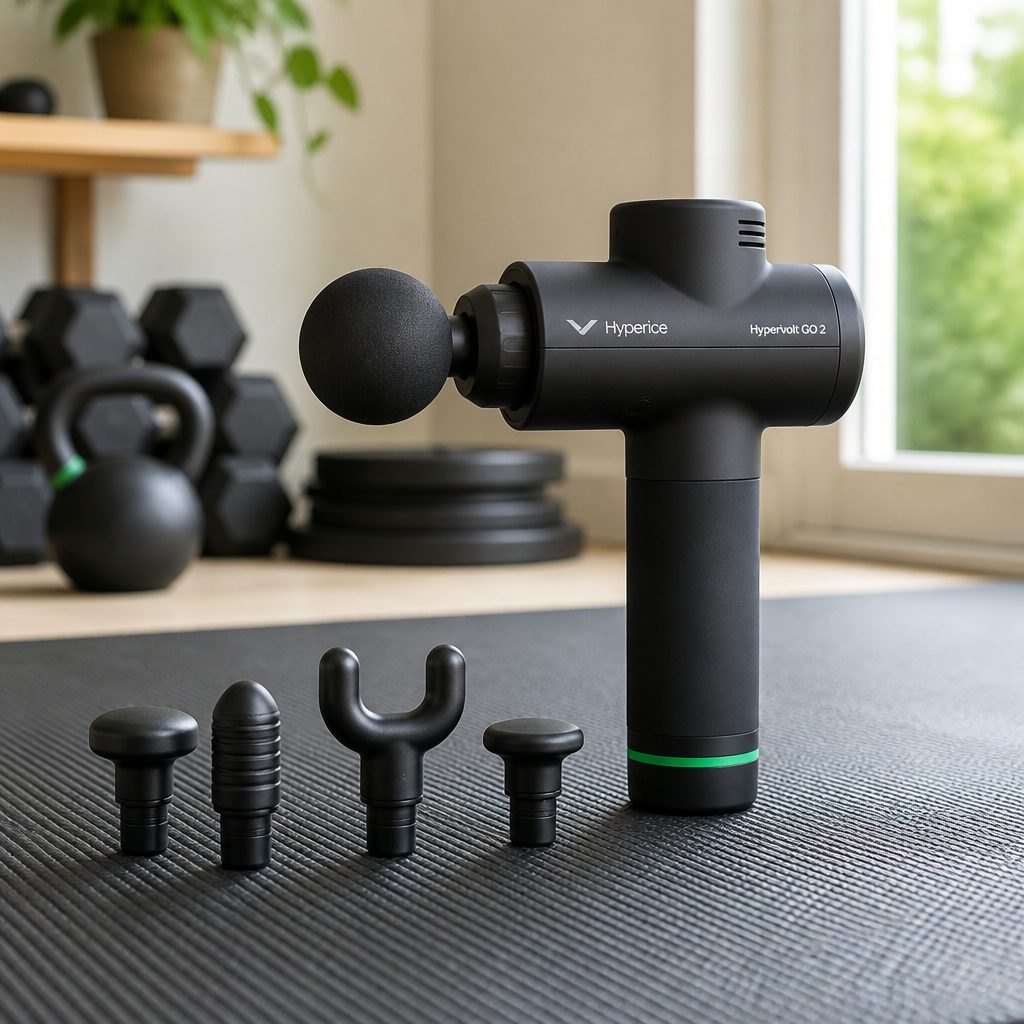
A broad ball attachment is the sensible starting point for glutes, quads and calves; highly focused heads are tools for careful, localised work rather than maximum-pressure bravado.
How the leading models compare in real use
The Hypervolt 2 and Theragun Prime are the premium names worth considering under the cap, but they serve different people. The Hypervolt feels like the smoother all-round system: modestly lighter, with a three-level pressure indicator, five attachments and app support that can make self-treatment less random. It has enough 12mm depth for most gym users without feeling needlessly aggressive.
The Theragun Prime is the more specialised choice. Its 16mm amplitude and 30lb stall force make it better suited to someone actively seeking deep work on larger muscle groups. Yet it is heavier, and its two-hour quoted runtime is shorter. Neither of those is a deal-breaker. They simply illustrate why "premium" and "best for me" are not identical phrases.
For a fast pre-training warm-up
Use a broader head, a low or middle setting, and short passes over the muscles you are about to train. The Hypervolt 2, C2 and RENPHO Active all make this simple. You are preparing tissue for movement, not trying to flatten it.
For post-leg-day stiffness
The Theragun Prime's 16mm amplitude is the deepest option here. The Hypervolt 2 and TOLOCO also provide 12mm travel, which is plenty for many people after squats, deadlifts or a long hilly run.
For evening recovery
Prioritise low measured noise. RENPHO Active is the standout below 40 dB, whilst the TOLOCO's 40–50 dB range makes it much easier to accommodate than louder alternatives.
For travel and race weekends
The Q2 Mini was designed for this job. A supplied carry case, compact format and multi-hour battery life are more important here than trying to carry the biggest gun possible through a station or airport.
Noise levels at a glance
Best-for awards: choose the right kind of recovery
A ranked list is useful, but it can still leave you staring at a shortlist wondering which one is actually yours. These cards are the quicker answer. Think about where you will use it, how much depth you genuinely enjoy, and whether quietness is a non-negotiable rather than a nice extra.
Best all-rounder: Bob and Brad C2
Choose it for a compact, capable and friendly introduction to regular percussion recovery. Its 8mm travel is manageable, its five heads are useful, and USB-C makes it easy to keep charged.
Best premium pick: Theragun Prime
Choose it when deep 16mm percussion is the priority, especially for frequent lower-body training and deliberate post-session work on bigger muscle groups.
Best quiet pick: RENPHO Active
Choose it for a home where noise matters. The below-40 dB claim is the key feature, backed by 10mm amplitude and five speed settings.
Best guided experience: Hyperice Hypervolt 2
Choose it if you appreciate pressure feedback, a more refined design and app support to take the guesswork out of an otherwise rather improvised routine.
Best travel companion: Bob and Brad Q2 Mini
Choose it if portability is the reason you are buying. Its carry case, five speeds and compact format make it an easy bag-friendly option.
Best for experimenting: TOLOCO Massage Gun
Choose it if you want 12mm travel, quieter operation and a large attachment selection without committing to a premium branded system.
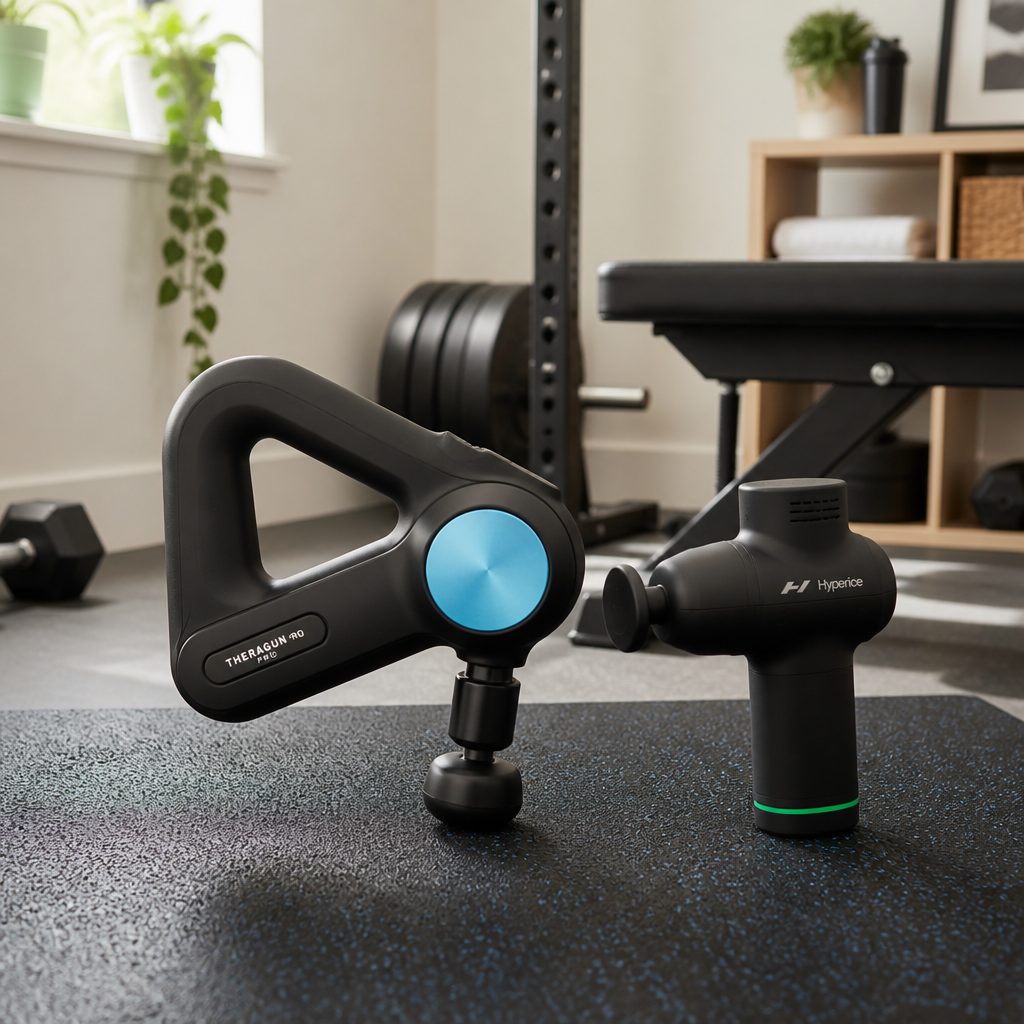
The right recovery gun is the one that fits your actual routine: a deep premium model for serious leg-day work, or a quieter compact device that gets used consistently in a busy household.
A practical recovery routine that does not overdo it
Massage guns work best as a small part of a bigger recovery picture: sensible training progression, sufficient food, hydration, sleep and movement on easier days. No handheld device can negotiate with the consequences of regularly sleeping badly and training like you are auditioning for an action film. It can, however, make you feel looser and more comfortable around a session.
Before training, use roughly 15 to 30 seconds over a muscle area with a soft or broad attachment and lower speed. Keep moving; do not park the gun in one spot and expect a miracle. After training, short passes of around 30 to 60 seconds per area can be enough. Let comfort guide you. Aggressive pressure and long sessions are not proof that the device is working harder.
A better starting point
Start at the lowest useful setting, use the broadest attachment you own, and move steadily. If you feel tingling, sharp pain, numbness or increasing discomfort, stop. Recovery gear should leave the area feeling more settled, not give you a fresh problem to discuss.
Common buying mistakes to avoid
The classic mistake is buying purely by stall force. Stall force tells you how much pressure a motor may tolerate before it slows or stops, but it says little about grip shape, noise, attachment quality or whether you will enjoy using the thing. The Bob and Brad C2's 35lb stall force figure is one data point, but its sensible weight, 8mm amplitude and USB-C convenience are arguably more relevant to daily ownership.
Another is buying too much depth. The Theragun Prime is brilliant for the person who wants its deeper 16mm travel. For someone new to percussion massage, a Hypervolt 2, C2 or RENPHO Active may be more comfortable and therefore more useful. A recovery tool should fit your tolerance as well as your training volume.
Finally, do not chase attachments for their own sake. The TOLOCO's 10-head package is generous, but you can recover extremely well with three heads used properly. A ball, flat head and cushion-style head will handle most ordinary work. The fork is helpful around either side of the spine and Achilles area, but never use it directly on your spine itself. This is an area where calm common sense remains deeply unfashionable but very effective.
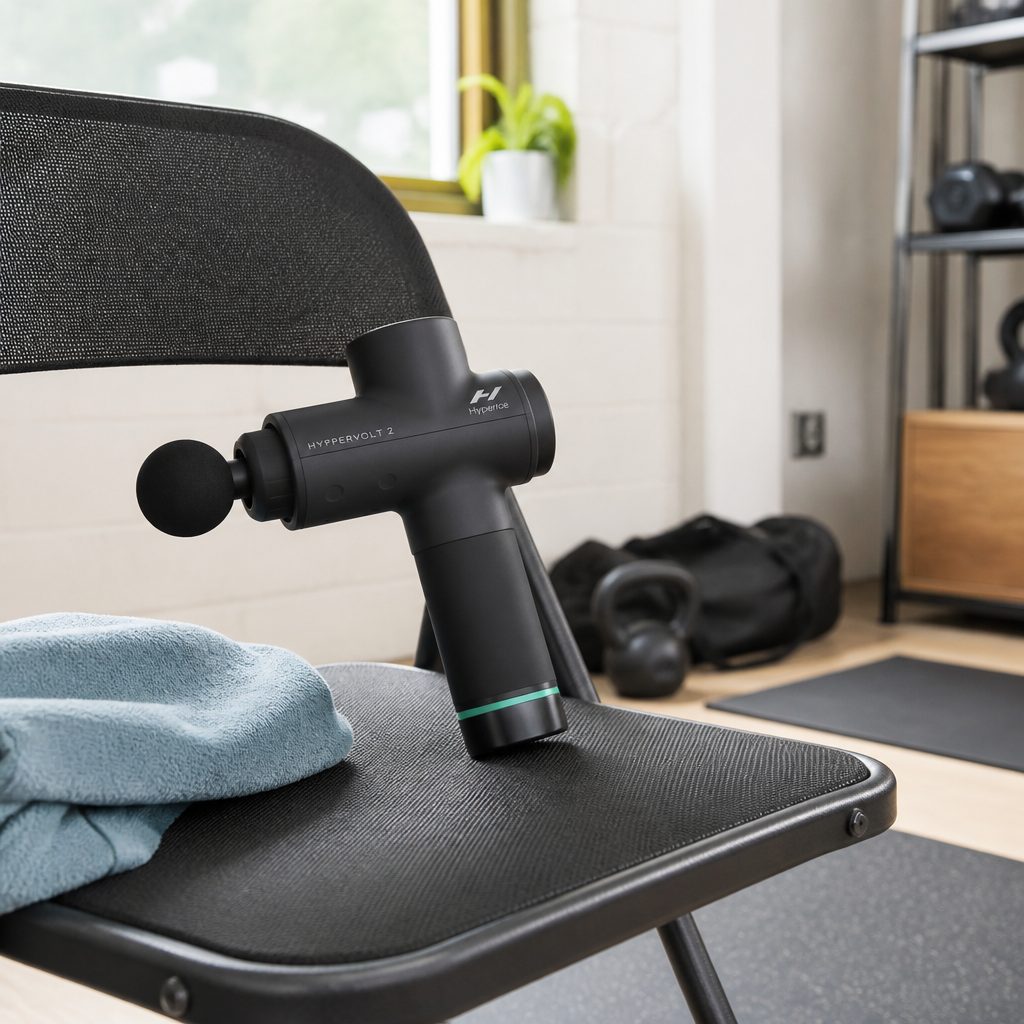
Keep a percussion gun where you can reach it after training, but do not mistake it for a treatment table: careful placement, moderate pressure and short sessions remain the winning formula.
Frequently asked questions
Yes, if you will use it as a convenient comfort and warm-up tool rather than expecting it to replace rest or medical care. A model such as the Bob and Brad C2 or RENPHO Active is particularly easy to justify for regular calves, quads, glutes and shoulders after training.
For general use, 8–12mm is a sensible range. The C2 sits at 8mm, the RENPHO Active offers 10mm, and the Hypervolt 2 and TOLOCO provide 12mm. Choose the Theragun Prime's 16mm only if you specifically want a deeper, more assertive sensation on larger muscles.
The RENPHO Active is the clearest quiet-use recommendation with a claimed output below 40 dB. The TOLOCO's 40–50 dB range is also appealing. The Hypervolt 2 and C2 are louder at their higher settings.
Many people can use one daily in short, comfortable sessions, especially for warm-up or light post-workout work. Keep pressure sensible, avoid tender or injured areas, and do not continue through pain. More force and more minutes are not automatically more productive.
Both can work. Before training, keep it brief and mobile: low or medium intensity, broad attachment, short passes. After training, use it more as a relaxing cooldown tool around muscles that feel tight or worked. It should complement a proper warm-up, not replace it.
Not necessarily, because it has five speeds starting at 1,750 PPM. However, its 16mm amplitude creates a deeper sensation than the other models here. Beginners who are unsure about that may find the Hypervolt 2, C2 or RENPHO Active easier to get comfortable with.
No. The Hyperice App and Therabody app can be useful for guidance and routine ideas, but simple controls are enough if you know where and how gently you wish to work. The best device is usually the one you find intuitive enough to use consistently.
The Hypervolt 2 is TSA approved for carry-on travel, but the smaller Bob and Brad Q2 Mini is the more natural travel-first choice. Its compact format, supplied carry case and two-to-four-hour battery life make it easier to justify packing around other gym kit.
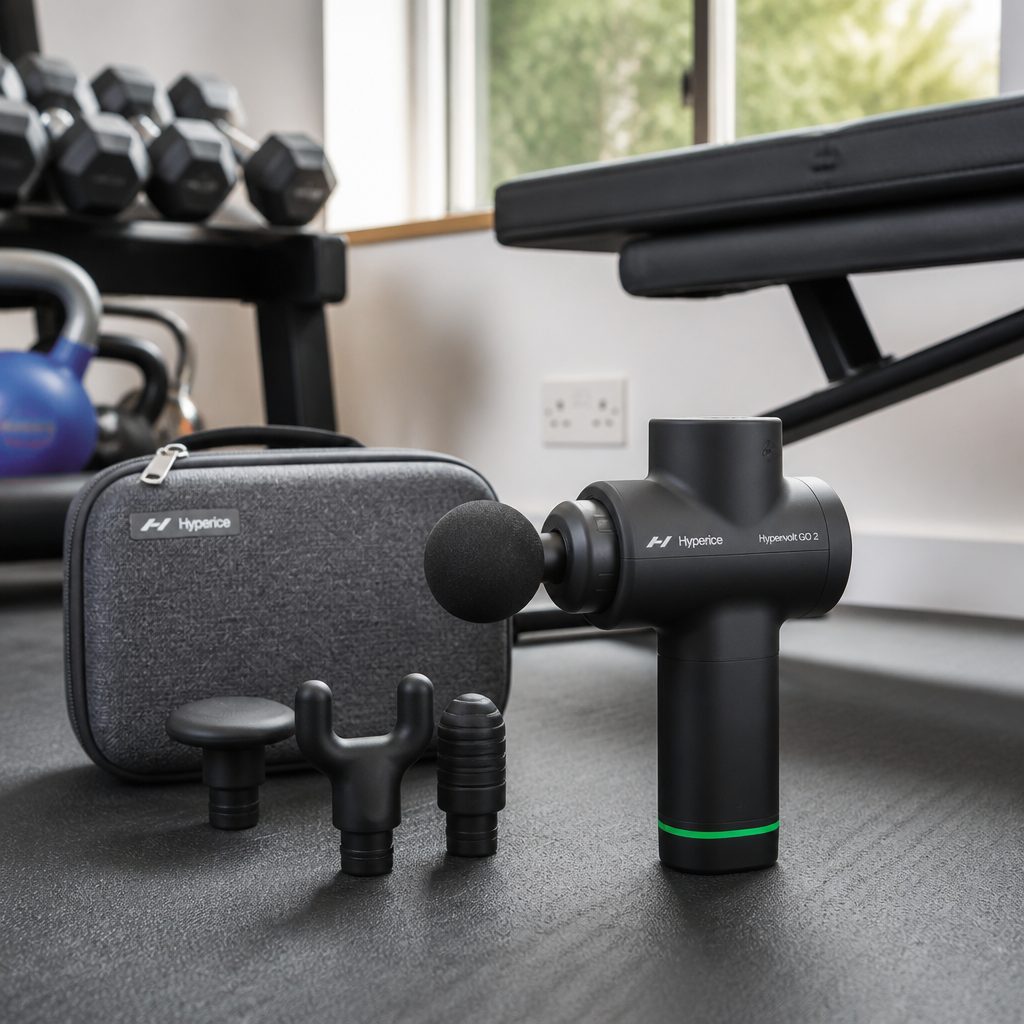
Recovery does not need to be elaborate. Pick a comfortable tool, use it consistently and sensibly, then let the ordinary fundamentals — food, sleep and sensible training — do the heavier lifting.
Final verdict
If you want one uncomplicated recommendation, buy the Bob and Brad C2. It offers the best balance of size, battery life, USB-C convenience, control and day-to-day usability for most gym-goers.
Step up to the Hyperice Hypervolt 2 if polished design, pressure feedback and guided sessions appeal, or choose the Theragun Prime when 16mm deep-tissue percussion is the clear goal. For quieter homes, the RENPHO Active is the one to beat. The important thing is not to buy the most intimidating machine; it is to buy the recovery gun you will happily use after the sessions that leave you moving like a slightly offended robot.