
Hyperice vs Therabody: Which Percussion Recovery Brand Is Right for You?
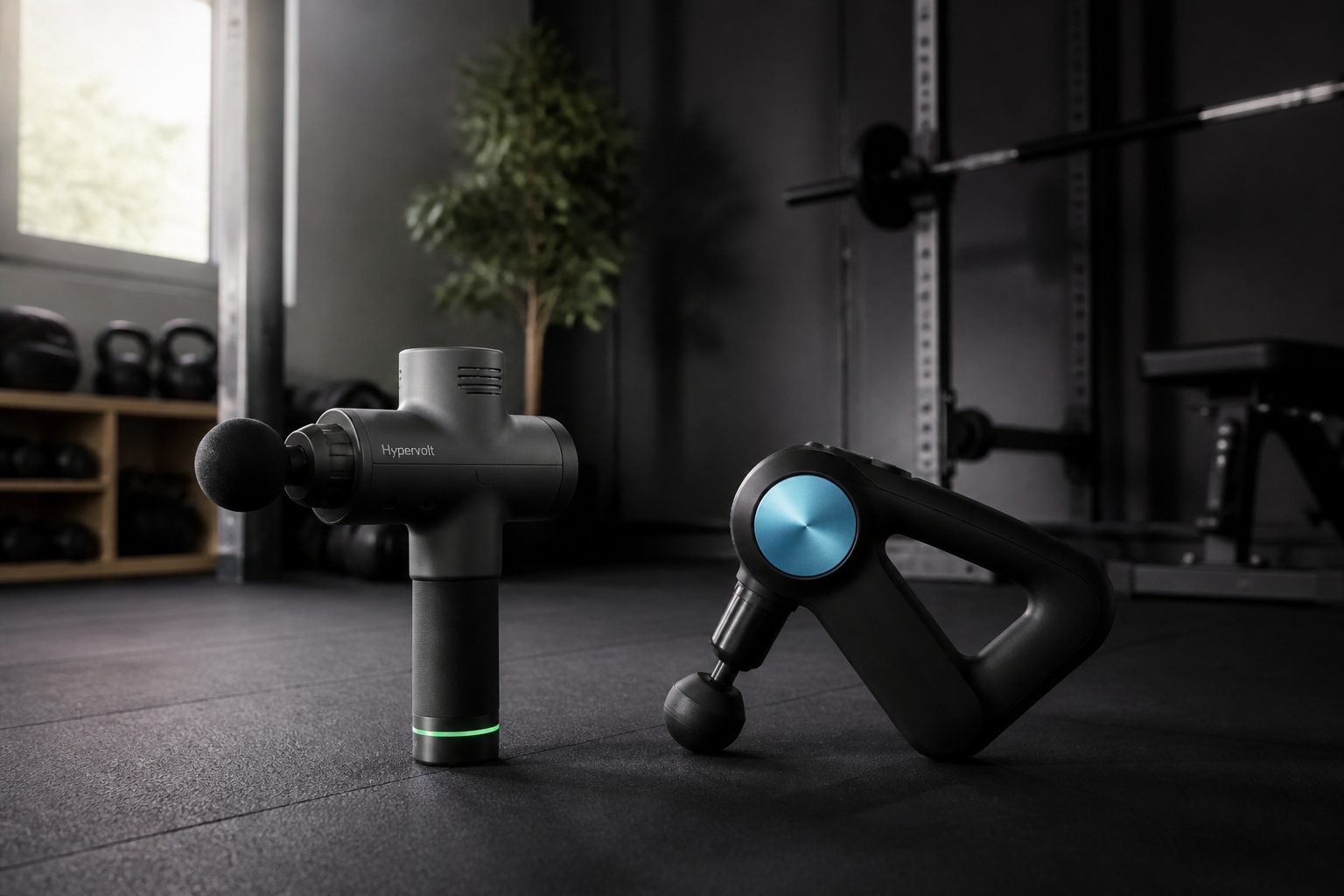
Hyperice Hypervolt and Therabody Theragun sit at the serious end of home percussion recovery: similar job, very different route to getting there.
Hyperice and Therabody both made percussion massage guns a normal sight in gym bags, physio rooms and the slightly chaotic drawer where resistance bands go to disappear. The key difference is not simply power. It is whether you value quieter, lighter, longer-running recovery kit or deeper 16mm treatment with a broader therapy ecosystem.
 By James Oduya · Staff Writer & Home Gym Columnist · Updated August 21, 2026
1. Hyperice vs Therabody: the short version
There is a pleasingly simple way to understand this comparison. Hyperice's current Hypervolt family feels built around straightforward everyday use: a conventional gun shape, relatively restrained weight, very strong battery claims and a notably quiet flagship. Therabody's Theragun family feels more clinical and ambitious. Its triangle grip is unmistakable, its premium products centre on 16mm amplitude, and the wider system branches into heat, cold, vibration and near-infrared LED treatment.
Neither approach is automatically better. If you train after work and want to use a massage gun on the sofa without making the room sound as though somebody is sanding a wardrobe, the Hypervolt 3 Pro is extremely persuasive. If you are the sort of person who actively seeks a deep, firm treatment on glutes, quads and other substantial muscles, Theragun's 16mm stroke can feel like the more purposeful tool.
That said, amplitude is not a magic quality score. A 16mm device does not make a person more recovered than a 12mm or 14mm device merely by existing. Pressure, attachment choice, session length, the muscle being treated and your ability to relax rather than brace against the thing all matter. Recovery gear is fond of big claims. Your body, rather irritatingly for marketers, remains an individual.
Percussion massage is best treated as a recovery and warm-up aid, not a substitute for sleep, sensible training load, food or medical advice. Avoid using a device over acute injuries, broken skin or areas where a clinician has told you not to apply pressure.
2. Hypervolt 3 Pro vs Theragun PRO Plus: headline specifications
The fairest flagship comparison is Hyperice Hypervolt 3 Pro against Therabody Theragun PRO Plus. They are both connected, athlete-oriented devices with pressure feedback and five included attachments. Yet the numbers show their personalities immediately: Hyperice published the stronger stall-force figure and longer battery estimate, whilst Therabody offered the longer 16mm amplitude and the more extensive multi-therapy proposition.
| Feature | Hyperice Hypervolt 3 Pro | Therabody Theragun PRO Plus | Therabody Theragun Prime (6th Gen) |
|---|---|---|---|
| Amplitude | 14mm | 16mm | 16mm |
| Speed range | 1,500–2,500 PPM across 6 speeds | 1,750–2,400 PPM | 1,750–2,400 PPM |
| Stall force | 70lb | Up to 60 lbs | Up to 35lb |
| Battery life | Approximately 4 hours | Approximately 150 minutes | Up to 2 hours |
| Weight | 2.5lb / 1.1kg | 1,650g without attachments | 2.9lb |
| Included attachments | 5 | 5 | 2 |
| Pressure feedback | Built-in pressure sensor | Force Meter | Real-time LED indicators |
| App connection | Bluetooth Hyperice App | Bluetooth Therabody app | Bluetooth Therabody app |
The Hypervolt 3 Pro's 70lb stall force is the clearest raw-power claim in this head-to-head. Stall force describes how much pressure the motor can tolerate before slowing or stopping. In practical terms, it matters when you lean into a large muscle rather than merely letting the gun buzz on the surface. It is a useful specification, but not an instruction to press as hard as physically possible. If a treatment becomes painful, harder is not bravely athletic; it is just uncomfortable.
Theragun's 16mm amplitude should not be overlooked, though. That extra travel gives its percussion a distinctly deeper character than the 14mm Hypervolt 3 Pro and 12mm Hypervolt 3. For dense quads after hill repeats, heavy hamstrings after Romanian deadlifts or the upper glute area after a long drive, it is the Theragun trait many regular users will notice first.
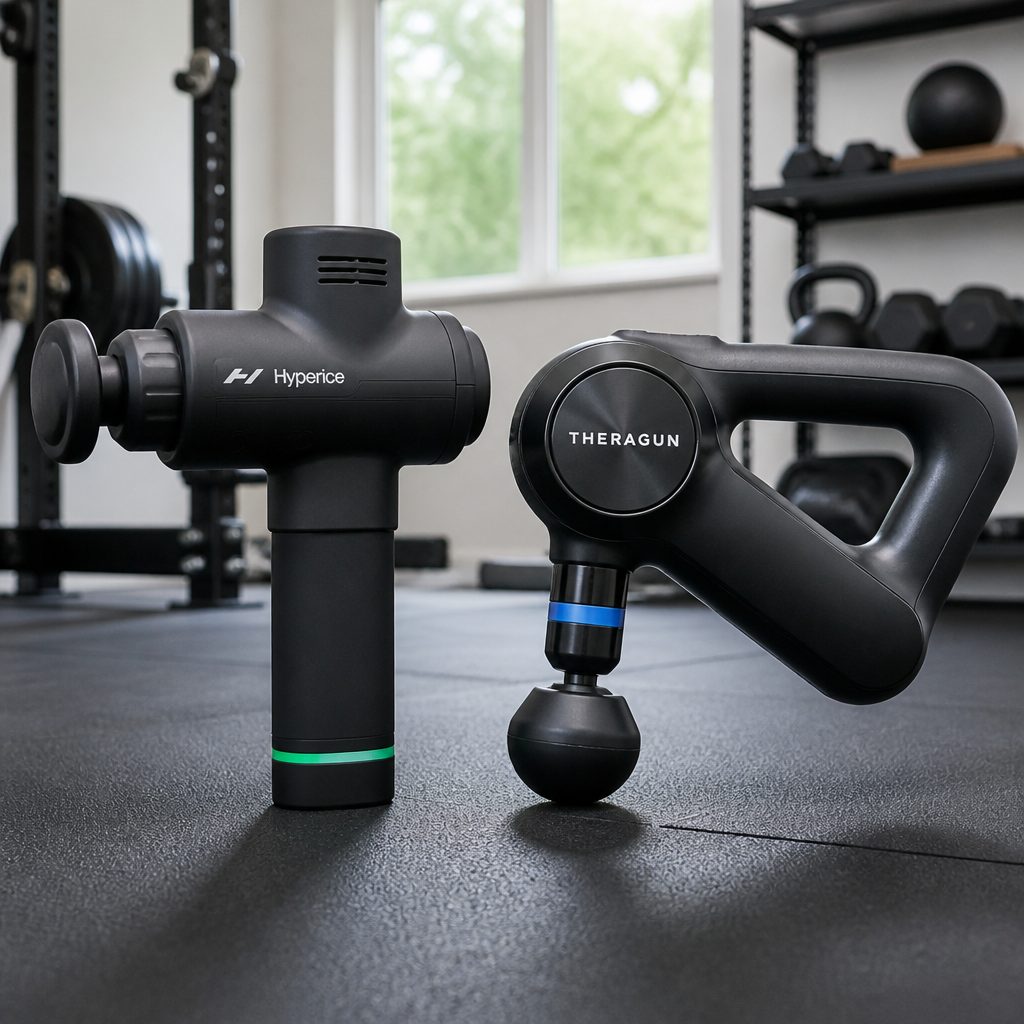
The flagship comparison is less about whether either gun is powerful enough and more about how that power is delivered: quiet 14mm percussion from Hyperice or the deeper 16mm Theragun approach.
3. Noise: Hyperice Hypervolt 3 Pro is the calmer choice
Shop Hyperice Hypervolt 3 Pro is the calmer choice on Amazon UK
Noise is the category where Hyperice makes its strongest case from a hard number. Hyperice rated the Hypervolt 3 Pro at 51dB. Therabody rated the Theragun Prime (6th Gen) at 65dB. Decibels are logarithmic, so the gap does not translate to a small, polite difference. It suggests a genuinely different experience when you are using a gun near someone watching television, sleeping nearby or attempting to have a conversation with you.
I would not pretend any percussion gun is silent. The head still strikes, the motor still works and the attachment transmits vibration into the body. But 51dB is a notably civilised figure for a high-output product. The Hypervolt 3 Pro therefore suits flat living, late-night post-training routines and anyone who dislikes equipment that announces itself before it has even reached their calf.
There is an important caveat. Noise figures vary with speed, contact pressure, attachment and the room around you. A gun used against a hard shoulder blade zone can sound quite different from one used gently on a quad. Still, these published figures give the Hypervolt 3 Pro the proper edge. If quiet operation is near the top of your wish list, rather than a nice bonus on the box, it is the better starting point.
A quiet gun is easier to use consistently
It sounds trivial until you own one. A recovery tool that feels antisocial at 10pm tends to stay in a drawer. The quieter Hyperice proposition is especially attractive if your realistic recovery window is after everyone else has gone to bed.
4. Power and depth: 70lb force versus 16mm amplitude
This is the heart of Hyperice versus Therabody. Hyperice gave the Hypervolt 3 Pro 70lb of stall force, six speed levels and a frequency range of 1,500 to 2,500 PPM. Therabody gave the Theragun PRO Plus its 16mm amplitude and a selectable range of 1,750 to 2,400 PPM. Both are premium-level figures, but they describe different strengths.
The Hypervolt has a broader stated top speed and starts lower at 1,500 PPM. The lower setting can be welcome for gentler warm-up work, tender areas or anyone new to percussion therapy who does not want their first session to feel like a particularly unforgiving MOT. The six fixed speed steps also make adjustment easy: click, assess, move on.
Theragun's 16mm stroke is the headline for users who seek depth. More amplitude means the attachment travels farther on each percussion. It does not mean you must apply huge additional pressure, and it certainly does not mean every muscle needs maximum depth. But it can feel especially useful on the large muscles that do most of the heavy lifting in training: quads, glutes, hamstrings and calves.
The Theragun Prime (6th Gen) gives a useful illustration of where this sits in the range. It retained the full 16mm amplitude but listed up to 35lb of force. That tells you why amplitude and stall force need reading together rather than picking whichever number sounds more dramatic. A compact paragraph on a product page can make either sound like the only thing that matters. It is not. How the gun fits your recovery routine matters more.
Hyperice strengths
- Hypervolt 3 Pro combined 70lb stall force with a 1,500–2,500 PPM range.
- Six speed levels offered more incremental adjustment than the Hypervolt 3's five.
- Its 14mm amplitude is substantial without being relentlessly aggressive.
Therabody trade-offs
- Deep 16mm treatment can be excessive if you naturally overdo pressure.
- The larger, treatment-led format is less discreet than a small travel gun.
- Theragun's depth advantage may matter less for gentle everyday mobility work.
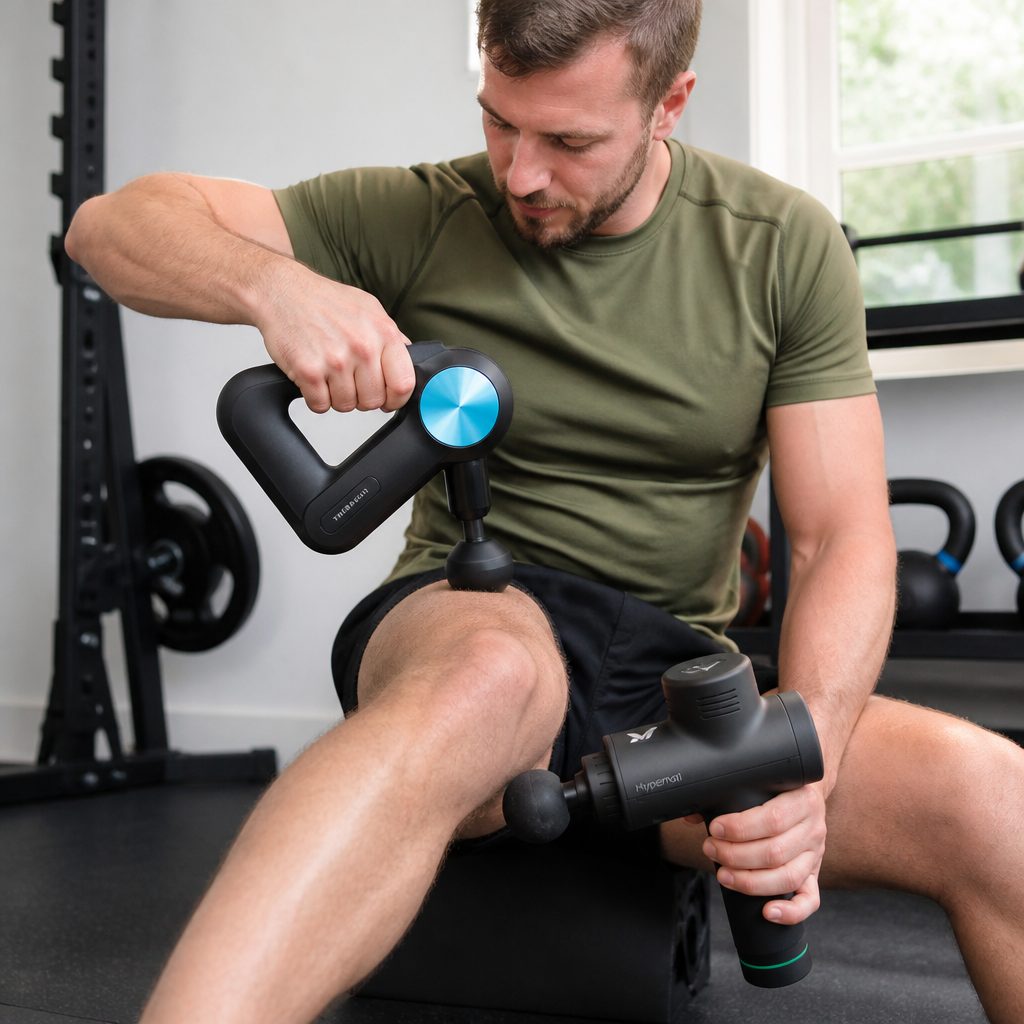
A deep-stroke Theragun is at its most convincing on large working muscles, whilst the Hypervolt approach is easier to keep gentle when that is what the session calls for.
5. Battery life and charging: Hyperice wins the long weekend
Battery life is less glamorous than heat or app coaching, but it shapes ownership more than people expect. Hyperice claimed approximately four hours from both Hypervolt 3 Pro and Hypervolt 3. Therabody claimed approximately 150 minutes of use for Theragun PRO Plus, with certain attachments capable of shortening that result. Theragun Prime (6th Gen) was rated for up to two hours.
Four hours is a very useful buffer. Most people do not need a 40-minute percussion session after every gym visit, and they absolutely should not feel obliged to have one. A four-hour claim means the Hypervolt 3 Pro can comfortably cover plenty of short warm-ups and recovery sessions before charging becomes another small household admin task. There are enough of those already.
Theragun PRO Plus still offered a workable 150-minute average. It is not inadequate; it simply asks you to keep a closer eye on charging if you use the more demanding therapy features. The trade-off is understandable. A device performing percussion plus heat, vibration or LED treatment is doing more than a conventional gun. Yet somebody who values the least fuss will reasonably prefer the Hyperice figure.
There is a further practical win for the Hypervolt Go 3: USB-C charging. That is the sort of detail that matters on a weekend away, at a race or in a work bag. Carrying one cable for phone, earbuds and recovery gear is not revolutionary. It is, however, a small modern mercy. The Go 3's claimed four-hour battery and 1.6lb weight make it Hyperice's most travel-friendly option.
6. Attachments and heat: Therabody builds the bigger therapy system
The flagship guns each included five attachments, but their approaches differ. Hypervolt 3 Pro included Heated Head, flat, wedge, fork and cushion attachments. Theragun PRO Plus came with Dampener, Wedge, Micro-Point, Standard Ball and Thumb attachments. Both cover the basics very well: a general-purpose rounder head, options for broad scraping-style work, more targeted pressure and gentler treatment.
Hyperice made heat part of the box. Its Heated Head Attachment offered three heat levels up to 120°F. That is a particularly neat implementation because it avoids turning the gun itself into a complicated science project. Warm the head, use percussion as desired, then change attachment if you want a different feel. For general pre-training comfort around hips, quads or the upper back, it is a genuinely useful inclusion rather than mere feature-list confetti.
Therabody's wider approach is more expansive. Theragun PRO Plus combined deep muscle percussion with near-infrared LED light and vibration, whilst heated percussive and cold therapy were available through separate options. Theragun Prime Plus also included a Heated Percussive Plus Attachment and had expandability for cold and vibration. This makes Therabody the brand for someone who wants a recovery platform, not simply an excellent massage gun.
Hyperice Hypervolt 3 Pro Heated Head
Three heat levels, reaching up to 120°F, came with the flagship Hypervolt. It is the simpler route to combining warmth and percussion in one session.
Therabody Theragun PRO Plus near-infrared LED light
PRO Plus added near-infrared LED therapy to percussion, giving Therabody a more feature-rich flagship treatment proposition.
Therabody cold therapy expandability
Theragun PRO Plus and Prime Plus could extend beyond percussion and heat with compatible cold-focused treatment options.
The best attachment is usually the one you will actually use correctly. A Standard Ball or flat head is plenty for broad quad work. A wedge is handy for a more targeted sweeping pass around the shoulder or calf. A fork can work around the Achilles area without directly hammering the tendon itself. The point is control, not attempting to recreate a medieval instrument collection on your legs.
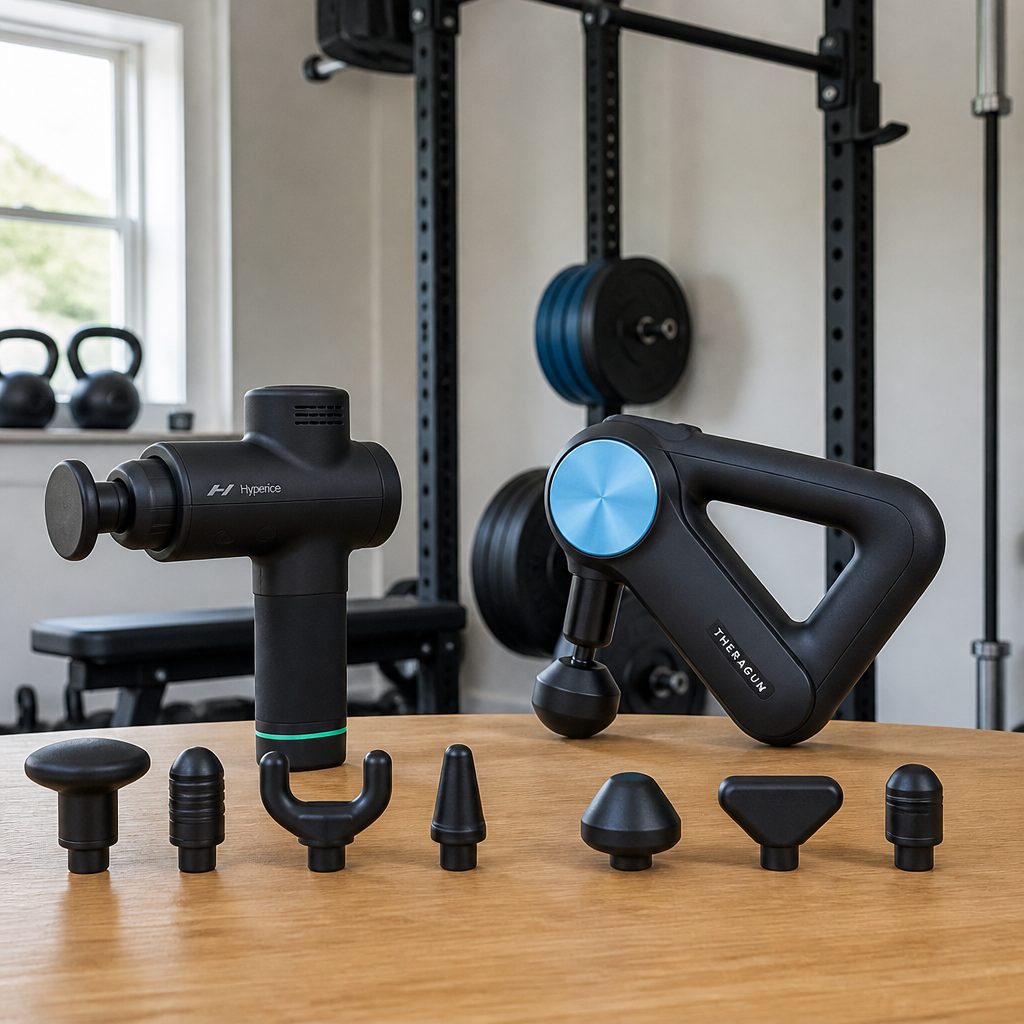
Attachment choice changes the feel of a massage gun more than many buyers expect; broad heads suit general muscle work, whilst wedges and targeted heads reward a gentler hand.
7. Ergonomics, weight and real-world handling
Theragun's triangle grip has been a defining feature for good reason. The alternative hand positions can make self-treatment easier, especially around the upper back, traps, glutes and calves. Trying to reach your own back with a conventional T-shaped gun can become an unplanned mobility test. Therabody designed around that problem rather than pretending it did not exist.
The Theragun Prime (6th Gen) also used an impact-resistant rubber exterior and reinforced corners rated to protect against drops up to 10 feet. That will appeal to coaches, busy households and anyone who has watched expensive kit meet a concrete floor in slow motion. Its 2.9lb weight is not featherweight, though, and prolonged self-treatment can make weight noticeable.
Hyperice's current range gives more obvious choice by size. Hypervolt Go 3 weighed 1.6lb, Hypervolt 3 weighed 2lb and Hypervolt 3 Pro weighed 2.5lb. The middle model is particularly sensible if you want enough muscle for regular training recovery without carrying the largest unit around. Its 60lb stall force, five speeds, 12mm amplitude and four-hour battery suggest a strong all-round machine rather than a stripped-down compromise.
Hypervolt Go 3 is the one to consider if the product must genuinely live in a kit bag. At 1.6lb, with five speeds, a digital dial, USB-C charging and flat and wedge attachments, it is more portable than either flagship. Its 45lb stall force will still be enough for many gym-goers, runners and travellers. If you are a very strong lifter who likes heavy pressure into large muscles, you may outgrow it. That is not a flaw. It is simply the consequence of physics refusing to take a day off.
8. Apps, pressure feedback and guided recovery
Both brands made app connectivity available on their upper models. Hypervolt 3 Pro connected to the Hyperice App through Bluetooth. Theragun PRO Plus and Theragun Prime (6th Gen) connected to the Therabody app. This can be helpful if you want a guided routine after a particular activity rather than guessing which head and speed to use.
The value of an app depends entirely on personality. Some people appreciate a structured sequence after running, lifting or cycling. Others will open the app twice, decide they understand the basics, then rely on a few familiar movements forever. Neither group is wrong. A massage gun should not become another subscription-like obligation in your life.
Pressure feedback is more universally useful. Hypervolt 3 Pro had a built-in pressure sensor. Theragun PRO Plus used a Force Meter that showed how many pounds of force you were applying, whilst Theragun Prime offered real-time LED pressure indicators. The real benefit is not chasing the highest reading. It is learning what moderate, repeatable pressure feels like.
Those scores are not a claim that one person's body will react identically to another's. They are a buying shorthand. Hyperice earned its stronger result through usable power, quiet operation, battery capacity and the inclusion of heat. Therabody's strength is its deeper treatment feel and greater therapy ecosystem, which is harder to distil into a single score without losing the point.
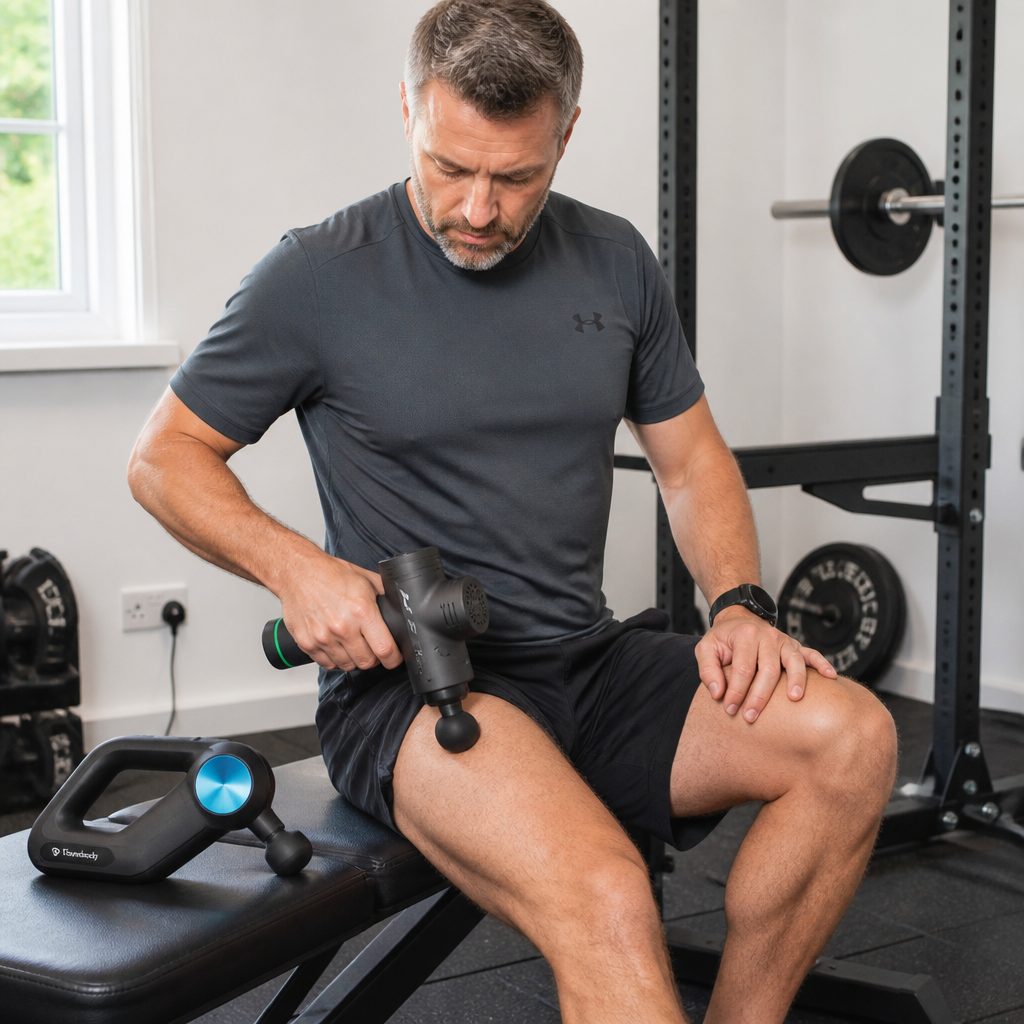
Pressure feedback is most useful as a reminder to stay controlled, rather than a scoreboard inviting you to attack a sore muscle with heroic enthusiasm.
9. Hyperice Hypervolt Go 3 vs Theragun Prime: compact sense versus deep-tissue focus
Not every buyer needs a flagship. In fact, most do not. The more useful everyday choice may be between Hyperice Hypervolt Go 3 and Theragun Prime (6th Gen), depending on whether portability or maximum depth sits higher on the list.
Hypervolt Go 3 had five speeds, a digital dial, 45lb of stall force, a claimed four-hour battery and two attachments. It weighed 1.6lb and charged by USB-C. That combination makes it the sensible travel companion. It can handle a brief calf warm-up before a run, a post-gym quad session or some lower-leg work in a hotel room without requiring a large case or dedicated socket.
Theragun Prime, on the other hand, was more substantial. Its 16mm amplitude, 1,750–2,400 PPM range and up-to-35lb force output positioned it as a serious deep-tissue tool. It also retained the triangle grip, Bluetooth connection and LED pressure feedback. The trade-off was a 2.9lb body, two attachments and up to two hours of battery life. It is the more treatment-focused choice; the Go 3 is the more convenient one.
| Feature | Hyperice Hypervolt Go 3 | Hyperice Hypervolt 3 | Therabody Theragun Prime (6th Gen) |
|---|---|---|---|
| Weight | 1.6lb / 0.73kg | 2lb / 0.9kg | 2.9lb |
| Stall force | 45lb | 60lb | Up to 35lb |
| Amplitude | — | 12mm | 16mm |
| Battery | 4 hours | Approximately 4 hours | Up to 2 hours |
| Speed settings | 5 | 5 | 1,750–2,400 PPM |
| Attachments included | 2 | 5 | 2 |
10. Best Hyperice and Therabody pick for each buyer
A straight brand winner would be tempting, tidy and slightly dishonest. These ranges cater to different habits. The right buy is the one whose strengths match what you will genuinely do three times a week, not the one with the most impressive collection of numbers when you are researching at midnight.
Best for travel: Hyperice Hypervolt Go 3
Choose it for its 1.6lb weight, USB-C charging, five speeds and claimed four-hour battery. It is the least troublesome option for a gym bag or weekend away.
Best all-rounder: Hyperice Hypervolt 3
The 2lb body, 60lb stall force, five speeds, 12mm amplitude, five attachments and four-hour battery make it the sensible middle ground.
Best for quiet homes: Hyperice Hypervolt 3 Pro
Shop Hyperice Hypervolt 3 Pro on Amazon UK
Its 51dB rating, 70lb stall force, six speeds, heated head and approximately four-hour battery make it the strongest all-round flagship for quiet use.
Best for deep tissue: Therabody Theragun Prime
Pick it if 16mm amplitude and the triangle grip matter more to you than lighter weight or a longer battery claim.
Best premium system: Therabody Theragun PRO Plus
This is for athletes and enthusiasts who want percussion alongside vibration, near-infrared LED light and compatibility with heat and cold therapies.
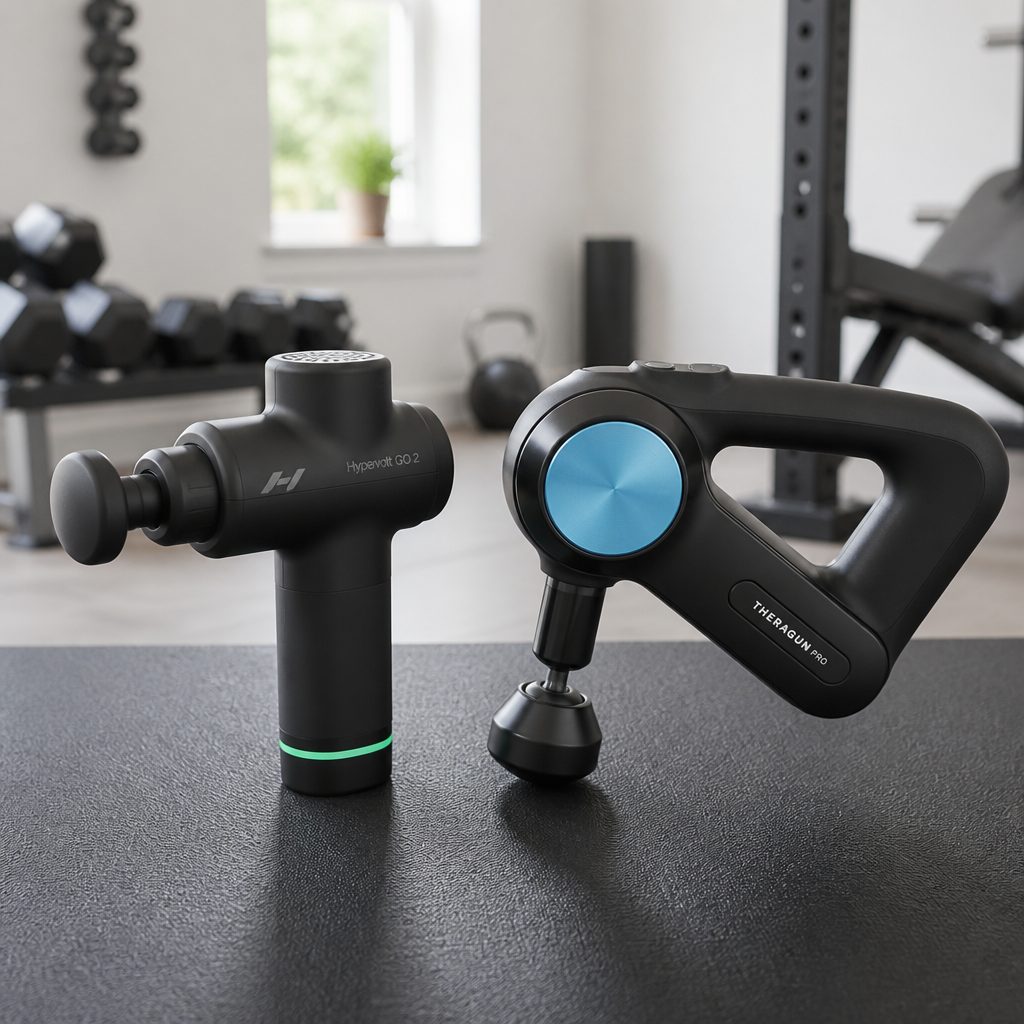
The practical split is clear: compact Hypervolt models suit regular, low-fuss use, whilst Theragun's triangle handle and deep stroke appeal to hands-on recovery enthusiasts.
11. The ownership question nobody puts on the box
Before buying either brand, ask yourself a boring but important question: how will you actually use it? If the answer is "five minutes on calves and quads after training", do not let a feature-packed flagship convince you that you need a recovery laboratory at home. A Hypervolt Go 3 or Hypervolt 3 may be more than enough.
If you train at high volume, work physically demanding shifts, compete regularly or already know that deep percussion helps you stay comfortable, premium models make more sense. Hypervolt 3 Pro adds quiet operation, higher stall force, six speeds, a carry case and its Heated Head. Theragun PRO Plus makes sense where its wider therapies are not just interesting but genuinely part of the recovery routine you enjoy.
Also consider reach. The Theragun triangle grip is a real ergonomic advantage for self-treatment. If you frequently target shoulders, upper back or awkward glute angles alone, it may outweigh the Hyperice advantage in noise and battery. Conversely, if another person usually helps with hard-to-reach areas, the traditional Hypervolt layout becomes less of a disadvantage.
Finally, remember that a massage gun should complement movement rather than replace it. Use it briefly before a session to make a tight area feel more ready, or after training when it feels pleasant and helpful. Then walk, eat, sleep and allow adaptation to happen. There is no attachment for those bits, sadly.
12. Frequently asked questions
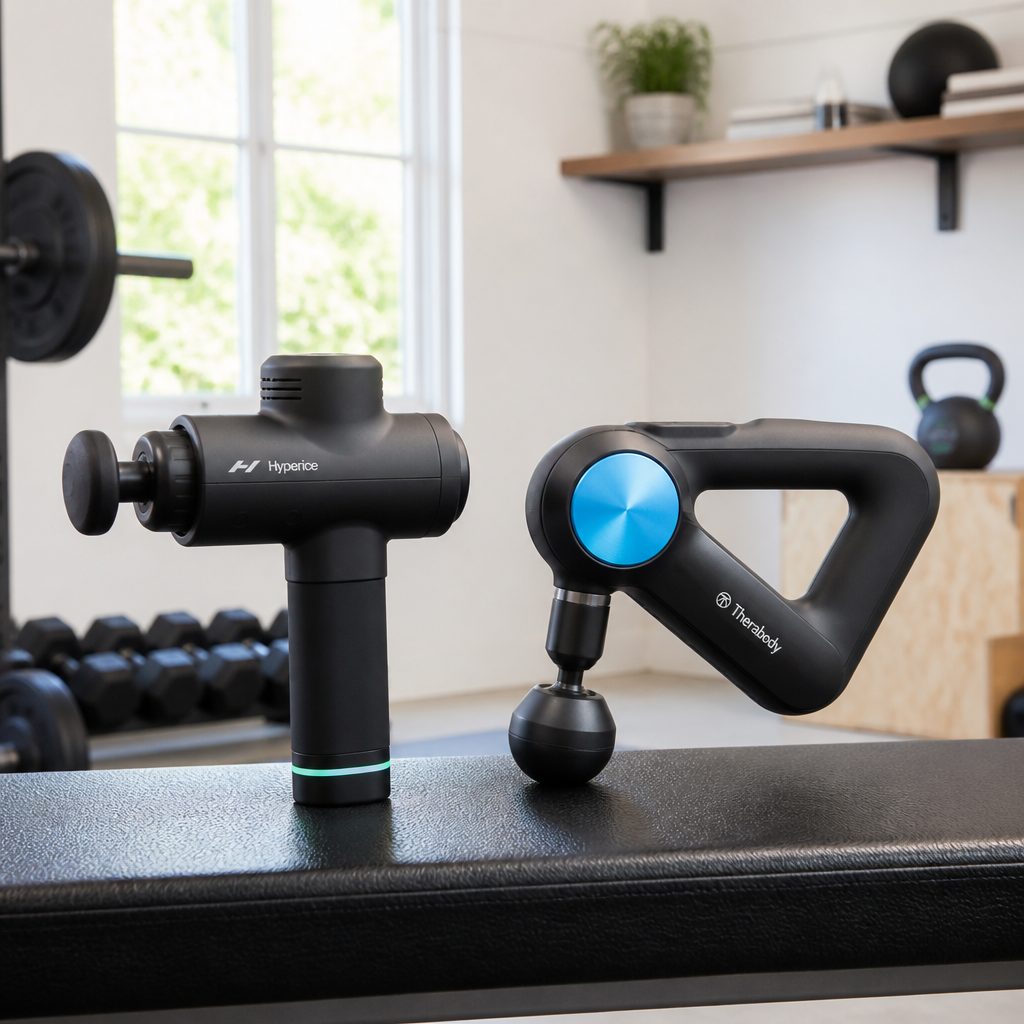
For most buyers, the best percussion gun is the one that is comfortable to hold, quiet enough to use and simple enough that it does not become forgotten recovery clutter.
Verdict: Hyperice for effortless recovery, Therabody for depth and therapies
Hyperice is the stronger recommendation for most people. Hypervolt 3 Pro paired 70lb stall force, 14mm amplitude, six speeds, five attachments, built-in heat, a 51dB rating and approximately four hours of battery life in a 2.5lb package. It is powerful without being needlessly theatrical, and it makes regular at-home use easy.
Therabody remains the better route for a particular buyer: someone who values a 16mm deep-tissue stroke, wants the flexibility of the triangle grip, and sees recovery as a broader programme involving vibration, near-infrared LED light, heat and cold options. Theragun PRO Plus is the premium therapy-system choice; Theragun Prime is the more direct 16mm option.
My buying call
Choose Hyperice Hypervolt Go 3 for portability, Hyperice Hypervolt 3 for the best balance of size and power, and Hyperice Hypervolt 3 Pro for the most rounded quiet-use flagship. Choose Therabody Theragun Prime for deep-tissue treatment and Therabody Theragun PRO Plus when you genuinely want its multi-therapy ecosystem. There is no universal winner. There is, however, a very clear winner for your routine.