
Concept2 RowErg vs Northern Gym Equipment Rower: Endurance Icon or Budget Upstart?
The RowErg has spent decades becoming the benchmark against which serious indoor rowers are measured. Northern Gym Equipment's air rower offers the same broad recipe for considerably less outlay. The interesting question is not whether both can make you puff. They certainly can. It is whether the less expensive machine can replace the confidence, data consistency and resale strength that made the Concept2 such a gym-floor institution.
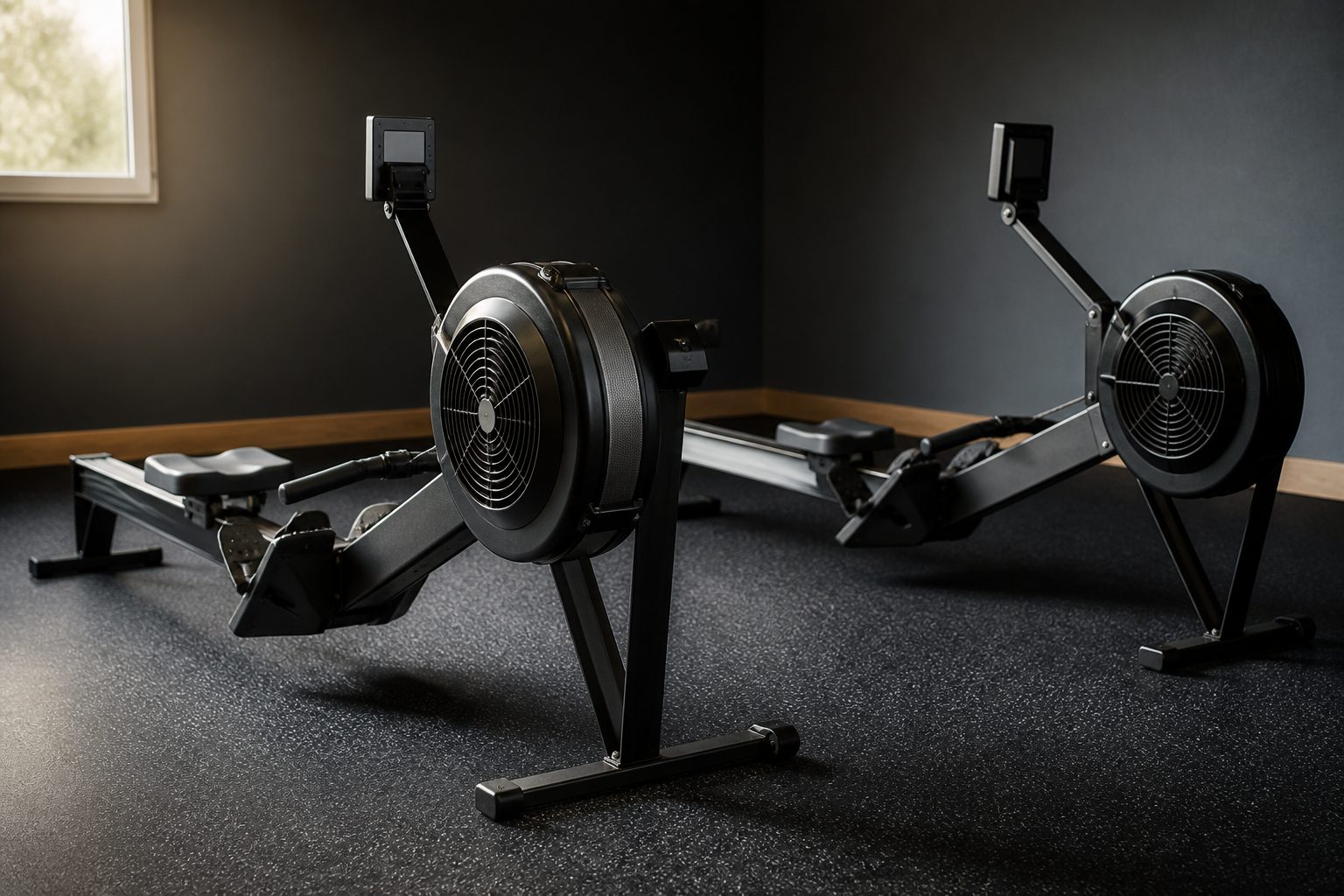
The Concept2 RowErg and Northern Cardio Rowing Machine share the familiar long-rail air-rower shape, but they make very different promises about accuracy, capacity and long-term ownership.
 By James Oduya · Staff Writer & Home Gym Columnist · Updated October 11, 2026
1. The short version: two air rowers, two very different propositions
At first glance, this looks wonderfully straightforward. Both machines use air resistance. Both use a chain-driven pull. Both have a long rail, a sliding seat, a console, transport wheels and a frame that can be separated for storage. Put either in a spare room, garage or conservatory and you can do steady aerobic work, intervals, rowing-specific sessions and the sort of "just ten minutes" finishers that somehow turn into half an hour.
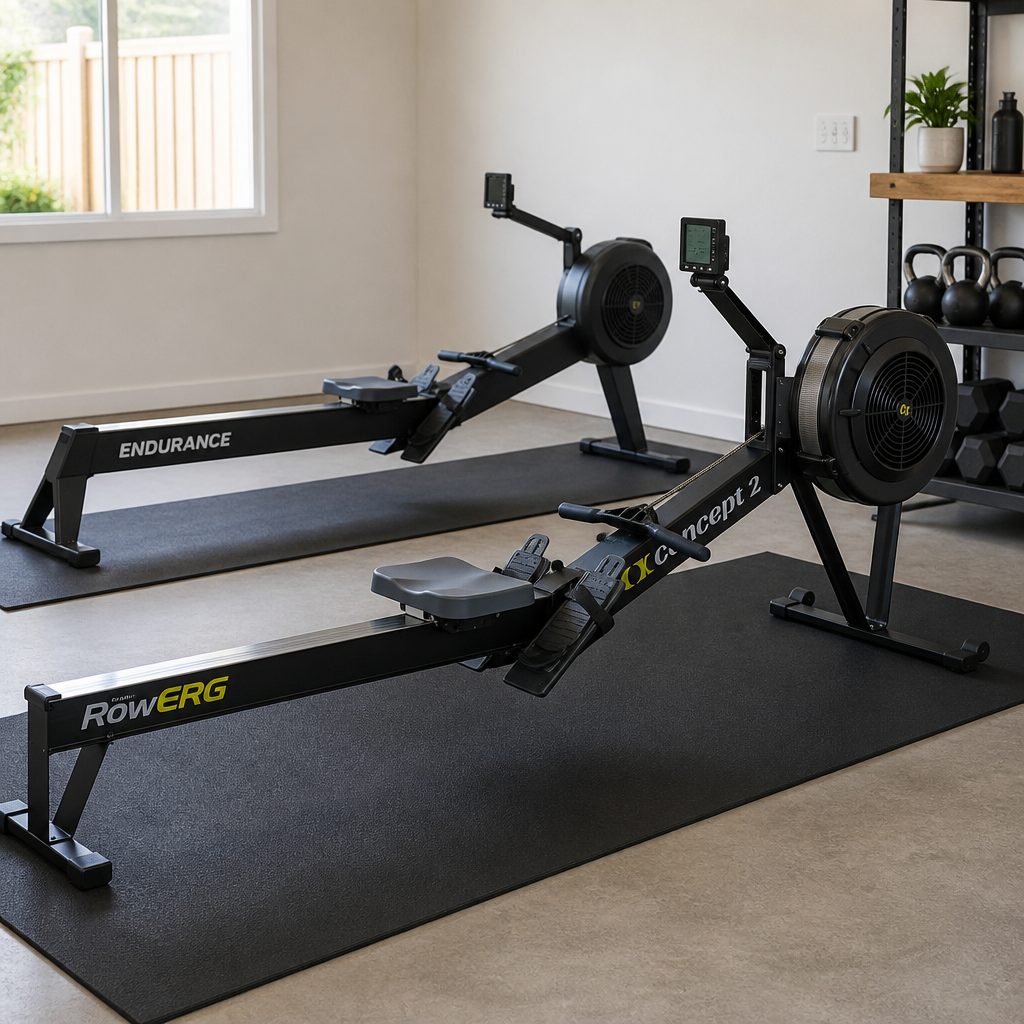
The measurements tell a useful story: both machines need roughly the same length of clear floor, but the RowErg has a dramatically higher stated user capacity.
But air rowers are not all interchangeable. The flywheel is only part of the story. The important bits are how accurately the machine interprets your effort, how repeatable its feedback remains over years of use, whether the ergonomics fit a broad range of bodies, how it copes with hard pulling, and what happens when you eventually decide it is time to sell it. That last bit sounds terribly unromantic. It is also where a bargain can become less of a bargain.
The Concept2 RowErg is the established, full-capacity choice. It supports users up to 500lb, accommodates athletes up to 6ft 6in, and pairs a nickel-plated steel chain with the PM5 Performance Monitor. It is a machine built around a performance ecosystem: club rowing, indoor races, training plans, benchmark workouts and an enormous body of historical comparison.
The Northern Cardio Rowing Machine is the simpler domestic proposition. It has a 265lb user-weight capacity, a battery-powered LCD, 16 resistance levels and a useful list of displayed training metrics, including watts and heart rate through an external receiver. It is not trying to be a rowing-club standard piece of kit. It is trying to give home users an air-rowing experience without making their bank account perform a distress signal.
The key buying thought
If you want a rower principally for general fitness, the Northern machine covers the essential movement pattern and air-resistance feel. If you want numbers you can trust session after session, or expect the machine to become a long-term training fixture, the RowErg's monitor accuracy and established durability history matter rather more than a few extra console functions.
2. Headline specifications at a glance
Before getting into the practical experience, it helps to put the hard numbers beside one another. This is where the RowErg's commercial-gym heritage becomes immediately obvious. The footprint is broadly similar, but the user capacity is not remotely close. That does not make the Northern unsuitable for every household; it simply makes its intended audience clearer.
| Feature | Concept2 RowErg | Northern Cardio Rowing Machine |
|---|---|---|
| Resistance system | Air resistance | Air resistance |
| Drive | Nickel-plated steel chain | Chain-driven |
| Length | 96in | 95in |
| Width | 24in | 24in |
| Height | 14in standard legs; 20in tall legs | 42in assembled |
| Machine weight | 57lb | 65lb |
| User weight capacity | 500lb | 265lb |
| Resistance adjustment | Spiral damper, settings 1–10 | 16 resistance levels |
| Console | PM5 Performance Monitor | Multi-function LCD with scan mode |
| Power | Two D batteries, with flywheel-assisted power during workouts | Battery-powered LCD console |
| Storage | Upright storage; separates into two pieces | Upright frame lock; splits into two without tools |
| Warranty | Five-year frame; two-year moving parts and monitor | — |
3. What the specification sheet means in a real UK home
Neither of these is a tiny fold-flat contraption you can tuck behind the sofa and forget about until January. Both are proper rowing machines with a footprint around eight feet long. You need space not just for the rail, but for a sensible amount of clearance around the handle at the finish and enough room to walk past the machine without doing a strange sideways shuffle. Measure first. It is dull advice, admittedly, but it beats discovering that the wardrobe door now opens three inches before hitting the flywheel.
The RowErg with standard legs has a 14in seat height. The tall-leg version raises that seat to 20in, which is a meaningful ergonomic change rather than a cosmetic upgrade. A higher seat can be more comfortable for users who dislike dropping low to the floor or who want an easier stand-up after intervals. The rowing action remains the same, but getting on and off feels less like a modest mobility test.
Northern's assembled height is much greater because it includes the raised flywheel and console assembly, whilst its length and width are near enough identical to the standard RowErg. Its 65lb machine weight is not a disaster for moving, especially with transport wheels, although it is heavier than the 57lb Concept2. In practice, both should live where you train if you have the option. Repeatedly moving any long-frame rower around a room gets old very quickly. It also tends to create a surprisingly strong emotional bond with your skirting boards.
The big practical separator is user capacity. A 265lb limit is workable for plenty of home users, but it leaves less headroom for households with larger athletes or anyone close to that threshold. The 500lb rating of the RowErg is not merely a bigger number for a brochure. It means a much broader pool of users can train with confidence, which matters in shared homes, small studios and PT spaces.
Capacity figures are equipment limits, not targets. If a machine is likely to be used regularly by someone near its stated maximum, the higher-capacity RowErg is the more conservative and more versatile choice.
4. Resistance feel: air is air, but the adjustment is not quite the same
Both rowers use air resistance, and that is a good thing for people who want a rowing stroke that responds to effort. Pull harder and the resistance rises; ease off and it settles down. It is a more natural relationship than a basic magnetic rower, where resistance can feel fixed and slightly detached from how powerfully you are actually moving.
The RowErg uses a spiral damper with settings from 1 to 10. This adjustment changes airflow at the flywheel, which changes the feel of the stroke. It is important not to confuse damper setting with difficulty level. A damper on 10 does not make someone stronger, nor does it automatically make a workout better. It creates a heavier, slower-feeling stroke, much like rowing a boat with a different drag characteristic. Plenty of experienced rowers train at modest damper settings because the aim is repeatable power, rhythm and sustainable technique rather than turning every pull into a small argument with the furniture.
The Northern machine lists 16 resistance levels. That looks more granular on paper, and a larger number always has a certain sales-floor appeal. Sixteen is, after all, clearly more than ten. But the useful question is how the machine feels at the handle and how consistently its console turns that effort into feedback. For a general home session, more selectable steps can be welcome if you prefer obvious changes in resistance. For rowing-specific training, the Concept2 approach is familiar because it is tied into a huge shared language of drag factor, pace and benchmark workouts.
The broader point is this: neither machine requires electricity to make resistance. The flywheel does the work, and you do the inconvenient bit of spinning it. That means the rowing sensation is available whenever you sit down, rather than depending on a motorised resistance system or app connection behaving itself.
Air resistance rewards a proper pull
Both machines respond to stroke power rather than forcing you into one fixed effort level. That makes them suitable for gentle steady work and sharp interval sessions alike.
RowErg's damper is about feel
The 1–10 damper range adjusts airflow and stroke character. It is not a badge of fitness, and a high setting is not automatically the clever setting.
Northern offers 16 selectable levels
For home users who like a clear menu of resistance changes, Northern provides more numbered positions to work through during a session.
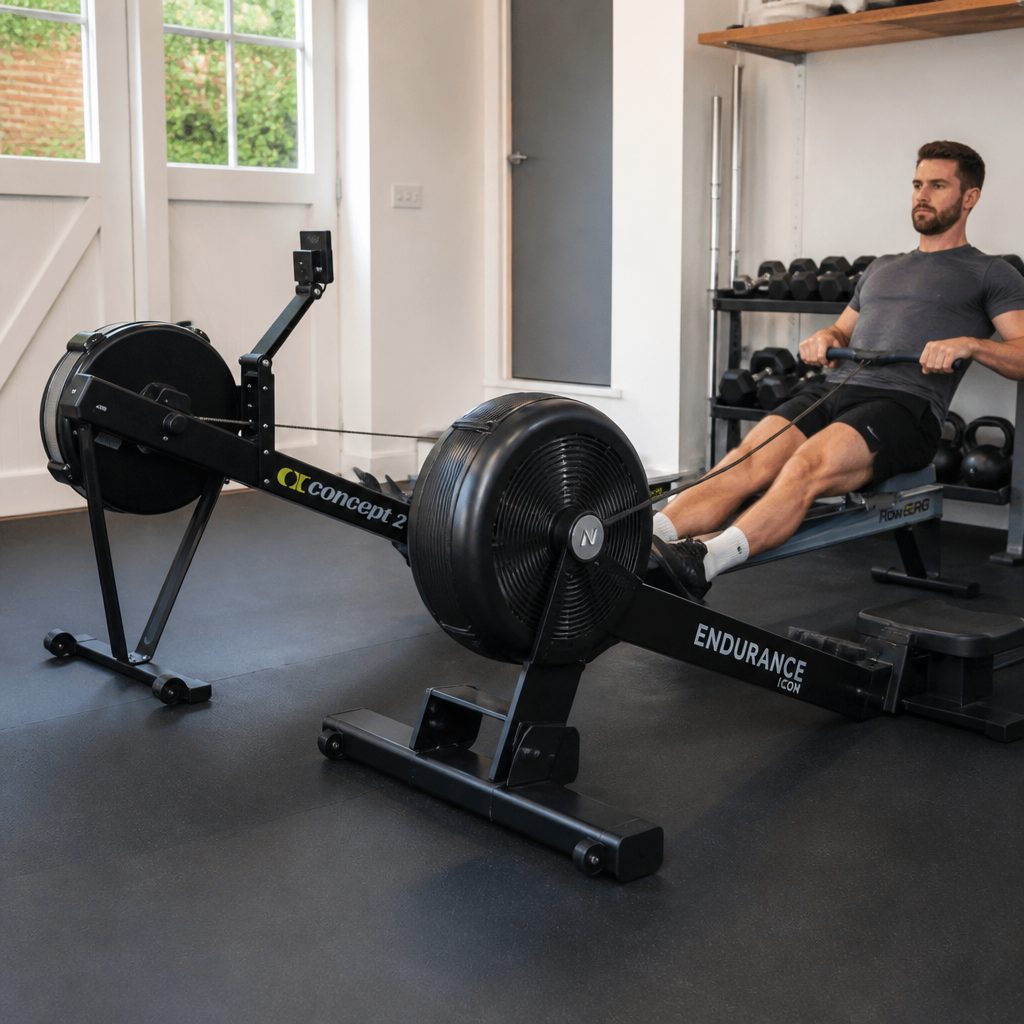
Air flywheels create resistance through your own effort, which is why both machines can feel appropriately gentle for warm-ups and brutally honest during hard intervals.
5. PM5 versus Northern LCD: this is the decisive category
If you are buying an indoor rower primarily to sweat, the console might seem secondary. It is not. The display is your training diary, pace setter, interval coach and occasional source of uncomfortable truth. A good monitor lets you see whether you are improving. A great one gives you confidence that the comparison is meaningful next week, next winter and years later.
The Concept2 PM5 is why the RowErg remains the reference point. It supports Bluetooth and ANT+, works with compatible training apps and is designed around rowing metrics rather than merely counting movement. The monitor is also powered by two D-cell batteries, yet draws energy from the spinning flywheel during workouts to extend battery life. It is an admirably sensible solution: you get a proper screen without needing a wall socket by the radiator or another USB cable breeding in a drawer.
The Northern LCD tracks time, distance, calories, strokes per minute, total strokes, watts and heart rate through an external receiver. That is a decent set of headline metrics for a domestic machine. Time and strokes per minute are particularly useful for keeping a relaxed steady row genuinely relaxed, whilst watts can give you a simple way to make interval work more structured. Scan mode also makes sense for a user who would rather row than fiddle with buttons.
The difference is not that Northern shows nothing useful. It plainly does. The difference is that the PM5 sits inside a long-established standard for repeatable rowing performance. On the RowErg, your split has meaning beyond the individual machine. You can follow rowing plans, compare a 2,000m effort with previous attempts and use common pacing targets with confidence. That is a very large advantage for anyone who enjoys measurable progress or trains with a club, coach or online community.
It also changes how you approach the workout. With a casual LCD, you may use distance as a rough prompt: row until the display says you have done enough. With a PM5, it is easier to prescribe a session precisely: controlled strokes per minute, repeatable power, consistent splits and a rest interval that does not rely on your increasingly unreliable sense of time. Both approaches burn calories. Only one makes it particularly easy to quantify the work.
Concept2 PM5 strengths
- Bluetooth and ANT+ connectivity for a broader training setup.
- Flywheel-assisted power helps the D-cell batteries last longer.
- Built around standardised rowing data and repeatable benchmark sessions.
- Covered by a two-year monitor warranty.
Northern LCD trade-offs
- Its simpler display is better suited to straightforward home training than data-led rowing culture.
- Heart-rate use depends on an external receiver.
- It does not offer the RowErg's confirmed Bluetooth and ANT+ connectivity.
- Displayed figures are useful prompts, but the RowErg remains the stronger choice for long-term benchmarking.
6. Monitor accuracy and repeatability: where the RowErg earned its reputation
This is the section that turns the comparison from "premium versus budget" into something more concrete. The Concept2 RowErg has not just become popular because it is robust and familiar. Independent long-term testing measured its power tracking within 1.2% of an on-water power meter. That is an exceptionally persuasive result for an indoor machine intended to show training effort rather than simply entertain you with changing numbers.
The same testing found identical splits at the same wattage across months, including half-marathon pieces performed in different seasons. That repeatability matters more than most people initially realise. If you train in October, then again in March, you want to know that a change in pace reflects your fitness, technique or effort—not a console that has decided to develop a personality.
For competitive rowers, the implication is obvious. A RowErg lets training data travel with you. A hard interval completed on one machine can be compared with a similar interval elsewhere. You can visit a gym, use a club machine, row at home and still operate in roughly the same performance language. It is hard to put a price on that until you have trained with inconsistent feedback. Then it becomes rather easy.
For beginners, this might sound a touch obsessive. It need not be. Accurate, repeatable feedback can simply make progress less confusing. If your five-minute steady pace improves at the same stroke rate, you have a useful sign that your engine or technique has improved. If it gets worse, you can look at sleep, fatigue, pacing or form rather than wondering whether the display had a sulk.
The 74dB reading at one metre is also worth taking seriously. Air rowers are not silent machines, and no sensible person should buy one expecting library hush. The sound is a broad rushing whoosh rather than a sharp mechanical clatter, but it will travel through a small flat. If you live above someone who regards dropped teaspoons as a personal affront, plan your hard intervals thoughtfully.
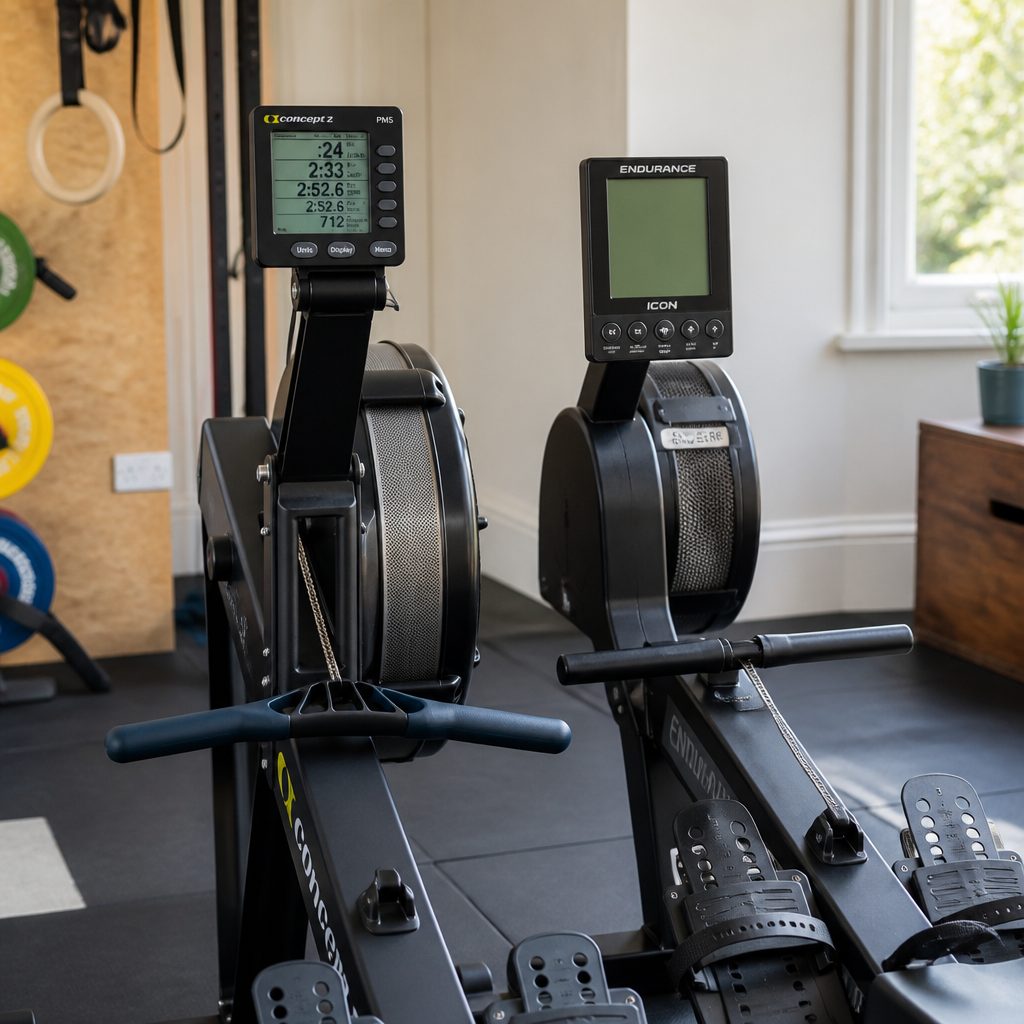
The PM5 is not flashy, which is rather the point. Its appeal is that a displayed split can be used as a meaningful training reference rather than a decorative suggestion.
7. Battery power, connectivity and everyday fuss
Home fitness equipment has a funny tendency to acquire needless dependencies. A machine that needs a subscription, a permanent Wi-Fi connection, a firmware update and a sacrificial goat before you can warm up is not necessarily the machine you use most often. Both rowers keep the core experience refreshingly direct.
The Northern's battery-powered LCD means you can place it where it fits, rather than where a plug socket happens to be available. That is genuinely useful in a garage gym, shed or spare room with dubious cable management. Press a button, sit down and row. For plenty of users, that is exactly the correct amount of technology.
The RowErg has the same practical independence, with a more sophisticated approach to conserving battery power. The PM5 uses two D batteries but takes energy from the flywheel when you row. It is a tiny detail, yet it fits the wider Concept2 philosophy: the rower should remain ready for work without demanding attention. There is no touch screen trying to sell you a scenic lake tour when you are simply trying to complete four hard minutes.
Connectivity is the clear differentiator. The PM5's Bluetooth and ANT+ support makes it possible to integrate the rower into a wider setup involving apps, compatible devices and heart-rate equipment. That does not mean every buyer needs it. A straightforward timer and a willingness to work are still perfectly valid. But if you like logging sessions, following structured workouts or pairing external kit, the Concept2 offers a more complete runway.
8. Build quality, maintenance and the long ownership question
The RowErg's status is not based on a short spell of social-media enthusiasm. The machine traced its lineage back to the Concept2 Model D and Model E, and the RowErg name carried that familiar design forward. The result is a rower that feels less like a fashionable home-fitness object and more like a piece of training equipment that happened to become popular in homes.
Real-world reports included daily use over seven to ten years without frame failure, alongside documented examples exceeding ten million metres on a single unit. Ten million metres is not a casual dabble. It is enough rowing to establish a relationship with every creak in your house, your favourite playlist and several parts of your personality.
The RowErg also has a five-year frame warranty and two years for moving parts and the monitor. Those terms do not promise immortality, obviously. Nothing with a chain, seat rollers and moving components is immune to wear. But they reinforce the machine's position as a serious long-term purchase rather than an item expected to be upgraded once the novelty wears off.
The Northern machine is more difficult to place in that same long historical context. Its appeal is immediate: an air rower with a chain drive, transport wheels, upright storage and a frame that separates without tools. For a buyer who wants a home rower for regular cardio, those are the right practical ingredients. There is no need to make it sound less useful than it is.
Still, durability is not only about whether a machine works on day one. It is about how confidently you can keep training hard after the first year, how much faith you have in the rail, chain, rollers and monitor, and whether another buyer will want it when your circumstances change. The RowErg's long record gives it a very substantial advantage there.
Ownership is part of the cost
A rower that is easy to sell, has a known maintenance history and delivers consistent training data can be the more economical machine over several years, even if its initial outlay is higher. The purchase price is only the opening chapter.
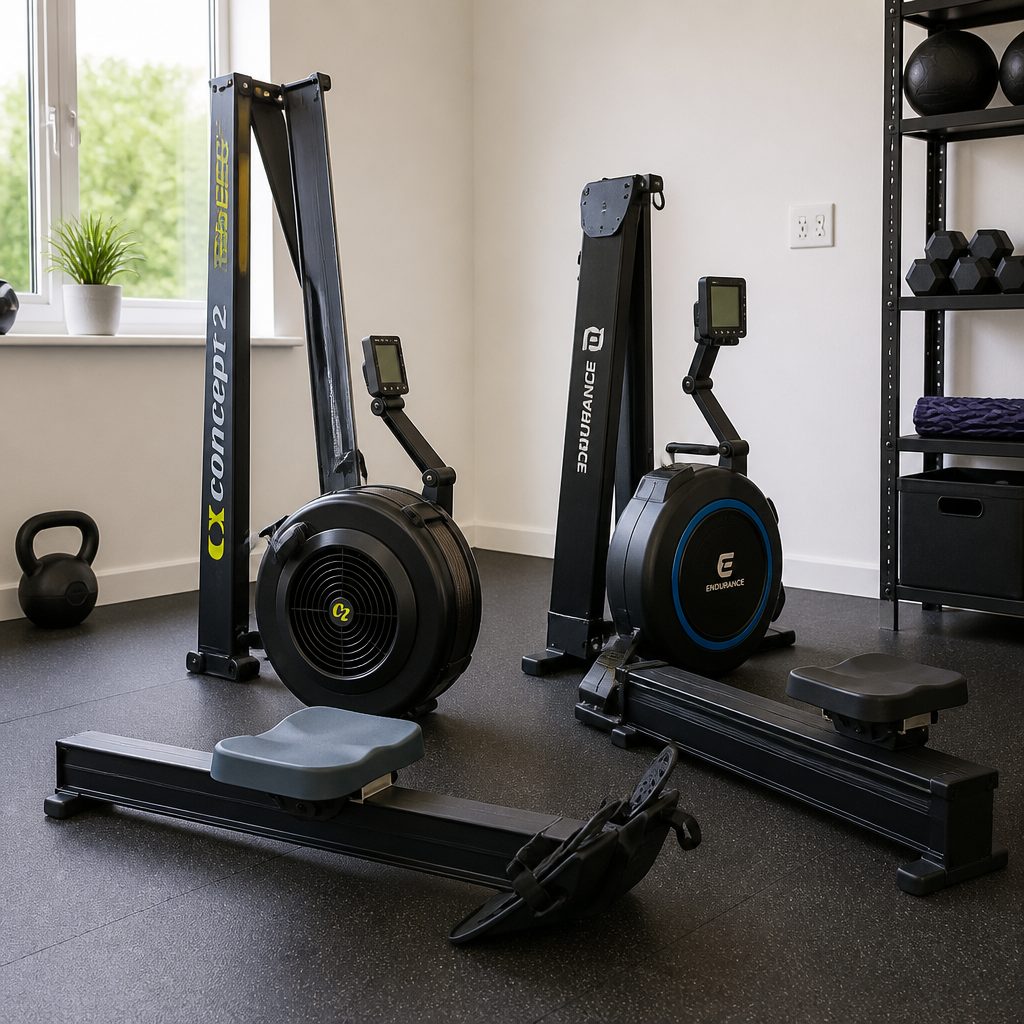
Both rowers can separate into sections for storage, but the RowErg's reputation was built on surviving sustained, repetitive training rather than merely fitting neatly into a room.
9. Storage, portability and domestic diplomacy
There is good news here: both machines are more manageable than their full-length dimensions suggest. The RowErg stores upright without extra hardware and splits into two pieces. The Northern machine has an upright frame lock and also separates into two sections without tools. That means either can be made far less visually dominant after training.
"Stores upright" is sometimes treated as a magical phrase, as though a rower then becomes the size of a paperback novel. It does not. You still need a stable patch of floor and enough ceiling height to stand the frame safely. But vertical storage substantially improves the chances of a machine actually staying in the home rather than being exiled to a damp corner of the garage.
Transport wheels are another quietly useful Northern feature. The RowErg's relatively lower 57lb weight is helpful when repositioning it, whilst the Northern's 65lb weight is still manageable for most users with wheels and a clear route. In either case, think about the journey from delivery point to training space. Narrow stairs, a tight landing and an enthusiastic dog can turn a simple move into an episode of amateur logistics.
For renters and flat dwellers, noise may be more important than storage. The measured 74dB level of the RowErg at one metre tells you to expect audible airflow. A thick exercise mat can help protect the floor and reduce transmitted vibration, although it cannot make an air flywheel silent. If quiet late-night sessions are non-negotiable, an air rower may not be your ideal category in the first place.
10. Value: budget machine today or enduring asset tomorrow?
Northern's rower sits in the budget end of the air-rower market, whilst the RowErg is the more premium investment. That is the obvious part. The more useful question is what each buyer gets for that difference in positioning.
The Northern is compelling for the person who wants an air-resistance workout, useful dashboard metrics and straightforward storage without paying for the established performance ecosystem. It is especially understandable if you are new to rowing and cannot yet say whether the machine will become a daily habit or a very expensive clothes rack. We have all seen exercise equipment earn its place in the laundry cycle. It is not a proud moment for anyone involved.
The RowErg asks you to value things that are not always visible in a product photograph: a monitor trusted for training comparisons, a huge user-capacity margin, connectivity, a known warranty structure, a long durability record and unusually strong resale. Independent tracking found RowErgs retaining around 70% of their original recommended price after five years. That is extraordinary for exercise equipment, which often loses value faster than a half-used tub of pre-workout loses its scoop.
That retained value makes the Concept2 less financially one-way than it initially appears. If your living situation changes, if you move to a smaller flat, or if you decide that cycling is more your thing after all, a RowErg has a mature second-hand audience. The machine is familiar to serious rowers, CrossFit athletes, home-gym buyers and clubs. Familiarity is resale fuel.
| Value consideration | Concept2 RowErg | Northern Cardio Rowing Machine |
|---|---|---|
| Market position | Premium, established performance rower | Budget-focused home air rower |
| Long-term data confidence | High, with measured power accuracy and repeatability | Best suited to straightforward home metrics |
| Resale proposition | Strong; around 70% of MSRP retained after five years | Best approached as a lower-entry-cost ownership decision |
| Best financial logic | Frequent use, structured training and future resale | Getting air-rowing cardio at a lower initial outlay |
11. Who should buy the Concept2 RowErg or Northern Gym Equipment Rower?
There is no universal winner because people do not buy rowing machines for one universal reason. One buyer wants rowing-race accuracy. Another wants a sturdy cardio tool beside the television. Someone else simply wants to survive winter without running in the rain. All perfectly respectable motives.
Best for serious rowing
Concept2 RowErg. The PM5, Bluetooth and ANT+ support, repeatable splits and measured power accuracy make it the clear choice for training plans, benchmark sessions and performance-minded athletes.
Best for a tighter budget
Northern Cardio Rowing Machine. It gives home users air resistance, a chain drive, selectable resistance levels and useful basic workout data without the RowErg's premium positioning.
Best all-round home investment
Concept2 RowErg. The higher capacity, long durability record, excellent monitor and resale performance make sense for a household that expects to use its rower for years.
Best for uncomplicated cardio
Northern Cardio Rowing Machine. If you want to row regularly, watch time and distance, and have no need to chase comparable splits, its simpler approach is entirely reasonable.
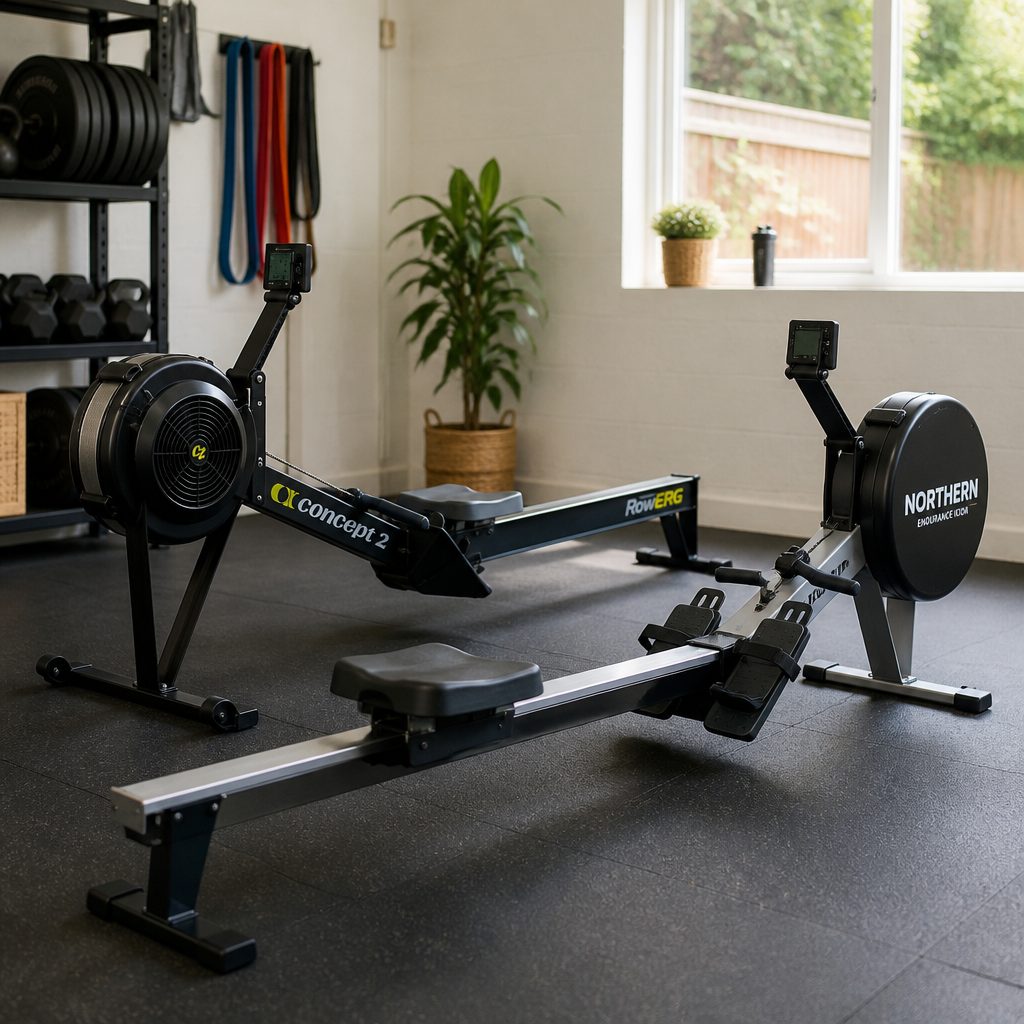
For a shared home gym, the RowErg's 500lb capacity and established performance monitor give it a wider comfort zone. For straightforward solo cardio, the Northern's simpler brief may be enough.
12. My scoring: performance heritage versus accessible entry point
A rating only helps if it reflects what the machine is trying to be. It would be unfair to mark Northern down simply because it is not trying to duplicate every part of Concept2's long-standing training ecosystem. Equally, the RowErg should not receive a free pass just because everyone recognises it. Its score rests on evidence: capacity, monitor quality, accuracy, warranty and demonstrated longevity.
The ratings should be read as buying guidance, not a declaration that one machine is morally superior to the other. Northern wins the entry-point argument. Concept2 wins the argument about what happens after you have put in hundreds of sessions and started caring about the numbers.
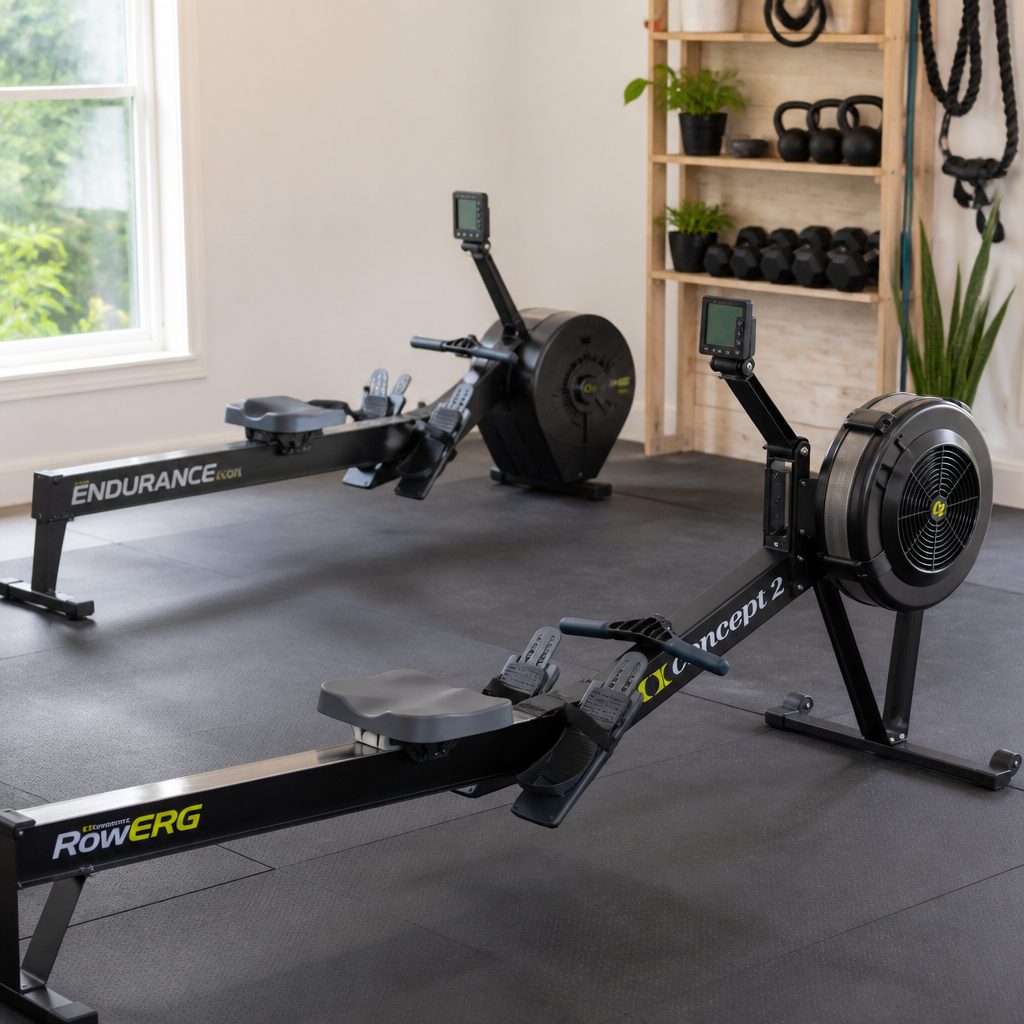
A RowErg earns its higher rating through the things that become more important over time: reliable data, a wide capacity range, durable construction and a remarkably healthy second-hand market.
13. Frequently asked questions
Final verdict: buy the machine that matches your relationship with rowing
Choose the Concept2 RowErg if you want the benchmark
The RowErg is the better buy for serious trainees, taller or heavier users, shared households, club rowers and anyone who wants meaningful performance data. The PM5's Bluetooth and ANT+ support, measured accuracy within 1.2% of an on-water power meter, repeatable splits, 500lb capacity, strong warranty and exceptional resale record make it more than a premium air rower. It is a durable training platform.
Choose the Northern Cardio Rowing Machine if straightforward home cardio is the goal
Northern's rower makes sense for the budget-minded UK buyer who wants air resistance, a chain drive, 16 resistance levels, basic workout metrics and practical storage without paying for the full Concept2 ecosystem. It is not the obvious choice for comparable race-style performance data or an ownership story built around decades of reputation. But for regular rowing at home, with sensible expectations, it is a credible budget upstart rather than a gimmick.
Put bluntly: the Northern gets you rowing. The Concept2 gives you a rower you can build years of training around. That distinction is why the RowErg remains the endurance icon.