
Dripex Magnetic Rower Review: Is This Flat-Friendly Rower Any Good?
The Dripex Magnetic Rower is a budget-minded, foldable magnetic machine built around a very simple promise: give people in smaller homes a smooth rowing workout without turning every interval into a neighbourhood announcement. It is genuinely quiet, reassuringly easy to live with, and more capable than its modest positioning suggests. It also makes the usual budget compromises, particularly if you want the fierce feedback and open-ended resistance of an air rower.
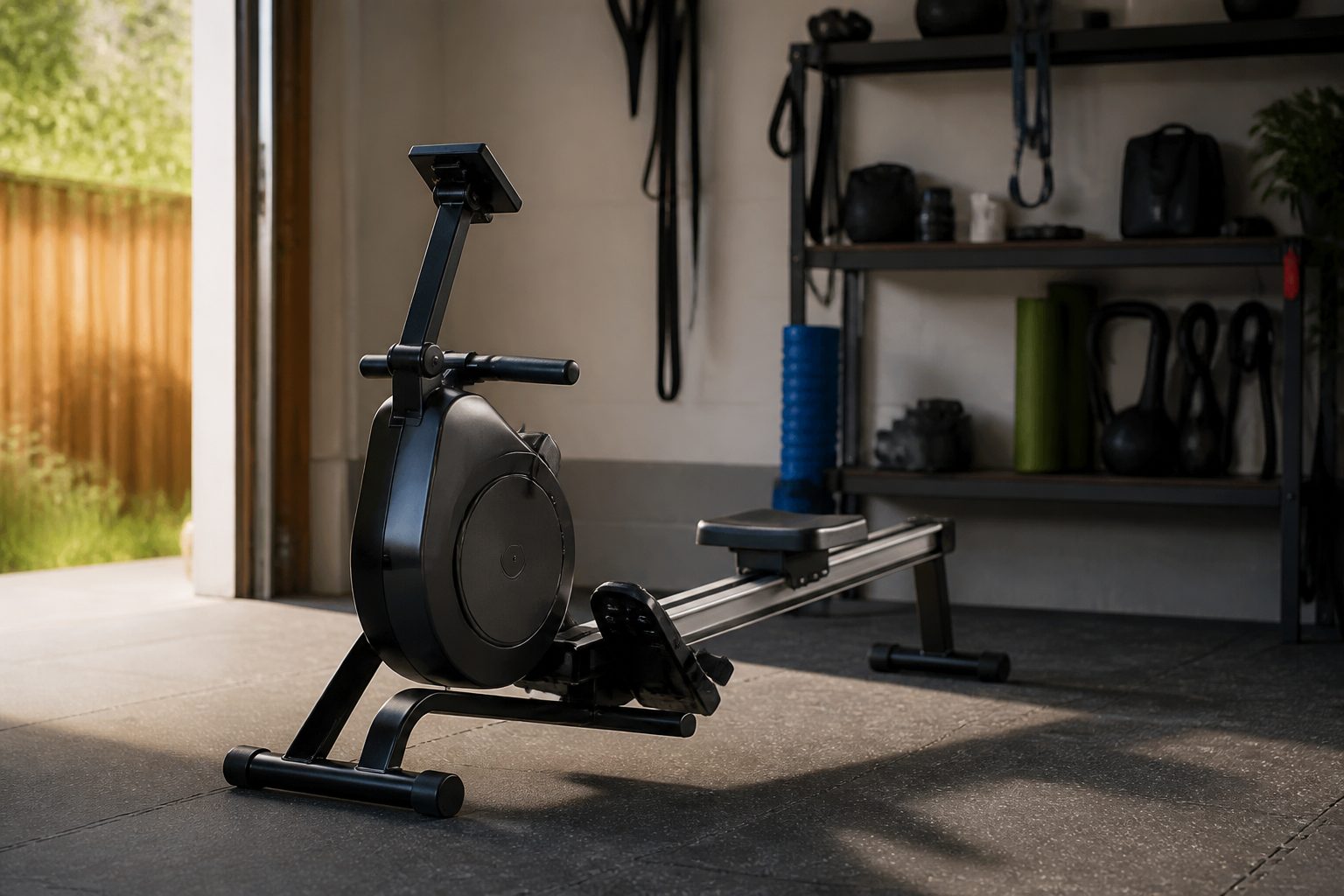
The Dripex magnetic rower uses a compact dual-rail layout and folds between sessions, which is rather more useful in a flat than a heroic machine that lives permanently in the middle of the room.
 By James Oduya · Staff Writer & Home Gym Columnist · Updated August 18, 2026
The short answer
Yes, the Dripex Magnetic Rower was a good option for the right buyer. The important qualifier is "right". This was not a stripped-down substitute for a commercial air rower, and it did not pretend to be one. It was a compact home machine for people who wanted regular, low-fuss cardio, a quieter training environment and the ability to reclaim some floor space afterwards.
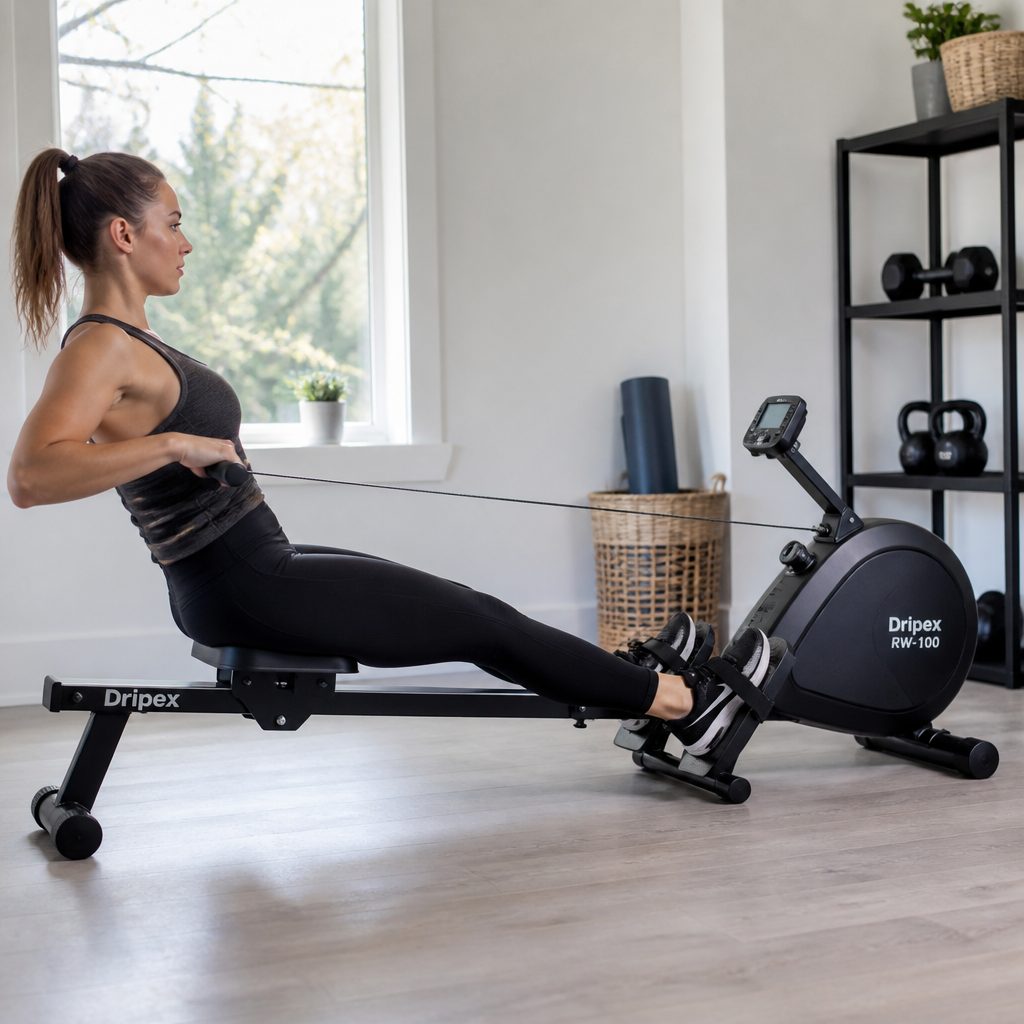
A magnetic flywheel does not create the fan roar associated with air resistance, making the Dripex a much easier machine to use during early mornings or late evenings.
Check the Dripex Magnetic Rower on Amazon UK
That last point matters more than gym equipment brands sometimes appreciate. A rowing machine can be brilliant in theory, then spend most of its life wearing washing in a spare room because it is awkward, loud or simply too large to leave out. Dripex had clearly understood the domestic side of the equation. The frame folded, transport wheels helped when you needed to shift it, and the magnetic resistance avoided the familiar whoosh of a fan-driven machine.
There were sixteen resistance levels, a belt-drive system, Bluetooth connectivity, a tablet holder and a basic LCD monitor. The dual aluminium rail was particularly welcome at this end of the market, because it gave the seat a more planted, less bargain-basement feel when you started pulling with proper intent. Add a padded seat, adjustable straps and pedal angle, and it became a sensible package for building a sustainable home routine.
The central question, though, was whether "quiet" meant quiet in real life rather than merely quiet in a product listing. Here, the Dripex did unusually well. One reviewer measurement put it at 15 dB, whilst Dripex's own claim was 30 dB. Both figures pointed in the same direction: this was dramatically less intrusive than the 70–80 dB fan noise associated with an air rower at moderate intensity. You still heard the seat travel, the belt and your own breathing. Happily, your downstairs neighbour was unlikely to hear the equivalent of a small helicopter beginning its warm-up routine.
Dripex Magnetic Rower specifications at a glance
The current dual-rail, Bluetooth-capable version was the one worth seeking out. Dripex had updated the range over several years, and older listings could still refer to a fifteen-level machine. The model discussed here used sixteen levels, a heavier flywheel than earlier versions and the more useful dual-rail layout.
At 179cm long, this was not tiny when open. No rowing machine that permits a proper leg drive really can be. It was, however, narrow enough at 53cm to sit beside a wall or in a living room without feeling as though you had installed a piece of industrial catering equipment. The 76cm height was also manageable under normal ceilings, even if the rowing stroke itself made you use a little more space around the machine than the footprint alone suggested.
Its net weight of roughly 25kg was another sensible middle ground. It was heavy enough to avoid feeling featherweight when you pushed through the legs, yet it remained realistic for one person to wheel out of the way. The transport wheels were not glamorous. They did not need to be. Their job was to save you from dragging a metal frame over flooring and then spending the evening regretting your enthusiasm.
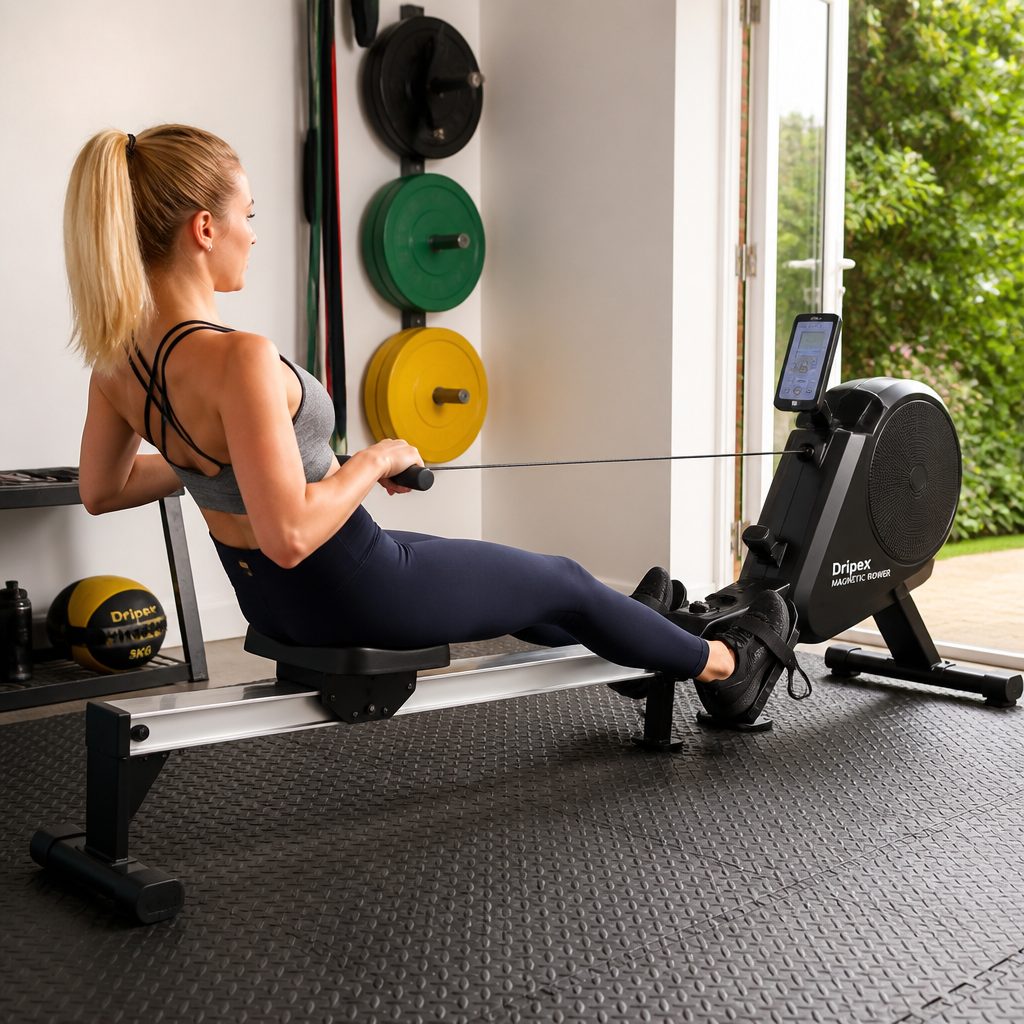
The long double aluminium rail is one of the Dripex's better decisions: it contributes to a smoother seat path and a more stable feeling during a full rowing stroke.
Design and build: better thought through than many budget rowers
The Dripex looked like what it was: a pragmatic home fitness machine rather than a boutique object you would display beside an expensive coffee-table book. I mean that kindly. Its strength was not visual theatre. Its strength was making the important physical choices largely correctly.
The double aluminium railway was the standout. A single rail can work perfectly well, but cheap single-rail rowers sometimes reveal their limitations when a user begins to pull hard or changes direction sharply at the finish. The Dripex's dual-rail arrangement felt more settled. Four aluminium rail balls and the seat-wheel design helped the seat roll through the stroke without the juddery, scratchy sensation that can make a budget rower feel tiresome surprisingly quickly.
The frame combined steel, aluminium and PU materials. That did not transform it into a gym-floor tank, nor should anyone expect it to. It did mean that the important touchpoints and moving areas had been approached with more care than the usual "make it cheap and hope" formula. The 3D padded seat was comfortable enough for normal steady rowing sessions. It was not an upholstered armchair, obviously. You were still sitting on a rowing machine. But it avoided the thin, punishing perch that turns a well-intended workout into a discussion about cushions.
Pedals had adjustable straps and an adjustable angle. The straps matter because an inefficient foot connection affects the whole stroke: feet lift, knees wander, timing goes odd, and you begin to pull too much with the arms. This Dripex gave enough adjustment to establish a secure, sensible setup. Take a minute to position the straps over the widest part of your foot, then tighten them firmly rather than strangling your trainers. The goal is connection, not circulation problems.
Dual aluminium rail
The two-rail construction was a meaningful upgrade over the flimsy feeling found on some entry-level machines. It helped the seat stay composed when your sessions became more energetic.
Padded seat with smooth rollers
The seat used built-in wheels and four aluminium rail balls for a smoother glide. It supported longer steady sessions without adding unnecessary noise.
Adjustable pedals and straps
A secure foot position makes the leg drive more effective and helps beginners learn the correct sequence: legs, body, then arms. It sounds boring. It is also what stops rowing becoming a very odd biceps exercise.
Folding frame and transport wheels
The security knob allowed the rower to fold for storage, while the wheels made moving its roughly 25kg frame much more civilised than carrying it.
The long slide rail was designed to suit both shorter and taller users, with the layout working particularly well for people up to around 6ft. That was an important caveat. Someone taller could potentially use it, but a taller frame needs enough slide length to obtain a comfortable full compression at the catch without feeling cramped. If you are around that height or below, the Dripex makes much more sense than it does for a long-limbed rower trying to chase competition-style technique.
Is the Dripex Magnetic Rower genuinely quiet enough for a flat?
This was its defining quality, and the answer was a confident yes. Magnetic resistance is frictionless and non-contact. Instead of creating resistance by moving air through a fan, the Dripex used magnets acting on the flywheel. There was no fan roar to rise with every harder pull, no chain clatter and no dramatic soundtrack for an otherwise private session.
Dripex claimed a noise level of 30 dB. A separate reviewer measurement came in at just 15 dB. Those were not interchangeable figures produced under a formally identical test protocol, so I would not treat either as a laboratory guarantee for every room, every floor and every rowing style. What they did establish was a very persuasive direction of travel. The machine was quiet enough that the background sounds of a home — conversation, a television, rain at a window, the boiler deciding it had something to say — were likely to matter more.
Contrast that with an air rower. At moderate effort, fan noise commonly sat around 70–80 dB. Air rowers were excellent machines and gave a wonderfully responsive, outdoorsy workout sensation, but they made their presence known. That may be completely fine in a garage, garden room or detached house. In a studio flat at 6.30am, with a bedroom below and a neighbour who has already sent one politely worded message about recycling, it is a different proposition.
The chart gives the useful practical contrast rather than pretending that dB figures tell the whole story. Sound travels differently through suspended timber floors, laminate, old Victorian floorboards and a thick gym mat. Your technique changes it too. A controlled recovery is quieter than allowing the seat to slam into the front stop. The Dripex's resistance mechanism was quiet, but good manners still apply. Row smoothly, place the handle gently at the finish and avoid using the rail as an anger-management device.
Flat-living tip
Place the rower on a proper exercise mat, especially on hard flooring. The magnetic mechanism was extremely restrained, but a mat reduced vibration transmission, protected the floor and softened the little contact noises created by shoes, seat travel and the frame itself.
Resistance and workout feel: smooth, controlled and finite
The Dripex used a 3kg flywheel and sixteen manually selectable magnetic resistance levels. The basic feel was smooth rather than aggressive. Pull the handle and the belt-drive system delivered a quiet, even load. There was no sudden catch, no lumpy mechanical transition and no need to overcome a fan that had decided to build a weather system in the front of the machine.
For beginners, that smoothness was an asset. Rowing had a learning curve, and the Dripex did not make it more difficult by punishing tentative technique. Start in the middle of the resistance range and concentrate on rhythm. Drive with the legs, swing the torso back slightly once the legs are nearly straight, then draw the handle to the lower ribs. On the way back, reverse that order: arms away, body forward, then slide in with bent knees. It was less dramatic than yanking the handle as hard as possible, but it was safer, more effective and considerably less likely to make your lower back send a strongly worded complaint.
For general cardio, steady-state rowing, short interval work and regular calorie-burning sessions, the available range was ample. Sixteen settings provided enough room to begin gently, build confidence and make sessions harder over time. The heavier flywheel used in the updated machine also gave each stroke a more substantial, more natural feeling than lighter versions in the range had managed.
The limitation was inherent to magnetic rowers: the resistance did not automatically rise in exact proportion to how hard you pulled. On an air rower, a harder stroke moves more air and therefore produces more resistance. That gives experienced rowers an almost limitless-feeling top end. On the Dripex, resistance was tied primarily to the selected level. You could still row faster, raise your heart rate and work hard. What you did not get was the same explosive, self-scaling response at the top of the stroke.
This distinction mattered most to strong, experienced athletes. If you had spent years using an air rower for maximal intervals, race-style pacing or brutally powerful sprints, the Dripex could feel a little restrained. It would work your lungs and legs, but it would not mimic that fan-driven crescendo. For the majority of people buying a home rower for fitness rather than indoor regatta ambitions, that was not a fatal flaw. It was simply a reason to buy the right category of machine.
The monitor, Bluetooth and daily data
The onboard LCD monitor covered the useful basics: time, distance, speed, calories, count and total count. That was enough for a simple structured session. You could row for a set time, chase a distance, keep an eye on stroke count or make sure your supposedly "easy" ten minutes had not turned into a three-minute burst followed by scrolling on your phone.
It was not a premium performance console. There was no reason to imagine it would replace the richly detailed training ecosystem associated with considerably more expensive equipment. Calories, in particular, should be treated as an estimate rather than a personal nutritional accountant. A rowing machine could not know your exact body composition, physiology, technique efficiency or whether you had spent half the workout trying to answer a text with one hand.
The welcome development was Bluetooth. The updated Dripex could connect with a smartphone or tablet for app-based workout tracking, and it supported compatibility with more than thirty apps. That gave the machine a longer lease of life than a basic standalone LCD might suggest. A tablet holder was included, so it was easy to put a larger screen in front of you for guided sessions, visual routes, entertainment or simply a familiar programme.
There was a sensible warning here: app experience depended on the app you chose and the device you paired. Bluetooth availability was not the same thing as a guarantee that every screen would be glamorous, every metric would be interpreted beautifully or every third-party service would meet the standards of a dedicated premium rowing platform. Still, connectivity was a meaningful bonus on a quiet budget machine. It made routine tracking less fiddly and helped turn a functional rower into something you might actually return to several times each week.
The console ran on AA batteries rather than a rechargeable internal battery. That was not especially exciting, but it was practical: no charging lead to lose, no wall socket required and no need to schedule your workout around an empty battery indicator.
Battery-powered consoles were not an inconvenience in normal use. A comparable rowing-machine monitor such as Concept2's had been known to run for between six and twelve months from a set of AA batteries, depending on use. The key point was that the Dripex did not need mains power to function. In a small home where plug sockets were already occupied by lamps, chargers, routers and whatever mystery appliance lived behind the television, that small freedom was genuinely useful.
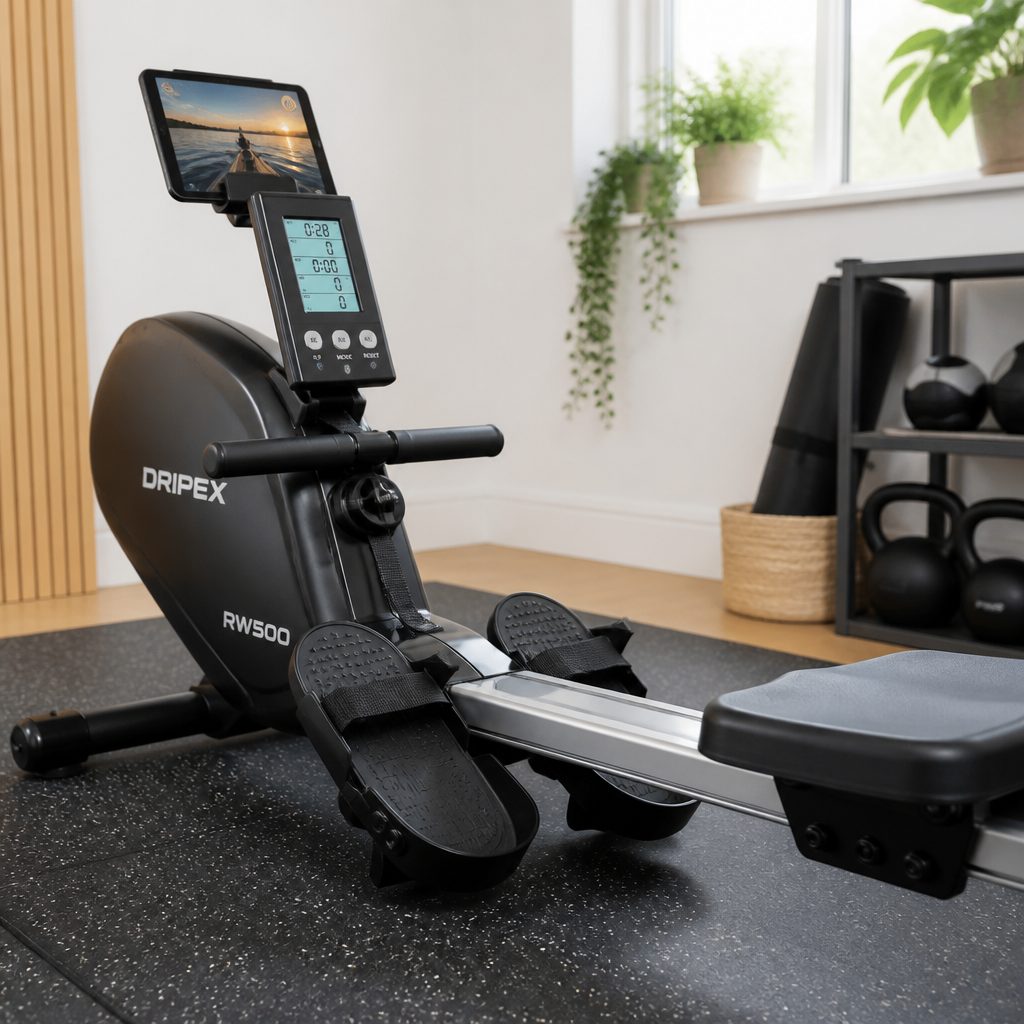
The LCD console tracks core session data, while Bluetooth and the tablet holder make it easier to add guided workouts or entertainment without cluttering the room with extra kit.
Assembly, folding and living with it every day
Dripex said the rower could be assembled from six main parts in around twenty minutes, and it arrived mostly pre-assembled. That was excellent news for anyone who had previously bought budget fitness equipment and found themselves confronting a bag of bolts that appeared to have been selected by a particularly mischievous engineer.
It was still worth taking the time to assemble it carefully. Tighten the appropriate fittings, make sure the rail and seat were properly aligned, check that the pedals were secure and keep the manual for future reference. A rower had moving parts and repetitive force going through it. Starting with a correctly assembled machine was rather easier than trying to diagnose a squeak after several weeks of enthusiastic use.
Once together, the Dripex was a good domestic companion. Its folding security knob let the rail move into a more storage-friendly position, with folded dimensions roughly half its assembled size. That did not make it disappear into a drawer — if it did, it would probably be a very disappointing rower — but it made a real difference in a flat, box room or multi-purpose living space.
I would still advise measuring before buying. Measure the place where you intend to use it, not merely the gap where you hope it might live. You needed room in front for the handle movement and space behind or beside the frame to get on and off safely. Consider the path from storage to workout position too. A rower that technically fitted in a bedroom but needed to negotiate a narrow hall, a turn and a cat's favourite sleeping spot before each session could quickly become a machine you avoided.
The transport wheels helped turn that movement into a manageable job. At about 25kg net, the Dripex had enough mass that you would not want to lift it repeatedly, but wheeling a folded unit was much more reasonable. The fold was particularly valuable for renters and anyone who did not want their home to become permanently gym-shaped.
Pros
- Exceptionally quiet magnetic system suited to shared homes and flats.
- Dual aluminium rail gave the seat a stable, smoother feel under effort.
- Sixteen resistance levels provided plenty of progression for normal home cardio.
- Foldable frame and transport wheels made the machine much easier to store.
- Bluetooth and a tablet holder added useful flexibility beyond the basic LCD.
- Mostly pre-assembled design kept setup refreshingly straightforward.
Cons
- Magnetic resistance did not deliver the self-scaling intensity of an air rower.
- The LCD display handled essentials rather than deep performance analysis.
- Taller users beyond roughly 6ft should be more cautious about rail length.
- A folded rower still needed a realistic storage spot in a small home.
- Older fifteen-level listings could be confusing beside the newer sixteen-level version.
Dripex Magnetic Rower versus an air rower
Most people deciding between a Dripex and an air rower were not really choosing between good and bad. They were choosing between two useful but distinctly different training experiences. It helped to be honest about what mattered in your home before becoming hypnotised by the word "performance".
An air rower remained the better fit for people who wanted responsive resistance, hard sprinting and a closer approximation of the machines used in rowing clubs and commercial gyms. The fan resistance rewarded a more powerful stroke instantly. It was satisfying, physical and wonderfully direct. It was also noisy. The very thing that made it feel alive could make it a terrible housemate.
The Dripex took the other route. Its magnetic flywheel was smooth, contained and quiet. It was the better choice for early sessions before work, television-on rowing in the evening and households where other people did not necessarily wish to participate in your cardio by listening to it through a wall.
| Feature | Dripex Magnetic Rower | Typical air rower | Concept2-style battery monitor reference |
|---|---|---|---|
| Resistance system | Frictionless magnetic resistance | Air resistance from a fan | Varies by rowing machine |
| Resistance settings | 16 levels | Resistance rises with pull intensity | Varies by rowing machine |
| Noise context | 15 dB reviewer measurement; 30 dB stated claim | 70–80 dB at moderate intensity | Not a resistance comparison |
| Flywheel | 3kg | Fan-based system | Not a resistance comparison |
| Monitor power | AA batteries | Depends on machine | AA sets often lasted 6–12 months |
| Best use case | Quiet home cardio and shared living | High-output performance rowing | Long-term basic console use |
The table did not mean that an air rower was somehow unsuitable for home use. Plenty of people used one very happily. It meant that acoustic tolerance was part of the buying decision. If you had a garage, a detached home or permissive family members, an air rower's noise might be irrelevant. If you trained in a first-floor flat, beneath a sleeping child or next to someone on video calls, the Dripex's quietness became a performance feature in its own right. The best workout machine was often the one you could actually use whenever you wanted.
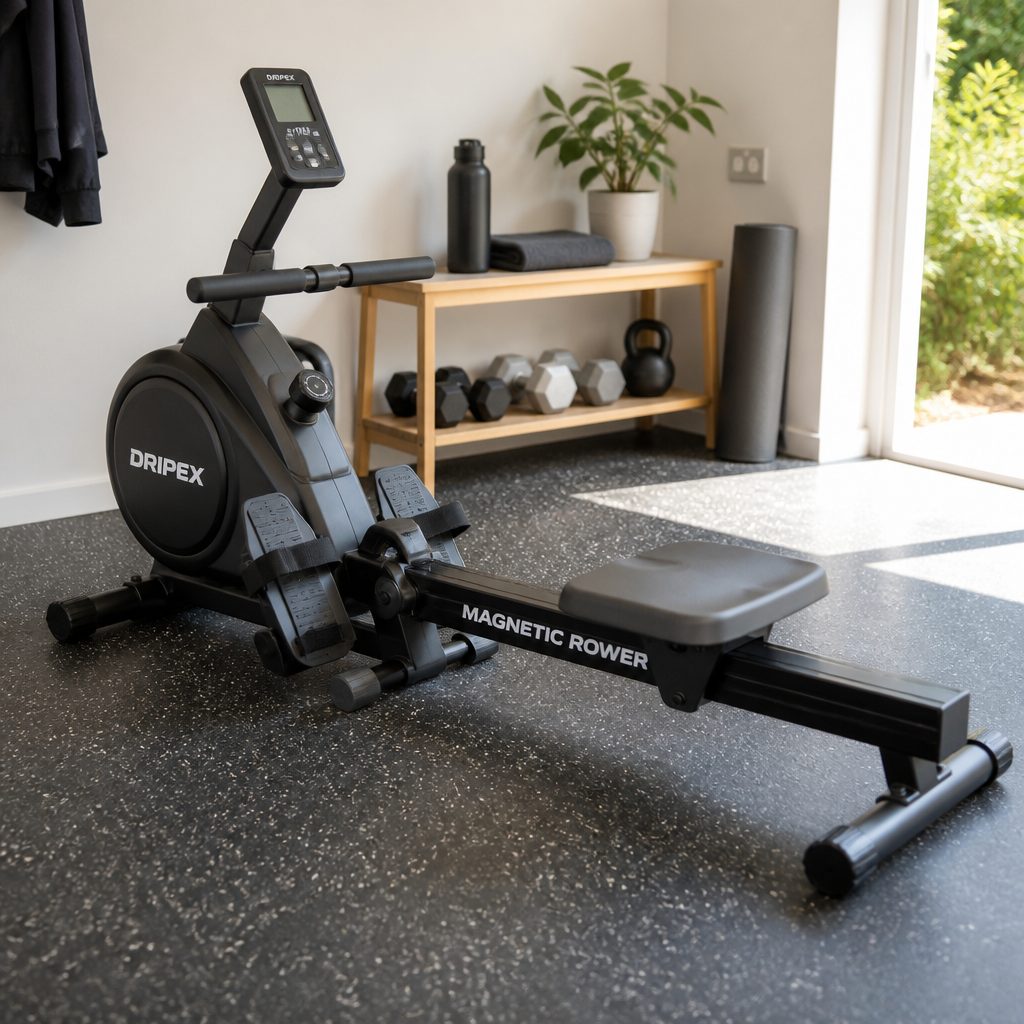
For compact homes, the decisive comparison is not simply training intensity: it is whether the machine's sound and storage needs fit your real routine.
Who should buy the Dripex Magnetic Rower?
The Dripex was at its best when bought for its actual strengths. It suited the person who wanted to move more, improve cardiovascular fitness and establish a repeatable routine without filling the home with noise or equipment. It was not a trophy machine for competitive rowers. It was a practical one, which is usually more valuable.
Best for flat dwellers
The magnetic drive was the Dripex's strongest argument. Its restrained sound made it the clear choice for upstairs homes, shared walls and early-morning exercise.
Best for beginners
Sixteen levels, a smooth pull and a stable dual rail gave new rowers enough progression without making the first few workouts feel intimidating.
Best for limited space
The folding frame and transport wheels made it much easier to share a room with your fitness equipment rather than surrendering the room to it.
Best for regular cardio
It worked well for steady rowing, moderate intervals and building a dependable home exercise habit with simple data tracking.
I would recommend it to beginners, casual-to-regular exercisers, people returning to fitness after a break and anyone whose main barrier was finding a low-impact workout they could do at home without fuss. Rowing recruited the legs, back, arms and core in one rhythmic movement, whilst keeping impact low. That combination made it useful for people who found running unpleasant, inconvenient or hard on the joints.
I would be more hesitant with very tall users, serious indoor rowing athletes and anyone specifically chasing race-pace data or maximal power training. The rail was designed for users up to around 6ft, and the magnetic system had a finite ceiling compared with an air machine. Neither weakness made the Dripex bad. They simply stopped it being a universal recommendation. Such things do not exist, despite what certain product pages would have you believe.
How to get the best workouts from it
One of the Dripex's quieter virtues was that it encouraged consistency. You could row with a podcast, watch a programme on the tablet holder or fit in twenty focused minutes before work without needing a major ritual. The most effective approach was usually to keep the plan simple enough that you actually did it.
For a first week, try ten to fifteen minutes at a steady, conversational effort. Use a middle resistance level, row smoothly and stop before form starts collapsing. Do this a few times rather than attempting one heroic session and then discovering muscles you did not know you owned. Your legs and upper back will appreciate the gradual approach.
Once that feels comfortable, use one of three very simple formats. The first is a steady session: row continuously at a sustainable pace for twenty to thirty minutes. The second is an interval session: alternate easier rowing with short periods of harder work, always recovering fully enough that the harder sections remain technically clean. The third is a distance target: pick a manageable total distance and gradually reduce the time it takes you to cover it without sacrificing stroke control.
Do not automatically turn the resistance to the highest setting. Higher resistance was not always better. A rower was not a weight stack, and setting it too high could encourage a slow, grinding pull that stressed the back and removed the fluid rhythm that made rowing so effective. Choose a level where you could drive powerfully with the legs, keep the handle path smooth and complete a full stroke repeatedly.
A better beginner cue
Think "push, swing, pull" on the drive and "arms, body, knees" on the recovery. Say it quietly in your head for the first few sessions. It is less glamorous than pretending you are in an Olympic final, but it quickly improves timing and makes the Dripex feel far more effective.
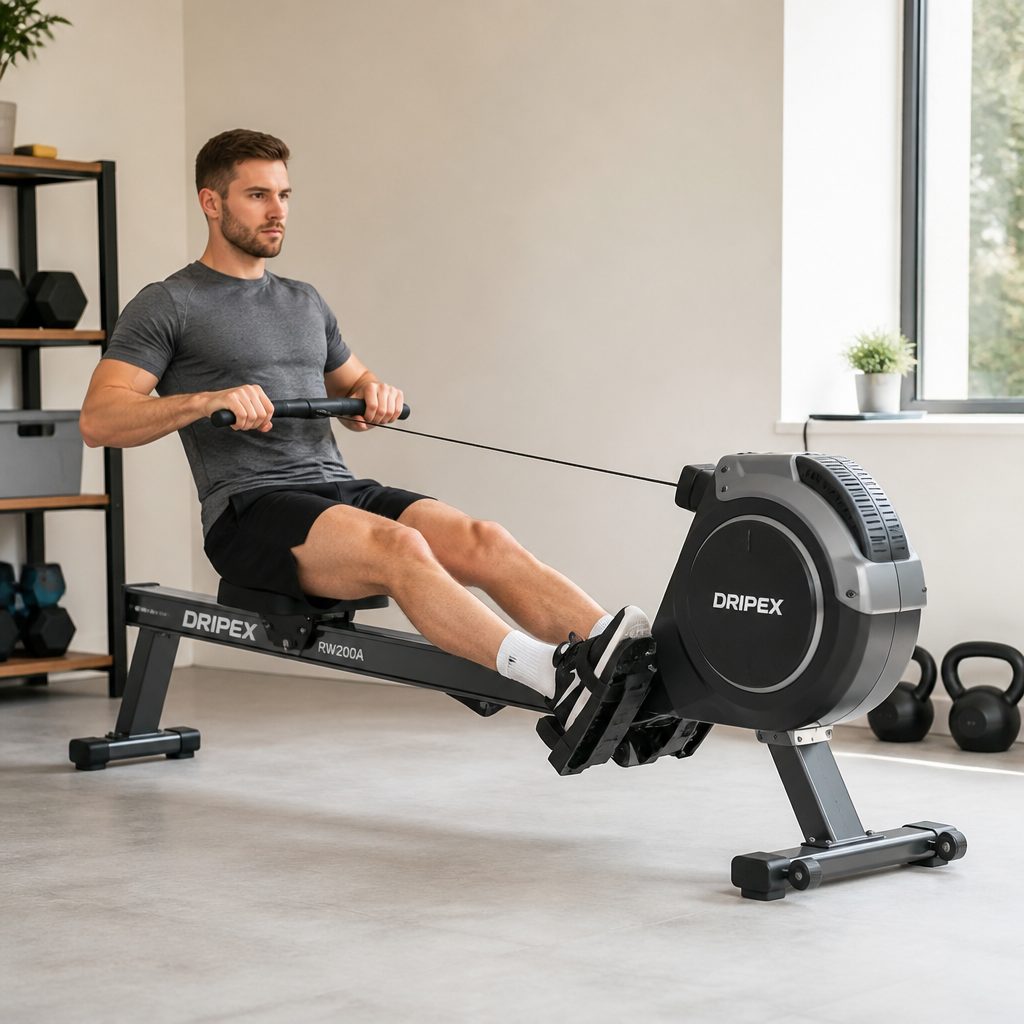
A smooth sequence of legs, body and arms makes better use of magnetic resistance than simply hauling at the handle with the shoulders.
Value: where Dripex cut corners, and where it did not
The Dripex was firmly a budget rower, so it was right to expect compromises. The question was whether those compromises harmed the core purpose of the machine. In most areas, they did not.
The console was basic, the finish was functional rather than luxurious, and the resistance system could not recreate the open-ended power response of air. Those were the obvious places where a more expensive rower would likely offer more. Serious athletes often wanted deeper metrics, stronger long-term adjustment and a more aggressive performance feel. If that was you, paying more for a specialist machine could be money well spent.
Dripex had made stronger choices where a budget home user was likely to notice them every day. The dual rail was stable. The resistance was quiet. The rower folded. It used wheels. It included a tablet holder. It had Bluetooth. It was mostly pre-assembled rather than demanding an afternoon of mechanical detective work. Those practical decisions were not flashy, but they made ownership easier.
There was also something refreshingly sensible about a rower that did not require constant mains power. The AA-powered monitor was uncomplicated. Change batteries when they eventually ran low, keep the console clean and you were done. In a category where some equipment tried very hard to turn every workout into another app subscription or software dependency, a simple battery console had its charms.
For someone who wanted the quietest practical route to home rowing, the balance was persuasive. You were buying a machine to use, not a piece of aspirational furniture. The Dripex's best value lay in that quiet usability: a machine that fitted the shape of normal life had a better chance of earning its space.
Ownership notes and simple maintenance
The attraction of frictionless magnetic resistance was that it reduced the kind of ongoing fuss associated with contact-based systems. There was no pad pressing physically against a flywheel and wearing away with every session. The belt-drive arrangement also kept operation calm and tidy.
That did not mean zero maintenance. Give the rail a regular wipe so dust, pet hair and ordinary household grime do not accumulate where the seat rollers travel. Check that fasteners remain secure from time to time, especially after the first few weeks of use. Inspect the foot straps for wear, and make sure the folding security knob was fully engaged before each workout. Boring checks are often the ones that keep equipment boring in the best possible way: quiet, reliable and not suddenly dramatic.
Keep drinks away from the monitor, particularly if you use a tablet above it. The holder was useful, but it did not turn a rowing machine into a café table. If you sweat heavily, wipe down the handle, seat and rails after training. It took a minute, stopped salts building up on surfaces and made the next session more pleasant.
Finally, resist the temptation to store it folded in a damp shed or balcony space. The Dripex was made for indoor home training. Folding it away indoors, where the frame and console stayed dry, was the much kinder long-term approach.
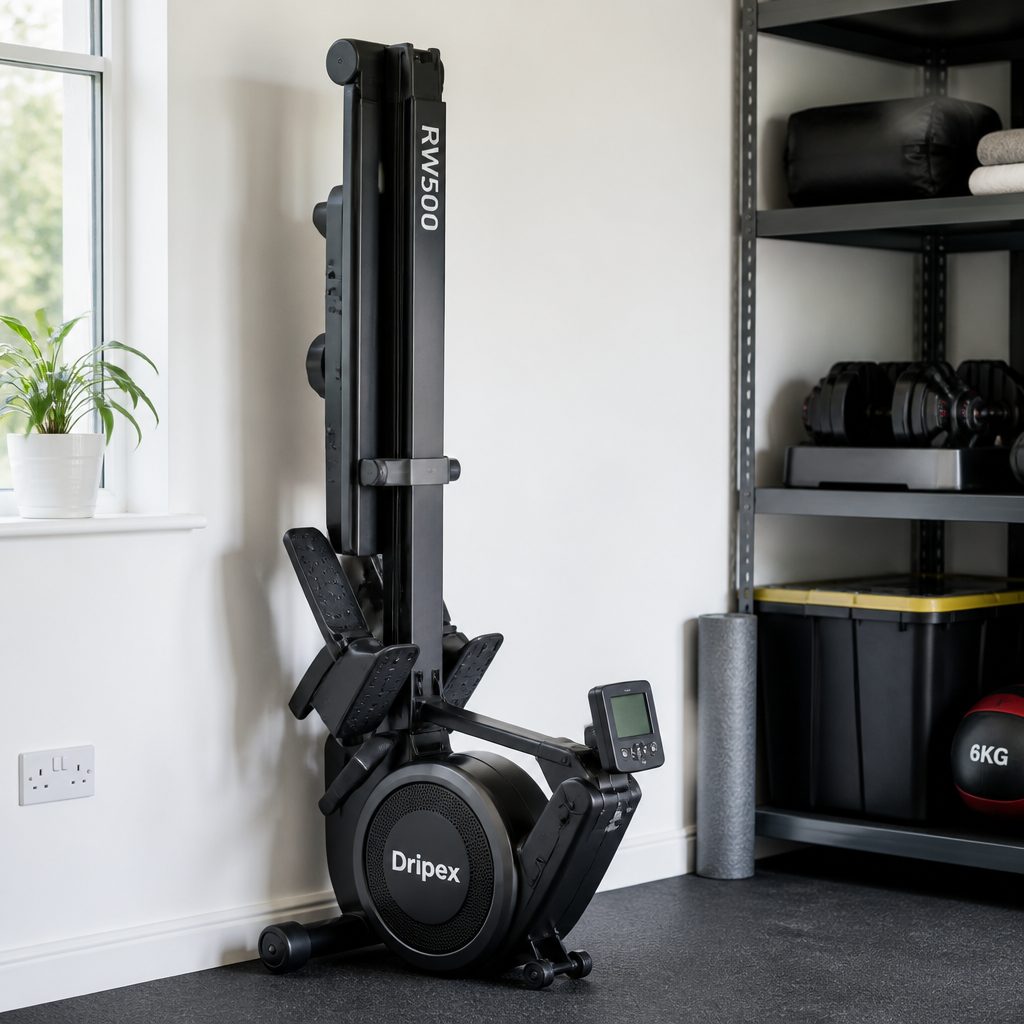
The Dripex made the most sense as a regular indoor machine: fold it after use, wheel it into its storage spot and keep the rails clean for consistently smooth seat travel.
Frequently asked questions
Dripex Magnetic Rower: a smart buy for quiet home cardio
The Dripex Magnetic Rower succeeded because it concentrated on the things that mattered most in a compact home. It was quiet enough for flats, smoother and more stable than many basic rowers thanks to its dual aluminium rail, easy to fold away, and equipped with enough resistance and Bluetooth flexibility to keep ordinary workouts from becoming dull.
Its weaknesses were honest budget-rower weaknesses rather than deal-breakers. The monitor was simple, the magnetic pull lacked the wild responsiveness of air resistance, and taller or performance-focused rowers should look more carefully at their options. But for beginners, regular cardio users and anyone trying to exercise without disturbing the household, this was a genuinely capable, sensible and pleasantly unshowy machine.
Buy it for quiet, consistent home rowing and easy storage. Skip it only if you need race-style power, advanced performance data or the uncompromising resistance feel of a serious air rower.