China Sets 10 New Gym Equipment Safety Standards From 2027
A sweeping package of mandatory and recommended standards covering treadmills, strength machines, rowers and more takes legal effect in October 2027 — and UK buyers will feel the impact.
 By James Oduya · Staff Writer & Home Gym Columnist · Updated August 10, 2026
What you need to know
- China released a mandatory national standard (GB 47368-2026) covering indoor stationary fitness equipment on 31 March 2026, with legal enforcement from 1 October 2027.
- The package includes one mandatory safety standard and nine recommended standards, collectively replacing earlier editions and covering treadmills, rowers, ellipticals, strength machines, steppers and stationary bikes.
- Because China manufactures roughly 40% of the world's gym equipment, UK retailers and gym operators sourcing from Chinese factories should expect re-certification requirements and possible supply disruption during the transition window.
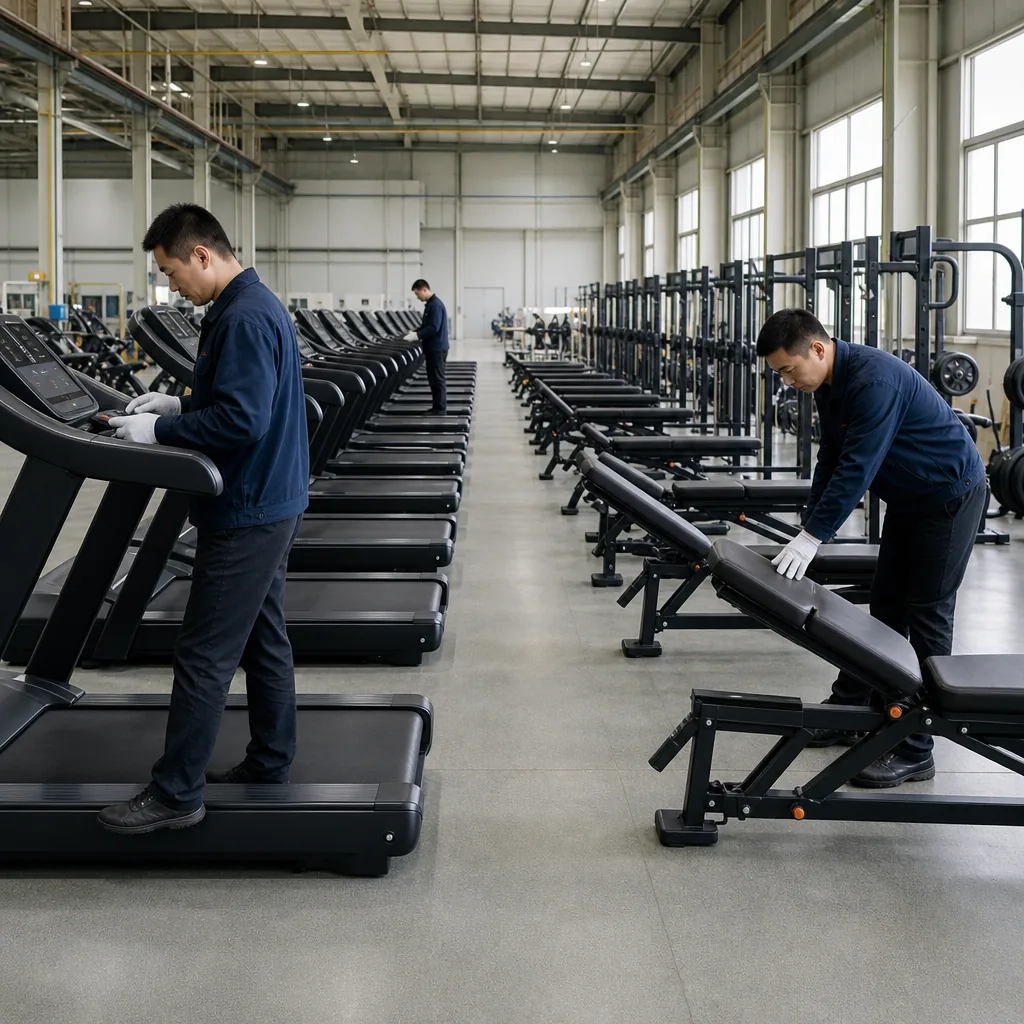
China has formally introduced a sweeping package of 10 updated national standards for indoor stationary fitness equipment, including a new mandatory safety standard that becomes legally enforceable on 1 October 2027. The move will affect manufacturers, retailers and gym operators worldwide — including in the UK, where a substantial share of fitness equipment is sourced from Chinese factories.
What was announced and when
The mandatory standard itself — officially designated GB 47368-2026, titled Safety Requirements for Indoor Stationary Fitness Equipment — was released on 31 March 2026 by China's State Administration for Market Regulation (SAMR) and the Standardisation Administration of China (SAC).
On 6 August 2026, with China preparing to mark its 18th National Fitness Day, a major industry conference was held in Beijing to formally introduce the full package to the sector. Organised by the China Stationery & Sporting Goods Association and hosted by the National Standardisation Technical Committee for Stationery and Sports Equipment, the event drew nearly 100 representatives from government agencies, leading Chinese manufacturers, testing and certification bodies, and media, according to FitGearSource.
What the standards cover
The package consists of one mandatory national standard — GB 47368-2026 — and nine accompanying recommended standards (GB/T 17498.1 through GB/T 17498.10-2026), collectively replacing earlier editions. Together they cover indoor stationary fitness equipment intended for users aged 14 and older, spanning:
- Treadmills (including foldable models)
- Strength training equipment and weight benches
- Rowing machines
- Stationary bikes
- Steppers and stair climbers
- Elliptical trainers
The mandatory standard sets 11 key safety requirements that manufacturers must meet, with GB 47368-2026 acting as a non-negotiable safety floor, while the nine recommended standards provide more granular, category-specific guidance — including dedicated requirements for strength training equipment and benches.
The technical detail
The updated standards tackle four broad technical areas: mechanical structural stability, electrical safety, hazardous chemical limits, and standardised user instructions.
On electrical safety, the 2026 standards harmonise requirements with existing mandatory national standards for sporting goods, with a particular focus on input power and current limits, leakage current and dielectric strength, and secure power connections and external flexible cords. These provisions are explicitly designed to reduce the risk of electric shocks and fires, according to FitGearSource.
Durability requirements are notably real-world in character: testing must be conducted under maximum load and at simulated normal exercise frequencies, rather than under idealised laboratory conditions. Labelling rules are equally practical — manufacturers must include clear warning labels and instructions addressing unsupervised use by children, heart rate monitoring systems, and power-off prompts and emergency alerts.
Who helped draft the standards
Key Chinese manufacturer representatives participated directly in drafting the standards and delivered technical briefings at the August conference. These included SHUA Sports, Hebei Provincial Institute of Product Quality Inspection, Relax (Shandong Yingjidu), Kpower (Xiamen Kanglejia), Lijiujia, Sportsoul (Qingdao Sanboshuo), and Acana Power (Zhejiang Lixuan), according to FitGearSource.
To demonstrate early compliance and innovation, a separate showcase featured products from Kingsmith, Kpower, Lijiujia, Hebei Weita, and Ironmaster (Nantong Tieren), covering treadmills, exercise bikes, ellipticals, rowers, foldable treadmills, and strength training units.
The bigger picture
The rollout forms part of China's National Fitness Plan (2026–2030), which sets a five-year roadmap raising requirements for standardisation, quality and safety across the fitness equipment sector. It arrives against a backdrop of substantial industry scale: China's sporting goods industry reached a market size of approximately ¥2.49 trillion (around $345 billion) by 2025, according to FitGearSource, and the country's production output accounts for an estimated 76% of worldwide manufacturing volume.
China is also the world's largest exporter of gym equipment, holding roughly 40% of the global market share. Europe is a major destination, with Germany, the UK, and France among the leading importers of Chinese fitness equipment — from budget home-use machines to high-end commercial kit.
It is worth noting that some export data figures circulating in industry sources — including a $30 billion equipment export figure and a separate $73.25 billion figure for the broader sporting goods sector — have not been fully reconciled, and should be treated as distinct metrics pending clarification from primary sources.
What happens next
All 10 standards carry a formal enforcement date of 1 October 2027, giving manufacturers a 14-month transition window to complete product certification and adjust manufacturing processes. Whether the standards apply solely to goods sold within China, or also to products exported to markets such as the UK, has not been confirmed — a scope distinction that procurement teams and retailers sourcing direct from Chinese factories should seek to clarify directly with suppliers or with the SAC and SAMR.
What is clear is that a large proportion of the gym equipment currently on sale in the UK originates from the Chinese factories that will be subject to these new rules. UK retailers, gym operators, and serious home buyers should anticipate potential product reformulations, re-certification delays, and possible short-term supply disruption as the October 2027 deadline approaches.
Why it matters
China is the world's largest exporter of gym equipment, supplying an estimated 40% of the global market, and a significant share of the treadmills, strength machines and cardio kit sold in British gyms and homes originates in Chinese factories. Once the October 2027 deadline arrives, any manufacturer that has not certified its products to the new standards risks being unable to legally sell in China — and potentially faces knock-on delays to export orders. UK retailers and gym operators who source direct from Chinese factories, or whose suppliers do, should begin asking questions now about compliance timelines, because a 14-month certification window can disappear quickly when testing laboratories are under industry-wide pressure. It is also worth noting that it has not been confirmed whether these standards apply solely to goods sold within China or extend to exported products — a distinction that buyers and procurement teams should clarify directly with their suppliers.