
The Best Wearables for Tracking HYROX Training Load
HYROX is not just running with a few gym exercises bolted on, and it is not quite strength training with an unnecessarily long warm-up either. These watches and heart-rate bands are the strongest options for seeing what the run-plus-station format really costs your body, from a dedicated race mode to long-term recovery data that stops every session becoming a heroic mistake.
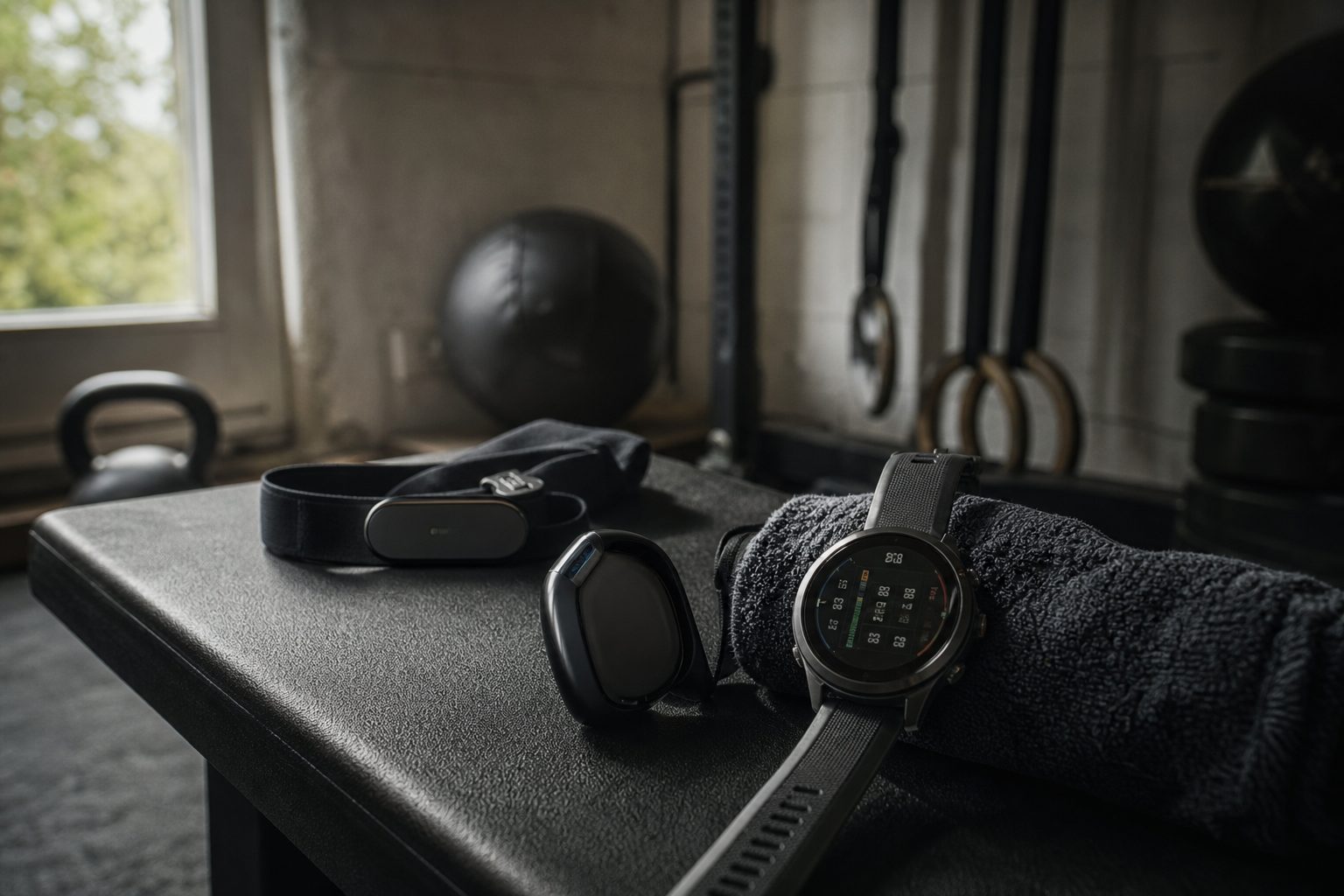
A useful HYROX wearable needs to make sense of the whole session: hard running, awkward stations, short recoveries and the accumulated fatigue that follows you home.
 By James Oduya · Staff Writer & Home Gym Columnist · Updated August 06, 2026
Why HYROX needs a slightly different sort of wearable
HYROX is wonderfully simple on paper. Eight one-kilometre runs. Eight functional stations. Then a finish line, a medal, and that peculiar period afterwards when standing up from a chair becomes a decision requiring both hands. The trouble, at least from a tracking perspective, is that the body does not experience it as one simple, steady activity.
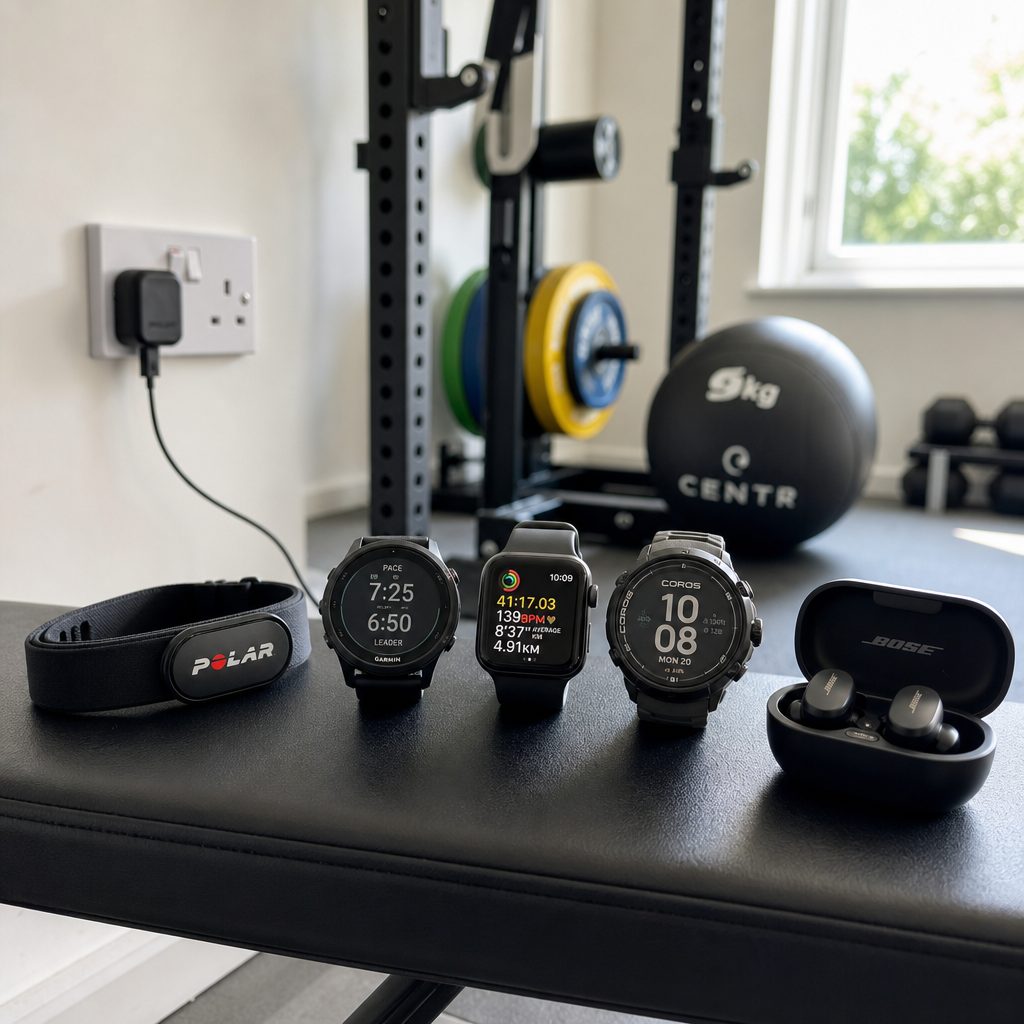
The right choice depends on where your training is weakest: running pace, station intensity, recovery discipline or simply remembering to charge the thing before a key session.
You might settle into an efficient rhythm on the running sections, then send your heart rate climbing with a sled push. You may be perfectly capable of rowing hard, yet need a minute or two longer to regain composure before the next run. Burpee broad jumps ask something different again: repeated floor-to-standing efforts, a lot of movement in the wrist and a very good way of finding whether an optical heart-rate sensor has a sense of humour.
That is why a useful HYROX wearable needs to do more than record distance and offer a flattering end-of-session calorie estimate. It should help you understand intensity, duration, repeatability and recovery. A serious runner might care most about pace and GPS. A gym-first athlete could put more value on heart-rate accuracy during stations and a clear view of readiness the following morning. Someone preparing for their first event might simply need a device that helps them stop turning every Tuesday session into race day.
There is no single perfect answer because HYROX athletes are gloriously varied. Some come from endurance sport and need to develop strength endurance. Some can move a sled all afternoon but find their running legs go missing after a row. Some are very fit, technically good and still rather poor at going easy. The right wearable should support the training problem you actually have, not the one marketing copy assumes you have.
A small but important distinction: training load is not the same thing as recording a workout. A watch can save a route without explaining whether the session was appropriately hard, whether it fitted your recent training, or whether your recovery is beginning to slide. For HYROX, those wider patterns tend to matter more than a single impressive graph.
What I looked for in a HYROX training tracker
For this roundup, I put the emphasis on how well each device supports the reality of a HYROX block rather than treating "sports watch" as a category where every model does broadly the same thing. Dedicated HYROX handling counts for plenty, of course. If a watch can organise the running legs, stations and transitions in one activity, that saves faff and makes post-session review much more useful. But native race tracking alone is not a free pass.
Battery life matters because HYROX training is rarely one neat run on a Saturday morning. It can mean a strength session, intervals, an easy run, perhaps a conditioning circuit, and continuous sleep and recovery tracking around all of it. GPS matters outdoors, particularly if your training involves threshold work or long aerobic running. Comfort matters more than people expect; a watch that feels bulky under grips, catches during a front-rack position or needs constant adjustment will very quickly find itself in a drawer.
I have also resisted the temptation to pretend that every number is equally meaningful. A displayed load score can be useful, but only if it gets you asking a sensible question: "Can I complete tomorrow's session well?" It is less useful if it persuades you that a colour-coded widget knows more about your legs than you do. Wearables are excellent assistants. They are not coaches, physiotherapists or a substitute for eating enough after a demanding session.
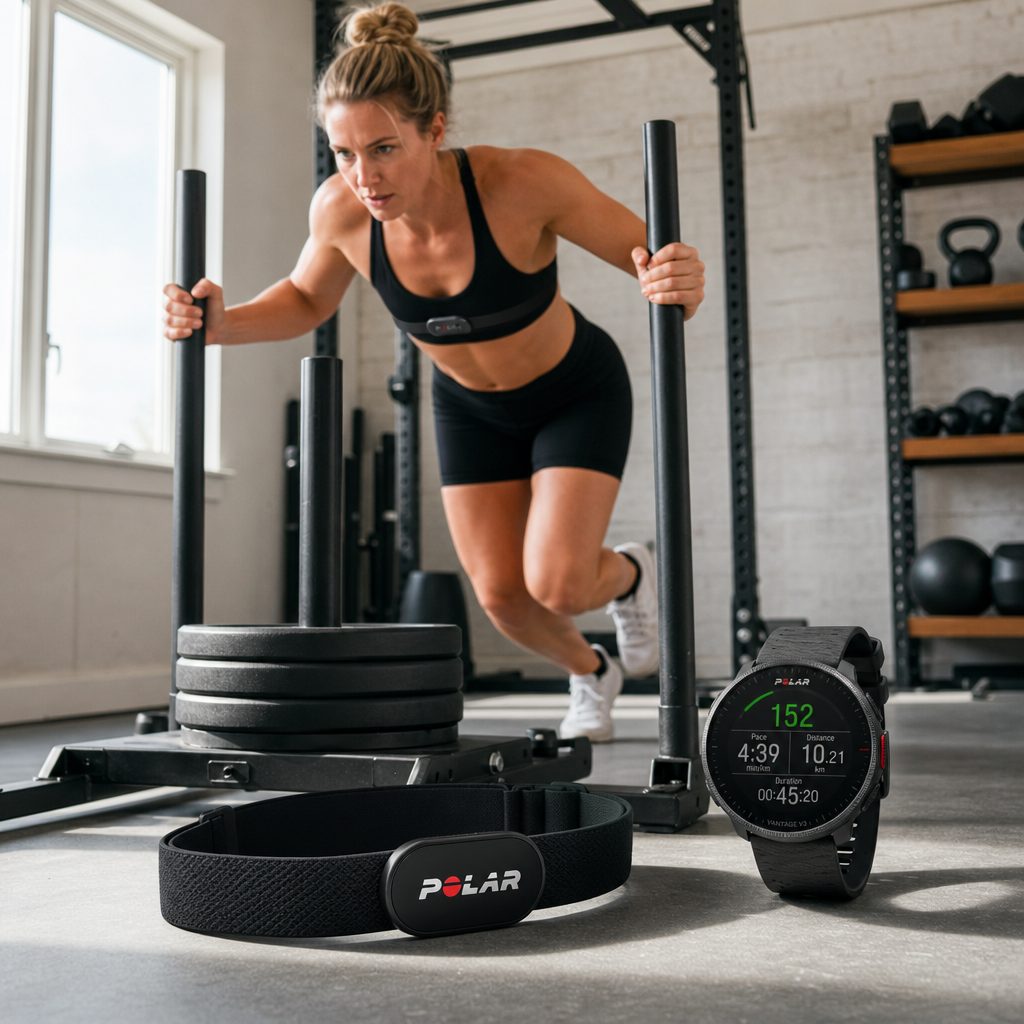
Wrist-based tracking is convenient, but HYROX's sled work, carries and burpees are exactly the moments when a chest strap can add valuable confidence to heart-rate data.
The shortlist at a glance
These are seven very different routes into better HYROX training data. The Amazfit models make the strongest case for the athlete who wants dedicated race handling from the wrist. Garmin brings more established running and broader training tools, with HYROX support arriving through an expanded multisport mode and the Roxfit Connect IQ app on the Forerunner 970. Apple Watch Ultra 3 is the smartwatch choice for people who want a tough, highly visible screen and an easily reachable physical control. Myzone takes a different route entirely: no watch face, no GPS, just chest-strap heart rate that can appear on supported HYROX venue screens.
| Pick | HYROX handling | Battery claim | Display / build highlight | Best fit |
|---|---|---|---|---|
| Amazfit Balance 2 | Official HYROX training and competition modes; HYROX Race among 170+ sports modes | Up to 21 days | 1.5-inch AMOLED, sapphire glass, 2,000 nits | Dedicated all-round HYROX preparation |
| Amazfit Cheetah Pro | Dedicated HYROX Race Mode for stations, runs and transitions | Up to 14 days; up to 44 hours automatic GPS | 1.45-inch AMOLED; titanium alloy bezel | Run-led athletes who want native race tracking |
| Amazfit Cheetah 2 Pro | HYROX-oriented premium running option | Up to 20 days | Titanium bezel and sapphire crystal lens | Long battery with premium materials |
| Garmin Forerunner 970 | Expanded multisport support and Roxfit Connect IQ functionality | — | 1.4-inch AMOLED, sapphire lens, LED flashlight | Data-led endurance athlete |
| Garmin Forerunner 265 | Third-party apps or manual segment marking | Up to 13 days in smartwatch mode | AMOLED touchscreen; 47g standard model | Training-load-focused runner |
| Apple Watch Ultra 3 | Flexible workout tracking and Action Button lap marking | Up to 36 hours | Wide-view OLED; Black Titanium body | Smartwatch-first gym athlete |
| Myzone MZ-Switch | Official partner chest strap; broadcasts to venue screens | — | Chest-based heart-rate monitoring | Heart-rate certainty and race visibility |
A dash in the table is deliberate rather than evasive. It is better to compare only confirmed figures than fill a buying guide with suspiciously tidy claims. The important takeaway is that the top end of the field splits into two camps: devices designed to make HYROX feel like a recognised sport, and devices which are excellent training tools but require a little setup or interpretation from you.
Ranked picks: the best wearables for HYROX load tracking
1. Amazfit Balance 2 — Best for dedicated HYROX training
Shop Amazfit Balance 2 on Amazon UK
The Amazfit Balance 2 is the cleanest all-round answer for someone whose training week is built around HYROX rather than merely containing the occasional HYROX-style circuit. It offered official HYROX training and competition modes, including HYROX Race within a list of more than 170 sports modes. That sounds like a specification-sheet detail until you consider the practical alternative: manually marking laps, stitching activities together afterwards, or trying to remember exactly when your grip failed on the sled pull. None of those is much fun when you are tired.
Its appeal is that the mode is designed around the sport's distinct rhythm. You are not trying to convince a generic running profile that a sled push was an unusually slow kilometre. The objective is to capture the running, stations and race context in a way that remains useful after the sweat has dried. For an athlete who is repeatedly practising compromised running, station pacing and transitions, that is a meaningful advantage.
The physical package is sensible too. The 1.5-inch AMOLED touchscreen has a 480 x 480 resolution at 323 PPI and is protected by sapphire glass. Maximum brightness is 2,000 nits, which is handy for outdoor sessions and for quickly reading a screen in a brightly lit gym. At 35g without the strap, the watch itself is light enough that it should not dominate a long run or make a farmer's carry feel like you have added decorative ballast to your wrist.
Battery life is one of Balance 2's strongest practical points. Amazfit claimed up to 21 days from its 658mAh battery. Real life always depends on use, especially GPS use, screen brightness and how often you are fiddling with it mid-session, but a large claimed reserve changes the ownership experience. It means you can track sleep and health trends continuously rather than becoming the person who only puts their watch on when they expect to do something impressive.
Pros
- Official HYROX training and competition modes make the sport feel properly supported rather than improvised.
- Up to 21 days of claimed battery life is excellent for continuous recovery context.
- Bright 2,000-nit AMOLED and sapphire glass suit both outdoor running and busy gym use.
- 35g weight without the strap is reassuringly light for a 46mm watch body.
Cons
- The case is roughly 48mm in overall diameter, so smaller wrists should consider the physical footprint carefully.
- A dedicated mode does not remove the need to learn sensible pacing and recovery habits.
- Some athletes will still prefer a chest strap for their hardest, most wrist-intensive station work.
There is a broader health package here too, including heart rate, SpO2, blood pressure, body temperature and altitude tracking. In a HYROX context, the useful bit is not to obsess over every individual metric. It is to establish your own pattern. If resting measures, sleep and perceived fatigue have all been poor after a high-volume week, perhaps do not make Friday's simulation even more theatrical. The Balance 2 gives you enough information to spot that pattern without requiring a degree in sports science.
For most athletes who want one wrist device to cover running, gym work, race-specific practice and recovery, this is the pick I would start with. It has the sport-specific argument, the battery argument and the straightforward day-to-day argument. That is an unusually complete trio.
2. Amazfit Cheetah Pro — Best for native HYROX race breakdowns
Shop Amazfit Cheetah Pro on Amazon UK
The Amazfit Cheetah Pro is the more running-minded dedicated HYROX option, and it makes a compelling case if your biggest question is what happens to your running once the stations start taking their toll. Its dedicated HYROX Race Mode tracks all eight stations, running segments and transitions. That gives your session a clear structure: you can look at the whole effort, but you can also consider the moments where time, heart rate and composure began to drift.
This matters because HYROX race preparation is not just about becoming faster at eight isolated exercises. It is about how quickly you can return to a competent run after each one. A watch that separates those chunks is inherently more useful than one large undifferentiated activity record. You can start seeing whether your problem is genuinely lack of running speed, whether the sled push is exploding your heart rate, or whether transitions are simply getting messier later in the session.
The Cheetah Pro weighed 43g and used a 47mm case with a titanium alloy bezel and fibre-reinforced polymer middle frame. It had an IP68 rating, dual-band GPS and support for six satellite systems. On a practical level, that means it was geared towards reliable route tracking and a relatively robust sports-watch life. The 1.45-inch AMOLED display had a 480 x 480 resolution and 331 PPI, giving you a large, sharp readout for pace checks and station cues.
Battery figures are particularly useful here because they are broken down by GPS behaviour: up to 14 days in general use, up to 44 hours in Automatic GPS mode, up to 54 hours in Power Saving mode and up to 26 hours in Accuracy mode with dual-band GPS. Those numbers are not a promise that every athlete will hit the headline figure, but they show why the Cheetah Pro works so well for runners who dislike frequent charging.
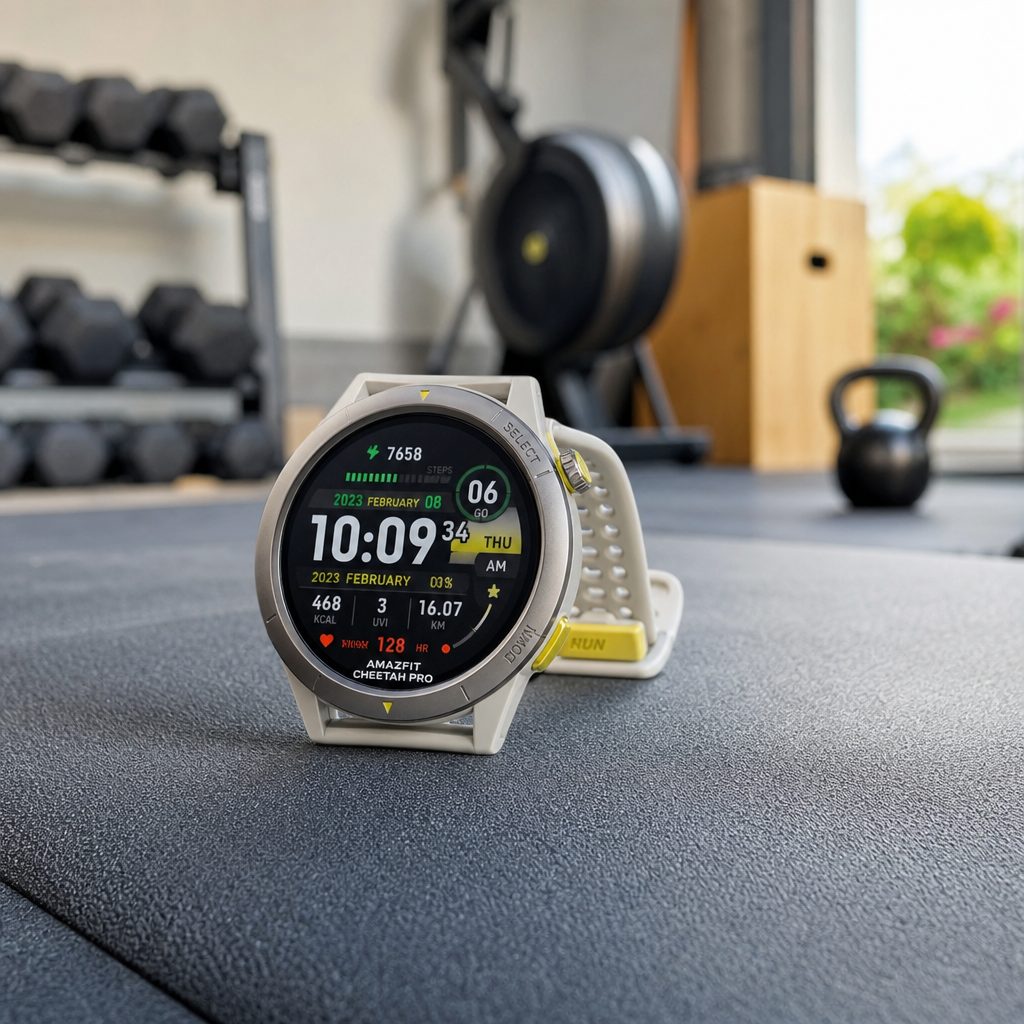
The Amazfit Cheetah Pro's proposition is especially clear for race simulations: one structured record for each run, station and the awkward little transition spaces between them.
GPS for the running half of the equation
Dual-band GPS and six satellite systems are valuable when pace work remains a major part of your HYROX programme. A compromised run is still a run, and knowing how your pace behaves after hard stations tells a more complete story than indoor calorie figures ever will.
Transitions count, even when they are not glamorous
Dedicated HYROX Race Mode captures transitions alongside the eight stations and running segments. That can expose the small chunks of time and focus that quietly become expensive during a full simulation.
Choose the GPS compromise yourself
Automatic GPS, Power Saving and Accuracy modes allow different battery priorities. For a key outdoor session, the 26-hour dual-band Accuracy figure is the relevant number; for ordinary use, the longer headline reserve is more comforting.
It also supported Bluetooth calling and charged from zero to 100% in around two hours. Those are not central reasons to choose a HYROX tracker, but they make the device easier to live with between sessions. The more often you wear a recovery-focused watch, the more useful its longer-term pattern becomes. Very few people get excellent insight from a wearable that spends most of the week on a bedside table at 0%.
The limitation is the one shared by every wrist watch in this guide. Strong wrist movement, gripping, impact and sweat can make optical heart-rate data less tidy during stations than during a smooth easy run. If precision through every burpee, carry and push matters greatly to you, pairing the watch with a chest strap remains the more cautious approach. As a dedicated race-structure tool, though, Cheetah Pro is very hard to overlook.
3. Garmin Forerunner 970 — Best for the data-led endurance athlete
Shop Garmin Forerunner 970 on Amazon UK
Garmin's Forerunner 970 was launched in May 2025, and it sits in this guide because it offered a serious running-watch platform with a route into HYROX rather than because it was built solely for hybrid racing. HYROX became supported via expanded multisport mode in firmware 16.28, while the Roxfit Connect IQ app supplied dedicated HYROX functionality. That is slightly less seamless than buying a watch with an official race mode already sitting front and centre, but it will appeal to people who have built their training life around Garmin's wider approach.
The 970 has a 1.4-inch AMOLED display with a 454 x 454 resolution and 459 PPI. It used a sapphire lens, came in at 56g, measured 47.0 x 47.0 x 12.9mm and had 5ATM water resistance. It also included an LED flashlight, speaker and microphone, ECG functionality, skin-temperature tracking and Garmin's Elevate Gen 5 heart-rate sensor. That is a packed list, but the sensible buying reason is not to tick every box. It is to have a watch that can follow a running plan, a mixed conditioning block and your recovery signals without feeling like a compromise on the endurance side.
The Forerunner 970 is particularly persuasive for someone who treats HYROX as one important target within a wider calendar of running events, long runs and structured training. The watch's GPS support includes GPS, GLONASS and Galileo, and it carries a deep sensor suite including accelerometer, gyroscope, altimeter, compass, thermometer, barometer, ECG, blood oxygen and ambient light sensor. It is the sort of watch for the athlete who actually enjoys going back through the evidence afterwards. There are more of us than we care to admit.
Pros
- High-resolution 454 x 454 AMOLED and sapphire lens make a premium, durable training watch package.
- HYROX support through expanded multisport mode and Roxfit Connect IQ gives established Garmin users a credible route in.
- Elevate Gen 5 heart-rate sensor, skin temperature and ECG broaden the health and recovery picture.
- Built-in LED flashlight is genuinely handy for dark starts and late finishes, not merely a party trick.
Cons
- HYROX handling depends on firmware support and a Connect IQ app rather than being the simplest native proposition here.
- At 56g, it is heavier than the Amazfit Balance 2 and Cheetah Pro.
- Its considerable feature set can be more watch than a first-time HYROX athlete needs.
This is a premium choice for a person who values the whole training ecosystem. It is less compelling for somebody who wants a simple "start HYROX, do the workout, see the stations" experience with minimal setup. But if your preparation contains plenty of proper running and you already think in terms of structured load, the Forerunner 970 offers one of the most complete long-game toolkits in the roundup.
4. Garmin Forerunner 265 — Best for balanced running load metrics
Shop Garmin Forerunner 265 on Amazon UK
The Garmin Forerunner 265 was released on 20 February 2024 and remained an established mid-level running watch rather than Garmin's flagship. That is not a criticism. In fact, for a great many HYROX athletes it may be the more sensible Garmin: focused enough to be useful, light enough to forget about during a run, and packed with the training-load features that turn a random week of workouts into something more coherent.
The standard Forerunner 265 used a 46mm body, a 1.3-inch AMOLED touchscreen at 416 x 416 resolution and weighed 47g. The smaller Forerunner 265S had a 41mm body, 1.1-inch 360 x 360 AMOLED display and 39g weight. That choice should not be dismissed as cosmetic. A secure, comfortable fit is important for wrist heart-rate tracking, and it is simply easier to wear a watch continuously when it suits your wrist rather than looking like a small navigation satellite.
For HYROX preparation, the key strengths are its full training-load metrics, real-time stamina, PacePro and triathlon profiles. There was also dual-frequency GPS with SatIQ and phone-free music. Those are excellent ingredients for the athlete whose programme leans heavily towards running development: intervals, tempo work, easy mileage and long runs alongside strength and station practice. Real-time stamina can be particularly interesting during a hard conditioning session, though it should be used as context rather than an excuse to abandon the plan the moment the number looks rude.
There was no native HYROX mode, so you needed either a third-party app or manual segment marking. That is the central compromise. If you want the device to understand the race format out of the box, buy one of the dedicated Amazfit options instead. If you are comfortable constructing a workout, marking the important chunks yourself, or using the available third-party route, the Forerunner 265's wider running and load tools are still very attractive.
Garmin Forerunner 265
Established mid-level running watch with AMOLED display, training-load metrics and dual-frequency GPS with SatIQ.
Amazfit Cheetah 2 Pro
Premium HYROX-oriented running watch with up to 20 days of battery life, titanium bezel and sapphire crystal lens.
At around £430, the Forerunner 265 sat close to the Cheetah 2 Pro's £449.90 UK price. The interesting choice is not simply which one costs less, because the difference is small. It is whether you value Garmin's running-first training approach and load metrics more than the Amazfit route towards sport-specific HYROX handling and extended claimed battery life.
5. Amazfit Cheetah 2 Pro — Best for long battery in a premium running watch
Shop Amazfit Cheetah 2 Pro on Amazon UK
The Amazfit Cheetah 2 Pro is for the HYROX athlete who wants a premium running-watch shape, tough materials and a battery claim that does not make constant charging part of their weekly admin. At $499.99 in the United States and £449.90 in the UK, it sat as a genuinely premium option rather than a cheap way into the category. Fortunately, it brought enough substance to justify being considered alongside more familiar high-end sports-watch names.
Its headline battery claim was up to 20 days. Again, that is a manufacturer claim and your own result will vary with GPS and screen habits, but the figure is still important. Long battery life encourages continuous use. Continuous use gives you a better chance of connecting a rough night's sleep, an unusually high-volume week and a flat-feeling run before you blindly schedule another all-out effort. Training load only becomes useful when it has context around it.
The Cheetah 2 Pro used a BioTracker 6.0 PPG biometric sensor with 5PD and 2LED, alongside acceleration, gyroscope, ambient light, geomagnetic, temperature and barometric-altimeter sensors. It also had dual-band positioning across six satellite systems. The titanium bezel and sapphire crystal lens are welcome practical details. HYROX sessions can involve ropes, kettlebells, benches, barbells and the occasional accidental collision with something you were certain was behind you. A more resilient lens is never a silly luxury.
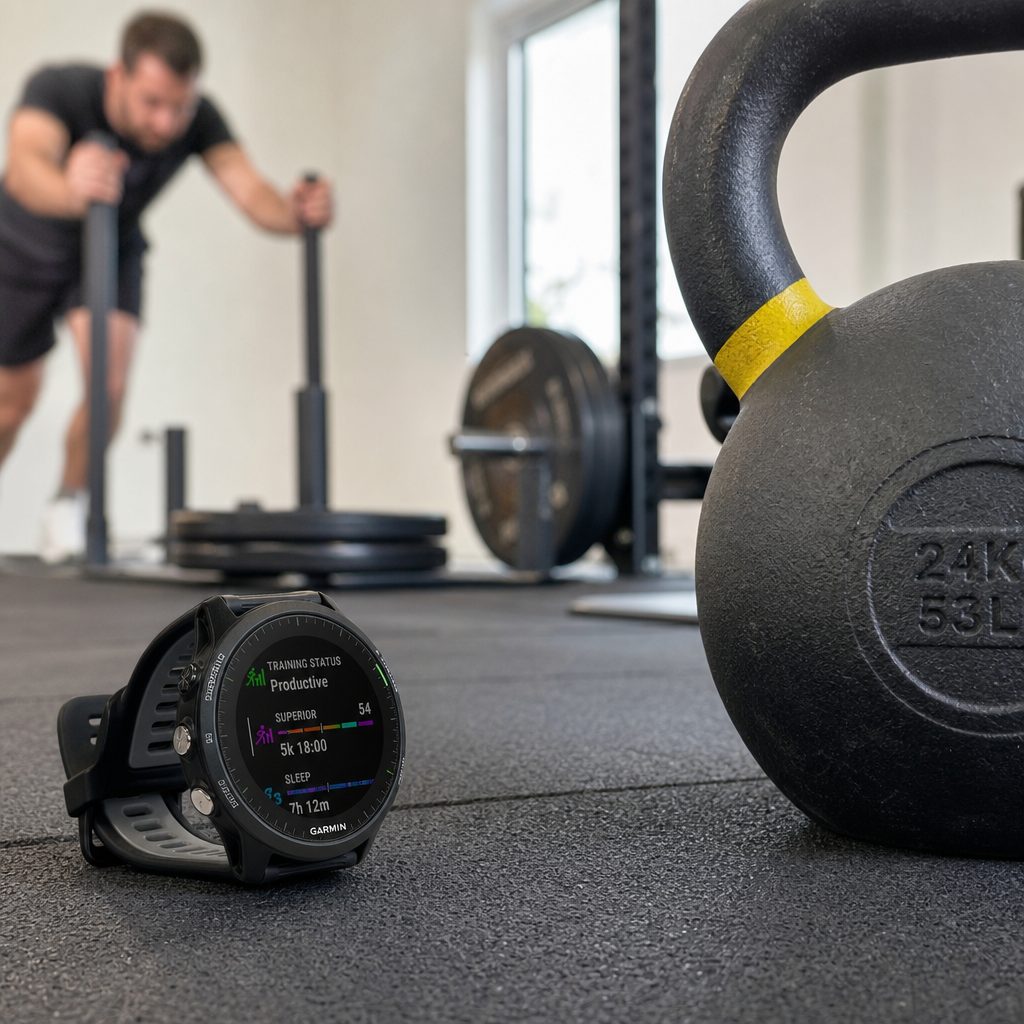
A premium running watch earns its place in HYROX preparation when it is comfortable on long aerobic work but resilient enough to survive the less elegant parts of a conditioning circuit.
It had 5ATM water resistance, which is useful for regular training life and for anyone who does not want to treat sweat like a hazardous substance. More importantly, the wider feature set lends itself to athletes who split their programme between outdoor running, treadmill sessions, gym work and recovery monitoring. It is not just a race-day trinket.
The trade-off against the Balance 2 is straightforward. Balance 2 made the stronger official HYROX case and offered a larger 1.5-inch AMOLED display plus a 21-day battery claim. Cheetah 2 Pro brought its own premium materials, sensor package and a 20-day claim. If your identity is "runner who is training for HYROX", the Cheetah name and build may feel more natural. If HYROX is the centre of the programme, Balance 2 is the more direct choice.
6. Apple Watch Ultra 3 — Best for smartwatch-first HYROX athletes
Shop Apple Watch Ultra 3 on Amazon UK
Apple Watch Ultra 3 is the choice for the athlete who wants a serious training companion but does not want to abandon the convenience of a full smartwatch. That is not a shallow preference. If you are already used to Apple Watch behaviour, notifications, everyday wear and quick interaction, a device you naturally wear all day is more likely to gather useful health and recovery context than one you admire only during workouts.
The Ultra 3 featured the S10 chip and a wide-viewing-angle OLED display with improved brightness from angles. That last detail is more useful than it sounds. HYROX does not provide many moments where you are politely standing still with your wrist held at the perfect angle. You may be bent over a rower, recovering from burpees, carrying equipment or trying to catch a glance at a metric without appearing dramatically unwell. A display that remains readable from awkward angles is welcome.
Its Black Titanium body was designed to withstand intense HYROX movements, while the orange Action Button offered a useful physical way to mark laps when touchscreen precision is not happening. That can be a very real advantage in a hard session. When you are breathless, sweaty and trying to move quickly, a button is often better than prodding a display with the delicate control of somebody operating a lift.
The key is to be honest about what you want the watch to do. Apple Watch Ultra 3 is not the best pick here if your first priority is a dedicated, official HYROX race mode or multi-week battery life. It is excellent if you value a bright smartwatch display, robust build and a straightforward physical control for training markers. It also makes sense for athletes who want one device for work, life, gym sessions and running, without wearing a traditional running-watch design every day.
A practical race-simulation habit
If your watch lets you mark laps or segments, practise doing it during ordinary training rather than first trying it in a full simulation. Decide exactly when you will mark the end of a run, the start of a station and the end of a station. A tracking method only helps if you can execute it whilst tired and thinking mostly about not dropping anything.
7. Myzone MZ-Switch — Best for heart-rate certainty and venue visibility
Shop Myzone MZ-Switch on Amazon UK
The Myzone MZ-Switch is the outlier in this list because it is not trying to be a mini computer on your wrist. It is a chest strap monitor, and that is precisely why it deserves a place. Myzone was an official HYROX partner, and the MZ-Switch could broadcast heart-rate information to venue screens. For people who care about heart-rate accuracy during the most chaotic parts of training and competition, chest-based monitoring remains the sensible benchmark.
There is a useful humility to a dedicated heart-rate strap. It does not pretend to solve every training question. It will not replace GPS for running routes, provide a big AMOLED map, or offer a watch face to admire in the queue for coffee. What it can do is focus on the physiological signal that matters most when you want to understand how hard a mixed session actually was.
This is especially relevant in HYROX because the stations can challenge wrist optical sensors. Wrist flexion, gripping, vibration, sweat, rapid movement and pressure from equipment all create difficult conditions. A chest strap is worn closer to the heart and does not have to interpret those movements through the wrist. If you have ever seen a wrist reading suddenly report a suspiciously calm heart rate while you are very obviously not calm, you will understand the appeal.
For some athletes, MZ-Switch is best used alongside a watch rather than instead of one. Let the watch handle running pace, route and general training history, and use the chest strap when you need a more dependable heart-rate signal. For others, especially gym members who train at facilities with Myzone displays, it may be all the session feedback they need. There is something oddly motivating about seeing your effort reflected publicly, provided you are not the sort of person who finds public information about their cardiovascular distress emotionally complicated.
Pros
- Chest-based heart-rate monitoring is highly relevant for wrist-intensive HYROX stations.
- Official HYROX partner status and venue-screen broadcasting add race-day appeal.
- Simple focus on effort can be less distracting than another screen full of metrics.
- Works particularly well as a companion to a GPS watch.
Cons
- It does not replace the running, display and smartwatch functions of a full sports watch.
- Some athletes simply prefer the convenience of an all-in-one wrist device.
- Venue-screen broadcasting depends on the supported environment rather than being a universal feature everywhere.
Battery claims: why they matter more than the headline race
Battery life can feel like the least exciting part of wearable shopping. It is also one of the details most likely to influence whether your data becomes genuinely useful. A one-hour HYROX session is not demanding for most sports watches. The real demand is wearing the device across easy runs, long runs, lifting sessions, intervals, sleep, travel and the inevitable days when you forget to charge it because life had other plans.
Of the confirmed claims here, Balance 2 led with up to 21 days, followed very closely by Cheetah 2 Pro at up to 20 days. Cheetah Pro claimed up to 14 days, while Garmin Forerunner 265 claimed up to 13 days in smartwatch mode. These figures are not directly identical tests, so do not treat a one-day gap as a scientific showdown. They are still useful indicators of the kind of charging rhythm each device was designed to support.
The Cheetah Pro deserves an extra mention because its GPS claims provide more useful context for runners. Up to 44 hours in Automatic GPS mode and 26 hours in Accuracy mode with dual-band GPS should cover a lot of outdoor training before charging becomes urgent. The Power Saving figure of up to 54 hours makes clear that you can trade some positioning behaviour for longevity when appropriate.
The broader lesson is simple. If you want sleep and recovery trends to influence your decisions, prioritise a wearable you can comfortably keep charged and wear overnight. If you only care about session recording and will charge after every run without complaint, the calculation changes. Be honest with yourself. Most of us want the first lifestyle and live the second for about a fortnight.
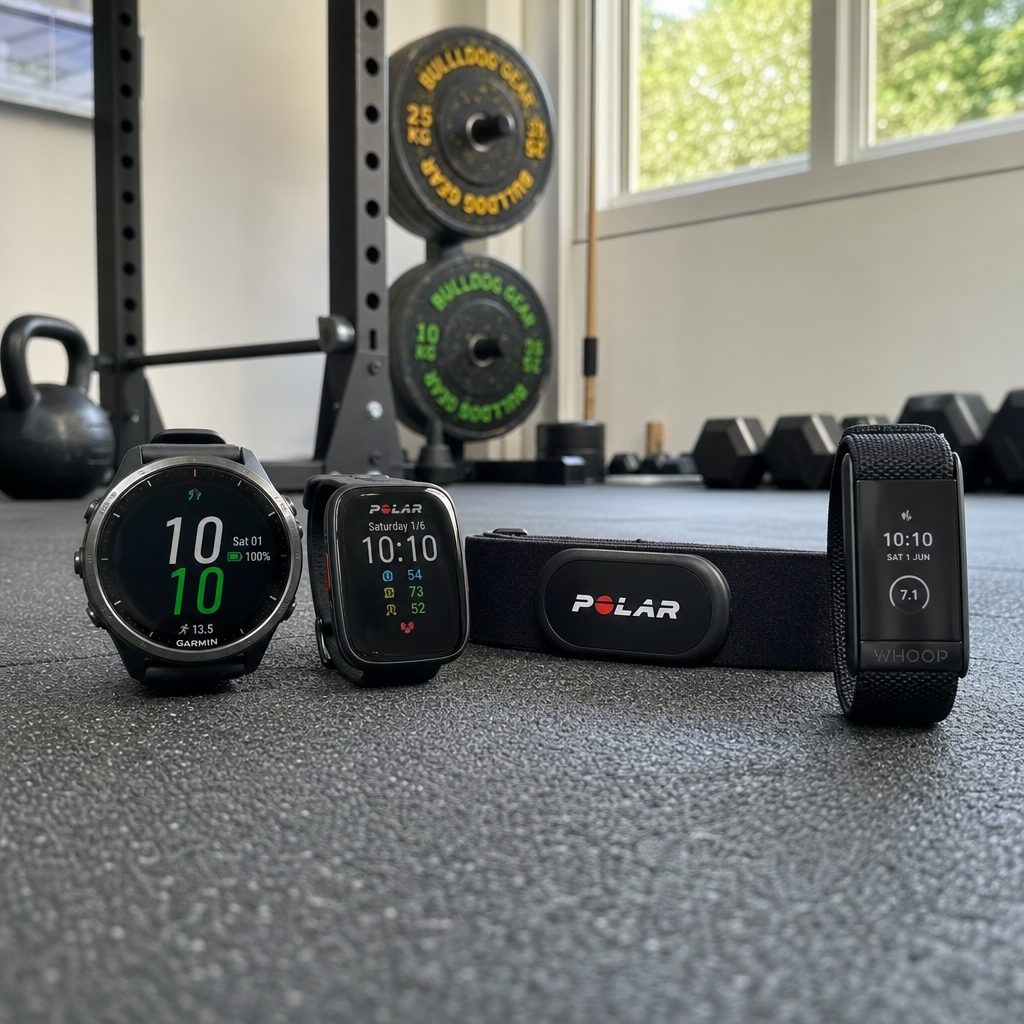
Continuous use is where battery capacity becomes meaningful: the best recovery insight comes from patterns across training, sleep and easier days, not one dramatic workout graph.
How to make your HYROX data genuinely useful
A wearable does not create a training plan. It simply makes it easier to see whether the plan is working. The most productive approach is to select a few signals and review them consistently, rather than looking at every possible number after every workout until you become emotionally attached to a graph.
For a HYROX-focused athlete, I would start with three practical questions. First: did the hard session produce the intended intensity? Second: how did the running sections behave after the stations? Third: did recovery appear to return to your normal pattern before the next key workout? Those questions are useful whether you own an Amazfit, Garmin, Apple Watch or chest strap.
Use pace to reveal compromised running
Do not only review average pace. Compare the opening runs with later runs in a repeatable session. If speed falls sharply after a particular station, that is useful training information. It may point towards pacing, local muscular endurance, technique or simply an overly ambitious start.
Use heart rate as a trend, not a courtroom verdict
A higher heart rate at a familiar pace can be meaningful, especially if it appears alongside poor sleep and heavy legs. But heat, hydration, stress and sensor behaviour all matter. Let the number start a conversation with your body rather than win an argument against it.
Repeat selected workouts
A regular benchmark session is more revealing than endlessly changing the format. It does not need to be a full HYROX simulation. A controlled run-and-station circuit performed occasionally can show whether transitions, pace and recovery are becoming more repeatable.
Respect the dull data
Sleep, easy-session effort and the way you feel on stairs are not glamorous, but they often identify fatigue earlier than a race-specific score. HYROX rewards the athlete who can stack productive weeks, not merely the athlete who can survive one gigantic session.
The biggest mistake is chasing a high training load for its own sake. More load is not automatically better load. A week with smart easy running, sensible strength work, one hard station session and enough recovery may move you forward far better than five heroic efforts that leave you unable to run well. Your wearable should help guard that consistency, not gamify exhaustion.
Best-for breakdown: which athlete should buy what?
There is no need to buy the most elaborate device simply because HYROX itself is demanding. The best choice is the one that solves the actual information gap in your training. A seasoned runner who struggles with stations needs a different tool from a gym specialist who cannot yet pace a kilometre. These are the short answers.
Best overall for HYROX
Amazfit Balance 2. Choose it if you want official HYROX training and competition modes, a bright sapphire-protected AMOLED display, a light 35g watch body and up to 21 days of claimed battery life.
Best for run-led athletes
Amazfit Cheetah Pro. Its dedicated HYROX Race Mode, dual-band GPS, six satellite systems and detailed GPS battery options make it the most natural fit for the runner learning to manage stations.
Best premium data ecosystem
Garmin Forerunner 970. Best for committed runners who want AMOLED, sapphire, advanced sensors and the Garmin route into HYROX through expanded multisport support and Roxfit Connect IQ.
Best balanced Garmin choice
Garmin Forerunner 265. A sensible pick for athletes who value full training-load metrics, real-time stamina, PacePro and a choice of 46mm or 41mm sizing, and can accept non-native HYROX tracking.
Best for extended battery
Amazfit Cheetah 2 Pro. Its up-to-20-day battery claim, titanium bezel, sapphire crystal and dual-band six-satellite positioning make it appealing for consistent running and hybrid training.
Best smartwatch experience
Apple Watch Ultra 3. Choose it for its wide-view OLED display, Black Titanium body and orange Action Button when all-day smartwatch use matters as much as workout tracking.
Best heart-rate companion
Myzone MZ-Switch. The best specialist choice for athletes who want chest-based heart-rate monitoring and the ability to broadcast to supported HYROX venue screens.
A note on wrist heart rate versus a chest strap
It is tempting to ask which wearable has the "most accurate" heart-rate tracking as if there is one fixed answer. In steady conditions, modern wrist tracking can be very useful. For easy and moderate running, especially with a snug fit, it gives many athletes perfectly actionable information. HYROX is less steady. It contains grip work, contact, rapid changes in arm position, repeated floor work and a good deal of sweat. That creates a tougher job for any wrist-based optical sensor.
This is not an argument against watches. Watches remain vastly more convenient and provide the running, GPS, pace, display and all-day health context a chest strap cannot. It is an argument for matching the tool to the question. If you want broad training-load and recovery information, a watch is the foundation. If you are assessing heart-rate response in maximal station intervals or want confidence in race-day effort data, adding the Myzone MZ-Switch can be a thoughtful move.
There is also a behavioural benefit. A chest strap can simplify a hard session. You do not need to repeatedly rotate your wrist and squint at a display. You can work to feel and review the information afterwards, or use venue screens when available. That is sometimes more valuable than another live metric screaming for your attention when you are halfway through burpees.
What not to overthink before buying
First, do not let the lack of a native HYROX mode stop you training intelligently. Garmin Forerunner 265 owners can use third-party apps or manual segment marking. Apple Watch Ultra 3 owners can use lap marking via the Action Button. A dedicated mode is better for convenience and post-session structure, but effort, pacing and good programming existed before anyone named a workout profile after them.
Second, do not assume that a more expensive watch makes you more prepared. The most important parts of HYROX preparation are still the awkwardly unsexy ones: building aerobic capacity, practising movement standards, learning station pacing, developing strength endurance, recovering properly and not turning every group session into a personal documentary about suffering.
Third, be careful about treating a single bad metric as a crisis. One strange heart-rate trace can be sensor fit. One poor sleep score can be life. One sluggish run can be accumulated fatigue, but it can also be a warm room, a heavy lunch or legs that simply did not fancy it. Look for repeat patterns across several days and training sessions.
That summary is why Amazfit Balance 2 takes the top spot here. It is not because every buyer needs it. It is because it combines the most direct official HYROX support with a light build, very long claimed battery life and a display that should remain useful in the real world. For an athlete who wants one device to organise the whole block, that is the strongest overall package.
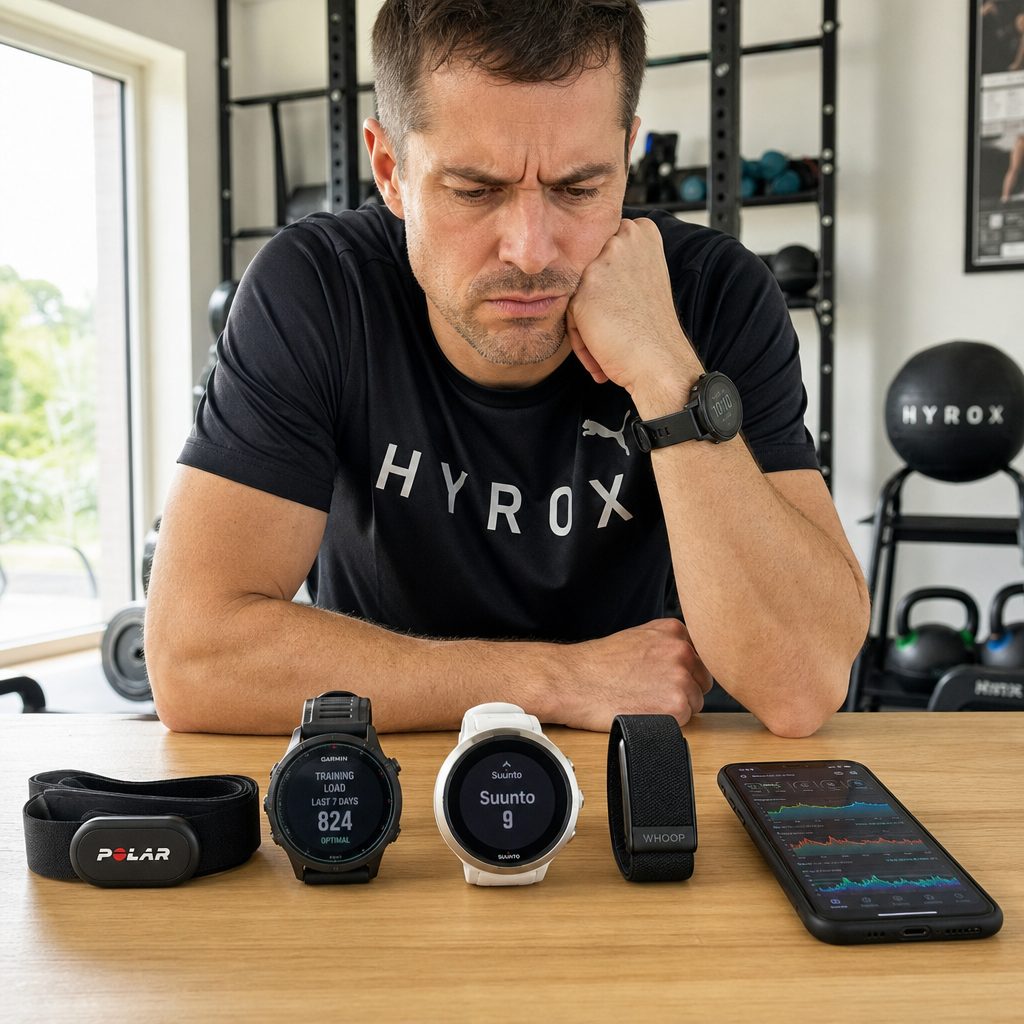
A wearable should make your next training decision clearer, not turn a perfectly good HYROX session into an argument with six different coloured charts.
Frequently asked questions
The bottom line
For the majority of HYROX athletes, the Amazfit Balance 2 is the best wearable in this roundup because it paired official HYROX training and competition modes with a light 35g body, sapphire-protected 1.5-inch AMOLED display and up to 21 days of claimed battery life. Choose the Amazfit Cheetah Pro if native race breakdowns and running-focused GPS are your priority. Choose Garmin Forerunner 970 or Forerunner 265 if Garmin's wider running and training-load approach is what you already understand and enjoy. Apple Watch Ultra 3 is the strongest smartwatch-led choice, while Myzone MZ-Switch is the smart specialist addition when chest-based heart-rate certainty matters most. Buy the device that will help you train consistently, recover honestly and arrive at the start line fit enough to make all those graphs worth having.