
What Is a HYROX Race and Which Kit Do You Actually Need to Train at Home?
HYROX looks straightforward on paper: run, do a workout station, repeat. In practice it is a long, very hard test of pacing, strength endurance and the ability to keep moving when your legs have begun negotiating with you. Here is how the race works, what each station asks of you, and the home kit that genuinely carries over to race day.
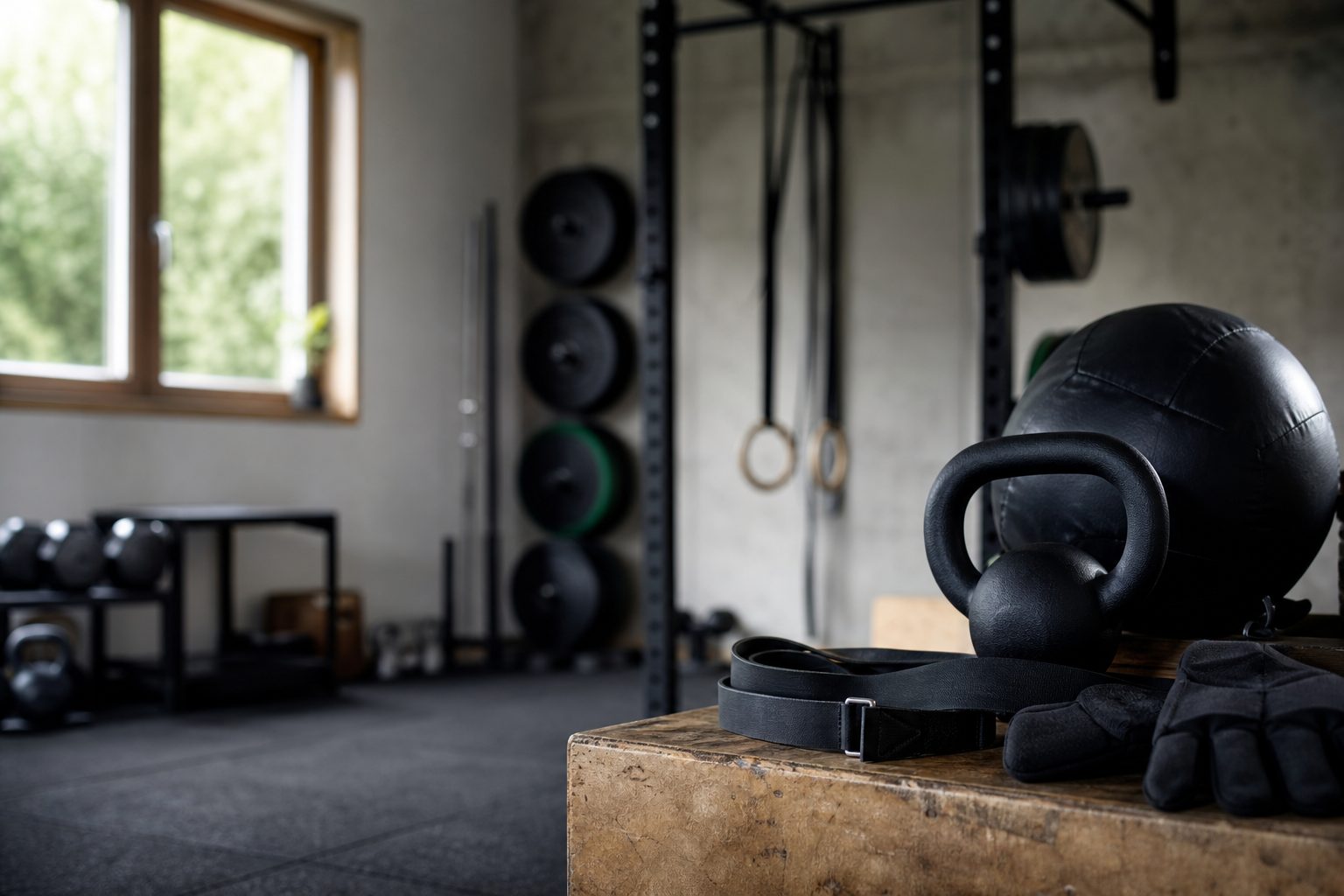
A HYROX race combines repeated one-kilometre runs with eight fixed functional fitness stations, so home training needs both engine work and sensible strength preparation.
 By James Oduya · Staff Writer & Home Gym Columnist · Updated July 14, 2026
1. Start with the simple explanation: what HYROX actually is
HYROX is a standardised indoor fitness race. Everybody completes the same running distance, in the same basic station order, and with prescribed movements and loads for their division. That is the important bit. It is not a free-form obstacle race where the course changes dramatically from one venue to the next, and it is not simply a gym class with a medal at the end.
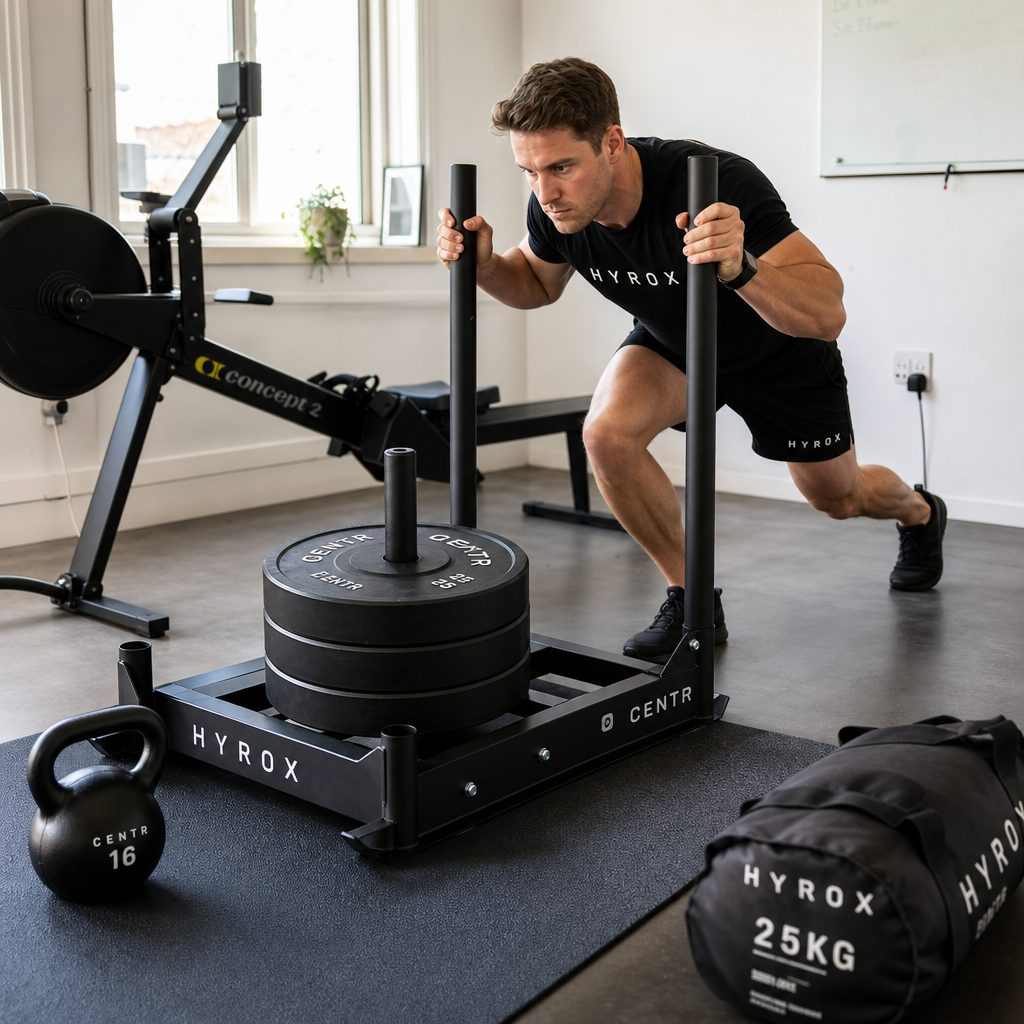
The best HYROX home setup is not the one with the most equipment; it is the one that lets you train consistently, safely and specifically enough to arrive confident.
The format first appeared in Hamburg, Germany, in April 2018. By 2025, the World Championships had been held six times, and events were being staged on five continents with more than 500,000 participants racing in cities including London, Chicago and Cape Town. That growth makes sense once you have watched one. The rules are easy to explain, the effort is visible, and you can measure yourself against the same challenge as athletes elsewhere.
A HYROX race consists of eight one-kilometre runs and eight workout stations. You run one kilometre before each station, complete the station, return to the run course and do it again. After the eighth station, there is one final one-kilometre run. That adds up to 8km of running in total, plus the station work.
Most athletes took about an hour and a half to finish, although division, fitness background, course flow and simple race-day execution all matter. Beginners commonly needed between 90 minutes and two hours. This is not a criticism. It is the nature of the event: you are trying to hold yourself together for a long time at a hard to very hard effort, often above 80 per cent of maximum heart rate.
The appeal is that you do not need to be a specialist in one sport to understand it. Runners can see where the kilometres will hurt. Strong gym-goers can see the carries, sleds and wall balls coming. Rowers and skiers can spot their favourite machines. Then the race puts all of those pieces together and asks you to perform them when you are already tired.
That final point matters more than almost anything when you train at home. The goal is not to recreate a glamorous competition floor in your spare room. It is to develop the physical qualities and practical confidence that mean race day feels familiar rather than like a very energetic ambush.
Useful mindset: HYROX is a running race with demanding functional stations, not eight isolated gym tests. If your running fades badly after loaded work, or your legs turn to porridge after a kilometre at pace, that is exactly the gap your home training should address.
2. Understand the race flow before buying anything
The stations are not randomly arranged. Their fixed order is SkiErg, sled push, sled pull, burpee broad jumps, rowing, farmers carry, sandbag lunges and wall balls. Every station arrives after a one-kilometre run, and every station changes how the next run feels.
The early sled work is an obvious example. A sled push asks for powerful leg drive and a stable torso; a sled pull loads the back, grip and legs in a different way. Neither takes very long for the strongest racers, but both can make the next kilometre feel oddly expensive. Your heart rate is high, your quads are full, and suddenly a pace that felt easy ten minutes earlier has become a serious conversation.
Later on, the row, carries and lunges accumulate fatigue rather than delivering one dramatic blow. Then wall balls arrive at the end, when squat endurance, overhead accuracy and patience are in noticeably shorter supply. The person who can do a hundred wall balls fresh is not necessarily the person who can do them well after 7km of running and seven stations. A small but important distinction.
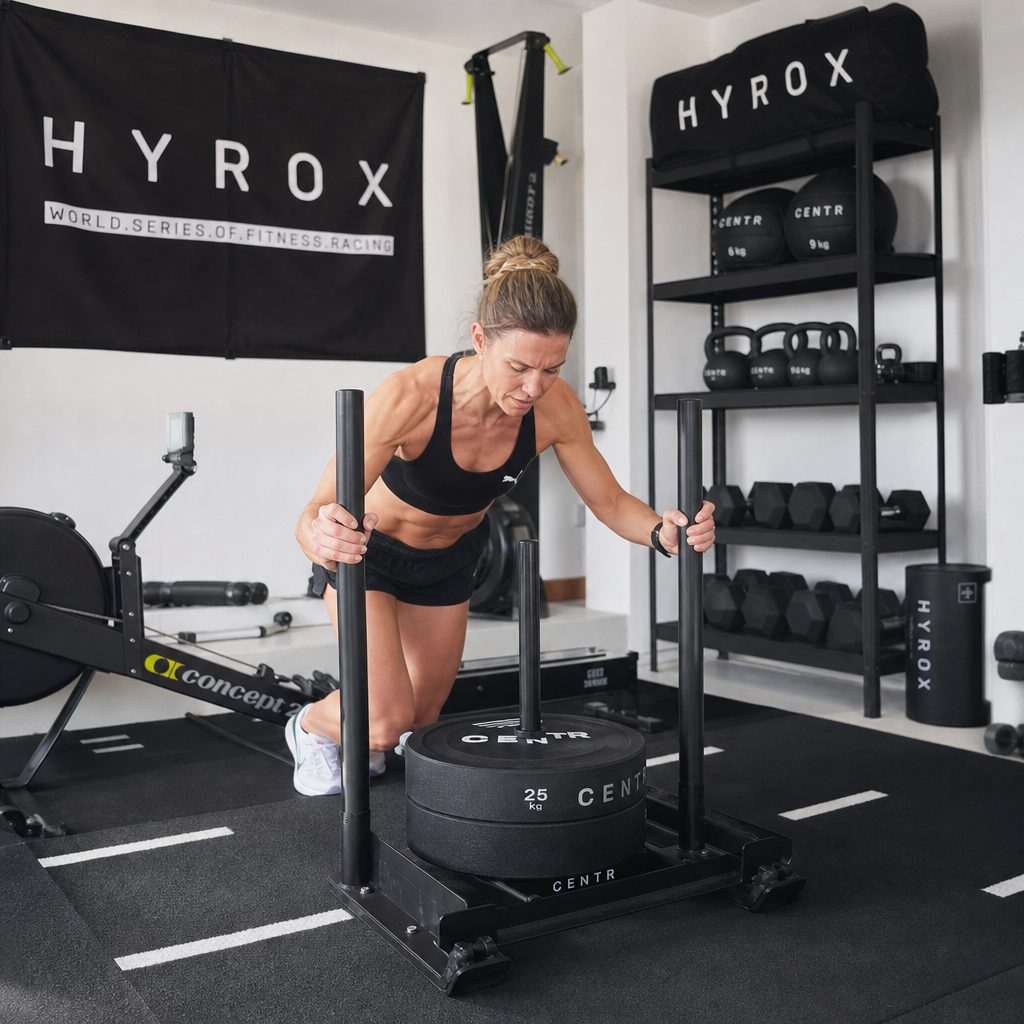
The race sequence matters: a strong isolated station does not automatically feel strong after a kilometre of running and the work that came before it.
Running is the thread through the whole race
The runs are not recovery breaks. They are where you must settle your breathing, establish a controlled pace and prepare your body for the next station without drifting into a jog too early.
Strength endurance beats one-rep strength
A useful HYROX body is not merely strong once. It can push, pull, carry, lunge and squat repeatedly whilst breathing hard and still move with some composure.
Grip is a quiet deciding factor
Farmers carries and sled pulling can expose grip endurance quickly. A person with fit legs but tired hands may lose time simply because they must stop more often than planned.
Pacing is a skill, not a motivational quote
Going hard is easy at the beginning. Going hard enough without detonating before wall balls is the more useful skill, and it is very trainable.
This is why I would resist the urge to buy the most complicated bit of equipment first. A proper machine is lovely when it fits your budget and room, but a few versatile tools, a sensible running plan and the willingness to practise unpleasant combinations will usually take a first-time racer further.
3. The eight HYROX stations, explained in race order
Knowing the exact sequence allows you to build specific sessions rather than vaguely doing "HYROX-style" circuits. That phrase gets thrown around rather freely. Some sessions are excellent conditioning; others are simply burpees with dramatic music. Both have their place, but only one gives you a useful rehearsal of the demands ahead.
| Station | Race task | Open division reference | Best home-training priority |
|---|---|---|---|
| SkiErg | 1,000m | Same distance for men and women | Pulling endurance and hard cardio |
| Sled Push | 50m | 152kg men / 102kg women | Leg drive and forward pressure |
| Sled Pull | 50m | 103kg men / 78kg women | Back, grip and backward movement |
| Burpee Broad Jumps | 80m | Distance-based bodyweight station | Movement quality under fatigue |
| Rowing | 1,000m | Same distance for men and women | Leg drive, trunk and cardio |
| Farmers Carry | 200m | 2 × 24kg men / 2 × 16kg women | Grip, posture and walking strength |
| Sandbag Lunges | 100m | 20kg men / 10kg women | Single-leg endurance and trunk control |
| Wall Balls | 100 reps | 9kg to 10ft men / 6kg to 9ft women | Squat endurance and target accuracy |
Station one: 1,000m SkiErg
The SkiErg comes first, which is kind in one sense because you are fresh. It is unkind in another because it asks you to establish an effort level before you have properly settled into the race. It is a whole-body pulling movement, involving a forceful hinge, trunk control and repeated arm drive. If you go too aggressively, you can spike your heart rate very early. If you are too cautious, you leave time behind before the sleds have even begun.
At home, a SkiErg is the closest possible practice. If you do not own one, resistance-band pulls, banded straight-arm pulldowns and hard running intervals can develop useful pieces of the same puzzle. They are not identical. No home substitute is. But the important qualities are still there: repeated upper-body pulling, braced posture and the ability to keep working when your breathing becomes loud enough to concern the dog.
Station two: 50m sled push
The sled push is a simple movement that is rarely simple in the moment. You lean into the sled, drive through the legs and keep pressure through the arms and shoulders. The Open division reference load was 152kg for men and 102kg for women. Pro division reference loads were 202kg for men and 152kg for women.
At home, the exact surface and friction will change what any sled weighs in practice, so a number on a plate stack is not a reliable like-for-like comparison. If you have a suitable space and a sled, use it. If you do not, a loaded sandbag pushed on a towel across a smooth surface can give you a useful forward-driving substitute. It will not perfectly replicate the event, but it can train the stance, leg effort and discomfort of pushing a reluctant object away from you.
Station three: 50m sled pull
The sled pull changes the problem. You are working backwards, pulling a rope and managing the urge to yank with your arms alone. Good practice teaches you to sit into the legs, stay organised through the torso and keep the hands working without panic. The Open division reference load was 103kg for men and 78kg for women. In Pro, it was 153kg for men and 103kg for women.
A loaded backpack or duffel bag attached to a rope can work as a modest home substitute if your flooring and anchor point are genuinely safe. Resistance-band rows and backwards walks with a band are also useful for patterning the posture. Do not attach anything to a flimsy banister, a light internal door or a piece of furniture that has not volunteered for this sort of career change.
Station four: 80m burpee broad jumps
This is the station that needs the least kit and often receives the least thoughtful practice. You perform a burpee with chest to floor, then jump forwards with a two-footed take-off and a two-footed landing. Repeat that over 80m. It is not particularly technical, but small inefficiencies compound rapidly.
Practise landing softly, standing with control and taking a consistent jump length. Huge leaps look impressive for about three repetitions. Then they become expensive. A repeatable rhythm normally beats a heroic first ten metres followed by the body language of someone searching for a chair.
Station five: 1,000m rowing
The row is a 1,000m effort after burpee broad jumps, so it rewards calm technique. Drive with the legs, organise the trunk and then finish the pull. If you have ever rowed hard after a squat-heavy circuit, you will know the odd sensation: your legs have the job, but they would prefer not to.
A rowing machine is the direct home option. A seated resistance-band row is not an equivalent cardio tool, but it can help reinforce pulling endurance. Running work remains valuable too, because the race asks you to go back to the run course after the row rather than sit down and congratulate yourself.
Station six: 200m farmers carry
The Open division carry reference was two 24kg implements for men and two 16kg implements for women. Pro reference loads were two 32kg implements for men and two 24kg implements for women. It is a deceptively plain task: pick up two weights and walk 200m. The details are where time goes.
Grip, shoulder position, ribcage control and a calm walking rhythm all matter. Train it with dumbbells or kettlebells. If your home space is short, walk shuttle lengths, turn carefully and count total distance. A carry does not need a long corridor to be useful; it needs a load that challenges your posture without turning every step into a sideways wiggle.
Station seven: 100m sandbag lunges
Sandbag lunges follow the carry, which means the hips, legs and upper back are already well acquainted with fatigue. The Open division reference was 20kg for men and 10kg for women. Pro division reference loads were 30kg for men and 20kg for women.
The sandbag is awkward by design. That is useful. It shifts slightly and encourages you to brace. At home, use a sandbag if possible. A loaded backpack can offer a practical alternative, but it should be packed so its contents cannot slide around or dig into your spine. Train controlled alternating steps first. Speed can come later. A lunge that becomes a knee-buckling stumble is not speed; it is merely exciting.
Station eight: 100 wall balls
Wall balls finish the station list, and they are the classic HYROX closer. Open division references were a 9kg ball to a 10ft target for men and a 6kg ball to a 9ft target for women. Pro division used a 9kg ball to a 10ft target for both men and women. You need 100 reps.
At home, the ball, the target height and the wall surface all deserve respect. A sturdy target and safe surrounding area matter. If you cannot throw a ball safely indoors, squat-to-press patterns with dumbbells or a lighter medicine ball can develop some of the leg-and-shoulder endurance, although they do not reproduce the catch and throw. Whenever possible, practise genuine wall balls somewhere appropriate before race day. Target accuracy and catching a descending ball are skills, not just fitness tests.
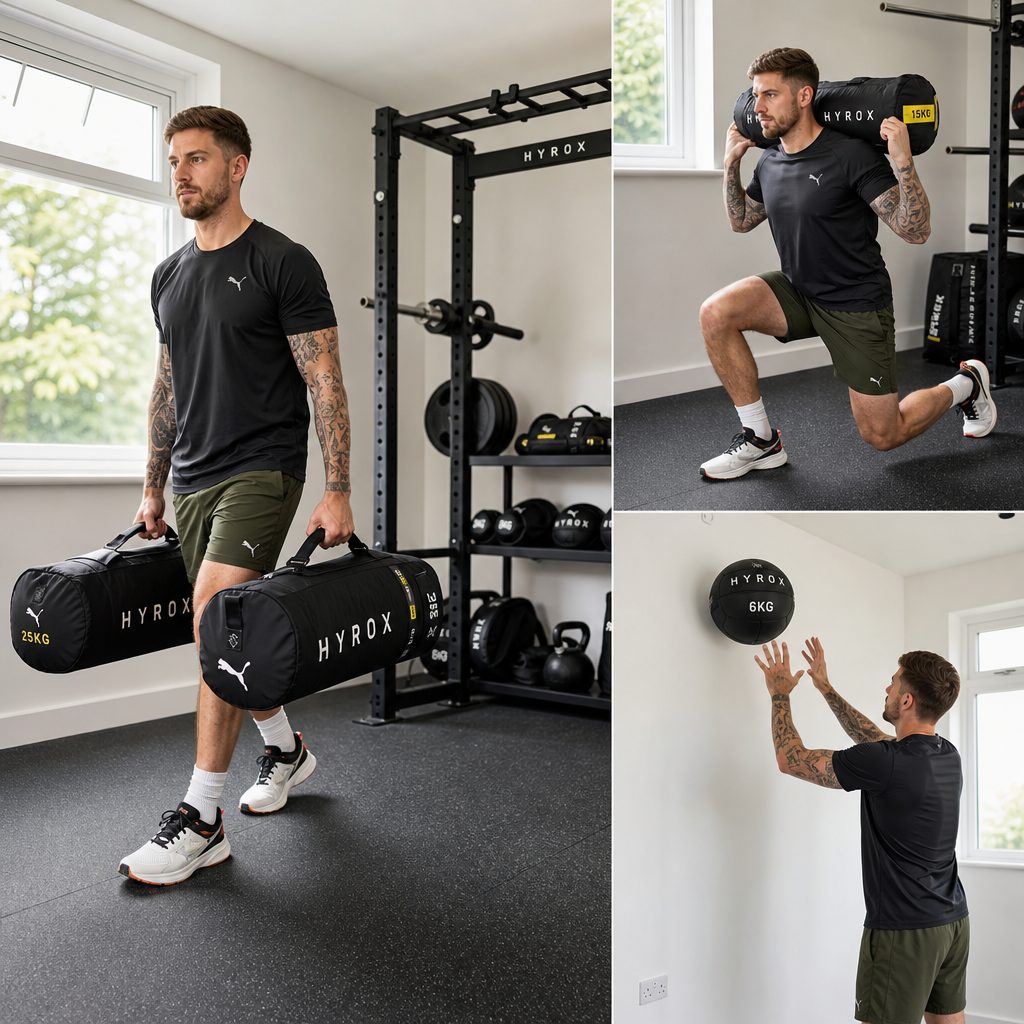
Farmers carries, sandbag lunges and wall balls reward straightforward equipment, but they also reward posture and patient repetition more than flashy training tricks.
4. Open division and Pro division: choose the right training reference
For most first-time racers, Open division standards are the sensible reference point. That does not mean every session must match race load immediately. It means you should know the target and steadily build towards being comfortable with it.
Pro division is not simply Open with a more serious facial expression. The sled push rose from 152kg to 202kg for men and from 102kg to 152kg for women. The sled pull increased from 103kg to 153kg for men and from 78kg to 103kg for women. Farmers carries moved to two 32kg implements for men and two 24kg implements for women, while sandbag lunges reached 30kg for men and 20kg for women.
| Movement | Open men | Open women | Pro men | Pro women |
|---|---|---|---|---|
| Sled push | 152kg | 102kg | 202kg | 152kg |
| Sled pull | 103kg | 78kg | 153kg | 103kg |
| Farmers carry | 2 × 24kg | 2 × 16kg | 2 × 32kg | 2 × 24kg |
| Sandbag lunges | 20kg | 10kg | 30kg | 20kg |
| Wall balls | 9kg to 10ft | 6kg to 9ft | 9kg to 10ft | 9kg to 10ft |
There is no prize for pretending you are training Pro if the result is poor movement, aching joints and a programme you cannot sustain. Equally, do not hide from load forever by calling every difficult session "conditioning". A good progression lets you maintain technique, recover adequately and gradually spend more time nearer to your intended race demand.
Train the gap, not your ego
If your runs are fine but your grip collapses on carries, train carries. If you can lunge but cannot maintain a steady run afterwards, combine lunges with short runs. HYROX rewards the work you would rather avoid, which is inconvenient but at least very clear.
5. The minimum home kit that actually transfers to HYROX
The most useful basic home setup is smaller than many people expect. You do not need to reproduce every station perfectly before you enter a race. You need enough equipment to train the core movement patterns, load them progressively and combine them with running.
For a genuinely practical starter setup, I would prioritise a sandbag, a wall ball or medicine ball, a pair of dumbbells or kettlebells suitable for carries, resistance bands, and a sturdy way to run uphill, climb stairs or use a treadmill. A weighted vest and a robust backpack or duffel bag are helpful additions rather than absolute requirements.
Each item earns its place because it covers several needs. A sandbag can train lunges, carries, squats, drags and general awkward-object strength. Dumbbells or kettlebells cover farmers carries, goblet squats, presses and loaded walking. Bands are low-cost tools for rows, pulldowns and controlled drag patterns. The wall ball gives you the closest home practice for the final station, provided your space is suitable.
What a lean setup does well
- Builds carry strength, lunge endurance, pulling work and squat volume with a small footprint.
- Lets you practise race-relevant combinations such as run, carry, run, lunge.
- Leaves room in the budget and the house for the thing many people overlook: consistent running.
- Can be progressed through more load, more distance, better movement or shorter rests.
What it cannot fully copy
- A band cannot perfectly replicate the resistance profile of a SkiErg or RowErg.
- A home drag will not necessarily feel like a competition sled on a race floor.
- Wall ball practice may be restricted by ceiling height, wall strength and neighbours.
- Machine pacing and exact event flow still benefit from occasional gym-based rehearsal.
A modest set of equipment is also easier to use. This sounds obvious, but it is worth saying. The best HYROX kit is not the kit that looks most like a boutique competition facility. It is the kit you can get out on a wet Wednesday evening, use for forty minutes and put away without rearranging the living room like a low-budget removal firm.
6. Build your setup in the right order
Buying kit in the correct order saves both money and floor space. Think in terms of what has the widest training return, then add specialist equipment only when it solves a genuine gap.
First purchase: a sandbag or safely loaded bag
A 20kg to 30kg sandbag can cover a remarkable amount of HYROX preparation. It is useful for sandbag lunges, front-loaded squats, carries, bear-hug walks, drags and pushing over a towel on a suitable smooth surface. A 25kg sandbag was listed in the £40 to £80 range, but the exact format and fill system vary, so concentrate on whether the bag can be loaded and used safely in your chosen space.
If you begin with a backpack or duffel bag, use stable contents and make sure there are no loose objects that can shift violently. Books and bottles can work for general loading, but they can also create uncomfortable pressure points. For lunges especially, a proper sandbag is usually friendlier to your body and much less likely to turn a training session into an argument with a zip.
Second purchase: carry weights
A pair of dumbbells or kettlebells is the next practical addition. For farmers carries, the Open race references are two 24kg implements for men and two 16kg implements for women. That is a useful eventual training target, not necessarily a day-one instruction.
Adjustable dumbbells can make sense where storage is limited. Fixed kettlebells are straightforward and durable. The particular choice matters less than having two implements that you can hold safely, walk with confidently and progress over time. Carrying one weight in each hand is very specific; do not assume that one heavy object held against the chest will develop exactly the same grip and shoulder demands.
Third purchase: a wall ball and target plan
A 6kg to 9kg wall ball provides direct practice for a major late-race station. It also gives you squats, throws and conditioning options. The target is part of the movement, though. Men in Open aimed for 10ft with a 9kg ball, while women in Open aimed for 9ft with a 6kg ball. If your ceiling does not permit that, do not force it. A dented ceiling is not a training adaptation.
Outdoor practice, a garage with enough height, or a suitable gym wall can be the better answer. At home, you can still build squat endurance and pressing stamina, then use occasional access to a proper target to sharpen the specific skill.
Fourth purchase: resistance bands
Medium and heavy resistance bands are not glamorous, but they are startlingly useful. They can support seated rows, standing rows, straight-arm pulls, assisted warm-ups and drag-style movements. They travel well, take almost no space and offer a sensible option for days when you want to train pulling without producing the noise of a large machine.
Use a secure anchor point. This cannot be stressed enough. A band under tension stores energy, and a poor anchor turns a simple row into a very fast lesson in physics.
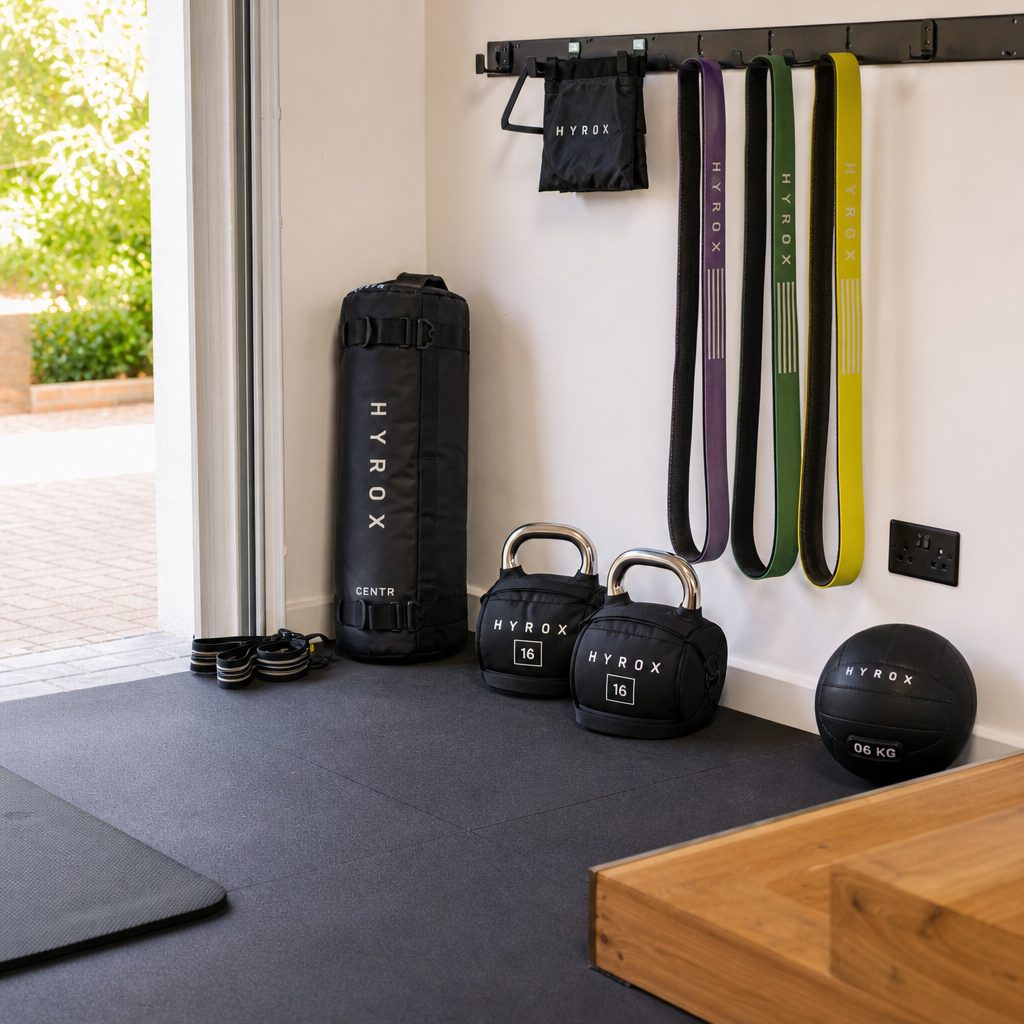
A compact HYROX corner can be built around a sandbag, carry weights, resistance bands and a safe route for running, stairs or incline work.
7. When a Concept2 SkiErg or Concept2 RowErg is worth adding
Once the basics are covered, a single machine can make home training more specific. The obvious choices are a Concept2 SkiErg or a Concept2 RowErg. Both appeared regularly on second-hand marketplaces, and Concept2 machines had a reputation for lasting for decades. Used examples were commonly budgeted at around 40 to 50 per cent below retail, depending on condition and local availability.
The choice should be based on your weakness, your room and the station that needs most direct practice. The SkiErg is the exact movement found early in the HYROX race. For many athletes, it is the higher-priority machine because it is harder to mimic convincingly with small kit. It demands shoulder endurance, trunk control and forceful repeated pulling.
The RowErg is a strong choice if you struggle with back strength, want broad cardio carryover or prefer the lower-impact movement. Rowing develops leg drive, trunk work and pulling endurance in a way that can be useful across the event. It is also a direct match for the 1,000m rowing station.
| Home-training option | Best for | Direct race carryover | Key limitation |
|---|---|---|---|
| Concept2 SkiErg | Shoulder endurance and the SkiErg station | Direct match for the 1,000m SkiErg | Specialist piece of equipment |
| Concept2 RowErg | Back strength, cardio and rowing practice | Direct match for the 1,000m row | Does not replace SkiErg work |
| Resistance bands | Compact pulling and drag preparation | Useful movement-pattern support | Cannot replicate machine pacing exactly |
| Sandbag and dumbbells | Loaded strength endurance | Strong carry, lunge and sled-substitute value | No direct machine simulation |
If you can access a gym occasionally, there is another sensible route: own the small, versatile kit at home and use gym sessions for sleds, SkiErg and rowing. That is often more realistic than trying to squeeze every station into a flat. Home training does not have to mean home-only training. It can simply mean that most of your consistency lives at home.
8. Best home setup for each kind of HYROX athlete
There is no universal perfect setup because people arrive at HYROX from different directions. A runner may need load tolerance. A strong lifter may need to become more economical over repeated kilometres. Someone who already rows might need more upper-body pulling endurance for the SkiErg and more confidence with wall balls.
Best on a budget: sandbag, bands and loaded backpack
Choose this if space and spending are tight. It covers drags, lunges, rows, loaded walks and sled-style effort, then relies on outdoor running, hills or stairs for the engine work.
Best all-rounder: sandbag, wall ball and two carry weights
This is the most balanced small-space setup for practical HYROX preparation. It directly supports lunges, wall-ball practice, carries, squats and general strength endurance.
Best specialist addition: Concept2 SkiErg
Shop Concept2 SkiErg on Amazon UK
For athletes who want the closest possible preparation for the first race station, a SkiErg is the most specific upgrade once the core kit is already in place.
Best for rowing weakness: Concept2 RowErg
Shop Concept2 RowErg Indoor Rowing Machine on Amazon UK
Choose this when the 1,000m row is a concern or when you want lower-impact cardio with useful leg, trunk and back involvement.
Notice that the "best all-rounder" setup is not necessarily the most expensive. That is deliberate. A home gym works when it makes training more repeatable. If you own a brilliant machine but never use it because it is in an awkward room, it has become a very expensive coat stand with excellent branding.
9. Use simple benchmarks without turning every session into a race
HYROX preparation benefits from benchmarks, but the best benchmarks are practical rather than theatrical. You do not need to complete a full simulated race every week. In fact, doing so often produces a lot of fatigue and not much focused improvement.
Instead, track whether you can maintain solid form at the relevant load, whether your transitions become calmer, and whether you can return to a controlled run after a demanding station. These are the things that make race day smoother.
The bar lengths above are not a scorecard. They are a reminder of where the race volume sits. Eight kilometres of running is the backbone. The carry and lunge distances matter because they load the legs and grip. One hundred wall balls matter because they arrive when those same systems are already tired.
A useful home benchmark might be a controlled 1km run followed by several carry shuttles, then another 1km run. Another could be short sets of wall balls with deliberately measured rest, so you learn what a sustainable set feels like. For burpee broad jumps, measure a modest lane and practise smooth, repeatable movement rather than chasing maximal distance.
The most valuable benchmark is repeatability
If a session leaves you wrecked for three days, it may have been satisfying but it is not automatically productive. Aim for work you can recover from, learn from and revisit with slightly better control next time.
10. Three home sessions that translate well to race day
These are not full race simulations. They are deliberately focused sessions that build the qualities HYROX asks for. Adjust loads and distances to your experience, space and current fitness. The intention is to finish challenged but still moving properly.
Session A: run and carry control
Warm up with easy running, hip mobility and a few unweighted squats. Then alternate a controlled run with farmers carry work. In a short space, carry back and forth, turning carefully. Focus on tall posture, relaxed shoulders and a grip that stays firm without squeezing every handle as if it owes you money.
This session is excellent for runners who have not spent much time carrying external load. Keep the first few attempts conservative. The surprise is rarely the legs; it is how much the forearms and upper back can complain when you try to keep moving after a run.
Session B: sled substitute and lunge endurance
Use a sandbag on a towel over a suitable smooth surface for controlled pushes, then drag it using a rope only if the setup is safe. Follow this with sandbag lunges. Keep the distance manageable at first and focus on even steps. Between rounds, use easy running, stairs or incline walking to practise recovering your breath whilst your legs are loaded.
This is not a perfect replica of the official sled stations, and it does not need to be. The point is to build the sensation of leg-driven effort followed by movement under fatigue. You are teaching yourself to resume running when the lower body would rather submit a formal complaint.
Session C: wall-ball finish practice
Start with a steady run, then do a small amount of rowing or band pulling if available, followed by carries and wall balls. The objective is to practise wall balls when fresh enough to use sound technique but tired enough that you must control your breathing.
Break the wall balls into manageable sets rather than attacking the whole total blindly. Learn what set size lets you keep the ball travelling to the target without long, unplanned rests. On race day, a short planned pause is usually much better than a long pause forced on you by a ball that no longer wants to go anywhere near the target.
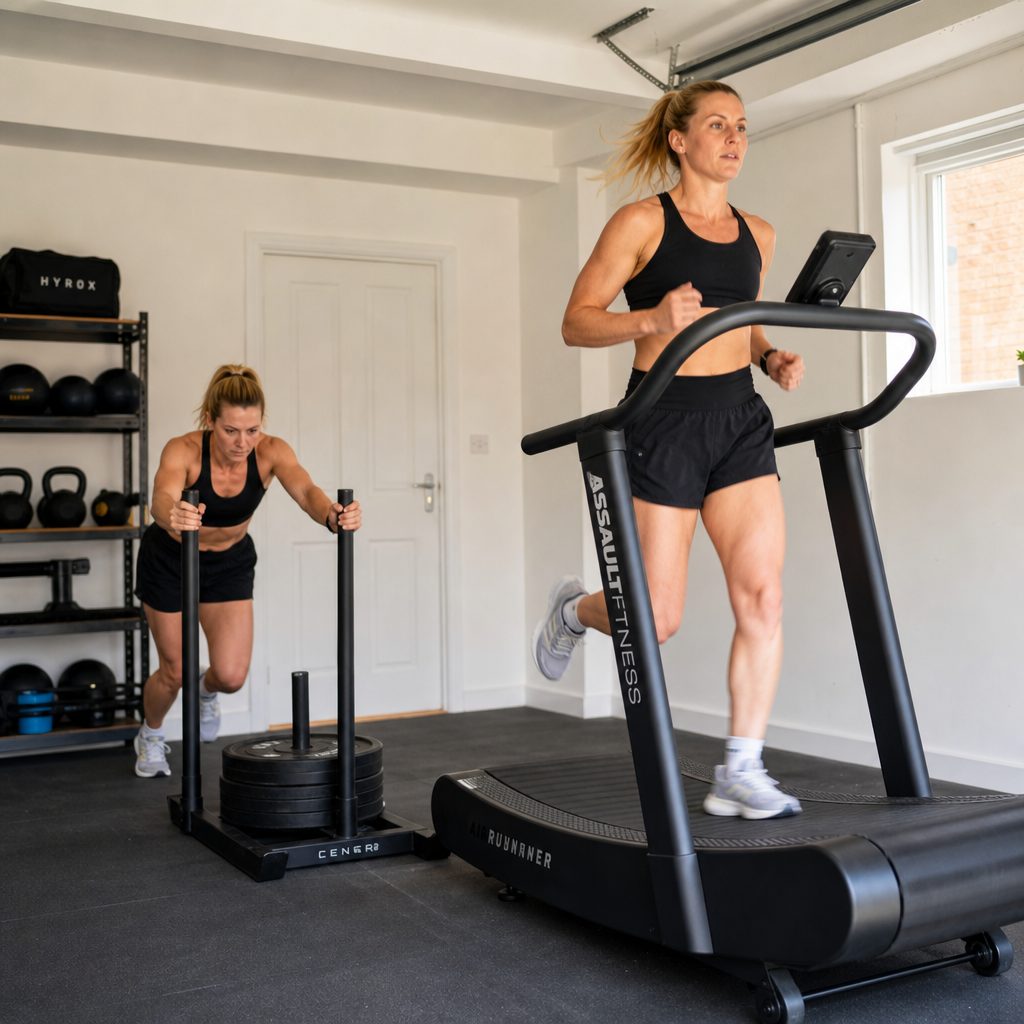
A useful home session combines short runs with one or two loaded movements, rather than trying to force an entire race into every workout.
11. Common home-training mistakes and how to avoid them
The biggest mistake is buying equipment before you have established a routine. HYROX kit can be useful, but it cannot make your calendar cooperate. Start with two or three repeatable weekly sessions, then add equipment when you know precisely what you will use it for.
The second mistake is only practising stations while fresh. Of course you should learn wall-ball mechanics, carries and lunges when you are not exhausted. But once the movement is secure, you also need to practise them after some running. That is where the race skill lies.
The third mistake is copying race load too soon. The official Open and Pro loads give you direction, but good training is progressive. Build enough strength to maintain position. Then build volume. Then combine it with running. Skipping straight to the hardest version usually produces messy repetitions, unnecessary soreness and a slightly haunted look at the thought of the next session.
The fourth mistake is neglecting the easy work. Because HYROX is hard, many people assume every workout must be a full-volume suffer-fest. It does not. Easier running, controlled strength work and technique practice support the hard sessions. They are the boringly sensible bits that let you keep training long enough to improve.
Better habits
- Practise a few stations after running, not every station every time.
- Use stable, repeatable loading and keep notes on carries, lunges and wall-ball sets.
- Build an easy aerobic base alongside harder race-specific work.
- Use occasional gym access for technical exposure to sleds and machines.
Habits that usually backfire
- Turning every workout into an all-out time trial.
- Assuming a home substitute matches a competition sled exactly.
- Ignoring target practice for wall balls until race week.
- Training carries only with one implement when the race uses two.
12. A practical weekly approach for beginners
If you are new to HYROX, think about covering three broad bases each week: running, strength endurance and one session that combines the two. You do not need to make every day specific to the race. In fact, that can become tiresome very quickly.
One session can focus on easy or steady running. This develops the capacity to cover the 8km total without treating the first kilometre as a dangerous event. Another can focus on strength: carries, lunges, squats, pulling and wall-ball technique. The third can be a hybrid session, such as short runs mixed with carries or sandbag work.
As your race gets closer, you can make the hybrid session more specific. Add more transitions, slightly longer pieces and the stations that concern you most. If wall balls are your weakness, do not merely do more wall balls until you hate them. Build the squat endurance, target rhythm and pacing that make them manageable.
For athletes with a good running background, the strength session deserves real attention. Carrying two heavy weights and lunging under load are not automatically solved by cardiovascular fitness. For gym-trained athletes, the running volume deserves the same respect. Being strong in a set of ten does not guarantee that your legs will enjoy eight one-kilometre efforts threaded through a hard event.
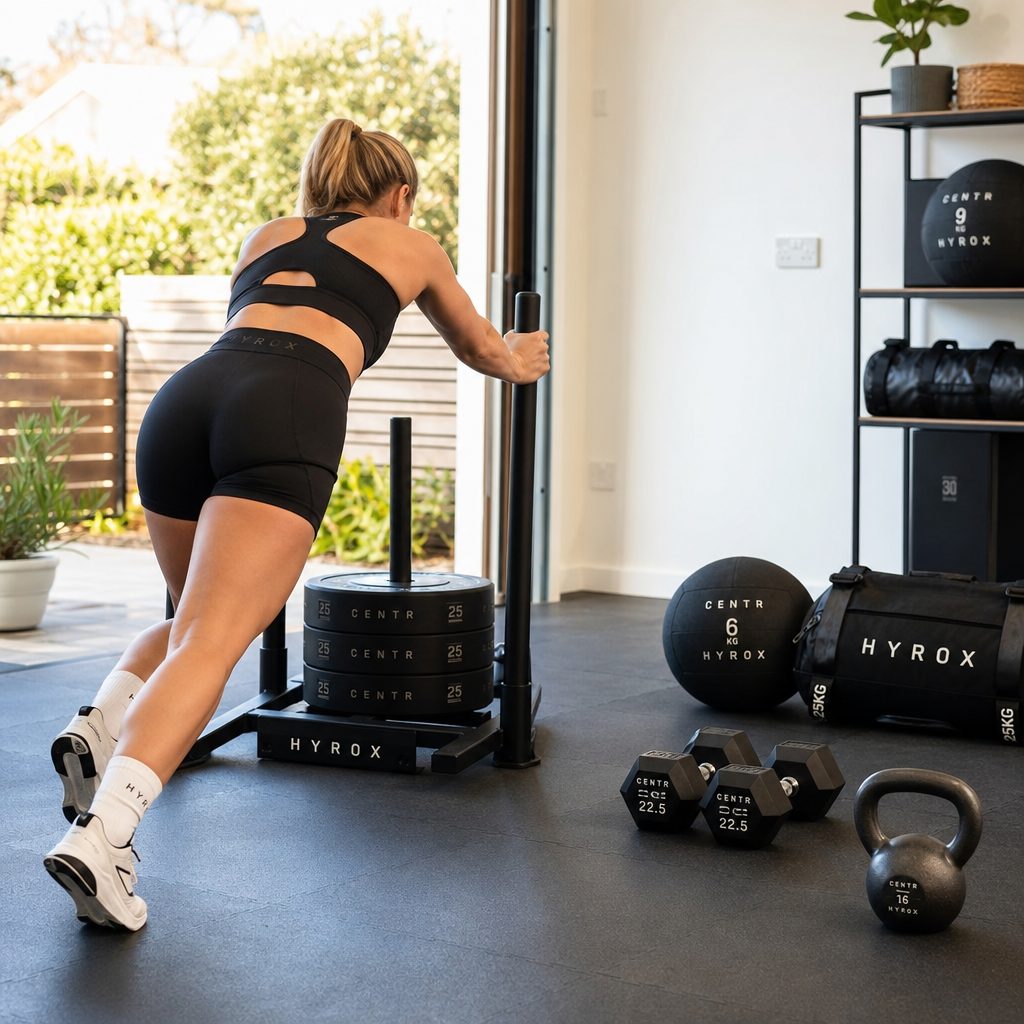
The strongest home plans blend running, strength endurance and occasional race-style combinations instead of relying on one punishing weekly simulation.
13. Final kit checklist before you commit to a home setup
Before buying, walk through the boring practical questions. They are boring right up until they save you from acquiring equipment that cannot be used safely in your house.
- Can you carry the equipment to its storage place without leaving it permanently in a walkway?
- Do you have a safe, sturdy surface for any pushing or dragging work?
- Can you throw a wall ball without endangering ceilings, windows, light fittings or other humans?
- Do you have a measured route for carries, or can you set out shuttle distances consistently?
- Can you run outside, use stairs, train on a hill or use a treadmill regularly?
- If you are considering a machine, will it be used enough to justify the floor space?
- Can you access a gym occasionally for sled, SkiErg, rowing or wall-ball target practice if needed?
For most people, the answer is a hybrid setup: a few compact tools at home, regular running outside and occasional access to the equipment that is hardest to replicate. That is not a compromise in the negative sense. It is simply intelligent use of the space you have.
A 20kg to 30kg sandbag, appropriate carry weights, resistance bands and a wall ball can give a first-time HYROX athlete plenty to work with. Add a SkiErg or RowErg when you know that direct station practice will meaningfully improve your training, not merely because a machine looks excellent in a photograph.
Frequently asked questions
You run 1km before each of the eight workout stations and then complete one final 1km after the last station. The total running distance is 8km.
Yes. You cannot perfectly copy a competition sled without the relevant kit and surface, but you can train useful qualities with a loaded sandbag pushed on a towel over a suitable smooth surface, safe rope drags, resistance-band work, loaded walking and leg-strength training.
For versatility, a sandbag is difficult to beat. It can be used for the lunge pattern, carries, squats, drags and pushing substitutes. It does not replace every station, but it covers a great deal of useful strength-endurance work in very little space.
Choose a SkiErg if you want the most direct match for the SkiErg station and need more shoulder endurance or upper-body pulling practice. Choose a RowErg if rowing is your weakness, you want strong cardio carryover and you prefer a lower-impact movement. Either is an upgrade, not a requirement for beginners.
The Open division reference is two 24kg implements for men and two 16kg implements for women, carried for 200m. Build progressively towards those loads if Open is your intended division.
You should build towards being able to manage the volume, but you do not need to attempt 100 every session. Practise sound squat-and-throw mechanics, target accuracy and sustainable sets. If your home is unsuitable for throwing, develop the strength at home and use a safe gym or outdoor space for specific target practice.
It is demanding, with most of the event performed at hard to very hard intensity. Beginner finish times commonly sit between 90 minutes and two hours. The event becomes much more approachable when you prepare the running, the strength endurance and the transitions rather than treating it as eight separate workouts.
No. A 5kg to 10kg vest can be useful for loaded walking, climbs and certain bodyweight drills, but it is not essential. A sandbag, carry weights and regular running generally have more direct relevance to the core race movements.
The bottom line
HYROX is an 8km running race broken up by eight fixed stations: SkiErg, sled push, sled pull, burpee broad jumps, rowing, farmers carry, sandbag lunges and wall balls. It rewards a broad engine, sensible pacing and the ability to perform loaded movements when your legs are already tired.
For home training, start modestly. A sandbag, two carry weights, resistance bands and a safe way to run or climb are enough to build very relevant fitness. Add a wall ball if you have a suitable target. Add a Concept2 SkiErg or Concept2 RowErg only when you have the space, the budget and a clear reason to want more direct machine practice.
Train the race demands, not the Instagram version of them. Run regularly, carry heavy things with good posture, lunge under control, practise your wall-ball rhythm and occasionally combine it all when tired. It is not glamorous every day. It is, however, exactly how you arrive at the start line far better prepared.