The Best Compact Cardio Machines for Serious HYROX Training at Home
The sensible home-HYROX shortlist is smaller than it first appears: one genuinely useful SkiErg, one brutally honest air bike, and a sled solution that does not demand a strip of turf through the middle of your living room. These are the picks that make sense when the training matters and the available floor space most definitely does too.
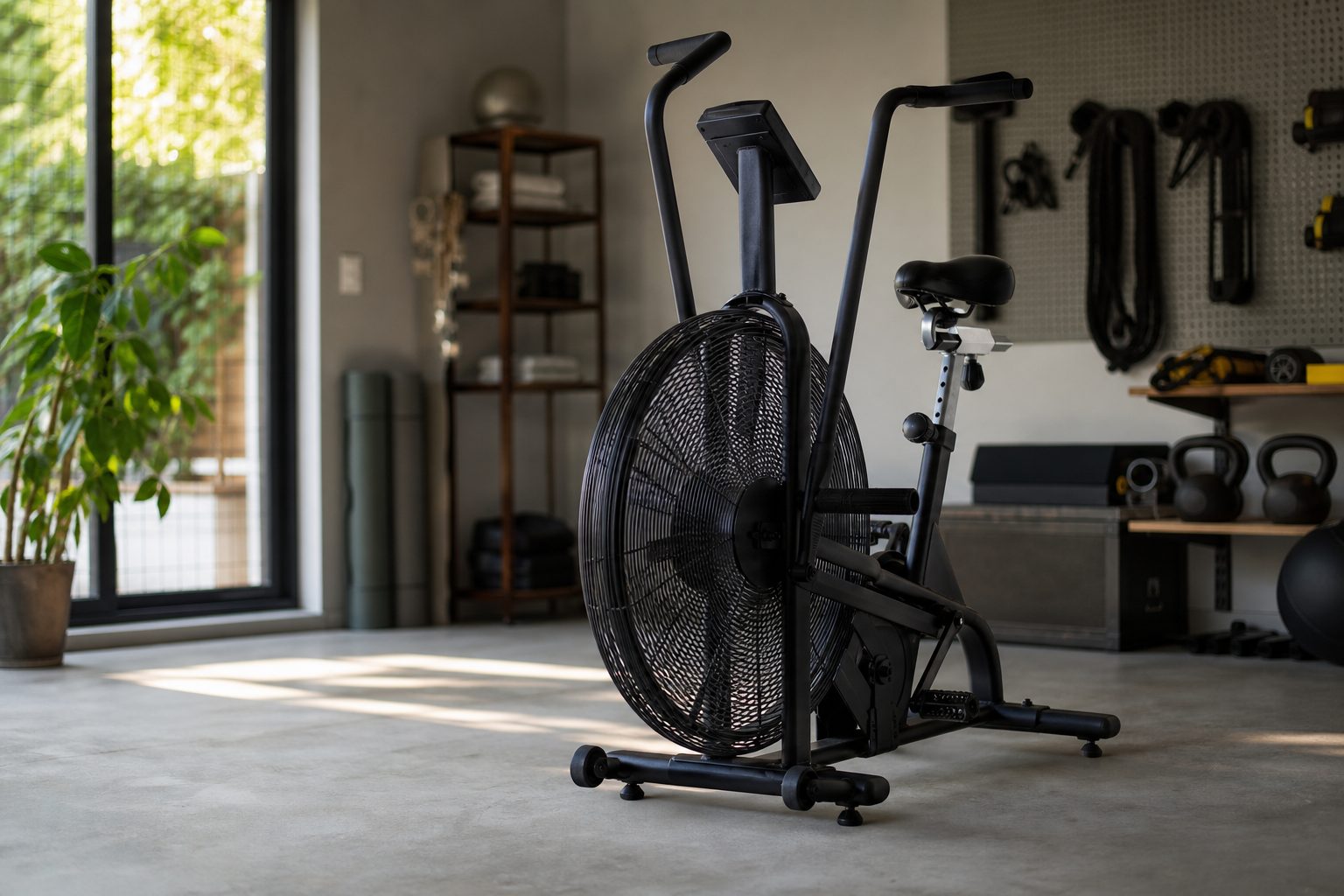
A compact HYROX-focused home setup does not need to resemble a commercial gym; the clever bit is choosing equipment that creates hard, repeatable station-specific work without taking over the flat.
 By Priya Nadarajah · Buying Guides Editor · Updated August 02, 2026
Why compact cardio kit matters for HYROX training
HYROX has a wonderful talent for exposing gaps in a training plan. You can be a capable runner, a strong lifter, or the person who is very good at telling everyone that they "normally do more functional stuff". Then you hit sustained full-body work with your heart rate already elevated and discover that your neat categories have stopped being terribly helpful.
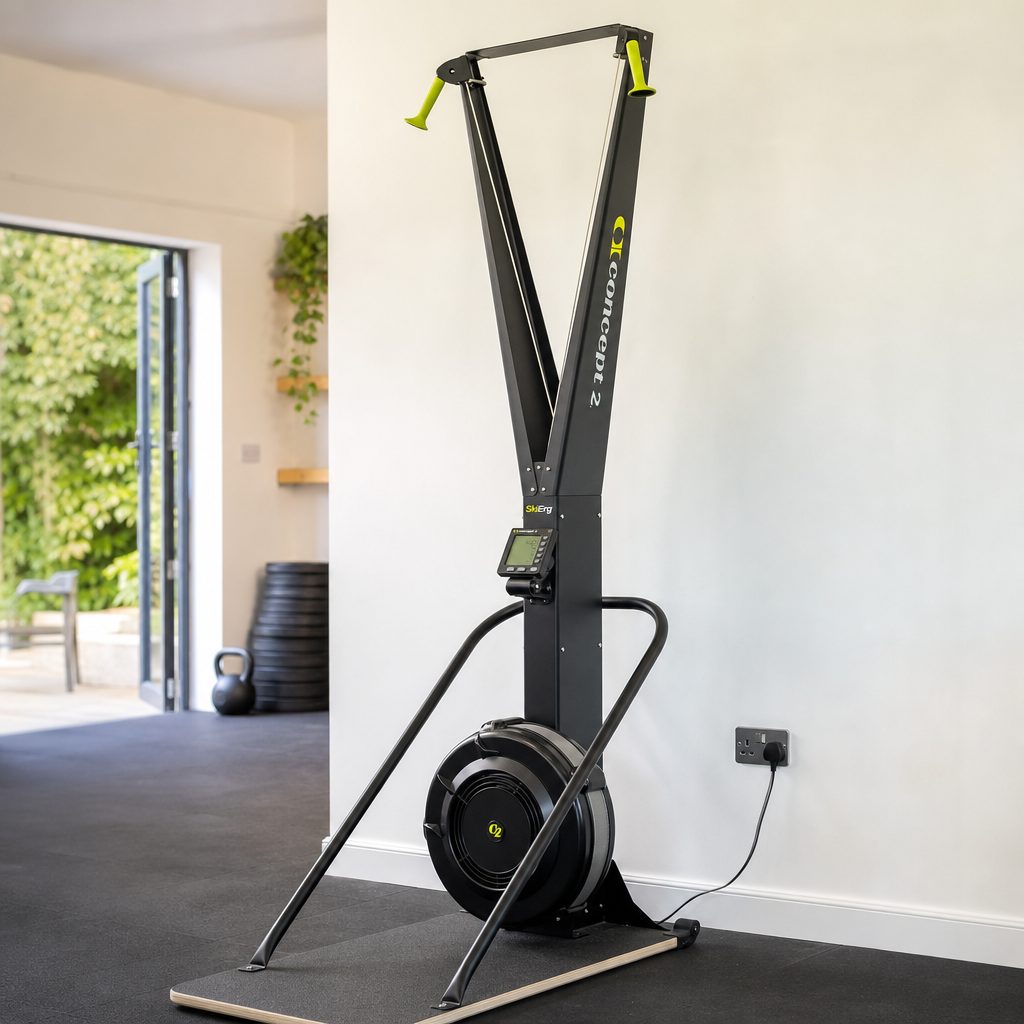
The Concept2 SkiErg's PM5 makes intervals and repeat sessions far easier to manage than relying on memory, enthusiasm and an increasingly optimistic sense of pace.
At home, the obvious answer is not to buy every machine that appears in a race-style workout video. That is how a perfectly decent spare room turns into a warehouse of mildly dusty intentions. The better approach is to buy for the movement demands that are difficult to recreate well with dumbbells, a kettlebell and good intentions: the double-pole skiing pattern, high-output cyclical conditioning, and resisted forward pushing.
A SkiErg is the clearest example. It gives you a repeatable, full-body pulling pattern and a monitor that lets you track the work rather than merely remember that it was unpleasant. An air bike is less specific to one station, but it is superb for developing the ability to keep producing effort when the legs and lungs would prefer an administrative break. A sled is the awkward third member of the family: enormously relevant, notoriously difficult to accommodate in a normal home, and therefore the category where design matters most.
For a flat, compact means more than a small footprint in a catalogue. It means a machine that can live against a wall, fit beneath a sensible ceiling, move when you need to clean, and train hard without requiring a dedicated runway. It also means thinking about neighbours. Air-resistance machines create noise. Sleds create friction or demand a surface. None of this makes them unsuitable; it simply means you should make the decision with your room in mind rather than with a montage soundtrack in your head.
The list below deliberately favours equipment you can build a serious plan around rather than equipment that merely looks athletic in a product photo. There are cheaper ways to make yourself tired. There are also much more expensive ways. The aim here is to spend on tools that let you progress, repeat sessions accurately, and keep training when the British weather has decided that outdoor intervals are a character-building exercise.
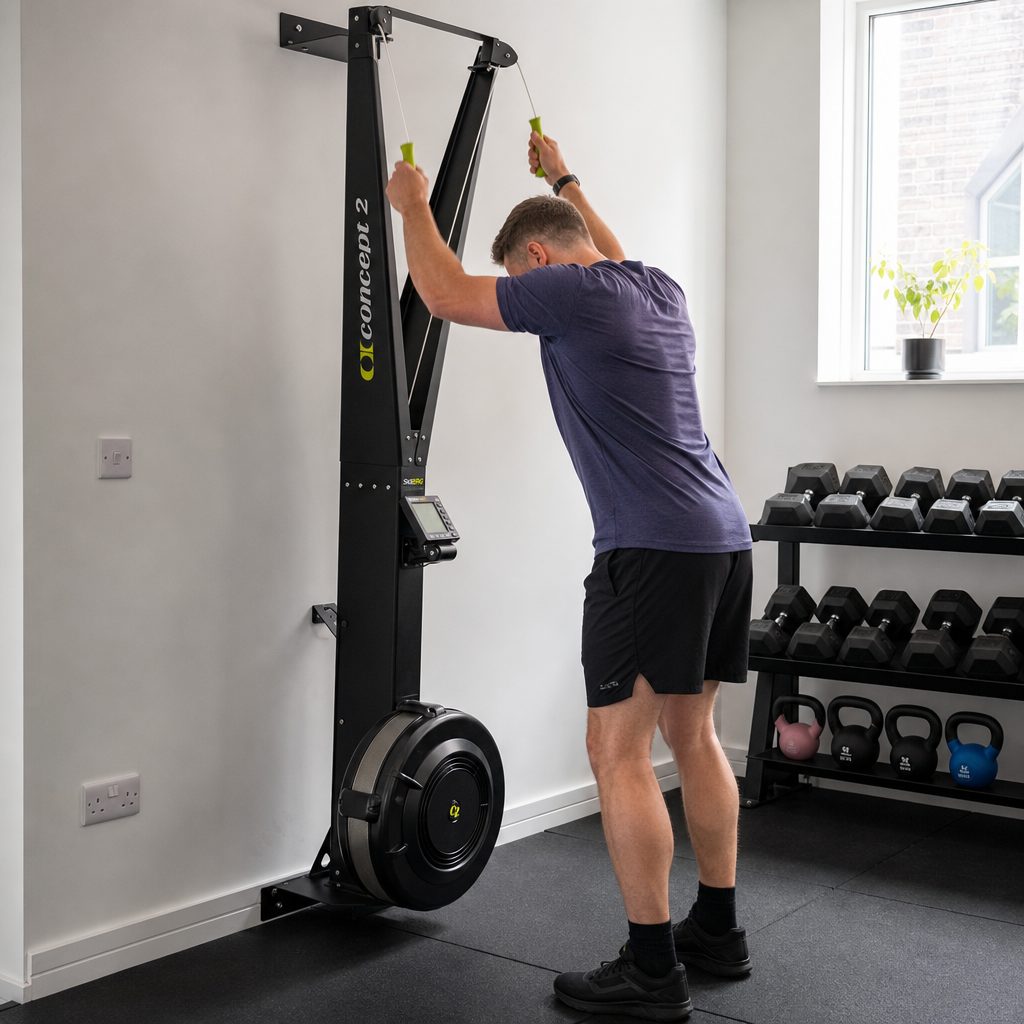
Wall-mounted SkiErg training is the space-saving answer for many flats, provided the room has the required height and a suitable wall position.
The compact-kit rule worth remembering
Buy the machine that removes the biggest compromise in your current training. If you can run outside and own a kettlebell, a SkiErg will usually add more HYROX-specific variety than another generic cardio bike. If you already have a SkiErg but cannot practise hard transitions under fatigue, an air bike can be the more useful next purchase.
What earns a place in this roundup
I have treated "compact" as a practical home-gym term, not marketing shorthand. A machine can be serious and still be manageable in a flat, but it should earn its space. The Concept2 SkiErg does that particularly well in wall-mounted form: it is 20 inches wide, 16 inches deep and 83 inches tall, with a machine weight of 46 lb. That is a very different proposition from dedicating a permanent lane to a friction sled.
Training relevance mattered just as much. The SkiErg category is here because the skiing movement is used in HYROX competition. Air bikes are included because they offer punishing, scalable full-body conditioning in a small area. Sleds are judged through a more pragmatic lens: can they provide progressive push work without a huge pile of plates, a long turf lane, or a floor that will never quite forgive you?
Finally, I have paid attention to feedback. A good home machine should make it easy to see whether you are improving. The Concept2 PM5 is a benchmark because it records distance, speed, pace, calories and watts, supports preset workouts and stores or transfers performance data. A simple console is not automatically bad, but a machine becomes much more useful when you can reproduce last week's interval rather than going by the vague scientific method of "that felt spicy".
Repeatable performance feedback
For interval work, a display that gives you pace, distance, watts or a structured workout makes progression much clearer. The PM5 on the Concept2 SkiErg is especially strong here, with several data-display modes and stored workout information.
A footprint that works in real homes
A machine may technically fit if you rotate the sofa, move the plant and breathe in. That is not the same as fitting well. Wall mounting, folding frames and short bike footprints have a genuine advantage when every square foot has another job.
Resistance that can grow with you
Air resistance rises with effort, while magnetic sled systems provide scalable resistance without relying entirely on loaded plates. Both approaches are useful, but they solve very different home-training problems.
Useful beyond one workout format
The best purchase is not a museum piece reserved for race preparation. A SkiErg can support aerobic work and hard intervals; an air bike can make a short conditioning session count; a versatile sled can be pushed, pulled and dragged.
The compact HYROX machines at a glance
There is no universal winner because the categories do different jobs. Still, the table makes the broad decision easier. If your number-one priority is direct station practice, start with the SkiErg. If you need a compact conditioning machine that can turn ten minutes into a very persuasive training session, look at the air bikes. If your training is missing serious push work and you cannot install turf, the magnetic-resistance sleds are the more realistic home option.
| Pick | Category | Compact detail | Key training strength | Confirmed price detail |
|---|---|---|---|---|
| Concept2 SkiErg with PM5 | SkiErg | 20in wide, 16in deep, 83in high wall-mounted | Direct skiing-pattern practice with detailed PM5 tracking | — |
| Rogue Echo Bike V3.0 | Air bike | — | Belt-driven high-output conditioning | $895 |
| Assault Fitness Assault Bike Classic | Air bike | — | Preset workouts and adjustable riding position | $699 |
| Schwinn AD2 Air Bike | Air bike | 24 × 46in footprint | Budget-minded full-body conditioning | $300–450 |
| Torque TANK M1 Push Sled | Magnetic sled | Works on any surface | Progressive push resistance without plates | Just under $1,000 |
| SledMill | Magnetic track sled | Compact track-based format | Push, pull and lateral work with up to 450lb resistance | — |
One small warning before we rank anything: do not read a comparison table as an excuse to compare unlike tools by one number. The SkiErg's 20-inch width is impressive, but it needs 83 inches of room height. The Schwinn AD2 has a stated 24 × 46-inch footprint, which is wonderfully manageable on paper, but you still need enough clear space to mount, dismount and move the handles freely. The "best" compact machine is the one you can use properly without rearranging your life every Tuesday evening.
Ranked picks: the best compact machines for serious home HYROX work
These rankings start with the machines that solve the largest HYROX-specific problem in the least awkward way for a normal home. That puts the Concept2 first not because everything else is lesser, but because it delivers direct ski training, robust data and a notably compact wall-mounted format in one thoroughly proven package. The air bikes and sleds then fill the conditioning and pushing gaps around it.
1. Concept2 SkiErg with PM5 — Best for race-specific home training
Shop Concept2 SkiErg on Amazon UK
If you are training for HYROX at home and can accommodate one specialist cardio machine, the Concept2 SkiErg with PM5 is the straightforward answer. It addresses the skiing movement directly, which is exactly what a general-purpose bike, treadmill or rower cannot do. More importantly, it does so without demanding a vast footprint. Wall-mounted, it measures 20 inches across, 16 inches deep and 83 inches high. It weighs 46 lb. For a serious piece of conditioning equipment, that is remarkably civilised.
The optional floor stand changes the conversation, increasing the depth to 52 inches. That may still be practical in a larger room, but anyone buying specifically for a flat should see wall mounting as the main attraction. Measure the ceiling before doing anything else. Eighty-three inches is a little under seven feet, which makes this a machine that rewards accuracy rather than optimism. A tape measure is less glamorous than training kit, admittedly, but it has saved many a home-gym purchase from becoming a very expensive hallway ornament.
The PM5 is a major reason this remains my all-round recommendation. It tracks distance, speed, pace, calories and watts, and it supports preset workouts, games and multiple languages. You can choose force curve, pace boat, bar chart, large-print or all-data views. It stores performance information and can transfer data to a Mac or PC by USB flash drive. That sounds like a lot of monitor detail because it is a lot of monitor detail. For serious training, it matters. You can build a session around a pace or watt target, repeat it a fortnight later and see whether you held your form and output when tired.
The resistance comes from the same flywheel and Performance Monitor ecosystem as the RowErg, but the movement is distinct. You are not simply trying to replace every cardio machine with one device. You are buying a tool for the specific job it does exceptionally well: tall, full-body pulling work that can be aerobic, interval-based or brutally sharp according to how you use it.
Pros
- Directly supports the skiing movement used in HYROX competition.
- Very compact 20 × 16-inch wall-mounted footprint.
- PM5 tracks pace, watts, distance and more for repeatable sessions.
- 46lb machine weight keeps installation and repositioning more manageable than many large cardio machines.
Consider before buying
- Its 83-inch height means low ceilings can rule it out.
- The optional floor stand increases depth to 52 inches.
- It is specialist equipment: brilliant for ski work, not a substitute for sled practice.
2. Torque TANK M1 Push Sled — Best for flat-friendly sled training
Shop Torque TANK M1 Push Sled on Amazon UK
Traditional sled training is magnificent in a proper gym and deeply inconvenient in many homes. You need plates, a suitable surface, enough lane length, and a level of confidence that the floor will be fine afterwards. "Fine" is a word that has ended many DIY conversations badly. The Torque TANK M1 Push Sled addresses the fundamental issue with Mag-Force Resistance Technology, delivering progressive resistance on any surface rather than relying on friction and a loaded stack of plates.
For a flat-based setup, that is the important bit. You are not trying to replicate a commercial turf lane down to the last fibre. You are trying to create demanding forward push work in the space you actually have. The M1's resistance increases with effort, so it can be used for controlled grinding work or faster pushes without a lengthy plate-loading ritual between efforts. It also removes the concern that a friction sled will be quietly sanding your floor while you are busy feeling virtuous.
The M1 had a price just under $1,000, so this is not a casual add-on. It is for the home athlete who has already established a habit, already knows that sled work is the limiting piece, and wants an elegant answer to the turf-and-plates problem. In that context, it is a coherent premium purchase. In a very tight flat, though, you still need usable pushing room. No technology gets around walls. It merely lets you make better use of the space between them.
Why magnetic resistance changes the home-sled equation
A friction sled needs a surface and usually gets harder through additional load. A magnetic-resistance sled provides scalable effort without treating weight plates and turf as compulsory accessories. That is why the TANK M1 makes more sense than a conventional plate sled for many serious home setups.
3. Rogue Echo Bike V3.0 — Best premium air bike for hard conditioning
Shop Rogue Echo Bike V3.0 on Amazon UK
The Rogue Echo Bike V3.0 is the air-bike pick for someone who wants a serious conditioning tool and does not want its drive system to become a hobby. It uses a maintenance-free belt drive, has a stated 330lb weight capacity, and gained Garmin ANT+ connectivity in January 2026. Those are not decorative upgrades. Belt drive suits the "get on, work hard, get off" appeal of this category, while ANT+ connectivity gives athletes who train with compatible Garmin kit another way to integrate the session into a wider training picture.
Air bikes work beautifully for HYROX preparation because they are indifferent to excuses. Push harder and the fan asks for more. Ease off and it immediately knows. There is no complicated resistance menu to negotiate, no waiting for an incline motor, and very little room to hide from a poor pacing decision. Use it for longer controlled efforts to build tolerance, then use it for sharp bouts immediately before a strength or carry movement. The bike is not a replacement for skiing or sled pushing, but it is a very efficient way to practise the uncomfortable transition between high-output movement and the next task.
At $895, the Echo Bike V3.0 occupied the premium end of the shortlist. That should make you pause, as it ought to. A cheap air bike can still be hard work; fans do not become kinder because the invoice is smaller. What the Echo offers is the confidence of a belt-driven design, a substantial 330lb capacity and current Garmin ANT+ support. If those things suit your training, it is a strong long-term buy. If you simply want to discover whether air-bike intervals are your idea of fun, start more modestly. Spoiler: they probably are not fun. They are useful.
Pros
- Maintenance-free belt drive suits frequent, high-intensity use.
- 330lb stated weight capacity.
- Garmin ANT+ connectivity was added in January 2026.
- A premium conditioning option for athletes who will use it consistently.
Consider before buying
- $895 places it well above entry-level air-bike spending.
- It trains conditioning extremely well, but does not reproduce the skiing station.
- Like all fan bikes, it is not the machine for a whisper-quiet late-night session.
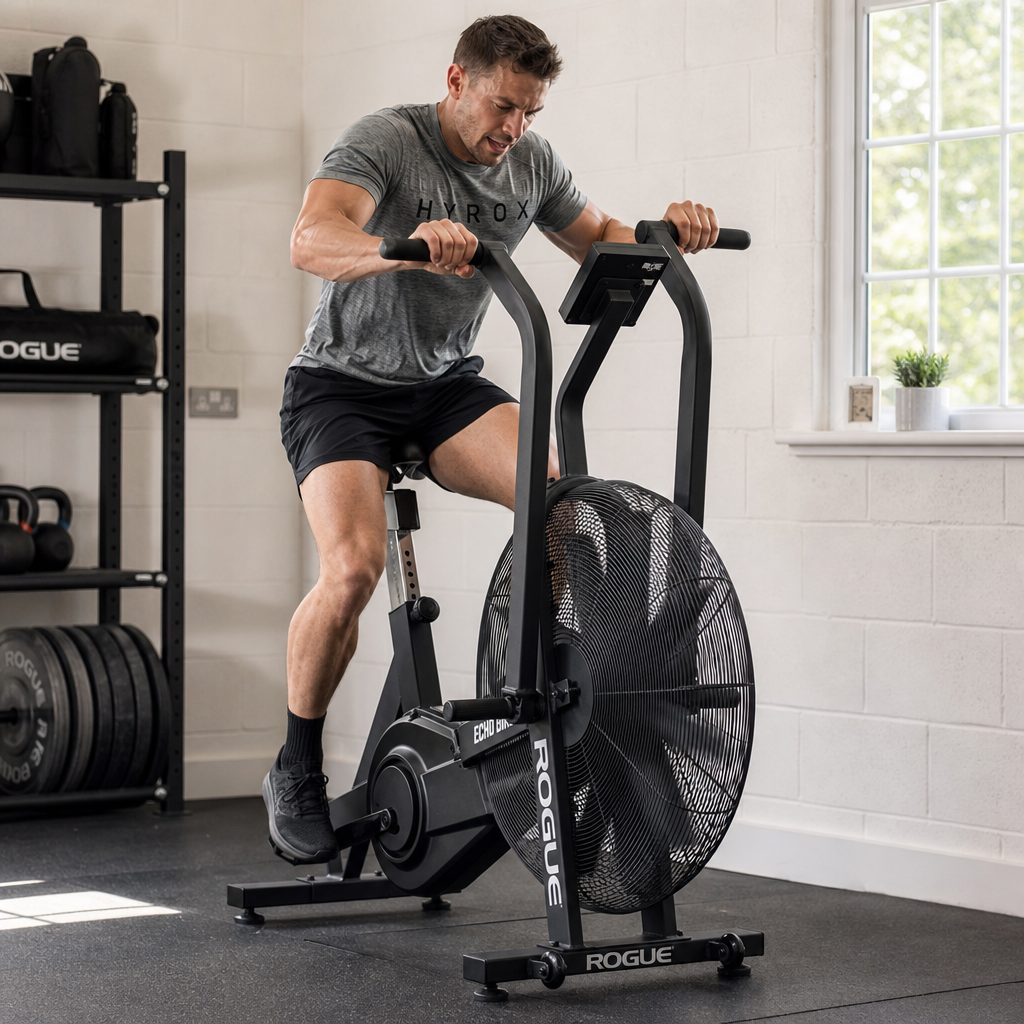
An air bike is not race-station specific in the way a SkiErg is, but it is exceptionally good at teaching you to keep working when your legs and lungs have started negotiating for fewer responsibilities.
4. Assault Fitness Assault Bike Classic — Best for proven programmed air-bike sessions
The Assault Fitness Assault Bike Classic earns its place by being a familiar, uncomplicated route into serious fan-bike work. It had a $699 Amazon price point and included seven preset workouts in the console. That is useful if you value some structure without wanting to assemble every interval manually. The frame is powder-coated, and adjustability covers the seat and ride height, both of which matter more than people expect when an exercise bike is shared between different users or used for frequent hard efforts.
The Classic is not trying to dazzle you with a sprawling technology story. It does the muscular, direct air-bike job: arms and legs working together against air resistance, with output responding to your effort. For HYROX-oriented training, that lends itself to sessions that pair a controlled bike interval with a practical home movement such as a loaded carry, bodyweight burpees or dumbbell lunges. You can create the sensation of moving from one difficult thing to another without needing to recreate every station exactly.
Its advantage over the Echo is not that it is inherently "easier"; neither machine has much sympathy. The appeal is the lower confirmed price and the built-in preset-workout count. Its advantage over cheaper fan bikes is that it arrives with a durable-frame reputation and a more established training identity. The seat and ride-height adjustment are also worth valuing if the machine needs to work for more than one person. A bike that fits you poorly becomes very convincing at persuading you to skip it.
5. SledMill — Best for maximum sled variety in limited space
The SledMill is a different answer to the same awkward question: how do you do meaningful sled work without a large open lane? Instead of relying on friction or plates, it uses a bi-directional magnetic track. It supports push, pull and lateral training, with up to 450lb of total resistance. That combination is unusually attractive for an athlete whose home space is at a premium but whose training plan needs more than a few straight-ahead pushes.
Its appeal is not merely that it is compact. Compact equipment can still be one-dimensional. The SledMill's advantage is that a single track-based unit lets you work in different directions and use different patterns. Push work can be followed by pulling and lateral work without creating a whole new equipment problem. For a home athlete trying to build general strength endurance around HYROX demands, that versatility makes a strong case.
There is a caveat, and it is an important one. A track-based sled is not the same sensory experience as taking a loaded sled across a long turf strip. That may be exactly why it works at home, but it is worth being honest about. If your goal is a perfect simulation of a commercial-gym sled lane, no compact indoor machine completely provides that. If your goal is difficult, scalable resisted work without needing turf or a huge open space, the SledMill is a far more realistic proposition.
Pros
- Push, pull and lateral training from one magnetic track-based system.
- Up to 450lb of total resistance.
- Does not require turf or a large open sled lane.
- Bi-directional operation adds useful variety around a home programme.
Consider before buying
- It is a specialised solution rather than a simple conventional sled.
- Track-based resistance feels different from a long friction-sled push.
- Best suited to buyers who will make full use of push, pull and lateral options.
6. Schwinn AD2 Air Bike — Best compact budget air bike
Shop Schwinn AD2 Air Bike on Amazon UK
The Schwinn AD2 Air Bike is the sensible choice for a shopper who wants real full-body air-bike conditioning without spending premium-bike money. It was priced at $300–450 and had a 24 × 46-inch footprint. Those two figures explain most of its appeal. This is a machine aimed squarely at people who have limited room, limited budget, and no desire to turn "trying air biking" into an investment committee meeting.
A 24-inch width and 46-inch depth is genuinely helpful information when you are laying out a home room. It is not tiny in the sense that it disappears behind a lamp, but it is compact enough to be plausible in a spare bedroom or dedicated corner. You still need clearance around it, of course. The handles travel; knees exist; occasionally a human needs to get off the thing. But compared with a full sled lane or a machine with a large fixed base, this is a much easier fit.
For HYROX training, the AD2 should be viewed as a conditioning workhorse rather than a station replica. It can create hard intervals, recovery efforts and transition fatigue. It is particularly useful if you have already spent your larger budget on a SkiErg and need a complementary machine that does not repeat the same movement pattern. You can get very fit on a modest air bike. The limitation is not the fan. The limitation is whether you will use it with enough intention to progress.
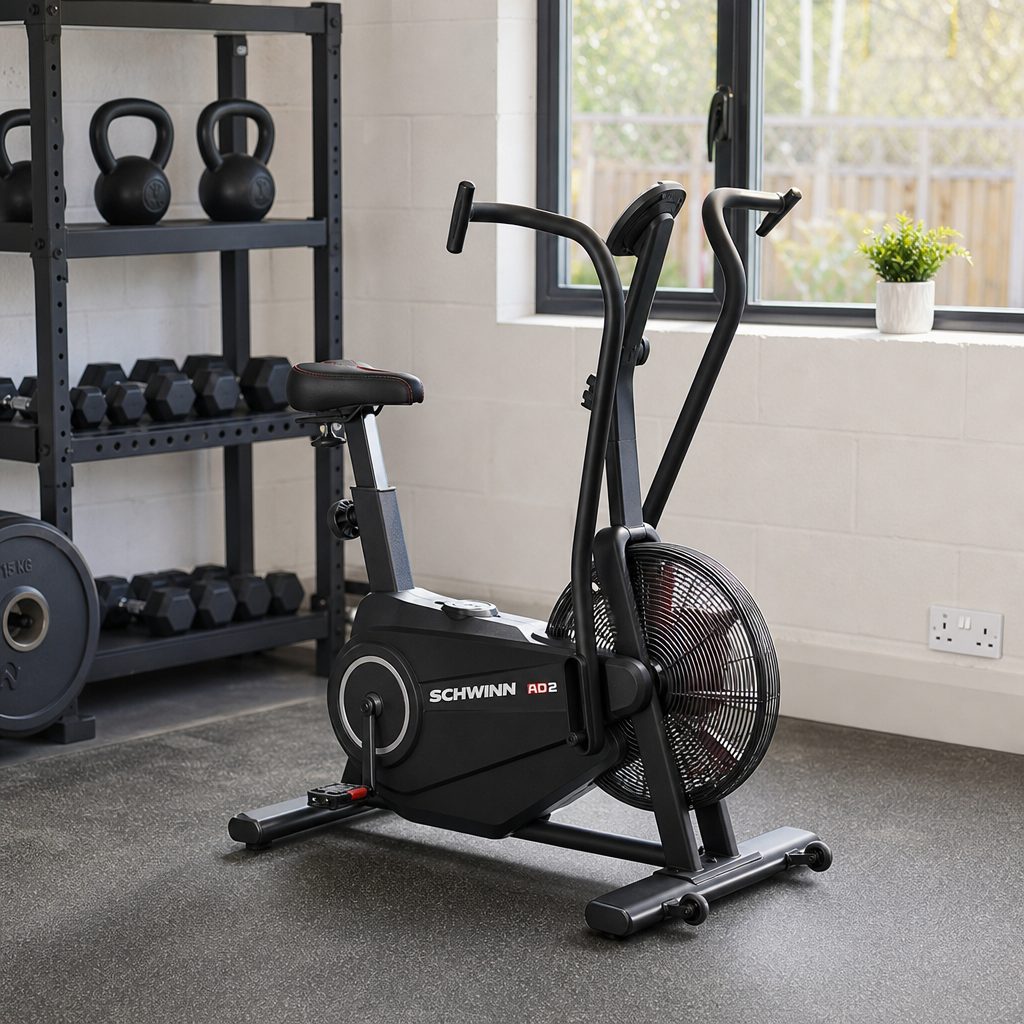
The Schwinn AD2's stated 24 × 46-inch footprint makes it one of the more practical options for a dedicated training corner rather than a full garage-gym takeover.
7. Torque TANK M3 Push Sled — Best for scalable multi-user resistance
Shop Torque TANK M3 Push Sled on Amazon UK
The Torque TANK M3 Push Sled follows the same core principle as the M1, using patented Mag-Force Resistance Technology to create scalable intensity while reducing the dependence on weight plates. Its case is strongest where more than one athlete will use it, or where a training plan needs a particularly broad range of difficulty. The M3 was designed around durability, performance and versatility, accommodating different fitness levels without turning resistance changes into a loading session.
That matters for households where one person is preparing seriously for HYROX and another simply wants demanding general conditioning. A conventional weighted sled can make this awkward. Somebody has to find plates, load them, unload them and decide whether the surface is suitable. The M3 keeps the focus where it belongs: on the push. For interval work, that is a proper practical advantage. You can move from a hard push into another movement without the equipment setup becoming the limiting factor.
It is not ranked above the M1 because the M1 is the clearer recommendation for a straightforward flat-friendly sled solution. The M3 is for the buyer who wants greater scope and has a more developed training environment. If your home setup is small and personal, simplicity is often the luxury. If it is shared and used frequently by different people, scalable versatility starts to matter a great deal more.
8. Sunny Health & Fitness SF-E3919 — Best budget SkiErg-style option for beginners
Shop Sunny Health & Fitness SF-E3919 on Amazon UK
The Sunny Health & Fitness SF-E3919 deserves a place because not everyone needs to begin with the most established monitor and the most race-focused setup. It uses air resistance that responds to your effort, has a multi-function monitor for time, distance and calories, and includes a folding frame for storage. For a beginner or budget-conscious home trainee, the folding element is the standout point. In a flat, being able to reclaim room after a session can make the difference between equipment that gets used and equipment that becomes part of the décor.
There is a clear distinction between this and the Concept2. The Concept2's PM5 is a much deeper performance-tracking tool, offering pace, watts, force curve and stored data among its functions. The Sunny monitor covers the straightforward essentials of time, distance and calories. That is enough to start building a habit and to complete simple intervals. It is not the same data ecosystem for someone who wants to chase precise repeat performances over a full training block.
That does not make the SF-E3919 a poor choice. It makes it a choice with a defined audience. If you are new to ski training, want air resistance, and need folding storage, it has a very understandable role. If a HYROX event is the central goal and you want to measure performance seriously over time, I would still start with the Concept2 if the room and budget allow. Buy the Sunny because its storage and accessible format match your reality, not because you expect it to behave exactly like the more data-rich alternative.
Footprint, height and the boring measurements that save expensive mistakes
Home gym buying becomes much more enjoyable when you deal with measurement before emotion. There is a short period after seeing a machine online when it appears to occupy almost no room whatsoever. It is a flattering little optical illusion. Then it arrives and has a physical relationship with your walls, ceiling and furniture that the product page was mysteriously quiet about.
The clearest dimensional comparison in this roundup involves the Concept2 SkiErg, the Schwinn AD2 and the GYMAX Fan Bike. The GYMAX measured 41 inches deep and 23 inches wide. The Schwinn AD2 measured 46 inches deep and 24 inches wide. The Concept2 SkiErg is only 20 inches wide and 16 inches deep when wall-mounted, but its 83-inch height introduces the ceiling question. None of these numbers tells the whole story, but together they show why "smallest footprint" is not always the complete answer.
The bars above use the largest stated figure in each simple comparison as the full scale. They are not a scorecard. The SkiErg's narrow base does not mean it is automatically easier to house than the bikes; 83 inches of height is decisive in some UK flats, especially in converted rooms or under sloping ceilings. Likewise, a 41-inch-deep GYMAX looks attractive beside the 46-inch Schwinn, but the difference matters only if that five inches changes the usable layout of your room.
My practical method is simple. Mark the machine's stated base on the floor with masking tape, then add a little living space around it. Stand where you would mount it, use the handles, reach down for a water bottle and step away after a hard interval. It sounds faintly theatrical. It is also far cheaper than discovering the problem after delivery. For a SkiErg, mark the wall position and measure height twice. For a sled solution, work out the actual movement path rather than merely the machine's resting footprint.
When comparing a wall-mounted SkiErg with a freestanding bike, distinguish the equipment's resting dimensions from the room you need to use it well. Compact equipment should reduce compromise, not force you to train in a cramped, awkward position.
How to build a three-machine HYROX corner without duplicating your training
The most capable compact home setup is not necessarily the largest one. In fact, a surprisingly effective trio is one SkiErg, one air bike and one home-appropriate sled solution. Each covers a different type of discomfort. The SkiErg gives you direct ski-pattern work and detailed pace feedback. The air bike adds full-body output with no meaningful learning curve. The magnetic sled supplies resisted pushing without the traditional turf-and-plates headache.
If you can only buy one piece, make it the SkiErg if HYROX is your primary objective. It is the one category in this guide that directly mirrors the skiing movement. If you can buy two, add an air bike if you have limited floor area and want additional conditioning variety. A bike gives you a way to train hard even when you do not have space to run, and it can make a brief session worthwhile. Ten purposeful minutes on a fan bike can be enough. It is often not emotionally enjoyable, but that was never really the brief.
The third purchase should be a sled only when you have identified that pushing is the missing element and you can use it safely. For most flat dwellers, that means a TANK M1, TANK M3 or SledMill-type solution rather than a friction sled. The Rogue Dog Sled 1.2 is popular and versatile for pushing, pulling and dragging, and its compact frame suits home gyms, but it remains a friction-based sled. It is a better answer where you have a suitable surface and can accept the plate and lane requirements. It is not automatically the answer for a laminate-floored spare room.
The Rogue Slice Sled offers another compact push/pull route, with a 300lb weight capacity and a focus on lighter-weight speed and acceleration training. That can be useful in the right environment, but it is better understood as a speed-oriented sled than as the all-purpose answer to heavy home sled work. The distinction is useful. Do not buy a speed sled and then resent it for not becoming a full commercial sled lane after delivery.
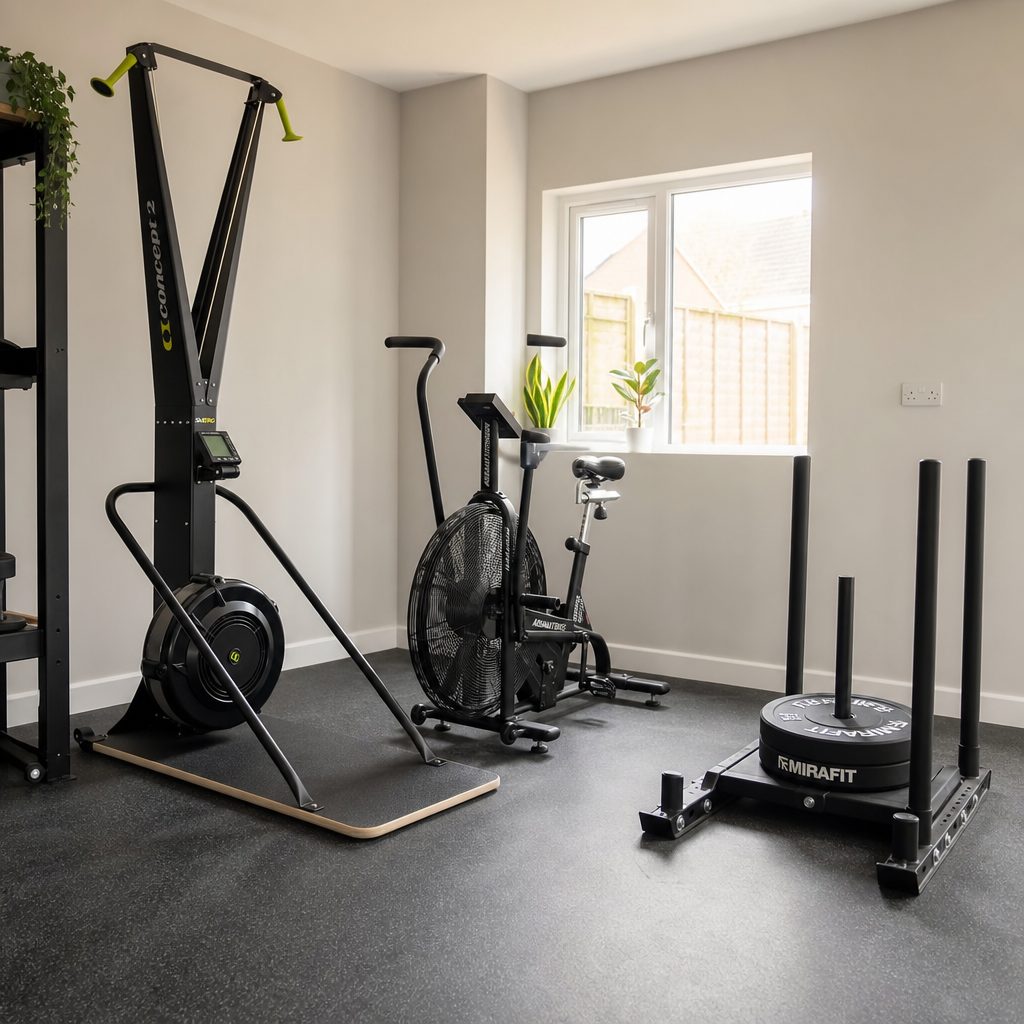
A compact home HYROX corner works best when every machine has a distinct job: ski-specific pulling, high-output conditioning and scalable resisted pushing.
Pricing and value: where spending more actually changes the experience
Prices only tell part of the story, but the confirmed figures here show a clear spread. The Schwinn AD2 sat at $300–450, the Assault Bike Classic held a $699 Amazon price point, the Rogue Echo Bike V3.0 was $895, and the Torque TANK M1 came in at just under $1,000. These are not interchangeable products, so the right conclusion is not simply to buy the cheapest or most expensive. It is to understand what additional spending changes.
Moving from the Schwinn AD2 to the Assault Bike Classic brings you to a machine with a powder-coated frame, adjustable seat and ride height, plus seven preset workouts. Moving to the Echo brings a maintenance-free belt drive, 330lb capacity and Garmin ANT+ connectivity added in January 2026. For an athlete who will train multiple times each week and values connected monitoring, those upgrades can be meaningful. For someone testing whether air-bike conditioning fits their routine, the AD2's lower range and small footprint may be the more sensible beginning.
The TANK M1's price needs to be judged against what it replaces. It is not simply "a sled that costs nearly a thousand dollars". It is a magnetic-resistance answer to buying plates, arranging turf, and accommodating a conventional sled lane. For some homes, that convenience is the product. For others, particularly where a garage or outdoor surface already exists, a traditional sled may be the more economical route. Context is everything, which is rather inconvenient for anyone hoping for a one-line answer.
Budget air-bike entry
Schwinn AD2 Air Bike: compact full-body conditioning with a 24 × 46-inch footprint.
Established air-bike middle ground
Assault Fitness Assault Bike Classic: seven preset workouts and adjustable setup.
Premium air-bike route
Rogue Echo Bike V3.0: belt drive, 330lb capacity and Garmin ANT+ connectivity.
Premium home-sled route
Torque TANK M1 Push Sled: Mag-Force resistance on any surface.
For UK shoppers, it is especially wise to budget for the whole setup rather than just the headline machine. That does not mean inventing a long shopping list to feel prepared. It means recognising that placement, floor protection and a sensible way to keep the room usable matter. The most expensive piece of training kit is the one that cannot be used comfortably at the time you usually train.
Practical training ideas for each machine
A good home machine earns its keep through repeat use, so it helps to have a few clear session structures ready. The point is not to copy a competition day in your lounge down to the last detail. The point is to practise output, pacing and transitions with tools that are available consistently. Keep the sessions simple enough that you can repeat them and compare how they feel over time.
On the Concept2 SkiErg, use the PM5 to make your target visible. You might complete several steady intervals at a pace you can maintain cleanly, watching pace and watts rather than yanking the handles as though you have personally fallen out with the machine. On another day, use shorter hard efforts with equal or longer recovery. The monitor lets you see whether your output is fading, which is useful information even when it is not flattering information.
On an air bike, use the fan's naturally responsive resistance for simple work-to-rest intervals. Short, hard efforts are excellent for learning how quickly your whole body can become involved in a supposedly "cardio" exercise. Longer, controlled bouts are valuable too. The mistake is to treat every air-bike session as an all-out test. That is a wonderful way to make the machine psychologically unavailable by Thursday. Mix hard and sustainable work so you can keep training week after week.
With a magnetic sled, focus on position and pressure as much as raw aggression. A controlled push against meaningful resistance can teach you to keep driving when your legs are tired without needing a long runway. The TANK systems' progressive resistance lets you vary intensity through how hard you push, while the SledMill gives you options to include pulling and lateral work. That variety is useful for building a more rounded conditioning base rather than doing one movement until you begin to dislike your own hallway.
Use time when space is limited
Timed intervals work well at home because they do not require a measured running route or a long sled lane. They are also easy to repeat, provided you note the resistance setting, effort level and recovery arrangement.
Practise managing, not merely surviving, effort
Air bikes and SkiErgs both punish poor pacing immediately. Start sessions at a sustainable output, then learn where you can increase it. Going out at maximum intensity is occasionally useful; making it your only strategy is less clever.
Repeat one benchmark session regularly
The PM5's stored data is especially useful here. On other equipment, keep a simple note of work and rest. Consistency of comparison beats elaborate sessions you never repeat.
Best-for awards: which pick suits which home athlete?
If you have skimmed to this part, I respect it. Buying equipment is ultimately a decision, not a literature review. Here are the cleanest recommendations by type of buyer. The important thing is that "best" changes according to the obstacle in front of you: budget, limited floor area, need for direct ski practice, or the desire to build a genuinely serious home conditioning space.
Best all-rounder
Concept2 SkiErg with PM5. The best choice for serious HYROX-focused home training because it directly supports ski work, measures only 20 × 16 inches when wall-mounted, and brings excellent performance tracking.
Best on a budget
Schwinn AD2 Air Bike. Its $300–450 range and 24 × 46-inch footprint make it the sensible compact conditioning choice when you need to manage spending.
Best premium air bike
Rogue Echo Bike V3.0. Choose it for belt drive, a 330lb capacity and Garmin ANT+ connectivity if you want a premium fan-bike experience.
Best for home sled work
Torque TANK M1 Push Sled. The clearest pick for flat-friendly resisted pushing because Mag-Force resistance works on any surface without plate loading.
Best for versatility
SledMill. Best if you want push, pull and lateral work from a compact magnetic track system with up to 450lb of resistance.
Best for stored-away training
Sunny Health & Fitness SF-E3919. A sensible beginner option when folding storage, air resistance and straightforward tracking are the priorities.
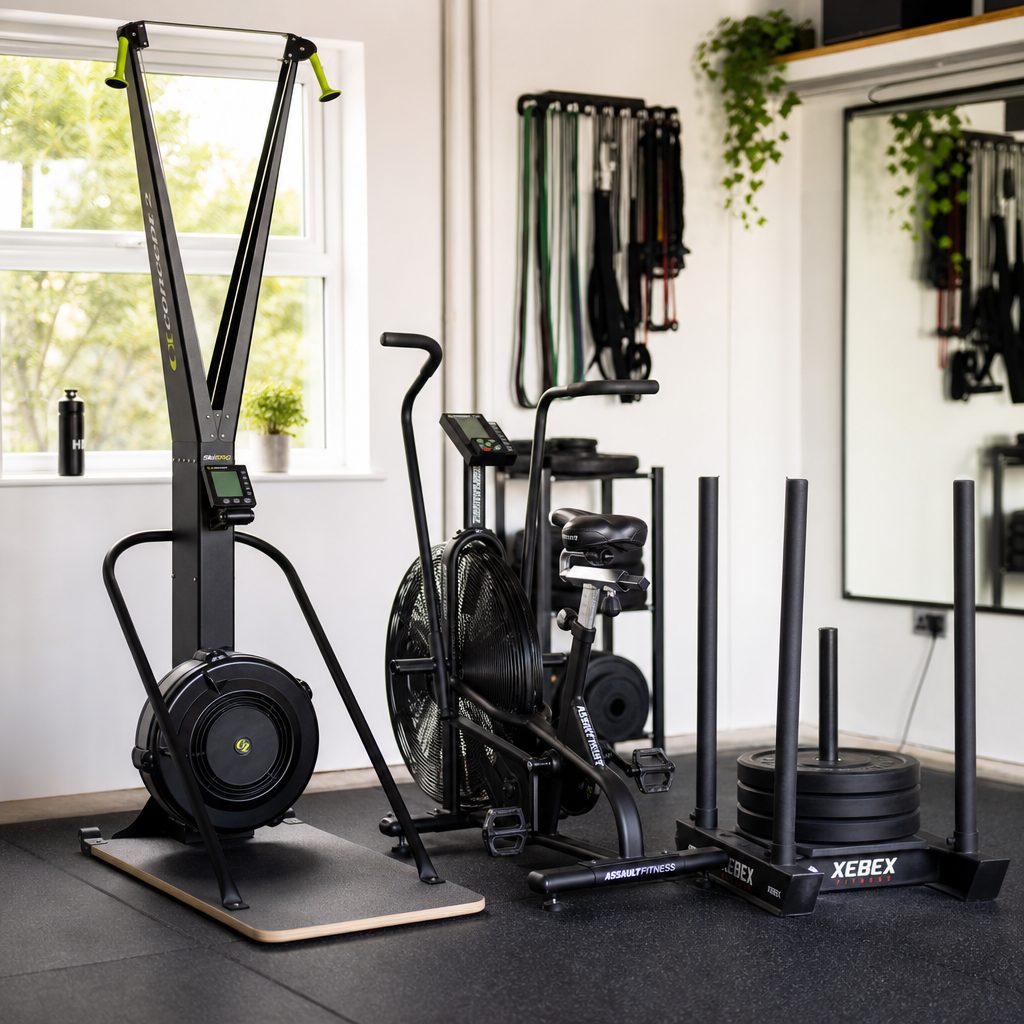
The right "best for" choice depends on what your home setup cannot currently do: direct SkiErg practice, hard fan-bike conditioning, or resisted pushing without a turf lane.
Common buying mistakes to avoid
The first mistake is buying an air bike when what you really wanted was a SkiErg. An air bike is excellent, but it cannot provide the same skiing movement. If direct race-specific practice is your main reason for spending, do not let a lower price or a familiar shape distract you from the actual need. Buy the category that solves the problem.
The second is treating a conventional friction sled as automatically compact because its frame is small. A Rogue Dog Sled 1.2 may have a compact frame and excellent versatility for pushes, pulls and drags, but its usable setup includes the plates, the surface and the room needed to move it. The object itself is only part of the footprint. This is exactly why magnetic sleds are so compelling for flats: they are not magic, but they remove several practical dependencies.
The third mistake is underestimating ceiling height. The wall-mounted Concept2 SkiErg is wonderfully narrow and shallow, but it is 83 inches tall. If you have a low ceiling, exposed beams, a sloped roof or a light fitting exactly where optimism says it will not be, measure. Then measure again. The optional floor stand adds depth too, so do not assume it is a simple fallback.
The fourth is buying based on maximum suffering rather than maximum repeatability. Every machine in this guide can make a workout extremely hard. The better question is whether you can use it three times a week, record your work and improve. A modestly priced AD2 used consistently will do more for your conditioning than a premium bike used once because it has become an intimidating monument to January motivation.
Finally, do not overlook how the machine will coexist with ordinary life. Flats need to remain flats. You may need the room for a desk, visitors, a drying rack or the radical luxury of sitting down. Folding storage, a wall-mounted format and compact track-based resistance are not lesser compromises; they are often what makes a serious training habit possible.
Frequently asked questions
If you want the most direct way to practise the skiing movement at home, a SkiErg is the most relevant machine in this roundup. You can still build strong conditioning with an air bike, running and strength work, but the SkiErg fills the specific movement gap. The Concept2 SkiErg with PM5 is the strongest all-round choice because of its compact wall-mounted dimensions and detailed performance tracking.
It can fit very well in the right flat. Wall-mounted, the SkiErg is 20 inches wide, 16 inches deep and 83 inches high. The width and depth are excellent for a small room, but the height is non-negotiable, so check ceiling clearance carefully. With the optional floor stand, the machine depth increases to 52 inches.
Yes. An air bike is valuable for full-body conditioning and for practising hard effort when you are already fatigued. It does not replace SkiErg practice, but it complements it very well. The Rogue Echo Bike V3.0 is the premium pick, while the Schwinn AD2 is the compact budget option with a stated 24 × 46-inch footprint.
The Torque TANK M1 is the clearest answer for many homes because its Mag-Force Resistance Technology provides progressive resistance on any surface. The SledMill is also compelling where you want a compact track-based format with push, pull and lateral work. Both avoid the central issue with conventional sleds: needing turf, plates and a suitable long lane.
Choose the Assault Fitness Assault Bike Classic if its $699 price, seven preset workouts and seat and ride-height adjustability match what you need. Choose the $895 Rogue Echo Bike V3.0 if you value its maintenance-free belt drive, 330lb weight capacity and Garmin ANT+ connectivity. Both are serious fan-bike choices; the better one is the one whose features you will actually use.
Yes. The Sunny Health & Fitness SF-E3919 is aimed at beginners and budget-conscious users, using air resistance and a monitor for time, distance and calories. Its folding frame is particularly useful where storage is important. The trade-off against the Concept2 is the depth of performance feedback: the PM5 offers substantially more data and workout functionality for structured progression.
It can be, especially if you have a suitable surface and enough room. The Rogue Dog Sled 1.2 is popular because it can be pushed, pulled and dragged, while the Rogue Slice Sled is compact and supports push/pull speed work with a 300lb capacity. For most flats, however, magnetic resistance is simply easier to live with because it reduces the dependence on plates, turf and friction-friendly flooring.
The GYMAX Fan Bike had one of the smallest stated footprints in this group at 41 inches deep and 23 inches wide. It also used an eight-blade performance fan, compared with six-blade designs on some competitors. The Schwinn AD2 was also compact at 24 × 46 inches, so the better choice depends on which dimension is more difficult in your room.
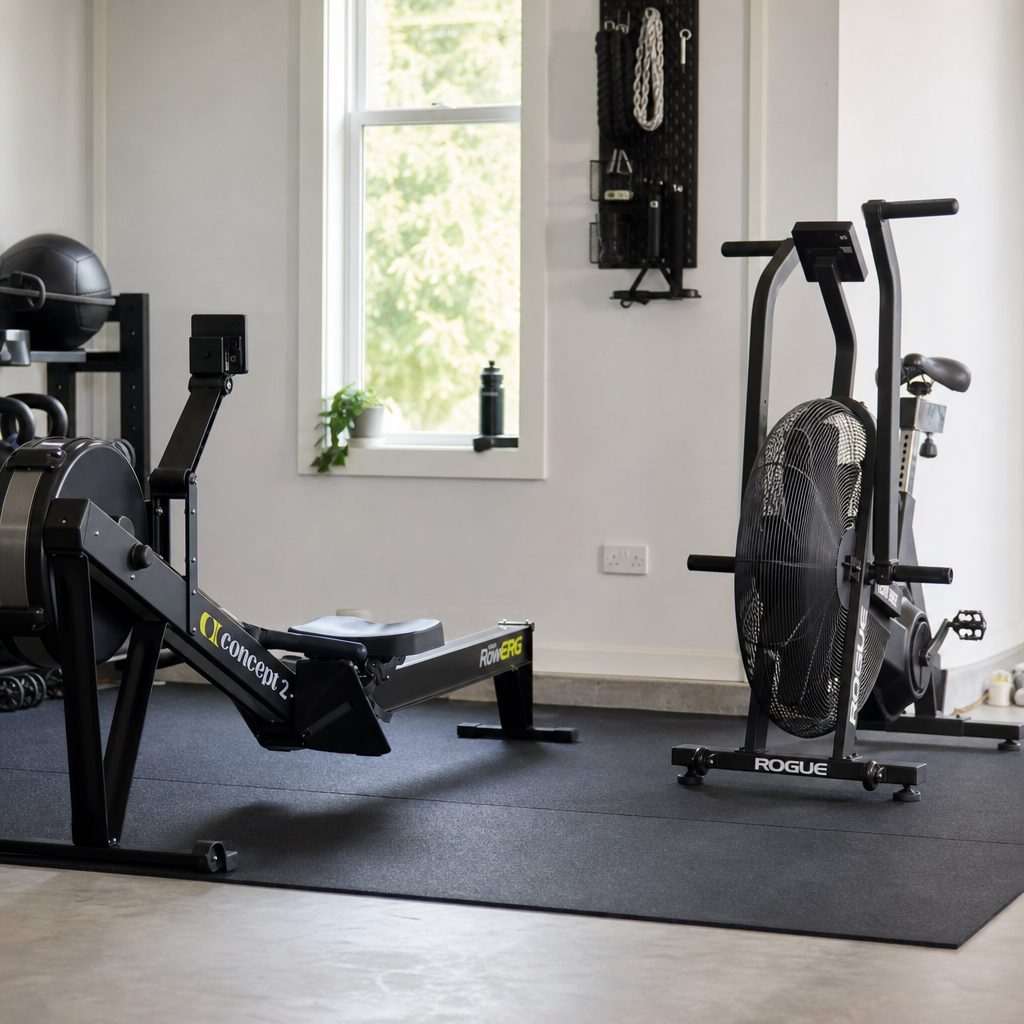
The goal is not to recreate a commercial training facility at home; it is to create a reliable setup that makes specific, measurable hard work easy to return to week after week.
The bottom line
The Concept2 SkiErg with PM5 is the best compact cardio machine for serious HYROX training at home. Its wall-mounted 20 × 16-inch footprint, 83-inch height, direct ski-pattern training and class-leading PM5 feedback make it the most convincing one-machine answer for an athlete who wants meaningful race-specific work in a flat.
Add the Rogue Echo Bike V3.0 if you want a premium conditioning companion, or choose the Schwinn AD2 Air Bike if budget and floor area are tighter. For sled work, avoid pretending a conventional plate sled will be painless in a small indoor room: the Torque TANK M1 is the more practical push-focused choice, while the SledMill is the standout when push, pull and lateral variety matter most.
Measure the room, choose the category that fixes your largest training gap, and buy the machine you will use when motivation is merely adequate rather than cinematic. That is how a compact home setup becomes serious training gear rather than very expensive furniture.