
How to Build a Compact HYROX Station in a One-Car Garage
You do not need a commercial functional-fitness warehouse to train intelligently for HYROX. You do need a clear plan, a short but useful turf lane, equipment that can move when the car needs its house back, and the discipline not to turn every spare wall into a shrine to gym clutter.
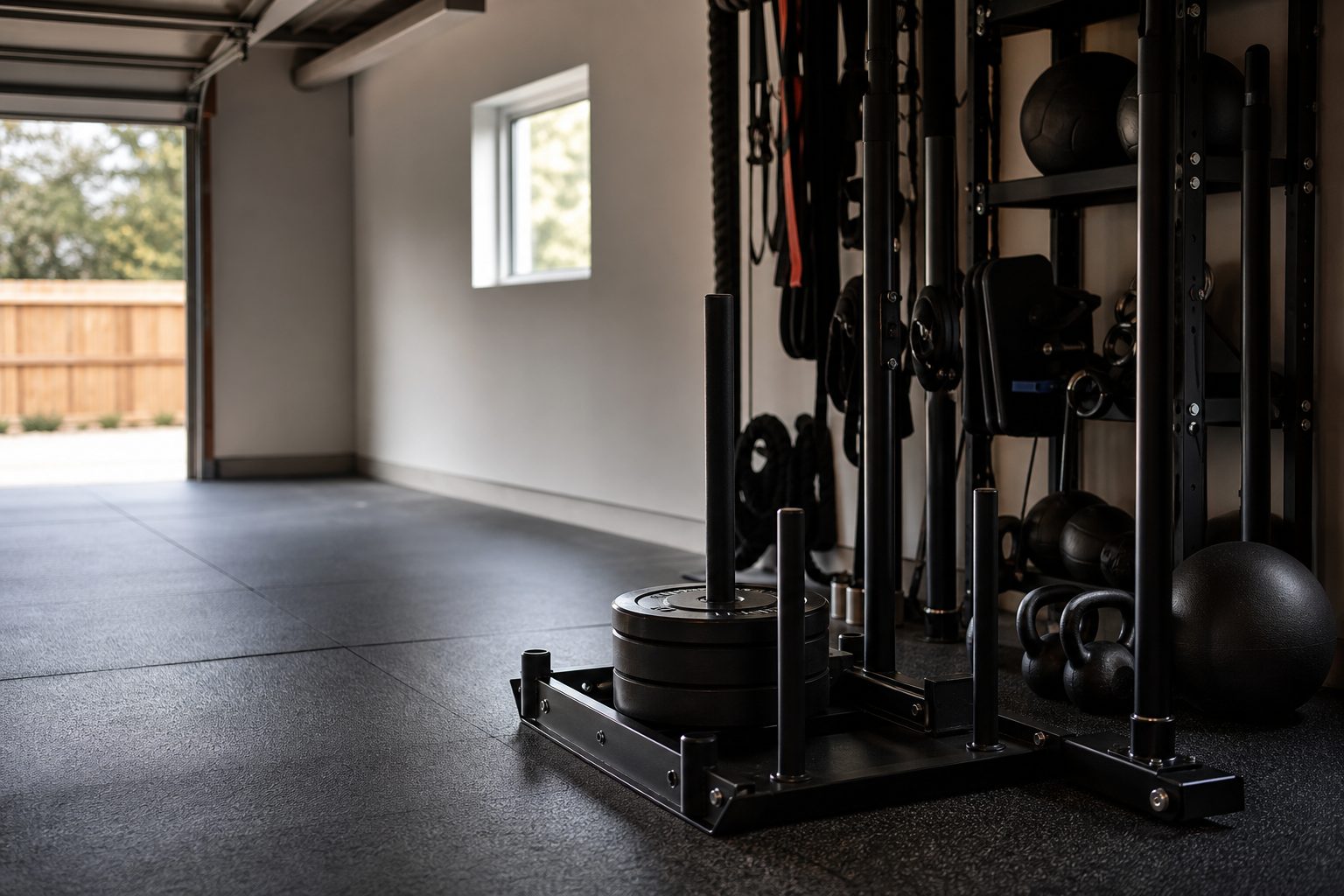
A compact garage HYROX training zone works best when the open lane stays clear and every bulky item has a deliberate parking place.
 By James Oduya · Staff Writer & Home Gym Columnist · Updated August 03, 2026
1. Start with the reality of HYROX, not a fantasy garage gym
HYROX is a race format and community, rather than a neat little product family you can buy in one enormous box. The format combined repeated 1km runs with eight functional stations: SkiErg, sled push, sled pull, burpee broad jumps, rowing, farmers carry, sandbag lunges and wall balls. It was deliberately simple on paper. In practice, it asked you to be comfortable moving when your lungs had started writing strongly worded complaints.
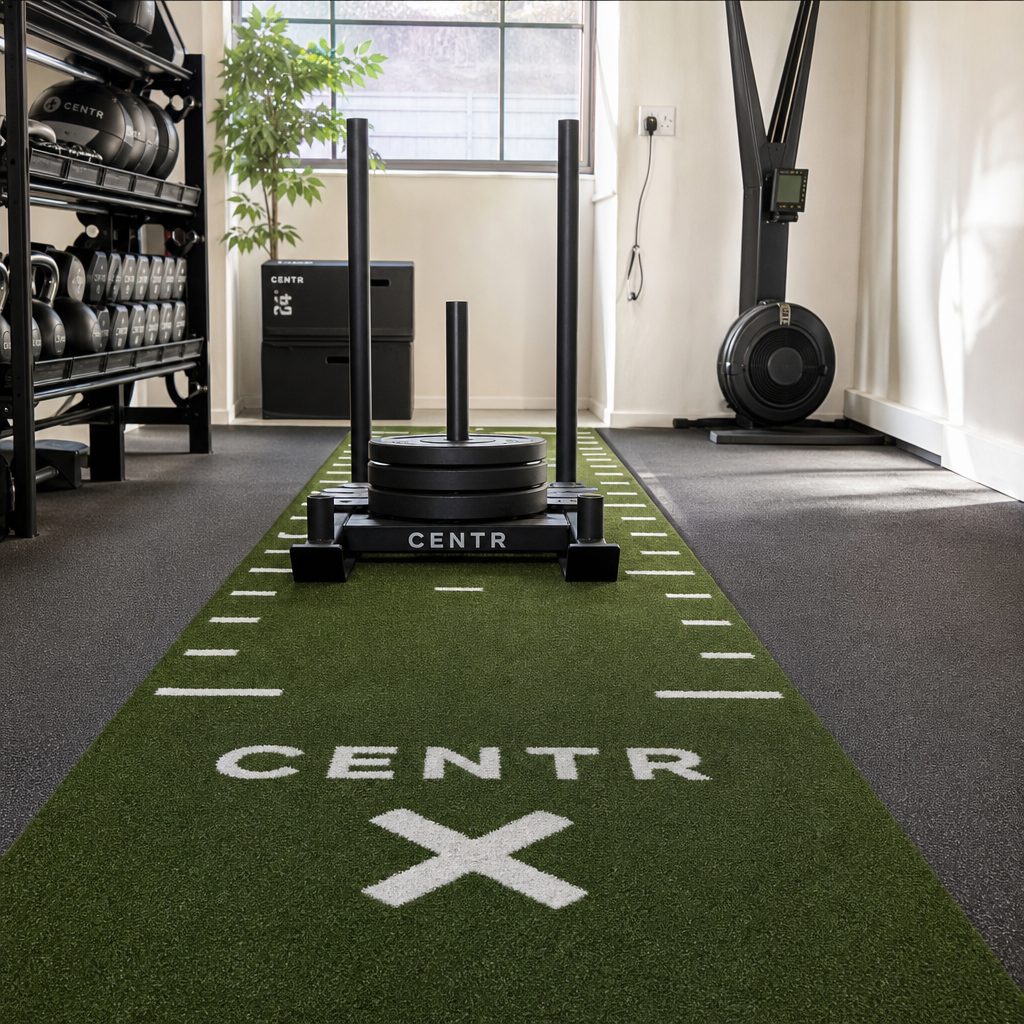
Dense turf with reinforced backing gives a short sled lane a far more consistent feel than an improvised patchwork of loose mats.
A full commercial HYROX training zone could be very large. A comfortable dedicated area was often quoted at 200–250m², which is not remotely what most of us had behind an up-and-over garage door, beside a stack of recycling and a bicycle with one mysteriously flat tyre. The good news is that race preparation and race replication are different things. You cannot reproduce repeated 1km running loops inside a one-car garage, but you can build an exceptionally useful station-practice space.
The sensible objective is to train the movement patterns, transitions, pacing and fatigue management of the functional stations. Your outdoor running route, treadmill access or local track handles the running volume. Your garage handles the things that are awkward, noisy, space-hungry or simply unpleasant to set up in a normal living room. That division of labour makes a great deal of sense.
In smaller gyms under 60m², a 6m turf lane could do triple duty as a sled track, short sprint zone and warm-up strip. In a one-car garage, that same principle is your best friend. The lane is the centrepiece. Everything else is there to support it, fold away from it or roll out of it. If you begin by buying machines and then hunt for places to squeeze them, you will create a very expensive obstacle course. Begin with flow instead.
Think "HYROX-capable garage" rather than "mini race venue". A well-organised lane, a sled, portable conditioning machines and the correct carry, lunge and wall-ball tools let you practise the parts that matter without permanently surrendering your garage to training.
That distinction also protects your budget. A class-ready commercial equipment package for 12 to 16 athletes could land between $25,000 and $60,000 depending on the brand and treadmill specification. One person in a garage did not need that. You needed enough equipment to train well, safely and consistently. It is a smaller target, thankfully.
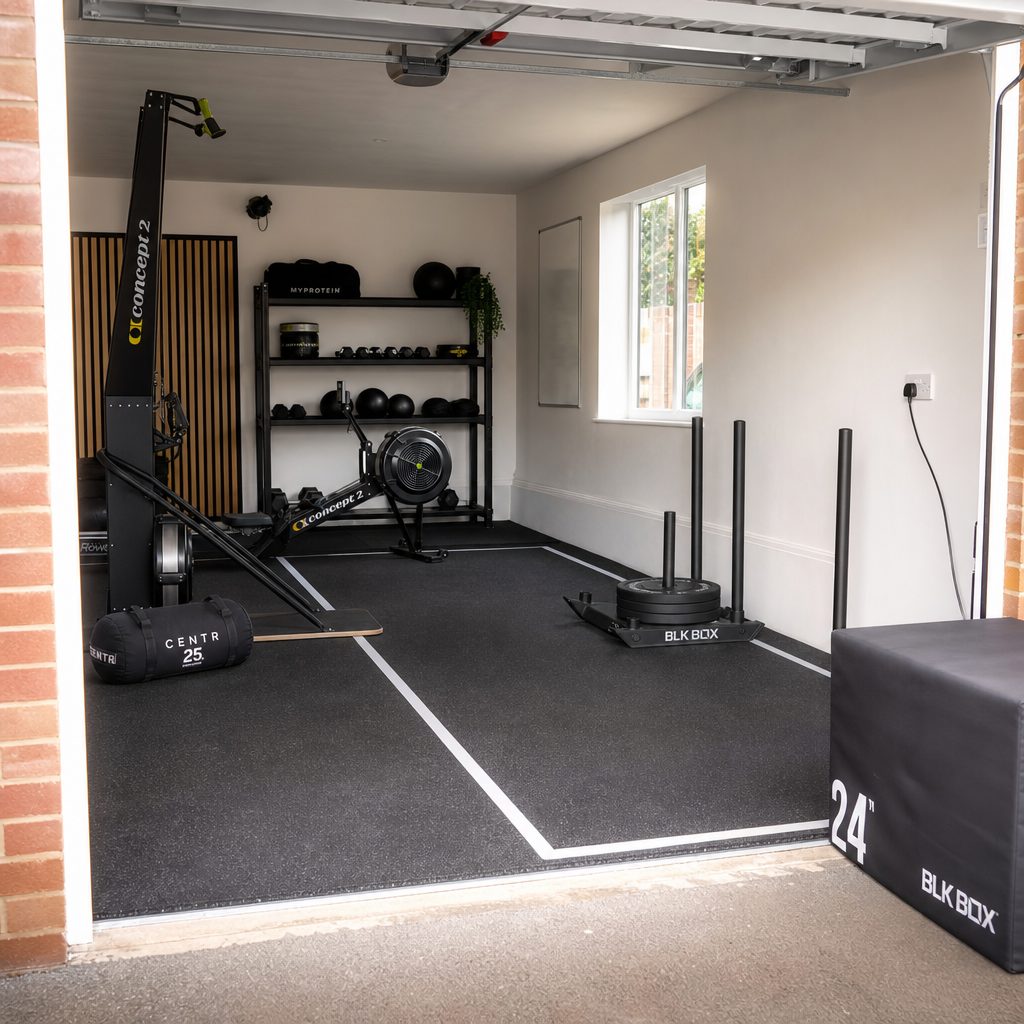
Before buying equipment, mark out the clear training lane with tape so you can see exactly what the garage will comfortably support.
2. Measure the garage and draw a proper floor plan
Take a tape measure to the space before you take a browser tab to any retailer. Measure the internal width, depth and ceiling height with the garage door closed. Then measure it again after accounting for the things that actually live there: boiler cupboards, wheelie-bin routes, door tracks, fuse boxes, shelving, side doors and that bit of wall where the damp always made an appearance in February.
Do not measure from bare wall to bare wall and assume it is all usable. A compact station was about movement corridors. You need to be able to walk around a loaded sled, get onto a rower without scraping your knuckles, step backwards from a wall-ball target and turn safely during carries. The clear route matters more than the theoretical square metre figure.
My preferred paper plan is very low-tech. Mark the garage footprint on graph paper, using one square for a sensible real-world increment. Cut paper rectangles for the sled, rower, SkiErg floor stand if you choose one, and a storage footprint for wall balls, kettlebells and sandbags. Then move them around. It feels faintly like primary-school arts and crafts, but it exposes bad layouts before you have spent a penny.
Build around a central or side-set linear lane. A circular arrangement could work too, especially if you are happy to shuttle from one end of the garage to the other, but the linear approach usually wastes less space in a narrow bay. Keep the sled lane uninterrupted. Place the rower along one wall only when it is in use, then separate it for storage afterwards. Keep smaller tools in a shallow vertical zone, not strewn along the floor as though they are auditioning for a safety video.
Measure usable space, not wishful space
Account for garage-door hardware, storage doors, electrical points and the room needed to turn with a loaded carry. Those details decide whether the space feels practical or constantly irritating.
Protect one uninterrupted lane
Your turf strip should be the part of the room you refuse to compromise. It is your sled track, warm-up area, shuttle space and burpee broad-jump practice route.
Plan for setup and pack-down
A garage station only remains compact if each item has somewhere to go after training. Include parked positions in the plan, rather than treating storage as tomorrow's problem.
It is also worth deciding whether the garage remains a garage. If the car must occasionally come back in, make a marked "reset line" at the far end of the turf. That tells you where every movable item needs to sit after a session. A clear reset system is not glamorous. Neither is arguing with a partner about why a rower is blocking access to the freezer. One of these things is easier to solve.
3. Build the floor first: turf where it works, protection where it does not
The floor determines whether the rest of the station feels solid or slightly bodged. Sled work especially is unforgiving of vague flooring choices. A useful compact solution is a turf lane with a 13–15mm pile height, dense stitch rate and reinforced latex backing. That specification was intended to cope with sled-push friction on short lanes, which is exactly the punishment a garage strip receives.
Lay the turf in the direction you intend to push. The key is not only getting six metres of useful length but making the surface predictable from one end to the other. A short lane means more turns, more restarts and more opportunities to lose rhythm. If one end bunches, lifts or catches the sled, the training becomes about managing flooring rather than managing effort. Nobody entered HYROX hoping their decisive weakness would be adhesive failure.
Where the rower, SkiErg or storage lives, use a protective floor treatment appropriate to the existing garage surface. The aim is to keep the machines stable, reduce unnecessary scuffing and make the whole room easier to sweep. Do not turn every inch into a permanently fixed puzzle of flooring layers. The most useful garage layouts retained a degree of flexibility, particularly near the entrance and around storage walls.
If your sled is going to travel over the turf repeatedly, test it unladen first. Push it from both directions. Check whether its feet move evenly and whether the turf stays flat at the stopping points. Then add load gradually. A lane that feels smooth with an empty sled can behave quite differently once you begin working towards the 152kg/102kg sled push and pull demands associated with HYROX preparation.
Pro tip: make the lane do three jobs
A six-metre turf strip earned its place when it handled sled work, warm-ups and movement drills. Keep it empty enough for shuttles, burpee broad jumps and walking lunges, rather than treating it as a permanent parking bay for a bench or spare plates.
There is a psychological benefit here too. A defined lane makes a small garage feel like a training room rather than a garage that happened to contain fitness equipment. When you step onto it, your session begins. When you roll the sled away and clear it, the garage returns to ordinary life. That boundary matters more than people expect, particularly through a wet British winter when heading to a commercial gym can feel like an administrative task.
4. Choose a mobile sled and learn to use a short lane properly
The sled is the awkward centre of a compact HYROX setup, but it is also the item that earns its space most clearly. The stated sled dimensions of 102cm long by 60cm wide make it compact enough to be realistic in a garage whilst still providing the platform you need for loaded push and pull practice. You do not need to recreate the full race distance in one uninterrupted push. You need repeatable effort, good positions and a sensible way to turn around.
Look for a foldable or otherwise easy-to-store sled where possible. The important feature is not a particular logo. It is the ability to stand it safely or park it against the wall without it colonising the room. If it has removable or folding uprights, make returning it to storage part of your post-session routine. Ten minutes spent wrestling equipment into a corner is a surprisingly effective deterrent to training tomorrow.
For sled pushes, use your lane in lengths. Start the sled at one end, work to the other, stop, turn it safely and return. That is a different experience from a long continuous commercial track, but it can still build the same essential habits: driving through the legs, keeping your torso braced, finding a sustainable torso angle and controlling your breathing when the load begins to feel personal.
For sled pulls, a rope lets you work down the same lane whilst keeping the sled travelling away from you. Reset the rope carefully between efforts. Avoid rushing backwards into a wall, storage rack or open door. A short garage rewarded deliberate setup. Place the rope neatly, make sure nobody will cross behind you, and create a clear finish point before you start hauling. The hard part should be the sled, not the risk assessment.
Why a short sled lane works
- It develops loaded pushing and pulling mechanics in the exact movement family you need.
- Repeated changes of direction make each effort easy to repeat and compare.
- The same strip supports warm-ups, lunges, carries and burpee broad-jump practice.
- A 102cm by 60cm sled can be stored far more easily than a large fixed station.
What it cannot perfectly replicate
- Short lengths involve more turns than a larger facility.
- Surface grip and friction can feel different from an event floor.
- You must spend time resetting the rope and turning the sled safely.
- It does not replace the need to practise running separately.
Do not become obsessed with converting every garage push into a supposed race equivalent. Friction varied between surfaces, and a short lane had more stop-start work by definition. Use the station to get strong, technically tidy and familiar with discomfort. Save the exact performance comparison for consistent sessions in your own environment. Same sled, same lane, same loading method, same shoes. That is useful data.
5. Concept2 SkiErg: the vertical-storage conditioning machine
Shop Concept2 SkiErg on Amazon UK
The Concept2 SkiErg was made for compact spaces almost by accident. Wall-mounted, it measured 19 inches wide at the bottom, 20.5 inches wide at the top, 16 inches deep and 85 inches high. That was a very small floor claim for a machine that allowed you to practise one of HYROX's most demanding stations. If your garage has an appropriate solid wall and the required height, it is arguably the cleanest way to add serious conditioning without losing your lane.
The SkiErg weighed 46lb, or 20.9kg, and used two D-cell batteries. During a workout, its monitor drew power from the spinning flywheel to extend battery life. More importantly for training, it used the same flywheel and Performance Monitor family as the RowErg. That meant you had a robust, familiar style of feedback without mains wiring or a screen that needed its own lifestyle coach.
If wall mounting is not suitable, the standard floor stand made the SkiErg 23.5 inches wide, 50 inches long and 85 inches high. The floor stand included caster wheels for mobility. It consumed more floor space, obviously, but it also preserved the no-permanent-fixtures approach. For renters, people with uncertain wall construction or anyone who needs to change the garage layout regularly, that flexibility could be worth the trade-off.
Place a wall-mounted SkiErg at the end of the garage or in a corner beyond the turf lane, where the pulling action does not interfere with other equipment. With the floor stand, park it facing the wall after use and roll it out only when needed. You want enough clear space to work the handles without clipping shelves, light fittings or an unsuspecting set of garden tools. Ski technique got messy enough under fatigue; there was no need to add a rake to the equation.
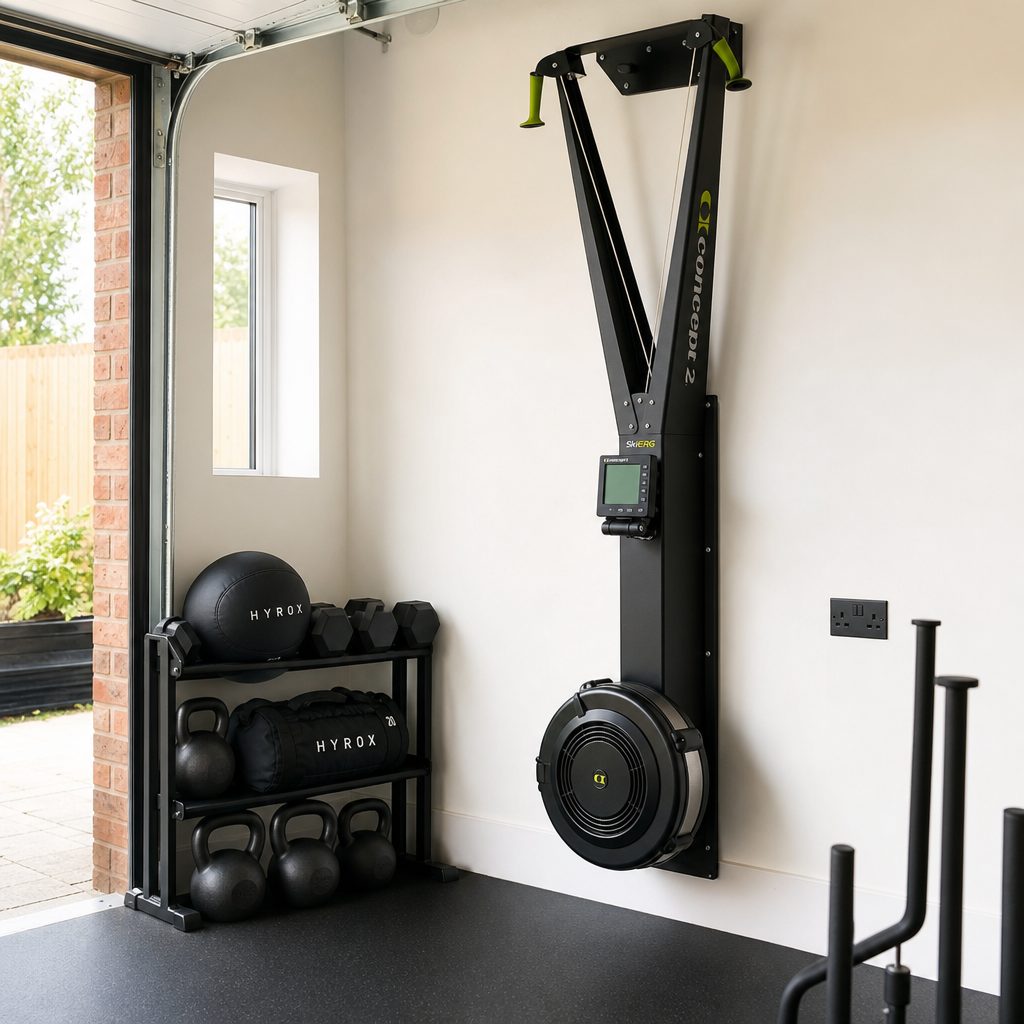
A wall-mounted Concept2 SkiErg uses height rather than precious floor area, making it especially attractive for a garage lane layout.
| Feature | Concept2 SkiErg wall mounted | Concept2 SkiErg with floor stand | Concept2 RowErg standard legs |
|---|---|---|---|
| Primary HYROX practice | SkiErg station | SkiErg station | Rowing station |
| Footprint or overall size | 19in bottom width, 20.5in top width, 16in depth, 85in height | 23.5in wide, 50in long, 85in high | 96in long, 24in wide |
| Mobility approach | Uses a wall rather than floor space | Caster wheels on the floor stand | Caster wheels and separates into two pieces |
| Machine weight | 46lb / 20.9kg | 46lb / 20.9kg | Not stated here |
| Power | Two D-cell batteries; flywheel extends battery life during exercise | Two D-cell batteries; flywheel extends battery life during exercise | Two D-cell batteries; flywheel extends battery life during exercise |
| UK listed price | £815 | Floor stand sold separately | £990 |
Technique is worth learning early. Drive the handles down using a strong trunk and hip hinge rather than making every stroke a frantic arm pull. Maintain a rhythm you can hold when fatigued. Short intervals are ideal initially: enough to find a sustainable cadence and enough rest to preserve quality. Later, pair the SkiErg with sled work or carries so you learn how it feels when the hands, shoulders and breathing have already had a difficult day.
6. Concept2 RowErg: big when working, sensible when stored
Shop Concept2 RowErg Indoor Rowing Machine on Amazon UK
The Concept2 RowErg required more respect in a one-car garage because its overall length was 96 inches, or 244cm. It was 24 inches, or 61cm, wide, with a 54-inch, 137cm monorail. That sounds like a lot when written down because it was a lot. Yet it remained one of the more garage-friendly rowing machines because it separated quickly into two pieces without tools and had caster wheels for moving it around.
That separation feature changes the planning conversation. You do not have to keep a 244cm machine permanently laid out. You can row with it parallel to your lane, or diagonally if that best suits the space, then break it down after training and store the two sections vertically or along a wall. Make the storage move easy enough that you will genuinely do it. If it requires emptying three shelves and moving a lawn mower, you will leave it out. Then it will become a laundry rack. They all do eventually if you let them.
The standard-leg RowErg had a 14-inch, 36cm seat height. The tall-leg version raised the seat to 20 inches, or 51cm. Both used two D-cell batteries, with the monitor drawing from the spinning flywheel during workouts to extend battery life. The standard-leg model had a listed UK price of £990, whilst the tall-leg version was listed at £1,150.
For a garage HYROX station, choose the leg height according to your own comfort and storage needs rather than assuming taller automatically means better. The short version kept things straightforward, and both versions retained the important capability: real rowing practice, repeatable monitor feedback, quick separation and wheels. What mattered was that you could set it up fast enough to use it several times per week.
RowErg placement rule
Do not plan the garage around the RowErg's full working length. Plan around its stored state and its setup route. If it can roll out, click together and sit beside the lane without blocking the sled, it belongs. If it becomes a permanent barrier, rethink the arrangement.
Rowing was one of the stations where a little technical work went a long way. Drive through the legs first, then swing through the hips and finish with the arms; recover in the reverse order. It is not glamorous advice, but it keeps the stroke connected. For HYROX-style training, avoid treating every row as a maximal sprint. Practise finding a pace that lets you get off the machine and move purposefully into the next task. The race did not hand out medals for winning your own garage row and then staring at the floor for two minutes.
7. Add the portable stations: wall balls, carries and sandbag lunges
The non-machine stations are where a compact setup becomes properly versatile. Wall balls, kettlebells and sandbags stored vertically or in a neat corner added very little visual chaos if you bought only what you could use. They also made it possible to practise some of the more race-specific work without permanent fixtures.
A wall-ball target can be useful, but in a garage the target choice needs thought. You need safe ceiling clearance, a wall that can tolerate missed catches and enough room to step back without colliding with the rower or shelves. If you do use a portable or wall-based target, position it at one end of the lane rather than mid-room. Keep the landing space clear. A dropped wall ball was not dramatic until it met a kettlebell, bounced sideways and went exploring under a car.
For farmers carries, the stated race-weight kettlebells were two 24kg bells for men and two 16kg bells for women. Those are useful reference points when choosing your eventual progression. In a compact garage, carries can run down the turf lane, turn carefully and return. Because the lane is short, treat the turn as a skill: slow the bells, set your feet, change direction without twisting through the lower back, and build again. There is nothing weak about a controlled turn. It is simply less entertaining for your neighbours than dropping heavy kettlebells onto concrete.
Sandbag lunges work beautifully in a narrow lane. Store the bag off the floor when possible, carry it to the start point and move in controlled steps along the turf. You can practise posture, trunk tension and rhythm without requiring an enormous area. The most useful bag is the one that comes out regularly; a huge collection of different loads looks impressive for roughly three minutes before it becomes a storage problem.
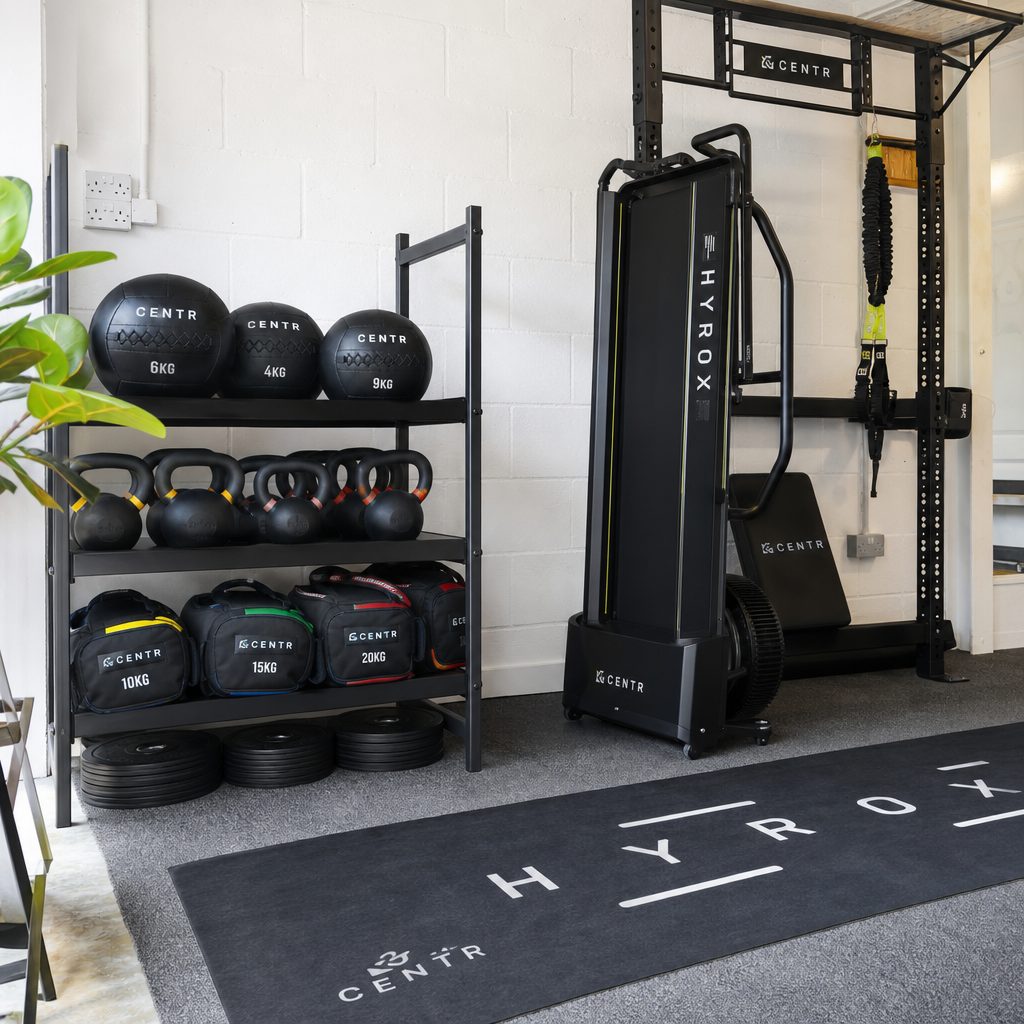
Wall balls, kettlebells and sandbags occupy little space when they are assigned a dedicated storage zone beside, rather than on, the training lane.
Wall balls: keep the landing area empty
Place the throwing station at the end of the garage and keep its rebound zone free of equipment. In a small room, a missed catch needs somewhere harmless to go.
Farmers carries: use the lane and practise turns
The short route is still useful if you focus on grip, posture, steady foot placement and controlled direction changes with the kettlebells.
Sandbag lunges: a compact station by nature
Walking lunges need a clear strip, not a huge room. The same turf that handles the sled gives you a logical, forgiving route for lunge practice.
Burpee broad jumps require even less gear and more discipline than people think. Use the lane but set a sensible turnaround point. Do not chase huge leaps in a cramped space. Train repeatable, tidy movement: down, chest to floor, get up with control, jump forward, reset. The point is to build a rhythm you can own when tired. A heroic first jump followed by a wobbly collision with a wall is not a useful session.
8. Design garage workouts around transitions, not just individual stations
Once the room is built, the temptation is to use each bit separately: row on Monday, sled on Wednesday, kettlebells on Saturday. That is fine for general fitness, but HYROX preparation becomes much more useful when you also practise transitions. The race demanded that you settle your breathing, change movement pattern and keep making decisions whilst fatigued. Your garage layout can teach that brilliantly.
Start with simple two-station pairings. For example, a short SkiErg effort followed by a controlled sled push and pull sequence. Or a RowErg interval followed by farmers carries down the lane. The machine work raises your heart rate; the lane work asks your legs, grip and posture to behave anyway. Keep the first few sessions conservative. Learn what a manageable effort feels like before making a complicated circuit that leaves you unable to judge technique.
Then add a short run outside or on your preferred running setup between garage stations. You do not need every session to mimic the full race structure. One useful arrangement is to run, enter the garage for one functional block, leave to run again, then return for a different block. It feels slightly eccentric the first time, particularly if your neighbours catch you jogging past your own driveway repeatedly. It is also remarkably specific.
A six-metre lane makes repetition your tool. Rather than trying to hide its limitations, use them. Count lengths. Keep the same turnaround rule. Record the load and the number of lengths. Notice whether your posture changes after the third, sixth or tenth push. That is better training information than vague memories of "the sled felt horrible", although the sled will continue to feel horrible. It is very committed to its brand.
For garage sessions, consistency beats theatre. Use the same lane, the same equipment positions and the same turning points often enough that you can identify genuine improvement in pacing, transitions and movement quality.
Keep a simple whiteboard or notebook near the door. Record the session structure, sled loading, machine work and how it felt. There is no need to create a doctoral thesis from each workout. A few honest notes are enough: "row pace settled after first minute", "sled turns tidy", "grip faded on final carry", "wall balls became scrappy". Over a training block, these notes reveal what needs attention far more reliably than the post-workout feeling of having been thoroughly humbled.
9. Compare the sensible equipment routes before committing
There were several ways to build a hybrid-race training setup. You could assemble each piece yourself, choosing a Concept2 SkiErg, RowErg, sled, rope, wall-ball arrangement, sandbag and kettlebells to suit the room. Or you could look at third-party packages such as the BullRock Hybrid Race Performance Pack or the BullRock Hybrid Race Pro Zone Pack.
The BullRock Hybrid Race Performance Pack included an Air Ski Vayu10, Air Rower Vayu8, MaxLoad Power Sled 200, sled pull rope, wall-ball target, wall balls, sandbags, competition kettlebells and bumper plates. The Hybrid Race Pro Zone Pack included the Air Ski Vayu14 Pro, Air Rower Vayu11 Pro, MaxLoad Power Sled 200, wall-ball station, sandbag range, kettlebell progression range, sled rope and bumper plates. Those packages made sense where somebody wanted a coordinated multi-station setup without selecting every piece individually.
For a one-car garage, though, individual selection often offered a better fit. You may have room for a wall-mounted SkiErg but not a floor-standing ski machine. You may value a RowErg that comes apart rapidly. You may already own kettlebells. You may need the garage to return to domestic duties every evening. A package was convenient, but convenience is only useful when its contents match the room.
| Setup route | What it includes | Best fit | Space-management consideration |
|---|---|---|---|
| Build your own with Concept2 machines | SkiErg and/or RowErg alongside a separate sled, rope, wall balls, kettlebells and sandbag | One-car garages with unusual dimensions or a need for phased buying | Wall-mounted SkiErg and separable RowErg make it easier to prioritise storage flexibility |
| BullRock Hybrid Race Performance Pack | Air Ski Vayu10, Air Rower Vayu8, MaxLoad Power Sled 200, rope, wall-ball target, wall balls, sandbags, competition kettlebells and bumper plates | Someone who wants a coordinated multi-station package | Check every included item against your lane and storage plan before committing |
| BullRock Hybrid Race Pro Zone Pack | Air Ski Vayu14 Pro, Air Rower Vayu11 Pro, MaxLoad Power Sled 200, wall-ball station, sandbag range, kettlebell progression range, rope and bumper plates | A more complete hybrid-race training environment | The broader equipment range needs a genuinely robust storage strategy in a compact bay |
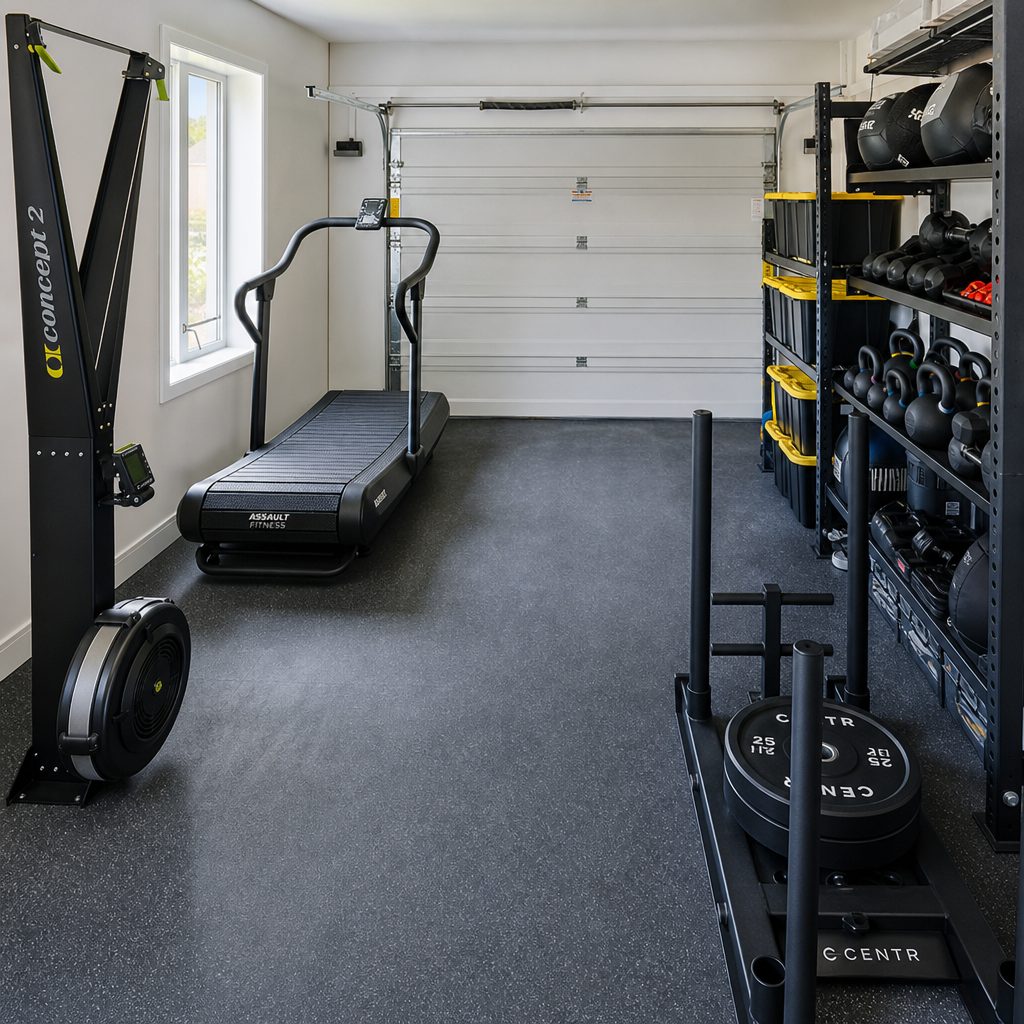
The best compact setup is not necessarily the biggest package; it is the one whose machines, sled and storage plan still leave a usable central lane.
Concept2 SkiErg with PM5 Console
A compact conditioning option that can be wall-mounted or used with the separately sold floor stand.
Concept2 RowErg standard legs
14-inch seat height, caster wheels and quick separation into two pieces for storage.
Concept2 RowErg tall legs
20-inch seat height with the same movable, separable approach to garage storage.
My practical order of purchase would be boringly sensible. Build the lane first. Add the sled and smaller portable tools. Then choose the machine that best fills your greatest training gap: SkiErg if vertical space is your advantage; RowErg if you can set up and store its length without making the garage unusable. Add the second machine later if the routine sticks. This avoids a very common home-gym experience: buying everything at once, discovering the layout is poor, then spending months moving expensive equipment around instead of training.
10. Best compact HYROX garage setup for different buyers
There was no single perfect equipment list because garages, budgets and training histories were not identical. A person who already rows well but had never pushed a heavy sled had a different priority from someone who owned kettlebells but lacked conditioning equipment. The good route was the one that solved your biggest limitation whilst preserving enough room to train.
Best on a tighter budget
Start with turf, a compact sled, rope, wall balls, a sandbag and the kettlebells you need. This creates a useful station-practice lane before you commit to a conditioning machine.
Best all-rounder for a narrow garage
Concept2 SkiErg wall mounted. Its small 16-inch depth and 85-inch height make excellent use of vertical space, leaving the floor clear for the sled lane.
Best for rowing priority
Concept2 RowErg standard legs. It took up 244cm when working, but its quick no-tool separation and caster wheels made it unusually manageable after the session.
Best for an all-in package
BullRock Hybrid Race Performance Pack. It brought together ski, row, sled, rope, wall-ball, sandbag, kettlebell and plate equipment for a coordinated hybrid-race setup.
Best premium route
BullRock Hybrid Race Pro Zone Pack. The broader machine and progression range suited someone creating a more complete dedicated hybrid training environment.
For most people, I would favour the all-rounder garage build: short turf lane, mobile sled, portable carry and lunge kit, then a wall-mounted SkiErg if the wall allowed it. It made the room feel less crowded, and it left enough open floor to do the work that could not be done while sitting or standing in one fixed spot.
The RowErg remained an outstanding addition if rowing was a weak station or a favourite conditioning tool. Just do not underestimate the difference between "it technically fits" and "I can quickly set it up at 6am without shifting half the garage". The former is a measurement. The latter is a training habit.
11. Storage, safety and the small habits that keep the station usable
Vertical storage could free up 15–20% more floor space, which was enormous in a one-car garage. The principle was simple: use walls for objects that did not need to be on the floor today. Wall balls, ropes, resistance accessories and smaller items should have an assigned home. Kettlebells and sandbags should sit in one predictable zone, ideally off the active lane. The sled should stand or fold away safely when not in use.
Keep heavy objects low. That sounds self-evident, but people often become so enthusiastic about wall storage that they put the heaviest, least pleasant-to-retrieve kit at shoulder height. Store things according to how they are used. Kettlebells and sandbags should be easy to lift from a stable low position. The sled rope can be coiled neatly. Wall balls can be stored where they will not roll underfoot. Your garage should reward training, not require a warm-up just to retrieve the equipment.
Ventilation mattered too. Hard intervals on a SkiErg, RowErg or sled created plenty of heat in a small room. Open the garage door when practical, or otherwise ensure the space is comfortable enough for hard work. Condensation and neglected damp were not ideal companions for gym equipment, especially machines that you expected to last for years. Wipe down handles and monitors after sweaty sessions, sweep turf regularly and clear grit from the sled route.
When training alone, choose sensible loading and make every turnaround predictable. The garage did not offer the forgiving empty floor of a commercial gym. Avoid pulling a sled directly towards fragile doors or stored possessions. Leave adequate room around wall-ball work. Keep electrical cables away from the lane. And if you are introducing heavier sled loading, do it progressively. The goal is repeatable training, not one afternoon of spectacular effort followed by three days of walking downstairs sideways.
The five-minute reset rule
Finish every session by returning the sled, separating or rolling away the rower, coiling the rope and clearing the turf. A station that is ready in five minutes is a station you will use. A station that needs twenty minutes of excavation becomes a very expensive storage display.
Finally, respect the neighbours. Sled work and rowing are generally manageable, but dropped kettlebells, wall balls rebounding against thin walls and late-night garage-door theatrics can quickly turn an excellent routine into a diplomatic incident. Controlled lowering, sensible training times and a tidy layout have a social benefit as well as a practical one.
12. Common compact-garage mistakes to avoid
The biggest mistake was trying to copy a commercial facility item for item. That approach ignored the point of a compact home setup. You were not building a public training venue. You were building the most useful version of a HYROX practice space that could exist in one garage bay. Every purchase should earn its footprint.
Another common error was buying a treadmill first and assuming the rest would work itself out. Running mattered hugely in HYROX, obviously, but a treadmill could consume the same precious central space that made sled work, carries and lunges possible. If you already had reliable outdoor routes, the garage was often better used for functional stations. If running indoors was essential for your circumstances, plan the treadmill first and be realistic about what remains. There is no magical layout trick that makes several large machines and a clear lane occupy the same square metre at the same time.
People also overcomplicated their station selection. You did not need multiple versions of every implement on day one. You needed a way to push and pull a sled, ski, row, carry, lunge and throw safely. Progress could be built through load, work duration, number of lengths, rest reduction and better movement quality. More equipment did not automatically create more training options when the floor had already disappeared.
Lastly, avoid treating the garage as a punishment chamber. The room should feel purposeful, not miserable. Good lighting, a clean lane, a visible session plan and equipment that rolls or stores smoothly make a genuine difference to consistency. HYROX training was hard enough. The setup should remove friction wherever it could.
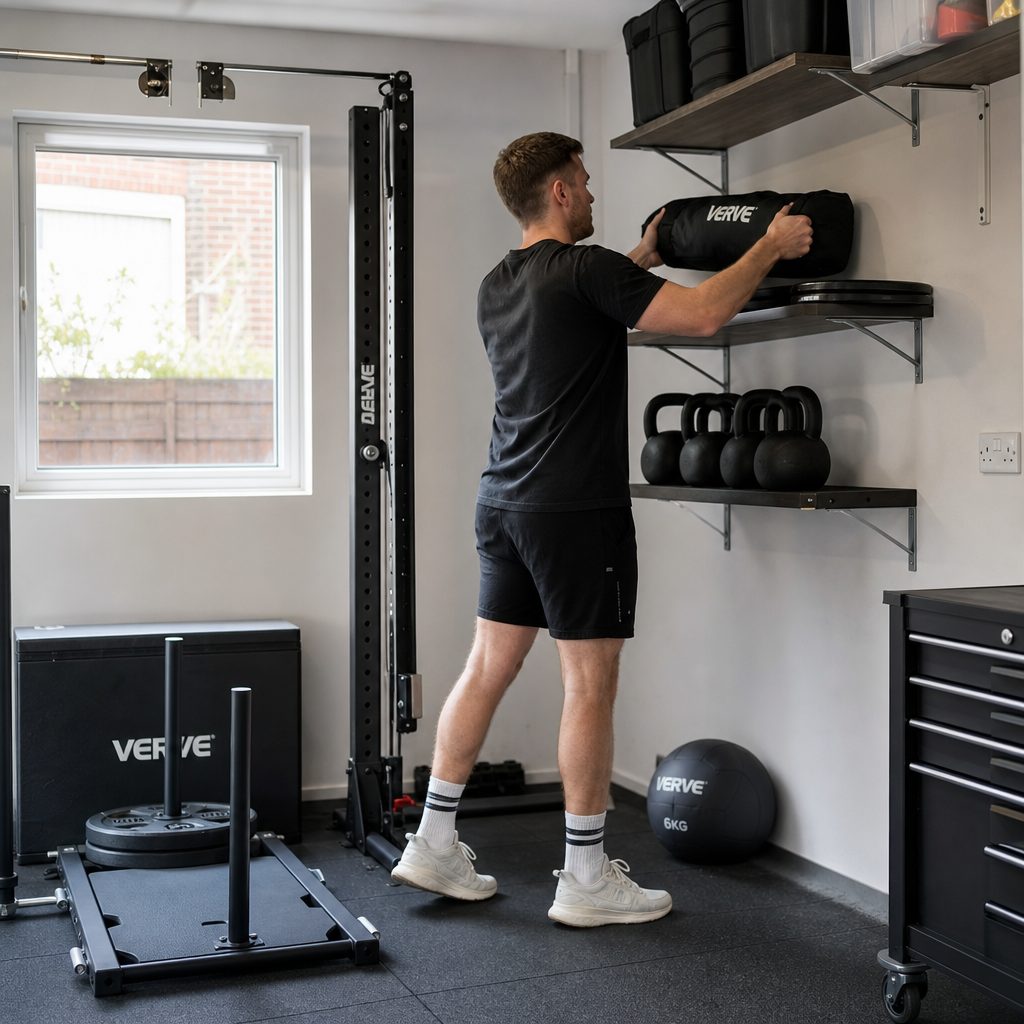
A tidy end-of-session reset keeps the garage functional for everyday life and makes the next HYROX workout far easier to start.
Frequently asked questions and final word
The bottom line
A compact HYROX station in a one-car garage was absolutely achievable, but it worked because of restraint. Build a clear six-metre turf lane first, choose a mobile 102cm by 60cm sled, keep wall balls, kettlebells and sandbags stored out of the way, and use vertical space wherever possible.
For most tight garages, the wall-mounted Concept2 SkiErg was the standout conditioning addition because it left the floor free. The Concept2 RowErg was equally valuable for rowing practice if you could genuinely use its wheels and no-tool separation to store it after each session. Add equipment in stages, keep the room resettable and let outdoor running handle the kilometres. It will not look like a commercial race hall. Frankly, that is rather the point. It will be yours, it will be usable, and it can make you very fit indeed.