
Whoop 5.0 vs Polar vs Garmin: Which Tracker Best Measures Recovery for Longevity Training?
For longevity-minded training, the best tracker is not necessarily the one with the loudest health claims or prettiest display. It is the one that turns sleep, heart rate variability and training load into a decision you can actually live with. Here is how the Whoop 5.0, Polar's recovery-led watches and Garmin's wider training ecosystem stack up.
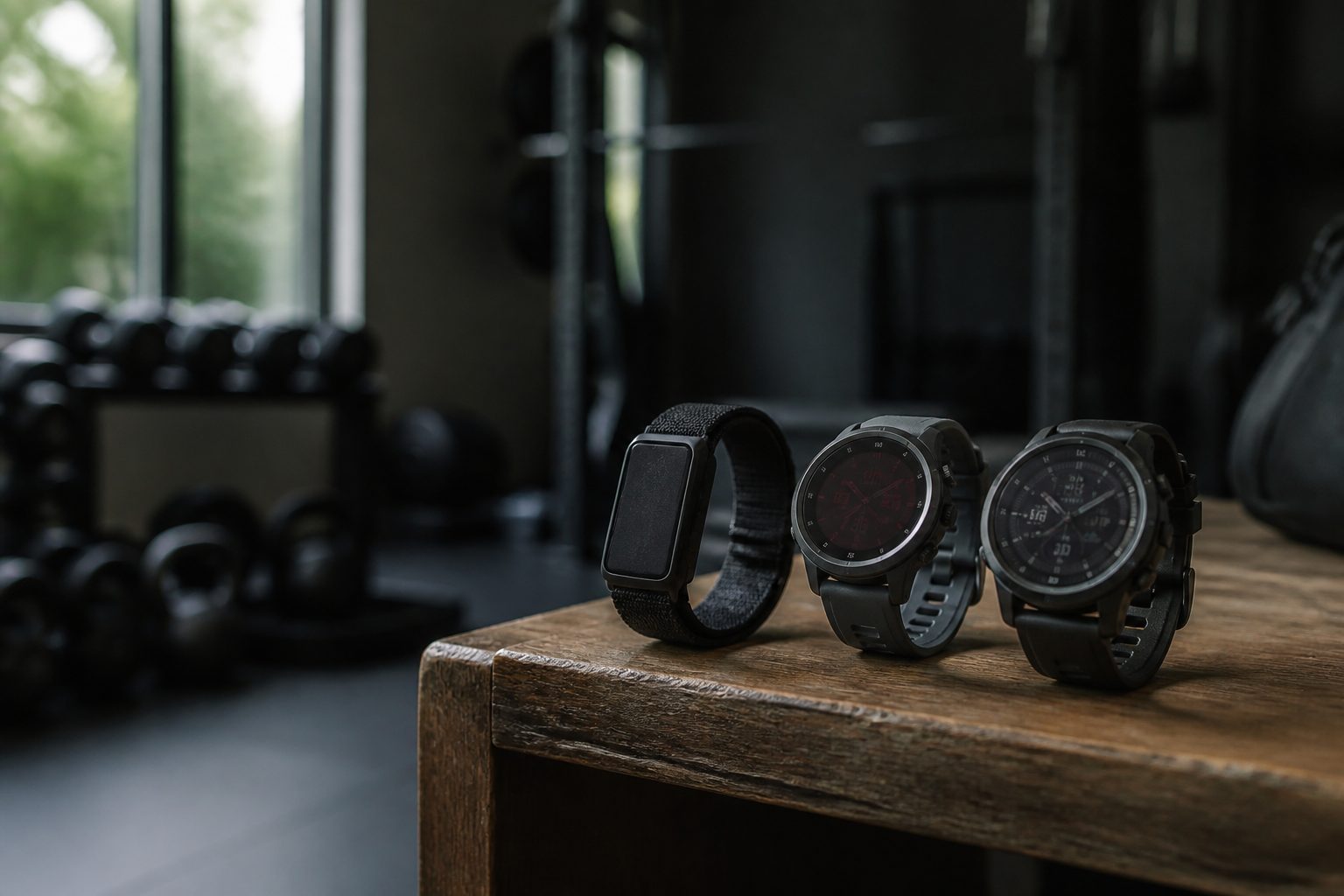
Recovery tracking has become less about a handsome watch face and more about whether the numbers help you train intelligently for the next decade.
 By James Oduya · Staff Writer & Home Gym Columnist · Updated August 17, 2026
The recovery tracker question in 2026
There was a time when choosing a fitness tracker mostly meant choosing how much watch you wanted on your wrist. Big display or little display. Square or round. Black strap, slightly less black strap. Very thrilling stuff.
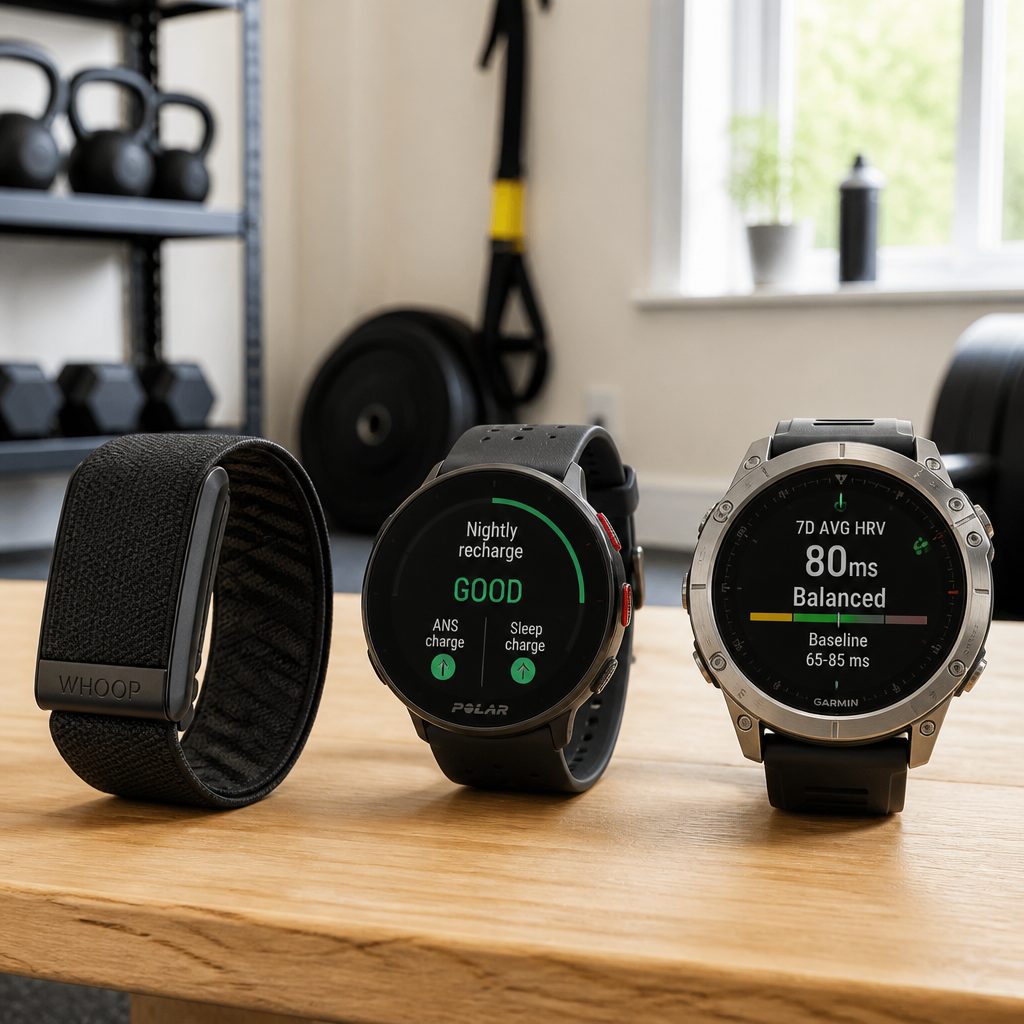
Whoop takes the "wear it and forget it" route, whilst Polar's Vantage V3 gives recovery data a visible home alongside maps and training information.
By August 2026, the more interesting question had become what happens after the workout. Can the wearable spot that your hard interval session, mediocre sleep and stressful workday have all landed on the same Thursday? Can it tell the difference between feeling merely lazy and being genuinely under-recovered? And, crucially for anyone training to stay capable rather than just chase a summer PB, can it encourage a pace that is sustainable?
Whoop, Polar and Garmin each approached that job from a different angle. Whoop 5.0 was a screenless, membership-led system built around daily recovery, strain and behaviour coaching. Polar's Vantage V3 was a premium multisport watch with a proper AMOLED display, dual-frequency GPS and a deep physiological toolkit. Garmin was not one single rival product at all, but a broad training ecosystem spanning traditional watches and screenless tracking.
That matters. This is not a tidy apples-to-apples shoot-out between three identical bands. It is a comparison of philosophies. Whoop wanted to disappear into your daily routine. Polar wanted to unite recovery data with athletic context. Garmin wanted to put a vast range of training and health data into one familiar platform. None is automatically right for every gym regular, runner or person quietly attempting to remain mobile when their knees have seen a few more birthdays.
A sensible longevity reminder: a recovery score is guidance, not permission from a tiny electronic headmaster. Persistent fatigue, unusual breathlessness, chest symptoms or dramatic changes in how you feel deserve real medical advice rather than a determined attempt to out-argue an app.
Whoop 5.0, Polar Vantage V3 and Garmin: the numbers that matter
It helps to start with the hard facts rather than the marketing mist. The table below focuses on confirmed figures that influence day-to-day recovery use. Garmin covered a considerably broader selection of devices than either Whoop or Polar, so its column reflects the ecosystem position rather than pretending every Garmin watch or band shares identical hardware.
| Feature | Whoop 5.0 | Polar Vantage V3 | Garmin ecosystem |
|---|---|---|---|
| Form factor | Screenless band | Display-based multisport watch | Broad range including watches and screenless tracking |
| Display | None | 1.39-inch AMOLED, 454 × 454 | Varied by model |
| Basic battery figure | 14 days | Approximately 8 days in basic watch mode | Varied by model |
| GPS | Phone required | Dual-frequency GPS | Varied by model |
| Water resistance | IP68 / 10m | Not the deciding comparison figure here | Varied by model |
| Body weight | 29g including strap | Not the deciding comparison figure here | Varied by model |
| Activity support | 145+ activities | Multisport focus | Broad sport and training focus |
| Distinctive recovery angle | Recovery percentage, strain target, WHOOP Age and Pace of Aging | Physiological sensing with training and outdoor-watch context | Training and health data within a large connected ecosystem |
Display and wearability: quiet band versus proper sports watch
Whoop 5.0 made the clearest aesthetic statement by declining to have a screen at all. That sounds like an omission until you wear one for a while. There is no wrist buzz pulling you away from dinner, no temptation to inspect pace in the middle of a deadlift, and no glowing rectangle asking to be charged at the exact moment you are trying to go to bed. It weighs 29g including its strap and was designed for constant use: training, work, sleep and the dull little bits between.
For recovery measurement, that unobtrusiveness is not a trivial detail. The data only becomes useful when it is consistent. A tracker abandoned on the bedside table every other night is exceptionally good at measuring the bedside table. Whoop's screenless format makes round-the-clock wear easier for many people, particularly those who dislike sleeping in a conventional watch.
Polar Vantage V3 took the opposite, entirely reasonable route. Its 1.39-inch AMOLED display with 454 × 454 resolution gave you a clear, immediate way to inspect training data. It was a full multisport watch rather than a hidden sensor in fabric. For runners, hikers and anyone who likes maps or live information outdoors, that is a substantial practical advantage. You do not need to fetch your phone merely to see how a session is going.
Garmin's strength was choice. Some people wanted a traditional sports-watch experience; others preferred the screenless direction represented in its newer tracking approach. That breadth is valuable if you already know what sort of wearable you will genuinely keep on. The caveat is that Garmin recovery experience varied with model, while Whoop's proposition was deliberately singular.
Best wearability points
- Whoop 5.0 was exceptionally focused on low-distraction, 24-hour wear.
- Polar Vantage V3 put a high-resolution display and navigation-oriented capability on the wrist.
- Garmin offered the widest route into either a watch-led or lower-distraction setup.
The trade-offs
- Whoop offered no on-wrist live stats and relied on a phone for GPS.
- A larger smartwatch can be less appealing for sleep than a simple band.
- Garmin's breadth means buyers must choose the individual model carefully.
Recovery scoring: Whoop 5.0's strongest argument
If your sole aim is to understand whether today should be a hard day, an easy day or a day for a very civilised walk, Whoop 5.0 remained the most direct of the three approaches. Its daily Recovery score drew on HRV, sleep and respiratory rate, then paired that score with a suggested exertion level. That final step is why it made sense to serious trainees. Plenty of watches can give you graphs. Whoop made a determined effort to turn the graphs into a practical instruction.
The strain system used a 0–21 scale to quantify cardiovascular load. A brutal conditioning session might register at 18 or above; a modest session would sit considerably lower. More importantly, Whoop compared the load you had accumulated with your overnight recovery signals. It was not simply saying, "You exercised." It was asking whether the work you had done matched the resources your body appeared to have available.
That is particularly useful for longevity training, where the winning strategy is usually less glamorous than it sounds. You want enough intensity to preserve fitness and capacity, enough resistance work to stay strong, and enough restraint that you can repeat the process next week, next month and next year. Whoop's entire interface was built to keep that tension visible.
In a 10-week protocol involving three athletes, following Whoop recovery recommendations was associated with better workout quality on 71% of occasions. When the recommendations were ignored, that figure was 49%. It was a small protocol, not a universal biological law carved into a mountain, but it neatly illustrated the value of matching effort to readiness rather than assuming every programmed session deserves identical enthusiasm.
The useful way to read a recovery score
Do not use a low score as an excuse to do nothing for 24 hours. Use it to adjust the dose. Swap maximal intervals for zone-two work, reduce the load on compound lifts, prioritise technique, or take the recovery day your programme should have contained in the first place.
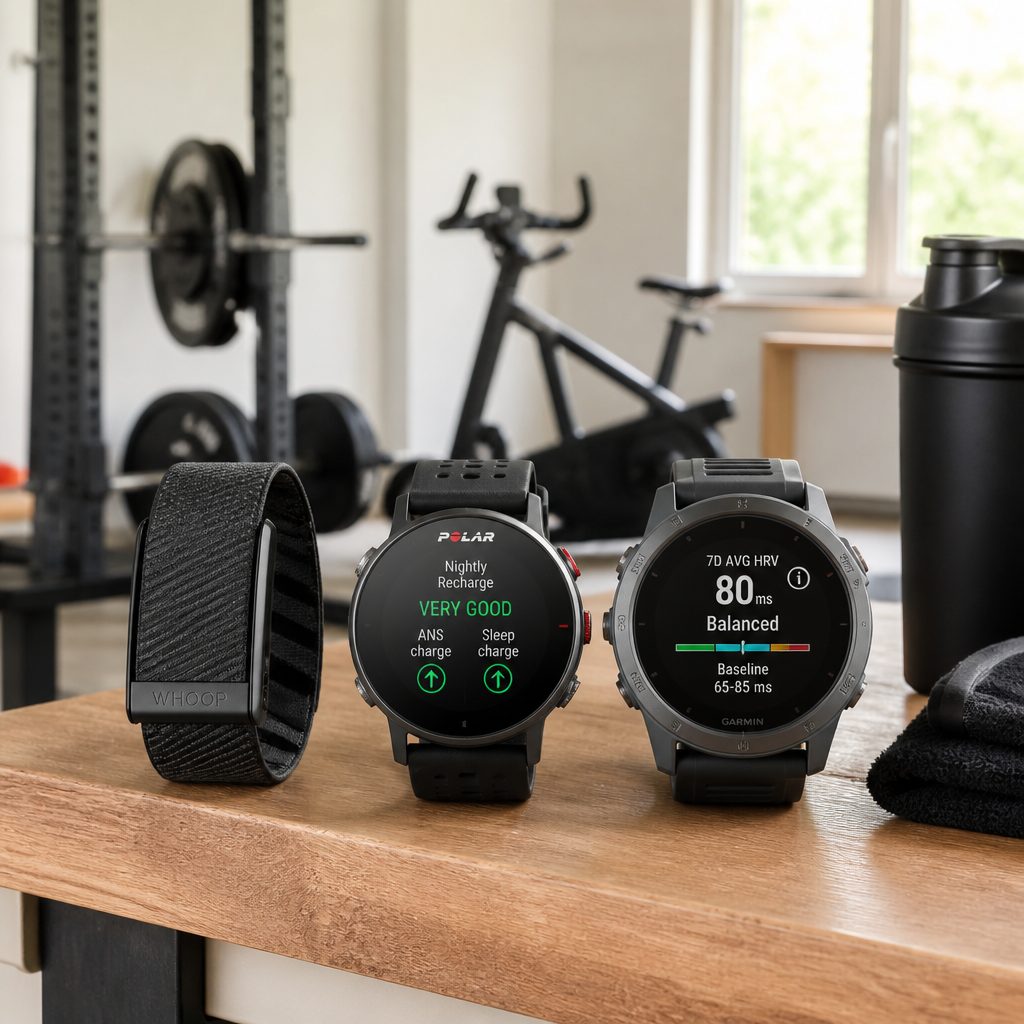
The most valuable recovery metric is the one that changes tomorrow's training dose, rather than becoming another attractive graph you inspect once.
Polar Vantage V3: recovery data with athlete context
Check Polar Vantage V3 on Amazon UK
Polar had long occupied a thoughtful place in endurance and training circles because it treated physiology as more than an accessory to notifications. The Vantage V3 brought together its fourth-generation Polar Elixir optical heart-rate sensor, ECG, nightly skin temperature and continuous SpO2 in a premium multisport package. It also included altitude, offline maps and dual-frequency GPS. That is a very different proposition from a band whose main ambition is to stay unnoticed.
The advantage is context. If your version of longevity training includes trail running, cycling, long walks in the hills, structured intervals or occasional events, recovery cannot be separated neatly from the session that created the fatigue. Vantage V3 had the tools to capture both sides: the body's status and the activity in front of you. Up to 43 hours of GPS training time made it a far more self-sufficient companion for longer outdoor sessions than Whoop, which required a smartphone for GPS.
The health sensors also gave Polar a compelling foundation for observing trends. ECG, temperature, blood-oxygen and heart-rate data are not magic wellness confetti; individual readings can vary and should be interpreted sensibly. Over time, however, they can add useful texture to sleep, effort and recovery patterns. That is the point. Longevity training is not a one-day optimisation challenge. It is the slow business of noticing what a body does repeatedly.
There is a slight irony here. A Vantage V3 could be the more capable training instrument, yet Whoop could be the better recovery habit-builder for someone who does not want to operate a sports watch. Polar asked the wearer to engage. Whoop reduced the decision to a morning check-in. Neither is inherently superior; it depends whether you want detail at the wrist or discipline through simplicity.
Polar Elixir sensing
Vantage V3 combined fourth-generation optical heart-rate sensing with ECG, nightly skin temperature and continuous SpO2, giving recovery-aware athletes several physiological streams to examine together.
Outdoor independence
Dual-frequency GPS, offline maps and altitude information made Polar the more natural choice for people whose healthy long game included exploring beyond the gym car park.
Information when you need it
The high-resolution AMOLED screen meant training data was available during the session, not only later in a phone app. For structured training, that can be the difference between useful feedback and historical trivia.
Garmin: the broadest longevity-training ecosystem
Check Garmin Forerunner 265 on Amazon UK
Garmin's case was not that every device did recovery in precisely the same manner. Its case was scale. It had watches for runners, multisport athletes, outdoors people and gym-goers, along with an emerging screenless direction for people who wanted less wrist distraction. If you already used Garmin's wider platform, staying inside that ecosystem could make a great deal of sense.
For longevity training, the appeal was continuity. Training does not happen in one clean category. A week may contain a strength session, an easy run, a long weekend walk and a slightly overambitious cycle with a friend who claims it is "mostly flat". Garmin's broad product range was designed around that real-world variety. You could choose a device style that suited your sport rather than forcing your habits around a single recovery band.
However, this breadth also prevents a simple blanket recommendation. Sensor hardware and feature sets varied across Garmin products. A Garmin buyer should decide first whether they need serious wrist-based sport functionality, then compare the recovery and health features on the exact watch or band under consideration. It is not enough to buy the logo and assume every model has the same measurement capability.
In direct heart-rate comparison, Whoop 5.0 was reported as more accurate than Garmin's ELEVATE 5 wrist sensor, although it was not quite as accurate as Polar SENSE worn on the biceps or Polar's HRM-600 chest strap. That does not make Garmin unusable. It does underline a boring but important truth: if exact heart rate matters for intervals, threshold work or recovery modelling, placement and sensor choice matter as much as brand reputation.
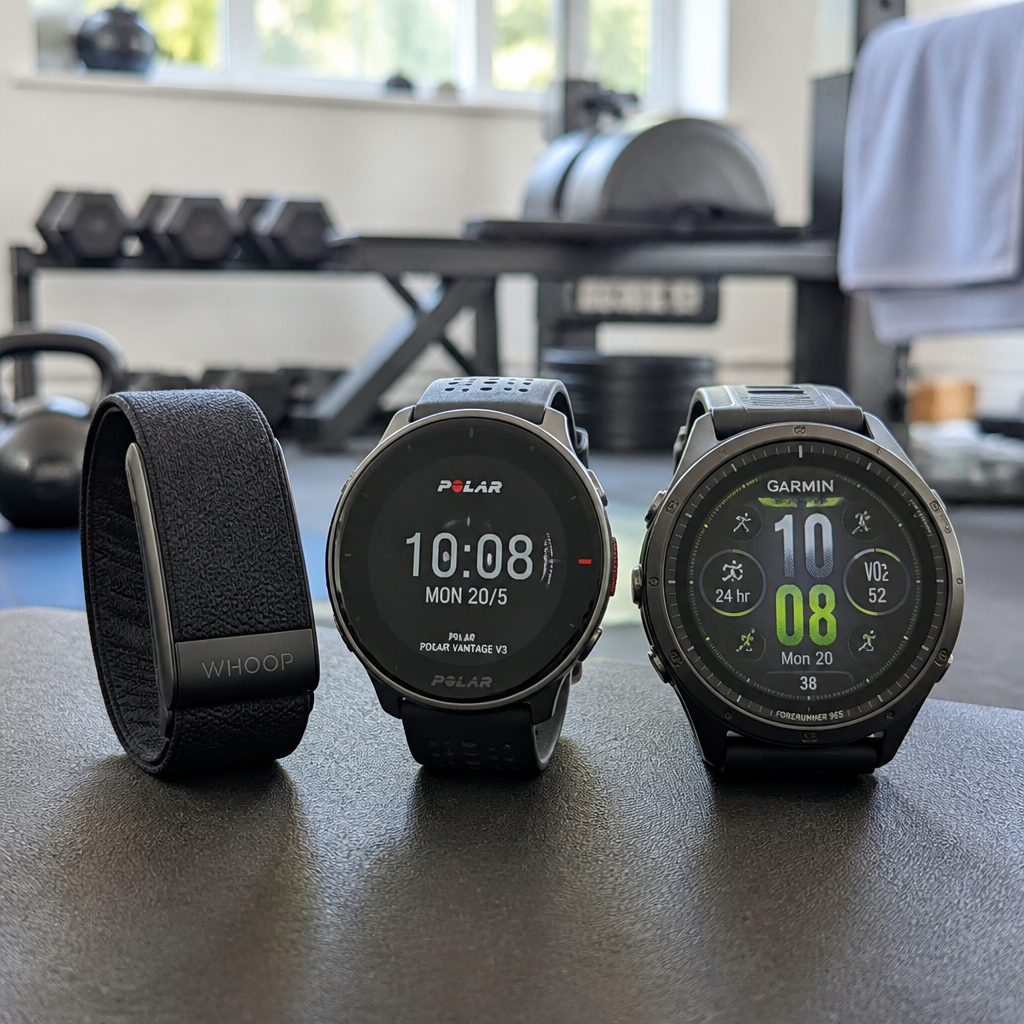
Garmin's advantage is choice: a familiar ecosystem that can suit a conventional sports-watch wearer as comfortably as someone moving towards lower-distraction tracking.
Heart-rate accuracy and workout load
Recovery systems are built on measurement, and heart rate is one of the foundations. If the source data goes wandering during a hard session, the clever readiness score built on top of it becomes less clever rather quickly. Optical sensors can be affected by fit, movement, skin contact and where the device is worn. That is not a Whoop problem, a Polar problem or a Garmin problem. It is a wrist-sensor reality.
Whoop 5.0's redesigned sensor technology was intended to provide more accurate and reliable heart-rate data, particularly during intense activity. The practical comparison was encouraging: it was more accurate than Garmin ELEVATE 5 at the wrist. Worn on the biceps, Whoop was described as undoubtedly accurate for live heart rate and strain calculation in endurance activity. That is a meaningful point for runners, cyclists and people who find a wrist strap shifts when lifting, rowing or getting rather sweaty in a circuit class.
Polar had an advantage when the job demanded a dedicated sensor. Polar SENSE on the biceps and the HRM-600 chest strap were reported to be more accurate than Whoop. For those who treat heart-rate zones as a serious training tool, a chest strap remains the sensible reference option. It is less glamorous than a sleek band, admittedly. So is warming up properly. Both are still useful.
Calorie estimates showed why no wearable should be treated as a nutritional accountant. In one spin session, Polar reported 400 calories, Garmin reported 397 and Whoop reported 348. Whoop showed a consistent tendency to under-report calories against Polar and Garmin. The gap is notable, but the bigger lesson is to use calorie data as a broad trend rather than permission to eat an extra pastry because the watch had a confident little number on it.
Sleep, stress and the longer-term health picture
Sleep tracking had become a central part of recovery wearables because it offered the clearest overnight window into your readiness. Whoop used sleep, HRV and respiratory rate in its daily Recovery score, then layered in stress monitoring and women's hormonal insights. That made it particularly appealing for anyone who wanted health behaviour to sit alongside training behaviour rather than in a separate app tab they never opened.
Its WHOOP Age and Pace of Aging features were also very much products of the longevity moment. Physiological-age tools can be useful prompts. They can encourage people to notice sleep regularity, training consistency and the general effect of their choices. They should not become an identity. A number that suggests you are biologically older or younger than your calendar age is not a diagnosis, a moral judgement or a reason to become unbearable at brunch.
Polar Vantage V3 had a more sensor-rich nightly picture through skin temperature, continuous SpO2 and ECG alongside heart-rate measurement. That makes it attractive to the curious athlete who wants more than a green-or-red readiness cue. The trade-off is cognitive load. More data can help you find patterns, but it can also create a lively new hobby of worrying about tiny variations that do not change how you train.
Garmin's broader health-and-training approach will suit people who prefer to interpret multiple patterns across a familiar ecosystem. That can be excellent for committed users. But if you know that you need the device to be firm, simple and a little bossy, Whoop's daily recovery and exertion recommendation remained the more focused proposition.
Consistency beats perfection
For longevity, look for multi-week patterns: whether hard sessions reliably harm your sleep, whether rest days improve your HRV trend, and whether your training is becoming repeatable. One strange night is information. It is not a referendum on your entire lifestyle.
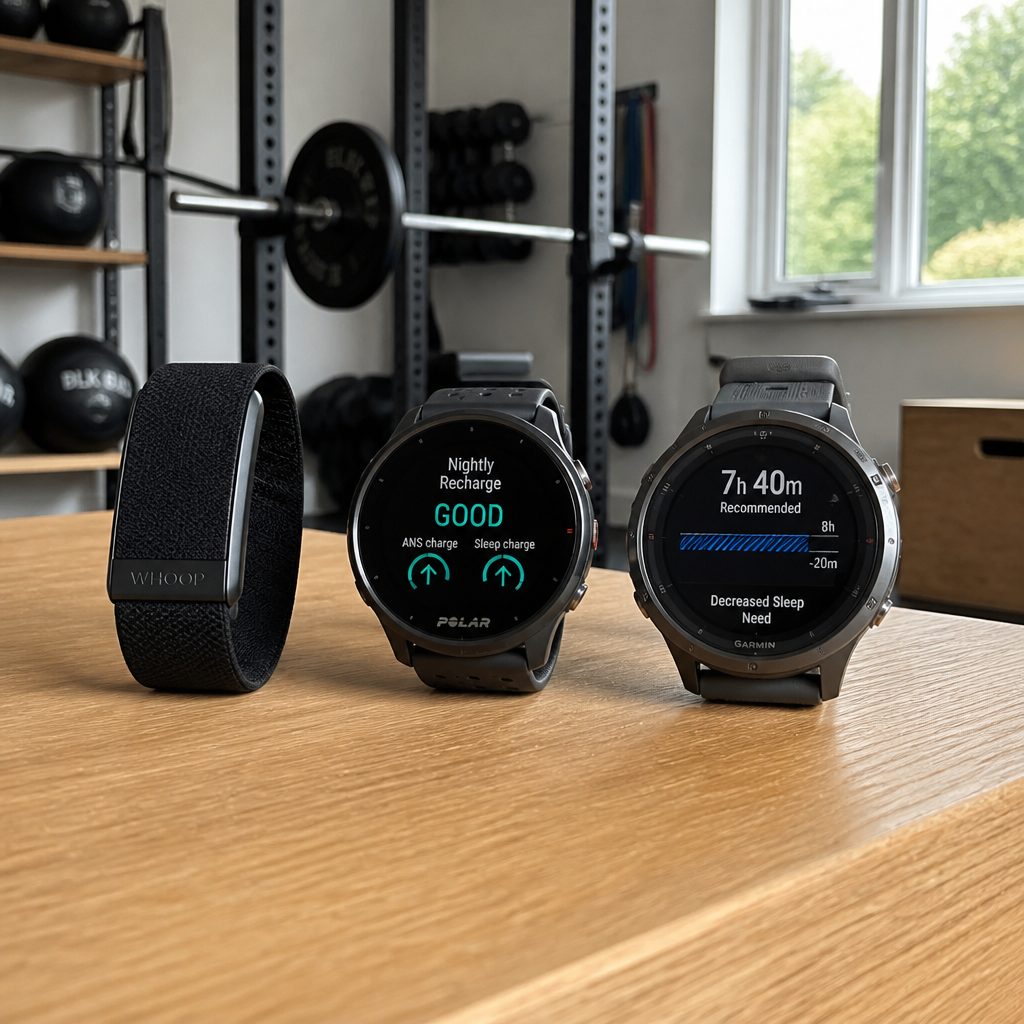
Recovery data earns its keep when it reveals repeatable patterns in sleep, stress and training load rather than prompting panic over one imperfect night.
Training experience: gym, endurance and outdoor use
Whoop supported more than 145 activities, which was plenty for a mixed training life. Its real strength was not giving each activity a flashy on-wrist experience; there was no display for that. Instead, it concentrated on the cardiovascular cost of the work. That made it well suited to strength-and-conditioning trainees, HYROX-style enthusiasts, busy people fitting workouts around life, and anyone who wanted to know whether a hard gym session had taken more out of them than expected.
The limitation was live feedback. A runner who wants pace, route information or in-session guidance will find a screenless band restrictive. Whoop required the smartphone for GPS, so it was less elegant for phone-free outdoor training. You could absolutely use it, but Polar Vantage V3 was simply the more complete independent training watch for that use.
Polar's combination of display, maps, altitude and dual-frequency GPS made the Vantage V3 a better fit for the athlete whose training takes place outside as much as inside. It had the equipment to be a genuine session companion, then bring the recovery story into the next day. That is a strong blend for runners and adventure-minded gym users who lift during the week and spend long weekends on trails.
Garmin was the sensible middle ground for people who wanted sport-specific choice. Its product family was expansive enough that you could match a device to your preferred activity and tolerance for smartwatch features. The trouble, if you can call it that, was decision fatigue. Garmin offered freedom; Whoop offered clarity. The best one depends on whether you enjoy setting up your tools or merely want them to get on with it.
Battery life, charging habits and the tyranny of the forgotten charger
Battery life affects recovery tracking more than most buyers initially realise. Miss a sleep because the tracker is charging, then miss a workout because you left it there, and suddenly your lovely trend line has a hole in it. This is where Whoop 5.0 made a very persuasive argument. Its 14-day battery figure was comfortably suited to continuous use and reduced the little maintenance rituals that cause people to stop wearing devices.
Polar Vantage V3 offered approximately eight days in basic watch mode, alongside up to 43 hours of GPS training time. That was a strong result for a feature-rich AMOLED sports watch with dual-frequency GPS, but it still involved more regular charging than Whoop. For many athletes, that will be a perfectly fair exchange for a display, maps and standalone outdoor capability. For somebody who chiefly wants uninterrupted sleep and recovery data, it may be unnecessary faff.
Garmin battery performance depended on which device you chose, so it cannot be fairly reduced to one number. Its advantage was that the ecosystem offered routes for different usage patterns. The key is to be honest about your own. If you routinely forget to charge headphones, keys somehow migrate to another dimension, and a smartwatch is likely to spend half its life on a cable, lean towards simplicity. The most sophisticated wearable in the world is not helpful when it is flat.
Membership, ownership and ongoing value
Whoop's hardware was tied to annual membership tiers. That is not automatically bad value; it depends on whether you use the coaching layer. The membership was the product in many ways. You were paying for the daily recovery interpretation, strain guidance, AI-led WHOOP Coach conversation and ongoing platform experience, not merely for a sensor strapped to your arm.
The snag is obvious. Some people dislike a recurring commitment on principle, particularly when conventional watches can offer broad training functionality without turning everyday ownership into a subscription relationship. If you only want basic activity tracking and occasional sleep information, Whoop's approach can feel like hiring a very keen personal assistant to remind you that you went to bed late.
For the right user, though, a focused platform can be more valuable than a longer feature list. If it prevents you from repeatedly training hard when you are poorly recovered, or helps establish better sleep and alcohol habits around important sessions, it may earn its place. The value is in changed behaviour, not the data dashboard itself.
Polar and Garmin appealed more naturally to buyers who wanted a conventional sports-watch ownership model and a device that did several jobs at once. Polar Vantage V3 justified its premium positioning through its sensor collection, display and outdoor capabilities. Garmin's value case depended heavily on choosing the right device in its vast line-up. Neither approach is universally cheaper in the only way that matters: buying a tracker that quietly ends up in a drawer is always expensive.
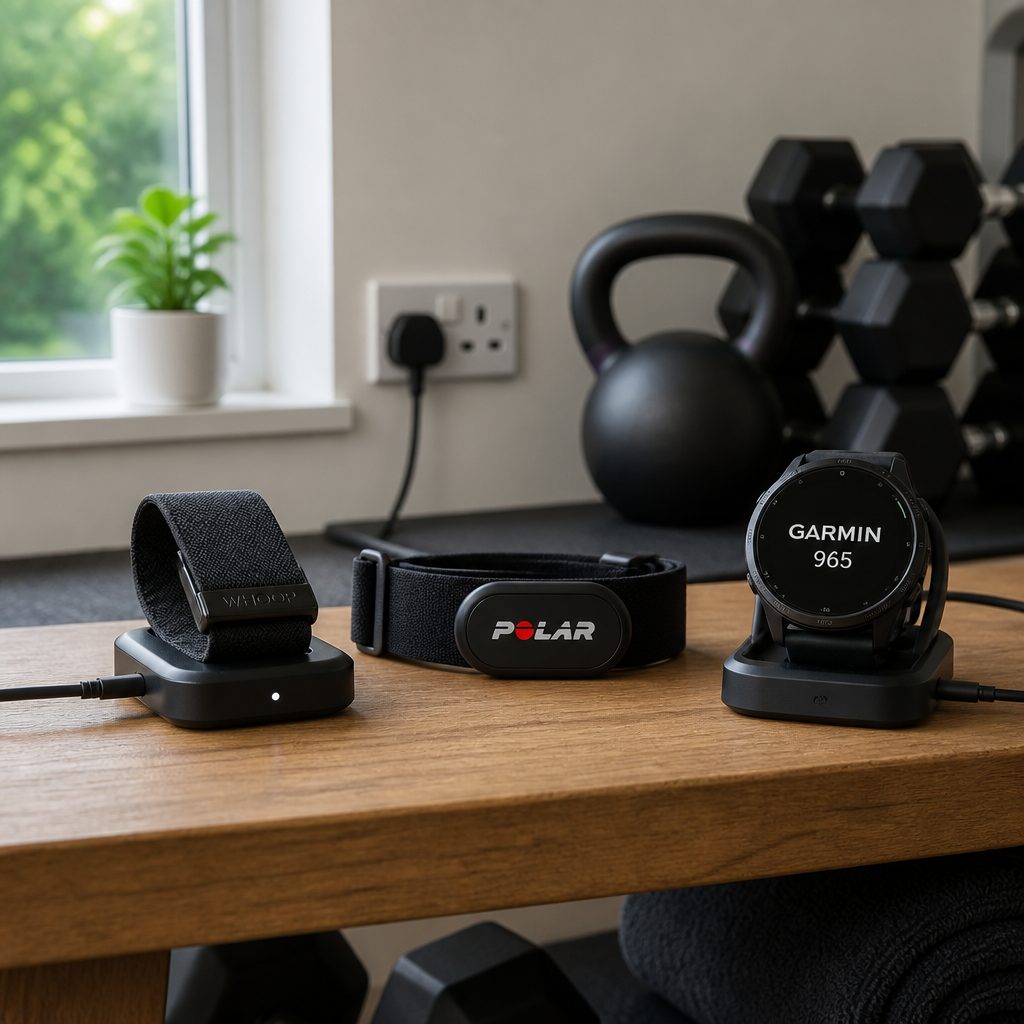
A recovery tracker is worthwhile only if its charging, data and coaching routines fit into ordinary life rather than becoming a new administrative task.
Best tracker for each longevity-training buyer
There is no honest single winner here because the priorities are genuinely different. Whoop 5.0 was the best specialist recovery coach. Polar Vantage V3 was the most capable premium training watch in this comparison. Garmin was the best route for shoppers who wanted ecosystem choice and a device style matched to their own sport.
Best for recovery-first training: Whoop 5.0
Choose Whoop if you want an explicit daily recovery percentage, a strain target and low-friction 24-hour wear. It is especially compelling for gym-goers, conditioning athletes and busy trainees who need a clear answer to "how hard should I go today?"
Best premium all-rounder: Polar Vantage V3
Choose Polar if you want recovery information alongside a real sports watch, AMOLED display, ECG, skin temperature, continuous SpO2, maps and dual-frequency GPS. It is the more complete independent tool for serious outdoor training.
Best for ecosystem flexibility: Garmin
Choose Garmin if you already use its platform or want the broadest selection of device styles for different sports. Match the individual model to your activity and desired recovery tools rather than buying purely by brand.
Best for people who dislike smartwatches: Whoop 5.0
The absence of a screen is its advantage here. Whoop offers continuous measurement without putting another buzzing, glowing device between you and a quiet evening or an uninterrupted night's sleep.
| Buyer priority | Best pick | Why it wins that use case |
|---|---|---|
| Simple daily readiness guidance | Whoop 5.0 | Recovery percentage, strain scale and suggested exertion are the core experience rather than secondary features. |
| Outdoor endurance and navigation | Polar Vantage V3 | Dual-frequency GPS, offline maps, altitude data and up to 43 hours of GPS training time give it genuine standalone sporting utility. |
| Dedicated sensor accuracy | Polar with SENSE or HRM-600 | Polar's biceps and chest options were reported to edge Whoop for heart-rate accuracy. |
| Low-distraction, continuous wear | Whoop 5.0 | No display, a 29g weight including strap and a 14-day battery support the habit of wearing it continuously. |
| Largest choice of device styles | Garmin | Its broad ecosystem lets buyers choose a device around sport, display preference and training routine. |
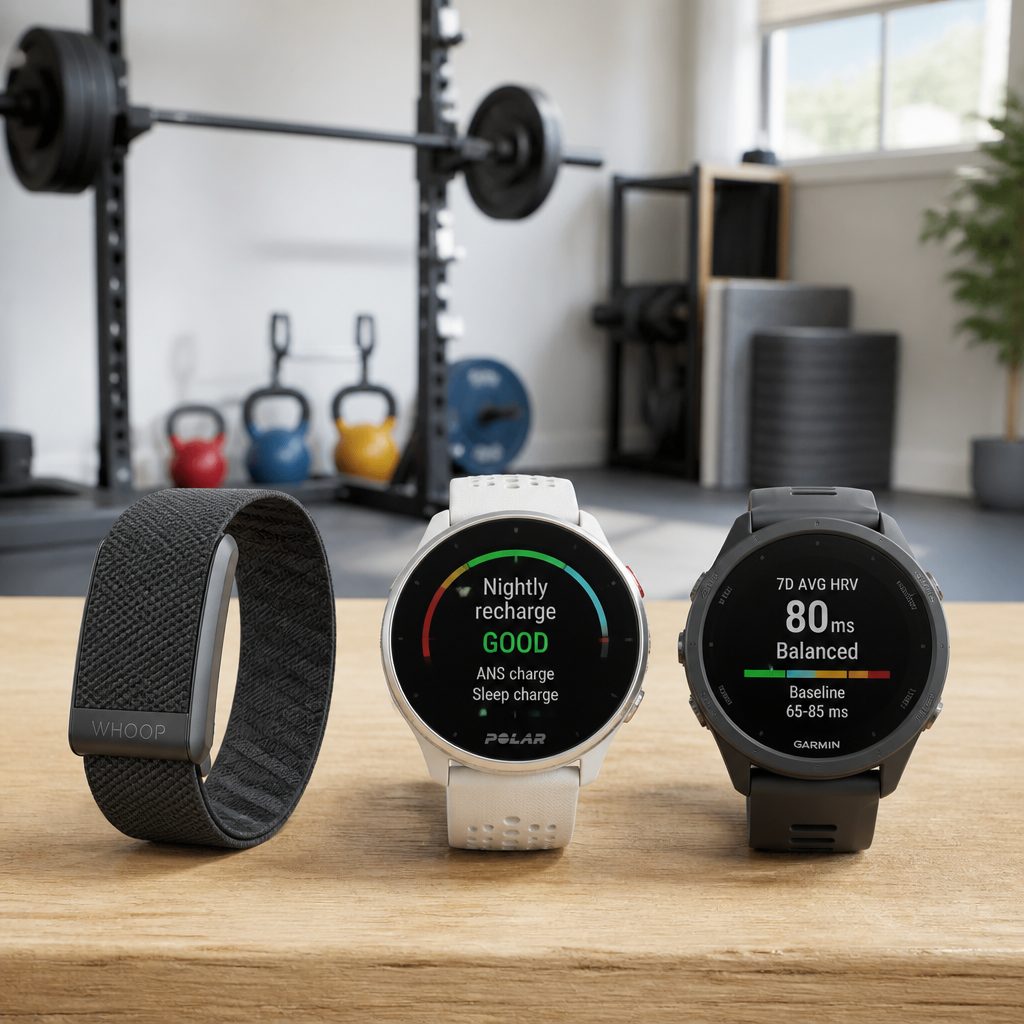
The right tracker depends on your training reality: a recovery-led band for consistent gym work, a full watch for outdoor independence, or a broad ecosystem for sport-specific choice.
Frequently asked questions
Longevity training is not about winning a single workout; it is about collecting thousands of sensible sessions with enough recovery to keep enjoying them.
The final verdict
Whoop 5.0 was the best buy for recovery-first longevity training. Its screenless design, 14-day battery, daily Recovery score, strain scale, suggested exertion and long-term WHOOP Age tools created the clearest system for people who wanted their tracker to influence training decisions. It made the most sense for gym regulars, hybrid athletes and anyone prone to treating every session as an audition for an action film.
Polar Vantage V3 was the better premium choice for the athlete who wanted recovery and a complete sports watch. With its AMOLED display, dual-frequency GPS, offline maps, ECG, skin temperature, continuous SpO2 and strong GPS training figure, it gave recovery meaningful exercise and outdoor context. It was the pick for runners, cyclists and adventurers who wanted to leave the phone behind.
Garmin remained the best choice for ecosystem-minded shoppers. Its strength was not one universal recovery answer but an extensive family of devices that could fit different sports and wearing preferences. Choose carefully by model, especially where sensor hardware and recovery features matter most.
The simple answer
If your priority is being nudged towards sustainable effort every morning, buy into Whoop's recovery philosophy. If you need your recovery tracker to be an accomplished watch as well, Polar Vantage V3 is the more rounded tool. If you value platform familiarity and the freedom to choose a device around your sport, Garmin remains a thoroughly sensible place to start.