
Hyperice Hypervolt 3 vs Therabody Theragun Prime Plus: The New Percussion Flagships Compared
Hyperice went for a light, long-running all-rounder with notably more quoted force. Therabody countered with deeper 16mm percussion, a proper heated attachment and its familiar triangular handle. Here is how the Hypervolt 3 and Theragun Prime Plus compared for noise, attachments, battery life and the less glamorous details that matter once the novelty has worn off.
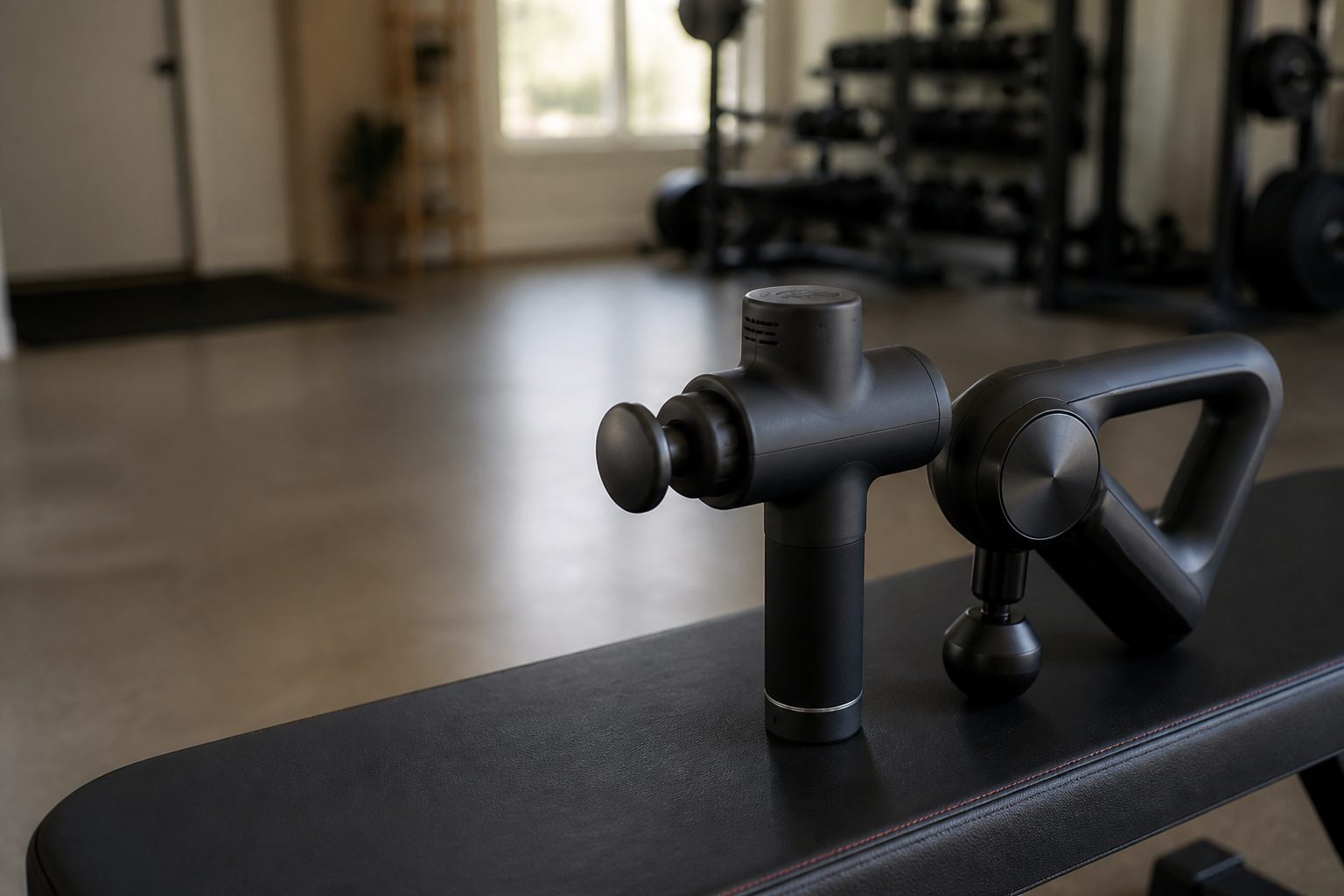
Hyperice Hypervolt 3 and Therabody Theragun Prime Plus represent two rather different routes to a modern, heat-capable recovery routine.
 By James Oduya · Staff Writer & Home Gym Columnist · Updated September 16, 2026
Percussion guns had become much less of a niche gym-bag accessory by September 2026. You will find them beside the squat rack, in the back of a car after a long ride, and occasionally being used with the enthusiasm of someone trying to excavate a tendon. That last one is not the idea. The useful bit of a good massage gun is controlled, repeatable treatment: a few sensible minutes on a tight calf, glute or upper back, rather than attempting to sand yourself down like an old garden bench.
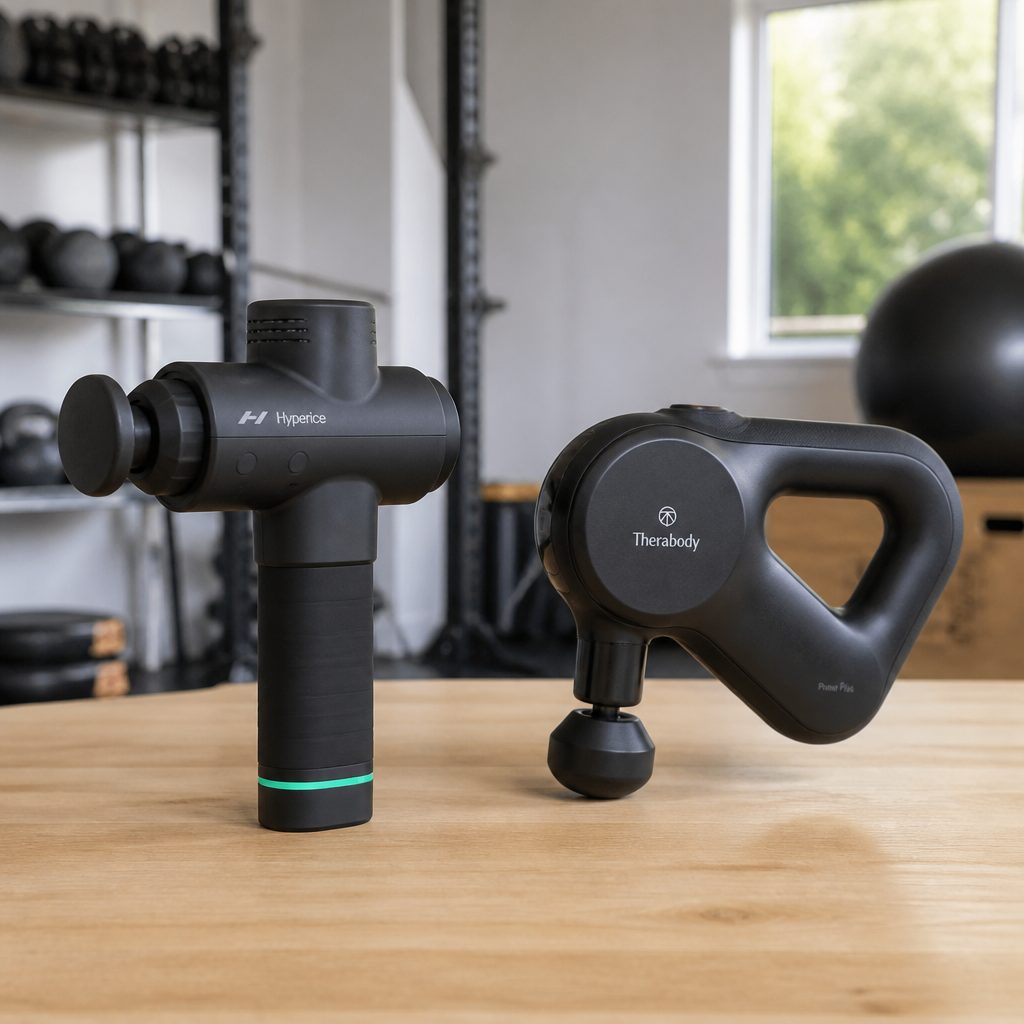
The Prime Plus's 16mm amplitude favours a deeper-feeling treatment on large muscles, while the Hypervolt 3 prioritises pressure resistance.
Hyperice Hypervolt 3 and Therabody Theragun Prime Plus both sat in the serious end of the mainstream percussion market. Neither was a stripped-back mini gun, and both combined app support with several heads and heat-led recovery options. Their priorities were distinctly different, though. The Hypervolt 3 concentrated on 60lb of stall force, five speeds reaching 2,500 percussions per minute and an unusually generous claimed four-hour battery life. The Prime Plus leaned into 16mm amplitude, a 10-foot drop-resistant build, three heat settings and a shape that made awkward body areas rather less awkward.
That made this less of a simple "which hits harder?" comparison than it first appeared. On paper, the Hypervolt 3 had more resistance to pressure. The Theragun Prime Plus travelled farther into soft tissue with each stroke. One stayed working longer between charges; the other was lighter by a whisker and appeared quieter at gentler settings. As ever with recovery kit, the winner depended on where and how you actually planned to use it.
Hyperice Hypervolt 3 and Therabody Theragun Prime Plus at a glance
Let us get the important numbers on the table before getting carried away with handle geometry and heated heads. The Hypervolt 3 was the middle model in Hyperice's 2026 three-gun family, sitting between the compact Hypervolt Go 3 and the more powerful Hypervolt 3 Pro. Therabody positioned the Prime Plus as its heated Prime-series flagship, rather than a lightly updated version of the older Prime.
| Specification | Hyperice Hypervolt 3 | Therabody Theragun Prime Plus | Hypervolt Go 3 | Hypervolt 3 Pro |
|---|---|---|---|---|
| Stall force | 60lb | 40lb | 45lb | 70lb |
| Stroke length / amplitude | 12mm | 16mm | 10mm | 14mm |
| Claimed battery life | About 4 hours | 150 minutes, varying by attachment | About 4 hours | About 4 hours |
| Weight | 2.0lb / 0.9kg | 31.2oz / 886g | 1.6lb / 0.73kg | 2.5lb / 1.1kg |
| Speed range | 1,500–2,500 PPM | 1,750–2,400 PPM | Not listed here | 1,500–2,500 PPM |
| Included attachments | 5 | 4 | Not listed here | Not listed here |
The table also gives useful context if you had been considering other Hypervolt 3 models. The Go 3 was substantially lighter, but gave up depth and force. The 3 Pro delivered more force and a longer 14mm stroke, whilst adding noticeable mass. Hypervolt 3 therefore made a credible middle-ground case: much more substantial than a travel model without becoming a 1.1kg piece of kit you might leave in a drawer because your wrist cannot be bothered.
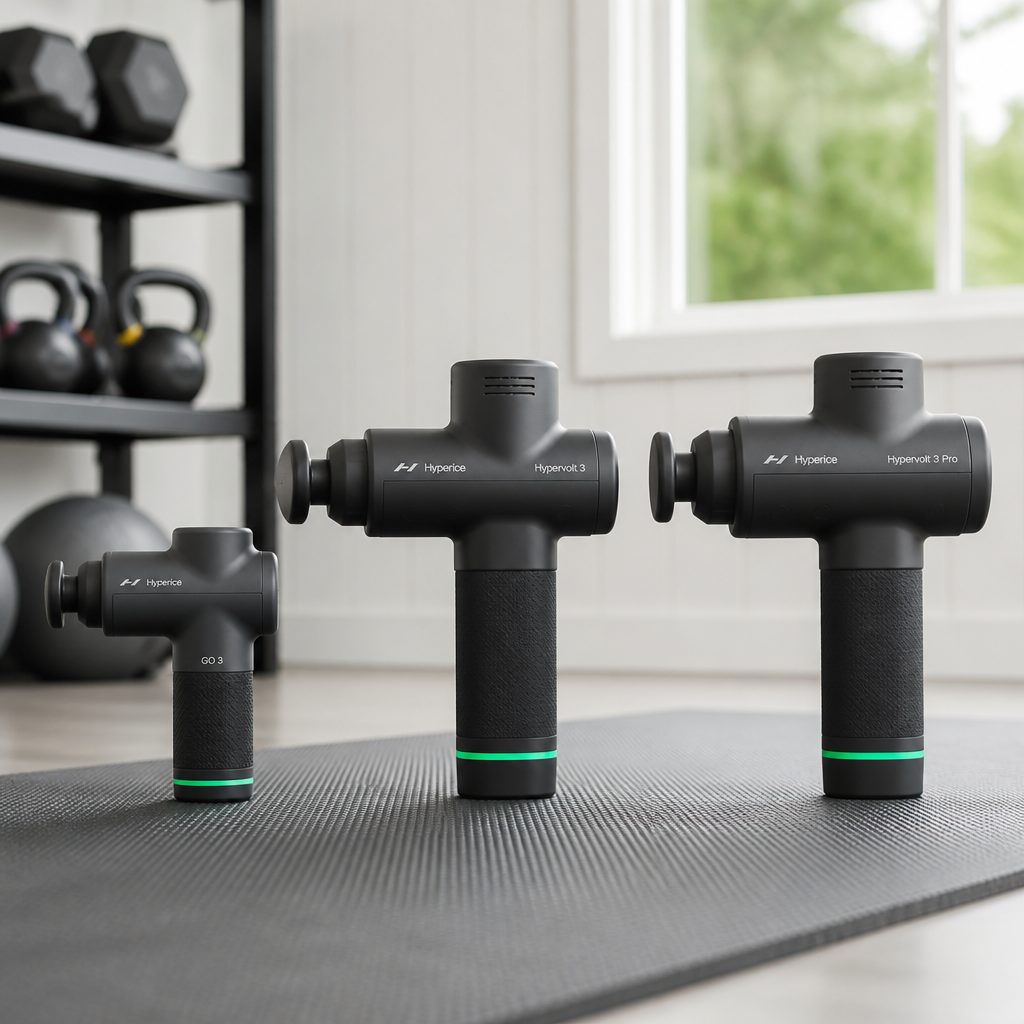
The Hypervolt 3 occupies the useful middle ground in Hyperice's range: more force and reach than the Go 3, but less weight than the 3 Pro.
Power and stall force: Hyperice Hypervolt 3 took this round
Shop Hyperice Hypervolt 3 took this round on Amazon UK
Stall force is the figure that describes how much pressure you can apply before the motor slows or stops. Hyperice rated the Hypervolt 3 at 60lb, compared with 40lb for the Theragun Prime Plus. That is a meaningful paper advantage, and it means the Hypervolt should retain its rhythm better when you lean into a large muscle group such as the quads, glutes or hamstrings.
Still, I would resist turning this into a pub argument about whose device is "more powerful". Most people should not be planting anything like 60lb of force through a percussion gun. The best treatment pressure is normally enough to feel productive whilst allowing the head to move freely and the muscle to relax. If you are bracing every limb and pulling a face like you have bitten into a lemon, ease off. The gun has won. You have not.
For a heavier lifter who regularly wants to work broad, robust areas after training, the extra headroom on the Hypervolt 3 was reassuring. It also suited users who like a firmer sensation but do not want to run permanently at the very highest speed. You can use a more moderate frequency and still have the motor capacity to keep the session smooth.
The Prime Plus should not be dismissed as underpowered. Forty pounds was still serious resistance, and amplitude often changes how a gun feels more than a raw force figure. Therabody's 16mm travel was deeper than the Hypervolt 3's 12mm. On a well-padded ball attachment and a large muscle, that longer stroke can feel more deliberate even when you are not using heavy pressure.
The useful distinction
Stall force tells you how much external pressure the motor can tolerate. Amplitude tells you how far the attachment travels. The Hypervolt 3 had the stronger quoted motor reserve; the Prime Plus had the longer, deeper percussion stroke. They were not measuring precisely the same thing.
Massage depth and speed range: Theragun Prime Plus went deeper
The 16mm amplitude of the Theragun Prime Plus was one of its clearest advantages. Compared with the Hypervolt 3's 12mm stroke, it had an extra 4mm of travel. That does not sound dramatic when written down. In use, though, long-throw percussion can feel distinctly more substantial across big muscles, especially if you prefer the dense, thumping style of treatment associated with Theragun.
The Hypervolt 3 was not shallow in the way a compact travel gun was shallow. Its 12mm stroke was comfortably beyond the 10mm Hypervolt Go 3, and it paired that movement with considerably more stall force than the Go. It simply chose a more controlled, less aggressively deep approach than the Prime Plus. For many everyday users, particularly those working calves after a run or shoulders after desk work, that can be exactly the right amount.
Hyperice offered five fixed speed levels: 1,500, 1,750, 2,000, 2,250 and 2,500 PPM. Therabody likewise offered five settings, covering a customisable 1,750–2,400 PPM range. Hyperice therefore reached lower at its gentlest setting and higher at maximum speed. Therabody's range began slightly faster but was built around its longer stroke and heat-capable attachment.
For post-leg-day work
The Theragun Prime Plus had the more convincing specification for users who wanted deep percussion over quads, glutes and hamstrings. Its 16mm amplitude gave it the greater mechanical reach.
For firmer pressure without a huge gun
The Hypervolt 3's 60lb stall-force figure made more sense for people who wanted a compact-feeling tool that could keep moving when pressed into larger muscles.
For gentler warm-up sessions
Hyperice's 1,500 PPM starting speed was lower than Therabody's 1,750 PPM. That gave the Hypervolt 3 a little more low-intensity flexibility before a workout or for lighter areas.
Heat and attachments: two good bundles, two different ideas
Heat was no longer a novelty feature on premium percussion guns in 2026, and both of these models included it in the box. That matters. A heated attachment only really earns its place if you can reach for it immediately, rather than discovering it is an additional purchase hidden somewhere in an accessory catalogue.
Hyperice supplied five attachments with the Hypervolt 3: Heated Head, flat, wedge, fork and cushion. Therabody included its Heated Percussive Plus Attachment along with Dampener, Standard Ball and Wedge Plus attachments. Hyperice therefore gave you one extra head, plus a fork and cushion that broadened the package for users who want several distinctly different contact surfaces.
The Theragun bundle was less about quantity and more about its heated centrepiece. Its Heated Percussive Plus Attachment combined heat and percussion, with three heat levels that could be adjusted during a treatment. That is the more developed heating implementation of the pair. If warming a tight area before training or easing into an evening recovery session is a major reason you are buying a gun, the Prime Plus had the clearer edge.
The Hypervolt Heated Head was still valuable. It meant you could move from ordinary percussion to warmth without changing product ecosystems, and its flat, wedge, fork and cushion heads covered the familiar jobs. Flat heads suit broad surfaces; a wedge can work around the shoulder blade or along the sole of the foot; the fork is useful around, rather than directly on, areas such as the Achilles; and cushion is the gentler option for tender places.
Hyperice Hypervolt 3 strengths
- Five included attachments gave the broader physical toolkit.
- The cushion and fork heads offered useful alternatives for more sensitive or more precise work.
- Attachments were redesigned to be 33% larger than the previous generation.
Hyperice Hypervolt 3 limitation
- Its heating approach was less adjustable than the Prime Plus's three-level heated attachment.
- The package was geared towards versatility rather than a single, deeply integrated heat-and-percussion experience.
Therabody Theragun Prime Plus strengths
- Three heat levels made warmth a controllable part of treatment rather than a simple on-or-off extra.
- The Dampener, Standard Ball and Wedge Plus cover the core recovery jobs well.
- Heat and 16mm amplitude made a particularly persuasive pairing for large muscle groups.
Therabody Theragun Prime Plus limitation
- There were four included attachments rather than five.
- People who regularly use a fork-style head may prefer Hyperice's more expansive bundle.
Noise: Theragun Prime Plus was surprisingly civilised
Massage gun noise is not a trivial concern. You may use one early in the morning, in a flat with less-than-heroic sound insulation, or while watching television. In each case, a loud, high-pitched motor can make a recovery habit feel a little too much like doing DIY indoors.
Hands-on measurement put the Theragun Prime Plus at roughly 40dB at low speed and just over 50dB at the top end. Therabody did not publish an official decibel specification, but those figures suggested that the Prime Plus was significantly calmer than older Theragun generations had often been. That was welcome. The older assumption that a triangular Theragun inevitably sounded like a determined kitchen appliance no longer held quite so firmly.
Hypervolt 3 noise was assessed at about 54–66dB depending on speed across the Hypervolt line. The Hypervolt 3 Pro had a confirmed 51dB figure, but that number should not simply be transplanted onto the standard Hypervolt 3. What we can say is that on these reported figures, the Prime Plus had the better low-speed noise result and was only just above 50dB at full pace.
For quiet evening use, the Prime Plus was the safer choice on measured results: around 40dB at the low end versus a broader Hypervolt-line estimate of roughly 54–66dB. Actual perceived sound will still vary with speed, attachment, pressure and the surface being treated.
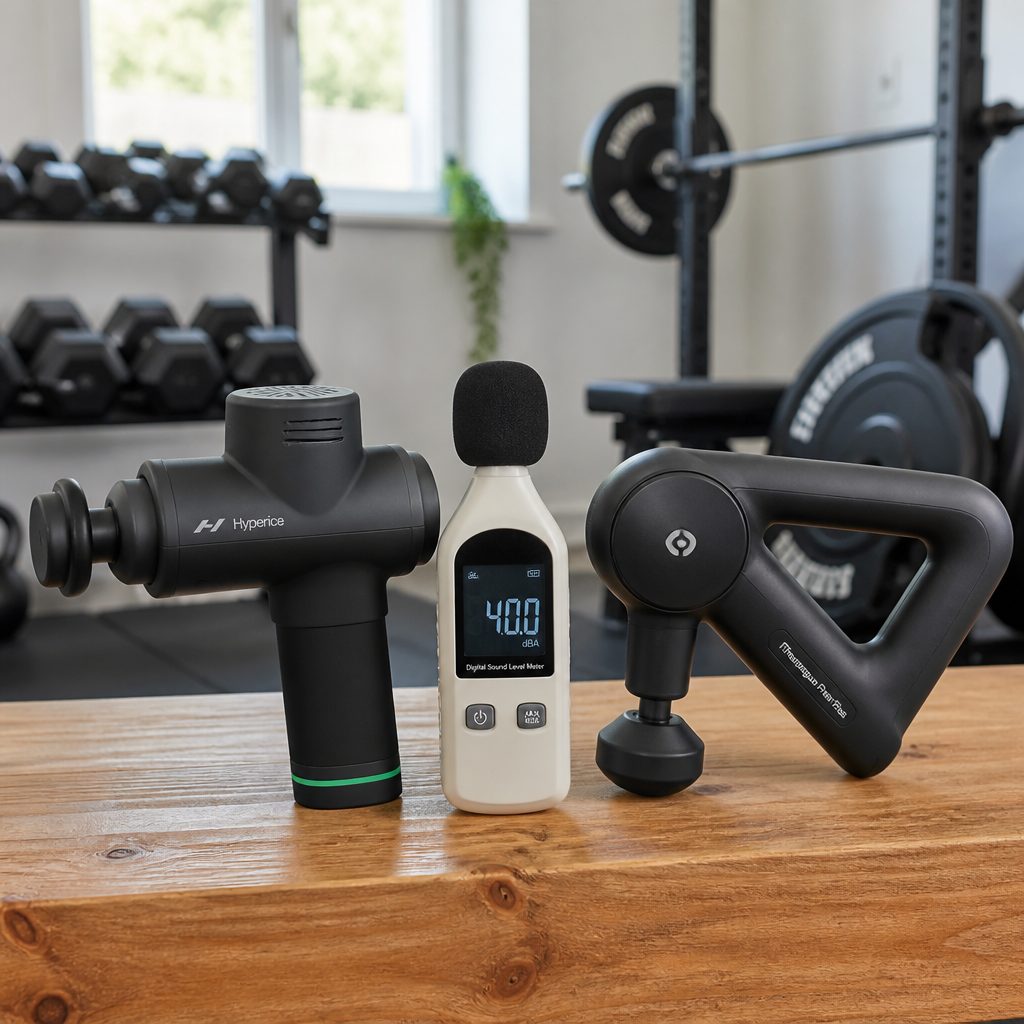
Noise mattered more than marketing usually admits: the Prime Plus recorded around 40dB at low speed, making it the more neighbour-friendly option.
Weight, handling and durability: the shapes matter
At 886g, the Theragun Prime Plus was fractionally lighter than the 0.9kg Hypervolt 3. In practice, that tiny difference did not decide the comfort story. The shape did. Therabody's triangular handle was the longstanding feature that made the brand feel different in the hand, and it gave you several grip positions without forcing your wrist into one fixed angle.
That was especially useful when treating your own upper back, traps, lower back or glutes. A conventional pistol grip can be perfectly fine for quads and calves, but it becomes a bit of a shoulder puzzle when you try to reach around yourself. The Prime Plus's handle made those awkward angles less ridiculous. You still might need to do a small amount of yoga with your elbow. At least the device was not adding to the problem.
The Hypervolt 3's 2.0lb weight was genuinely manageable and its conventional form remained intuitive. It was likely the one people could pick up without a learning curve, move across large muscles and put away again. QuietGlide technology was intended to make operation smoother, and the newly enlarged attachments should help create a more stable, less fiddly contact patch during use.
Therabody also specified a drop-resistant design able to withstand drops up to 10 feet. That was a concrete durability advantage for anyone whose equipment lives in a busy household, a gym locker or the boot of a car. It is not a licence to start throwing it around for amusement, obviously, but it was reassuring engineering rather than vague "premium build" language. The Prime Plus also carried a one-year limited warranty.
Battery life and charging: Hyperice Hypervolt 3 went much longer
Shop Hyperice Hypervolt 3 went much longer on Amazon UK
Battery was the simplest win in this comparison. Hyperice claimed approximately four hours for the Hypervolt 3. Therabody claimed 150 minutes for the Prime Plus, with runtime varying by attachment. Four hours equates to 240 minutes, so Hyperice's headline estimate was 90 minutes longer.
Both were likely to survive a good number of normal recovery sessions. Most people use percussion guns in short bursts, not as a feature-length film. Even a ten-minute routine across calves, quads, glutes and upper body would leave ample charge for repeat use. Still, the difference becomes more meaningful if the gun is shared, lives in a gym studio, accompanies you on trips, or is routinely used at higher settings.
The Hypervolt 3's rechargeable lithium-ion battery was rated at 14.4V, 3,050mAh and 43.92Wh, with charging through Hyperice's 18V wall charger. The supplied charger accepted 100–240V input at 50/60Hz, which was helpful for travel with the correct plug arrangement. Therabody's claim explicitly varied according to attachment, and heat was the obvious reason to take its 150-minute headline as a best-case-style guide rather than a universal promise.
Battery reality check
The Hypervolt 3 was the better fit if charging was something you reliably forgot until the moment you needed the device. The Prime Plus's battery was still practical for personal use, but active heat settings and attachment choice made its runtime less straightforward.
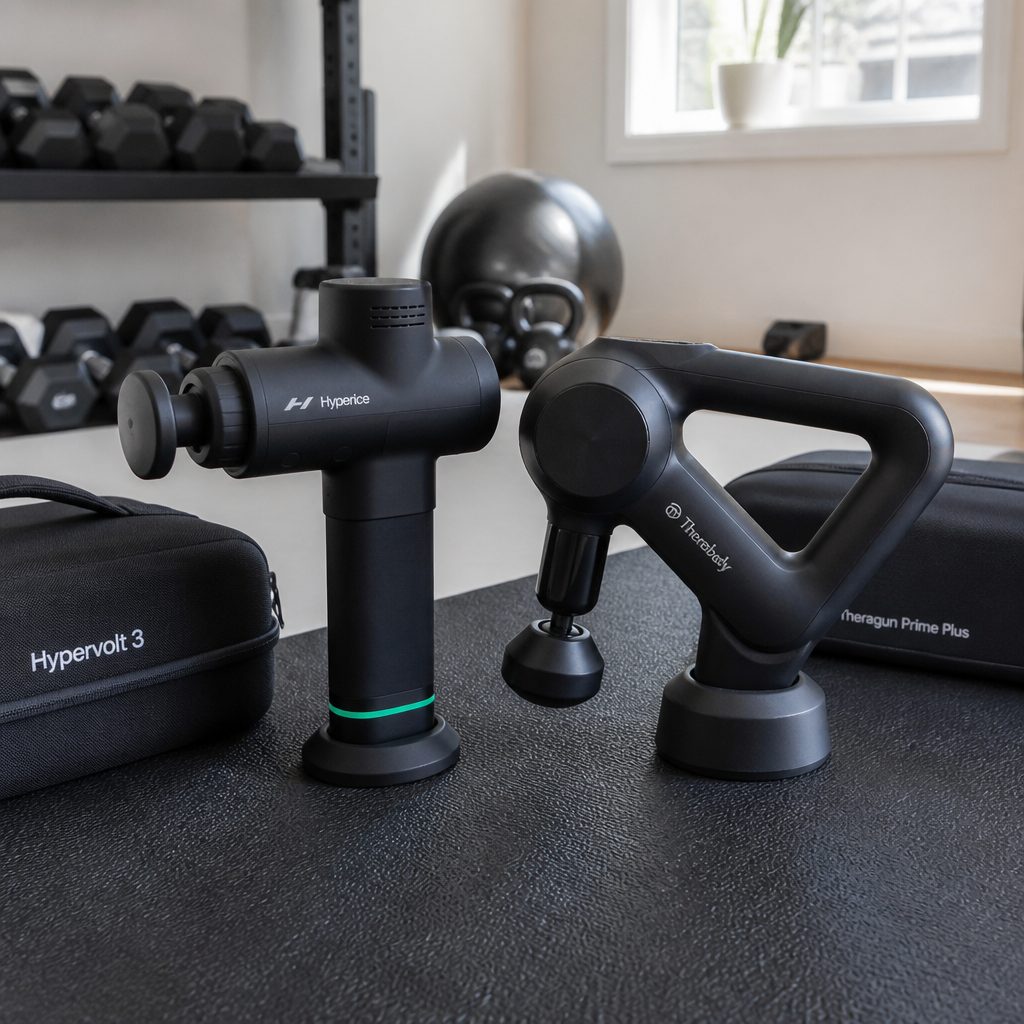
The Hypervolt 3's claimed four-hour runtime gives it a substantial endurance advantage for shared households, frequent travellers and forgetful chargers.
App guidance and controls: both were smarter than a basic gun
Both devices included Bluetooth connectivity and companion-app support. Hyperice connected to the Hyperice App and included a pressure sensor. Therabody connected to the Therabody app for personalised treatment routines. Neither was simply a motor with a button, which is useful if you are new to percussion therapy and want more structure than "point it at the sore bit and hope".
The Hypervolt 3 pressure sensor was particularly useful for self-management. Pressure is the easy thing to overdo when a muscle feels tight, because more intensity can feel satisfyingly purposeful in the moment. Guidance that helps you avoid mashing a sensitive area was arguably more useful than another decorative feature.
Therabody's personalised routines made sense alongside the Prime Plus's heat settings and multi-grip body. Its proposition was more treatment-led: choose an intended outcome, bring in heat if it suits the session, and adjust the frequency during use. That may appeal to someone who wants the gun to feel like a recovery system rather than an especially refined bit of gym kit.
Neither app should replace basic judgement. Do not use percussion over acute injuries, areas of unexplained pain, open wounds or the front of the neck. If you have a medical condition, are pregnant, use blood-thinning medication or have any uncertainty about whether percussion is suitable, check with an appropriate healthcare professional first. These are powerful devices, not enchanted wellness wands.
The Theragun Prime Plus was an FDA-registered medical device, whilst the Hypervolt 3 included app-linked pressure sensing. Those features are useful, but neither removes the need to use sensible technique and stop if a treatment causes pain or aggravates symptoms.
Hyperice Hypervolt 3 vs Therabody Theragun Prime Plus: the best pick for each user
There was no absolute winner because the two devices solved slightly different problems. The Hypervolt 3 was the more practical power-and-endurance option. The Prime Plus was the more specialised deep-treatment and heated-recovery machine. This breakdown should make the decision rather less tortuous than a ten-minute session on a tender calf.
Best for battery life: Hyperice Hypervolt 3
Its claimed four-hour runtime was 90 minutes longer than the Prime Plus's 150-minute claim, making it the clear choice for frequent use between charges.
Best for firm pressure: Hyperice Hypervolt 3
The 60lb stall-force rating gave it a substantial advantage over the Prime Plus's 40lb rating for users who want more motor reserve.
Best for heated recovery: Therabody Theragun Prime Plus
Its three adjustable heat levels and Heated Percussive Plus Attachment offered the more sophisticated warmth-and-percussion combination.
Best for deep treatment: Therabody Theragun Prime Plus
Its 16mm amplitude exceeded the Hypervolt 3's 12mm stroke, giving it the deeper percussion specification for large muscles.
Best for quieter use: Therabody Theragun Prime Plus
Measured at roughly 40dB at low speed and just over 50dB at full pace, it was the more civilised choice for shared spaces.
Best attachment variety: Hyperice Hypervolt 3
Five included heads, including fork and cushion options, made it the more adaptable out-of-box kit.
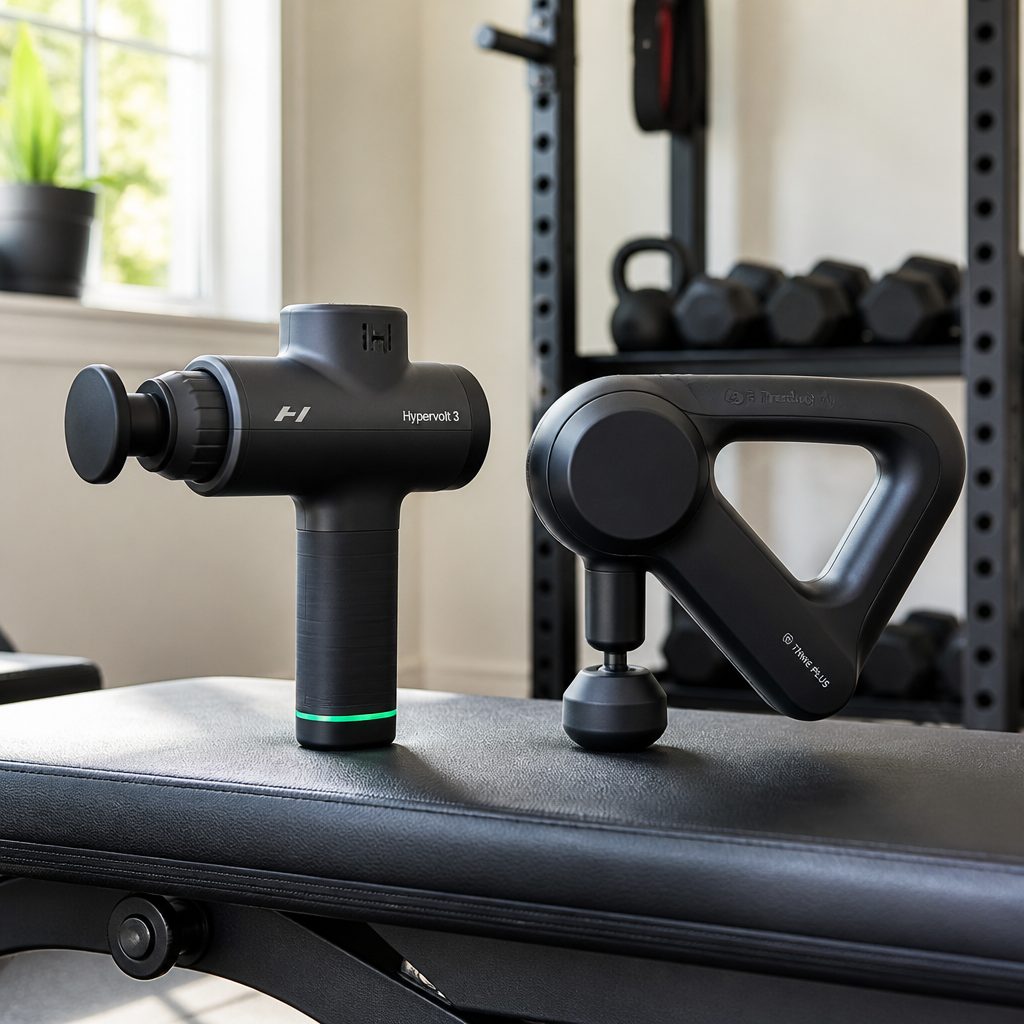
The best choice depends less on brand allegiance than on whether you value force and battery life, or deeper amplitude, heat control and flexible grips.
Which percussion gun made more sense for training recovery?
For most regular gym-goers, the Hypervolt 3 was the easier recommendation. It was only a touch heavier than the Prime Plus, yet offered the longer claimed battery life, higher stall-force rating, five attachments and a low starting speed of 1,500 PPM. It had the broad competence of a machine you could use for a warm-up before squats, a short calf session after a run and a bit of upper-body recovery without feeling that it had been designed for one very particular ritual.
The Theragun Prime Plus made more sense when your use case was more focused. If you consistently wanted the deeper feel of 16mm amplitude, valued a triangular handle for self-treatment, and genuinely planned to use heat rather than merely admire the idea of heat, it was the more compelling product. Its lower weight was a small bonus, its 10-foot drop-resistant design was welcome, and its measured low-speed sound was a real practical advantage.
There was also a question of sensitivity. Deeper did not automatically mean better. People who were new to percussion, who tend to overdo recovery tools, or who prefer lower-intensity work may find the Hypervolt 3's 12mm stroke more approachable. Its cushion attachment and lower starting frequency strengthen that case. Conversely, experienced users who know they enjoy long-throw percussion may find the Theragun's deeper action worth the shorter battery estimate.
Frequently asked questions
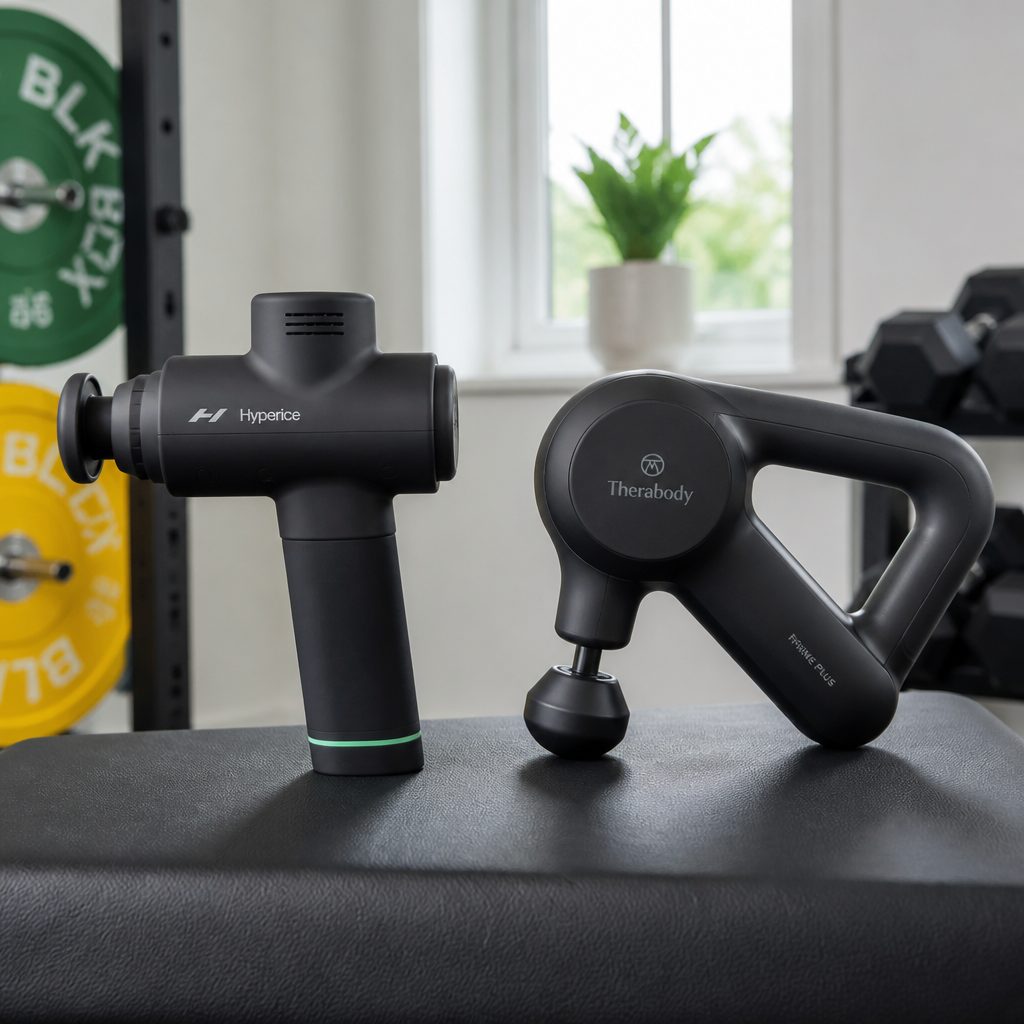
Both guns are capable recovery tools, but the better long-term buy is the one whose treatment style you will actually use consistently and sensibly.
Final verdict
Choose the Hyperice Hypervolt 3 if you want the better all-round training companion: it offered 60lb of stall force, a claimed four-hour battery, five attachments and a gentler 1,500 PPM starting setting in a manageable 0.9kg body. It was the practical pick for regular gym users, households sharing one device and anyone who values fewer charging interruptions.
Choose the Therabody Theragun Prime Plus if your priority is deeper percussion, controlled heat and more versatile self-treatment angles. Its 16mm amplitude, three heat levels, triangular handle, drop-resistant design and quieter reported low-speed operation made it the stronger specialist choice for people who take recovery seriously and know they prefer a more assertive treatment. Neither was a bad decision. They simply put their best effort into different muscles.