
How to Kit Out a Home Gym in a Small UK Flat Without Wrecking the Floor
You do not need a garage, a spare room or the ability to deadlift next to a lawnmower to train properly at home. You do need a realistic plan for floor loading, impact, vibration, storage and the people living below you. Here is how to build a genuinely useful small-flat gym that feels good to use and does not turn the downstairs ceiling into an unwilling percussion instrument.
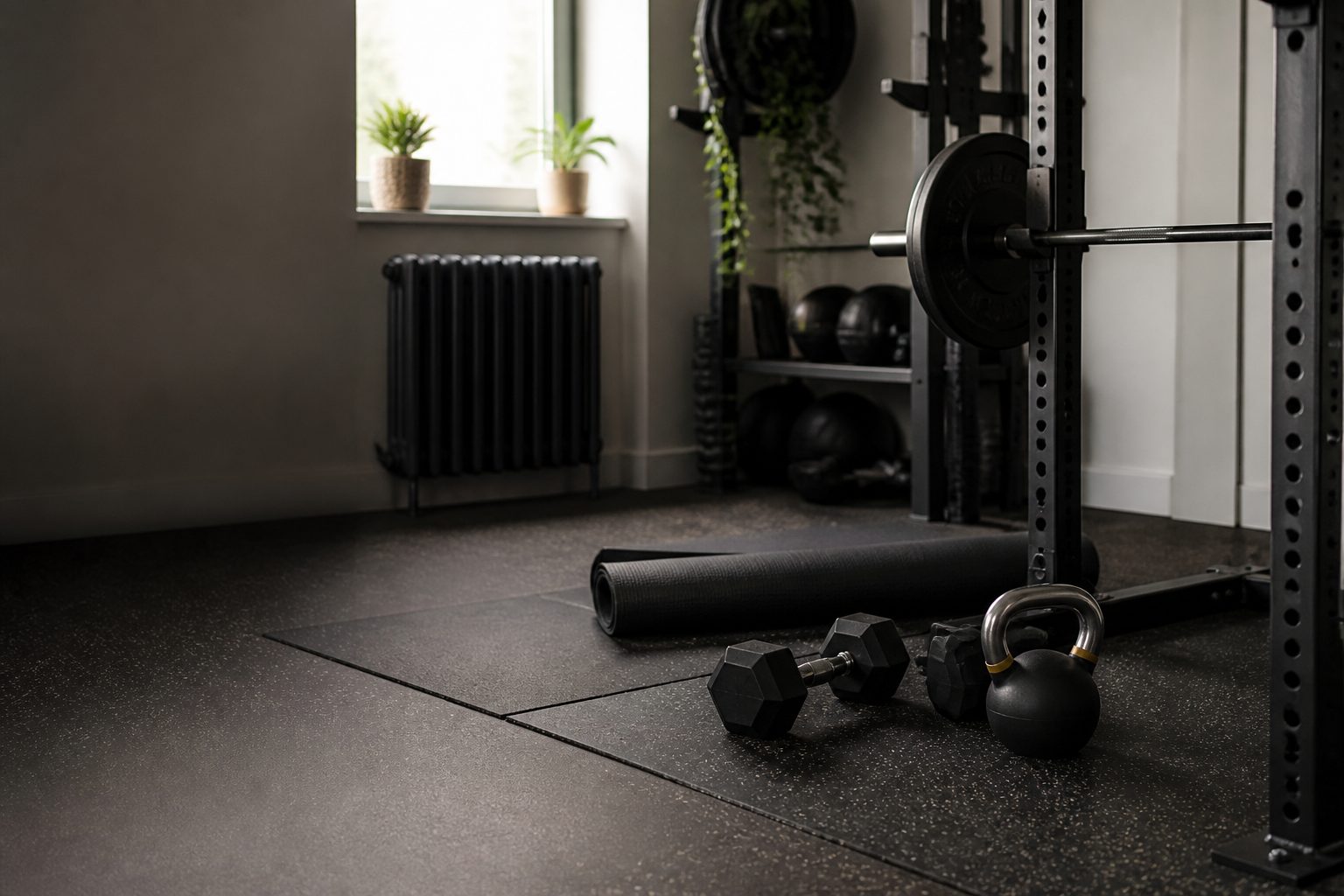
A compact training corner can work brilliantly in a flat when the floor protection, storage route and workout style are planned together rather than bought in a panic.
 By James Oduya · Staff Writer & Home Gym Columnist · Updated August 16, 2026
1. Start with the flat, not the fitness fantasy
The first rule of a small home gym is gloriously unsexy: measure the room before buying anything. Not just the patch of floor that is currently visible, either. Measure the usable area once furniture, doors, radiators, cupboards and the route to the kitchen have all had their say. A workout space that requires you to shuffle the sofa, move three laundry baskets and apologise to a drying rack every time you exercise will not become your favourite habit.
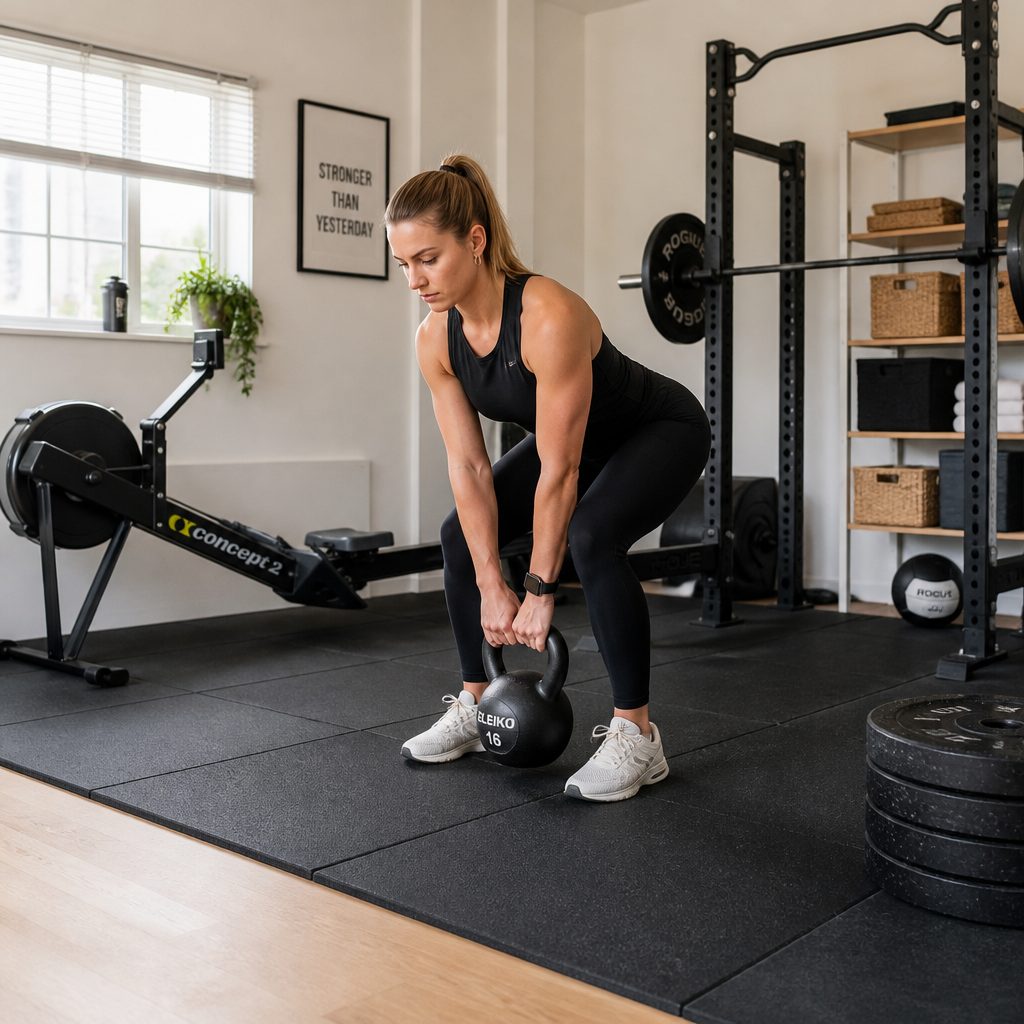
Quiet apartment training is built around stable footing, controlled repetitions and equipment that does not rattle against walls or bare floorboards.
Think about your equipment in two states: in use and stored. A folding bike, walking pad or adjustable dumbbells can be excellent in a flat precisely because they do not need permanent territory. But folded equipment still has to live somewhere. Check under-bed clearance, cupboard depth, the gap beside a wardrobe, and whether you can actually lift or roll the item there without scraping skirting boards or trapping your fingers. It is not the glamorous bit. It is the bit that saves you from owning a very expensive clothes horse.
Next, identify the floor type. Most modern flats have a hard finished surface over a subfloor, whilst older properties may have timber floors that feel rather more communicative. The finish matters for scratches and dents. The structure underneath matters for vibration. A compact dumbbell workout on a protected floor is one thing; repeated jumping, hard kettlebell landings or dropping weights is quite another.
There is also a useful mindset shift here. Your flat gym does not have to recreate a commercial gym. In fact, trying to do that is normally how people end up with a bargain bench they cannot store, a barbell they cannot safely use, and a floor that bears the emotional scars. A good flat setup is deliberately selective: enough resistance training to get stronger, enough cardio to raise your heart rate, enough floor space to move well, and no equipment that makes you dread the sound it produces.
2. Choose one training zone and protect the whole thing
Instead of scattering individual mats under individual pieces of kit, create one defined training zone. It looks neater, catches sweat where you expect it, and reduces the temptation to put a dumbbell down on the bare floor "just for a second". That phrase has damaged more laminate than most people would care to admit.
For most small flats, a corner of the living room or bedroom is enough. You want room to lie down, stand with your arms overhead, step back from the weights, and get on and off cardio equipment without twisting around furniture. If the zone doubles as your normal living space, choose equipment that can be reset quickly. A tidy five-minute pack-away routine is considerably more valuable than a grand plan which blocks the room for weeks.
A better rule than "will it fit?"
Ask whether you can complete a session without moving more than one household item. If the answer is no, simplify the kit. Convenience beats theoretical perfection in a small flat every single time.
Position the zone away from the most delicate or consequential spots where possible. Avoid blocking a fire exit, crowding a balcony door, or placing a heavy cardio machine where it presses continually against a thin wall. If you rent, take a few photographs of the room before laying flooring down. It is not pessimistic. It is simply the sort of boringly sensible thing that feels clever when a tenancy inspection rolls around.
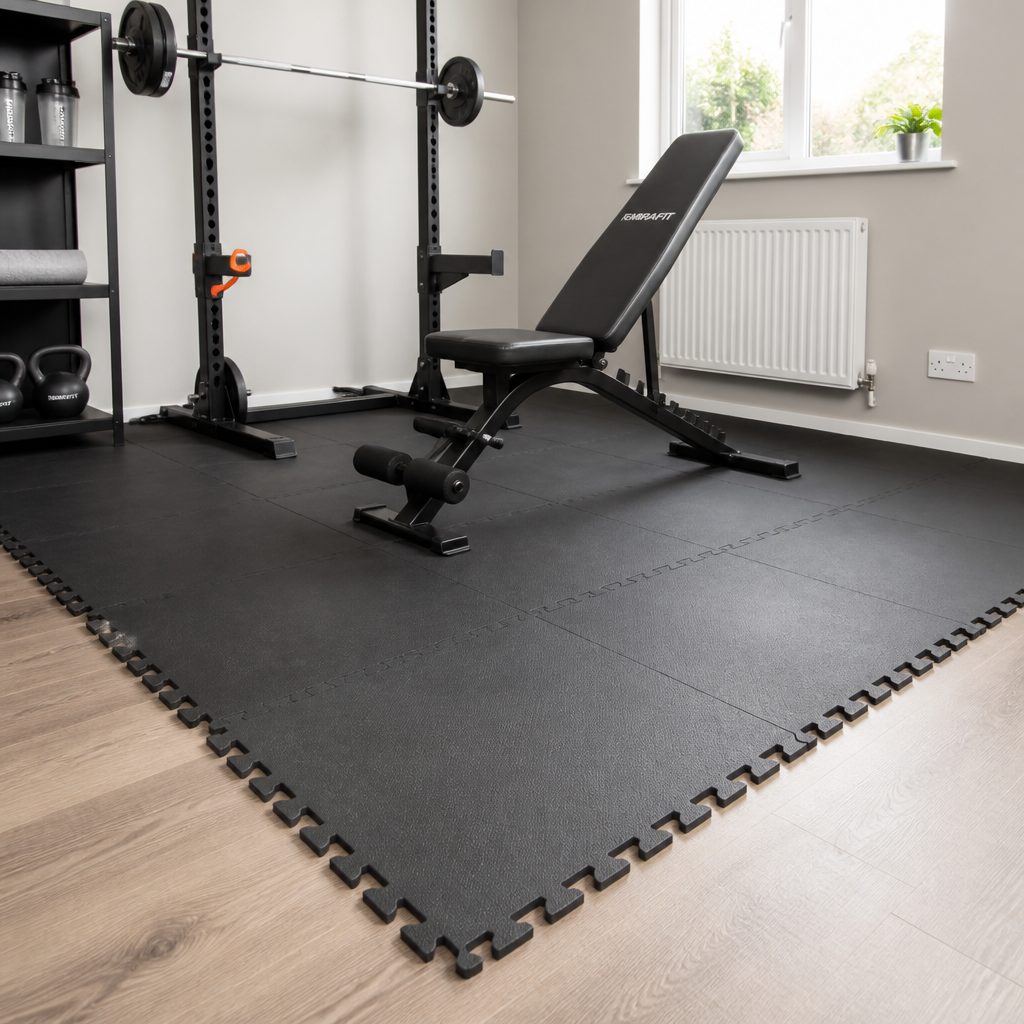
Interlocking flooring creates a visible boundary for training and protects a larger area than a token mat placed directly beneath one machine.
3. Build the floor from the ground up
Floor protection is not just about preventing a scratch. In flats, it is a three-part job: guard the visible surface, spread the pressure from equipment, and reduce the transmission of impact and vibration into the building. No mat makes heavy dropping magically neighbour-proof, sadly. Physics has not become more flexible because we live in compact homes. But the right flooring lets you train much more calmly and confidently.
EVA interlocking mats are the sensible all-round choice for many apartment workouts. They are closed-cell foam, modular, comfortable underfoot and particularly well suited to yoga, Pilates, stretching, aerobics and general fitness. They also make a forgiving base for adjustable dumbbells, a compact bench and controlled kettlebell work. The jigsaw edges click together without glue, tape or tools, which is very handy in a rental where your deposit would prefer you not to bond anything permanently to the floor.
Rubber flooring is denser and tougher. It is especially useful where dumbbells, kettlebells, benches and compact equipment are used regularly, and it is highly effective at reducing impact noise, the type of noise downstairs neighbours tend to notice rather promptly. Rubber is also durable, moisture-resistant, non-slip and easy to clean. If you are training with controlled weights rather than dropping loaded barbells from height, rubber in the 15–20mm range is a sensible sweet spot.
Thicker is not always required, but it does matter when you are specifically trying to tame impact. Thirty-millimetre sprung tiles deliver substantially better noise reduction than 20mm tiles, with roughly 85–90% impact absorption rather than around 70–80%. That is a meaningful difference if you have a particularly lively timber floor, a walking pad that seems eager to broadcast its existence, or an exercise style involving repeated foot strikes. For gentle mobility work, though, do not assume the thickest option is automatically best. A raised edge can become a trip point and softer foam is not the ideal stable base for every exercise.
Protective flooring reduces impact and vibration; it does not make it appropriate to drop dumbbells, kettlebells or barbells from height in a flat. Lower every weight under control. Your floor, your neighbours and your own toes will all be happier.
4. Match mat thickness to what you actually do
There is a tendency to buy flooring as though you are preparing for a powerlifting competition, then use it mainly for press-ups and a few squats. Save the serious protection for a serious use case. Choose based on the equipment and movement patterns you will repeat every week.
| Flooring route | Best use in a flat | Confirmed thickness guidance | Key practical point |
|---|---|---|---|
| EVA interlocking mats | Yoga, Pilates, stretching, aerobics and general fitness | 30mm is ideal for apartment gyms where greater impact protection is wanted | Comfortable, modular and tool-free to install |
| Rubber gym flooring | Dumbbells, kettlebells, benches and compact equipment | 15–20mm is the sweet spot when weights are not dropped from height | Dense, durable, non-slip and effective for impact noise |
| 30mm sprung tiles | Higher-impact apartment training zones | Roughly 85–90% impact absorption | Substantially more impact reduction than 20mm |
| 20mm tiles | Moderate equipment and controlled lifting | Roughly 70–80% impact absorption | Useful protection with a lower profile |
If you mainly do bodyweight strength, mobility and light dumbbell work, EVA can be the friendlier surface. It is more pleasant for knees and forearms during floor work, and it makes a living-room training space feel less industrial. If your adjustable dumbbells are a central part of the plan, consider a denser rubber area or at least a rubber landing strip where they are set down. This is not because you should be tossing them about. It is because even careful training has moments when fatigue makes the final set-down less graceful than intended.
A layered approach can work well: stable protective flooring as the main base, with a yoga mat on top for kneeling exercises and stretching. The top mat adds comfort, whilst the layer underneath handles the more serious job of protecting the floor. Keep edges flat and inspect them occasionally. Curling corners and loose interlocks are more likely to cause a stumble than a genuinely useful workout challenge.
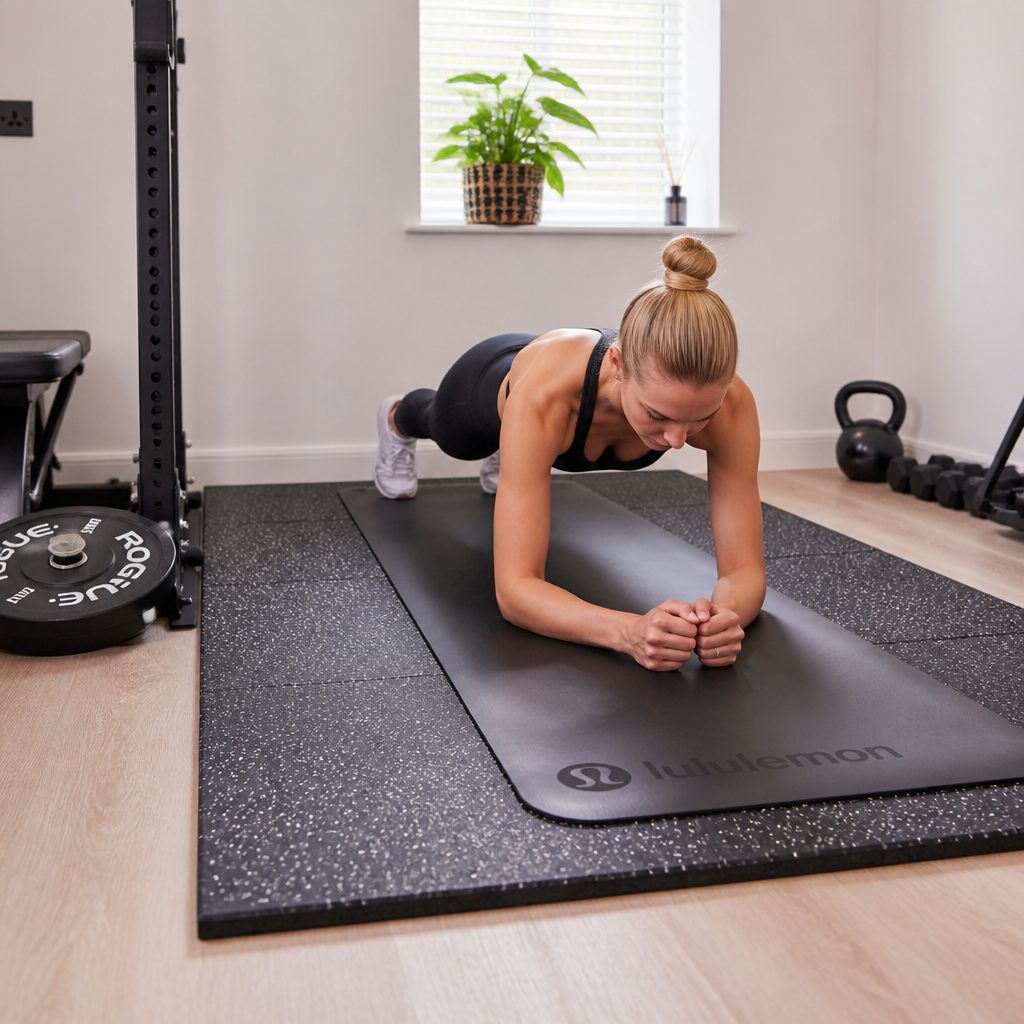
A layered setup can give you a stable protective base for weights with a softer surface on top for floor-based mobility and core work.
5. Buy quiet cardio before buying impressive cardio
A foldable cardio machine makes sense in a small flat because it can provide regular movement without permanently occupying the room. The key word is foldable, not necessarily intense. For most apartment dwellers, low-impact cardio is the sane choice: walking, steady cycling and controlled intervals are much easier on joints, floors and neighbours than repeated jumping or all-out sprints.
A walking pad or foldable treadmill can be useful if walking is your preferred daily habit. Put it on a properly protected zone, avoid hard foot strikes, and treat the machine's sound as only part of the equation. The motor may be reasonably quiet, yet your footsteps can still travel through a building. Wear supportive trainers rather than clomping around in hard-soled shoes, start gently, and use it at civilised hours. These small choices make a surprisingly large difference.
A folding exercise bike is often the more neighbour-friendly option because there is no repeated foot impact. The Xterra Fitness FB150 is compact, at 81cm long when assembled, and folds to around 46cm deep. At 17kg, it is the easiest of the noted Xterra bikes to lift, fold and store. It uses a 1.5kg flywheel, has eight levels of magnetic resistance, and supports users up to 102kg. Its simple LCD tracks time, speed, distance, odometer, calories and handlebar-sensor heart rate.
The trade-off is straightforward. The FB150 is a functional choice for gentle, steady cardio rather than hard or sustained training. A very light flywheel does not give a pedal stroke much momentum, so the ride can feel more mechanical than fluid. It also lacks an accessory tray. That will not ruin a workout, obviously, but if you like following a class or watching something pleasantly silly whilst cycling, you will notice.
The Xterra Fitness FB350 remains a more comfortable compact-bike option for people who cannot offer a bike permanent floor space. It folds to a slim 52cm-deep shape and has wheels for storage. Like the FB150, it has a 1.5kg flywheel, eight levels of magnetic resistance and a 102kg user limit, so it is still built around gentle cardio rather than a heavy studio-bike feel. What it adds is a padded back-support seat, cushioned lower-back pad, soft-foam multi-grip handlebars and an accessory tray. For returning to exercise, shared rooms and longer easy sessions, those comfort details matter.
Flat-friendly cardio wins
- Walking and magnetic-resistance cycling avoid the explosive impact of jumps.
- Folding designs let the room return to normal after training.
- Steady sessions are easier to schedule around neighbours and housemates.
- A bike with a back-support seat can suit gentle, longer workouts particularly well.
Things to avoid
- Assuming a quiet motor means silent training; footfall still matters.
- Buying a light folding bike expecting the momentum of a heavy gym bike.
- Leaving a machine directly on vulnerable flooring.
- Late-night high-impact intervals, however motivational the playlist may be.
6. Xterra Fitness FB150 vs Xterra Fitness FB350: the compact-bike decision
These two folding bikes are close enough that the decision should be practical rather than dramatic. Both are designed for small-space storage, both use an eight-level magnetic system and both have a 1.5kg flywheel. Neither is trying to be a race bike. They are compact tools for getting some reliable, low-impact movement done in limited space.
| Feature | Xterra Fitness FB150 | Xterra Fitness FB350 | What it means in a flat |
|---|---|---|---|
| Folded depth | Around 46cm | 52cm | The FB150 stores in a slightly slimmer footprint. |
| Assembled length | 81cm | Not stated | Measure the live training position, not only the folded shape. |
| Bike weight | 17kg | Not stated | The FB150 is particularly manageable to lift and shift. |
| Flywheel | 1.5kg | 1.5kg | Expect functional, gentle pedalling rather than abundant momentum. |
| Resistance | Eight magnetic levels | Eight magnetic levels | Both favour low-impact everyday cardio. |
| User capacity | 102kg | 102kg | Check this against the intended rider before buying. |
| Comfort extras | Basic format; no accessory tray | Back support, cushioned lower-back pad and accessory tray | The FB350 is the nicer place to spend a longer easy session. |
My view is simple. Choose the FB150 when compact storage and easy lifting are the entire brief. It is the one for a narrow cupboard, a small bedroom and the person who will genuinely fold it away after every ride. Choose the FB350 when comfort is likely to determine whether you use it. The back support and tray are not fancy luxuries in this context; they are the features that make gentle cardio feel less like a punishment arranged by office furniture.
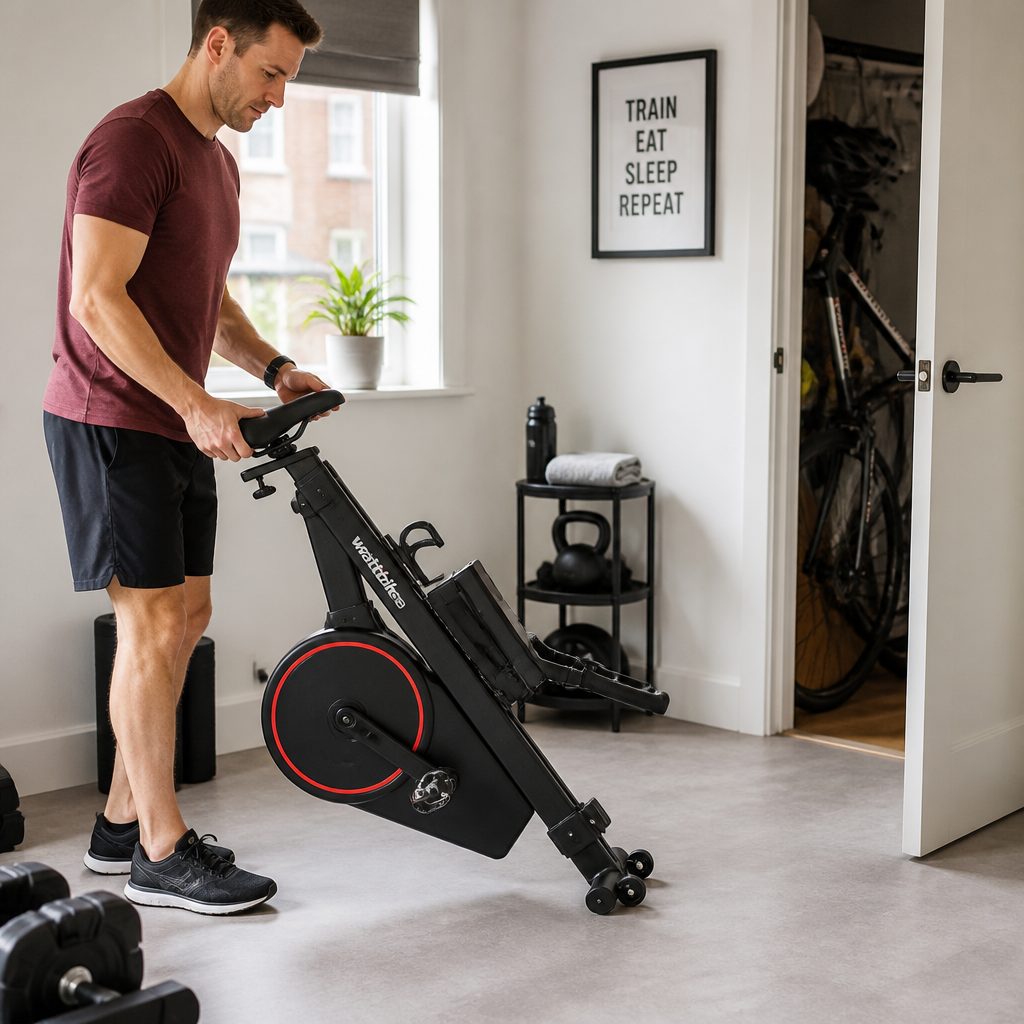
A folding bike only earns its place in a small flat if it can be rolled or lifted into storage without making every session a logistical event.
7. Make adjustable dumbbells the strength-training centrepiece
For strength work, adjustable dumbbells are one of the best uses of limited space. A single compact pair can cover presses, rows, squats, lunges, Romanian deadlifts, carries, curls, floor presses and much more, without a rack of fixed weights taking over the room. The crucial point is not the number of exercises. It is the way you handle them.
Set the dumbbells down gently, every time. Use a dedicated base or tray within your protected flooring zone, rather than parking them under a coffee table where they can roll, scuff or surprise an unsuspecting toe. Keep adjustment mechanisms clear of dust and sweat, and return the handles fully to their cradle if the design uses one. Equipment lasts longer when it is not repeatedly dropped into place after a final set performed in a haze of self-congratulation.
In a flat, controlled tempo is your secret weapon. Slow lowering phases, pauses, unilateral movements and higher-quality repetitions make relatively modest equipment demanding without needing impact. Split squats, single-leg Romanian deadlifts, one-arm rows and floor presses are all wonderfully effective and comparatively quiet. You do not need to hop between sets or fling a kettlebell into the air to have trained properly. You just need enough challenge and a progression plan.
Lower weights, do not drop them
Even protected floors and dense tiles have limits. Controlled set-downs protect the finish, reduce vibration and preserve a calmer relationship with the people below.
Use tempo as resistance
A slower lowering phase, pause or single-limb variation creates difficulty without demanding more equipment or noisier movements.
Give weights a home
Store dumbbells on the protected zone or in a stable dedicated storage spot. A clear home keeps them out of walkways and off bare flooring.
Favour stable patterns
Rows, presses, squats, hinges and carries are useful, quiet building blocks. They are not less serious because they do not cause a small earthquake.
8. Treat noise as vibration management, not just volume
The sound you hear in your room is not necessarily the sound a neighbour hears. In a flat, low-frequency vibration and structure-borne impact can travel through floors and walls in ways that feel deeply unfair. Your music may seem modest; the bass can still become somebody else's unwanted soundtrack. A quiet footfall on your floor may turn into a repetitive thud below. This is why "it did not sound loud to me" is not a particularly reliable test.
Start with the obvious: train at reasonable hours, use headphones for music or classes, and avoid jump-heavy circuits. Then refine the setup. Put equipment on full-contact flooring rather than balancing a machine partly on a mat and partly on bare boards. Make sure a folding bike is stable before riding. Check that interlocking tiles are fully seated. A tiny wobble can become a very noticeable rattle after half an hour.
For dumbbell sessions, keep the session grounded. Replace burpees with controlled squat-to-press work; replace jumping lunges with reverse lunges; replace box jumps with step-ups where appropriate. There is no moral superiority in making a noise. The goal is to train consistently, not to make your flat sound as though a bison has found a HIIT video.
Quick neighbour-friendly workout check
- Flooring is flat, connected and covers the full training zone.
- Weights have a protected place to land between sets.
- Cardio equipment is stable and not touching a wall.
- Music is in headphones rather than travelling through the building.
- The workout avoids deliberate drops, jumping and late-night impact.
- You can finish and pack away quietly without dragging kit across the room.
9. Create a storage routine that takes less than five minutes
Storage is where the best compact setup distinguishes itself from a collection of good intentions. Every piece should have a final destination: mats stacked or rolled, dumbbells in their base, bands in a basket or drawer, and folding kit returned to its allotted gap. If you have to decide where something goes after every workout, you will eventually decide that the floor is fine. The floor is rarely fine.
For folding equipment, practise the route when you first set it up. Fold it, wheel it or lift it to storage, then bring it back again. Check the turning points. Check the cupboard door. Check whether you need to move something else first. This mildly tedious rehearsal can reveal that a theoretically compact machine is awkward in your actual home, which is better discovered before it becomes part of your weekly furniture arrangement.
Keep a small cleaning cloth nearby and wipe down the machine, mat and handles after use. Rubber flooring is moisture-resistant and easy to clean, but sweat left in seams and under equipment is still an unpleasant little surprise to find later. Let mats air when needed, especially if the training zone is in a bedroom or a corner without much airflow.
A final practical note for renters: avoid glues and permanent tape unless you have clear permission and know exactly how your floor finish will react. Interlocking systems are attractive partly because they can be lifted, rearranged and taken with you. That flexibility is worth a great deal when your "home gym room" is currently also your lounge, office, dining space and occasionally the place where a guest sleeps.
10. Pick the setup that matches your real routine
There is no single best small-flat gym. There is only the one you can safely store, quietly use and return to often enough to matter. That said, the strongest choices become clearer once you decide what job the equipment must do.
Best for a minimal budget-minded setup
Interlocking EVA mats, adjustable dumbbells and bodyweight training. This keeps the footprint low, creates a comfortable movement zone and avoids buying cardio equipment before you know you need it.
Best all-rounder
Rubber or dense protective flooring paired with adjustable dumbbells and a walking pad or foldable bike. It covers strength, daily movement and floor protection without demanding a dedicated room.
Best for comfort-first cycling
Xterra Fitness FB350. Its padded back-support seat, lower-back pad and accessory tray make more sense than bare-bones compactness if gentle longer rides are your plan.
Best for the tightest storage
Xterra Fitness FB150. It is the sensible pick where a lighter 17kg bike and folded depth of around 46cm matter more than comfort extras.
The YYFITT 2-in-1 Foldable Exercise Bike is another option worth considering if your priority is a more adjustable, comfortable and stable foldable-bike format. It has been regarded as a strong overall choice for people who want a compact bike that feels less compromised in everyday use. As always, measure your storage space first. A bike can be brilliant on paper and still be entirely wrong for the gap beside your wardrobe.
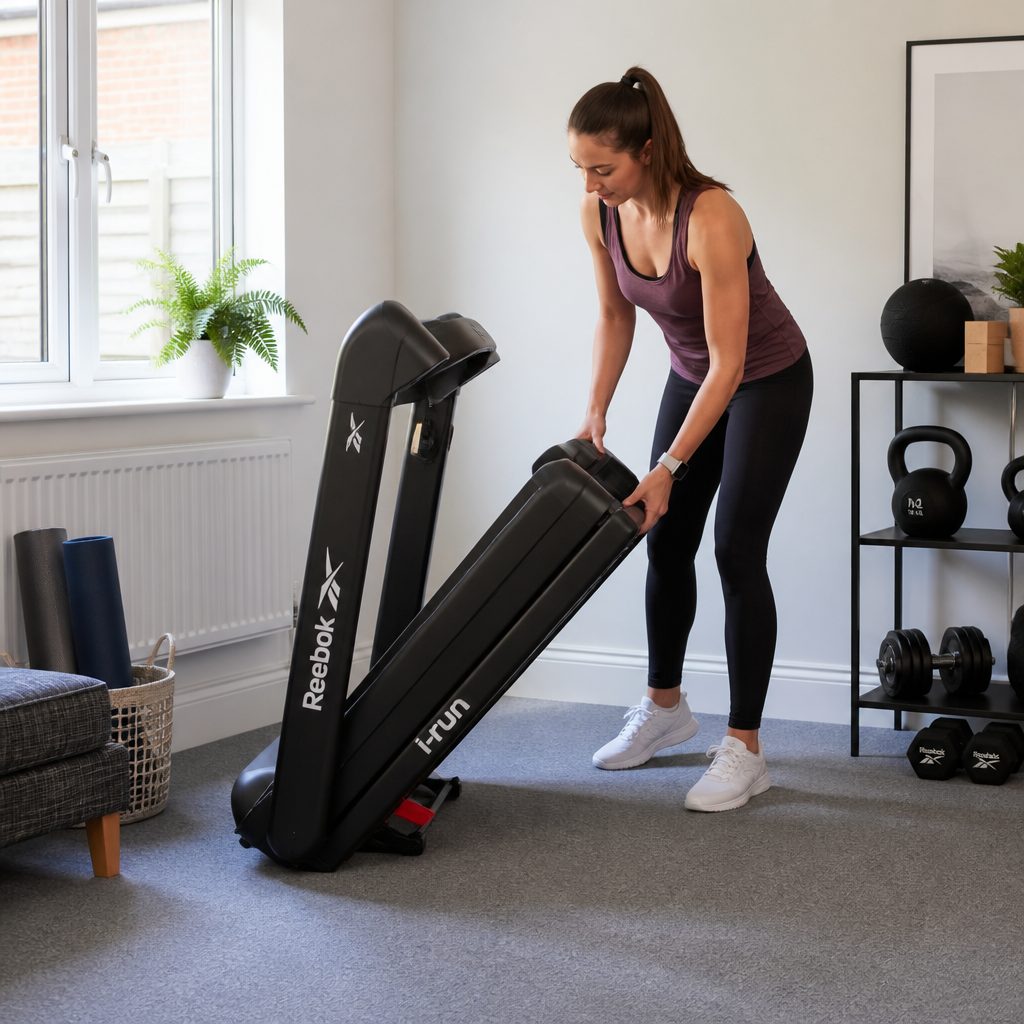
The best compact-gym setup is not necessarily the largest one; it is the one you can unfold, use and restore to normal living space without a battle.
11. A practical first-week setup plan
Do not try to build the finished dream gym in one shopping spree. Start with a floor-protection plan and a modest training menu. Spend the first week learning how the space behaves: whether the mat shifts, whether the machine feels stable, whether storage is actually manageable, and how much sound your normal workout creates.
- Clear and measure the zone. Include the space needed to get equipment in and out, not just the exercise footprint.
- Lay the flooring flat. Check edges, seams and any door clearance before putting kit on top.
- Add the quiet strength essentials. Adjustable dumbbells and a comfortable floor-work surface will take you a long way.
- Test cardio at a gentle pace. Listen for rattles, movement and unexpected vibration before committing to harder sessions.
- Build your pack-away routine. Time it. If it takes longer than a few minutes, refine where things live.
- Progress the workout, not the chaos. Add sets, reps, control and consistency before adding more bulky kit.
This slower approach also protects you from the classic home-gym error: buying equipment for an imaginary version of yourself and ignoring the version who will actually train on a rainy Tuesday evening after work. Your real routine may be twenty minutes of dumbbells and an easy ride. Excellent. That is a proper home gym doing its job.
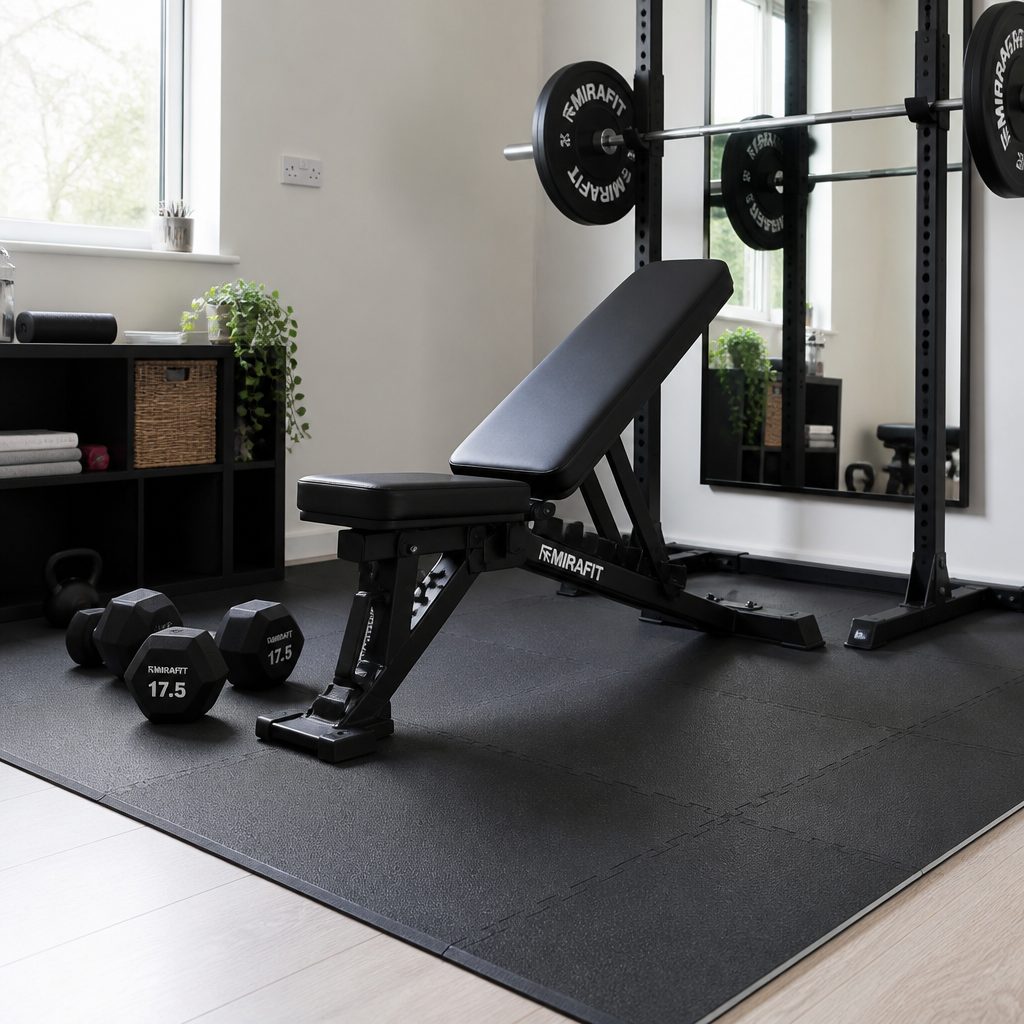
A simple, repeatable routine with protected flooring beats an overcrowded home gym that is difficult to use, store or live around.
Frequently asked questions
They can provide useful protection for controlled dumbbell training, especially when the weights are placed down carefully. For regular heavier dumbbell, kettlebell or bench use, denser rubber flooring offers a tougher, more stable surface. Neither option is an excuse to drop weights from height.
For controlled dumbbells, kettlebells, benches and compact equipment, 15–20mm rubber flooring is a sensible range. Twenty-millimetre tiles offer roughly 70–80% impact absorption. If greater impact reduction is the priority, 30mm sprung tiles offer roughly 85–90% absorption.
You can, but the motor is only part of the noise picture. Protect the floor, walk with controlled foot strikes, wear appropriate trainers, keep the machine stable and choose considerate times. Walking is generally easier to manage than running, particularly on shared floors.
It often suits flats better because cycling does not involve repeated foot impact against the floor. Magnetic-resistance folding bikes are designed for low-impact cardio, although you should still use a protective base and check that the bike is stable rather than rattling against the surface.
Choose the FB150 if minimal folded depth and easier lifting matter most: it weighs 17kg and folds to around 46cm deep. Choose the FB350 if comfort is more likely to keep you cycling, as it adds a padded back-support seat, cushioned lower-back pad and accessory tray, whilst retaining the same 1.5kg flywheel, eight resistance levels and 102kg user limit.
No. A large bench can be useful, but it is not essential. Floor presses, split squats, rows, hinges, overhead presses and core work can all be done with adjustable dumbbells and protected floor space. Add a bench only if it has a clear role and a reliable storage place.
Start with a clean, dry, level floor and make sure every interlocking edge is fully connected. Build a training zone large enough that you are not constantly stepping on the perimeter. Check it periodically, particularly after moving cardio equipment or folding the tiles away for cleaning.
Buying for intensity rather than repeatability. A small flat gym works when equipment is easy to retrieve, quiet to use, protected underneath and straightforward to pack away. The impressive-looking item that never leaves the cupboard is not helping anybody get fitter.
The bottom line
A small UK flat can support a thoroughly effective home gym without sacrificing the floor or your neighbours' patience. Start with a properly sized protected zone, choose EVA for comfort-led general training or denser rubber for regular controlled weight work, and make low-impact cardio your default. Adjustable dumbbells plus folding cardio equipment are a particularly sensible pairing because they offer real training variety without colonising the room. Keep the movements controlled, the storage routine simple and the volume civilised. Do that, and your flat gym will feel less like a compromise and more like the setup you actually use.