
Best Compact Home Gym Setups Under £500 for a Spare Room
A proper home gym does not need a cable stack, a mirrored wall or a room that looks like it has been annexed by a small fitness franchise. These compact builds combine a bench, adjustable dumbbells, bands and a mat into realistic spare-room setups with enough range for productive strength training.
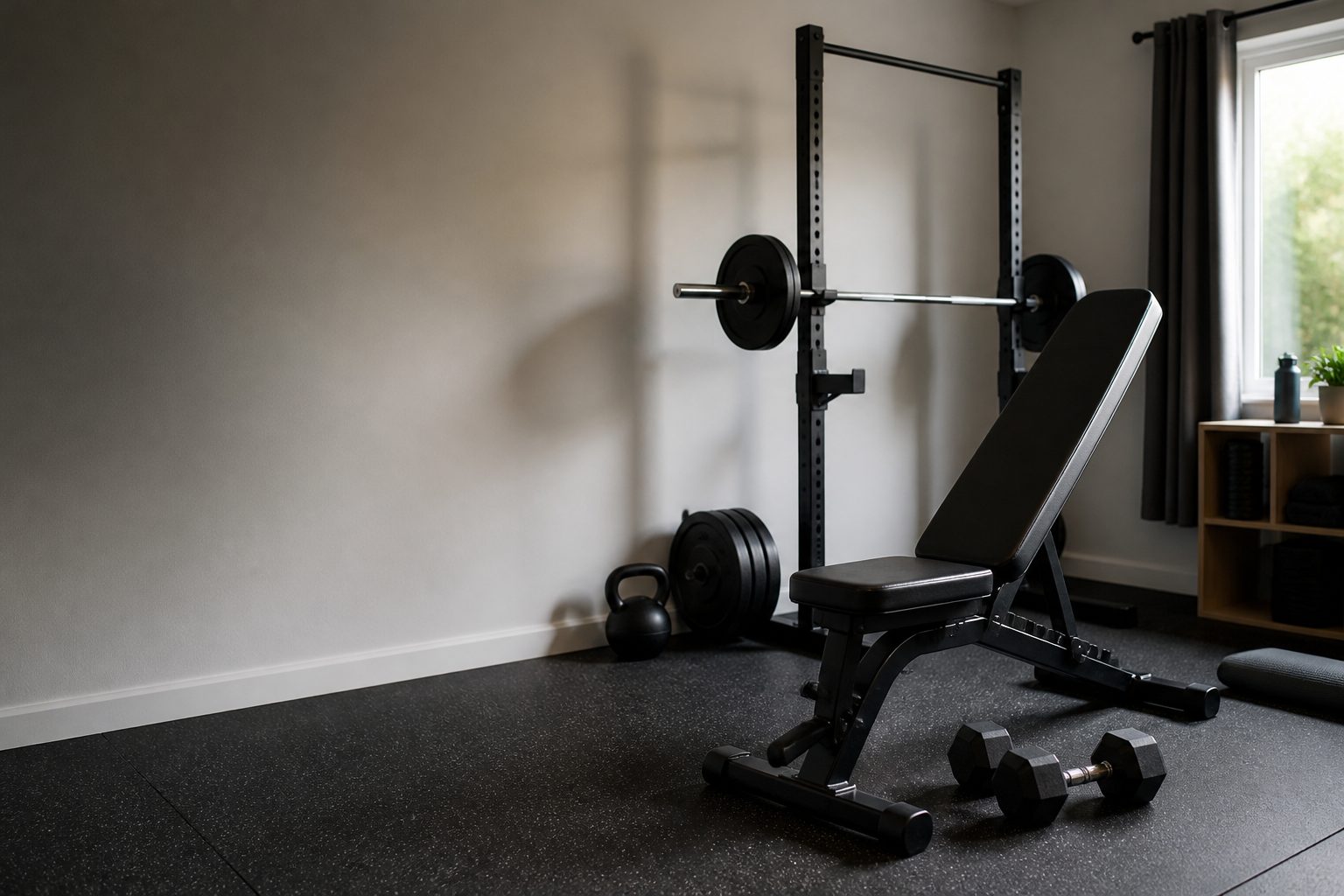
A sensible spare-room gym is not a miniature commercial facility. It is a clear training area, a stable bench, adaptable resistance and enough floor protection to let you train without negotiating with the carpet.
 By James Oduya · Staff Writer & Home Gym Columnist · Updated October 15, 2026
Why these four pieces make such a good small-room gym
The first mistake many people make with a home gym is buying one big thing because it looks decisive. A multi-gym can be brilliant in the right setting, of course, but it can also become a large, expensive monument to January motivation. In a spare room, versatility wins. You want equipment that earns its footprint, moves when you need the room for something else, and lets you progress without buying an entirely new training environment every few months.
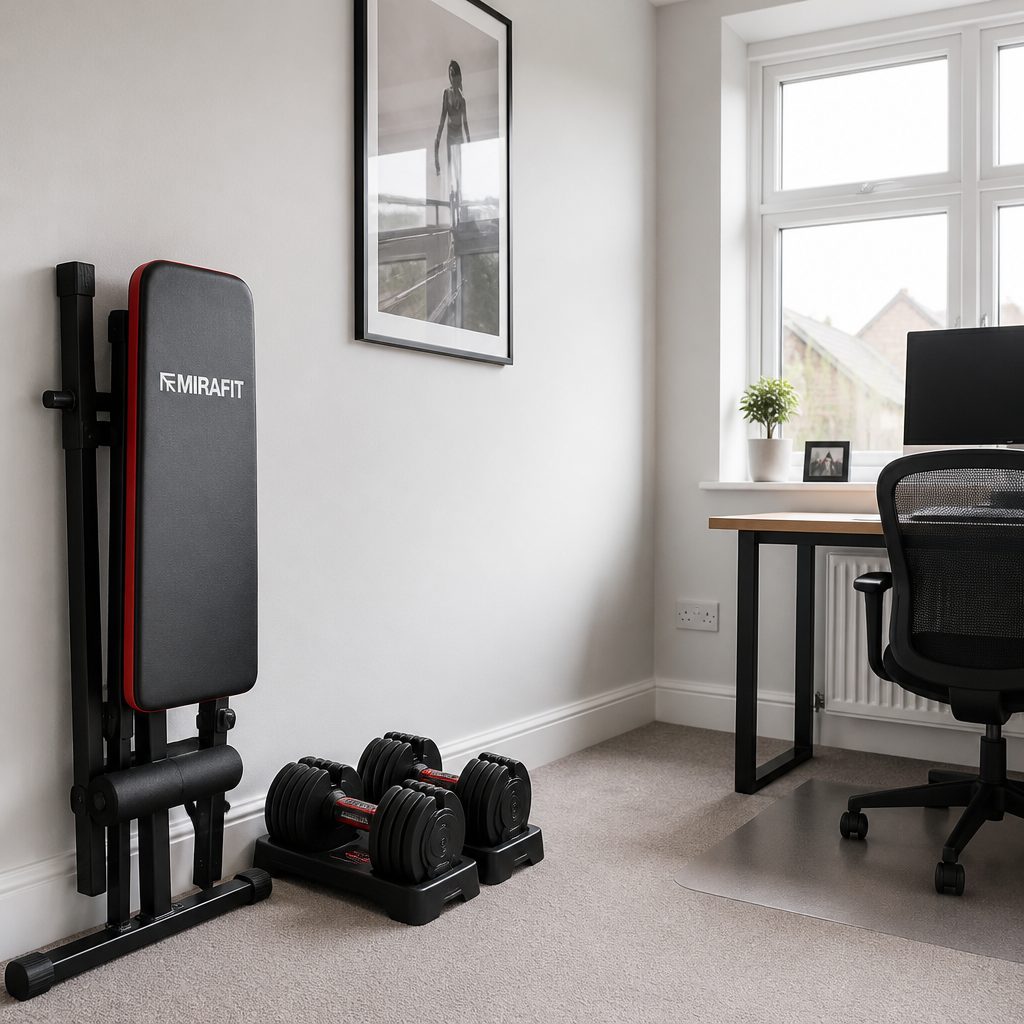
A foldable bench and adjustable dumbbells can be tucked to one side after training, leaving the room usable for its ordinary civilian duties.
That is why I keep returning to the same four-part formula: adjustable dumbbells, an adjustable bench, resistance bands and a substantial exercise mat. It is not terribly glamorous. It is, however, remarkably effective. Dumbbells cover the bulk of your loaded pushing, rowing, hinging, squatting, carrying and arm work. A bench turns floor presses into proper presses, makes chest-supported rows possible and gives you reliable angles for incline work. Bands provide low-impact pulling, warm-ups, assistance and the sort of high-rep finishers that make you wonder why you thought "one more set" was a sensible phrase. The mat protects the room and makes floor work much nicer.
A usable training zone can work in roughly 2m by 1.5m. That is a very manageable patch of a spare room. You still need enough clearance to stand, hinge and move your arms without introducing a lampshade to a kettlebell-style swing, but this is not a garage conversion project. It can share space with a desk, guest bed or laundry mountain. We have all got one.
The sets below are deliberately built around products that complement one another rather than chasing an imaginary perfect single purchase. Every option includes the same essential categories, but each leans in a slightly different direction: maximum stability, easier storage, beginner-friendly spending or a more ambitious progression path. None demands a dedicated gym room. That is rather the point.
For a spare room with carpet, the mat is not an optional finishing touch. It protects the pile, reduces transmitted impact and gives the bench a more consistent surface. Choose at least 15mm thickness for general use; if you expect weights to be dropped, 20mm is the more sensible starting point.
How I judged a compact setup rather than a pile of gear
A cheap pile of gym equipment is not automatically a cheap gym. The individual pieces have to work together. In this category, I care first about how a setup behaves on an ordinary weekday evening: can you move from a dumbbell press to a row without shuffling furniture for ten minutes; does the bench feel planted; can the weights change quickly enough to keep a circuit moving; and is there a straightforward place for everything when you finish?
Bench stability matters more than a flashy long feature list. An adjustable bench supports some of the exercises where poor positioning is most annoying: pressing, single-arm rows, Bulgarian split squats, hip thrusts and seated shoulder work. A proper seat angle is valuable on incline presses because it helps prevent you sliding forward as fatigue sets in. That sounds minor until you are halfway through a set and trying to hold yourself in place with your eyebrows.
I also weighed the ceiling of the setup against its physical inconvenience. A beginner does not necessarily need a bench designed around very heavy dumbbell pressing, but they still deserve one that does not feel like a garden chair during a row. Equally, an experienced lifter might value a heavier fixed bench even if it is less convenient to fold away. Small-room gym buying is almost always an exercise in accepting the right compromise, rather than pretending there is no compromise at all.
Fast weight changes keep sessions flowing
A dial-adjustable dumbbell system is particularly useful when a single session moves between presses, rows, curls and lunges. The less fiddling between exercises, the more likely you are to finish the work you planned.
Floor protection is part of the equipment
A mat cushions kneeling work and gives you a defined training boundary. More importantly, it helps protect both the floor and your relationship with whoever occupies the room below.
Storage is a training feature
Gear that is easy to move, fold or keep together gets used. Gear that requires a small archaeological excavation before every workout tends to become decorative surprisingly quickly.
Ranked compact home gym setups
There is no magical build that suits every spare room, every budget or every training history. The rankings below are therefore about fit. The best overall setup gives most people a stable, flexible base. The others make more sense if folding storage, a firmer bench platform or a very cautious first purchase matters more to you.
1. MuscleSquad Adjustable Dumbbells, Flybird Adjustable Bench, MuscleSquad Resistance Bands and 15mm Exercise Mat — Best for most spare-room lifters
This is the build I would point most people towards first. It gets the fundamentals right without wasting precious room on awkward specialist kit. MuscleSquad's adjustable dumbbells use a quick-select dial system, so changes happen in seconds with a twist rather than a lengthy session moving loose plates and collars about. That is a real quality-of-life benefit in a spare room, where you often want to train efficiently before the room resumes being an office, a guest room or somewhere to put parcels you meant to deal with last weekend.
The adjustable dumbbells were available in single-dumbbell variants including 18kg and 27kg, with up to 10 weights in one. That flexibility lets one pair cover a wide range of exercises. You can use a lighter setting for lateral raises and curls, then move swiftly to a heavier selection for rows, Romanian deadlifts, split squats and pressing. As your strength develops, the ability to add meaningful load without adding a rack full of individual dumbbells becomes the central attraction.
The Flybird Adjustable Bench is the logical partner for a compact all-rounder. It offered eight back positions, four seat positions and three leg positions, giving 96 possible combinations. Not every one of those combinations will become part of your weekly routine, and that is fine. What matters is that flat, incline and supported positions are available for the exercises most home lifters actually perform. Its competition-style height was listed at 44.15cm, which is useful for stable setup and leg drive when pressing.
Its stated capacity was 300kg, whilst the Pro version was listed at 363kg. For the ordinary home lifter, the more practical story is that it combined a substantial quoted capacity with a foldable format. That is unusual enough to matter. You can get a genuine adjustable bench experience without leaving a permanent obstacle in the middle of the spare room.
Add MuscleSquad resistance bands and a 15mm mat, and this becomes a very rounded little gym. Use bands for pull-aparts, face pulls, triceps press-down variations, glute work and warm-ups. Use the mat for planks, dead bugs, press-ups, stretching and any work where knees meet floor. It is not elaborate. It simply covers a surprising amount of ground well.
Pros
- Quick-select dumbbell changes suit circuits and mixed dumbbell sessions.
- Flybird's foldable design is especially helpful in a shared spare room.
- Eight back positions and adjustable seat settings allow useful pressing and rowing angles.
- Loop bands fill the pulling and mobility gaps that dumbbells alone can leave.
Considerations
- Adjustable dumbbells remain bulkier at lighter settings than fixed light dumbbells.
- The bench's many positions are useful, but take a little setup time between exercises.
- A 15mm mat is sensible for controlled lifting, not an invitation to drop weights.
2. MuscleSquad Adjustable Dumbbells, Mirafit M150 Adjustable Bench, MuscleSquad Resistance Bands and 20mm Exercise Mat — Best for heavier dumbbell training
If your priority is a bench that feels more planted under loaded pressing and rows, this is the more serious compact build. The Mirafit M150 Adjustable Bench had a 28kg construction weight, which is precisely the sort of unsexy specification I like to see when choosing a bench. A heavier bench is not automatically better in every respect, but it is much less likely to shuffle, rock or feel nervous when you are working hard.
The M150 offered six backrest positions and four seat positions. That is fewer adjustment permutations than the Flybird, but it is plenty for the core jobs: flat dumbbell pressing, incline work, seated pressing, supported rows, split squats and a range of abdominal exercises. Crucially, the adjustable seat helps you preserve position during incline pressing. Without it, the gentle slide towards the front of the bench can become the surprise extra exercise nobody requested.
Mirafit listed a 300kg capacity for the M150, with a separate 260kg capacity figure also associated with the bench. Whichever stated figure you use as your reference, this was a sturdy proposition for a compact home setup. It makes particular sense for someone who had already built confidence with dumbbell work and wanted the reassurance of a more substantial bench rather than the smallest possible folded footprint.
The MuscleSquad dumbbells remain a strong match here because fast selection complements a bench designed for multiple angles. You can work through flat presses, incline presses, chest-supported rows and shoulder presses without turning every change into a plates-on-and-plates-off intermission. Bands still matter too. Heavy dumbbell work is often push-dominant in a small home gym; loop bands make it easy to add pulling volume, shoulder-health work and lighter lower-body sessions without another large purchase.
The sensible upgrade path
Choose the more substantial bench when you expect dumbbell pressing to become a mainstay of your training. The bench is the part you feel every session: it affects your setup, your confidence and whether loaded movements feel calm or slightly like a negotiation.
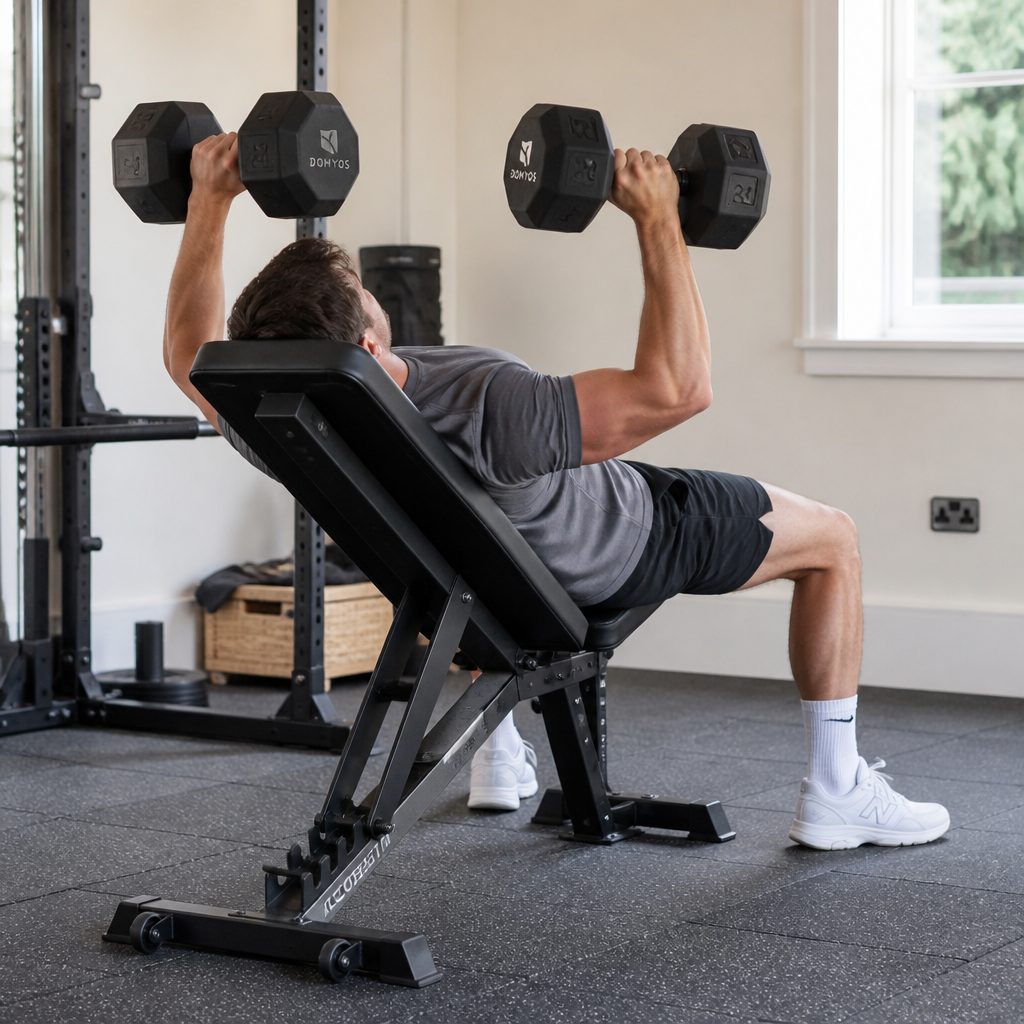
A sturdier adjustable bench brings useful confidence to flat presses, incline presses, chest-supported rows and Bulgarian split squats.
3. PROIRON 40kg Set, Mirafit Foldable Bench, Generic 5-Band Resistance Set and 15mm Exercise Mat — Best for beginners who need easy storage
This is the sensible entry point for someone who wants to begin strength training in a spare room without buying equipment that feels intimidating, oversized or needlessly elaborate. The PROIRON 40kg Set is the budget-minded dumbbell option here. It does not offer the instant dial selection of the MuscleSquad system, but that need not be a deal-breaker if you are learning basic movements, using fairly straightforward rep schemes and are happy to make deliberate changes between exercises.
The Mirafit Foldable Bench was the key choice for tight rooms. It adjusted through incline positions and was stable enough for dumbbell work up to roughly 25–30kg per hand. That is meaningful capacity for beginner and intermediate training. Plenty of people can build a very capable physique with weights in that range, particularly when exercises are controlled, unilateral work is included and progress is measured in reps as well as load.
There is a caveat, and it is worth saying plainly. The lighter construction meant detectable wobble under heavier loads. If you were pressing 35kg dumbbells or more in each hand, you would feel the difference. This is not the bench for somebody who knows they want to chase heavier dumbbell pressing immediately. But for a new trainee, a returner or someone who wants a compact setup for three full-body sessions each week, it represents a much more proportionate piece of kit.
A generic five-band resistance set broadens the programme at very little physical cost. Typical sets covered light to heavy resistance, commonly from 5–15kg through to 25–55kg. That gives you plenty of ways to scale pull-aparts, rows, good mornings, glute bridges, press-downs and assisted mobility. Keep the bands in a small basket or bag beside the bench and you have a neat solution rather than a drawer full of tangled elastic spaghetti.
This setup is best approached with sensible expectations. It is not the one I would select for maximal loading or rapid transitions. It is the one I would choose if the most important thing was making training feel approachable and easy to put away. Starting modestly is not a failure of ambition. It is usually what allows the habit to survive long enough to become useful.
Pros
- Mirafit's foldable format makes it easier to reclaim the room after training.
- The dumbbell set suits learning fundamental movement patterns at a measured pace.
- Five resistance levels give useful scaling for mobility, warm-ups and accessories.
- A controlled beginner programme needs very little equipment beyond this.
Considerations
- Changing traditional dumbbell loads is slower than using a dial system.
- The lighter bench is less convincing once very heavy dumbbell work enters the plan.
- Generic band sets vary in feel, so inspect them regularly for wear.
4. MuscleSquad Adjustable Dumbbells, Flybird Adjustable Bench, MuscleSquad Resistance Bands and 20mm Exercise Mat — Best for flat dwellers and quieter training
This final build is about being considerate of the room and the building around it. If you train upstairs, live in a flat or simply dislike the idea of transmitting every set into the floorboards, put more thought into the mat. A 20mm mat is the wiser option where impact protection is a bigger concern. It will not turn dropped dumbbells into a silent event; nothing sensible will. But it offers more cushioning than a thinner layer and encourages the controlled, deliberate style of lifting that suits a spare-room gym beautifully.
The MuscleSquad dumbbells and Flybird bench work here for the same reasons they led the overall build: quick changes, useful angles and foldable storage. The difference is programme design. This is the setup for someone who wants to train hard without treating their home like a warehouse gym. Think controlled Romanian deadlifts rather than dropping the weights at the bottom. Think goblet squats, split squats, floor work, presses, rows and slow tempo work rather than explosive movements that need more clearance and more robust flooring.
Resistance bands are particularly valuable in this quieter build because they add fatigue without impact. A banded row, a set of face pulls or high-rep glute work can be humblingly difficult while making very little noise. You can also use bands to make lighter dumbbell sessions feel challenging: slower eccentrics, pauses, higher reps and unilateral movements go a long way. The spare-room gym does not need to mimic every exercise in a commercial facility. It needs to give you enough good options that you keep turning up.
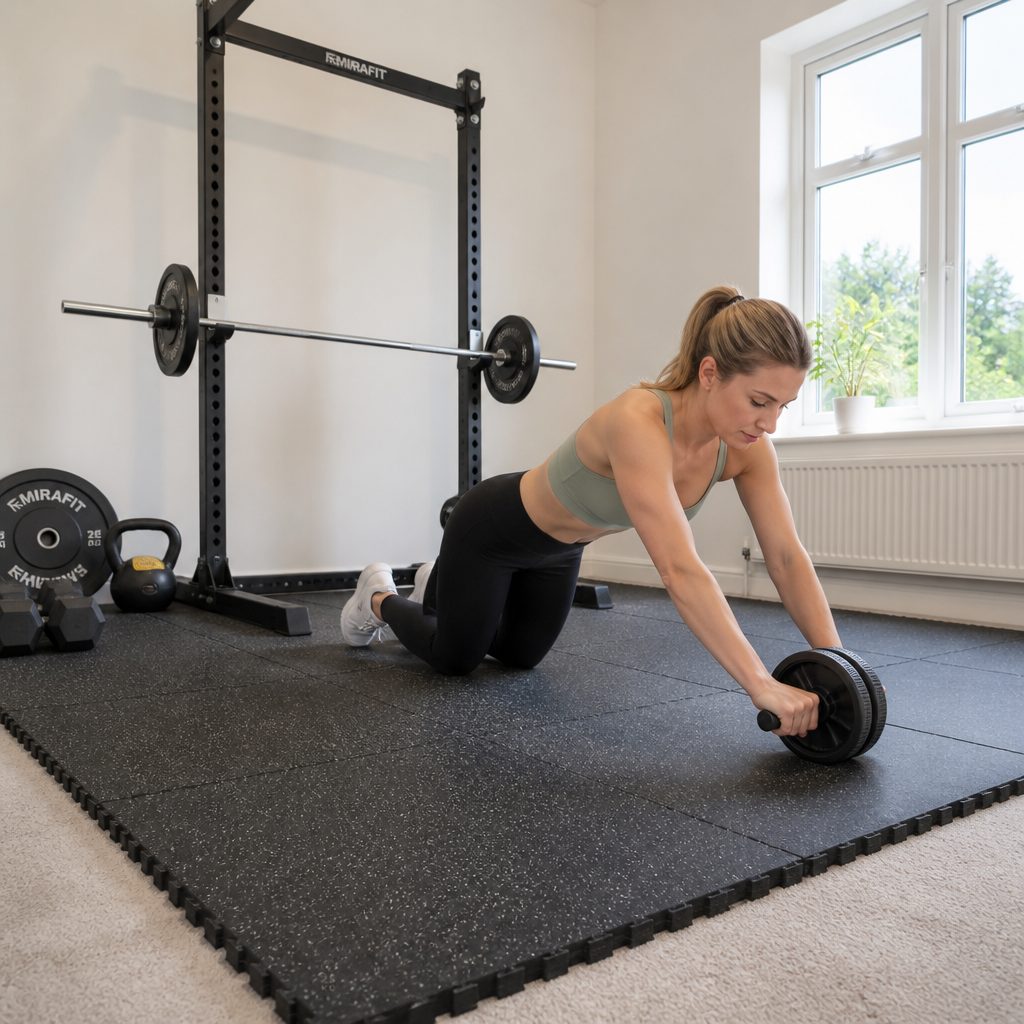
Thicker flooring is a practical investment for upstairs rooms: it makes kneeling work kinder and helps reduce the impact transmitted through the floor.
At-a-glance comparison of all four setups
The table below is intentionally about capability rather than frozen shop prices. Retail listings change, bundles appear and disappear, and the useful question is not whether a setup was briefly discounted on a Tuesday afternoon. It is whether the pieces match the kind of training you genuinely expect to do.
| Ranked setup | Dumbbell approach | Bench focus | Known bench figures | Mat choice | Best use |
|---|---|---|---|---|---|
| MuscleSquad + Flybird + MuscleSquad bands | Quick-select dial; up to 10 weights in one | Versatility and folding storage | 8 back, 4 seat and 3 leg positions; 300kg stated capacity | 15mm | Most spare-room lifters |
| MuscleSquad + Mirafit M150 + MuscleSquad bands | Quick-select dial; 18kg and 27kg single variants | Stable, more substantial training base | 6 back and 4 seat positions; 28kg construction weight | 20mm | Heavier dumbbell work |
| PROIRON + Mirafit Foldable + generic bands | Traditional adjustable set | Entry-level folding practicality | Suitable for work up to roughly 25–30kg per hand | 15mm | Beginners and tight storage |
| MuscleSquad + Flybird + MuscleSquad bands | Quick-select dial; fast between-set changes | Quiet, controlled home training | 8 back positions; foldable design | 20mm | Flats and shared buildings |
The first and fourth builds share major components because the environment changes the recommendation. A thicker mat and a quieter training style can matter more than another adjustment on a bench. This is the sort of detail that gets lost when every buying guide treats equipment as though it lives in an empty warehouse rather than in a British home with neighbours, floorboards and a cat who has suddenly decided the mat is theirs.
How to set the room up without making it feel like a gym showroom
Start with the mat, not the bench. Mark out the place where you will actually stand, kneel and lie down. If the room has a door that opens inward, make sure you can still use it without performing a low-level obstacle course. Give yourself enough side clearance for dumbbell movements and enough room behind the bench to adjust it. You do not need acres of space, but you do need to move normally.
Place the bench so that its long axis runs along the room rather than across a narrow path where possible. Keep dumbbells at the head end or alongside the mat rather than directly behind the bench, where they become a toe-stubbing trap. Bands can live in a lidded storage box, canvas tote or small drawer. The aim is not Instagram perfection. The aim is being able to begin a session with as little friction as possible.
Protect the room's normal function
Leave a clear route to windows, wardrobes and doors. A gym setup that interferes with daily life will eventually be moved, usually to the least convenient place possible.
Store by session order
Keep the mat ready first, dumbbells second and bands together. This tiny bit of organisation makes a quick workout feel like a quick workout rather than a domestic project.
Train with controlled finishes
Set dumbbells down rather than dropping them. It is better for the mat, the room, the equipment and whoever is trying to watch television downstairs.
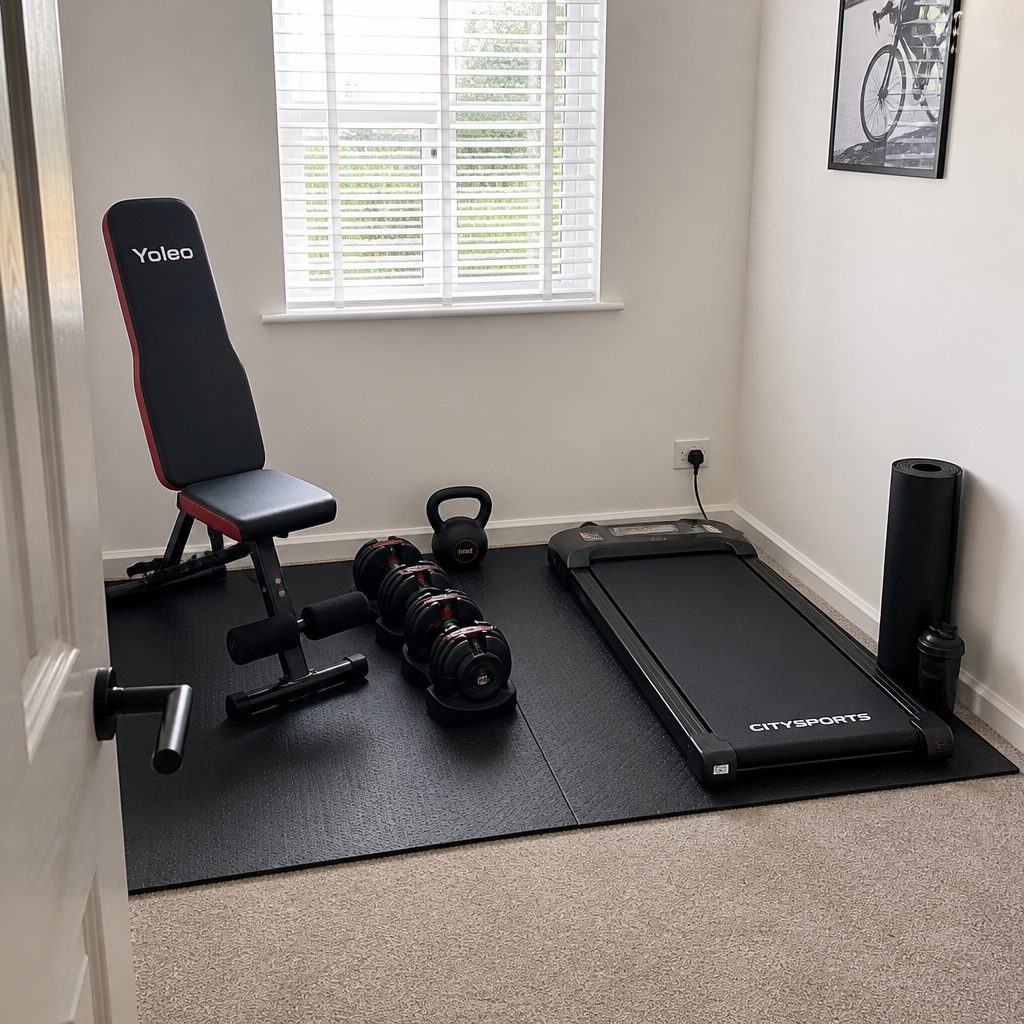
The most successful small gym layouts protect a clear route through the room and keep every piece of equipment close to the training mat.
Exercises that justify the bench, dumbbells and bands
A compact home gym works because the equipment overlaps in useful ways. Do not think in terms of finding one exercise per item. Think in terms of building movement patterns. You need a push, a pull, a squat or lunge, a hinge, some core work and a few accessories that make your shoulders and hips feel happier rather than creakier.
For upper-body pushing, the bench gives you flat dumbbell presses, incline presses and seated shoulder presses. If you do not fancy pressing overhead in a low-ceilinged room, that is entirely reasonable; use incline presses and floor presses instead. For pulling, do one-arm dumbbell rows, chest-supported rows where the bench angle permits, and band rows or face pulls. Bands are especially useful because many compact dumbbell-only routines become a bit too press-heavy without them.
Lower body is where newcomers sometimes underestimate dumbbells. Goblet squats, Romanian deadlifts, split squats, reverse lunges, hip thrusts and step-free variations all work in very modest space. Single-leg work is particularly handy because it makes limited load go further. A hard set of Bulgarian split squats does not care that your gym room has a guest bed. It will find you.
A very simple three-day approach is enough. Day one: dumbbell press, row, goblet squat, band face pull and plank. Day two: Romanian deadlift, split squat, seated press, band row and dead bug. Day three: incline press, chest-supported row, reverse lunge, band pull-apart and glute bridge. Keep repetitions controlled, stop a rep or two before form falls apart, and add reps before immediately chasing heavier resistance.
Do not overcomplicate progression
With compact equipment, progress can mean an extra repetition, a slower lowering phase, a better range of motion, a more stable setup or another set completed with good form. More weight is useful, but it is not the only measure that counts.
What to prioritise when your budget is finite
If you cannot buy every ideal piece at once, prioritise the mat and dumbbells first, then add the bench, then bands if needed. That is not because bands lack value; they are extremely useful. It is because adjustable dumbbells and floor space already let you train your entire body, whilst the bench is the upgrade that unlocks better pressing and supported pulling. The mat protects the space from day one.
Once you are choosing a bench, decide whether storage or stability is the non-negotiable feature. The Flybird is compelling for people who genuinely need to fold the bench away. The Mirafit M150 makes more sense if the bench will mostly stay out and you expect loaded pressing to be central to your training. The Mirafit Foldable Bench belongs in the middle: genuinely useful, compact and sensible, but not the answer for a lifter already working with very heavy dumbbells.
For dumbbells, fast adjustment is worth considering honestly. If you tend to do supersets, circuits or varied full-body sessions, a dial system helps keep momentum. If you are happy to complete straight sets of one exercise before changing load, a traditional adjustable set can be perfectly adequate. Buying the system that matches how you actually train beats buying the one that looks most impressive in a product photo.
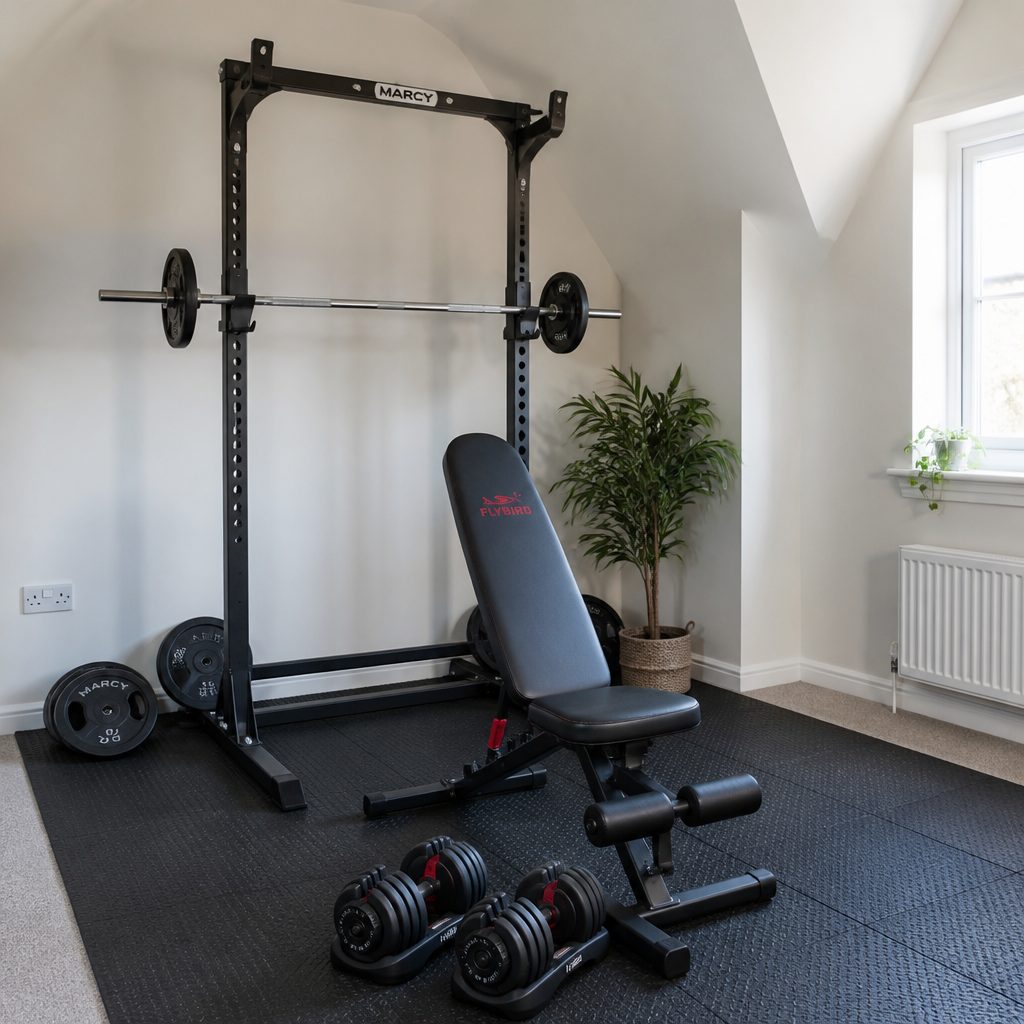
A compact kit can still support full-body strength work, provided the equipment is selected for progression rather than novelty.
Best-for awards: choose the setup that fits your life
Best all-rounder
MuscleSquad Adjustable Dumbbells, Flybird Adjustable Bench, MuscleSquad Resistance Bands and 15mm Exercise Mat. The strongest balance of fast adjustments, bench versatility and folding convenience.
Best for heavier training
MuscleSquad Adjustable Dumbbells, Mirafit M150 Adjustable Bench, MuscleSquad Resistance Bands and 20mm Exercise Mat. Choose this if a more substantial bench matters most.
Best for beginners
PROIRON 40kg Set, Mirafit Foldable Bench, Generic 5-Band Resistance Set and 15mm Exercise Mat. A practical, approachable route into regular strength work.
Best for flats
MuscleSquad Adjustable Dumbbells, Flybird Adjustable Bench, MuscleSquad Resistance Bands and 20mm Exercise Mat. The thicker mat supports quieter, controlled training.
The important word in all of these awards is "best for", not simply "best". A heavier bench is not best if you must fold it away after every session. A traditional dumbbell set is not worse if you enjoy slower, methodical training and want a modest entry point. The correct setup is the one that gets used consistently. The rest is just equipment collecting with better intentions.
Care, safety and the boring details that save hassle
Inspect bands before use, particularly around attachment points and any place where the material has been folded or stored under tension. Resistance bands are simple tools, but worn elastic can fail abruptly. Keep them away from sharp edges and do not stretch them across a room full of furniture as though you are trying to recreate a low-budget action film.
With adjustable dumbbells, make sure the selected load is properly engaged before lifting. A quick-select system is convenient precisely because it removes faff, but that does not mean you should rush the check. For benches, confirm that the backrest and seat are fully locked into their chosen positions before you sit or lie down. It takes seconds and is considerably less dramatic than discovering the answer midway through a press.
Finally, treat stated capacity as one part of the picture rather than a target to test. Your bodyweight, the load and the way an exercise shifts force all matter. Good technique, stable placement and gradual progression remain more important than any large number printed in a listing.
Do not use a domestic exercise mat as permission to drop dumbbells. Even a thicker 20mm surface is designed to improve protection and comfort, not to turn a spare room into a weightlifting platform.
Frequently asked questions
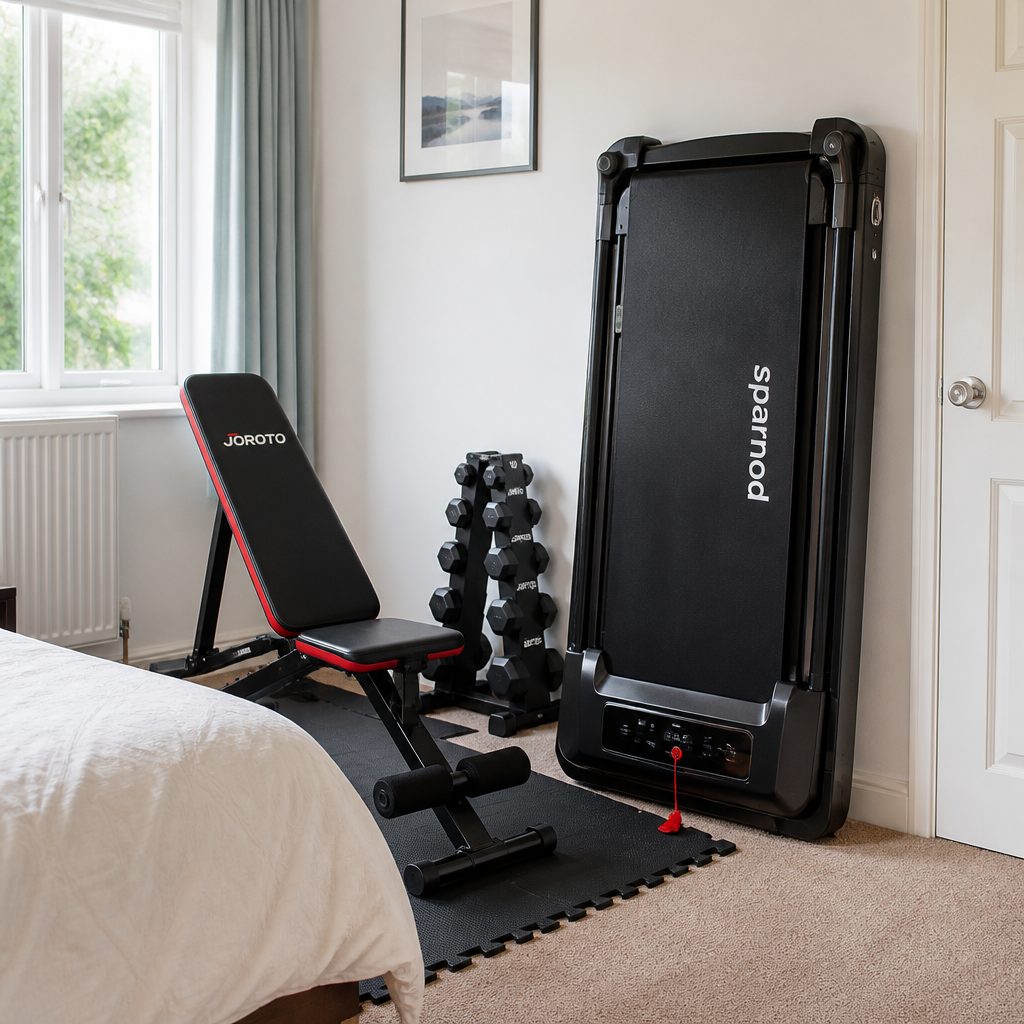
The best home gym is the one that is ready for a weekday workout, then disappears neatly enough that the spare room can remain a spare room.
The bottom line
For most people, the MuscleSquad Adjustable Dumbbells, Flybird Adjustable Bench, MuscleSquad Resistance Bands and a 15mm exercise mat make the most balanced compact home gym setup. It is versatile, practical to store and capable of supporting years of sensible progression. Pick the Mirafit M150 build if bench stability and heavier dumbbell work are the priority, choose the PROIRON and Mirafit Foldable combination if you are starting cautiously, and move to a 20mm mat if your flat or floor demands a quieter approach. Keep the programme simple, train with control and let the spare room do more than collect laundry.