
The Best Adjustable Kettlebells for Small Spaces
A good adjustable kettlebell frees up floor space without turning every workout into an engineering project. We compare the strongest dial, pin-selector and plate-loaded options on useful weight range, handle comfort, shape and the all-important question of whether the weights stay settled when the swings get lively.
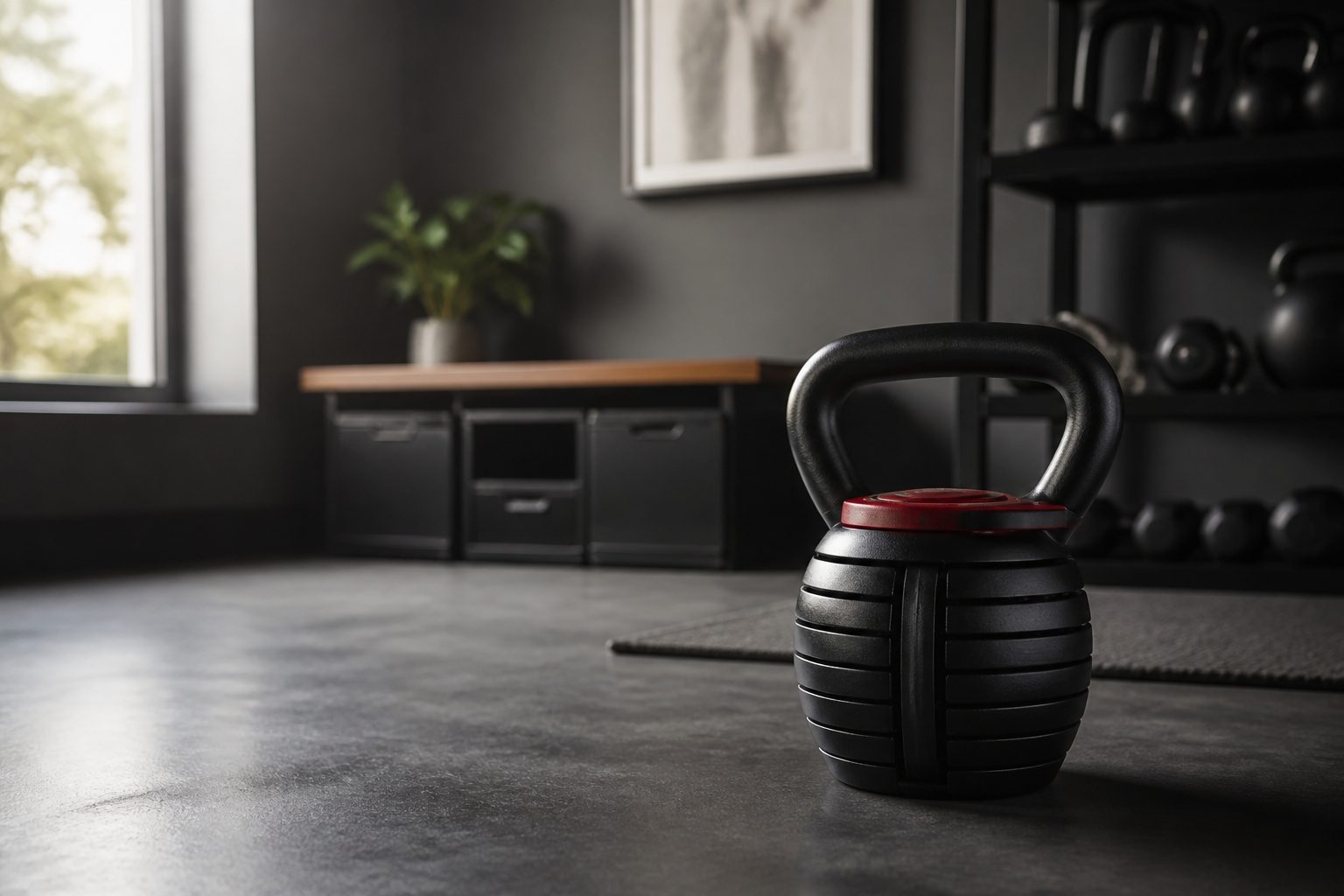
An adjustable kettlebell can replace a surprisingly unruly line-up of fixed bells, which is rather useful when the spare room also needs to remain a spare room.
 By Sophie Marchant · Product Reviews Editor · Updated August 20, 2026
Why an adjustable kettlebell makes such a difference at home
Home training has a habit of beginning modestly. One kettlebell becomes two. Then you decide that the jump between them is a little too dramatic for presses, so a third arrives. Before long, your carefully planned workout corner has acquired the visual language of a Victorian cannonball store.
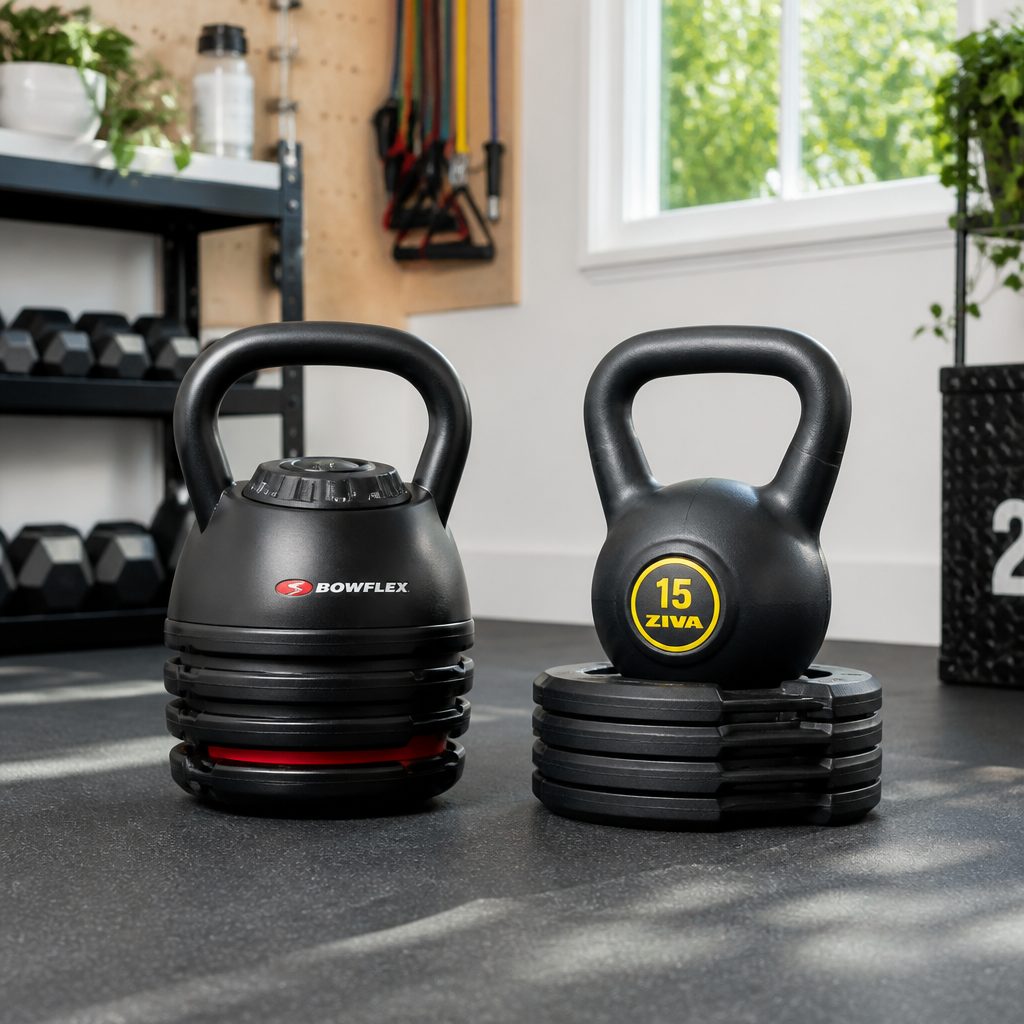
A small-space kettlebell setup works best when the adjustment method matches the session: quick selectors for changing circuits, plate systems for settled strength blocks.
An adjustable kettlebell solves the storage half of that problem. Instead of keeping a sequence of individual weights around, one shell covers several training loads. That is especially appealing in a flat, a box room, a shared living space or the sort of garage gym where every square inch is already negotiating with a bike, a bench and a folding clothes airer.
The catch is that kettlebells are not dumbbells with a more interesting silhouette. Their balance, handle clearance and shell geometry matter through swings, cleans, snatches and rack work. A system that feels secure for a controlled goblet squat can feel entirely different when it is travelling through a hard swing. This is why the best choice is not automatically the model with the biggest stated range.
For most people, the decision comes down to a simple trade-off. Dial and pin systems are made for convenience: put the bell in its dock, select a weight and get moving. Plate-loaded competition bells take longer to alter but tend to offer much finer increments, a more traditional shell and a wider progression runway. Neither approach is universally better. They simply reward different kinds of training.
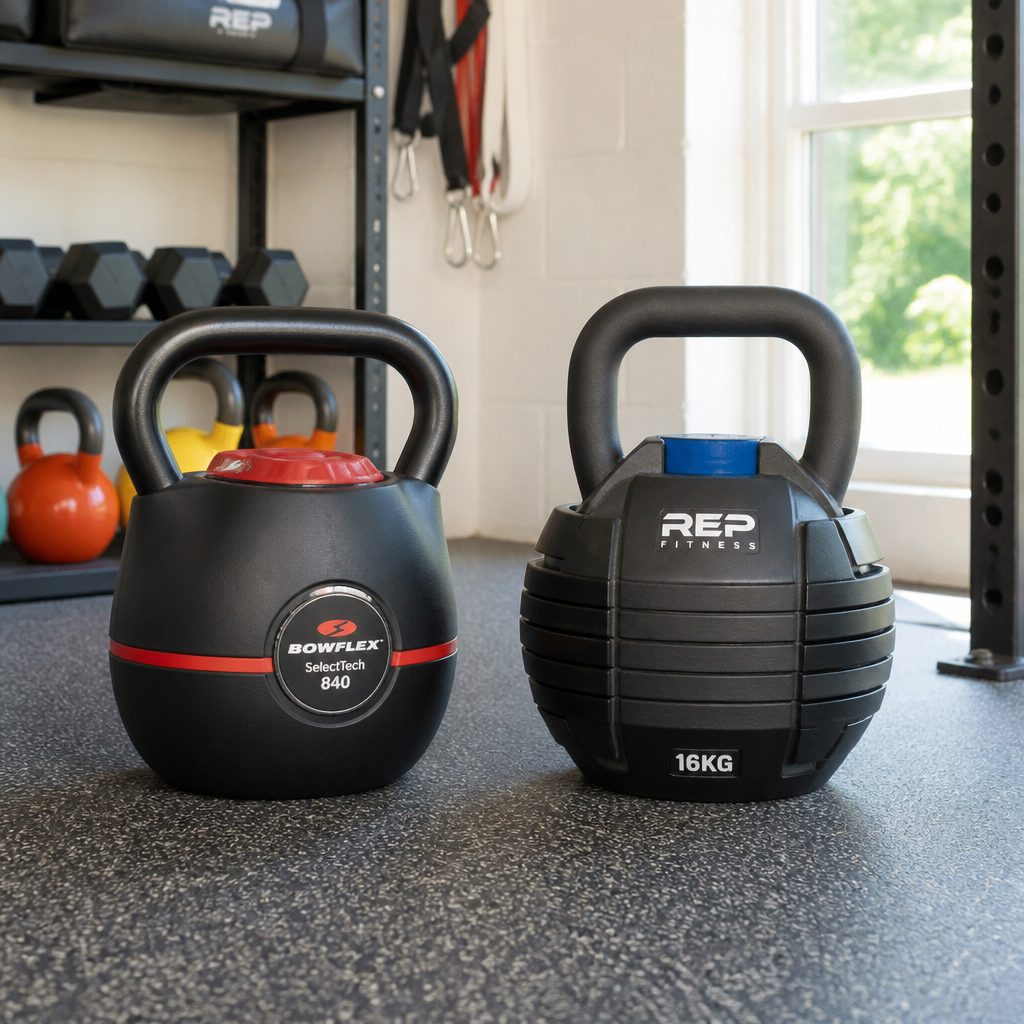
Dial systems prioritise quick changes between exercises, while plate-loaded competition shells reward patients who want very fine progression over time.
Dial, pin-selector or plate-loaded: choose the right compromise
Dial-adjustable kettlebells are the easy recommendation for mixed circuits. If you are moving from a lighter press to a heavier hinge, the ability to change load in under five seconds is not a trivial luxury. It preserves the rhythm of the session. You do not cool down whilst undoing bolts, and you are less likely to decide that one more interval can wait until tomorrow. We all know how that story ends.
The Bowflex SelectTech 840 and REP Fitness Adjustable Kettlebell are the standout dial-style choices here, albeit with distinct priorities. Bowflex concentrated on compact convenience and a lower ceiling of 40 lb. REP offered a competition-inspired constant shape across its ranges, cast-iron construction and a rubber base, making it the more serious-feeling option for someone who intends to use an adjustable bell as a central training tool rather than an occasional circuit accessory.
PowerBlock uses a pin-selector system rather than a dial, but it serves the same quick-change purpose. Its two silhouettes cover either 18–35 lb or 35–62 lb. The design is visibly different from a conventional bell, which will matter to technique purists, but the racked position can feel comfortable across the forearm for presses. That is a meaningful point if clean-and-press work sits high on your list.
Plate-loaded models are slower. Bells of Steel requires an Allen wrench and a couple of minutes to change the internal plates; Kettlebell Kings uses a screw-lock system. That might sound annoying, and it can be if you are doing a frantic weights-changing circuit. But the payoff is substantial: fine jumps, more total weight and a proper competition-style form that stays the same as the load changes.
Choose speed for circuits
A dial or selector system makes practical sense when your programme calls for several loads in one workout. It is the least fussy route from swings to rows to presses.
Choose increments for long-term progression
Plate-loaded competition bells are better suited to a programme where you select a load, train with it for weeks and make small, deliberate increases rather than changing weight every round.
Do not treat handle shape as a footnote
Your hand has to move inside the handle during cleans and snatches. A number on a specification sheet helps, but the shell opening and the way the bell sits on the forearm are equally important.
Small-space rule worth following
Buy for the heaviest movement you genuinely expect to train, not merely the first exercise you try. A bell that is ideal for a beginner's press may soon be far too light for deadlifts, swings and rows. Conversely, a large competition shell can be overkill if your sessions are mainly modest-load conditioning.
The ranked adjustable kettlebells
1. REP Fitness Adjustable Kettlebell — Best for all-round home training
The REP Fitness Adjustable Kettlebell is the best all-round answer for someone who wants one adjustable bell to feel like a serious piece of gym kit rather than a compromise that happens to fit under the sofa. It used a dial/push-twist arrangement, but the surrounding construction was mostly cast iron with a powder-coat finish. That matters. A kettlebell is handled, cleaned, racked, swung and occasionally bumped into furniture that had no right to be there. It benefits from feeling robust.
There were three versions: 8–16 kg, 16–24 kg and 20–40 lb. Each offered five increments. The metric versions make the most sense for British kettlebell training, particularly if you follow programmes written around standard kilogram bells. The 8–16 kg unit covers a very practical beginner-to-intermediate zone, whilst the 16–24 kg version gives more room for stronger swings, rows and lower-body work. The constant competition-style exterior is the clever bit: unlike many adjustable designs, the bell retained a consistent shape as you changed the load.
Its 32.77 mm handle is a sensible middle ground. It is substantial enough to feel secure but not so thick that it automatically becomes a grip workout. Reports of the internal plates staying locked and quiet during swings are important here. There is little that undermines confidence faster than a rattle inside a weight being moved close to your knees at speed.
It was not perfect. Plate alignment could occasionally cause sticking, and the weight markings could be hard to read in low light. There were also understandable long-term questions around its plastic adjustment parts. Still, the combination of quick changes, cast-iron character, secure internal plates and a rubber base made this the most rounded small-space choice.
Pros
- Competition-style shape remained consistent across the selected weight settings.
- Cast-iron build and powder coat gave it a notably durable, gym-ready feel.
- 32.77 mm handle was a versatile diameter for one- and two-handed work.
- Locked plates stayed secure during kettlebell swings rather than rattling around.
Cons
- The selector could stick when plates were not aligned properly.
- Weight markers were less easy to read in dim conditions.
- Plastic elements in the adjustment system warrant sensible handling over years of use.
2. Bells of Steel Adjustable Competition Kettlebell — Best for fine progression
The Bells of Steel Adjustable Competition Kettlebell is the choice for the person who would rather spend a little longer setting up and then forget that the bell is adjustable at all. Its 12–32 kg package combined the 12–20.5 kg base bell with an expansion pack, creating 41 possible increments with 0.5–1 kg jumps. That level of control is a huge advantage if you take strength progression seriously. It allows a move from 16 kg to 16.5 kg rather than making you leap straight to a load that changes an exercise completely.
The empty shell weighs 12 kg, and it stands 11 inches high with an 8.25-inch diameter. Those are recognisably competition-inspired proportions. Its steel shell and iron plates should appeal to lifters who prefer fewer moving plastic parts and who do not need a quick change between every set. The lifetime warranty strengthened the argument further.
There is no pretending that the adjustment system is rapid. You need an Allen wrench and must work with the split body, bolts and threaded nuts. Changing load takes a couple of minutes. It is therefore a poor match for a HIIT class where the coach is shouting "ten seconds" and you are still holding an Allen key. For structured strength work, however, it is very convincing.
Be aware of the 35 mm handle and the relatively narrow handle opening compared with the shell diameter. Lifters with larger hands may find two-handed movements less comfortable. If your main goal is heavy two-handed swinging, that deserves real consideration rather than a hopeful shrug.
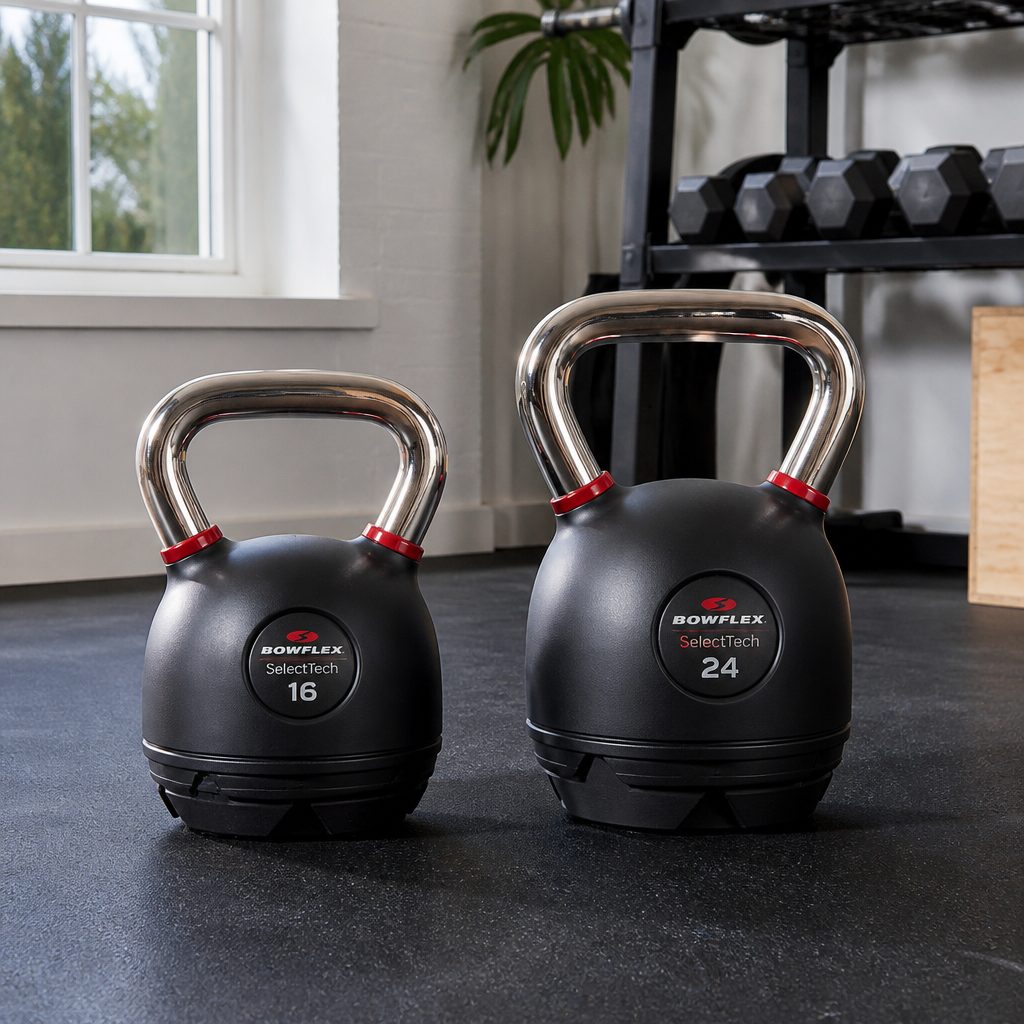
Competition-style adjustable bells keep the outer shell stable as internal loading changes, an advantage for lifters who value familiar clean, rack and snatch mechanics.
3. Bowflex SelectTech 840 Adjustable Kettlebell — Best for quick circuit changes
Shop Bowflex SelectTech 840 Adjustable Kettlebell on Amazon UK
The Bowflex SelectTech 840 Adjustable Kettlebell remains a very practical answer to the "I have no room for six kettlebells" problem. Its six settings are 8, 12, 20, 25, 35 and 40 lb, covering 3.5–18 kg overall. Set it in the cradle, turn the dial and lift. The whole process took under five seconds, which is exactly what a dial mechanism ought to do.
Its compact dimensions of 8.8 inches long, 7 inches wide and 12.5 inches high help its case in a tight home setup. Bowflex said it replaced six conventional bells, and that is the central appeal: a single stored unit can handle warm-ups, lighter unilateral work, general conditioning, goblet squats and moderate-load swings without a rack full of iron staring accusingly at you from the corner.
Its handle width was favourably assessed, which is welcome for a bell built around convenience. The limitation was the plastic housing. This is not a tool to drop, throw down or treat as though it were an all-steel competition bell. It needs a controlled training environment and a little courtesy. Frankly, that is not a great hardship in a small flat where the floorboards and neighbours may have opinions of their own.
The larger issue is the jump pattern. Going from 25 to 35 lb is a meaningful leap for presses and some accessory work. It may be entirely fine for swings. It may not be fine for a strict overhead press. Think about the exercises that will govern your progression before deciding that six settings are enough.
Pros
- Dial changes took under five seconds when the bell was in its cradle.
- Six useful settings replaced several fixed bells in a compact footprint.
- Handle width was well suited to general home training.
- A straightforward, unintimidating choice for circuits and beginner programmes.
Cons
- Maximum load stopped at 40 lb, limiting stronger lower-body training.
- Weight jumps were relatively wide for gradual press progression.
- Plastic housing means it was not designed to be dropped.
4. PowerBlock Adjustable Kettlebell — Best for comfortable rack work
PowerBlock took a different route. Rather than trying to disguise an adjustable mechanism inside a classic round bell, it used a more distinctive silhouette and a pin-selector system. The resulting kettlebell was available in 18–35 lb and 35–62 lb versions, both with a 32.77 mm handle. Weight selection took under five seconds and required no tools.
The unconventional shape is the point of hesitation for traditionalists. Kettlebell technique is tactile, and there is value in practising with something that behaves like the bells you might encounter at a class or gym. Yet PowerBlock's design created a comfortable sensation when the weight rested across the forearm for pressing. For someone whose training centres on cleans, strict presses, push presses and carries, that comfort can matter more than visual tradition.
It is also reassuring that the construction had no plastic components and came with a five-year warranty. That does not make it indestructible, and it does not make dropping weights indoors wise. It does mean the core design was built with longer-term use in mind. The heavier 35–62 lb model, in particular, gives a stronger trainee considerably more headroom than the Bowflex 840.
I would think of PowerBlock as the practical specialist. It is not the bell I would choose if the closest possible competition-kettlebell feel is non-negotiable. It is a very sensible option if you want quick changes, a robust mechanism and a rack position that does not leave you bargaining with your forearm halfway through a set.
5. Kettlebell Kings Adjustable Competition Kettlebell — Best for a traditional competition feel
The Kettlebell Kings Adjustable Competition Kettlebell covered 26–70 lb through a plate-loaded screw-lock system. That range makes it a compelling all-in-one option for people moving beyond entry-level training. A 70 lb ceiling is enough to keep many home lifters busy for a long time with swings, deadlifts, squats, rows and loaded carries.
Its appeal is refreshingly uncomplicated. It pursued a competition-style approach and asked you to change the internal loading via the screw-lock arrangement. That makes it a better fit for planned sessions than improvised circuits. Choose your weight, ensure the mechanism is secure, train properly, then alter it later when the programme says so. There is a certain elegance to equipment that does not pretend every job should happen instantly.
The 26 lb starting point is the important caveat. It is not a natural first kettlebell for somebody who needs very light loads for learning movement patterns, shoulder rehabilitation or cautious overhead work. But for an established trainee whose current fixed bells are already in the mid-range, it can consolidate a lot of equipment into one traditional-format object.
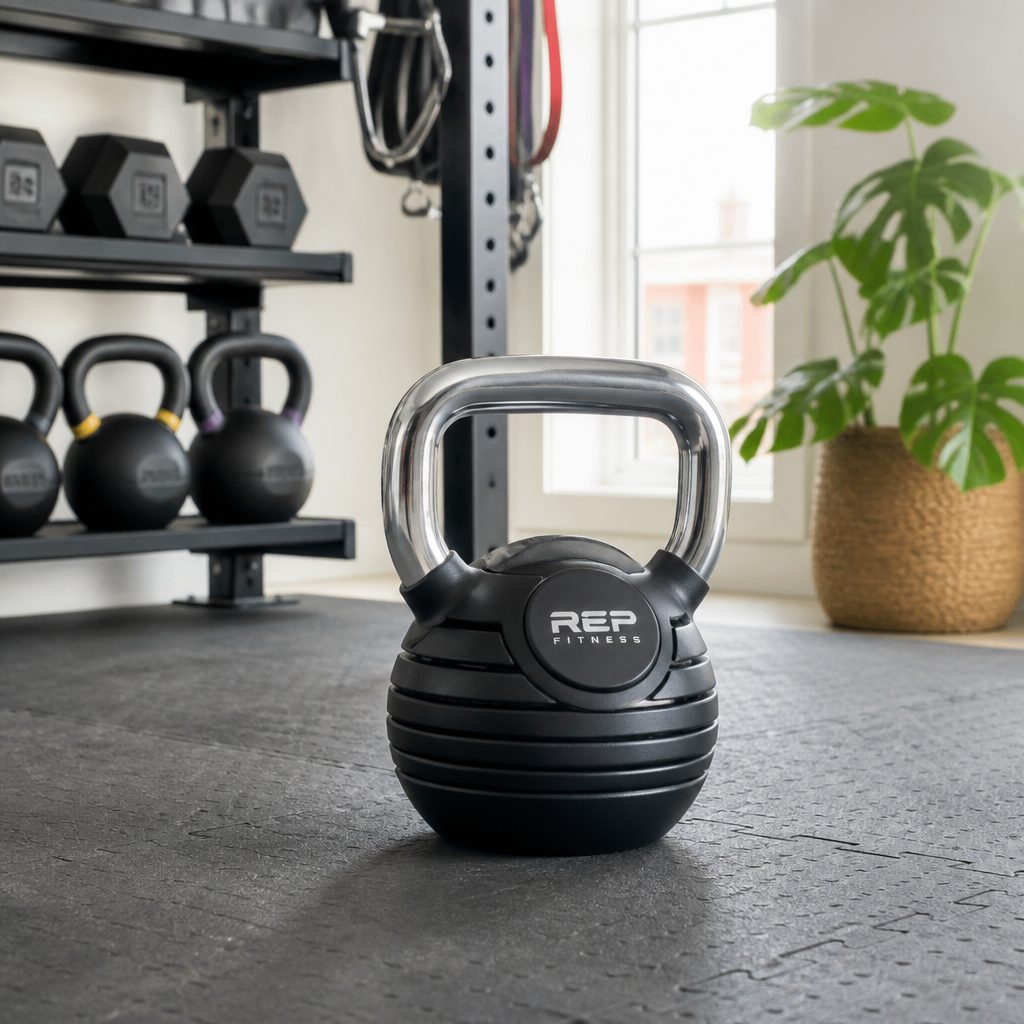
For established lifters, a plate-loaded bell with a higher ceiling can cover demanding swings, rows, carries and lower-body work without claiming a whole wall of storage.
6. Titan Adjustable Kettlebell — Best for straightforward traditional-shape training
Titan's plate-loaded Adjustable Kettlebell took the conventional kettlebell shape and paired it with a tiered column slot-loading design. With its included plates, it reached 40 lb. This is a sensible format for the home user who wants a familiar-looking bell and prefers a mechanical loading approach over a dial system.
The practical attraction is that traditional shape. A familiar bell is easier to understand when you are learning how to hinge, let the handle rotate in the hand on a clean, or find a comfortable rack position. There is no need to acclimatise to a rectangular shell or a distinctly non-standard body. For simple full-body training in a small space, that counts for a lot.
At the same time, the 40 lb ceiling places it in a similar broad training bracket to the Bowflex, rather than the more ambitious 62 lb PowerBlock or 70 lb competition-style alternatives. It is best viewed as a space-saving solution for light-to-moderate home sessions, not a single purchase guaranteed to cover every strength goal indefinitely.
The loading method also makes it more naturally suited to a session where you keep the same weight for several sets. If you are mainly doing goblet squats, deadlifts, rows and swings at one selected load, that is unlikely to trouble you. If your plan is a circuit with three different weights in 20 minutes, a quick selector is plainly the more enjoyable answer.
7. Yes4All Adjustable Kettlebell — Best for simple seven-setting versatility
The Yes4All Adjustable Kettlebell is a plate-loaded option with up to seven weight settings. That relatively simple format will suit people who do not require extremely fine increments and would rather have several clearly differentiated loads in one compact piece of equipment.
Seven settings are enough to create a sensible division of labour within a beginner or general-fitness programme: lighter work for pressing and controlled rows, middle settings for goblet squats and deadlifts, and heavier choices for swings when technique permits. It is not the sort of ultra-fine progression offered by the Bells of Steel system, but not everybody needs 41 choices. Sometimes seven is quite enough, particularly if training consistency is still the priority.
As with the other plate-loaded designs, consider how often you really change weights. The model makes most sense for an uncomplicated session structure rather than a fast-paced class format. It is an accessible route into adjustability, but the plate-loaded approach asks you to choose your load with intention. That is not a flaw. It is simply a different way of training.
Any adjustable kettlebell should be checked before a session, especially before ballistic work. Make sure the selected mechanism is fully engaged, internal plates are seated correctly and all locking hardware on plate-loaded models is secure. A quick inspection is boring right up until the moment it proves very sensible.
Comparison table: range, handle and adjustment style
The table below focuses on the information that changes the buying decision. Numbers are useful, but context is more useful: a huge range is valuable only if you can use it comfortably, and rapid adjustment is valuable only if it matches how you actually train.
| Model | Weight range | Adjustment method | Handle detail | Best suited to |
|---|---|---|---|---|
| REP Fitness Adjustable Kettlebell | 8–16 kg, 16–24 kg, or 20–40 lb versions | Dial/push-twist | 32.77 mm | All-round training with fast changes |
| Bells of Steel Adjustable Competition Kettlebell | 12–32 kg with expansion pack | Allen wrench plate loading | 35 mm | Fine, long-term strength progression |
| Bowflex SelectTech 840 Adjustable Kettlebell | 8, 12, 20, 25, 35 and 40 lb | Dial in cradle | Favourably assessed width | Compact circuit training |
| PowerBlock Adjustable Kettlebell | 18–35 lb or 35–62 lb | Pin selector | 32.77 mm | Quick changes and rack comfort |
| Kettlebell Kings Adjustable Competition Kettlebell | 26–70 lb | Screw-lock plate loading | Competition-style format | Heavier traditional training |
| Titan Adjustable Kettlebell | Up to 40 lb with included plates | Tiered column slot loading | Traditional kettlebell shape | Simple home strength sessions |
| Yes4All Adjustable Kettlebell | Up to seven settings | Plate loaded | Adjustable kettlebell format | Basic multi-load versatility |
Handle comfort, rack position and stability when swinging
Weight range tends to grab attention because it is easy to compare. Handle comfort is what you notice on rep 47. A good handle should give you enough clearance to move the bell naturally, allow a comfortable two-handed grip where relevant and avoid pressing unhelpfully into the wrist during rack work. There is no magical diameter that suits every hand, but the published 32.77 mm handles on the REP and PowerBlock are useful reference points for a general-purpose size.
The REP's competition-style outer form gives it a major advantage in consistency. Your relationship with the shell should not change dramatically just because the internal load does. This is particularly helpful for cleans and snatches, where a familiar path and rack position can make the movement feel safer and more repeatable.
PowerBlock deserves special credit for its forearm-rack comfort. Its shape did not mimic a standard kettlebell, but it could create a comfortable contact point when racked for pressing. That is a reminder that "traditional" and "comfortable" are not always identical. Some people will prefer the classic experience; others will be rather happier with the design that feels kinder during a rack hold.
For dynamic swings, security matters more than a clever adjustment mechanism. REP's securely locked cast-iron plates were reported not to rattle during swings. That inspires confidence. Plate-loaded bells can also be very solid, provided they are correctly assembled and tightened. The responsibility is simply more visible: inspect the hardware, make sure the assembly is properly seated and resist the temptation to rush setup because the workout playlist has started.
How much room do you really need?
An adjustable kettlebell needs barely any storage room, but it still needs a safe training envelope. Storage footprint and training footprint are different things. The Bowflex's 8.8 by 7 inch base is pleasingly compact, yet you still need clear space around you to hinge, swing and recover safely. A bell does not care that your coffee table is aesthetically restrained; it can still find it with remarkable accuracy.
For controlled exercises such as goblet squats, floor presses, deadlifts and suitcase carries, a compact patch of clear floor is often enough. Swings and snatches need a more considered area, especially overhead. Look not only at what is in front of you but what is above you, behind you and beside you at the bottom of the arc. A low ceiling, hanging light fitting or shelf may rule out snatches even if the room seems generous at first glance.
Plate-loaded systems also need a small setup surface. Keep the Allen wrench, plates and locking hardware together rather than scattering them across a cupboard. Dial models need their cradles stored accessibly and on a stable, level surface. It sounds obvious, but the entire promise of an adjustable bell is defeated if changing the weight requires a minor archaeological dig through the hallway cupboard.
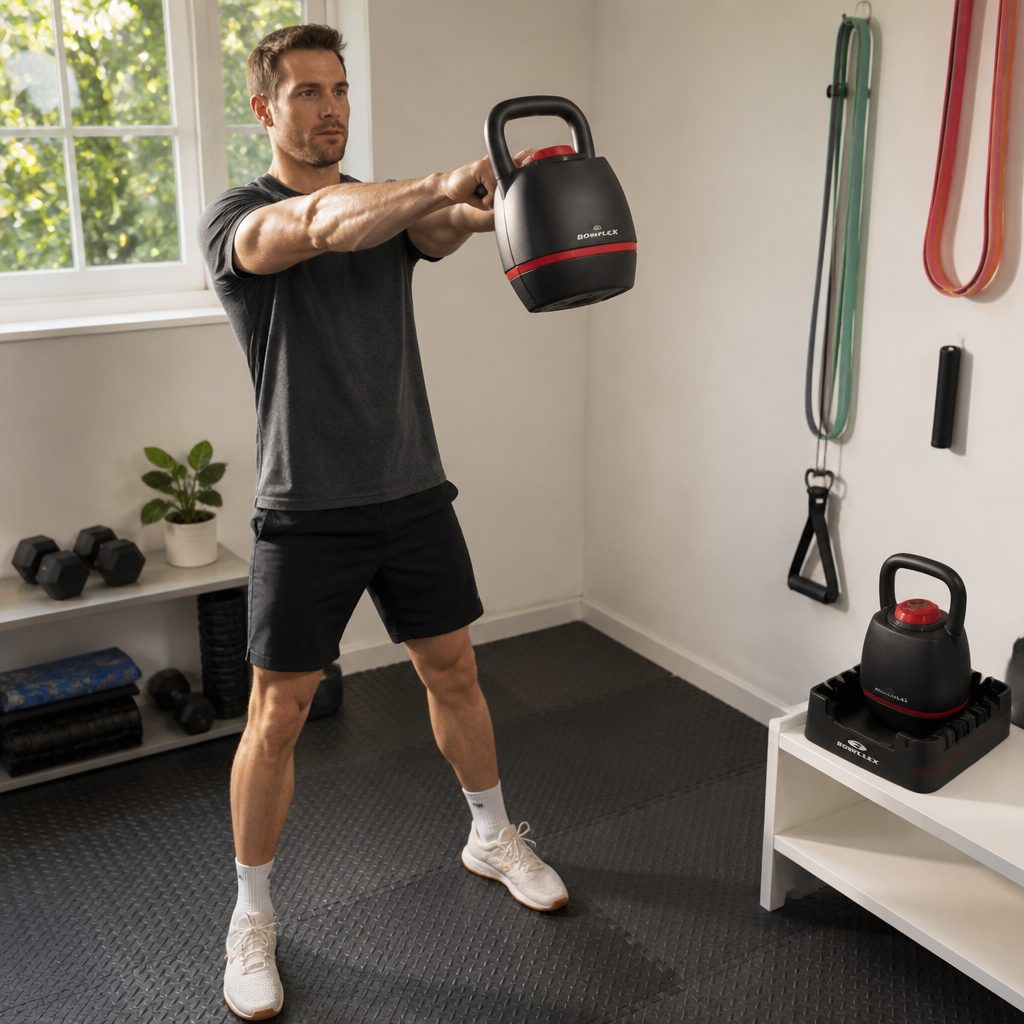
The bell may store in a tiny footprint, but ballistic exercises still need proper clearance around the body and above the head.
How to choose the right weight range for your training
Start with the movements you will actually do, then identify the movement likely to become strongest. For many beginners, pressing is the limiting exercise. That can make a lower-range bell look sensible initially. But swings, deadlifts and goblet squats usually progress more quickly, so a 40 lb maximum may eventually become the restriction for lower-body work even if it remains challenging overhead.
If you are new to kettlebells, the REP 8–16 kg version, Bowflex SelectTech 840, Titan Adjustable Kettlebell and Yes4All Adjustable Kettlebell all sit naturally in a general home-training conversation. Their purpose is accessibility, variety and manageable storage. Do not dismiss lighter loading as somehow less authentic. Strong technique built at an appropriate weight is much more useful than trying to bully a heavy bell into a movement your body does not yet own.
If you already swing a moderate or heavy fixed kettlebell comfortably, look harder at the REP 16–24 kg, PowerBlock 35–62 lb, Bells of Steel 12–32 kg and Kettlebell Kings 26–70 lb options. These give more space for the movements that commonly outgrow lighter adjustable systems. The Bells of Steel package stands apart for micro-loading. It can cover 41 increments across its full setup, making it particularly attractive to anyone following a measured progression plan.
A sensible progression mindset
For presses, small jumps are gold. For two-handed swings, bigger jumps can be more tolerable. That is why a broad range with coarse settings may be excellent for conditioning but frustrating for strength-focused overhead work. Think movement by movement, not just maximum weight.
Best-for breakdown: the right pick for each type of buyer
Best all-rounder
REP Fitness Adjustable Kettlebell. The best blend of fast selection, a consistent competition-style body, secure plates and a robust cast-iron feel.
Best premium progression pick
Bells of Steel Adjustable Competition Kettlebell. The choice for fine 0.5–1 kg jumps, 41 settings with expansion and a 12–32 kg range.
Best for fast circuits
Bowflex SelectTech 840 Adjustable Kettlebell. It changed between its six settings in under five seconds and took up very little room.
Best for rack comfort
PowerBlock Adjustable Kettlebell. Its unusual form favoured a comfortable forearm position for press-focused training.
Best for heavier classic-style work
Kettlebell Kings Adjustable Competition Kettlebell. Its 26–70 lb range suits established lifters who want a plate-loaded competition format.
Best straightforward home option
Titan Adjustable Kettlebell. A traditional-shaped, plate-loaded bell for simple training sessions up to 40 lb.
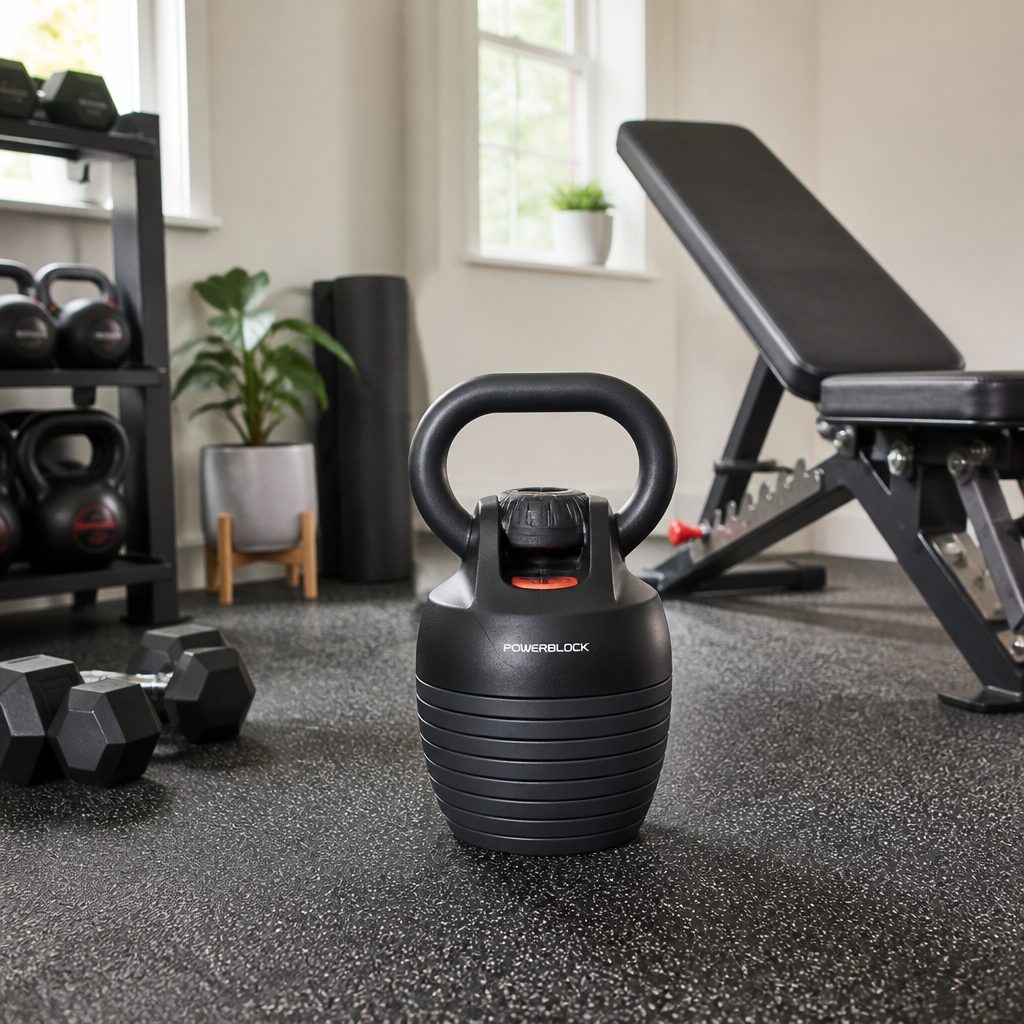
The best adjustable bell is not always the largest one; it is the model whose range and adjustment method support the sessions you will repeat week after week.
Living with an adjustable kettlebell: care, setup and sensible use
Adjustable equipment asks for slightly more attention than a fixed cast-iron bell. That is the deal. You get a compact system in return for checking selectors, plates and locks. It is a good deal, provided you do your part.
With dial and pin-selector models, always return the bell fully to its cradle or intended adjustment position before changing the load. Lift only after confirming the selection has engaged. With plate-loaded bells, place parts on a stable surface, follow the intended loading order and make sure bolts, threaded nuts or screw-locks are properly secured. Do this before every session involving swings, cleans or snatches, not just the first time you assemble it.
Avoid dropping adjustable bells. This is especially important for the Bowflex's plastic housing, but it is good practice across the category. A thick training mat can protect the floor during controlled set-downs, though it does not grant permission to dump a bell from chest height. The mechanism, the floor and anyone downstairs will all appreciate the distinction.
Finally, keep the handle clean and dry. Chalk may be useful for grip, depending on your preference and training environment, but a build-up of dust, hand cream or whatever mysterious substance has accumulated in the garage can make any handle less pleasant. The ordinary maintenance habits are the ones that let adjustable gear remain a convenience rather than a source of low-level suspicion.
Frequently asked questions
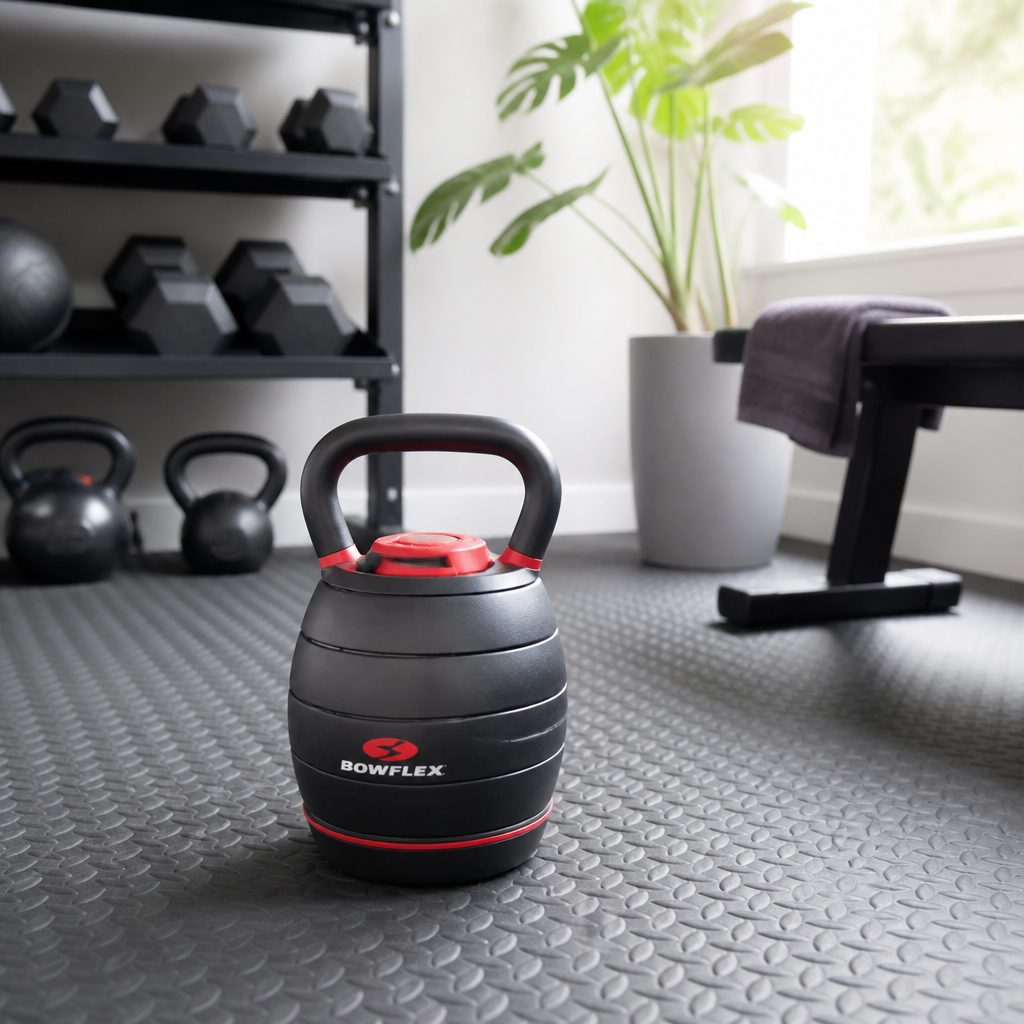
A well-chosen adjustable kettlebell can keep a compact home gym capable, tidy and ready for training without requiring an entire collection of fixed weights.
The bottom line
The REP Fitness Adjustable Kettlebell is the best adjustable kettlebell for most small-space home gyms because it combines rapid changes with a cast-iron, competition-style design that feels suited to real training. It is the rare quick-adjust model that does not make you feel as though you have traded away all the familiar qualities of a proper bell.
Choose the Bells of Steel Adjustable Competition Kettlebell if fine progression and a serious 12–32 kg range matter more than speed. Choose the Bowflex SelectTech 840 if compact circuit convenience is the mission. And if your priority is press comfort or a heavier ceiling, PowerBlock and Kettlebell Kings deserve a very close look. The best bell is the one you can store easily, adjust without grumbling and use confidently often. That last bit is rather the whole game.