
Rogue Woodway Curve LTG Review: Is a £3k Manual Treadmill Worth It for a Home Gym?
The Rogue-branded Woodway Curve LTG paired a famously smooth slat belt with a compact-for-its-class frame, a revised v2 console and the uncompromising character of a genuinely manual runner. It was not the sensible choice for every home gym. For the right person, though, that was rather the point.
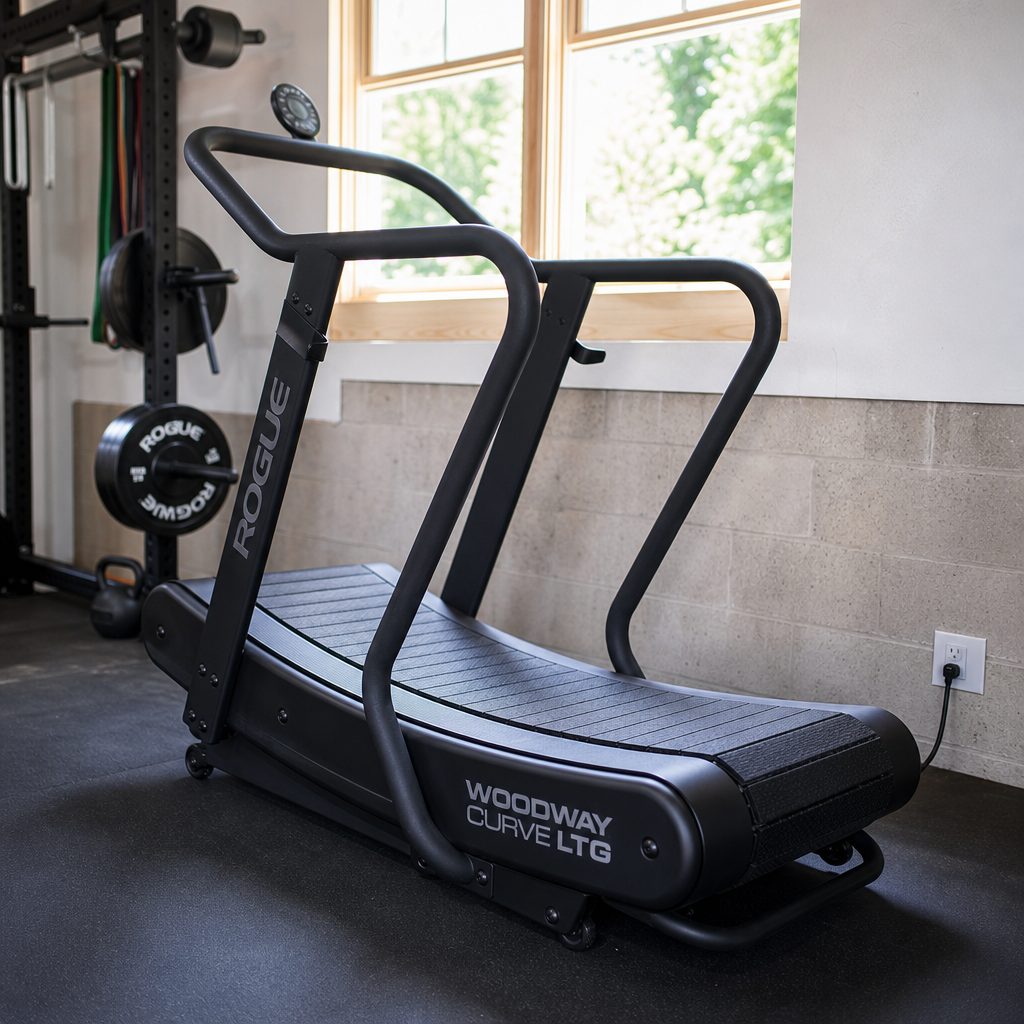
The Rogue | Woodway Curve LTG makes most sense as a long-term training tool for runners and conditioning athletes, not as a decorative substitute for regular movement.
 By James Oduya · Staff Writer & Home Gym Columnist · Updated July 19, 2026
1. The short version: a serious runner for people who enjoy doing the work
The Rogue | Woodway Curve LTG was not built to make running feel easier. It was built to make it feel direct. That distinction matters, because a curved manual treadmill asks more of you than a conventional motorised deck from the very first step. There is no motor humming beneath your feet, no programmed speed doing the pace-setting, and no familiar pause while a belt gradually comes up to speed. You move, the belt moves. You slow down, it slows down. If you have ever wanted a treadmill that behaves less like an appliance and more like a bit of training equipment, this is the argument for it.
Woodway had been making non-motorised treadmills since the original Curve arrived in 1974, so the underlying concept was not some fleeting functional-fitness fashion. The Rogue version took that established platform and gave it Rogue-exclusive branding, while the later Curve LTG 2.0 manual documented the updated v2 console introduced by mid-2025. As of 19 July 2026, Rogue still listed the machine as in stock, whilst Woodway's direct listing showed it as sold out. That makes Rogue the meaningful route for somebody seeking this particular version rather than merely admiring it from a safe financial distance.
The "LTG" name is best understood as the lighter, more manageable Curve. Manageable is relative, mind you. At nearly 300lb, it is still a substantial piece of equipment and it still occupies a serious patch of floor. But beside the larger commercial-style curved runners that have become familiar in CrossFit boxes and performance facilities, the LTG makes more sense for a committed home gym or smaller training space. Its 67.5-inch overall length and 33.6-inch width are not dainty, yet they are at least a realistic proposition where a full commercial runner may simply become a permanent interior-design event.
The basic appeal is very strong. You receive Woodway's slatted running system, 60 TPE-covered slats, 112 ball bearings and a belt rated to 150,000 miles. The belt has no tension adjustment to babysit and the machine has no drive motor waiting to become the expensive bit of an expensive treadmill. There is a 62 x 17-inch running surface, Bluetooth and ANT+ heart-rate connectivity, useful storage for a phone and two bottles, and a console that finally feels designed for quick reading rather than for impressing somebody in a showroom.
It is also a specialist machine. Walking gently is possible, but a Curve LTG truly makes sense for someone who will run, sprint, perform intervals, train for Hyrox-style efforts or use it repeatedly alongside sled work, lifting and conditioning. If your dream is to watch a long series whilst strolling at a fixed speed with a cup of tea nearby, I would gently point you towards a conventional treadmill. This one has opinions.
2. Rogue | Woodway Curve LTG key specifications at a glance
Before getting swept away by the appeal of a curved slat belt, it helps to ground the discussion in the actual machine. The Curve LTG was substantial, but it was not as sprawling as some people assumed from photographs. Its long, upright profile was more visually imposing than its footprint suggested. Height is the figure to consider carefully: at 70.1 inches tall, this is not something to wedge under a low ceiling and forget about.
That 62-inch running surface deserves more attention than it usually gets. It is generous in length, particularly when you remember that the curved deck gives you a natural fore-and-aft control zone rather than a single fixed strip of flat belt. Taller runners and people working at fast paces have room to settle into a stride. The 17-inch width is not extravagantly broad, but it is a purposeful running lane rather than a narrow compromise. On a manual curved treadmill, too much width can be less useful than people expect; what matters is confident placement and a belt that responds cleanly underfoot.
The capacity figures are also revealing. The standard stated user capacity is 350lb at all speeds. Woodway additionally specified that the treadmill was built to handle runners up to 800lb at speeds between 0 and 4mph, and 400lb above 4mph. That is an unusually robust set of numbers and speaks to the engineering intent. This was made for repeated hard use, not occasional New Year optimism followed by a quiet life as an expensive coat rack.
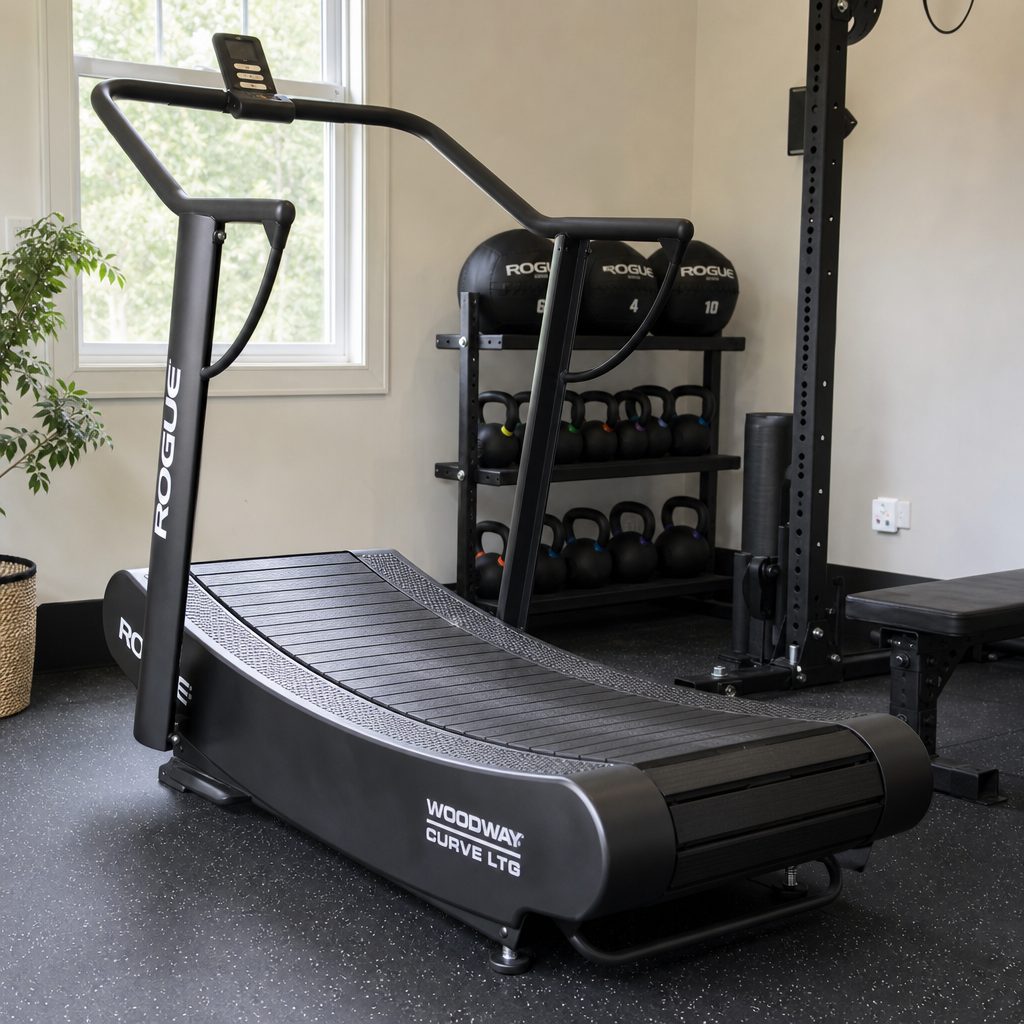
The 62-inch slatted running surface is long enough for proper running, while the curved profile lets you control pace by where you place your feet.
Space planning matters. The Curve LTG measures 70.1 inches high and weighs nearly 300lb. Measure the route into the room as carefully as the space where it will live. A treadmill that fits on paper but cannot negotiate the hallway is a surprisingly poor home-gym purchase.
3. Design and build: the polished industrial look is backed up by proper engineering
There are premium machines that look premium because they have a large screen, lots of glossy trim and enough ambient lighting to suggest they might also make a decent cocktail. The Curve LTG takes a different route. Its appeal is mechanical. You can see the slat belt, the curved frame and the physical architecture that makes the thing work. It looks like training equipment because it is training equipment. That will either suit your home gym beautifully or make your spare room feel slightly more like a performance lab. I happen to think it wears the role well.
The steel frame is a central part of the proposition. This is not a lightweight folding deck that asks you to believe its reassuring marketing copy whilst it trembles a little during a brisk run. The Curve LTG has the planted character that its mass suggests. It was designed for residential and light-commercial use, and its frame, bearing system and slatted belt all point in the same direction: durability first, novelty very much second.
The slats have a thermoplastic elastomer covering, and it is the slat arrangement rather than a conventional continuous belt that defines the experience. Woodway's curved decks have long had a reputation for a more cushioned feel than standard treadmill belts. The point is not that the machine magically removes the demands of running. It does not. Rather, the segmented belt provides a different interaction beneath the foot, with the slats moving around the curved chassis rather than sliding over a flat deck in the usual way.
That is why the 112 ball bearings matter. It is not a sexy number, admittedly. Nobody puts "112 ball bearings" on a motivational quote above the squat rack. Yet smooth, low-friction movement is the foundation of a good manual treadmill. If the belt resists you too much, the runner becomes a strangely punishing device that encourages awkward form and unnecessary fatigue. If it moves too freely without stability, control disappears. The Curve LTG's system was engineered to sit on the useful side of that balance.
The approximate 3% curvature is a similarly important detail. This is not an incline setting you select. It is the geometry that lets you accelerate by moving forwards and decelerate by drifting back. At the front of the curve, each foot strike encourages the belt to turn. Find the middle and you can cruise. Move towards the rear and the system naturally sheds speed. After a familiarisation period, it becomes intuitive. Before that point, it can feel faintly like trying to learn a new accent: you know what you mean, but your body has other ideas.
Motor-free by design
There is no drive motor, no motorised maximum speed ceiling and no need to wait for a belt to catch up with your intended effort. Your movement is the drive system.
Curved pace control
Stepping further forwards increases belt speed, whilst easing towards the rear of the curve slows it down. It is a physical system rather than a button-led one.
No belt-tension adjustment
The slat-belt design does not require the periodic tension adjustments associated with conventional treadmill belts, which is a meaningful ownership advantage.
Made for repeated use
The high user-capacity figures, steel frame and long belt rating give the LTG the sort of headroom that enthusiastic home training actually needs.
There is one design reservation worth stating clearly: the curved handles are not as immediately supportive as the handrails found on some other manual treadmills. Their steep curve can make them less helpful when you want a quick, instinctive grab during very hard efforts. This will not bother a confident runner who treats the rails as occasional balance aids. It may bother a newer runner, someone returning from injury, or anybody whose sprint sessions tend to get a little untidy around rep seven. Which, in fairness, is most of us eventually.
4. How the manual curved belt changes your running
A motorised treadmill gives you external pace. You select a number and then your job is to match it. The Curve LTG flips that relationship. Pace is produced by your posture, foot placement and intent. That is its greatest strength, and it is also the reason it cannot be judged as though it were simply a motorised treadmill with the motor accidentally missing.
At easy running pace, the manual system rewards relaxed, rhythmic steps. You do not need to constantly fight the belt, but you do need to remain present. A lazy trailing foot or a sudden backward lean can have more effect than it would on a fixed-speed treadmill. Some runners will love that. It creates a sense of involvement that can make indoor running less numbing. Others will find it tiring, especially during long steady sessions where they would prefer to set a pace and let their brain wander towards whatever they are having for dinner.
At faster speeds, the Curve LTG comes into its own. The absence of a speed ceiling means there is no artificial cap imposed by a motor. Accelerations are immediate because they are yours. You do not press a button and wait for the machine to negotiate. You simply move more assertively into the front of the curve. For sprint intervals, shuttle-style conditioning and the kind of on-off sessions common in Hyrox and CrossFit training, that responsiveness is the entire game.
Woodway stated that manual treadmills can burn 30% more calories than motorised treadmills and positioned the format as ideal for high-intensity exercise. As ever, calorie figures are influenced by body size, pace, duration and how honestly you work. They are not a permission slip for a biscuit. But the general logic is sound: on a manual runner, you are not merely keeping up with a moving belt. You are generating the belt movement. That changes the muscular and cardiovascular demand.
The learning curve should not be understated. A newcomer can step on and jog, certainly, but the first few sessions are about learning control, not proving fitness. Begin with a few short easy efforts. Practice moving slightly forwards and backwards without abruptly braking. Learn where your comfortable running position is. Then introduce faster work. The person who tries to launch into all-out sprints within thirty seconds of first stepping aboard is likely to gain an impressive story, if not particularly useful training data.
What I like most is that the machine does not make fast running feel translated through software. A quick pace feels quick because you are creating it in real time. There is no lag, no ramp and no awkward decision about whether to press plus once, twice or repeatedly while the interval disappears before your eyes. That directness feels very close to the way outdoor efforts develop, albeit without wind, weather or the local pavement's creative approach to camber.
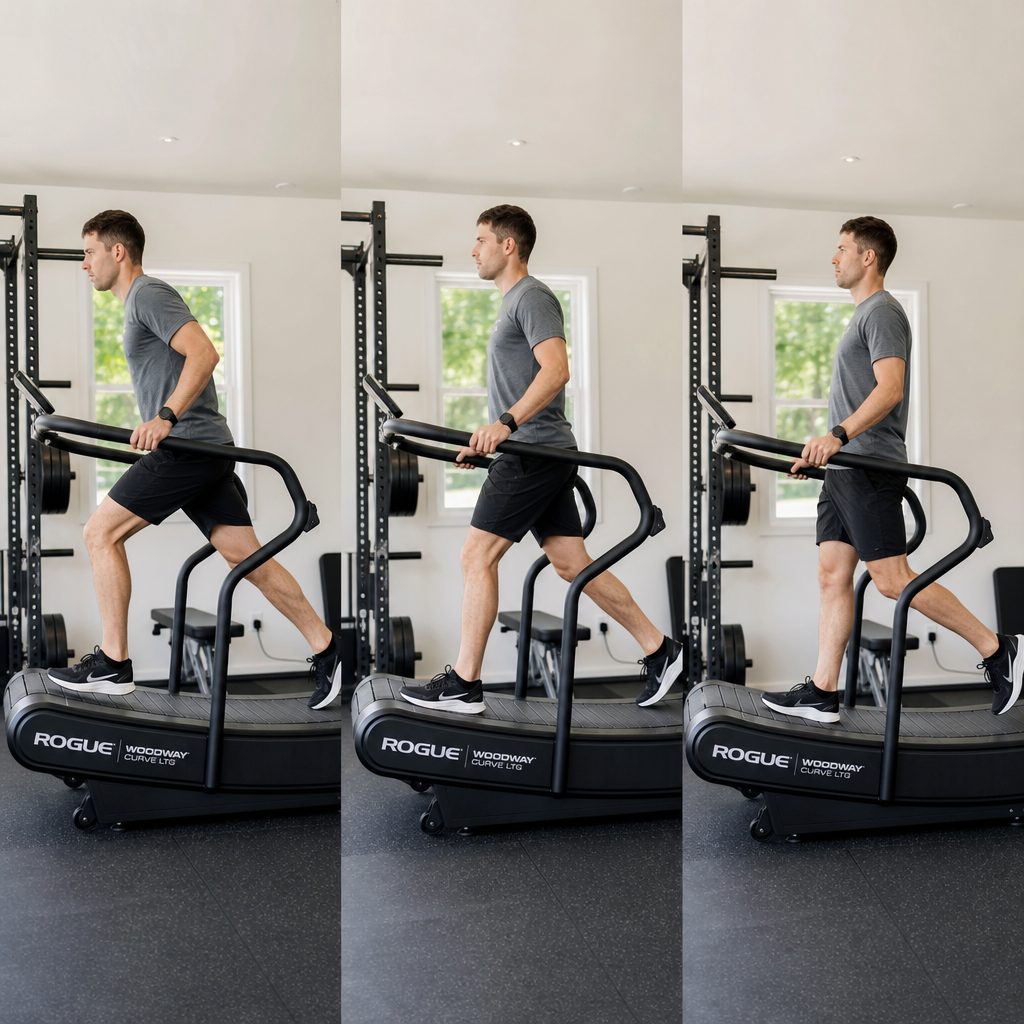
The Curve LTG's running position is controlled by foot placement: forward for acceleration, central for cruising and further back for a natural reduction in pace.
5. The v2 console: better where it counts, sensibly restrained where it does not
The revised Curve LTG v2 console was a welcome development. Manual treadmills do not need an enormous entertainment screen to do their job, but they do need a display that can be read at a glance when you are breathing hard and reconsidering your interval plan. The updated console focused on clarity: sharper visuals, a high-resolution LCD display, bold font treatment and static prompts instead of scrolling text.
That last detail sounds small until you picture it in use. Scrolling text requires you to wait for the information to make its way across the display, which is not ideal when you are trying to locate a setting between rounds or check a metric during a hard effort. Static prompts are faster and less irritating. It is a very practical improvement, which is exactly what a training console should be.
Navigation was simplified through front-facing buttons and intuitive short- and long-press controls. Again, this is not the sort of feature that earns breathless launch-day headlines, but it is more valuable in day-to-day ownership than another decorative menu. The console lets you access speed, peak speed and average speed, together with total time and pace. Distance is shown to the hundredths place, and units can be set to miles, kilometres, yards or metres. The dual time readouts can be toggled between MPH and KmH, a useful touch for households with different preferences or athletes following programmes written in different units.
Heart-rate monitoring works through Bluetooth or ANT+, so it should fit naturally with a compatible heart-rate strap. It does not pretend to be a full connected-fitness ecosystem, and I think that is appropriate. The Curve LTG does not need subscription classes, a leaderboard or a rotating instructor insisting that this is your moment. It needs to show useful numbers without getting in the way. The revised console largely did that.
There is also a Group/Circuit mode that can track and summarise statistics for up to four runners. That is more useful than it first appears. In a home-gym setting, it can support shared workouts without everyone attempting to remember what they did after a sweaty rotation. In a compact training facility, it gives coaches a straightforward way to organise a small group. In either case, it makes the LTG more social without forcing a social-media layer onto the experience.
Console tip
Set your preferred distance and speed units before a hard workout rather than fiddling with settings mid-session. The Curve LTG's value lies in fast, clean transitions; it is a shame to interrupt them because somebody suddenly needs metres instead of miles.
There are sensible practical details around the console too. The machine provides space for a phone and two water bottles. That means a longer workout does not require balancing your drink on a nearby bench or putting your phone on the floor where it will inevitably receive a stray shoe, dumbbell or overly ambitious stretch. Little storage details are not glamorous. They are, however, the difference between a well-considered home-gym machine and one designed by somebody who apparently never trains with water.
6. Battery, pause settings and daily ownership
Because the Curve LTG has no drive motor, its electrical requirements are minimal. That is one of the format's understated pleasures. You are not buying a machine whose fundamental operation depends on a mains-powered motor, and you are not using household electricity to keep a belt moving beneath you. The display itself is powered by an enclosed battery, so the technology serves the metrics rather than becoming the centre of the machine.
The pause setting defaults to 30 seconds to help optimise battery life. It can be adjusted in 15-second increments up to five minutes. That tells you quite a lot about the intended use. This is a treadmill meant to support working sessions: run, recover briefly, return to work. It is not primarily designed for a person who wants to pause for an extended chat, make a coffee or negotiate with a toddler about why the treadmill is not currently a climbing frame.
For interval training, the 30-second default makes sense. It preserves battery life and prevents sessions being fragmented into a succession of long pauses that blur the line between training and simply standing near premium equipment. For circuits, though, extending the pause time can be useful. If your workout includes kettlebell swings, burpees, rowing or strength movements between runs, a longer window makes it easier to retain a continuous session record.
Daily use should be pleasantly straightforward. There is no drive motor to warm up, no belt speed to dial in and no belt tension to adjust. You step on, create movement and get on with it. The machine's mass means you will not casually move it around the room each morning, but the LTG was specifically positioned as the lighter Curve for people who may need to reposition a treadmill more often than a full commercial machine. "More often" still needs to be interpreted with a healthy respect for nearly 300lb of steel and slats.
Noise is another worthwhile consideration. Manual treadmills avoid the characteristic motor noise of a conventional treadmill, which can make them less intrusive in the home. That does not make the Curve LTG silent. Footfalls and the moving slats remain, particularly at sprint pace, and a hard session will still announce itself to anyone in the adjoining room. But the sound is more mechanical and physical than the persistent electric whirr of a motorised belt. For many home users, that is the more tolerable flavour of treadmill noise.
Pros
- Genuinely self-powered running with no motor-imposed maximum speed.
- Woodway slat system combines 60 TPE-covered slats with 112 ball bearings for a smooth, low-friction feel.
- Long 62-inch running surface suits proper running rather than merely cautious jogging.
- Updated v2 console is clearer, easier to navigate and supports Bluetooth and ANT+ heart-rate monitoring.
- No conventional belt-tension adjustment and a belt rated for up to 150,000 miles.
- Group/Circuit mode supports up to four runners, which is useful in a shared gym.
Cons
- The manual curved format requires an adaptation period and is not as effortless for easy walking.
- At roughly 297lb and 70.1 inches high, it remains a major piece of home-gym furniture.
- Curved handles are less supportive than more conventional handrails during very hard efforts.
- The 17-inch belt width is purposeful rather than especially generous.
- It is designed for training focus, not screen-led entertainment or passive treadmill miles.
- The premium proposition only makes sense if you will regularly use its manual-running advantages.
7. Is the Rogue | Woodway Curve LTG practical in a UK home gym?
This is where the romance of a commercial-grade curved runner meets the realities of British houses. The Curve LTG was more compact than the largest models in its category, but "more compact" is not synonymous with small. Its overall dimensions were 67.5 inches long, 33.6 inches wide and 70.1 inches high. In metric terms, that is approximately 172cm long, 85cm wide and 178cm high. It needs a dedicated position, not a corner you expect to reclaim whenever guests arrive.
The 85cm width is a point in its favour. It is broad enough to feel stable and serious, without swallowing a room the way an extra-wide commercial machine can. The long vertical silhouette can actually be easier to accommodate than a huge console that juts forward, provided ceiling height and access are sensible. Still, do not assess only the floor area. Consider the room's doorway, stairs, turns on the route in, and the practical logistics of positioning a 297lb machine. A very good treadmill does not become more charming halfway up a narrow staircase.
Once installed, the LTG's lack of a drive motor makes it attractive for a dedicated training room. It is not dependent on being next to a permanent socket in the same way as a motorised treadmill. That can make layout easier, especially if your best home-gym location is a garage, garden room or converted space where electrical outlets are already doing battle with a rack, lighting, fan and whatever charger has mysteriously appeared there.
It also sits naturally alongside strength equipment. The design language feels at home beside a power rack, dumbbells, kettlebells and a sled rather than looking like a lonely piece of domestic cardio equipment that wandered into the wrong room. More importantly, its performance supports mixed-modal sessions. You can transition from lifts, carries or bodyweight work straight into a run without programming a speed or waiting for a belt. The transition is as quick as your willingness to start running.
The warranty was appropriate for a premium, durable machine: five years on the frame, three years on the belt and moving parts, and one year on wear items and labour. It is not limitless protection, and nobody should read it as a reason to disregard normal care. But it does offer more reassurance than a generic short-term warranty on a heavy, complex piece of gym equipment. The split is sensible too, recognising that the core frame, moving system and wear items are not all exposed to the same stresses.
For a single committed runner, the Curve LTG may become the centrepiece of the room. For a household of casual walkers, it may become an impressive object used most often when somebody has company and wants to say, "Yes, that is manual." Be honest about which household you are. That little bit of self-knowledge can save an awful lot of buyer's remorse.
8. Rogue | Woodway Curve LTG training use: intervals, Hyrox and conditioning
The Curve LTG was made for the kind of sessions that benefit from rapid changes in effort. Sprint intervals are the obvious example. A conventional motorised treadmill can be excellent for structured intervals, but every adjustment has a delay. Even a fast motor takes time to move from a jog to a hard pace. On a manual runner, the change happens through the athlete. You can surge, settle, surge again and stop without negotiating with a control panel.
That makes the LTG particularly appealing for Hyrox-style training, where running is regularly broken up by demanding stations and where a quick return to pace matters. It is also a natural fit for CrossFit-influenced conditioning. Rogue's connection is not accidental here: Woodway curved treadmills have been used in the CrossFit world, and the Curve LTG has been associated with the same sort of hard, repeatable efforts that dominate that environment.
For conditioning blocks, I would use the machine in several ways. Short 10- to 20-second hard accelerations work well because you can begin and finish sharply. Longer repeats at a controlled strong pace let you practice maintaining position on the curve. Mixed circuits can use the Group/Circuit mode if several people are sharing the treadmill. And simple threshold-style work becomes interesting because the belt gives immediate feedback when your form loses discipline. Drift too far back, and you slow. Overreach into the front, and you may find yourself going harder than intended.
It is not only about maximal efforts. The Curve LTG can support warm-ups, cooldowns and moderate steady running. But I would not buy it chiefly for those jobs. The machine's strength is the involvement it demands. If your training is mostly very easy walking, gentle recovery mileage or long, fixed-pace running while watching a screen, then a motorised deck often remains the more relaxing and logical tool. The Curve LTG is better thought of as a performance runner which can also do easy work, rather than an easy-work machine that sometimes performs.
| Training approach | Rogue | Woodway Curve LTG | What the manual format changes |
|---|---|---|
| Fast accelerations | User-driven, with no stated maximum speed limitation. | Acceleration begins when you move forward on the curve rather than after a motor ramps the belt. |
| Interval sessions | Short default 30-second pause setting, adjustable up to five minutes. | Well suited to tight work-rest structures and circuit-style training. |
| Heart-rate-led work | Bluetooth and ANT+ heart-rate monitoring. | Lets you use external heart-rate data without turning the machine into a subscription platform. |
| Shared training | Group/Circuit mode records and summarises up to four runners. | Useful when the treadmill is one station in a rotating workout. |
| High-volume ownership | 60 slats, 112 ball bearings and belt rating up to 150,000 miles. | The build is aimed at repeated use rather than a handful of occasional weekly sessions. |
A note on form: manual curved running can reveal inefficiencies. That is not a criticism of the runner or the machine; it is simply what happens when pace is being produced by your own mechanics. Keep steps controlled, avoid leaning excessively into the front of the curve, and build volume patiently. There is no prize for turning the first week into a calf-and-hamstring grievance procedure.
9. Who should buy the Rogue | Woodway Curve LTG?
The most useful buying decision is not "is this a good treadmill?" It plainly has the engineering and features to justify being called one. The more useful question is whether its particular strengths match your training. The Curve LTG rewards deliberate use. It is less convincing as a general household compromise.
Best for interval runners
Choose the Curve LTG if you value instant pace changes, hard accelerations and a treadmill that responds directly to your effort rather than a programmed speed.
Best for Hyrox-style training
The self-powered format, quick transitions and circuit mode make it particularly compelling for mixed conditioning sessions with runs between stations.
Best premium home-gym centrepiece
For a dedicated training space with racks, free weights and serious cardio ambitions, its robust build and industrial character fit naturally.
Best for shared training
Group/Circuit mode for up to four runners gives the LTG an advantage for families, training partners and small facilities.
Not best for casual walking
If easy, fixed-speed walking is your main objective, the manual curve asks for more attention and effort than you may actually want.
Not best for entertainment-led cardio
The v2 LCD console is practical rather than immersive. Buy this for the running experience, not for an enormous screen and classes.
The ideal owner is somebody who already understands what they like about manual running, or who has tried a curved treadmill and wants that sensation at home. They may be a runner who dislikes the disconnected feel of a motorised belt. They may be a functional-fitness enthusiast wanting to recreate more of their gym sessions at home. They may simply be someone who values durable, mechanical equipment over large connected displays. Whatever the route, they should expect to use it hard.
I would also include committed heavier users, within the stated capacity, among the potential audience. The 350lb all-speed capacity and Woodway's additional published operating limits show considerable structural headroom. That does not mean any individual should leap straight into maximal efforts; training progression remains training progression. But it does make the Curve LTG a more reassuring prospect than lightweight domestic treadmills that appear designed around an optimistic average user and a very forgiving legal department.
Who should hesitate? Beginners who have never run regularly and want a straightforward walking platform. People with limited access space or low ceilings. Households where one person is enthusiastic but everyone else will merely tolerate it. And people who want lots of digital content. The v2 console is better because it is simple and readable, not because it attempts to replace a television. That is a feature, not a flaw, but only if it aligns with your priorities.
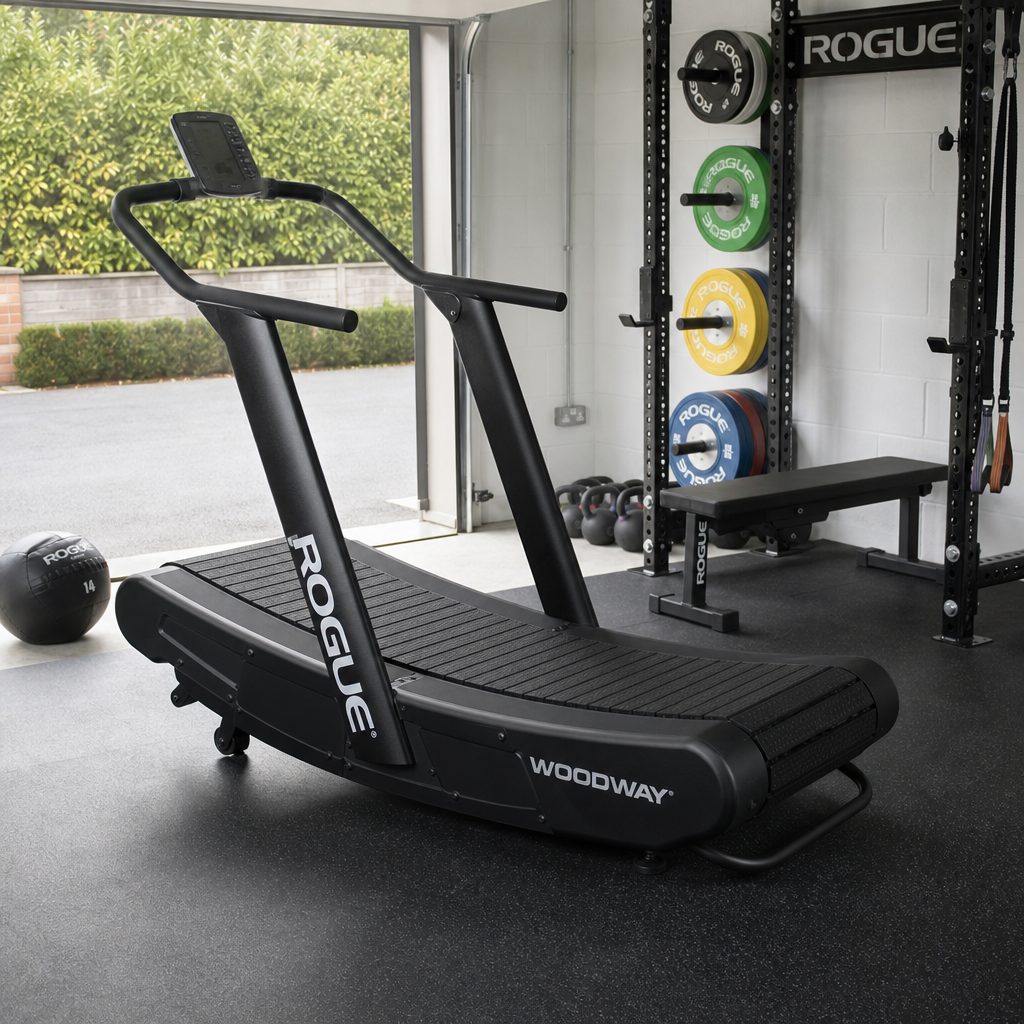
For interval-focused athletes, the Curve LTG works best as part of a wider home-gym setup where running, lifting and conditioning can flow together.
10. The value question: when a premium manual treadmill earns its place
The title asks whether this sort of premium manual treadmill is worth the money for a home gym. The honest answer is annoyingly conditional. For a person who will perform two brisk walks a week while scrolling through emails, no. It is too specialised, too substantial and too capable for that use. There are more rational ways to accumulate steps.
For someone who trains hard, values the feel of a slat belt, wants immediate self-powered speed control and expects to keep the machine for a long time, the argument becomes much stronger. The Curve LTG's value is not based on a flashy screen or a giant catalogue of content. It rests on the parts most likely to matter years later: the steel frame, the 60 slats, the 112 bearings, the lack of a drive motor, the substantial capacity, the 150,000-mile belt rating and the warranty structure.
That does not make it a bargain by ordinary home-gym standards. It makes it a premium equipment purchase that has a coherent reason for being premium. There is a difference. A cheap curved runner that feels sticky, unstable or awkward would defeat the point entirely. The Woodway approach has always been about the running mechanism first. The Rogue branding makes it especially attractive to the strength-and-conditioning audience, but the real value is still the belt and chassis beneath your feet.
It is worth comparing the purchase mentally with a premium motorised treadmill, even without treating them as identical products. A motorised machine can offer programmed incline, a huge display, entertainment and easy cruising. The Curve LTG offers immediacy, a mechanical running feel and fewer motor-driven complications. Neither answer is objectively superior. They serve different versions of "I want a treadmill at home." The wrong decision is buying one while really wanting the other.
Buying perspective
Do not buy the Curve LTG because it looks impressive in a gym tour. Buy it if you specifically want manual, self-powered running. That is the feature you will feel on every session, and it is the feature that justifies the whole machine.
One practical financial point is longevity of interest. The machine is more likely to earn its keep if it replaces regular gym cardio, becomes part of your conditioning programming, or is used by more than one committed athlete. If it is a once-a-week novelty, even superb construction cannot rescue the value proposition. A premium treadmill should be a favourite tool, not expensive proof that you once had an excellent intention.
11. Setup, familiarisation and getting the best from it
Set-up requires patience because the Curve LTG is heavy and physically substantial. Plan the final location before it arrives. Clear access routes. Account for doorway widths, turns and flooring. If the treadmill will live in a garage or outbuilding, think about the journey from delivery point to training area rather than merely imagining the finished room with a motivational poster in the background. The unglamorous part of buying large gym gear is usually the bit that determines whether you enjoy the purchase immediately or spend the first afternoon negotiating with a stairwell.
Once it is in place, give yourself a proper learning phase. I would begin with five to ten minutes of very gentle familiarisation rather than a complete workout. Stand tall, locate the centre of the curve, and let the belt move without gripping the handles. Then practice small changes in position. Move forward slightly, feel the acceleration, then drift back and let the belt slow. Repeat. The goal is not speed; it is confidence.
In the next few sessions, introduce controlled efforts. A handful of short pickups is enough. Focus on smoothness rather than trying to recreate your outdoor sprint pace immediately. Manual treadmills can make people overstride or lean too aggressively because they want to force speed. The better approach is to let cadence, posture and purposeful foot placement create the pace. It looks calmer and usually feels better.
For a hard conditioning session, use the console before you are exhausted. Pair your heart-rate strap if you are using one, select your units, decide whether the 30-second default pause setting is suitable, and choose a longer pause window if the workout includes multiple stations. It is far easier to make those choices when you are fresh than after a set of burpees when every button begins to resemble advanced mathematics.
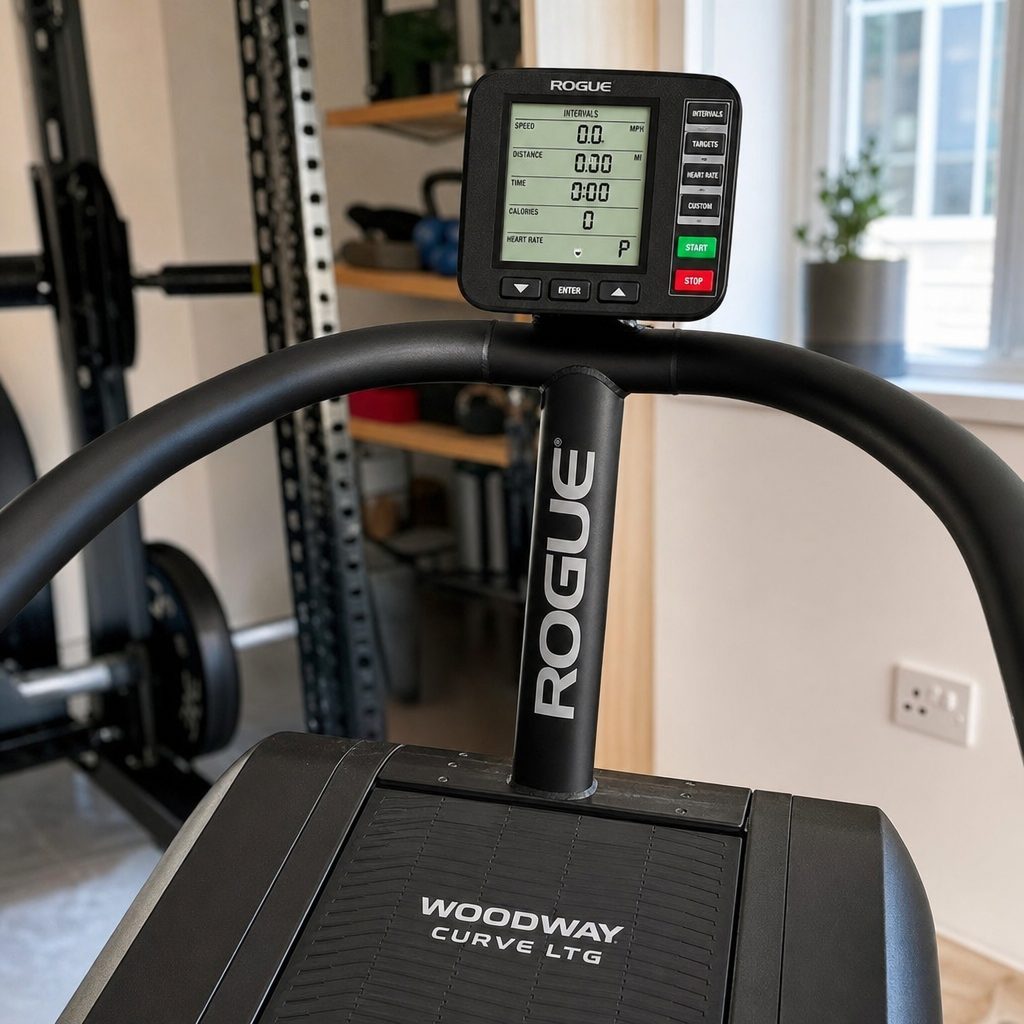
The updated v2 console prioritises bold, legible training data and quick controls over unnecessary distractions, which suits the LTG's focused character.
Daily care is pleasingly uncomplicated in principle. Keep the machine clean, avoid treating it as storage, and pay attention to anything that sounds or feels unusual. The absence of normal belt-tension adjustment is a welcome reduction in routine fuss, but premium equipment still deserves basic respect. A home gym is often dustier than people imagine, particularly if it shares space with tools, bikes, chalk or a dog who believes every training session is also a supervision opportunity.
12. Frequently asked questions
Yes. The Curve LTG uses a 100% manual, self-powered slat belt. It has no drive motor. The belt moves because you move it, and your position on the curved deck controls how quickly it runs. Moving forwards encourages acceleration, whilst drifting back helps the belt slow naturally.
There is no stated maximum speed limitation because the treadmill is user-driven rather than governed by a motor. In practical terms, speed is limited by your own ability, confidence and technique. That makes it especially compelling for accelerations and sprint-focused conditioning.
The running surface measures 62 inches long by 17 inches wide. The overall machine dimensions are 67.5 inches long, 33.6 inches wide and 70.1 inches high. Those figures make it more home-gym friendly than some larger commercial curved runners, but it is still a substantial permanent installation.
It can be used for walking, but it is not the most natural reason to buy it. The manual curved format rewards active foot placement and involvement, which is excellent for running and conditioning but less relaxing than fixed-speed walking on a motorised treadmill. It suits people who want training engagement rather than passive miles.
Yes. The v2 console supports Bluetooth and ANT+ heart-rate monitoring. When paired, the display can show heart-rate information alongside the machine's other workout metrics, including speed, time, distance and calorie estimates calculated using the ACSM formula.
The updated console brought sharper visuals, a high-resolution LCD display, bold fonts, simplified navigation and static prompts instead of scrolling text. It also has front-facing buttons with short- and long-press controls, dual time readouts with MPH/KmH toggles, expanded customisation and a Group/Circuit mode for up to four runners.
The stated all-speed user capacity is 350lb. Woodway also specified that the treadmill was built to handle runners up to 800lb between 0 and 4mph, and up to 400lb at speeds above 4mph. Those are unusually robust figures for a home-gym-oriented runner.
The treadmill has no drive motor and requires minimal electrical power. Its display is powered by an enclosed battery. The default pause period is 30 seconds to preserve battery life, although it can be adjusted in 15-second increments up to five minutes for workouts that need longer recovery or circuit transitions.
The warranty covered the frame for five years, the belt and moving parts for three years, and wear items and labour for one year. That structure is sensible for a treadmill where the durable frame and moving slat system are the central long-term ownership considerations.
Final verdict: the Rogue | Woodway Curve LTG is worth it if you want manual running on purpose
The Rogue | Woodway Curve LTG was one of those products that made little sense as a compromise and a great deal of sense as a deliberate choice. It offered an excellent slat-belt running experience, serious frame strength, a 62-inch running surface, unlimited user-driven speed potential and a v2 console that improved the daily experience without turning the treadmill into a distracting screen-first gadget.
It was not ideal for everybody. Casual walkers, screen-led cardio fans and buyers with awkward access or limited room should think carefully. The curved handles were also not the most confidence-inspiring option for those who rely heavily on rails. But for runners, Hyrox athletes, functional-fitness enthusiasts and committed home-gym owners who wanted sharp intervals and a highly durable self-powered runner, the Curve LTG delivered exactly what its serious appearance promised. It was expensive equipment, certainly. It was also properly engineered equipment. Those are not always the same thing.