
Peloton Cross Training Tread Review: Is the Swivel Screen Worth £3,499?
Peloton's £3,499 Cross Training Tread combined a quick motor, a 360-degree swivel display and polished instructor-led training in one imposing home machine. It was also expensive, relatively short for taller runners and backed by a warranty that felt distinctly mean at this level. Here is the honest version.
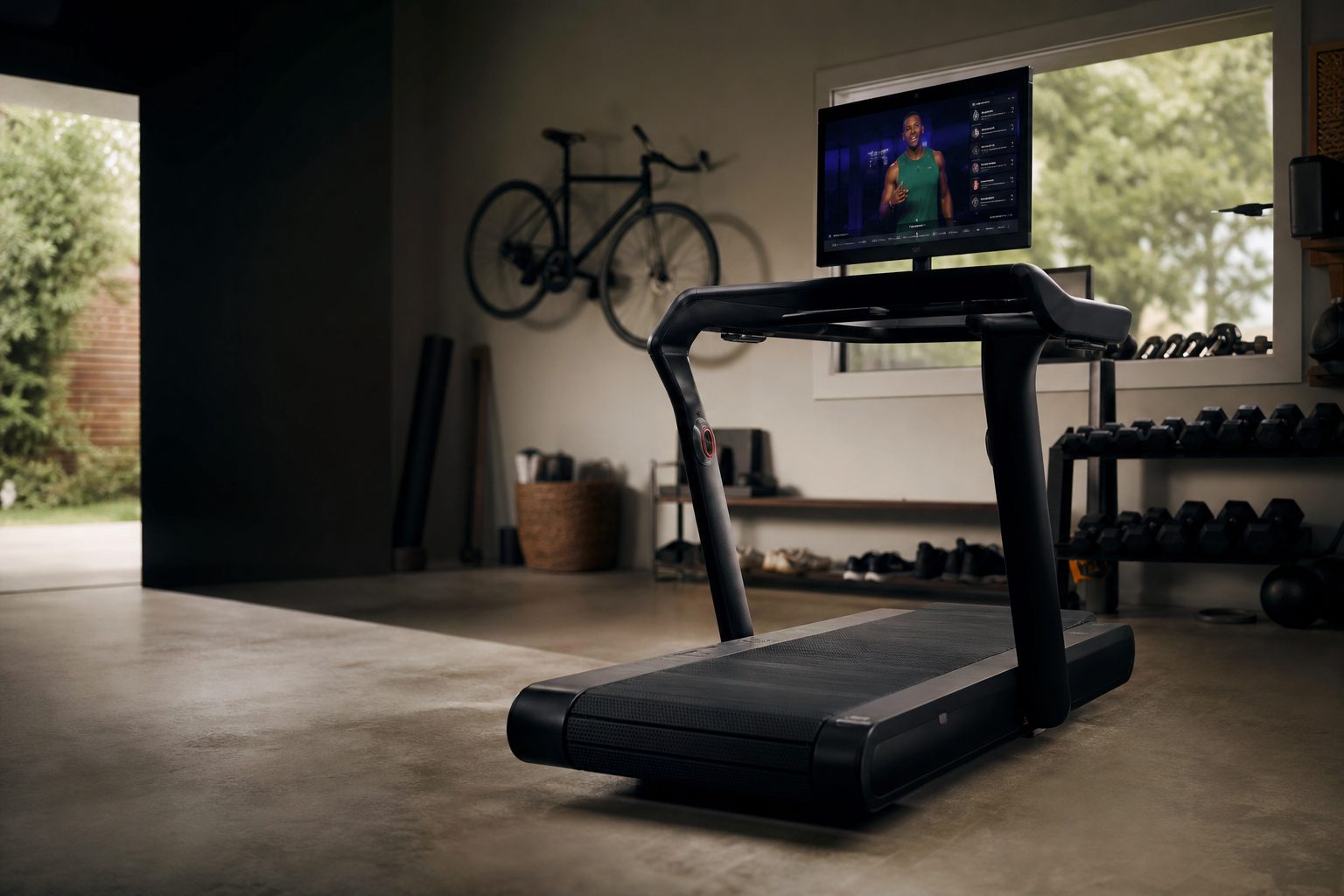
The Peloton Cross Training Tread put a large, fully rotating screen at the centre of a conventional motorised treadmill format.
 By James Oduya · Staff Writer & Home Gym Columnist · Updated July 18, 2026
Quick verdict: a lovely screen attached to a compromised premium treadmill
The Peloton Cross Training Tread arrived in October 2025 with a straightforward mission: make the treadmill the centre of a broader home training routine rather than a machine you use only for miles. In that respect, it made immediate sense. Run or walk on it, rotate the 21.5-inch Full HD screen, then follow a strength, yoga or mobility class without dragging a tablet across the room or rearranging the furniture. That simple physical movement was the point. It sounds minor until you have tried to make a fixed-screen treadmill pull double duty.
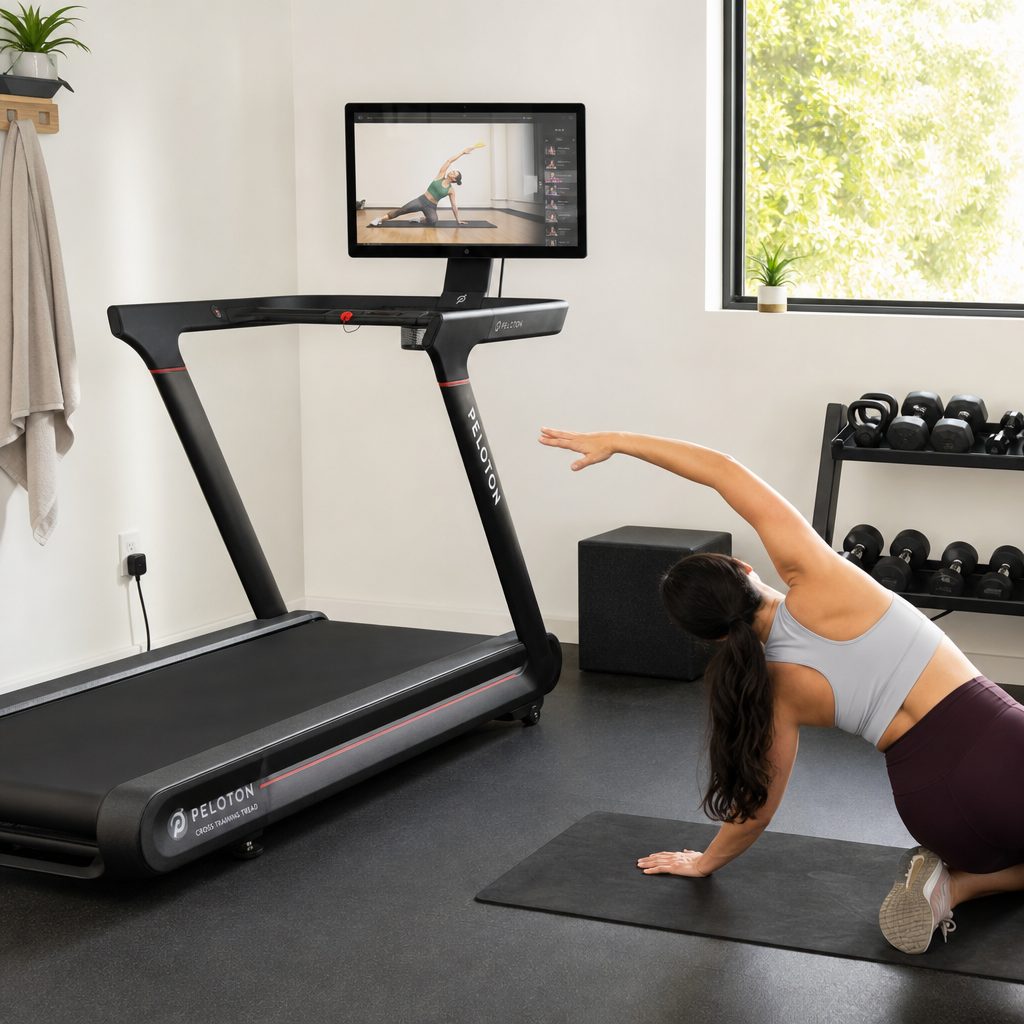
The rotating display was most convincing when a run flowed straight into strength, mobility or yoga without needing a second screen elsewhere in the room.
There is a great deal to like. The motor was impressively responsive, reaching 12mph from 1mph in 18 seconds, which is exactly the sort of brisk reaction that makes instructor-led intervals feel sharp rather than vaguely aspirational. Its measured 12.5mph maximum speed was exceptionally accurate, with less than 0.5% error. The automatic incline followed class cues, the controls were intuitive, and the display was genuinely useful rather than a decorative television bolted to the front of a deck.
But this is not a review where the screen gets a free pass because it swivels elegantly. At £3,499, the Cross Training Tread sat in serious-money territory. The 150cm, or 59-inch, belt was not tiny, but it was noticeably less generous than the 67-inch slatted deck on Peloton's own Tread+. For a tall runner with a long stride, particularly one who enjoys fast sessions, that distinction mattered more than the marketing copy made it sound. The standard belt was also the less exotic, less cushioned proposition in the family.
Then there was the warranty. Peloton covered the touchscreen, frame, drive motor, walking belt and most components for 12 months under its limited warranty. A year is not no protection, of course. Yet on a heavy £3,499 connected treadmill that was expected to work hard, occupy a permanent slice of your home and contain a large screen, it was not a confidence-inspiring term. I would expect prospective owners to take that seriously rather than treating it as small print for another day.
The short version is this: it was a compelling choice for an established Peloton household that genuinely used classes beyond running and had a room large enough to accommodate a 173cm-long machine. It was less convincing for a tall, fast runner who wanted the biggest possible deck for the money, or for anyone who wanted longer warranty reassurance. The swivel screen was worth having. Whether it was worth paying £3,499 for depended on whether you would actually swivel it several times a week.
Peloton Cross Training Tread at a glance
Before getting into the arguments, here are the meaningful numbers. They tell a useful story. This was not a compact walking pad with a big tablet glued on top; it was a substantial motorised treadmill with proper running credentials. It was also not a slat-belt flagship. Peloton had deliberately put it between the ordinary home treadmill world and the Tread+ experience.
The deck was 20 inches wide, which gave sensible side-to-side room for normal running. Width is often where cheaper machines betray themselves, creating that slightly guarded feeling where you never quite forget that the edges exist. Twenty inches was a proper treadmill width. The tension here was length. A 59-inch running surface will suit a lot of people perfectly well, especially walkers, joggers and runners of average height. Still, it placed a practical ceiling on how carefree the Tread felt for long-legged athletes at high speed.
The physical machine weighed 291lb. That is a useful reminder that this was not something to wheel casually out from behind a sofa after work. Delivery and professional setup were included, which was sensible because a machine of this size deserved more respect than an optimistic flat-pack afternoon and a cup of tea. Once installed, it was designed to stay put.
It also carried Bluetooth 5.2, a USB-C charging port on the frame and a 3.5mm headphone jack. Those details are less glamorous than the screen but matter in daily use. Bluetooth gives you a tidy route to wireless audio, USB-C stops your phone becoming collateral damage in a long workout, and a wired headphone option remains wonderfully unfussy when pairing technology decides to become theatrical.
Important practical point: the Cross Training Tread was a corded AC treadmill, not a battery-powered device. There was no battery runtime to manage. Its daily practicality came down to room, mains power, ventilation, floor protection and whether the household could live with its running noise.
Design and setup: handsome, imposing and not remotely discreet
Peloton's design language was very much present here: clean, screen-led and deliberately domestic rather than commercial-gym brutalist. The display took visual priority, while the frame and deck did the less glamorous work of supporting a serious running machine. It looked more polished than many traditional treadmills, which can resemble a slightly cross piece of warehouse equipment that has wandered into the spare room.
That polish does not alter the space calculation. At 173cm long, 84cm wide and 165cm tall, this was a tall, deep piece of kit. The 84cm width was not just deck width; it was the full machine standing in your room, and the screen height made it visually substantial. If your intended home gym was actually a narrow box room, measuring it properly was not optional. Measure the floor, measure the ceiling, measure walking clearance around it, and remember that using the screen off the side of the treadmill changes how you use the surrounding space.
The professional setup inclusion was one of the more sensible parts of the package. A 291lb treadmill was not a thing you wanted delivered at the kerb and then negotiated upstairs by a mate who had once watched a strongman competition. Proper positioning mattered. So did placing it on a sensible surface. A treadmill creates moving load, vibration and footfall noise, particularly during intervals. The machine's mass helped it feel planted, but it did not make it invisible to people below you.
The red centred line on the textured belt was a small but welcome visual feature. On a treadmill, particularly when a coach asks you to increase pace quickly, the brain is doing several jobs at once: listening, breathing, watching the display and remembering not to launch a water bottle into the wall. A central reference line helps with positioning without turning the deck into a brightly coloured obstacle course.
The speed and incline controls used intuitive knobs. This mattered more than it might first appear. Touchscreen controls are fine when you are walking gently. They become less appealing when you are at speed, sweating heavily and trying to move from one effort to another without looking down for long enough to regret it. Physical controls let the hand find a familiar place. It is a simple piece of gym equipment ergonomics, and Peloton got it right.
There was Tread Lock too, intended to prevent unauthorised access. For homes with children or anyone simply wanting a little more control over a large powered machine, it was a sensible inclusion. The feature did not turn the treadmill into a toy-safe object — it remained heavy, powered equipment and should be treated accordingly — but it added a layer of reassurance to a device that could reach 12.5mph.
The swivel screen: the best reason to buy it, provided you use it
The 21.5-inch Full HD touchscreen could move through 360 degrees. That was the defining feature of the Cross Training Tread, and it was much more useful than a screen that merely tilted for glare. You could finish a run, rotate the display towards open floor space and move directly into a strength, stretching, yoga or other Peloton session. No awkwardly craning sideways. No need to park an iPad on a radiator. No having the instructor face a wall whilst you face the television. It created a surprisingly coherent training station.
I think there are two types of buyer here. The first sees the swivel function and imagines using it occasionally: perhaps a stretch after a Sunday run, or a strength class when motivation happens to strike. The second already knows that they are more likely to train if one device lowers the friction between cardio and everything else. For the second person, the screen was genuinely valuable. It transformed the treadmill from a single-purpose running machine into a convenient anchor for a weekly routine.
For the first person, it was much harder to justify. A fixed-screen treadmill still lets you run classes. A television, tablet or phone can support an off-tread workout. The swivel did not make your squats deeper, your yoga balance better or your dumbbells lighter. It made transitions smoother. That distinction matters because smooth transitions are worth a lot only when they alter behaviour.
The display also formed the centre of the Peloton IQ platform, including personalised weekly plans tailored around your goals and preferences. The appeal was not simply that there were workouts available. Plenty of people can find workouts online. The appeal was that the treadmill, the class display, the instructor cues, the automatic incline and the broader training plan were part of the same system. That can be highly motivating for people who dislike deciding exactly what to do every evening.
360-degree screen movement
The screen could face the treadmill for runs and walks, then turn towards your workout floor space for classes that did not involve the belt. This was the feature that separated it from a more conventional connected treadmill.
Personalised plans through Peloton IQ
Weekly training plans were tailored to stated goals and preferences, helping turn the screen into a training organiser rather than simply a place to choose individual sessions.
Auto-incline in supported workouts
The incline could synchronise with instructor cues, reducing the small but persistent distraction of manually changing gradient during structured runs.
Flexible audio connections
Bluetooth 5.2 supported wireless listening, while the 3.5mm headphone jack offered a direct alternative. Both options are welcome when you share a home with people who do not want your hill session soundtrack.
There was a limitation worth spelling out. The base Cross Training Tread did not have the movement-tracking camera used on the Cross Training Tread+, Bike+ and Row+. So whilst the base machine offered the rotating screen and Peloton IQ ecosystem, it did not provide the Tread+'s real-time form correction, rep tracking or suggested weights through a camera. If your interest in cross-training was specifically about automated strength feedback, the cheaper model was not the full expression of that idea.
My honest screen test
Ask yourself whether you would rotate the display after at least two or three sessions a week. If the answer is yes, it was a genuinely useful premium feature. If the answer is "probably sometimes", do not let a clever hinge carry a £3,499 buying decision on its own.
Running performance: quick reactions, accurate speed and useful incline
A treadmill at this price needed to run well before it earned credit for being clever. Happily, the Cross Training Tread's 3.0 horsepower motor was one of its stronger points. It reached a top speed of 12.5mph and climbed from 1mph to 12mph in 18 seconds. That is rapid enough to keep up with interval sessions where the instructor expects a real change in effort rather than a leisurely drift in the right direction.
For context, 12.5mph is a serious maximum speed for a home treadmill. Most buyers will never need it. A fast recreational runner, however, may appreciate that the machine had headroom rather than forcing high-intensity work into an awkward ceiling. More important than the headline maximum was the speed accuracy: testing found less than 0.5% margin of error at the top speed. It is reassuring to know that when the display says 12.5mph, it was not making a vague suggestion.
The incline range ran from flat to 12.5%, with no decline function. The absence of decline will not matter to everyone. Plenty of people are perfectly content using incline for hill work, walking and variety, then doing flat runs for everything else. But it was still a limitation in a premium machine. Decline training has a specific feel and can be useful for runners who want to mimic rolling terrain or practise control on a downward grade. The Cross Training Tread did not offer that option.
Auto-incline was the more practical positive. When it followed instructor cues, it kept the class moving. This sounds trivial, but an automatic incline adjustment changes the feeling of a coached session. You remain in the rhythm of the run rather than half-listening for the next instruction and reaching for controls. It is the difference between following a workout and managing a workout. For some people, that is precisely why they buy Peloton equipment.
The motor was a conventional DC unit, which is the normal arrangement for a home treadmill. It delivered the expected powered experience: the belt moved because the motor moved it. There was no manual running mode on the base Tread. That distinction mattered when comparing it with the Tread+, whose Free mode allowed the slatted belt to be moved manually by your feet. The standard Cross Training Tread was more conventional in that respect, despite the advanced software wrapped around it.
In ordinary use, I would describe the performance as capable and polished rather than revolutionary. It did not need to reinvent running. It needed to feel stable, accurately paced and responsive in the workouts people actually did. It achieved that. The concern was not the motor or the controls. The concern was whether the deck beneath your feet gave you enough length for the way you ran.
The 59-inch belt: fine for many runners, not generous for all
Peloton specified a 150cm textured belt, equivalent to 59 inches in length, with a 20-inch width. It is important to be fair here: 59 inches was not objectively short in the way a compact under-desk walking pad is short. It was a running-capable deck, and many people would run happily on it. The issue was the context. This was a £3,499 treadmill positioned as a premium cross-training product, not a budget compromise built to fit under a bed.
For walkers and steady joggers, the belt length was unlikely to dominate the ownership experience. Their stride tends to remain compact, and the generous 20-inch width supplies helpful confidence. A runner of average height using sensible paces may also have no issue at all. It is possible to overthink deck dimensions and talk yourself out of perfectly usable equipment. Gym gear has a knack for producing spreadsheets before it produces sweat.
For taller runners, fast runners and anyone who opens their stride substantially during intervals, the calculation changed. You want room behind the foot at the back of the stride and confidence at the front without subconsciously shortening your gait. A treadmill should let you concentrate on effort, breathing and form. If you are aware of where the rear roller might be, it is not doing its job as well as it could.
The most awkward comparison was inside Peloton's own family. The Tread+ used 59 individual rubberised slats and provided 67 inches of cushioned running space. That was eight inches more length than the Cross Training Tread, alongside a very different deck construction. It also reached 15% incline rather than 12.5%. The Tread+ cost much more in the United States, with a listed price of $6,695, so it was not a casual upgrade. But it made the standard model look less complete for serious runners who had the budget and wanted the most accommodating deck.
A textured standard belt is a familiar treadmill solution and should not be dismissed merely because it lacks slats. It has the advantage of familiarity and simplicity. Yet at this price, I wanted Peloton to make a stronger case for the conventional belt. The large screen was excellent, but the thing you actually run on remained the core product. If you were buying primarily for running rather than all-round classes, I would put belt length ahead of screen rotation in your decision-making order.
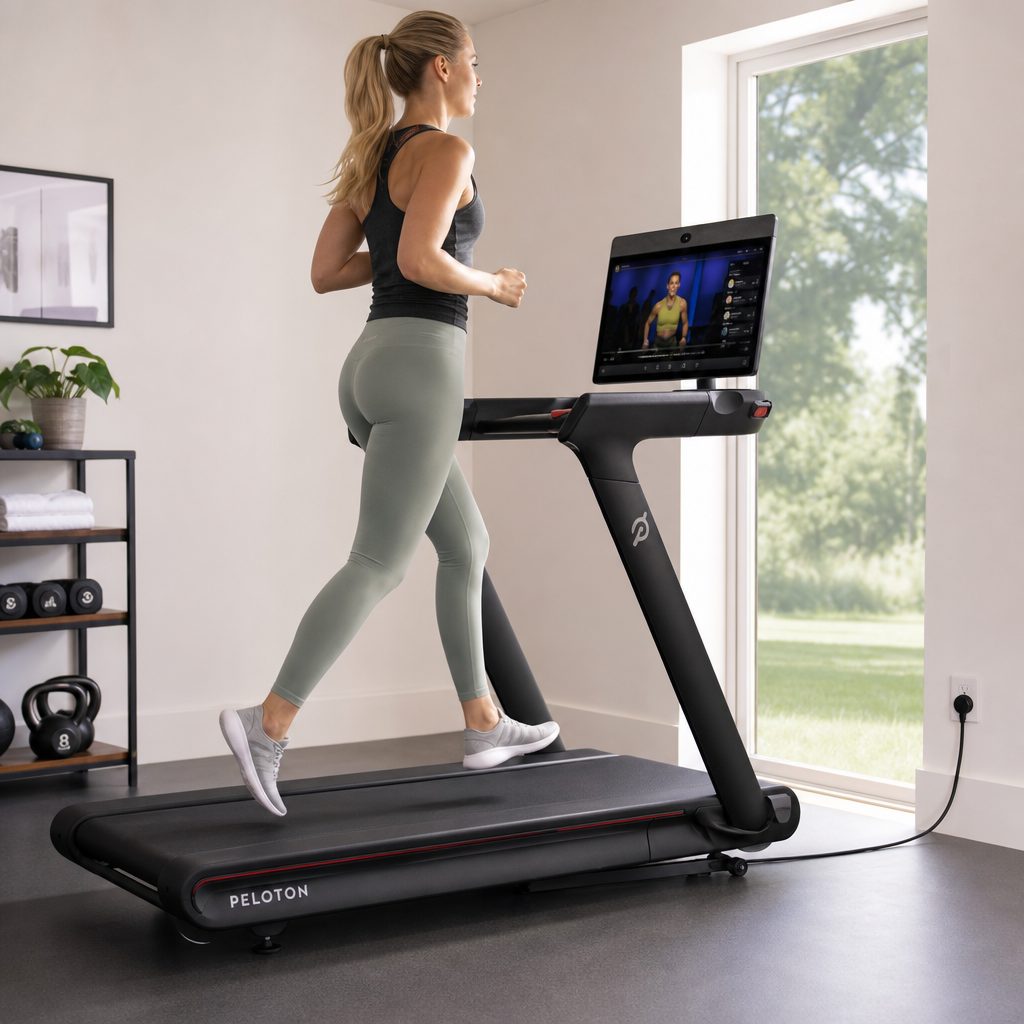
The base Tread's 59-inch running surface was practical for walking, jogging and many runs, but it gave tall or fast runners less spare room than the 67-inch Tread+ deck.
Noise and household reality: not silent, and the footfalls matter
Treadmill noise is often discussed as though it begins and ends with the motor. It does not. The sound that travels through a home includes belt movement, drivetrain noise, speaker output, frame vibration and, most significantly at faster paces, the repeated impact of your feet. A treadmill can have a sophisticated screen and a quick motor whilst still being a fairly antisocial thing to use above somebody's ceiling at 6am.
Measured noise from the Cross Training Tread was 65dB during a one-mile walk. That is around the level of an office conversation: audible, certainly, but not alarming in a detached house or a well-separated room. A leisurely 2.5-mile jog with inclines reached 78dB, closer to a washing machine. At a 2.5-mile run at maximum speed, testing recorded 88dB, comparable to a food processor. At 7.5mph, including footfalls, it measured 69dB.
Those figures explain the machine well. Walking was manageable. Gentle running had a clear audible presence. Hard running was noisy enough that planning mattered. The Tread ran roughly 2 to 5dB louder than the average competing treadmill in testing. That difference may sound small on paper, but decibels are logarithmic and, more importantly, the character of treadmill noise carries through floors differently from a simple steady appliance hum.
I would not call this a reason to reject it automatically. A treadmill will never be a whisper-quiet piece of equipment once someone starts running at pace. The more useful question is whether your setup suits it. Ground-floor home gym? Probably manageable. Detached property? Less stressful. Upstairs flat with neighbours below? You need to be realistic, especially if you favour early mornings, intervals or longer runs.
The 10W front-facing two-speaker setup was another part of that household equation. It was sufficient for a workout in a room by yourself, but headphones make more sense if your training times are antisocial or your music tastes are, shall we say, individual. Bluetooth 5.2 was the route I would favour for most people, with the headphone jack as useful backup. The Tread+ had Sonos-tuned speakers and a woofer, but the base machine's audio was plainly less ambitious.
Peloton Cross Training Tread versus Peloton Cross Training Tread+
The most relevant comparison was not really with an anonymous treadmill in a showroom. It was with the Tread+ sitting above it in Peloton's own range. These were both Cross Training Series machines, both offered a rotating Full HD screen and both were designed to sit inside the same wider Peloton training ecosystem. But they were aimed at quite different levels of buyer.
| Feature | Peloton Cross Training Tread | Peloton Cross Training Tread+ |
|---|---|---|
| Display | 21.5in Full HD touchscreen with up to 360° movement | 23.8in Full HD screen with up to 360° movement |
| Running surface | 20in wide, 59in / 150cm textured standard belt | 67in cushioned rubberised slat belt with 59 individual slats |
| Maximum incline | 12.5% | 15% |
| Manual running option | Motor-powered belt | Free mode allowed foot-powered movement |
| Movement-tracking camera | No | Yes, with form correction, rep tracking and weight suggestions |
| Audio | Two front-facing speakers, 10W total | Sonos-tuned speakers and woofer |
| Fan | Not included | Integrated three-speed fan |
| Warranty | 12-month limited warranty | 12-month limited warranty |
The Tread+ was plainly the more advanced running machine. Its slatted surface, 67-inch deck, higher incline and Free mode gave it a more special proposition beneath your feet. The camera-based movement tracking and better audio made it the richer cross-training hub too. In other words, it was not just a Tread with a slightly bigger screen. It was the full-fat version of the concept.
That said, the base Cross Training Tread had a useful identity. It delivered the central practical benefit of the new line — a display that could genuinely support both treadmill and floor training — without pushing into the Tread+'s extreme premium territory. The US listed price of the Tread+ was $6,695, compared with $3,295 for the Cross Training Tread there. Those figures made clear that the gap was enormous, not a small upgrade decision.
For UK shoppers, the base Tread's £3,499 price already demanded thought. The Tread+ therefore made sense only for the person who knew why they needed it: a serious runner wanting a longer deck and slatted surface, or a committed Peloton user who wanted movement tracking, stronger sound and the extra hardware. Buying the Tread+ merely because it was "better" would be a very expensive way to avoid deciding what you actually needed.
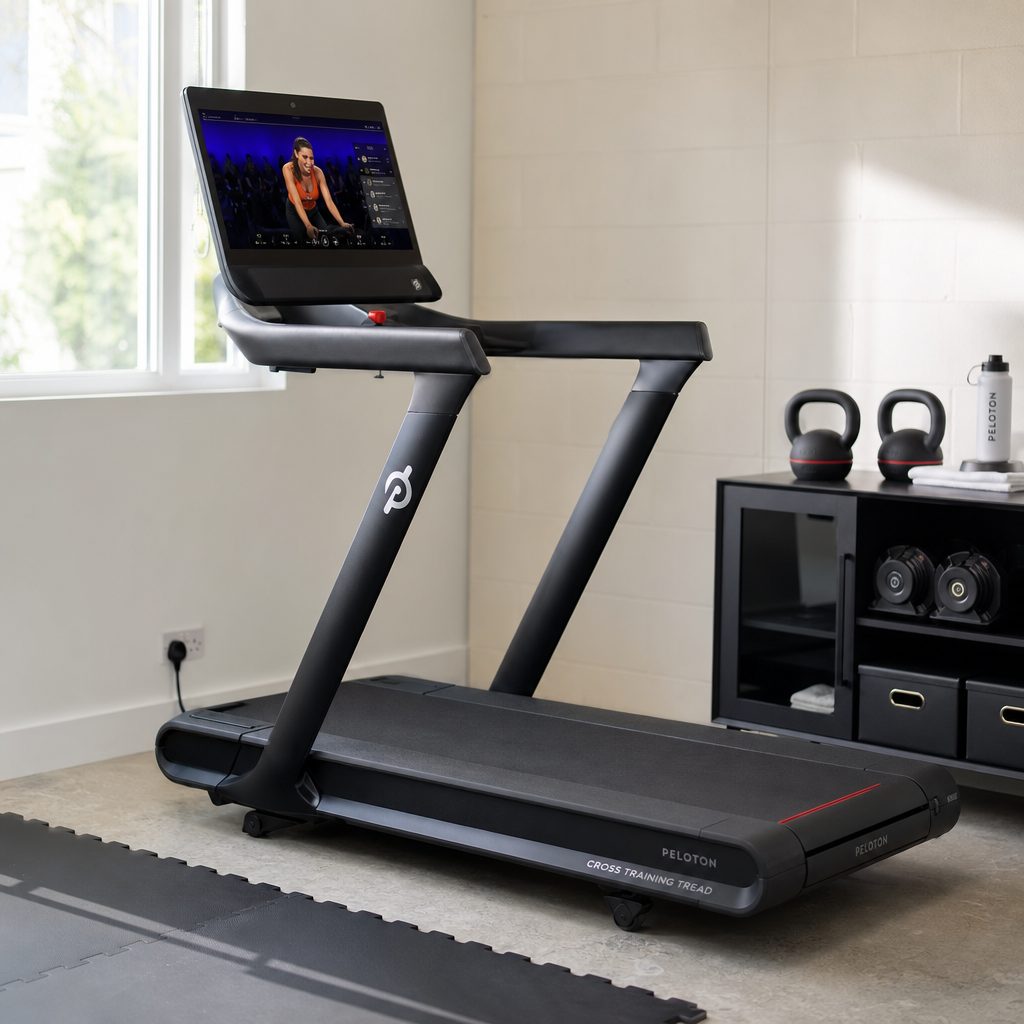
The Cross Training Tread and Tread+ shared the rotating-screen concept, but the Tread+ added a longer slatted deck, a larger display and camera-based movement tracking.
Daily use: where the connected experience earned its keep
The Cross Training Tread was at its best on an ordinary weekday. Not the day you are building a dream home gym in your head, but the wet Tuesday when you have forty minutes, low enthusiasm and just enough energy to do something if the machine makes the choice easy. This was Peloton's core strength. The hardware, display, instructor structure and training plans were trying to remove the little barriers that stop people beginning.
You could walk, jog or run with the main screen facing forward, then rotate it for training off the deck. That rhythm was particularly good for users who do not want their fitness life split into separate corners of the house: treadmill here, mat there, laptop somewhere else, resistance kit slowly breeding in a cupboard. The screen gave the sessions a single home.
The physical controls helped when the workout became demanding. Speed changes did not require poking at a glossy display whilst bouncing along. Incline could follow workout cues automatically. Tread Lock added a sensible layer of access control. The USB-C point made it easier to keep a device charged, and the audio options meant you could choose between the speakers, wireless headphones and wired headphones according to the room and the time of day.
The limitations also appeared in daily life. You had to live with the screen, not merely admire it. It needed a sensible viewing position, and the machine itself needed a room where screen rotation did not immediately point an instructor into a wardrobe. You also had to be comfortable with a treadmill being a connected fitness product rather than a straightforward motor-and-belt appliance. The value proposition depended on participation in that environment.
There was no battery to charge or replace, which is exactly how a large treadmill should be. But being mains-powered meant its position needed planning from the start. Do not choose the prettiest spot in the room and only then discover that your power arrangement becomes a trailing-cable sculpture. Good home gym ownership is often gloriously boring: sensible placement, a stable surface, a clear route around the equipment and enough airflow that a hard session does not turn the room into a greenhouse.
The best ownership experience would be someone who used the machine as a routine builder. A brisk incline walk one day. Intervals the next. A short strength session after a run. Yoga or mobility while the same screen faced the other way. If that is your actual pattern, the Cross Training Tread's conveniences compound over time. If your routine is "run three miles whilst watching a drama", a cheaper and simpler approach may be more rational.
Price, membership and the uncomfortable value question
The Peloton Cross Training Tread was listed at £3,499 in the UK. Finance was offered through Klarna at 0% APR, quoted at £291.58 a month for 12 months. Delivery and professional setup were included. It was also available through Peloton, Peloton retail stores and Amazon UK.
Peloton Cross Training Tread
UK direct price, including delivery and professional setup.
0% APR finance example
Per month over 12 months through Klarna.
All-Access Membership
Peloton listed this UK monthly membership price; the newest Cross Training edition was described as including it at no additional monthly cost.
That £3,499 figure was the part of the review that made everything else harder. At a lower price, I would have been more relaxed about the 59-inch belt and the standard deck construction. At a lower price, a one-year limited warranty would still not be generous, but it would be easier to swallow. At £3,499, every compromise becomes more visible because the buyer is entitled to ask not only "is this good?" but "why is this not more complete?"
The best answer was the screen and ecosystem. The 21.5-inch rotating display was not a cheap add-on, and the whole purpose of the Cross Training Series was broader training rather than a narrow treadmill proposition. Buyers who used the display for instructor-led running, strength, yoga and plans could reasonably see value in the integration. It was not a fair product to judge as merely a belt, motor and incline mechanism.
But nor was it fair to wave away the fundamentals because the software was pleasant. The running deck was still 59 inches. There was still no decline. There was still a 12-month limited warranty. And the Tread+ showed that Peloton knew how to build a more generous, more premium running platform; it simply placed that experience higher up the ladder.
My view is that the Cross Training Tread was good value only for a specific person: somebody who already valued Peloton classes, wanted one main screen for varied training and was not especially constrained by the deck length. For a pure runner, it was difficult to call a £3,499 treadmill with a conventional 59-inch belt and year-long warranty an automatic bargain. It was better understood as a premium connected fitness station that happened to be a very capable treadmill.
What it did well
- The 21.5-inch screen could rotate through 360 degrees, making off-tread classes genuinely convenient.
- The 3.0 HP motor accelerated from 1mph to 12mph in 18 seconds, excellent for intervals.
- Its 12.5mph top speed tested with less than 0.5% error.
- Auto-incline and physical speed/incline controls made coached sessions easier to follow.
- Bluetooth 5.2, USB-C charging and a headphone jack covered the everyday connectivity basics.
- Professional setup was included, which was appropriate for a 291lb treadmill.
Where it fell short
- The 59-inch belt was less forgiving for tall or fast runners than the Tread+'s 67-inch surface.
- There was no decline function, only 0–12.5% incline.
- Noise reached 78dB on a leisurely incline jog and 88dB at maximum-speed running.
- It measured around 2–5dB louder than average competing treadmills in testing.
- The limited warranty lasted only 12 months despite the £3,499 price.
- The base model lacked the Tread+ movement-tracking camera, Free mode, fan and upgraded audio.
Warranty: the weakest part of the ownership proposition
The Cross Training Tread came with a 12-month limited warranty covering the touchscreen, Tread frame, drive motor, walking belt and most Tread components. I am glad those major elements were included. A warranty that omitted the motor, belt or screen on a connected treadmill would be hard to defend at any price. Still, coverage length matters just as much as the component list, and one year was the aspect that gave me the most pause.
A treadmill is not a small gadget you upgrade after a couple of seasons. It is a large, expensive appliance-like piece of training equipment containing a motor, electronics, moving belt, display and structural frame. It is expected to absorb repeated impacts, potentially from multiple users, and stay in a single place for years. Buyers at this end of the market have every right to think about ownership beyond the first twelve months.
The warranty was particularly difficult to overlook because the product's premium pitch encouraged you to see it as a long-term centrepiece. The screen did not merely display a few basic metrics; it was integral to how the Tread differentiated itself. The drive motor was central to its quick interval performance. The belt and frame were the pieces that made running feel secure. These were not peripheral extras.
I would not advise anyone to panic or assume a problem is inevitable. That would be silly. Plenty of machines will operate without drama. But I would advise prospective buyers to give the warranty the same weight they give the screen size. Ask yourself whether you would feel content owning a £3,499 treadmill once that 12-month period had elapsed. If the answer causes a slight tightening in the chest, listen to it.
Buy for the years after the honeymoon period
The first month with a big connected treadmill is usually brilliant. The more useful question is whether the warranty and deck specification will still feel acceptable after two winters of regular use. The answer may be yes. It should be a conscious yes, not a detail lost beneath the screen's first impression.
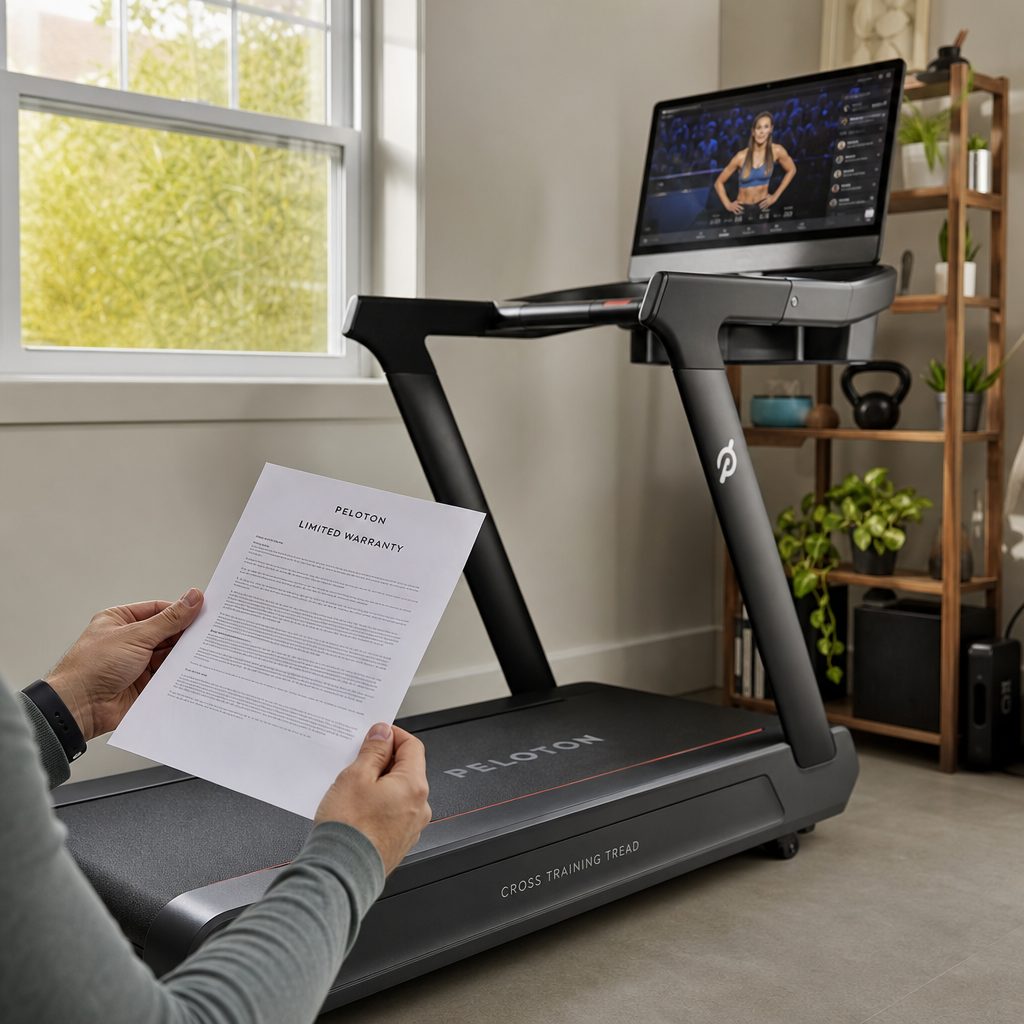
For a connected treadmill at this price, the 12-month limited warranty deserved as much scrutiny as the screen, motor and training platform.
Who the Peloton Cross Training Tread suited best
This was not a machine that needed to suit everyone. In fact, trying to make it suit every buyer would obscure what it did well. Its strongest use case was someone building a varied home-training routine around Peloton classes. The rotating screen was not a novelty for that person; it was a practical time-saver.
Best for Peloton regulars
Choose the Cross Training Tread if instructor-led runs, plans and off-tread classes are already central to how you exercise. The screen rotation makes that ecosystem much easier to use in one room.
Best for mixed training
It suited someone who wants walking or running followed by strength, yoga or mobility without setting up a separate display. The machine's main advantage was reducing that transition friction.
Best for interval fans
The 18-second rise from 1mph to 12mph, accurate 12.5mph top speed and auto-incline were well aligned with structured, instructor-led hard sessions.
Not best for long-stride runners
Tall runners or those who regularly run fast should think carefully about the 59-inch belt. The Tread+'s 67-inch slatted surface was the more accommodating option in the range.
Not best for noise-sensitive flats
Walking was relatively manageable, but running created substantial sound. At 78dB for an incline jog and 88dB at maximum speed, location and neighbours mattered.
Not best for value-first buyers
At £3,499, the Cross Training Tread made most sense when you placed a high value on Peloton's rotating-screen experience. A pure runner may prioritise deck and warranty differently.
For a beginner, the decision was more nuanced. The Tread was approachable because a good instructor and a clear plan can be extremely helpful when you are not sure what to do. But it was also a lot of money to spend before you know whether treadmill training is genuinely going to become a long-term habit. New runners should not confuse a polished interface with a guarantee of adherence. The best equipment is still the equipment you use, but there are cheaper ways to discover whether you enjoy walking or running indoors.
For experienced runners, I would separate those who wanted structured variety from those who wanted maximum run hardware. The former could enjoy the Tread greatly. The latter should be more demanding. If long, fast runs are your primary use, deck space and the feel beneath your feet should outweigh almost every screen feature. The Tread+ was the obvious in-range alternative for that buyer, though it was in a much higher financial bracket.
Living with it over a week: the routine it encouraged
The Cross Training Tread made most sense as a weekly routine machine, not simply a once-a-week running toy. A possible pattern showed why. On Monday, a short incline walk could use auto-incline and a coached class. On Wednesday, a faster interval workout could exploit the motor's quick 18-second climb from 1mph to 12mph. On Friday, a steady run could end with the screen turned around for mobility. At the weekend, yoga or strength could happen on the same display without the treadmill belt moving at all.
That is the case for the swivel screen in its strongest form. It did not add one extraordinary workout feature. It added a series of small conveniences across different sessions. The screen was already there. Your profile and plans were already there. You did not need to start a separate device, find a class, adjust a stand or decide whether your phone battery had enough optimism left. The machine shortened the distance between intending to train and actually training.
There is a mild irony in that: the Tread itself occupied a lot of room, but it could simplify the room's training setup. Instead of a treadmill plus a television plus a tablet stand, the big central screen did more of the work. That may be worthwhile in a dedicated gym or a generous living space. In a compact home, though, its 173cm by 84cm footprint and 165cm overall height could make the room feel dominated by one idea: running.
The audio system was likely sufficient for background instruction and music, but it was not the sort of specification that justified buying this model over another. With 10W total output through two front-facing speakers, it was practical rather than lavish. Headphones would remain the better choice for immersive classes or considerate training. The 3.5mm jack deserves a small round of applause here. It is not glamorous, but a simple cable still solves problems when wireless audio refuses to cooperate.
Its daily rhythm also depended on a willingness to embrace structured classes. Some runners prefer to set a pace and disappear into a podcast, a football match or the quiet misery of a tempo session. Nothing wrong with that. Those people may not extract enough additional benefit from Peloton's screen and plans to justify the price. The machine was designed for engagement. It wanted you to look, follow, respond and then rotate the screen for another session. If that sounds energising, excellent. If it sounds like being managed by a large rectangle, save your money.
Frequently asked questions
Yes, if you regularly do workouts beyond running. The 21.5-inch Full HD screen could move through 360 degrees, so you could turn it from the belt towards floor space for strength, yoga and other classes. It was far more useful than a fixed display for a mixed routine. If you only ever run whilst watching the same type of content, it was a nice feature rather than a decisive one.
For walkers, joggers and many runners, yes. The 20-inch width also gave useful side-to-side room. The concern was for taller runners, people with naturally long strides and those doing fast intervals, where extra deck length can make running feel more relaxed. Peloton's Tread+ offered a 67-inch slatted surface, which was substantially more accommodating.
It reached 12.5mph. Testing found that top speed was exceptionally accurate, with a margin of error below 0.5%. Its 3.0 HP motor also went from 1mph to 12mph in 18 seconds, making it one of the faster-responding motors for interval-style workouts.
No. The Cross Training Tread offered incline from 0 to 12.5%, including auto-incline that could follow instructor cues, but it did not have a decline function. If downhill simulation is important to your training, this was a clear limitation.
It was relatively manageable for walking but became much louder as pace increased. Testing recorded 65dB for a one-mile walk, 78dB for a leisurely 2.5-mile jog with inclines and 88dB for a maximum-speed 2.5-mile run. It also measured around 2 to 5dB louder than the average competing treadmill. Upstairs flats and early-morning runners should take those figures seriously.
No. The movement-tracking camera was reserved for the Cross Training Tread+, Bike+ and Row+. The Tread+ used it for real-time form correction, rep tracking and suggested weights. The base Cross Training Tread still offered the rotating screen and Peloton IQ platform, but not those camera-driven functions.
It had a 12-month limited warranty covering the touchscreen, frame, drive motor, walking belt and most components. That was the least impressive part of the overall proposition. On a £3,499 connected treadmill, a single year of limited coverage felt restrained and should be considered before purchase.
No. The Cross Training Tread was corded AC-powered equipment, so there was no battery runtime or battery charging routine. It did include USB-C charging on the frame for compatible devices, alongside Bluetooth 5.2 and a 3.5mm headphone jack.
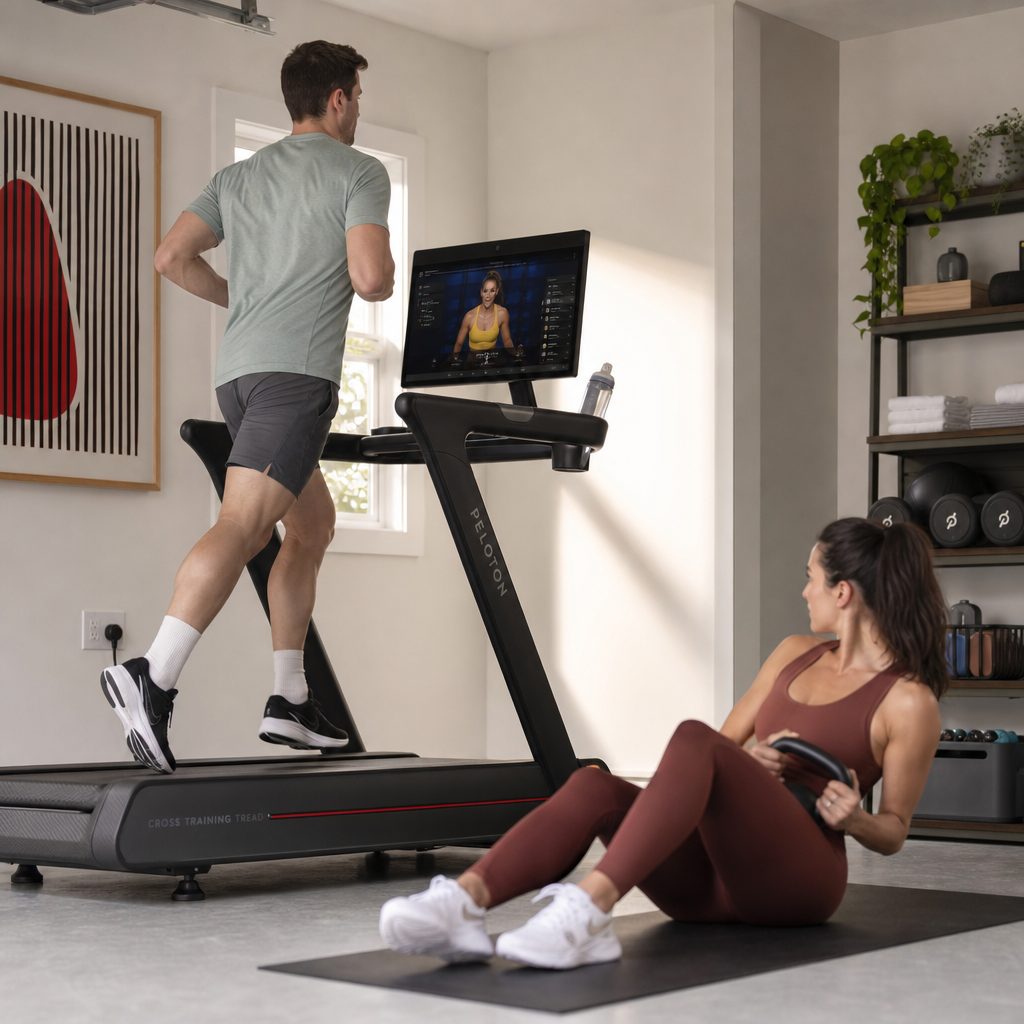
The Cross Training Tread made most sense as a permanent home-training station for runners who would genuinely use both the belt and the rotated display.
Final verdict: the screen was excellent; the value was more complicated
The Peloton Cross Training Tread was a very good connected treadmill and an even better all-in-one class station. Its 21.5-inch 360-degree swivel display was not gimmicky. For the right household, it made running, strength, mobility and yoga feel like parts of one routine rather than separate chores scattered around the room. Add quick 18-second acceleration from 1mph to 12mph, accurate top-speed performance, auto-incline and well-judged physical controls, and there was real quality here.
However, £3,499 was a demanding price. The 59-inch belt was adequate rather than lavish for a premium running machine, there was no decline, running noise was above average, and the 12-month limited warranty felt weak. My recommendation is conditional: buy it if Peloton classes and the rotating screen will materially change how often and how broadly you train. Skip it if you primarily want the most generous running deck and strongest long-term reassurance for your money. The swivel screen was worth having. It was not, by itself, enough to make every £3,499 purchase sensible.