
Hyperice Hypervolt Go 3 Review: Is the Travel Massage Gun Worth It?
The Hypervolt Go 3 brought five speeds, USB-C charging and a more useful four-hour claimed battery life to Hyperice's smallest massage gun. It was impressively portable and pleasantly simple, but its compact remit mattered: this was a recovery tool for regular maintenance, not a tiny pneumatic drill for conquering stubborn quad armour.
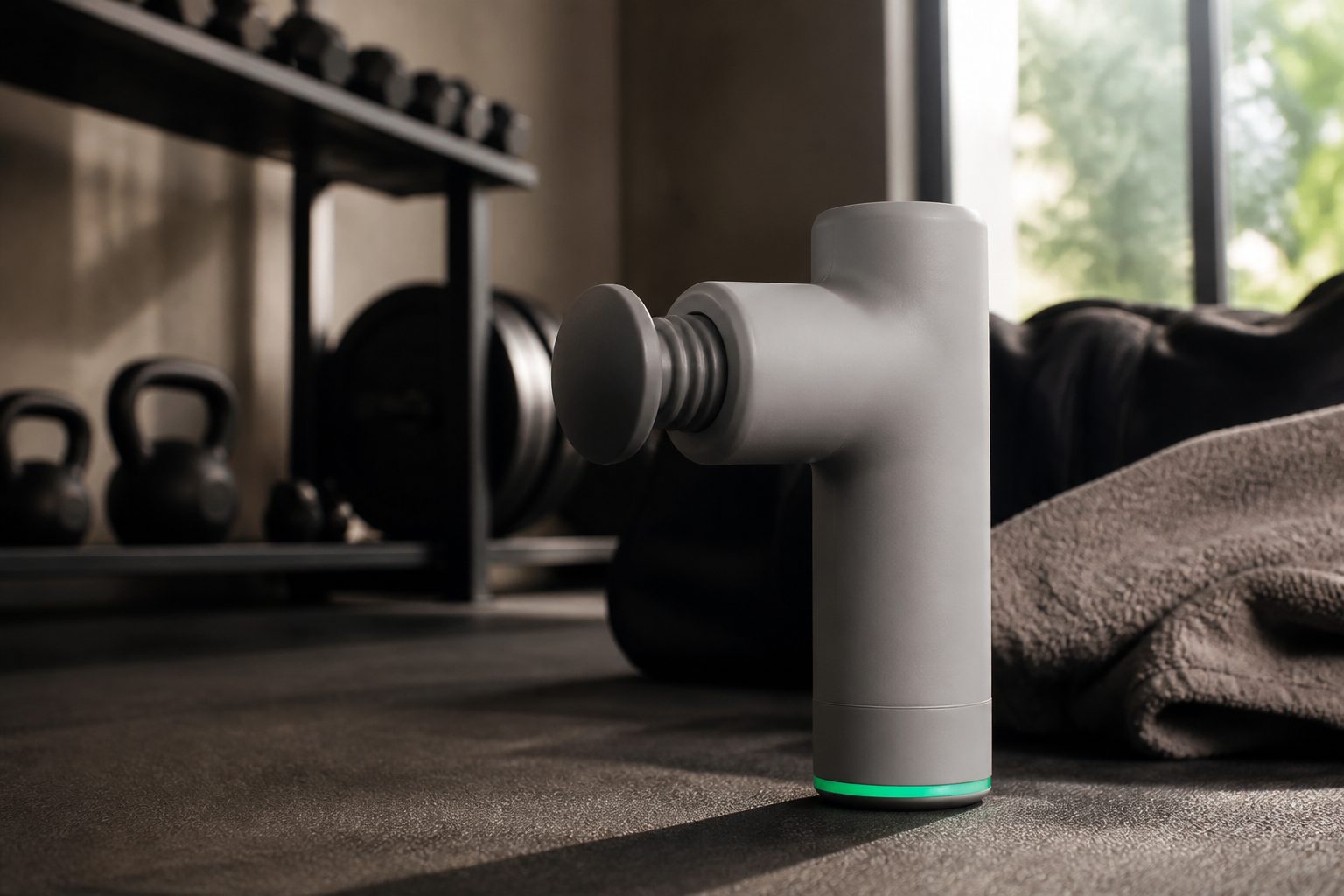
The Hypervolt Go 3 is the smallest member of Hyperice's 2026 percussion range, built around a travel-friendly shape rather than maximum brute force.
 By James Oduya · Staff Writer & Home Gym Columnist · Updated September 29, 2026
Hyperice Hypervolt Go 3: the short answer
The Hyperice Hypervolt Go 3 was the sensible choice in the Hypervolt 3 family for somebody who wanted a massage gun they would actually carry. At 0.73kg, it was substantially easier to pack than a full-sized percussion device, yet it retained five selectable speeds across a 1,500–2,500 RPM range, app connectivity, a proper carry case and a claimed four hours of battery life.
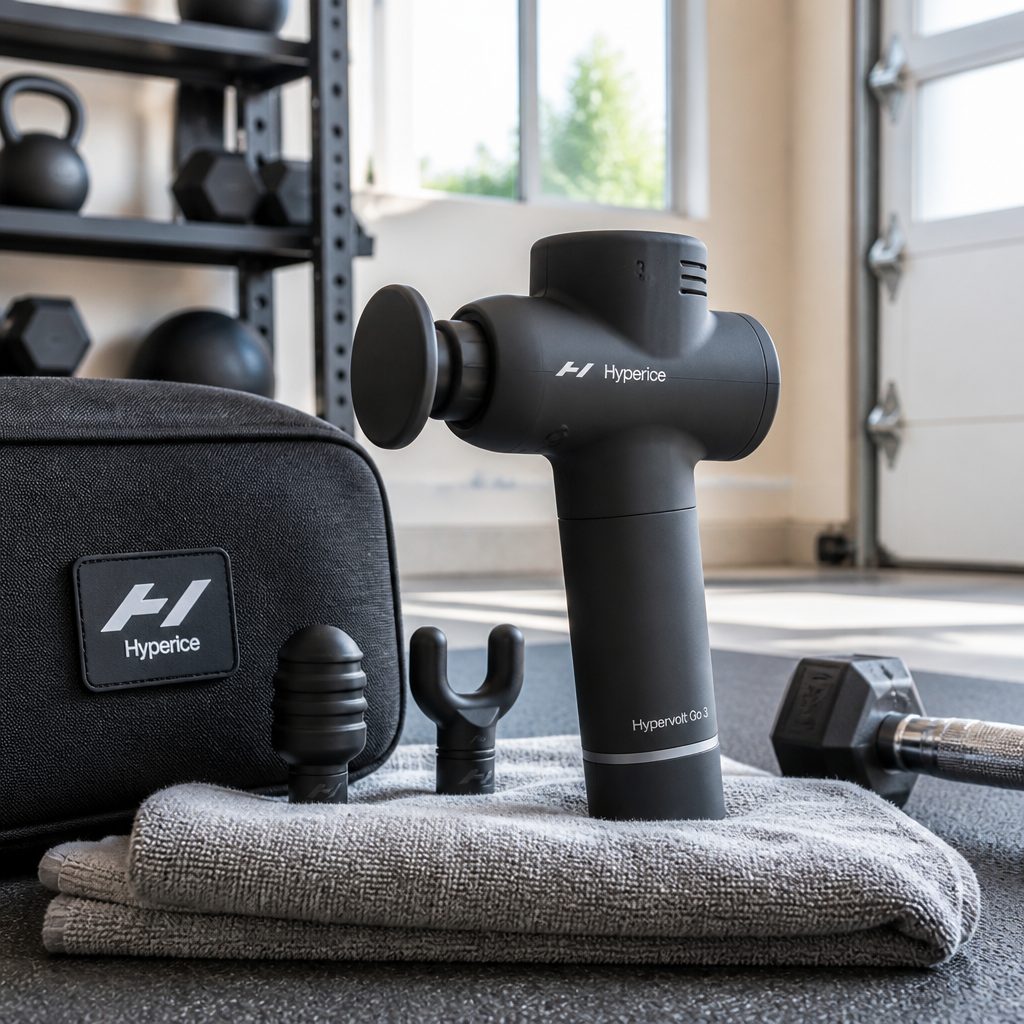
The Go 3 was at its best when used as a compact, repeatable recovery companion rather than expected to replace a full-size deep-tissue device.
That combination made it more than a token "mini" model. Plenty of compact massage guns looked tidy in a product photo and then felt like an afterthought once they met a calf, a glute or a post-leg-day back. The Go 3 had a respectable 45lb stall force and 10mm amplitude, so it could deliver genuinely useful percussion to tired everyday muscles. For runners, gym-goers, commuters and people who travelled with training kit, that was the central attraction.
The catch was equally clear. Hyperice's own larger models reached 60lb and 70lb of stall force, with 12mm and 14mm amplitude respectively. They were objectively better equipped for deep, heavy pressure. If your ideal recovery session involved leaning hard into a massage gun after squats, deadlifts or a long rugby match, the Go 3 was not the obvious winner simply because it was smaller. Physics remains annoyingly resistant to branding.
Key specifications at a glance
There was no need to decipher a particularly complicated spec sheet here. The Go 3's story was compactness first, then enough performance to make that compactness worthwhile. It used a rechargeable 7.2V, 4,250mAh lithium-ion battery with a 30.6Wh rating, charged through USB-C at 5V/2A, and offered a substantial improvement in speed choice over the previous Go generation.
Its dimensions of 5-9/16in long, 2-5/16in wide and 7in deep explain why it made sense in a kit bag. It was not pocket-sized in the absurd social-media sense of that phrase, but it was compact enough to live beside lifting straps, a water bottle and a change of clothes without monopolising the bag. The included premium carry case completed the point nicely.
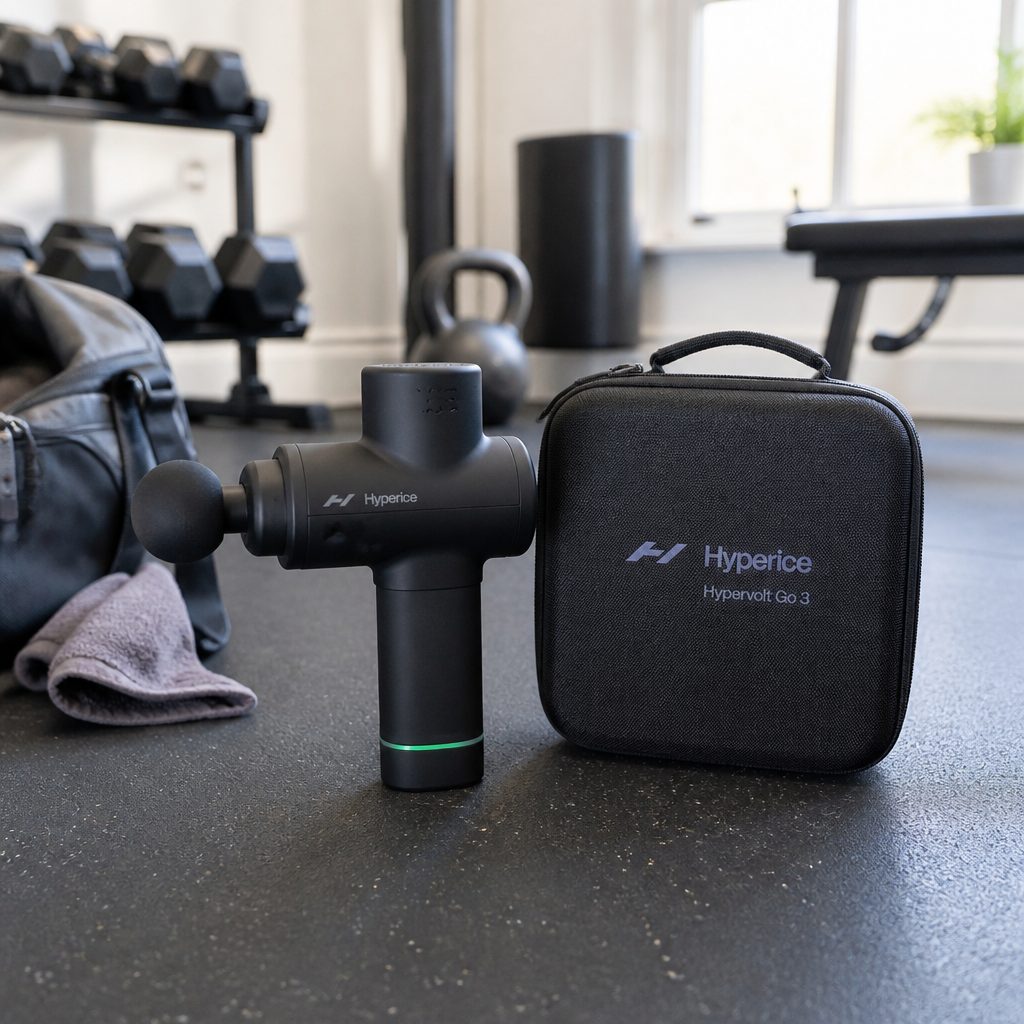
The Go 3's modest footprint and supplied carry case suited gym bags, weekend travel and the sort of office drawer where recovery tools are slightly more welcome than another stale protein bar.
Design and handling: compact without feeling toy-like
The best thing about the Go 3's physical design was that it did not make portability feel like a compromise you had to apologise for. It had an angled handle that was easy to hold, particularly when working around calves, hamstrings and shoulders. That matters more than it sounds. A massage gun that makes your wrist ache whilst you are trying to loosen your back has missed a fairly basic brief.
At 0.73kg, it was light enough for one-handed use over more than a quick 30-second burst. That made it well suited to the ordinary, repeatable maintenance sessions most people actually do: a few minutes over calves after a run, a little work around the upper back after sitting all day, or a short routine before training when you feel like your hips have become part of the furniture.
The Go 3 came with two attachments: a Flat head and a Wedge. It was a deliberately edited bundle, not a large foam menagerie. The Flat attachment was the general-purpose option, appropriate for broad areas where you wanted an even, uncomplicated contact point. The Wedge made more sense for scraping-style work around the shoulder blades, IT-band region or other areas where a flatter edge felt more targeted. Neither was a gimmick, and both were easy choices for a travel device.
A genuinely packable format
The Go 3 was light, compact and supplied with a carry case, which gave it a practical advantage over full-size devices that tend to be left at home once the novelty has worn off.
Angled handle for self-treatment
The handle shape supported the real-world task of reaching awkward areas without turning a recovery session into a small flexibility assessment.
Two useful attachments rather than clutter
The Flat and Wedge heads covered broad massage and more directed work. The limited selection helped keep the travel proposition simple.
There was also compatibility with Hyperice's Heated Head Attachment, sold separately. That broadened the Go 3's appeal for people who liked heat alongside percussion, though it was important to view that as an optional ecosystem extra rather than part of the out-of-box package. The larger Hypervolt 3 included a Heated Head as standard, which changed the value equation if heat was central to your recovery routine.
The portability test is brutally simple
If you would normally leave a heavier massage gun in a cupboard because it feels like another thing to pack, the Go 3's smaller size was not a minor feature. A recovery tool used often at moderate intensity was generally more useful than a monster device reserved for occasional heroic intentions.
Performance: how much massage can 45lb of stall force deliver?
The Go 3 was not underpowered; it was correctly categorised. Its 45lb stall force and 10mm amplitude positioned it as a capable compact massager for warm-ups, everyday tightness and post-session maintenance. It had enough resistance to continue working under sensible pressure, rather than immediately slowing the moment you pressed it against a large muscle group.
For common recovery jobs, that was enough. Calves, forearms, traps, feet-adjacent lower legs and moderately tight glutes did not require maximum amplitude simply because somebody on the internet had described them as "knots". The Go 3's five speed settings also mattered here. Moving from 1,500 RPM through to 2,500 RPM gave you more scope to begin gently, find a tolerable level, and increase intensity only if the muscle actually benefited from it.
This was especially welcome for people new to percussion therapy. A massage gun does not need to be driven into a muscle like you are trying to start a lawnmower. The lower settings were suitable for a calmer introduction or a pre-training wake-up, whilst the higher options gave a more energetic feel for larger areas. Five speeds was a significant improvement over the prior model's three, and it made the Go 3 feel less like a one-note travel accessory.
Where it reached its limits was predictable: heavily trained thighs, dense glutes and anyone who liked applying substantial bodyweight through the device. The 10mm stroke did not reach as deeply as the 12mm Hypervolt 3 or 14mm Hypervolt 3 Pro. Likewise, 45lb of stall force sat well below their 60lb and 70lb figures. It could help these areas, certainly, but it was not the model I would choose if deep-tissue percussion was your number-one reason for buying.
Those bars are not a claim that more is always better. They simply show where the Go 3 sat within its own family. Its RPM ceiling matched the larger models, so it did not lack speed. The main trade-off was force and stroke depth. That was a sensible trade to make for travel, but it was still a trade.
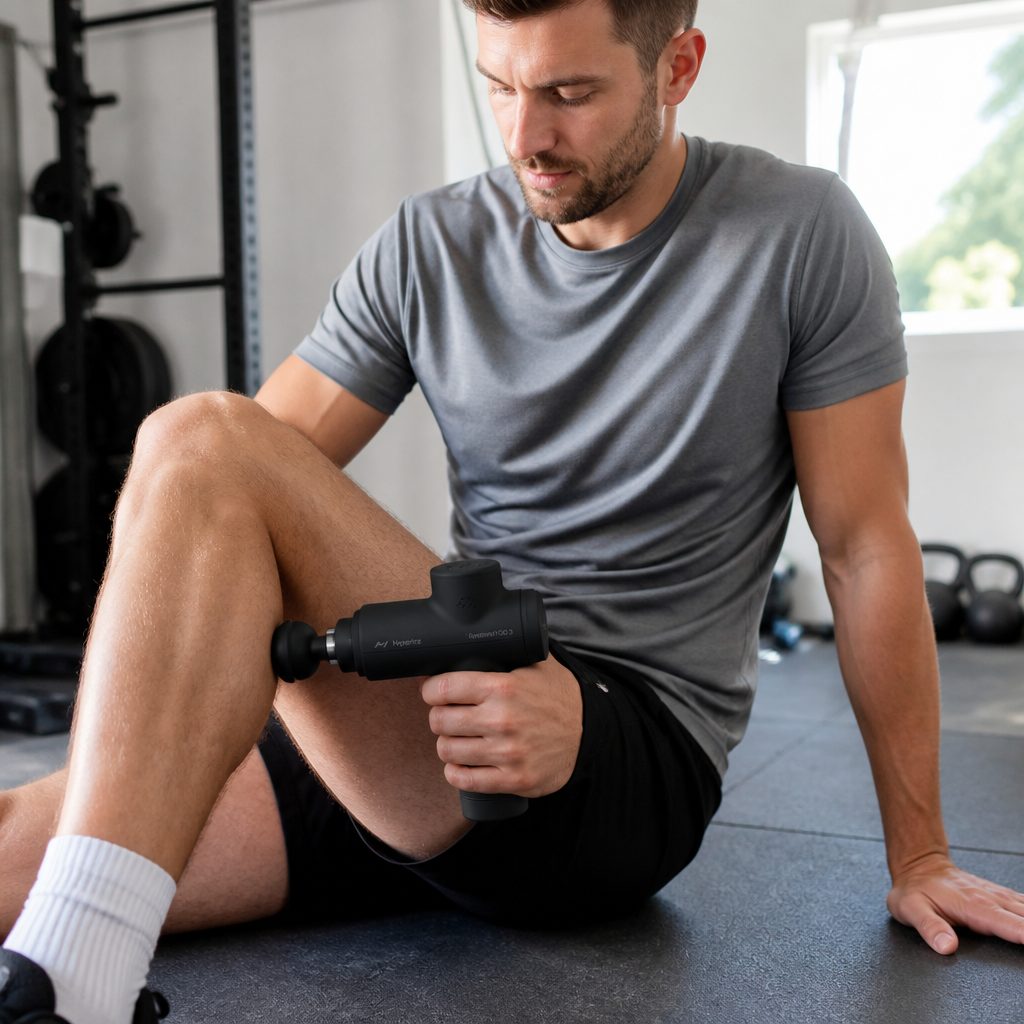
For calves, shoulders, forearms and general post-gym maintenance, the Go 3 had enough output to feel purposeful without becoming cumbersome to hold.
QuietGlide noise: quiet enough, not silent
Hyperice used its QuietGlide technology across this generation, and the Go 3 measured 55dB. That was manageable in a shared home, hotel room or gym changing area, particularly compared with older percussion guns that sounded as though they were attempting to drill through the coffee table.
However, the Go 3 was not the quietest Hypervolt 3 model. The standard Hypervolt 3 measured roughly 48dB, whilst the Hypervolt 3 Pro measured 51dB. The compact model therefore made a little more audible fuss than its bigger siblings. It was not an enormous practical problem, but it was worth noting because "small" does not automatically mean "quietest". Motors remain contrary little things.
In day-to-day terms, 55dB was unlikely to disturb a whole household from another room, but people close by would know you were using it. It was a reasonable level for a hotel room before bed, provided you were not treating your hamstrings at midnight with the highest speed setting and a complete disregard for neighbours.
The Go 3's sound level was reasonable for shared spaces, but the larger Hypervolt 3 was the better choice within this family if near-silent use was especially important. Portability and lower noise did not entirely travel together here.
Battery life and USB-C charging in everyday use
The Go 3's claimed battery life was up to four hours, a 33% improvement over the previous Go model's three-hour figure. That was an important upgrade because a compact massage gun was at its best when you could treat it as grab-and-go equipment, not another gadget needing its own peculiar charging routine.
For perspective, a person using it for five minutes most days could comfortably get through a week of daily sessions before charging became an issue. Even allowing for higher speeds and firmer pressure, four hours was a generous claim for a small recovery device. Most users did not need a single uninterrupted four-hour massage-gun session, unless they had accidentally opened a wellness retreat.
USB-C was one of the Go 3's most convincing practical wins. Instead of carrying a separate proprietary wall charger, you could use a compatible USB-C power source at 5V/2A. For travel, that reduced cable clutter and made the device easier to live with beside phones, headphones and other modern kit. It also made it friendlier for the sort of person who had already accepted that every bag contained three mystery charging leads.
The larger Hypervolt 3 and Hypervolt 3 Pro also claimed up to four hours, but they used dedicated 18V wall chargers. There was nothing inherently wrong with that arrangement, yet the Go 3's USB-C setup better matched its portable identity. The smaller battery capacity did not undermine practical endurance, and the charging approach was arguably the more convenient one for weekends away or frequent work travel.
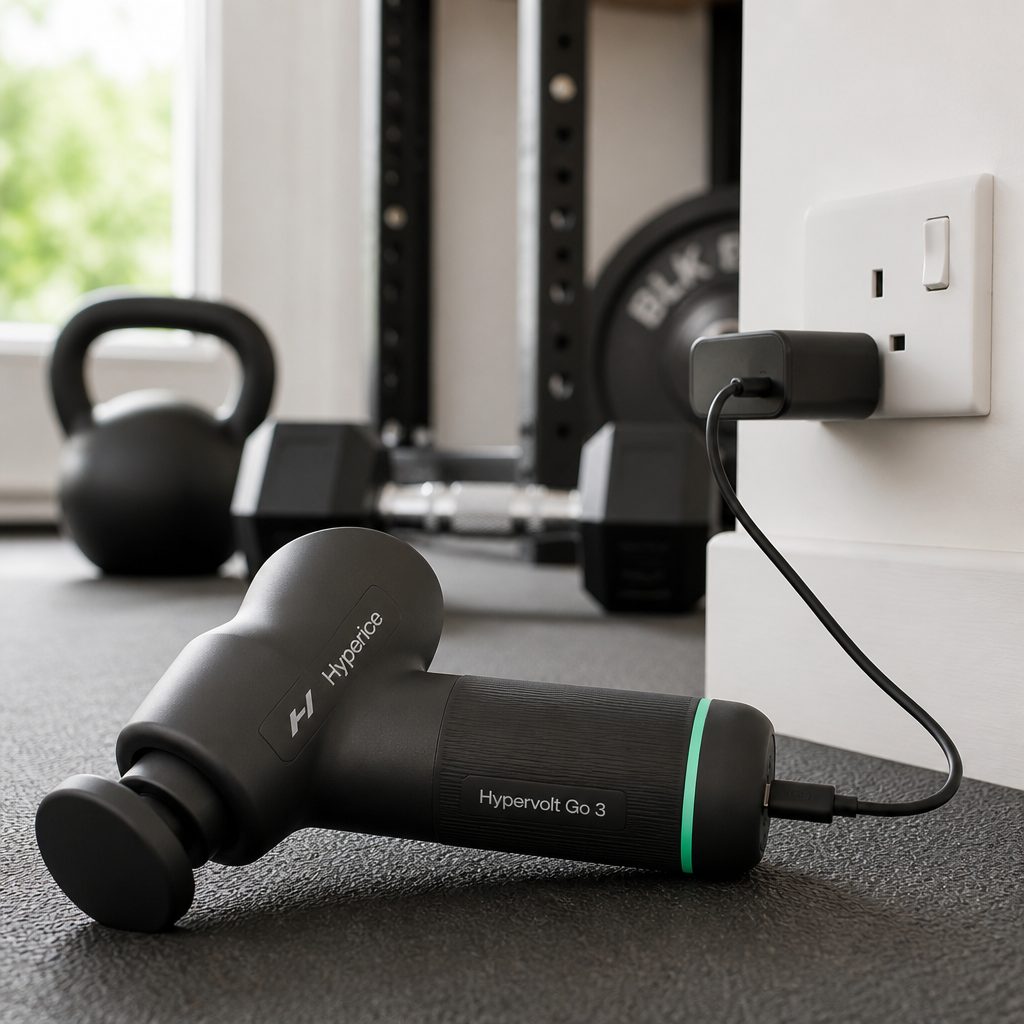
USB-C charging was a small but meaningful advantage for travel: one less proprietary power brick to remember when packing around training sessions.
Hyperice App guidance: useful structure, not compulsory homework
The Go 3 connected to the Hyperice App, which opened the door to guided routines and a little more structure around when and where to use the device. For inexperienced users, that was genuinely useful. Percussion therapy could feel oddly vague at first: you owned the tool, your muscles felt tired, and then you were left wondering whether you should use the Wedge on your shoulder for ten seconds or ten minutes.
Guidance gave the Go 3 a slightly more considered role than simply vibrating at whatever body part happened to be nearest. It could help you build a repeatable pre-workout or post-workout habit and make better decisions about duration and target areas. That was particularly welcome for runners managing calves after mileage, desk workers looking after the upper back, or gym beginners who wanted a calmer routine than aggressively prodding their quads at random.
At the same time, app support was not the product's main value. The core controls needed to remain easy enough to use without reaching for a phone, and they did. You could select a speed, fit an attachment and get on with it. The app was best viewed as optional coaching, not a gatekeeper between you and your massage gun.
The Go 3 did not include the pressure sensor found on the Hypervolt 3 and Hypervolt 3 Pro. That feature gave the larger models an advantage for users who wanted visual feedback on how firmly they were pressing. On the Go 3, you needed to use judgement. That is not a tragedy. Most people could learn to use moderate pressure and allow the device to do its job, but the absence of a sensor was one more reminder that this was the streamlined model.
Hyperice Hypervolt Go 3 vs Hypervolt 3 vs Hypervolt 3 Pro
The clearest way to judge the Go 3 was against its own siblings. All three shared a 1,500–2,500 RPM speed range, app connectivity and a claimed battery life of up to four hours. The important differences were physical weight, depth, force, accessories, noise and the degree of guided feedback.
| Feature | Hypervolt Go 3 | Hypervolt 3 | Hypervolt 3 Pro |
|---|---|---|---|
| Weight | 0.73kg | 0.91kg | 1.13kg |
| Speed settings | Five | Five | Six |
| Speed range | 1,500–2,500 RPM | 1,500–2,500 RPM | 1,500–2,500 RPM |
| Stall force | 45lb | 60lb | 70lb |
| Amplitude | 10mm | 12mm | 14mm |
| Noise level | 55dB | Roughly 48dB | 51dB |
| Attachments included | Flat and Wedge | Five, including Heated Head | Five, including Heated Head |
| Pressure sensor | No | Yes | Yes |
| Charging | USB-C | 18V wall charger | 18V wall charger |
The standard Hypervolt 3 was the most difficult sibling for the Go 3 to dismiss. It was still fairly manageable at 0.91kg, but it offered 60lb of stall force, 12mm amplitude, a pressure sensor, five attachments including the Heated Head, and quieter operation. If your massage gun lived mainly at home and you regularly trained hard, that broader capability made a compelling case.
The Hypervolt 3 Pro was for the user who wanted maximum intensity. Its 70lb stall force and 14mm amplitude were far more suited to deep-tissue work, whilst its sixth speed and pressure sensor gave it the fullest feature set. It was also the heaviest of the three. That extra weight was not a drawback if raw performance was the priority, but it made less sense for somebody counting every item in a cabin bag.
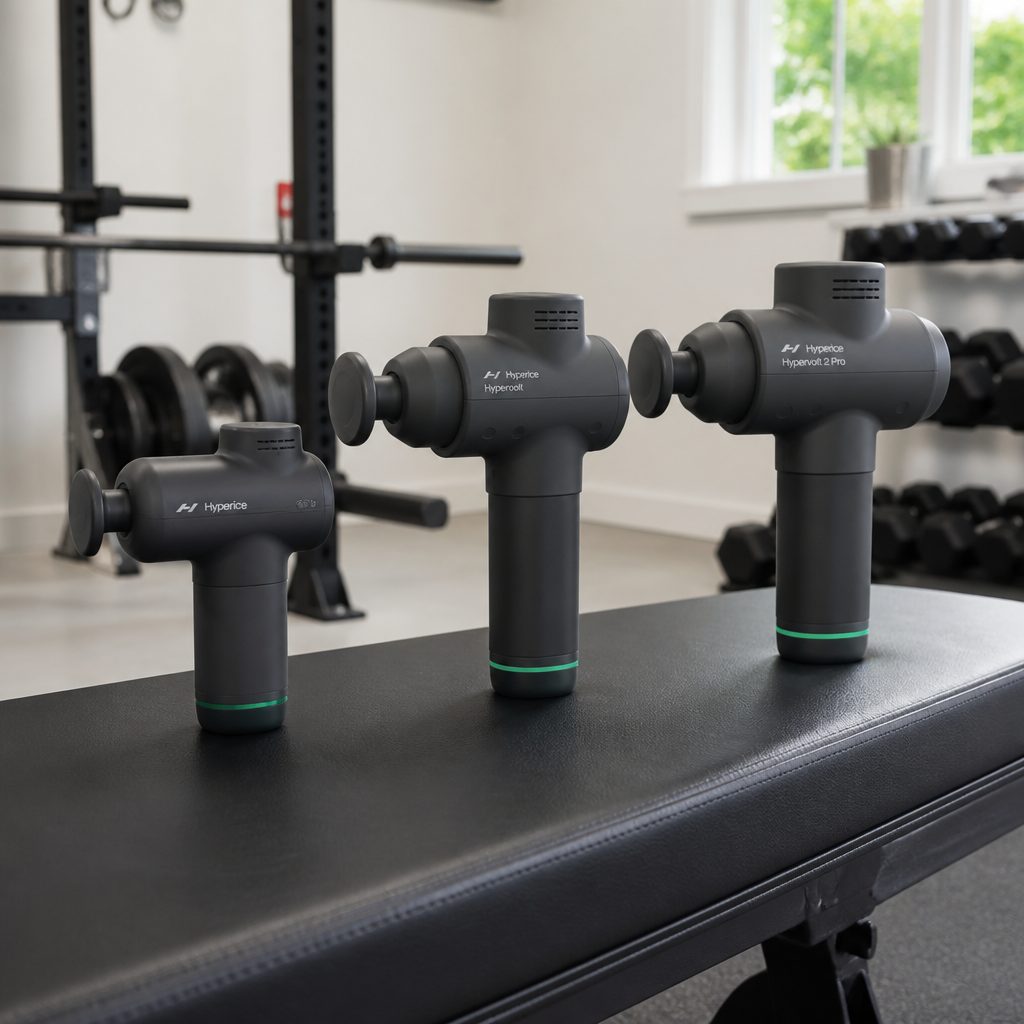
The family comparison made the Go 3's role very clear: choose it for mobility and simple daily use, not because it was the strongest percussion gun Hyperice made.
Value: does the Go 3 earn its place below the mid-range models?
The Go 3 occupied the more accessible end of Hyperice's 2026 line, but it was not cheap simply because it was small. Its value rested on whether you genuinely valued the things it did differently: low weight, compact dimensions, USB-C charging, a carry case and enough battery life to remove day-to-day friction.
If your routine involved commuting to a gym, travelling for work, racing at weekends or staying away from home often, it had a convincing answer. A larger model might offer superior force on paper, but the Go 3 had a better chance of being present when your calves tightened after a long journey or your shoulders stiffened after a hotel-gym session. That is not a romantic observation. It is logistics, which is usually where good intentions go to die.
For home-only buyers, the calculation changed. The Hypervolt 3 brought noticeably better hardware: more force, deeper amplitude, lower noise, pressure sensing and a larger attachment bundle that included heat. The Go 3's price position only looked especially strong if its size made a meaningful difference to your ownership. Buying the compact model and then using it exclusively in the living room would be fine, but it would not exploit its most distinctive advantage.
Pros
- Light 0.73kg build was easy to carry and comfortable to use one-handed.
- Five speeds offered far more flexibility than the previous three-speed Go model.
- USB-C charging suited travel and reduced dependence on a proprietary charger.
- Claimed four-hour battery life was excellent for brief, regular recovery sessions.
- Flat and Wedge attachments covered the most useful compact-massage jobs.
- Included carry case strengthened the portability proposition.
Cons
- 45lb stall force was well behind the two larger Hypervolt 3 models.
- 10mm amplitude limited deep-tissue work on very dense muscle groups.
- It was louder than both the Hypervolt 3 and Hypervolt 3 Pro.
- Only two attachments came in the box.
- There was no pressure sensor for users who wanted feedback on applied force.
- The Heated Head Attachment required a separate purchase.
Who should buy the Hyperice Hypervolt Go 3?
The Go 3 was not trying to suit everybody, and that was a strength. Hyperice already had larger devices for higher-force recovery. The smaller model made most sense when convenience was not an afterthought but the deciding feature.
Best for frequent travellers: Hypervolt Go 3
The lightweight body, carry case and USB-C charging made this the natural Hypervolt for people who trained away from home or wanted recovery kit in a cabin bag.
Best all-rounder: Hypervolt 3
For home users wanting more depth, more force, quieter running, pressure sensing and the heated attachment included, the standard model was the broader choice.
Best for maximum intensity: Hypervolt 3 Pro
The 70lb stall force and 14mm amplitude made the Pro the right pick for people prioritising the most substantial deep-tissue capability.
Best for daily mobility: Hypervolt Go 3
Runners, desk workers and gym regulars who valued consistency over sheer force were likely to get the most from the Go 3.
I would recommend the Go 3 to people who tended to do a little recovery work often. That includes runners who wanted a quick calf routine, lifters managing shoulder and forearm fatigue, cyclists who wanted something compact for travel, and office workers whose upper back needed attention before it became a permanent personality trait.
I would be more cautious for serious strength athletes who consistently wanted hard, deep work on glutes and quads. The Go 3 could still have a role, especially as a second device for travel, but the standard Hypervolt 3 offered a more satisfying main machine. If maximum percussion power was the point, the Pro was plainly the better fit.
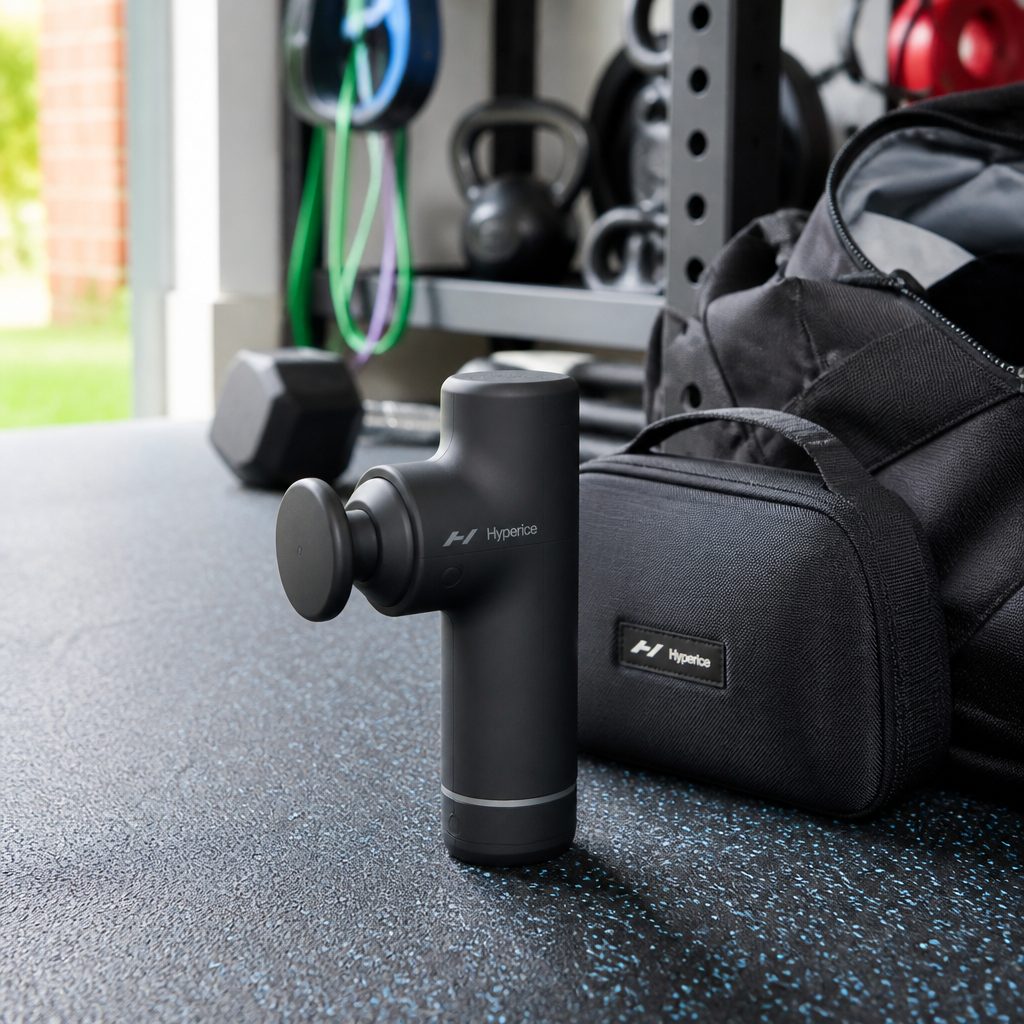
The Go 3 made the most sense for people whose recovery routine moved with them: runners, commuters, gym regulars and travellers rather than permanent residents of the home gym.
How to use it sensibly for gym recovery
A massage gun was not a substitute for a warm-up, sensible training progression, proper sleep or seeing a qualified clinician when pain was persistent or severe. It was a recovery and comfort tool. Used well, it could help you make a short mobility routine more enjoyable and more likely to happen. Used badly, it could turn into an expensive way to annoy a sore area.
For a pre-workout routine, start on a lower speed and spend a short amount of time moving over a broad muscle area rather than parking the head on one spot. The Flat attachment was a sensible default here. Think calves before a run, upper back before pressing, or glutes before lower-body training. The aim was to feel more prepared to move, not battered before the first working set.
After exercise, increase speed only when it felt comfortable and productive. The Wedge could be useful around the shoulder blade area or where you wanted a more directed edge, but restraint was still wise. Avoid bony areas, joints, the front of the neck and any place that made you wince. More pressure was not automatically more therapeutic. The Go 3's lack of a pressure sensor made that point especially important: listen to your body rather than trying to achieve imaginary maximum force.
A better recovery habit beats a more aggressive one
The Go 3 worked best as part of a short routine you could repeat. A few measured minutes after training, combined with normal mobility work and recovery basics, was more sensible than attacking one tender spot for ages because it felt impressively intense.
Frequently asked questions
Final verdict: a very good travel massage gun, with honest limits
The Hyperice Hypervolt Go 3 was worth choosing if portability genuinely shaped how you trained and recovered. Its 0.73kg weight, compact dimensions, USB-C charging, carry case, five speeds and claimed four-hour battery life made it unusually easy to own day to day. It had enough 45lb force and 10mm amplitude for meaningful warm-ups and regular post-exercise maintenance, rather than feeling like a novelty mini device.
Just buy it for the right reason. The Go 3 was not the best Hypervolt for hard deep-tissue work, maximum attachment choice or the quietest operation. The standard Hypervolt 3 was the better all-round home option, and the Hypervolt 3 Pro was the serious power pick. But for gym bags, travel days and people who wanted a recovery tool they would actually use, the Go 3 got the essentials right. Small, practical and refreshingly free of unnecessary drama.