
Everything You Need to Train for HYROX at Home in the Garage
A practical garage-gym kit list for building the movement patterns, stamina and awkward-work capacity HYROX demands — including sensible substitutions for the stations you cannot recreate exactly at home.
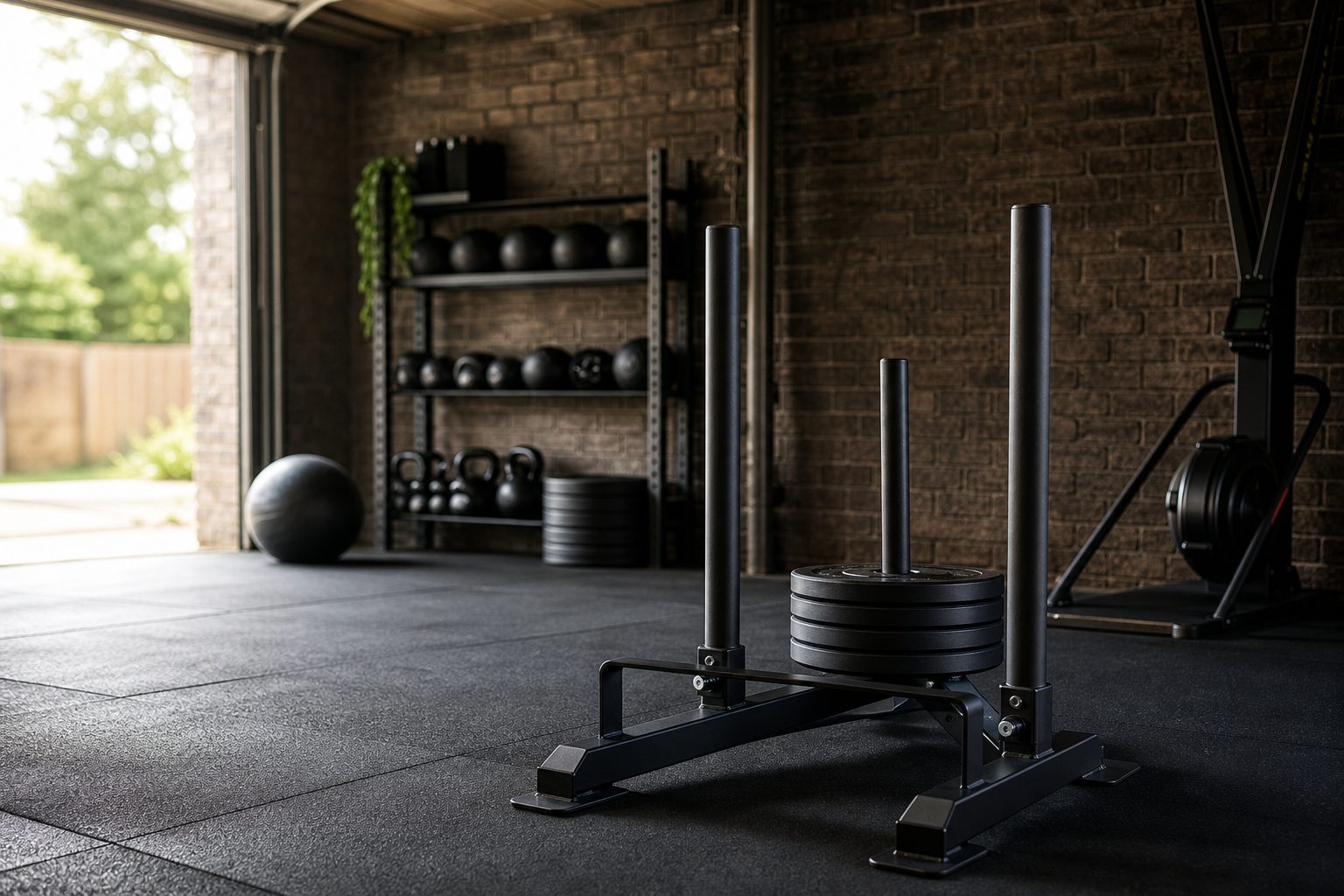
A sensible home HYROX corner is less about making the garage look like an arena and more about creating repeatable stations that you will actually use.
 By James Oduya · Staff Writer & Home Gym Columnist · Updated July 16, 2026
1. Start with the job, not the shopping trolley
HYROX has a slightly mischievous way of making ordinary-looking movements feel very unordinary. A row is a row, until you have already run hard. A lunge is a lunge, until your legs have spent the previous several minutes negotiating a heavy sled. Then there is the wall-ball station: technically straightforward, emotionally quite rude.
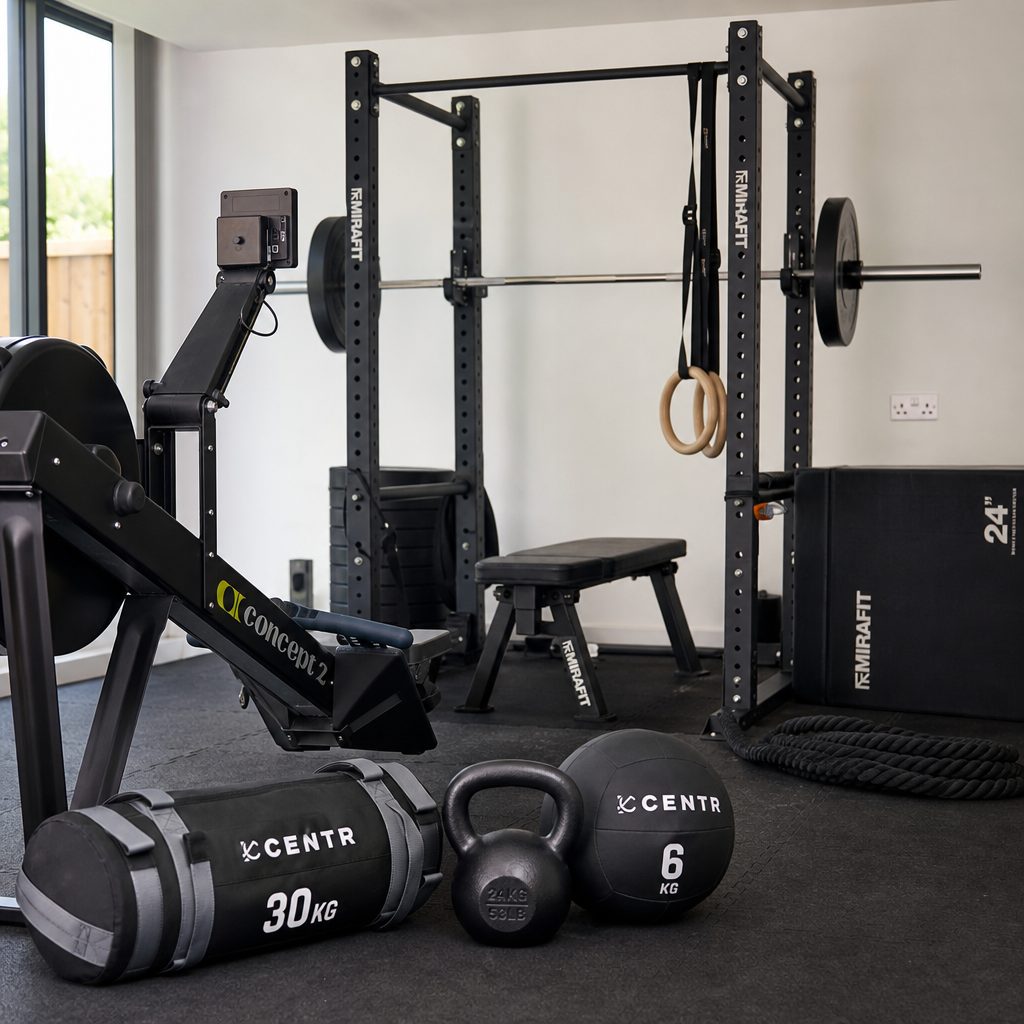
The most useful upgrade path starts with versatile training tools, then adds exact station practice where your own weaknesses justify the space.
That is why I would not approach a garage setup as a quest to own every impressive-looking bit of functional-fitness kit. The useful question is simpler: what movement pattern does each station ask me to repeat under fatigue? Once you answer that, the home setup becomes far more manageable. You need a way to pull down powerfully, a way to row, something to push and drag, implements to carry, a load for lunges, a target for throwing, and enough clear floor to move without meeting the lawnmower at speed.
The June 2026 Hyrox Vault home-training guide made the central point neatly: a home substitute is not identical to the race station, but it can build the movement capacity and fitness needed for race day. That distinction matters. A resistance-band pull-down does not turn into a SkiErg because you believe in it very intensely. It does, however, train a similar overhead pulling and hip-hinge pattern. That is useful. Useful wins.
There is also a hierarchy here. If you are new to HYROX, buy equipment that lets you train often and safely. A compact, flexible setup that sees three sessions a week is much more valuable than an elaborate sled lane that becomes a very expensive shelf for coats. If you are already committed and you have the room, then specificity becomes increasingly worthwhile. A real rower, a real SkiErg and a properly loadable sled make practice more direct and make pacing lessons much harder to avoid.
2. Map your garage to the stations before you buy
The best garage HYROX gym is usually arranged like a circuit, not like a showroom. Think in routes. Where will you walk with heavy handles? Where can you lunge without having to reverse every few steps? Can you perform burpees in a spot where your hands are not landing beside a stack of paint tins? The answers are not glamorous, but they decide whether the room feels inviting or perpetually inconvenient.
Start by protecting a clear strip of floor. That strip can host lunges, carries, burpees and a simple shuttle-style running substitute when weather, daylight or family logistics make outdoor running awkward. You do not need to pretend it is the same as running outside; it is not. But it gives you an option for practising transitions and for completing structured sessions when life has become life-ish.
Next, put the equipment that stays put around the edges. A rower and SkiErg-style station are easiest to live with when they do not bisect the room. Sled work needs a straight lane and a surface you are happy to use. Throwing work needs a secure target area with nothing fragile behind it. This may sound laughably obvious. It is also precisely the sort of thing people discover after buying a wall ball and launching it towards the garage door opener.
Design for movement routes
Choose a lane for pushing, pulling and carrying before choosing an implement. Equipment is easier to adapt than a garage wall.
Store the awkward kit low and securely
Sandbags, handles and balls need a predictable home. The session begins more readily when you are not hunting for a strap.
Leave a transition zone
HYROX is not only about completing stations; it is about moving into the next one with composure. A little open space lets you rehearse that skill.
Respect the room
Noise, neighbours, ceiling height and floor protection all affect what equipment makes sense. The practical setup is the good setup.
Do not confuse station-specific equipment with station-specific fitness. A garage setup can develop the engine, grip, hinge, squat, pull and resilience behind HYROX even where the exact race apparatus is unavailable.
3. The ranked garage kit list
The picks below are ranked by how much useful HYROX training capacity they can add to a home garage, rather than by how dramatic they look in a social-media clip. A rower can be wonderfully specific. A set of heavy carry implements can be surprisingly transformative. Resistance bands are humble, but humble kit that gets used is a bit of a superhero.
None of these items absolves you from running. HYROX still rewards people who can run economically, settle their breathing and then work again. Your home equipment should support that running rather than replace it. The goal is not to create a perfect miniature event. It is to arrive at the event with fewer surprises.
1. Resistance Band Overhead Pull-Down Setup — Best for SkiErg-style training in a small garage
If your garage does not have room for a SkiErg, an anchored resistance band is the first thing I would add. Hyrox Vault identified the resistance-band overhead pull-down as the closest home substitute for the SkiErg movement: anchor the band above head height, face the anchor, begin with both hands overhead and pull down past the thighs. It is a simple arrangement, but it asks for a coordinated downward pull and a hip hinge rather than an isolated arm exercise.
The key is to treat it like a movement, not a hurried set of triceps push-downs. Stand tall enough to begin with a meaningful overhead reach. Brace the trunk. Let the hips hinge as the hands travel down. Return with control. When your breathing is elevated, keep the sequence clean: reach, pull, hinge, stand. The temptation will be to make it all shoulders and panic. Resist. Panic is for race photos.
Why it earns top spot
- Creates a practical SkiErg-pattern substitute without dedicating much floor space.
- Lets you practise upper-body pulling and hinging repeatedly.
- Easy to include in intervals, mixed circuits and technique work.
What it cannot do
- It does not reproduce the feel or feedback of a SkiErg.
- Anchor security and a safe setup are essential.
- Band resistance changes through the movement, so effort feels different from an ergometer.
2. Rower — Best for direct rowing-station practice
A rower is the most straightforward way to practise the rowing movement at home. There is no need to overcomplicate the case. If rowing will appear in your race and you can accommodate a machine, practising rowing helps. More importantly, it teaches you how your own legs, trunk and arms behave after running and loaded work. That knowledge is valuable on an ordinary Tuesday, and very valuable when your quads begin negotiating with you during a hard session.
Use the rower for more than long, steady pieces. Keep some easy rowing in the programme, certainly, but also practise getting on it with an elevated heart rate. Learn the first minute after burpees. Learn what happens to your stroke when your grip is tired from carries. Learn whether you rush the slide when anxious. Those are training discoveries, not character flaws.
Technique remains the sensible starting point. The leg drive should initiate the stroke, followed by trunk movement and then the pull. On the return, reverse the sequence calmly. A frantic stroke may feel busy, but it does not always feel productive. HYROX is already generous enough with fatigue; you do not need to manufacture more through avoidable inefficiency.
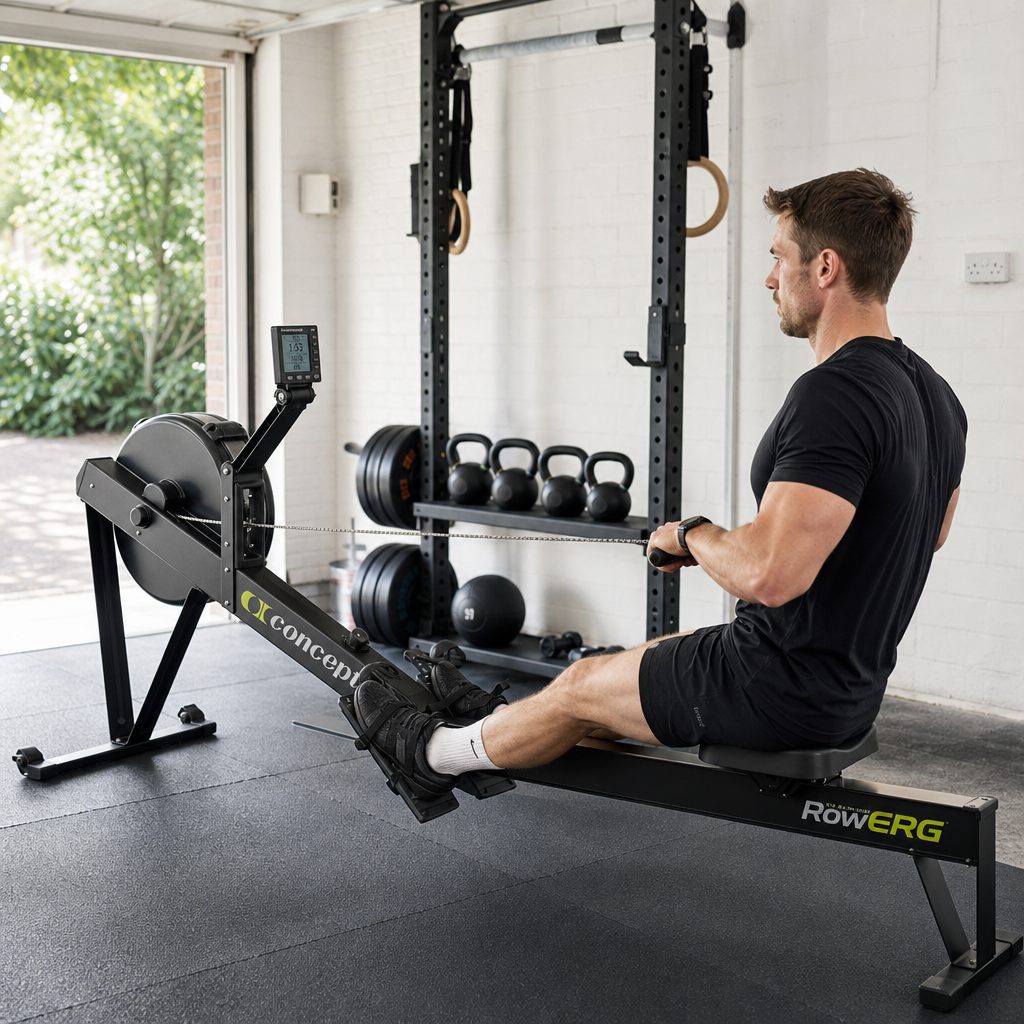
A rower lets you practise the rhythm of leg drive, trunk movement and pull after running or loaded work — not just in a fresh, comfortable standalone session.
3. SkiErg — Best for the most specific pull-and-hinge practice
If budget and space allow, a SkiErg is the more exact option for the ski station than bands. The reason is not that a machine magically improves fitness. It is that repeated exposure to the actual movement and the same broad demand removes guesswork. You can learn a sustainable rhythm, practise changes in cadence and discover what pace leaves enough in the tank for the next task.
That specificity is especially useful once you have built a general base. Early on, bands may give you much of what you need: repeated pulling, hinging and an elevated heart rate. Later, exact practice becomes more valuable because the limiter can become familiarity rather than raw fitness. In other words, you may be strong enough to work hard, but still not yet efficient at working hard on that particular machine. HYROX is fond of such distinctions.
A SkiErg is not compulsory for every home athlete. It is a specialist choice. Make room for it only if it will be used regularly and if it does not crowd out the general-purpose kit that supports the rest of your training. The best garage gyms have a little ruthlessness about them.
4. Loadable Sled — Best for push and pull specificity
A loadable sled is the most direct home tool for learning the physical and mental texture of sled work. There is a difference between having strong legs and being able to keep driving when a sled has decided it would rather become part of the floor. The posture, patient footwork and full-body tension are distinct. A sled makes them difficult to ignore.
You will need a usable lane and a surface that suits sled work. That requirement is not a small footnote; it is the reason this pick sits below more adaptable equipment. In a generous garage, outbuilding or covered outdoor area, it can be a superb addition. In a narrow single garage shared with bikes, storage and a freezer, it may be an argument waiting to happen.
Train both directions of effort where your setup permits: a forward push with purposeful steps, and a pulling pattern that lets you practise bracing and staying organised. Keep the first sessions conservative. It is very easy to make a sled session brutally hard. It is harder, and smarter, to make it repeatable enough that you can still run, row or lunge later in the week.
Garage-gym reality check
A sled earns its space when you have a clear lane, a compatible surface and a genuine plan to use it. If one of those is missing, build sled-relevant leg and trunk capacity with loaded carries, squats, lunges and conditioning instead of forcing a bad setup.
5. Sandbag — Best for lunges and deliberately awkward strength
A sandbag is one of the least glamorous and most useful pieces of HYROX-adjacent kit you can own. It moves a little. It sits differently from a tidy dumbbell. It asks you to brace and adjust. For loaded lunges, that mild unpredictability can be a feature rather than a flaw, because fatigue in a race rarely feels perfectly balanced and convenient either.
Use it for walking lunges, static lunges, squats, carries and ground-to-shoulder-style conditioning where appropriate to your ability. The important thing is that you build confidence in holding a load whilst moving with control. Start with a consistent route. Set a posture standard before the session begins. When form becomes ragged, shorten the set, rest briefly and return to good repetitions. Quantity has a sneaky habit of getting all the attention; quality is what lets you train next week.
A sandbag also gives a simple answer to the home athlete who wants one implement that feels more event-like than a conventional weight. It is not a replacement for every station. Nothing is. But it covers a lot of useful ground and it stores more easily than a machine.
6. Heavy Carry Implements — Best for farmer's-carry grip and posture
Farmer's carries are beautifully honest. Pick up something heavy, walk without folding yourself into a question mark, turn carefully, repeat. They develop grip, trunk stiffness, upper-back endurance and the ability to keep moving whilst the rest of the body is loudly requesting a sit-down.
Your carry implements can be whatever safe, matched load you can hold securely: dedicated handles, kettlebells, dumbbells or another robust option. The exact object matters less than the training intent. Stand tall. Keep your steps controlled. Avoid taking turns like a supermarket trolley with one broken wheel. If the route is short, make more turns; if it is longer, use it to practise settling into a sustainable rhythm.
Carry training has a useful transfer effect beyond the station itself. It exposes weak links. If your hands give up first, you learn that. If your shoulders creep up to your ears, you learn that too. Better to meet these facts in a garage than in the middle of a race when there is nowhere to hide except behind your own sunglasses.
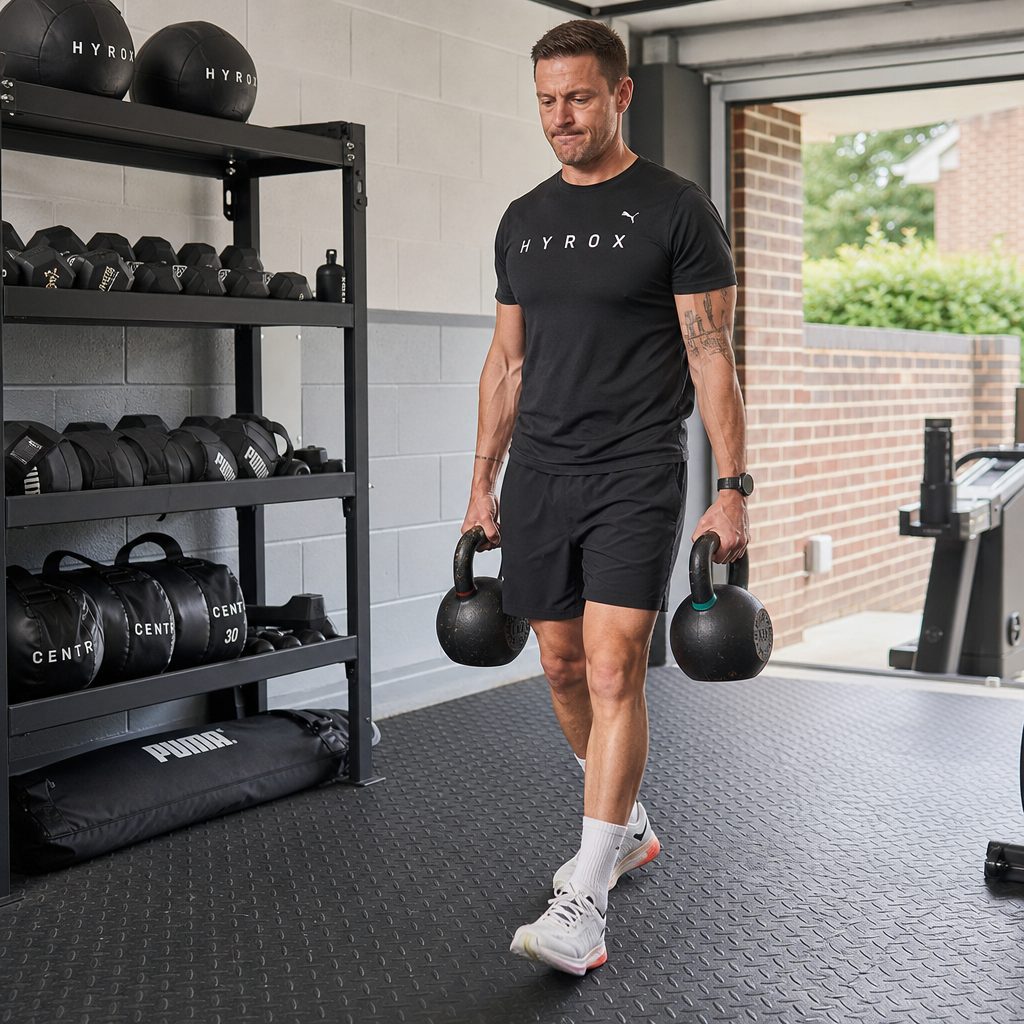
Carries look simple until grip, posture and breathing have all been challenged at once; a clear turn point helps make garage practice consistent.
7. Wall Ball and Secure Target — Best for repeatable squat-to-throw practice
The wall-ball station demands a rhythm that is easy to underestimate. You squat, drive, throw accurately, receive, and do it again without allowing the ball to dictate the session. At home, a suitable ball and a safe, secure target let you practise the combined squat-and-throw pattern, timing and calmness that make a large difference once fatigue arrives.
The word safe deserves emphasis. A throw target should not be improvised around fragile garage contents, low ceilings or anything that will punish a poor rebound. Give yourself space. Check the path. Make sure the landing area is clear. If the room does not allow safe throwing, train the squat pattern and upper-body conditioning separately rather than turning the garage into a minor insurance claim.
Practise sets that are manageable enough to reinforce clean movement. Establish the target, breathe at the top, and let the legs do their share of the work. The worst home habit is treating every set as a frantic test. You need the ability to keep repeating sound reps when tired, not simply the ability to survive one spectacularly untidy minute.
8. Burpee Broad-Jump Lane — Best for no-kit station practice
Not every valuable station needs a product. A clearly marked burpee broad-jump lane costs very little, takes modest space and can teach a great deal about pacing. The broad jump asks for leg drive and landing control after you have repeatedly moved to and from the floor. The burpee asks for body control when the heart rate is already high. Put them together and they become an excellent lesson in not starting too fast.
Use floor markers to keep your efforts consistent. Prioritise a controlled landing and a reliable way of getting down and up. If your garage floor is unforgiving, protect the training area appropriately and make sure your hands and feet have a stable surface. There is no medal for slipping during a practice burpee. There is merely embarrassment, which is a very poor training metric.
This is also the station most people should practise without trying to mimic an entire race every time. Short, controlled blocks inside a broader session are plenty. Pair them with easy running or rowing, then learn to resume a steady effort. That transition skill is where the useful work lives.
4. What each pick covers — and what it does not
A good buying guide should make gaps visible. No single item covers HYROX in full, and that is perfectly fine. The table below is a planning tool rather than a shopping commandment. It shows how each ranked pick contributes to the movement patterns the event asks for and where substitutions remain just that: substitutions.
| Ranked pick | Primary HYROX-style role | Best home-training use | Important limitation |
|---|---|---|---|
| Resistance Band Overhead Pull-Down Setup | SkiErg substitute | Overhead pulling with hip hinge | Does not replicate an ergometer's feel |
| Rower | Rowing practice | Leg drive, trunk movement and pull | Requires dedicated machine space |
| SkiErg | Ski station practice | Specific pull-and-hinge conditioning | Specialist rather than multi-purpose kit |
| Loadable Sled | Sled push and pull | Bracing, drive and loaded horizontal effort | Needs a suitable lane and surface |
| Sandbag | Loaded lunge preparation | Awkward carries, lunges and squats | Does not replicate every station directly |
| Heavy Carry Implements | Farmer's carry | Grip, posture and walking under load | Short routes require frequent turning |
| Wall Ball and Secure Target | Wall-ball practice | Squat-to-throw rhythm and accuracy | Needs a safe throwing area |
| Burpee Broad-Jump Lane | Burpee broad jumps | Floor-to-feet control and pacing | Does not replace running fitness |
The practical takeaway is reassuring. You do not need every row in the table to train well. A resistance-band setup, sandbag, carry option, safe wall-ball area and floor lane can cover a surprising amount of meaningful work. Add a rower if rowing specificity matters to you. Add a SkiErg when that is a priority. Add a sled only when the garage can genuinely support one.
5. Build in stages instead of buying in a panic
There is an understandable urge to buy the full dream setup immediately. HYROX training can make equipment look essential very quickly, particularly when a video ends with somebody collapsing tastefully beside a sled. But staged buying is usually smarter. It allows the garage, your routine and your actual preferences to reveal themselves.
Stage one is the versatile foundation: a safe band anchor and resistance bands, a portable loaded implement for lunges, a way to carry load, and a clear floor route. This stage gives you a great deal of conditioning without turning the room into a warehouse. It also reveals whether you enjoy circuit work, whether the garage is warm enough in winter, and whether your planned training time is realistic. These are useful discoveries, even if they are not terribly exciting ones.
Stage two adds the equipment linked to your limiting stations. If rowing is your weak point, add a rower. If the ski movement feels alien, choose the more specific SkiErg route when the space supports it. If your legs are strong but you struggle to move a sled-like load, examine whether a proper sled lane is feasible. Buy to solve a training problem, not to collect an identity.
Stage three is refinement: better storage, an improved target arrangement, clearer lane markings and session structures that combine running with stations. By this point you know what you use. That means every extra purchase has a much better chance of becoming a training tool rather than expensive garage décor.
6. A four-week home block that uses the kit properly
The June 2026 home-training guide included a four-week plan, and four weeks is a useful length for a garage block because it is long enough to create rhythm without becoming a grand declaration about the rest of your life. The aim is not to smash every session. The aim is to become more capable at repeating work, managing transitions and moving well when slightly tired.
In week one, establish positions. Learn the band pull-down sequence. Find a safe carry route. Rehearse sandbag lunges with control. Row at an effort where technique remains recognisable. Practise a modest number of wall-ball repetitions if your setup permits. It may feel almost too sensible. Good. You are building the version of training that survives contact with week three.
In week two, start joining tasks together. For example, pair an easy run with band pull-down intervals, or alternate carries and burpee broad jumps with generous recovery. The focus is learning transitions: arriving at a station, beginning calmly and leaving without needing a dramatic lie-down beside the equipment. A little drama is allowed. We are only human.
In week three, make one session more race-like. Use a running segment followed by one or two stations, then repeat. Choose the stations that your garage supports well rather than creating an awkward parody of the full event. You can pair rowing with sandbag lunges, or carries with wall balls, or band pull-downs with burpee broad jumps. Keep the work honest, but do not chase exhaustion for its own sake.
In week four, reduce the urge to prove fitness and focus on repeatability. Compare how your movement feels with week one. Are your turns smoother during carries? Is the band pull-down still a hip hinge under fatigue, rather than a shoulder-only yank? Can you settle into the row sooner after running? Those small improvements are precisely the point of home training.
| Four-week focus | Main purpose | Garage-kit emphasis | What good progress looks like |
|---|---|---|---|
| Week 1 | Learn positions and routes | Bands, carries, lunges, easy rowing | Controlled movement and safe setup |
| Week 2 | Practise transitions | Two-station combinations | Less frantic switching between tasks |
| Week 3 | Build event-like tolerance | Run-to-station pairings | Steadier effort after fatigue arrives |
| Week 4 | Consolidate the work | Repeat favourite sessions with restraint | Cleaner technique and better judgement |
7. How to train the transitions everyone forgets
It is tempting to judge a station only by what happens in the middle of it. But home HYROX training becomes much more effective when you practise the beginning and end too. Put the sandbag down safely, then move into a light jog. Finish the row, stand up without rushing, then walk into a carry. Finish a carry, take one breath, then begin a controlled burpee. These are tiny pieces of choreography, and they matter.
Transitions reveal whether your sessions are realistic. If you need five minutes to clear equipment out of the way, fetch a band, rearrange a target and locate your water bottle, the circuit does not teach you much about moving between tasks. Make your garage boringly efficient before you start. Lay out implements. Mark your route. Decide the order. The less thought required in the moment, the more attention you can give to effort and form.
For a simple garage session, choose one engine movement, one loaded movement and one floor-based movement. Row, carry and burpee broad jumps work nicely. Band pull-downs, sandbag lunges and wall balls are another sensible combination. Add an easy run outside before or after, or use short shuttle work if that is the only practical option. The exact recipe is less important than learning to remain composed across different demands.
The pace you can repeat is the useful pace
For most home sessions, stop chasing the most punishing possible opening minute. Start at an effort that lets you preserve technique, breathe with some control and complete the next station with intent. HYROX rewards durable judgement.
8. Best picks for different garage athletes
There is no single "best" HYROX garage setup because garages, budgets, schedules and priorities vary wildly. One person has a dedicated training room and wants exact station practice. Another has half a garage, a fold-up table and a strong preference not to move three bicycles every session. Both can train very well. They simply need different priorities.
Best starting point
Resistance Band Overhead Pull-Down Setup. Best for the athlete who wants a compact way to train a SkiErg-style pull-and-hinge movement whilst keeping the garage flexible.
Best all-rounder
Sandbag. Useful for lunges, squats, carries and general awkward-load conditioning, with far fewer space demands than a large machine.
Best for grip and posture
Heavy Carry Implements. The right choice if farmer's carries expose your grip, upper back or ability to stay tall under load.
Best for rowing specificity
Rower. The pick for athletes who want direct rowing practice and want to learn how their stroke holds together after hard work.
Best for maximum specificity
SkiErg. Best when the ski station is a genuine priority and a dedicated machine makes sense in the room.
Best for the big garage
Loadable Sled. Worth considering only when you have a clear lane and a suitable surface for regular push-and-pull practice.
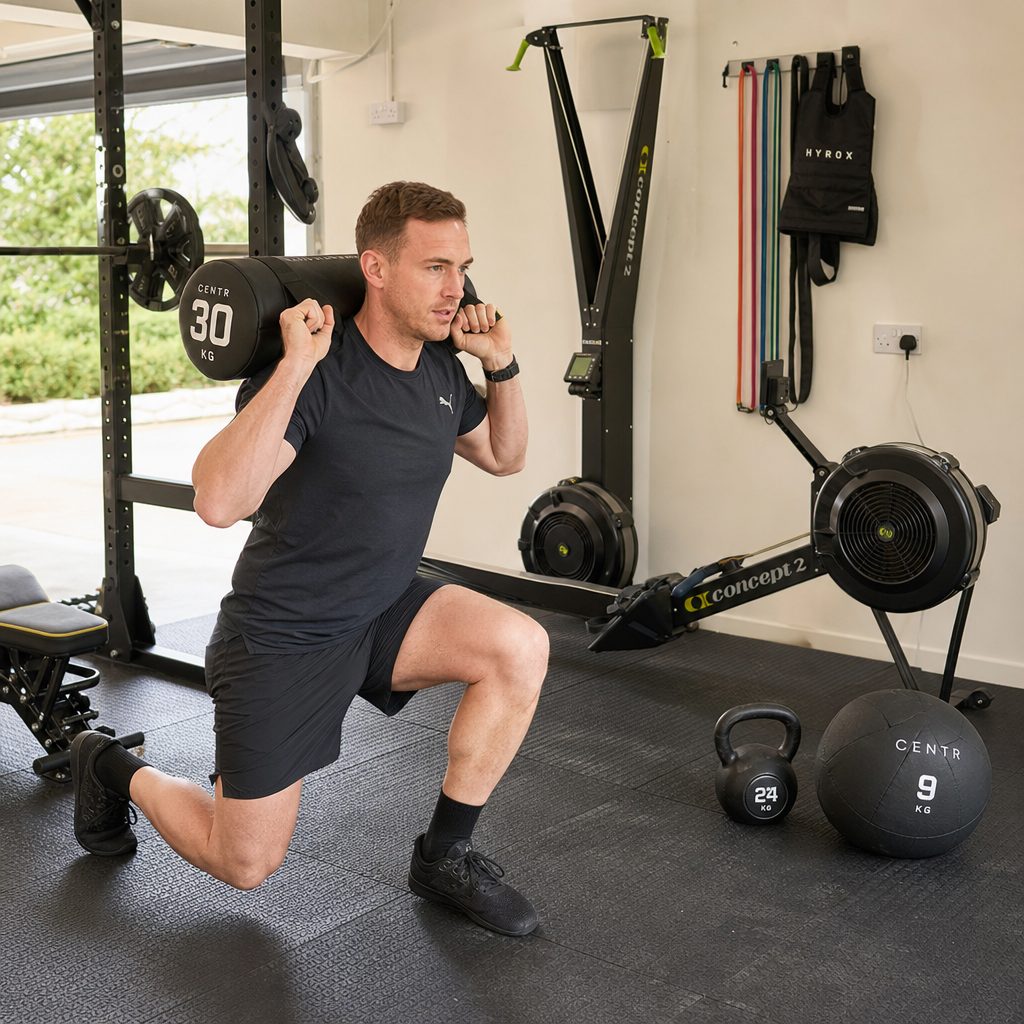
The right garage setup is personal: a compact, frequently used circuit can prepare you better than a room full of specialist equipment you avoid setting up.
9. The mistakes that make home HYROX training less useful
The first mistake is buying equipment before measuring the room. It happens constantly because fitness kit photographs beautifully and tape measures do not. Measure first. Map the routes. Consider storage. Then decide what will realistically fit and still leave space for you to move.
The second is turning every session into a test. HYROX is demanding, so it is easy to conclude that every workout must be punishing. In practice, you need a mixture: technical sessions, aerobic work, controlled strength endurance, more challenging mixed sessions and recovery. The athlete who can train consistently generally beats the athlete who trains heroically for ten days and then needs a fortnight to rediscover stairs.
The third is ignoring running because the garage kit feels more interesting. Machines, sleds and sandbags are tangible. Running is just you and the weather, which is less photogenic but remains very important. Keep outdoor running in the week wherever possible. Use your garage circuit to make that running more relevant, not to avoid it.
The fourth is chasing exactness where it is not available. If you do not own a sled, train the underlying leg drive, bracing and tolerance for loaded effort. If you do not own a SkiErg, perform disciplined band pull-downs. Substitution is not failure. It is sensible training design.
Smart garage habits
- Set out kit before the session begins.
- Use clear routes and safe targets.
- Practise fresh technique as well as fatigued technique.
- Keep running in the broader training week.
Habits to avoid
- Buying a sled without a viable lane.
- Using unsafe anchors or throwing areas.
- Testing maximum effort every session.
- Forgetting that a substitute is useful even when it is not identical.
10. The bottom line on a garage HYROX setup
A garage can become a remarkably capable HYROX training space without becoming a full commercial gym. The winning approach is to focus on movement patterns, choose kit that solves your actual training problems and keep enough open floor that the room remains easy to use. A band setup can build a credible vertical-pull substitute. A sandbag and carry option make loaded movement accessible. A rower and SkiErg add specificity when you have the room. A sled is excellent when the garage genuinely supports one, and a nuisance when it does not.
Most importantly, build a space that encourages repetition. You want to be able to walk in, pick up the first implement and start. No lengthy rearranging. No elaborate ritual. No moment of wondering whether the garage is too chaotic to bother. The boringly usable setup is usually the one that produces the most satisfying race-day result.
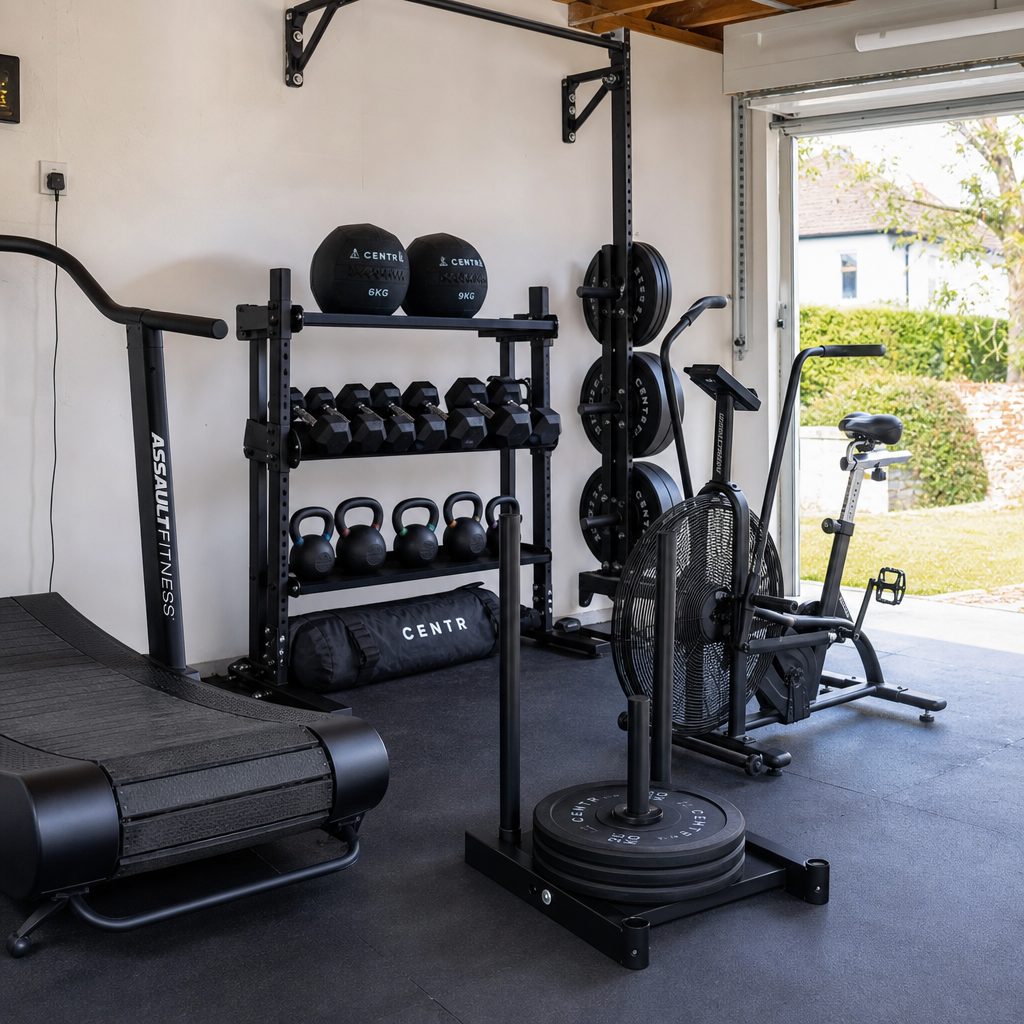
A finished garage HYROX corner should make the next session feel straightforward: clear routes, accessible equipment and enough room to move with purpose.
Frequently asked questions
Yes. Home training can develop the movement patterns and conditioning behind each station even when the exact equipment is unavailable. The resistance-band overhead pull-down is a practical example: it is not identical to a SkiErg, but it trains a similar overhead-pull and hip-hinge pattern.
A secure resistance-band setup is an excellent first addition because it takes little room and supports repeated pull-and-hinge work. Pair it with a portable load for carries and lunges, and you can create varied sessions without filling the garage.
No. A sled is the most specific tool for sled pushing and pulling, but it needs a suitable lane and surface. If your room cannot accommodate it safely, use loaded lunges, carries, squats and mixed conditioning to build relevant lower-body and trunk capacity.
Choose the machine that addresses your biggest training need and fits your room. A rower gives direct practice for the rowing movement. A SkiErg gives more specific practice for the ski station. If neither fits, bands remain a useful SkiErg-style substitute.
Only use a target area with enough clear space, a suitable ceiling and nothing breakable behind or around it. If safe throwing is not possible, train squatting and conditioning separately rather than forcing an unsafe workaround.
Use mixed circuits thoughtfully rather than making every training day a maximal simulation. Include technical work, easier aerobic work and controlled strength endurance alongside more demanding combinations. Consistency matters more than repeatedly emptying the tank.
It can be a practical option when necessary, particularly for practising transitions, but it is not the same as running outside. Keep regular running in your programme where possible, and use the garage to complement it with station work.
Look for the station or transition that repeatedly breaks down first. It might be grip during carries, posture during lunges, the ability to row smoothly after running, or maintaining a clean hip hinge during band pull-downs. Let that observation guide the next block and any future equipment purchase.
Verdict: buy for repeatable training, not garage theatre
The smartest home HYROX setup begins with a clear floor route, a safe resistance-band pull-down station, a load for lunges and carries, and a plan to keep running. Add a rower, SkiErg, wall-ball target or sled where space and your own weak points justify them. Exact station practice is valuable, but practical consistency is more valuable still. Build the garage you can use on an ordinary weeknight, and it will do far more for your HYROX preparation than the fanciest setup you only admire from the doorway.