
Garmin Enduro 4 vs Fenix 9: Which Flagship Garmin Earns the Extra Battery?
The Garmin Enduro 4 arrived on 6 October 2026 with solar endurance as its whole personality. The Garmin Fenix 9 had already arrived on 25 August 2026 as Garmin's wider flagship family, complete with AMOLED choices, Solar alternatives and more lifestyle-friendly extras. One is built for the sort of event that needs an alarming amount of flapjack. The other is built for almost everybody else.
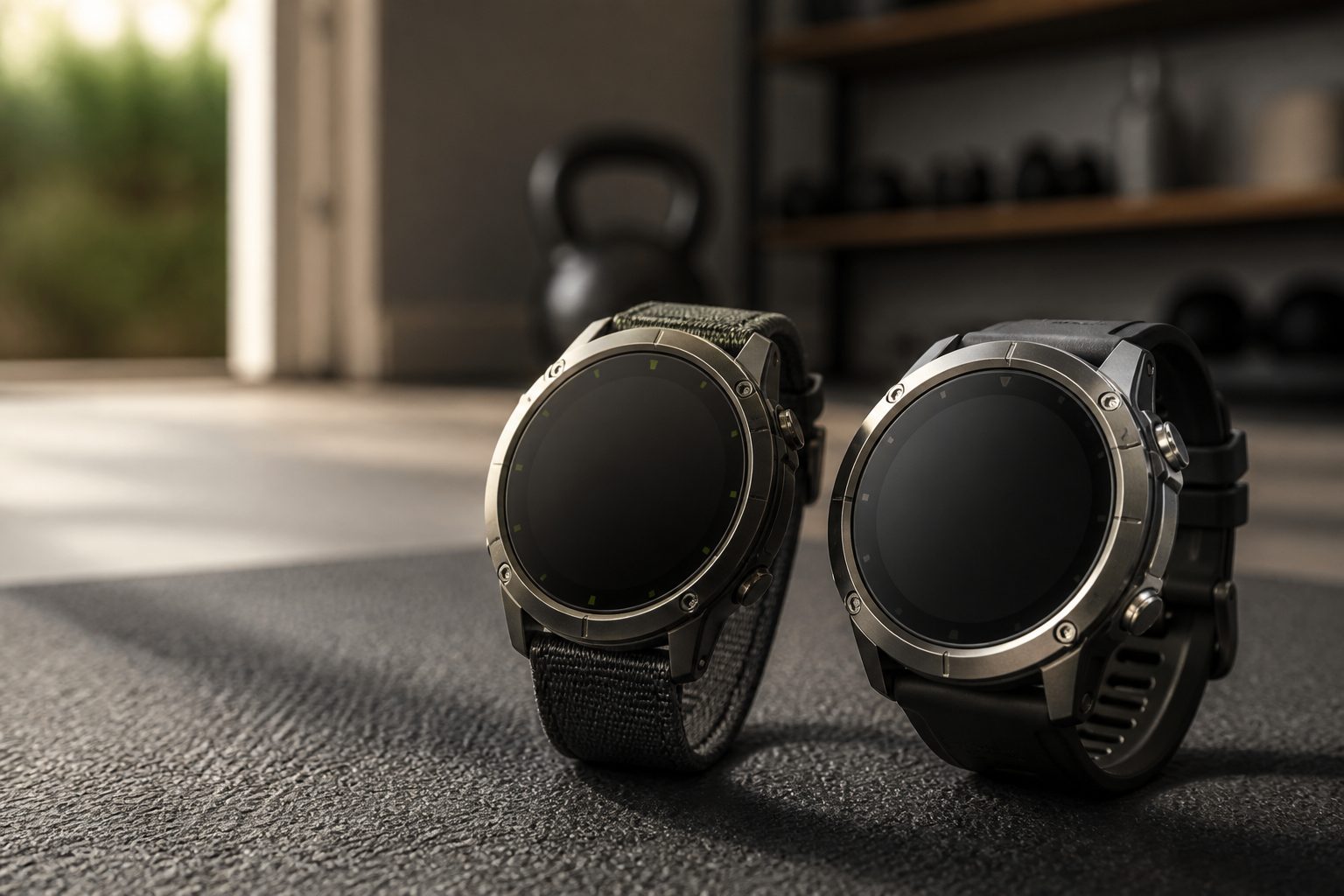
Garmin's Enduro 4 and 51mm Fenix 9 models share serious outdoor intent, but their screens and battery priorities could not be more different.
 By James Oduya · Staff Writer & Home Gym Columnist · Updated October 07, 2026
1. Garmin Enduro 4 vs Fenix 9: the short answer
There is a slightly awkward truth at the heart of this comparison: the Garmin Enduro 4 and Garmin Fenix 9 are not trying to win exactly the same race. They happen to share a great deal of Garmin's top-tier training, navigation and outdoor technology, but they arrive there through very different priorities.
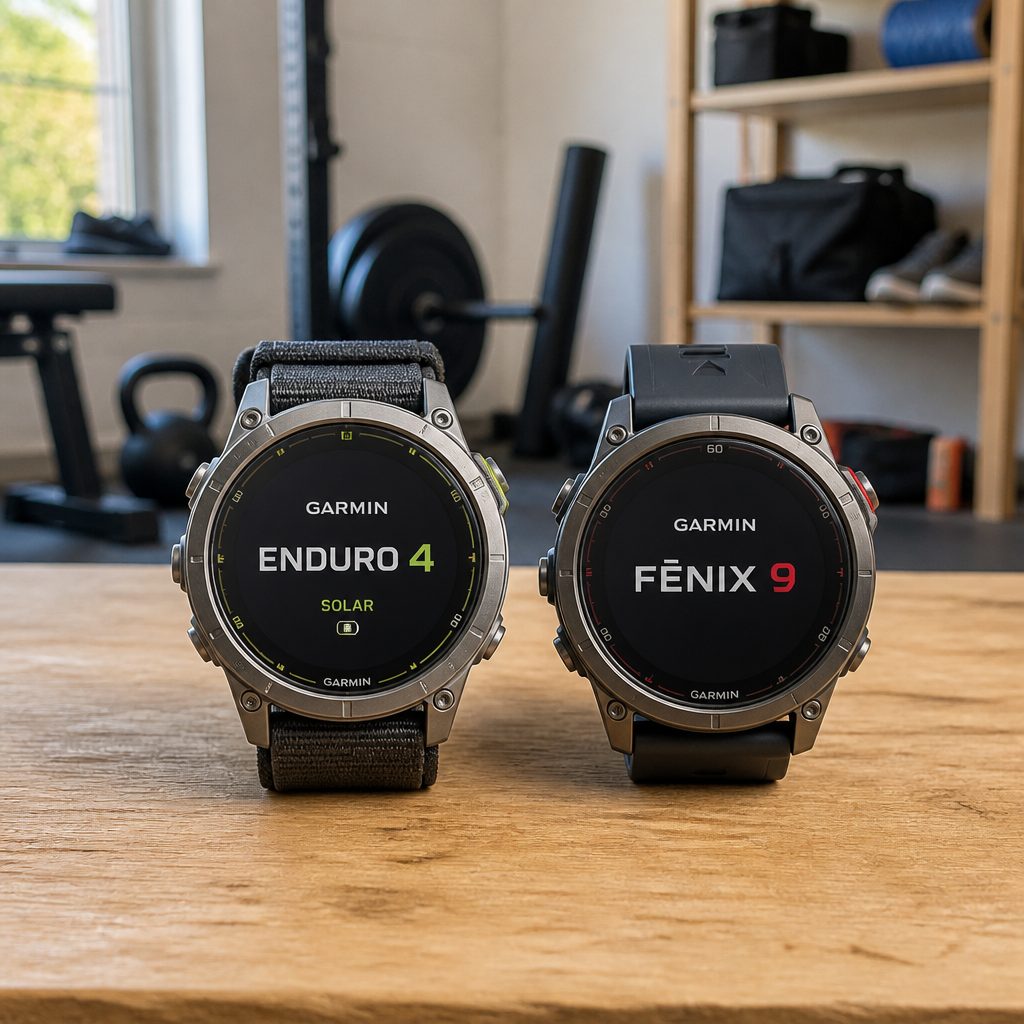
The Enduro 4's 51mm Power Sapphire construction, integrated flashlight and fabric ComfortFit band are plainly aimed at long days outside rather than quiet understatement.
The Enduro 4 is the single-minded one. It comes only in a large 51mm body, only with a solar memory-in-pixel display, and only with the sort of battery claims that make ordinary smartwatches look as though they are waiting for a lift home. Its headline figure is up to 36 days in smartwatch mode, rising to 90 days with solar charging. For GPS recording, its extended-battery activity mode reaches up to 120 hours, or up to 320 hours with solar assistance. That is the bit to underline twice if you race ultras, hike for days, bikepack, or simply dislike packing yet another cable.
The standard 51mm Garmin Fenix 9 takes a different route. It has a bright AMOLED display, smartwatch battery life of up to 29 days, and up to 54 hours in normal activity mode. It is still an extremely capable endurance watch. It is simply more interested in looking gorgeous in the kitchen, in the gym and during the Monday morning meeting than it is in surviving several days of GPS use with a solar panel doing its best work.
Then there is the Garmin Fenix 9 Pro Solar, which complicates things in the most Garmin way imaginable. It brings a solar MIP display, up to 57 days in smartwatch mode under Garmin's stated solar conditions, phone calls and voice commands from the wrist, dive-computer functionality and satellite messaging. It does not match the Enduro 4 for maximum solar-assisted GPS stamina, but it is the more feature-complete outdoor flagship.
The practical split: choose the Enduro 4 when battery duration and low-distraction outdoor readability matter more than everything else. Choose the AMOLED Fenix 9 when the screen is something you want to enjoy all day. Choose the Fenix 9 Pro Solar when you want solar longevity but cannot ignore calling, dive and satellite features.
2. At-a-glance specifications: three flagship approaches
It helps to keep the three most relevant models on the same page. The regular Fenix 9 AMOLED is the everyday flagship in this comparison. The Fenix 9 Pro Solar is the closest alternative to the Enduro 4's solar proposition, but with a rather more expansive feature list. All figures below refer to the 51mm versions where that option exists.
| Feature | Garmin Enduro 4 | Garmin Fenix 9 | Garmin Fenix 9 Pro Solar |
|---|---|---|---|
| Case size | 51 x 51 x 15.7mm | 51mm option | 51 x 51 x 16.6mm |
| Display | 1.4in, 280 x 280 solar MIP | AMOLED, 466 x 466 | 1.4in, 280 x 280 solar MIP |
| Lens | Power Sapphire | Sapphire | Power Sapphire |
| Weight | 66g | 50g (51g Pro) | 102g with band |
| Smartwatch battery | Up to 36 days; 90 days with solar | Up to 29 days | Up to 57 days with solar |
| Normal activity battery | Up to 34 days | Up to 54 hours | — |
| Extended battery activity | Up to 120 hours; 320 hours solar | Up to 65 hours | Up to 100 hours; 211 hours solar |
| Max-accuracy activity | Up to 60 hours; 90 hours solar | Up to 45 hours | Up to 54 hours; 75 hours solar |
| Water or dive rating | 10 ATM | Dive-rated to 40m | Dive-computer capability |
| Phone calls and wrist voice commands | No | No | Yes |
| Satellite messaging | No | No | Yes |
This table also explains why an apparently simple Enduro-versus-Fenix question becomes more nuanced the longer you look at it. The Enduro 4 wins the pure endurance contest cleanly. The AMOLED Fenix 9 wins the display contest even more cleanly. The Pro Solar occupies the middle ground: it has formidable solar battery life and functions the Enduro deliberately leaves behind, but is materially heavier and cannot stretch GPS time as far as the Enduro 4 when sunlight is on your side.
3. Display: Garmin Enduro 4 outdoors, Garmin Fenix 9 everywhere
For many people, this is the deciding category before a single running shoe has touched a trail. Garmin has not tried to disguise the philosophical difference. The Enduro 4 uses a 1.4-inch transflective MIP display with a 280 x 280 resolution and solar harvesting built into the screen. The standard Fenix 9 uses AMOLED. On the 51mm model, that is a 466 x 466 display. There is no polite way around it: the Fenix screen is dramatically sharper, more colourful and more inviting for maps, watch faces, widgets and indoor training data.
AMOLED is the screen you notice. A route line looks richer. Text has proper polish. Garmin said the base Fenix 9 AMOLED reached approximately 2,000 nits, whilst Pro models reached up to 3,000 nits. The Fenix 9 was also twice as bright as the Fenix 8. In a dim gym, early morning hallway or badly lit hotel room, it is simply the more pleasant watch to use. If you train indoors several days a week and wear your watch from breakfast to bedtime, that has genuine value rather than being mere spec-sheet glitter.
The Enduro 4's MIP screen is less theatrical, which is precisely its appeal. It remains readable in daylight without trying to dazzle you, and it does so whilst consuming very little power. On a mountain ridge, during a summer long run or while trying to read a route with sunglasses on, the low-fuss, always-visible nature of MIP makes sense. It looks like an instrument rather than a miniature phone. I mean that as praise, though it will not suit everyone.
One important distinction: the Fenix 9 Pro Solar also uses MIP rather than AMOLED. So if solar charging matters but you crave the Fenix family's deeper set of connected and dive features, its display experience is closer to the Enduro 4 than the ordinary Fenix 9. The 51mm Pro Solar has a 1.4-inch, 280 x 280 MIP solar display. Do not buy it assuming it is a solar-powered version of the vivid AMOLED Fenix 9. Garmin's naming department has been allowed near the cupboard again.
Garmin Enduro 4 display strengths
- Solar MIP design supports the extraordinary battery claims.
- 1.4-inch transflective panel is naturally suited to bright daylight.
- Power Sapphire lens suits a watch intended for knocks, weather and extended use.
- Lower-distraction presentation is excellent when you want data, not a tiny cinema screen.
Garmin Enduro 4 display compromises
- 280 x 280 resolution is much less detailed than the AMOLED Fenix 9.
- Maps and everyday smartwatch visuals are less immediately impressive.
- There is no smaller Enduro 4 option for slimmer wrists.
- People who love vivid watch faces may find it utilitarian rather than luxurious.
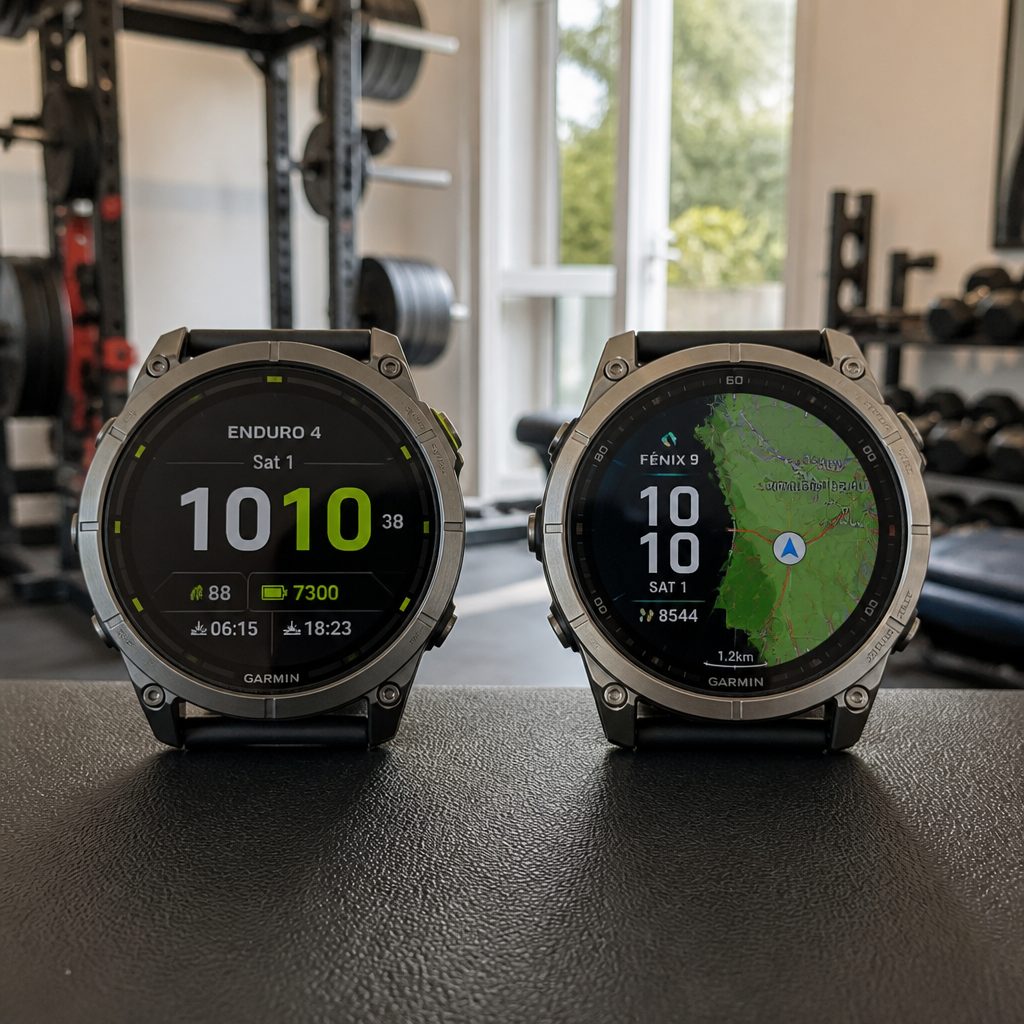
AMOLED gives the 51mm Garmin Fenix 9 a more phone-like, high-definition presentation for maps, metrics and everyday watch faces.
4. Battery life: this is where the Enduro 4 earns its name
Battery claims always need a little adult supervision. Screen choice, GPS mode, music, maps, usage habits and sunlight all make a difference. Even so, Garmin's published figures paint a useful picture, and the Enduro 4's advantage is not a rounding error.
In smartwatch mode, the Enduro 4 is rated for up to 36 days before solar enters the chat. With enough sun, Garmin rated it for up to 90 days. The Fenix 9 AMOLED 51mm is rated for up to 29 days in smartwatch mode, which remains excellent for a display of its type. The Fenix 9 Pro Solar reached up to 57 days under Garmin's stated solar conditions: all-day wear with three hours outdoors at 50,000 lux each day.
For serious events, the activity figures matter more. The Enduro 4 reaches up to 120 hours in extended-battery activity mode, or an extraordinary 320 hours with solar assistance. Its maximum-accuracy activity mode reaches up to 60 hours, or up to 90 hours with solar. The Fenix 9 Pro Solar gets to 100 hours extended-battery activity mode, or 211 hours with solar, and 54 hours maximum accuracy, or 75 with solar. That is superb, but the Enduro's ceiling remains much higher.
The standard AMOLED Fenix 9 is still no slouch. Garmin quoted up to 54 hours in normal activity mode, 45 hours in maximum-accuracy mode, 65 hours in extended-battery mode and 145 hours in maximum battery mode. It also has up to 21 hours for activity with music, 31 days in expedition mode and 42 days in low-power mode. For a marathoner, gym-goer, road cyclist or someone tackling the occasional long weekend hike, that can be more than sufficient. Most people do not require 320 hours of solar-assisted GPS. Most people also do not own three head torches. But the people who do will know exactly why the Enduro exists.
Battery reality check
Solar is a multiplier, not magic. The Enduro 4's best figures depend on getting useful outdoor light. If your training happens mostly under gym LEDs, on dark winter evenings or under a waterproof sleeve, buy the watch whose non-solar figure already meets your routine. Happily, all three start from a very strong place.
5. Size, weight and day-to-day comfort
The Enduro 4 is only available in a 51mm case. That will be perfect for some wrists and a non-starter for others. Its dimensions are 51 x 51 x 15.7mm, so it is not pretending to be a discreet dress watch. What helps is the 66g weight and ComfortFit fabric band. For a large watch with a Power Sapphire lens, touchscreen, titanium bezel, flashlight and enormous battery ambitions, 66g is genuinely restrained.
The 51mm Fenix 9 AMOLED gives you that large-screen flagship experience, but the broader Fenix 9 family is available in 43mm, 47mm and 51mm sizes. That is a decisive advantage if you have a smaller wrist, dislike oversized hardware during kettlebell work, or simply prefer a watch that can disappear beneath a shirt cuff. Solar options begin at 47mm, so the 43mm route means AMOLED.
The Fenix 9 Pro Solar 51mm is a different proposition again. It measures 51 x 51 x 16.6mm and weighs 102g with its band, with a 77g case. That is substantial kit. It may be completely reasonable for a diver, expedition hiker or person who wants every outdoor function Garmin has put in the tin. But it is not the obvious choice if you want a watch for sleep tracking, strength training and typing at a laptop without being constantly aware of your wrist.
There is an irony here. The Enduro 4 is physically large but comparatively light. The Pro Solar is large and undeniably hefty. The AMOLED Fenix 9 gives the most flexible sizing across the range. You should not underestimate that last point. A watch can offer every metric ever devised, but if it spends half the week on a bedside table because the case feels too large, it has lost the health-tracking argument before breakfast.
Enduro 4: large, but unusually manageable
The 51mm Enduro 4 will still look and feel substantial, but 66g with the ComfortFit fabric band gives it a far less cumbersome character than its size suggests. That matters during long runs, sleep and multi-day use.
Fenix 9: the family for different wrists
The standard Fenix 9 range's 43mm, 47mm and 51mm options make it the sensible choice for buyers who want flagship Garmin features without accepting a 51mm-only case.
Fenix 9 Pro Solar: capability has a physical cost
At 102g with its band, the 51mm Pro Solar is the one to try on before committing. Its specification is broad, but broad wrists and outdoor priorities help it make much more sense.
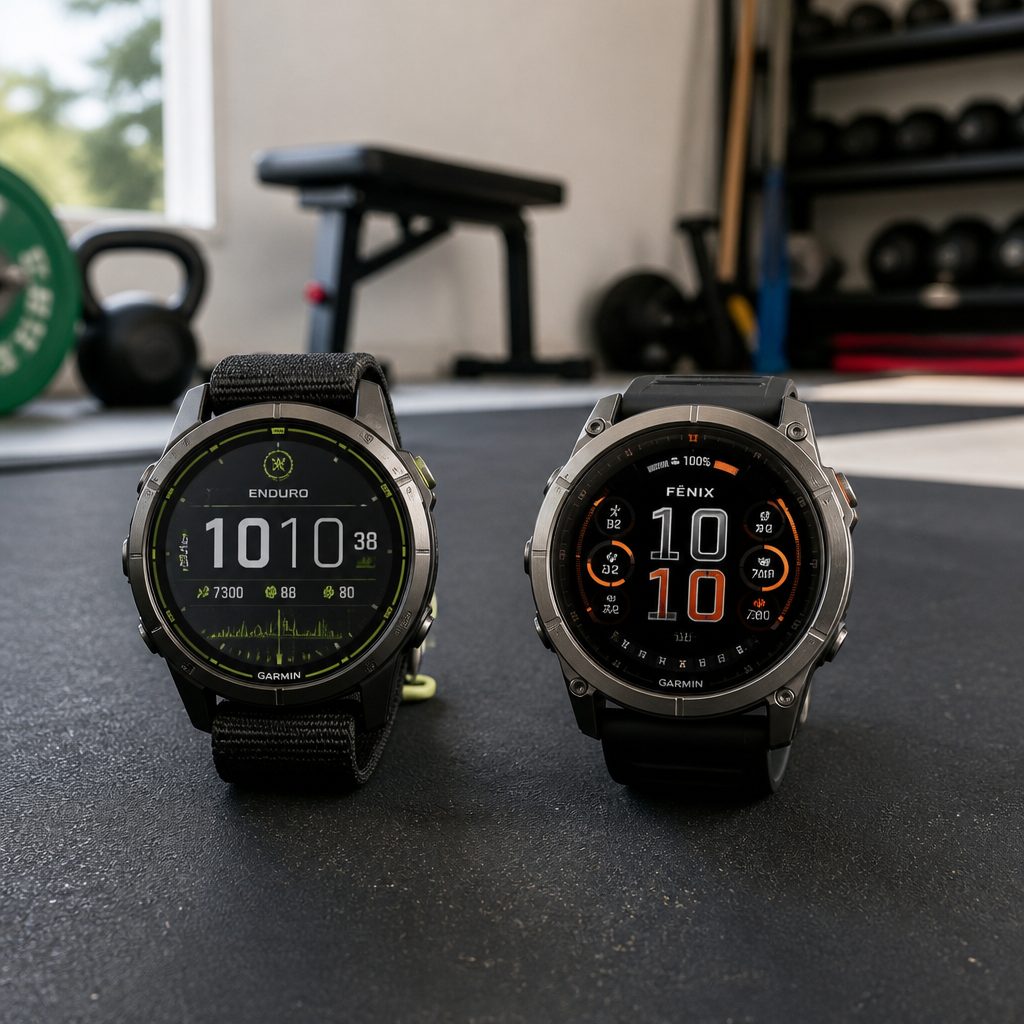
The 51mm Enduro 4 is unapologetically big, yet its 66g weight and fabric band make it a more practical all-day companion than the dimensions first suggest.
6. Training tools, maps and the athlete-first experience
This is where the Enduro 4 demonstrates that it is not merely an Enduro 3 with a larger battery number taped to the box. Garmin added grade-adjusted pace targets for workouts and rolling pace to show pace over changing terrain. Those are meaningful updates for hill runners and trail racers, where a flat-road pace target can become a little silly the moment the route turns vertical.
It also adds Stamina Zones and a Stamina Curve, designed to show how your endurance is holding up during activity and over time. During a long race, the difficult trick is not seeing data. It is knowing which data deserves your attention before you make a poor decision because your brain has become a small exhausted potato. A more intelligible view of stamina can be valuable if you use it as guidance rather than a command from the wrist.
Garmin Epic is another Enduro 4-specific attraction. It groups activity from a multi-day effort into one record. That sounds small until you have tried to interpret a long adventure as a collection of disconnected files. For stage efforts, multi-day trail challenges or long bikepacking trips, keeping the story together is tidy and useful.
Navigation is properly equipped, with multi-continent TopoActive maps, turn-by-turn navigation, ClimbPro, NextFork and dynamic round-trip routing. The Enduro 4 also has 50% more RAM than the Enduro 3, which Garmin said enabled map panning approximately 30% faster. Nobody buys a watch because map panning is 30% faster. They do, however, notice when a route needs checking at a wet junction and a device thinks for a while about whether it fancies cooperating.
The Fenix 9 family is hardly short of athlete credentials. Its software included real-time Stamina Zones, dedicated rucking algorithms with pack-weight calculations, expanded indoor rowing metrics and the same broad flagship positioning. For gym users, rowers, strength trainers and people who mix outdoor sports with regular life, those additions help the Fenix feel less like an endurance specialist and more like the general-purpose sports computer you happen to wear as a watch.
The main distinction is focus. The Enduro 4 feels tuned for the athlete who measures success in moving efficiently across terrain for a very long time. The Fenix 9 feels tuned for the athlete who might run a trail race on Saturday, row on Tuesday, lift on Thursday and would quite like an attractive display when checking sleep data on Sunday.
7. Smart features, safety and outdoor extras
The Enduro 4 has an integrated LED flashlight with white and red-light options. Once you have used a proper wrist flashlight to find a tent zip, unlock a front door, look for a dropped gel or avoid waking everyone in a shared room, it becomes one of those features that seems unnecessary right up until it is quietly brilliant. It also has 64GB of storage, double the capacity of its predecessor, plus 10 ATM water resistance, touchscreen controls and the familiar Garmin hardware confidence of a titanium bezel and fibre-reinforced polymer case.
Yet Garmin drew a clear line around what it did not include. The Enduro 4 has no wrist phone calls, no dive features and no satellite messaging. That is not necessarily a flaw. Keeping the product focused may be part of why it achieves its imposing endurance numbers. Still, these omissions matter if you are choosing a single watch for expedition use, water sports and emergency communication.
The standard Fenix 9 also does not offer phone calls or satellite messaging, but it does bring leakproof buttons, a sapphire lens and dive rating to 40 metres. That makes it a better fit for someone who wants a premium sports watch that can move confidently between training, swimming and everyday wear, with AMOLED polish as a constant companion.
The Fenix 9 Pro Solar takes the biggest step beyond both. It adds phone calls and voice commands from the wrist, dive-computer functionality and satellite messaging. These are not little checkbox features. They change what the watch can replace or supplement when you are outside. Satellite messaging especially speaks to a different kind of risk management than a longer battery figure alone. The Enduro 4 is built to keep tracking. The Pro Solar is built to remain more connected while it does.
Do not choose by battery alone if your trips are remote. The Enduro 4 lasts longer in its solar-assisted GPS modes, but the Fenix 9 Pro Solar's satellite messaging is the relevant advantage for buyers who specifically want an emergency-capable outdoor communications tool.
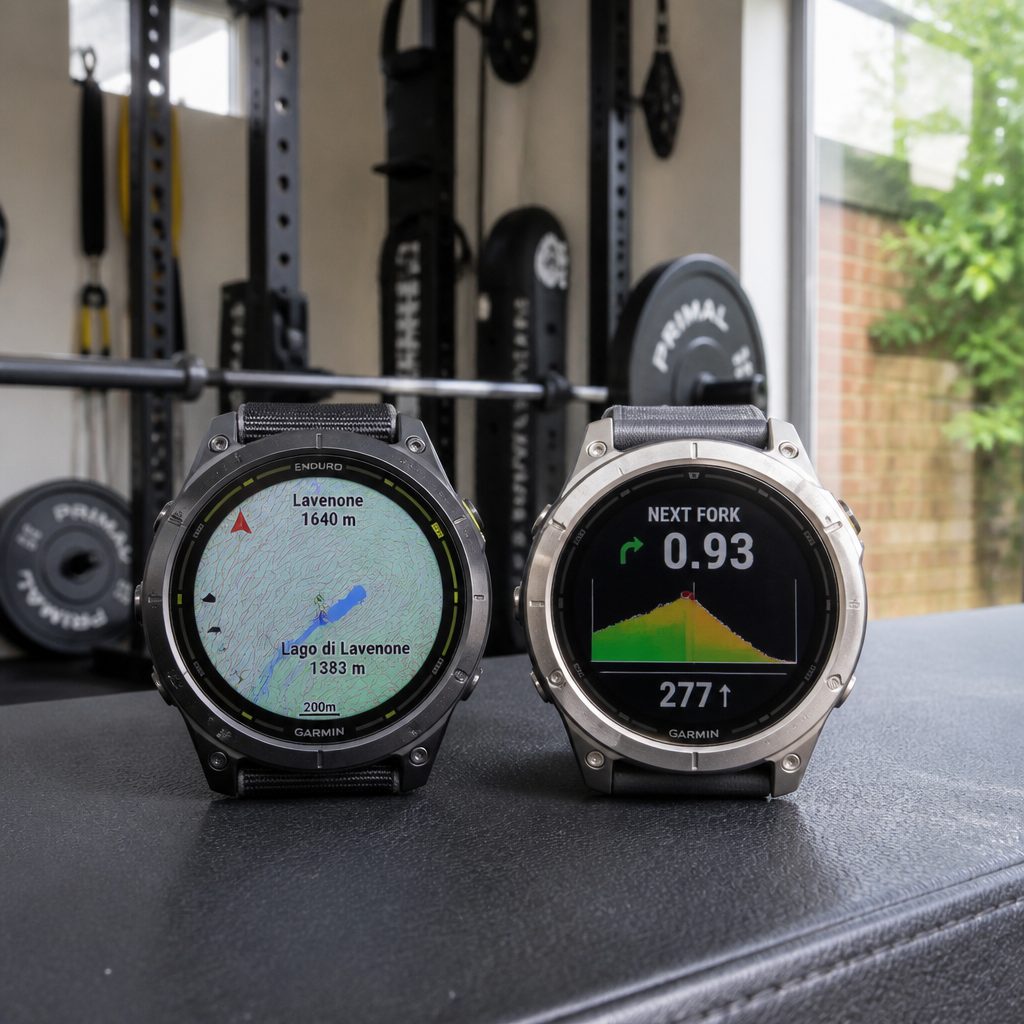
Maps, turn-by-turn directions, ClimbPro and a built-in LED flashlight give the Enduro 4 a serious navigation-and-nightfall toolkit.
8. Garmin Enduro 4 vs Fenix 9 Pro Solar: the solar showdown
This is the comparison that endurance athletes should read most carefully. The standard AMOLED Fenix 9 is the obvious everyday alternative. The Fenix 9 Pro Solar is the watch that asks whether the Enduro 4's stamina is worth giving up additional hardware functions for.
The Enduro 4 wins on weight by a very large margin: 66g against 102g with band for the 51mm Pro Solar. It is also slimmer, at 15.7mm against 16.6mm. For running, especially long running, that gap is not academic. A hundred-gram watch may be entirely manageable, but it is very much present. The Enduro 4's fabric band and lower weight make it the more convincing choice for someone who wants to sleep in it, race in it and forget it exists until a route prompt arrives.
It also wins on headline endurance. Up to 90 days of smartwatch use with solar compares with up to 57 days on the Pro Solar under Garmin's specified solar conditions. In extended-battery activity mode, the Enduro's 320-hour solar claim is far beyond the Pro Solar's 211 hours. In maximum-accuracy activity mode, it reaches 90 solar-assisted hours against 75. For an ultra-distance runner, fastpacker or remote bikepacker, that is the whole point.
But the Pro Solar has more strings to its bow. It offers calls and voice commands from the wrist, dive-computer capability and satellite messaging. If your adventures involve diving, if you want the reassurance of satellite contact, or if hands-free voice interaction appeals, it is the more complete outdoor device. It is not as specialised; it is more versatile.
There is also a visual preference to confront. Both watches use MIP solar displays. Neither offers the glamour of the AMOLED Fenix 9. So this particular choice is not about vibrant visuals. It is about whether you want the lightest, longest-running endurance machine Garmin makes, or a heavier outdoor flagship that carries communications and diving functions into the bargain.
| Solar priority | Garmin Enduro 4 | Garmin Fenix 9 Pro Solar |
|---|---|---|
| Best reason to choose it | Maximum solar-assisted GPS endurance in a lighter 51mm package. | Solar endurance with satellite messaging, calls, voice commands and dive capability. |
| Smartwatch claim with solar | Up to 90 days | Up to 57 days |
| Extended-battery activity claim with solar | Up to 320 hours | Up to 211 hours |
| Maximum-accuracy activity claim with solar | Up to 90 hours | Up to 75 hours |
| Weight with band | 66g | 102g |
| Satellite messaging | No | Yes |
9. The best Garmin for each type of buyer
There is no single winner because the watches solve different problems. The right answer becomes much clearer when you start with your own training, wrist size and tolerance for charging, rather than simply buying the model with the longest list of heroic-sounding specifications.
Best for ultra-runners: Garmin Enduro 4
See Garmin Enduro 4 on Amazon UK
The 66g weight, 51mm solar MIP display, 320-hour solar-assisted extended-battery activity claim and trail-focused pace and stamina tools make this the clear endurance specialist.
Best all-rounder: Garmin Fenix 9
Shop Garmin Fenix 9 on Amazon UK
Its AMOLED display, broad size range and substantial 29-day smartwatch claim make it the most natural choice for people mixing gym sessions, running, maps and ordinary daily wear.
Best for remote versatility: Garmin Fenix 9 Pro Solar
Shop Garmin Fenix 9 Pro Solar on Amazon UK
Choose this when solar battery life matters, but you also want satellite messaging, wrist calling, voice commands and a dive computer on your expedition watch.
Best for smaller wrists: Garmin Fenix 9
The regular Fenix 9 is available in 43mm, 47mm and 51mm sizes. The Enduro 4 is only 51mm, while Solar models begin at 47mm.
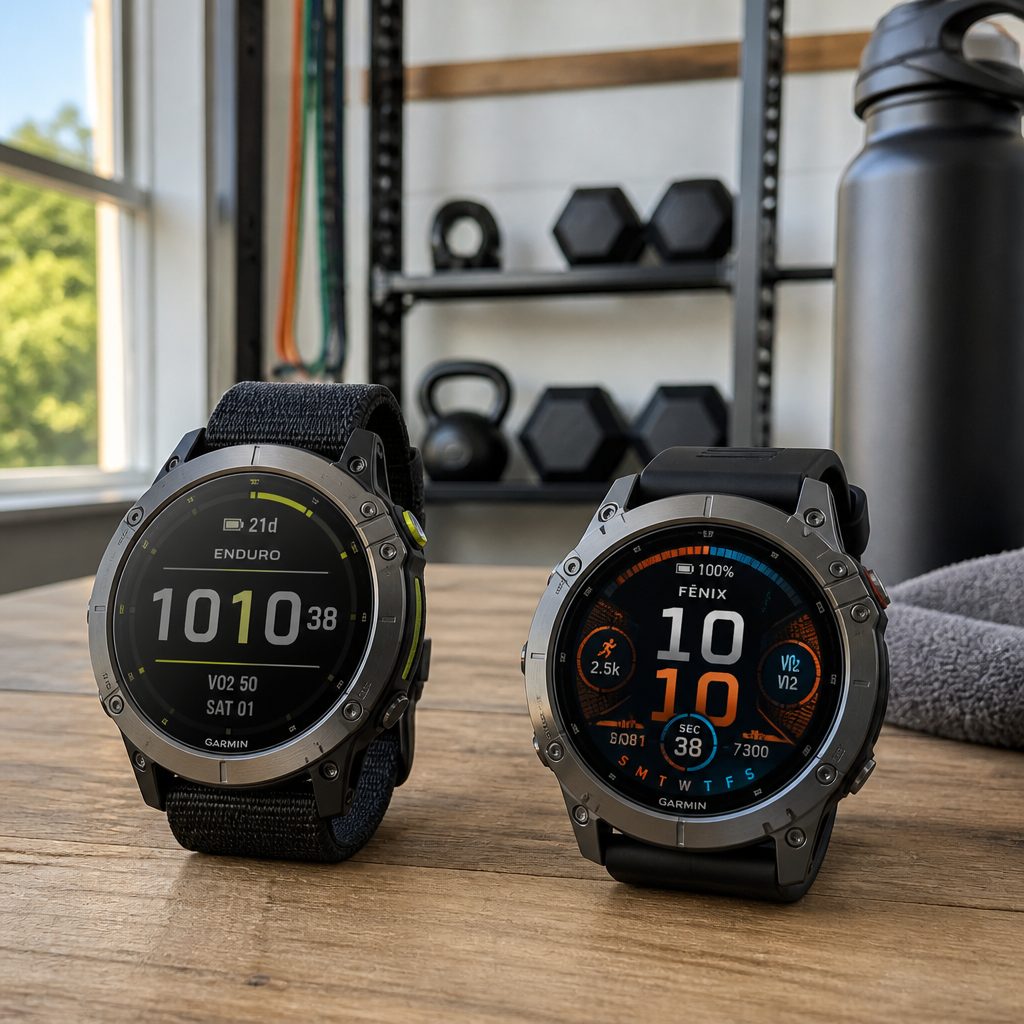
For mixed training weeks, the AMOLED Garmin Fenix 9 makes the stronger case as a polished gym, running and everyday watch rather than a dedicated ultra-endurance instrument.
10. Who should avoid each model?
The Enduro 4 is easy to admire and equally easy to buy for the wrong reasons. If you mostly train indoors, run shorter distances, work at a desk and want your watch to look excellent at a glance, the AMOLED Fenix 9 makes more sense. The Enduro's battery reserve is wonderful, but unused endurance capacity is still unused capacity. You do not need a watch capable of tracking an exceptionally long solar-assisted adventure simply because it can.
Likewise, the standard Fenix 9 is not the automatic pick for an ultra athlete just because AMOLED looks lovely. During a multi-day event, a 51mm Enduro 4's 120-hour extended-battery figure before solar assistance, rising to 320 hours with solar, is a fundamentally different proposition. Carrying a charging lead or battery pack changes the logistics of an event. Not needing either changes them more.
The Fenix 9 Pro Solar deserves the same honesty. It is the most functionally expansive solar option here, but it weighs 102g with its band. If you are sensitive to watch weight, sleep with your tracker or spend hours doing repetitive arm movement on the trail, bike or gym floor, that deserves serious consideration. Its capabilities are persuasive, but no feature list can make a bulky watch vanish from your awareness.
My simplest buying rule
If your longest outings repeatedly test battery planning, buy the Garmin Enduro 4. If you want the nicest screen and the most flexible everyday fit, buy the Garmin Fenix 9. If satellite messaging and dive capability are non-negotiable, the Garmin Fenix 9 Pro Solar is the model that changes the conversation.
11. Garmin Enduro 4 vs Fenix 9 FAQ
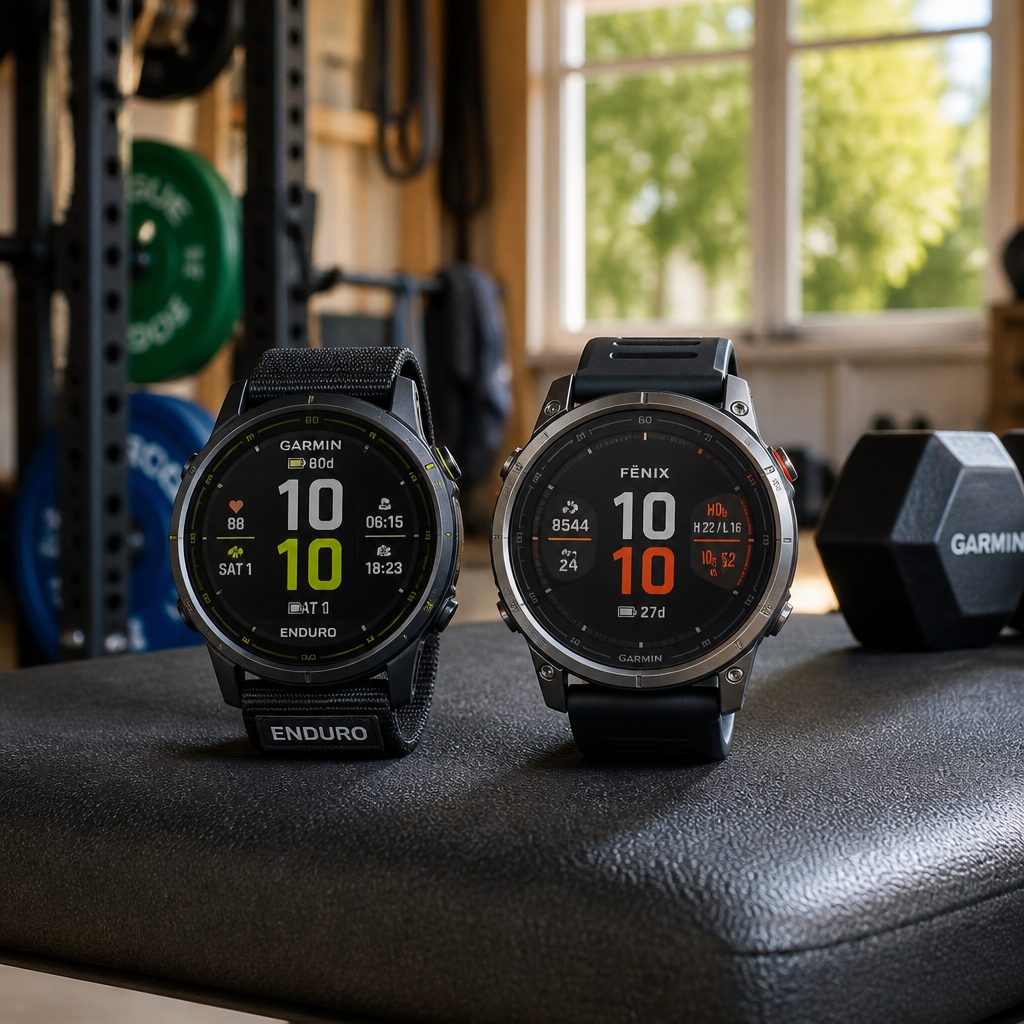
The final choice is not really about which Garmin is more impressive; it is about whether your own training demands endurance, display quality or connected outdoor versatility.
Verdict: choose the Garmin that matches your actual adventures
Garmin Enduro 4 is the better buy for ultra-runners, multi-day hikers, bikepackers and endurance athletes who see charging as an unwelcome logistical failure. Its 66g weight, solar MIP display, 64GB storage, trail-aware training additions and extraordinary up-to-320-hour solar-assisted extended-battery activity claim make it a wonderfully focused machine. It is not trying to do everything, and that is why it can do this particular job so well.
Garmin Fenix 9 is the better buy for the everyday athlete. The AMOLED screen is far more vivid and detailed, the family offers smaller sizes, and up to 29 days of smartwatch battery life is still outstanding. If your week includes gym sessions, road running, occasional navigation and normal life, it is probably the flagship you will enjoy wearing more often.
Garmin Fenix 9 Pro Solar is the premium outdoor all-rounder. It cannot match the Enduro 4's maximum solar-assisted endurance and it is much heavier, but calls, voice commands, satellite messaging and dive-computer capability give it a broader expedition brief. In short: Enduro 4 for maximum time moving, Fenix 9 for maximum everyday appeal, and Fenix 9 Pro Solar for maximum capability away from home.