
Garmin Quietly Buys Muscle Oxygen Sensor Firm Moxy Monitor
The GPS giant has confirmed it acquired Moxy Monitor, the maker of a near-infrared muscle oxygen sensor favoured by elite endurance athletes and coaches — but won't say what it paid or what comes next.
 By James Oduya · Staff Writer & Home Gym Columnist · Updated October 06, 2026
What you need to know
- Garmin confirmed it has acquired Moxy Monitor, maker of a near-infrared muscle oxygen sensor, with the deal first reported on 28 September 2026
- No purchase price, staffing details, or product roadmap have been disclosed; Garmin's entire public statement is one sentence
- Garmin filed a trademark for "Muscle Battery" — a software feature built around muscle oxygen saturation — in February 2026, pointing strongly toward its own consumer hardware
Garmin confirms Moxy deal — then goes silent
Garmin has acquired Moxy Monitor, the Canadian company behind one of the few commercially available muscle oxygen sensors trusted by professional endurance athletes and coaches. The deal was first reported on 28 September 2026 — after being quietly disclosed to a small industry gathering earlier that month — with Garmin confirming the purchase to cycling and running technology analyst Ray Maker of DC Rainmaker. The confirmation came in a single sentence.
"Garmin can confirm its acquisition of Moxy Monitor, but we have no further comment at this time."
No purchase price was given. There has been no word on whether Moxy's staff are joining Garmin, and the company has said nothing publicly about what it intends to do with the technology. Moxy Monitor's founder, Roger Schmitz, responded to a request for comment but declined to confirm or deny the deal, saying his "handlers" had him on a tight leash and directing further questions to Garmin's media relations team. The story was first broken by the5krunner, which learned of the transaction from a source with direct knowledge of it.
Because Moxy Monitor is a small, privately held company set against a roughly $55 billion Garmin, the deal almost certainly fell well beneath the threshold that would trigger a mandatory SEC disclosure — a route the company has taken before with similarly sized acquisitions, disclosing them only later as immaterial in routine regulatory filings.
What Moxy Monitor actually does
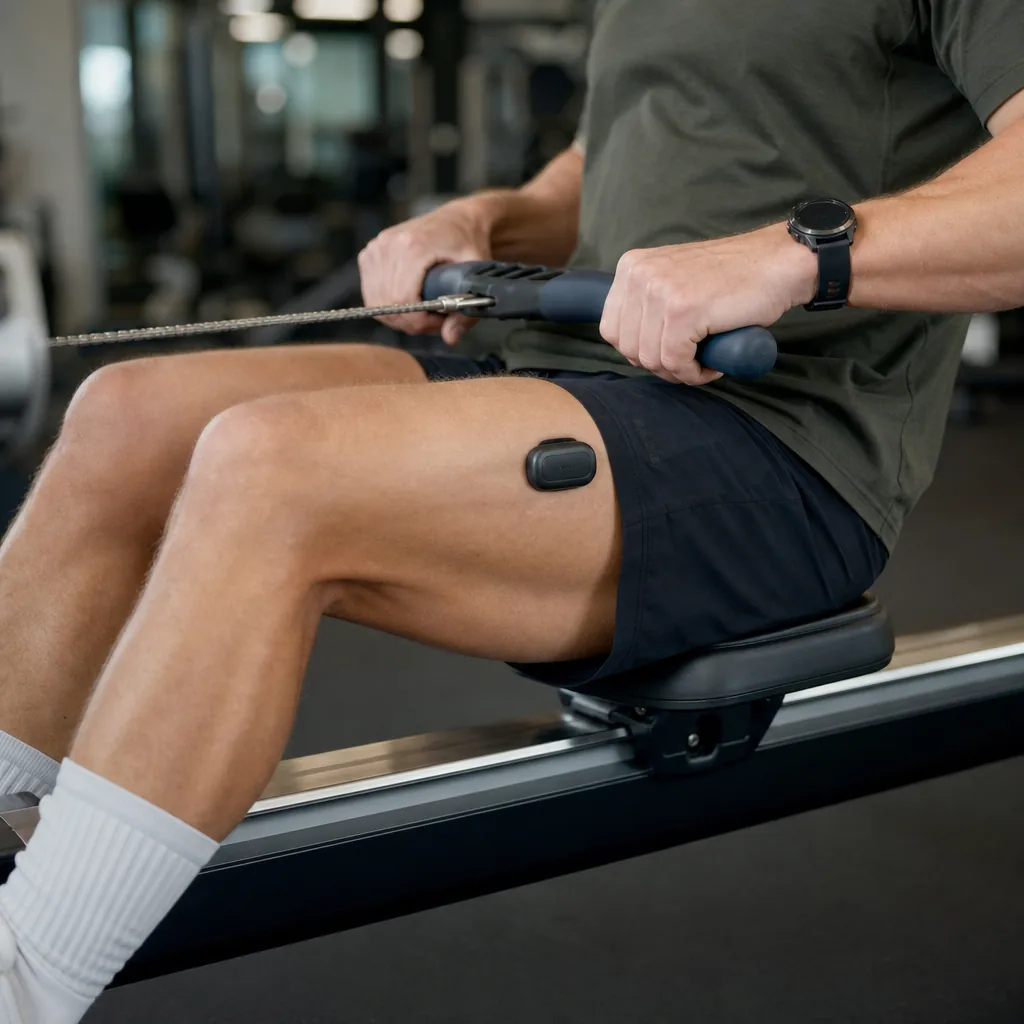
The Moxy Monitor is a wearable device that uses near-infrared spectroscopy (NIRS) to measure muscle oxygen saturation in real time. It tracks the percentage of oxygenated haemoglobin and myoglobin within active muscle tissue, transmitting that data wirelessly over ANT+ and Bluetooth to sports computers, smartwatches, and training platforms. The current Moxy 5 sensor can be placed on any superficial muscle and measures through up to 15mm of skin and fat.
Key specifications for the Moxy 5, from the official product listing, include:
- Weight: 59g with Light Shield, 48g without
- Battery life: 4 hours standard mode, 7 hours in low power mode
- Wireless: ANT+ MO2 Profile and Bluetooth Low Energy
- On-sensor data storage: 10,000 data points
- Operating range: 15°C–35°C; water and sweat resistant
- Update rate: 0.5 Hz to 2 Hz
In the UK, one specialist retailer, cyclepowermeters.com, lists the Moxy Monitor at £850. The US retail price for the 1-Sensor Bundle sits at $879. A 3-Sensor Bundle is listed at $2,637 in the United States. This is not mass-market territory.
A relationship more than a decade in the making
The acquisition did not come out of nowhere. Moxy and Garmin have operated in close proximity since at least January 2014, when Moxy announced early support for ANT+, the wireless sensor protocol in which Garmin is heavily invested. By early 2015, Moxy's data had reached Garmin watches via Connect IQ — described by DC Rainmaker at the time as the first app of its kind on the platform. Subsequently, Moxy secured its muscle oxygen profile directly onto Garmin devices without requiring a Connect IQ intermediary, a development DC Rainmaker called significant when new sensor profiles reaching new devices was essentially unheard of.
Prior to the acquisition, Garmin could already read SmO2 data from third-party sensors including Moxy and Train Red over the ANT+ muscle oxygen profile. What it did not have was its own hardware, its own calibration data, or meaningful control over the sensor experience. That has now changed.
The 'Muscle Battery' trademark is the real tell
The clearest signal of Garmin's intent predates the acquisition itself. On 19 February 2026, Garmin applied to register the US trademark Muscle Battery (serial number 99661177, still pending). The filing describes software that "captures, processes, and analyzes muscle oxygen saturation or related sports performance metrics using special algorithms," and states that the feature would be "sold as an integral component of personal electronic devices, namely wearable fitness trackers, smartwatches, and health monitoring devices."
The5krunner reported in April 2026 that the filing effectively confirmed new Garmin hardware in development, since SmO2 cannot be measured at the wrist and requires a dedicated NIRS sensor worn directly against the target muscle. A subsequent teardown of the Garmin Connect app, reported in July 2026, found detailed data fields for muscle oxygen saturation and total haemoglobin concentration already built into the application. Garmin has not publicly linked the Muscle Battery filing to the Moxy acquisition.
The defensive play against Whoop
There is a second strategic dimension to the deal. According to DC Rainmaker's analysis, Whoop would be the primary competitor likely to have pursued Moxy, and given Whoop's track record of litigation, acquiring Moxy as a pre-emptive move would almost certainly cost Garmin less than defending against Whoop in court further down the line. Whoop has already acquired the patents of Humon, a company that had previously put muscle oxygen sensing into a commercial wearable — giving it both technology and intellectual property in the space.
What existing Moxy owners should know
There is no immediate reason for existing hardware to stop working. Moxy sensors communicate over ANT+ and Bluetooth and store data internally, meaning their compatibility with Garmin devices does not depend entirely on a proprietary cloud service. People who already own a sensor are not stranded by the sale.
The longer-term picture is less clear. Garmin has maintained some acquired brands as standalone operations, and folded others directly into its own product lines. The Muscle Battery trademark — described explicitly as an algorithm layer built to sit on proprietary hardware — points toward the latter outcome, and carries no commitment to keep reading third-party sensors indefinitely.
For the vast majority of UK athletes, the question is simpler: if Garmin does bring muscle oxygen monitoring into its mainstream wearable range at a consumer price point, it would represent a genuinely significant shift in what everyday training data looks like. That prospect is now considerably more plausible than it was a fortnight ago.
Why it matters
For most UK buyers the Moxy 5 at around £850 has always been out of reach, sitting firmly in the territory of elite coaches and performance labs rather than weekend athletes. If Garmin successfully miniaturises and integrates the technology into its own wearables under the Muscle Battery brand, that could bring real-time muscle oxygen data to a mass-market audience for the first time. The defensive dimension matters too: by acquiring Moxy, Garmin has likely blocked a rival — the lawsuit-prone Whoop, which already holds Humon muscle oxygen patents — from gaining further ground in the space. Existing Moxy owners are not immediately affected, but the long-term picture for third-party sensor support is genuinely uncertain.