
Concept2 RowErg vs BikeErg: Which Air Machine Belongs in Your Flat?
Same PM5 monitor, same air-resistance principle and the same no-subscription appeal — but one machine asks your whole body to work whilst the other makes a remarkably convincing case for quiet, compact indoor cycling.
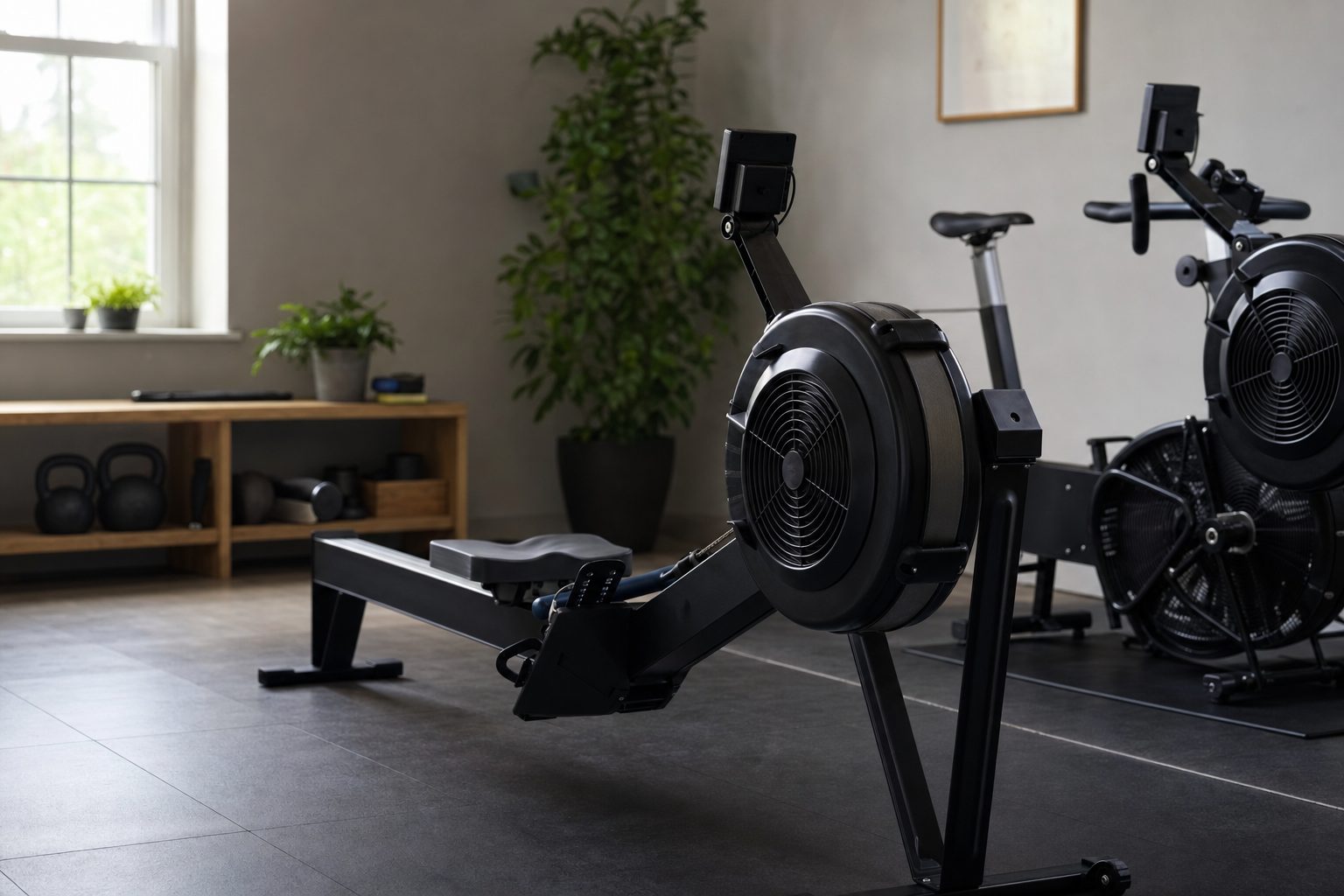
The Concept2 RowErg and BikeErg share the same unmistakable air-flywheel character, but their movement patterns make them very different flat-friendly training tools.
 By James Oduya · Staff Writer & Home Gym Columnist · Updated July 13, 2026
1. The short answer: choose the movement before the machine
Concept2's RowErg and BikeErg are often grouped together because they share a family resemblance. Both use a fanned flywheel, both let you alter the feel through a damper, both use the PM5 Performance Monitor, and both are known for straightforward engineering rather than screens, subscriptions or flashy virtual scenery. If your shortlist begins with "I want a dependable air machine at home", either can make sense.
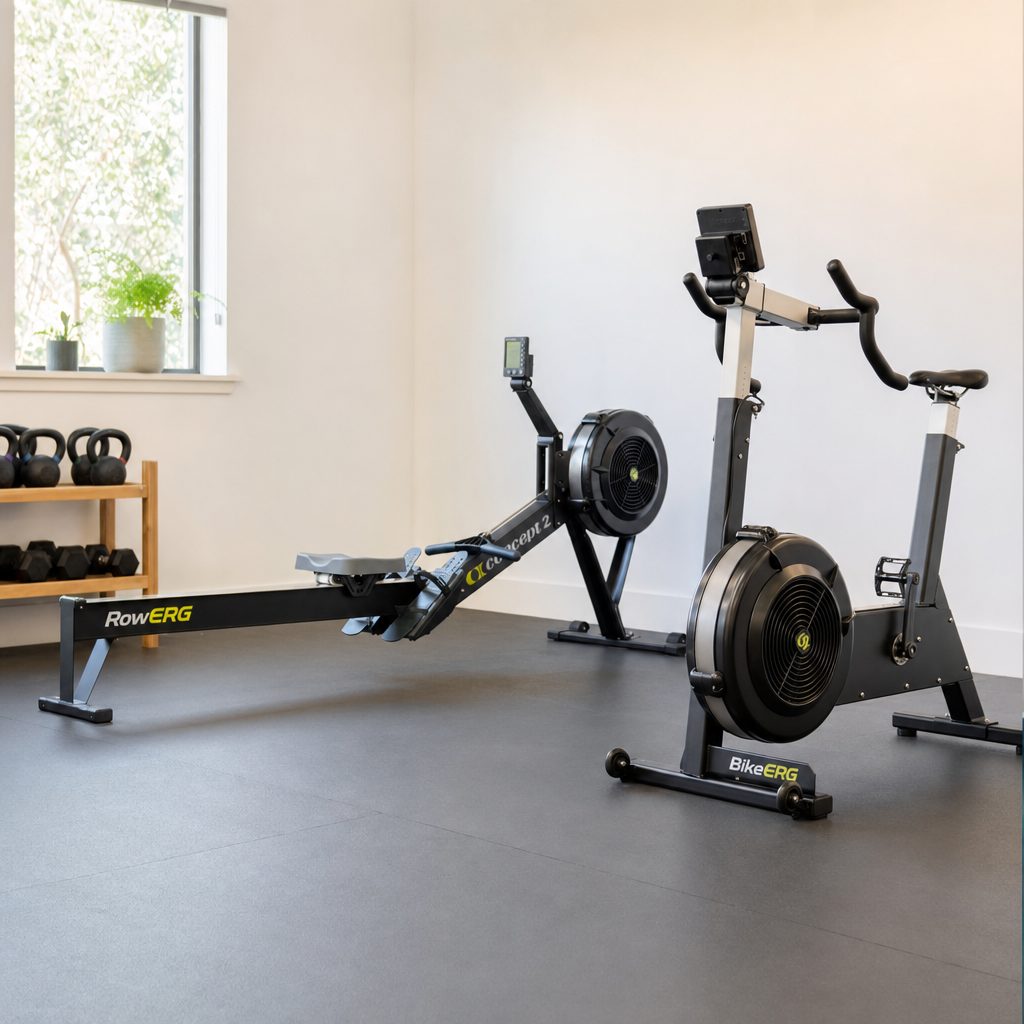
The RowErg's long monorail creates a full rowing stroke, whilst the BikeErg uses a much shorter bike-shaped footprint that is easier to position in a narrow room.
That similarity can make the buying decision look deceptively simple. It is not. The difference between rowing and cycling matters much more than the difference between two pieces of gym equipment with a similar logo. The RowErg is a full-body, sliding-seat machine. Each stroke combines a leg drive with trunk movement and a pull through the back and arms. The BikeErg is a cycling-specific machine: your legs provide the main propulsion, your upper body steadies you, and the experience is more immediately familiar to anyone who has ridden a bicycle.
For a flat, I would start with three practical questions. First, do you have a genuine 244cm clear run of floor for the RowErg when it is in use, or is a roughly 122cm-long BikeErg easier to live around? Secondly, will the rhythmic rush of an air flywheel bother your household or neighbours? Thirdly, are you more likely to use a machine that delivers a short, hard all-body session, or one that invites long, steady cardio whilst you listen to music, watch something or simply ride?
The RowErg generally wins on training efficiency. It involves legs, core, back and arms in one coordinated movement, so a modest amount of time can feel extremely productive. The BikeErg generally wins on routine friendliness. It takes less floor length, its belt drive is designed for quiet operation, and cycling is a movement many people can settle into without learning a technical stroke sequence.
Neither is inherently the "better" machine. The better one is the one that suits your room, your joints, your training history and, crucially, the kind of session you will happily repeat on an ordinary Tuesday evening.
The key buying insight
Do not treat the BikeErg as simply a RowErg with pedals, or the RowErg as simply a more intense exercise bike. They turn the same air-resistance idea into two distinct sports. Buy the movement you enjoy enough to use consistently; the PM5 and flywheel quality are the shared bonus.
2. Concept2 RowErg vs BikeErg at a glance
The figures below expose the most important physical distinction immediately. The RowErg is longer because the user travels back and forth on its monorail. The BikeErg has a much shorter stated overall length, although it remains a substantial piece of home fitness equipment rather than something to tuck invisibly behind a door.
| Specification | Concept2 RowErg | Concept2 BikeErg |
|---|---|---|
| Resistance system | Air flywheel with 1–10 spiral damper | Air flywheel with damper-based "gearing" feel |
| Overall length | 96in / 244cm | 48in / 122cm |
| Width | 24in / 61cm | — |
| Product weight | 57lb | 65lb / 29kg |
| Seat height | 14in / 36cm standard legs; 20in / 51cm tall legs | Approximately 31–40.5in / 79–103cm from seat to pedal |
| Weight capacity | 500lb Concept2 figure; 300lb EN 20957-7 rating | 300lb |
| Drive system | Nickel-plated chain | Self-tensioning high-strength polygroove belts |
| Monitor | PM5 Performance Monitor | PM5 Performance Monitor with device holder |
| Wireless connections | Heart-rate support, ErgData, app compatibility and machine-to-machine racing | Bluetooth and ANT+ for heart-rate belts, devices and apps |
| Storage approach | Separates into two pieces without tools | Compact upright bike format |
On paper, the BikeErg is eight pounds heavier, yet its shorter length will normally matter more when you are shifting furniture or deciding where the machine lives. The RowErg's front caster wheels make moving it around easier than its long silhouette suggests, and the ability to separate it into two pieces is valuable. Still, a machine that needs 244cm of clear operating length asks more of a studio flat than one listed at 122cm.
The RowErg's two leg options are also worth taking seriously rather than treating as a cosmetic choice. Standard legs put the seat at 36cm from the floor; tall legs raise it to 51cm. For some people, especially those who find a lower seat inconvenient to get on and off, that change affects daily usability more than any monitor feature ever could. The BikeErg's adjustment is cycling based: its stated seat-to-pedal range is about 79–103cm, and a low-seat option is available for those who need it.
3. Workout feel: full-body rowing versus cycling-specific cardio
This is the category that should decide the purchase for most people. The RowErg performs a coordinated movement rather than a collection of isolated exercises. At the front of the stroke, your shins are close to vertical and your arms are extended. You drive away primarily with the legs, swing the body through the middle of the stroke, then finish with a pull of the handle. On the return, the order reverses. Done well, it links the lower body, core, back and arms into one repeated sequence.
That makes the RowErg unusually broad in its muscle involvement. It trains legs, core, back and arms together, which is why it can feel satisfying for someone who does not want separate cardio and resistance-style sessions. You are not literally replacing a properly loaded strength programme, but the sensation is more muscular and more whole-body than steady cycling. A 20-minute row can make you feel as though you have actually worked rather than merely accumulated minutes.
The BikeErg is no less serious, but its effort is distributed differently. Pedalling makes the legs the main engine. Your posture, hands and trunk contribute to stability and comfort, but the movement is cycling-specific rather than a pulling exercise. That specificity is a virtue if you enjoy riding, want an indoor complement to outdoor cycling, or simply prefer a movement that allows you to settle into a rhythm quickly. There is less to co-ordinate, no sliding seat and no need to time a catch, drive, finish and recovery.
At a given displayed power output, rowing can feel harder than cycling. Research comparing the two showed that, when normalised for power, the RowErg required the rower to work significantly harder. A key reason is that the RowErg monitor does not account for the energy involved in moving the body back and forth. That matters in real life: matching a BikeErg wattage number on a RowErg does not necessarily mean matching the same physiological experience.
This is one reason I would not buy either machine based on a vague claim that one "burns more" than the other. A good session is the session you can programme sensibly and repeat. The RowErg's whole-body demand can be excellent when time is tight. The BikeErg's more focused leg-driven movement can be excellent when you want to ride frequently, build a larger aerobic base, or keep the session mentally straightforward.
Concept2 RowErg: coordinated, full-body work
The leg drive, body swing and handle pull involve legs, core, back and arms. It rewards sound sequencing and can make a relatively short session feel comprehensive.
Concept2 BikeErg: direct cycling specificity
The pedalling movement is immediately recognisable, making it especially appealing for cyclists and for anyone who wants straightforward lower-body-led aerobic work.
Both: responsive air resistance
The harder you work, the more air the flywheel moves. Neither machine relies on a fixed resistance level that ignores how forcefully you move.
For interval work, both can be brutally effective. The RowErg encourages powerful, repeatable efforts with a clear stroke rhythm. It is particularly satisfying if you enjoy chasing split times and watching each hard drive register on the PM5. The BikeErg makes it simpler to hold a cadence-led effort, spin between intervals, and return to a steady pace without worrying about stroke mechanics becoming untidy as fatigue builds.
For easy aerobic work, the BikeErg has an advantage for many beginners. You can get on, adjust yourself and pedal. The RowErg becomes pleasantly repetitive once learned, but it is more technical. Beginners sometimes turn every stroke into an arm pull, rush the return, or set the damper too high and mistake a heavy feel for good technique. None of those issues make the RowErg unsuitable for a beginner; they simply mean it deserves a little practice.
4. Resistance, damper settings and what "same flywheel" really means
Both machines use air resistance, which is one of the reasons Concept2 equipment has such a recognisable feel. The flywheel draws resistance from moving air. Work more forcefully and the flywheel responds; ease off and it responds in the other direction. This gives both machines a naturally variable, responsive character that is quite unlike a bike or rower where you select one resistance number and every repetition feels mechanically identical.
On the RowErg, the spiral damper runs from 1 to 10. It changes how much air enters the flywheel housing, affecting the feel of the stroke. It is tempting to think of the damper as a simple difficulty dial, but that is not quite right. A higher setting alters the drag sensation and can make the stroke feel heavier. It does not magically make every workout better, nor does it turn a recreational rower into a stronger athlete. The sensible setting is the one that lets you maintain sound, repeatable strokes for the workout you are doing.
The BikeErg uses the damper as its "gearing". That is a particularly useful way to frame it. You can quickly change the ride feel, choosing a lighter, freer sensation or a more substantial gear-like feel. Because the BikeErg has a clutch, the flywheel keeps spinning when you stop pedalling, just as it would on a real bicycle. This makes the ride feel more like cycling than a stationary bike with a fixed flywheel relationship.
The clutch is not a trivial detail. It affects how rest moments and changes of pace feel. On the BikeErg, you can momentarily stop applying pressure whilst the flywheel continues. On the RowErg, each stroke has its own beginning, drive and recovery; the flywheel keeps moving, but your body must return along the rail before the next meaningful drive. That is part of why the two machines produce different training rhythms even though both use air.
For flats, the practical point is that air resistance is self-regulating but not silent. The air has to move, and you will hear it. The RowErg also has a chain system, whilst the BikeErg uses self-tensioning polygroove belts. The belt approach was designed to reduce maintenance and support a quieter ride. This does not turn the BikeErg into a silent exercise bike at a hard sprint, but it does help explain why it is commonly the more neighbour-considerate choice.
The damper is best treated as a feel adjustment rather than a badge of fitness. Start at a manageable setting, prioritise controlled movement and adjust only after you understand what the machine is telling you through the PM5 and through your own technique.
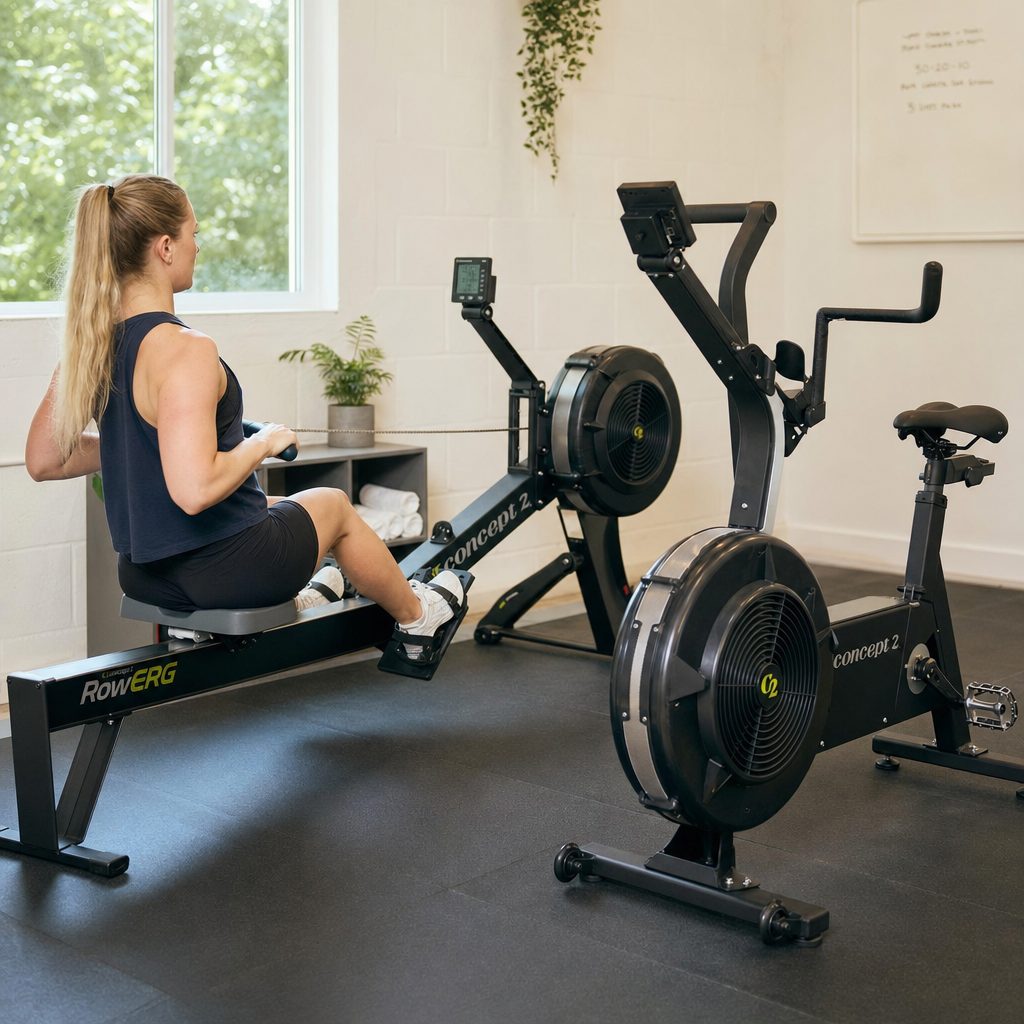
The air flywheel and damper are central to both machines, but the RowErg turns that resistance into strokes whilst the BikeErg turns it into a cycling-style gear feel.
5. Muscle engagement, joint impact and learning curve
The RowErg's biggest strength is also its main demand: it asks a lot of the body at once. When your technique is organised, the legs start the stroke, the trunk transfers force and the arms complete it. The result is a powerful, coordinated movement involving major muscle groups. For people who want one machine to make cardio feel less repetitive and more athletic, it is difficult to beat.
However, broad engagement also means more places for a rushed technique to go wrong. If you begin every drive by yanking with the arms, your back and arms may fatigue before the legs are doing enough useful work. If you collapse at the catch or overreach at the finish, the workout can feel awkward rather than flowing. The RowErg does not require perfection, but it rewards patience. A few sessions spent learning the sequence can improve comfort and make the machine feel dramatically more effective.
The BikeErg has a gentler learning curve because most people understand the basic task immediately. You pedal, you alter the damper to change the ride feel, and you use the PM5 to guide pace or power. This makes it particularly approachable in a shared household, where one person may be a keen trainer and another may simply want a low-fuss way to move more. The BikeErg does not ask every user to learn a technical pulling sequence before they can have a satisfying workout.
Both formats are low impact in the sense that neither involves repeated foot strikes against the ground. That can be valuable for people who dislike running's impact or want an indoor alternative to jumping-based conditioning. Yet "low impact" does not mean "identical for every joint". Rowing involves repeated knee bending, hip movement, a trunk swing and arm pulling. Cycling keeps the movement more fixed and cycling-specific. If you already know that a particular cycling position agrees with you, the BikeErg is the safer bet from a familiarity perspective.
The RowErg may suit you if you want to spread work around the body rather than concentrate it through pedalling. The BikeErg may suit you if you prefer a movement that is easy to scale down on a tired day. On a bike, it is usually straightforward to ride gently for 20 minutes without it becoming a technical project. On a rower, an easy session still benefits from deliberate sequencing, even though the intensity can certainly be low.
There is also a psychological distinction. The RowErg is often intensely engaging because every stroke is a small event: push, swing, pull, recover. Some people love that feedback. Others find they would rather climb onto a bike and let their legs turn over whilst they decompress. Neither preference is shallow. Enjoyment has a direct effect on consistency, and consistency remains more useful than a theoretically perfect machine that gathers dust.
RowErg strengths
- Trains legs, core, back and arms in one coordinated session.
- Excellent fit for users who want full-body conditioning from a single machine.
- Low-impact movement without the foot strikes associated with running.
- Rewards technique development with a smooth, powerful stroke.
RowErg limitations
- Requires more learning than simply getting on and pedalling.
- Longer in use and potentially harder to position in a small flat.
- Its body movement can make a given displayed power feel more demanding.
- Chain and air-flywheel noise deserve consideration in close quarters.
BikeErg strengths
- Familiar pedalling movement with a straightforward learning curve.
- Shorter stated length makes placement easier in many rooms.
- Self-tensioning belt system supports a quieter, low-maintenance ride.
- Standard bike parts can be swapped for a more personal fit.
BikeErg limitations
- Less upper-body and back involvement than rowing.
- Hard sprinting still increases air-flywheel noise.
- It is cycling-specific, so it will not satisfy someone who wants a rowing movement.
- Its seated riding format may not appeal to people who prefer varied full-body motion.
6. Noise in a flat: the BikeErg has the more neighbour-friendly case
Noise is where the head-to-head becomes particularly important for flat dwellers. An air machine will never behave like a whisper-quiet magnetic unit because its defining mechanism involves moving air through a flywheel. The question is not whether you will hear it; you will. The question is whether its sound, plus the sound of your movement, is realistic for your walls, floors, housemates and preferred training times.
The RowErg has been measured in use at around 67–74 dBA in one recorded experience, whilst broader reported use figures sit around 70–100 dB. The spread makes sense because effort changes the sound. Gentle strokes, moderate training and hard intervals are not equally loud. The familiar rushing flywheel note becomes more prominent as you push harder, and the chain-driven system adds its own mechanical character.
A useful real-world comparison from that recorded experience was a washing machine on its spin cycle. That does not mean every RowErg session will sound exactly like a washing machine, nor does it tell you how much vibration reaches a neighbour below. It does, however, make the point clearly: this is not a silent machine, especially if your favourite workouts are vigorous intervals.
The BikeErg has the stronger practical reputation here. At normal training outputs of around 200–300 watts, it has been described as very quiet. At 500–600 watts, the sound picks up, as you would expect when more air is being moved. The self-tensioning polygroove belts are a meaningful advantage over a chain for domestic use, and one user report noted that a neighbour had heard and complained about the rower on a few occasions but had never heard the BikeErg.
That is not a guarantee of silence through every wall. A hard BikeErg sprint is still a hard air-machine sprint. But if you rent, share a building, work irregular hours or worry about using equipment after dinner, the BikeErg is the less risky choice. It is especially appealing if most of your training will be steady rides rather than repeated all-out bursts.
The bar chart is not a direct decibel comparison between the two products; only the RowErg figures are stated as sound measurements. It is instead a practical guide to the evidence available: the RowErg has a clearly documented audible presence, whilst the BikeErg is notably restrained at ordinary training watts and gets louder at very high outputs.
Whatever you choose, thoughtful placement helps. Avoid placing either machine directly against a shared wall if you can. Give yourself enough clear space that you are not clipping furniture or shifting the unit during use. The RowErg needs particular attention because the sliding seat and long frame invite more whole-body movement. The BikeErg is easier to isolate as a single compact station, but a stable, sensible location is still preferable to trying to squeeze it into a walkway.
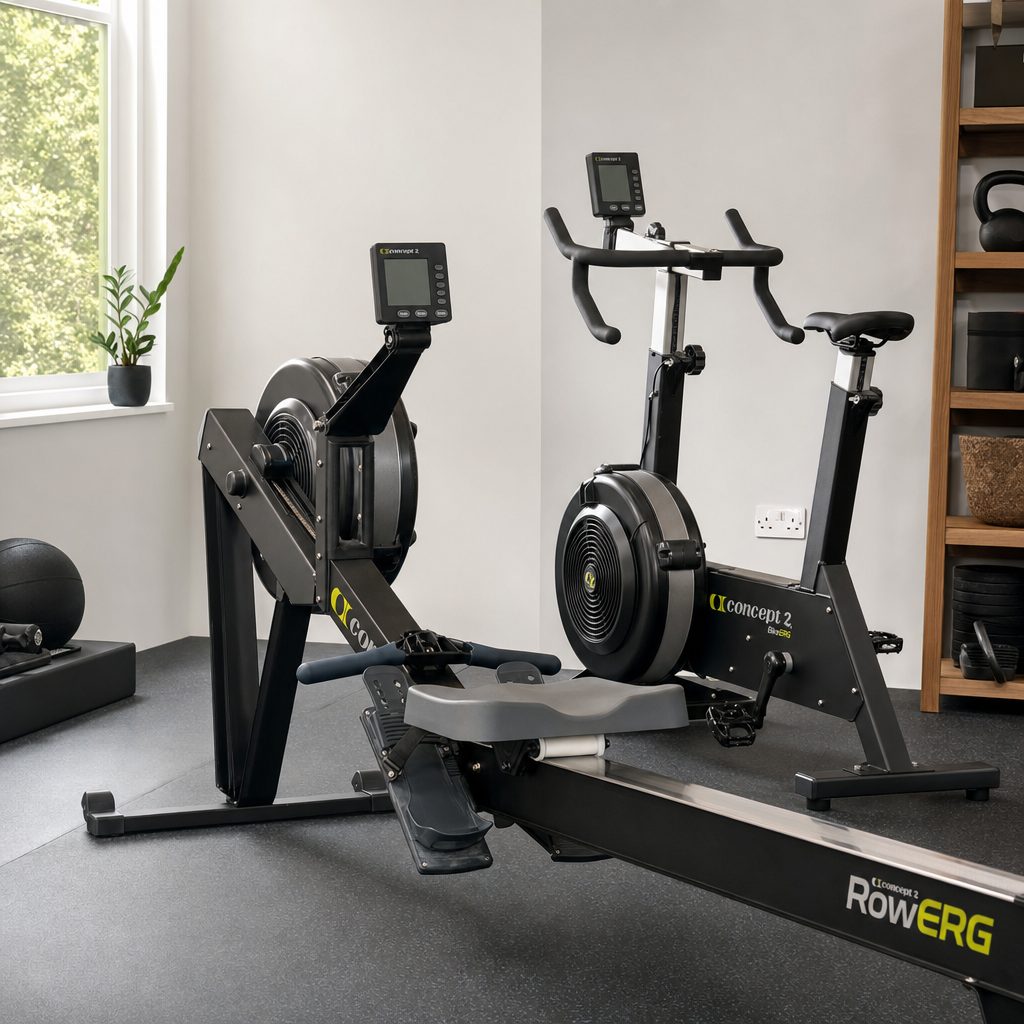
For shared buildings, the BikeErg's belt-driven format is generally the more considerate option for steady training, while the RowErg's air rush is more obvious during hard work.
7. Footprint, storage and the reality of living with each machine
It is easy to focus on the product dimensions, then forget that home gym equipment needs living space around it. The RowErg is 244cm long and 61cm wide, with a 137cm monorail. That long rail is the point of the machine: it gives you room to slide through a full stroke. But it means the RowErg should be measured against your actual usable floor, not simply the longest wall in the room.
Before buying a RowErg, I would mark out 244cm with tape or a long piece of string. Stand where your feet would be, look at where the back of the machine would reach and imagine the route you take to the sofa, kitchen or balcony. In a dedicated spare room, that length is rarely a problem. In a studio or a living room that doubles as an office, it can become the deciding factor.
Concept2 offers a sensible answer to this: the RowErg can be quickly separated into two pieces without tools. That is genuinely useful for a flat. It means the machine does not have to occupy its full operating form permanently. Front caster wheels also help when you need to shift it. Separating the machine is not the same as making it disappear, of course, but it is a practical storage arrangement rather than a theoretical one.
The BikeErg's stated overall length is 122cm, exactly half the RowErg's listed length. That is a major advantage where floor depth is limited. It is still 65lb or 29kg, so it is not a featherweight prop to move constantly, but its bike form is inherently easier to place in the corner of a room. You can make it a permanent part of a bedroom, home office or lounge without needing a long unobstructed channel every time you want to train.
Seat access also matters in compact rooms. The RowErg standard-leg version has a 36cm seat height, while tall legs raise it to 51cm. The higher version can make getting on and off feel easier for some users, particularly where dropping down to a lower seat is inconvenient. The BikeErg's seat-to-pedal range of approximately 79–103cm is more relevant to fitting your leg length and cycling position, and the availability of a low seat adds another route to tailoring access.
There is no universal flat winner because layouts differ. A long but narrow room could accommodate the RowErg beautifully along one wall. A compact square room with furniture on every side will normally favour the BikeErg. The BikeErg wins the default space argument; the RowErg wins if you can give it a reliable, dedicated lane or are genuinely happy to split it for storage.
| Flat-living question | Better answer | Why it matters |
|---|---|---|
| You have limited floor depth | Concept2 BikeErg | Its stated length is 122cm, compared with 244cm for the RowErg. |
| You can store equipment between sessions | Concept2 RowErg | It separates into two pieces without tools and has front caster wheels. |
| You want a fixed training corner | Concept2 BikeErg | A compact bike format is easier to keep ready for spontaneous rides. |
| You want one machine for full-body movement | Concept2 RowErg | The stroke combines legs, core, back and arms. |
| You train at sensitive hours | Concept2 BikeErg | Its belt drive and quieter normal-watt riding character better suit close neighbours. |
8. PM5 monitor, connectivity and the subscription-free advantage
The PM5 is a major reason both machines remain compelling. It is not trying to be a tablet, and that is exactly the appeal for many buyers. Rather than attaching the machine's usefulness to a monthly entertainment platform, Concept2 centres the experience on training data, programmed workouts and compatibility. You get a monitor designed to tell you what the machine is doing rather than distract you from it.
On the RowErg, the PM5 provides accurate data, workout programmes, Bluetooth connectivity and support for heart-rate monitoring, ErgData, compatible apps and machine-to-machine racing. That last feature underlines the RowErg's long connection to rowing communities and structured training. You can train alone in a flat without the equipment feeling isolated from the broader world of rowing data and challenges.
The BikeErg's PM5 includes Bluetooth and ANT+ connectivity, allowing it to connect with many heart-rate belts, fitness devices and apps. A device holder is included, which is a quietly useful domestic feature. It means you can position a phone or other device for a ride without improvising with a chair, shelf or precarious pile of books. For a long aerobic session, that convenience can make the BikeErg feel especially easy to use.
The monitor uses two D-cell batteries. During a workout, the BikeErg PM5 draws power from the spinning flywheel. That arrangement fits the wider Concept2 approach: the equipment is built around the activity itself rather than an always-plugged-in display. You are not buying a machine because it has the largest screen; you are buying a durable training platform whose monitor happens to be highly functional.
For a data-minded buyer, the machines are closely matched. The meaningful difference is how you interpret the numbers. Rowing data is tied to strokes and rowing pace, whereas bike training naturally leans into pedalling, wattage and ride-like efforts. Crucially, do not assume that a watt value means the same experience on each machine. As noted earlier, the body movement required on the RowErg means normalised power can feel significantly harder there.
For someone who has been paying for a subscription-based fitness experience and wants to step away from that model, both are refreshingly direct. You can use the PM5's programmes and connectivity without making the hardware dependent on a giant screen. The trade-off is obvious: if you want an instructor-led visual class to be the centre of every workout, neither product is designed around that. If you want robust metrics and freedom to choose your own app or session style, both are excellent fits.
PM5 on both machines
Both products use the PM5 Performance Monitor for workout data and programmed sessions, delivering a consistent Concept2 training interface.
Heart-rate and app connections
The RowErg supports heart-rate monitoring, ErgData and app compatibility; the BikeErg offers Bluetooth and ANT+ links for many belts, devices and apps.
BikeErg device holder
The BikeErg includes a device holder, a useful touch for longer indoor rides where you want your own screen in view.
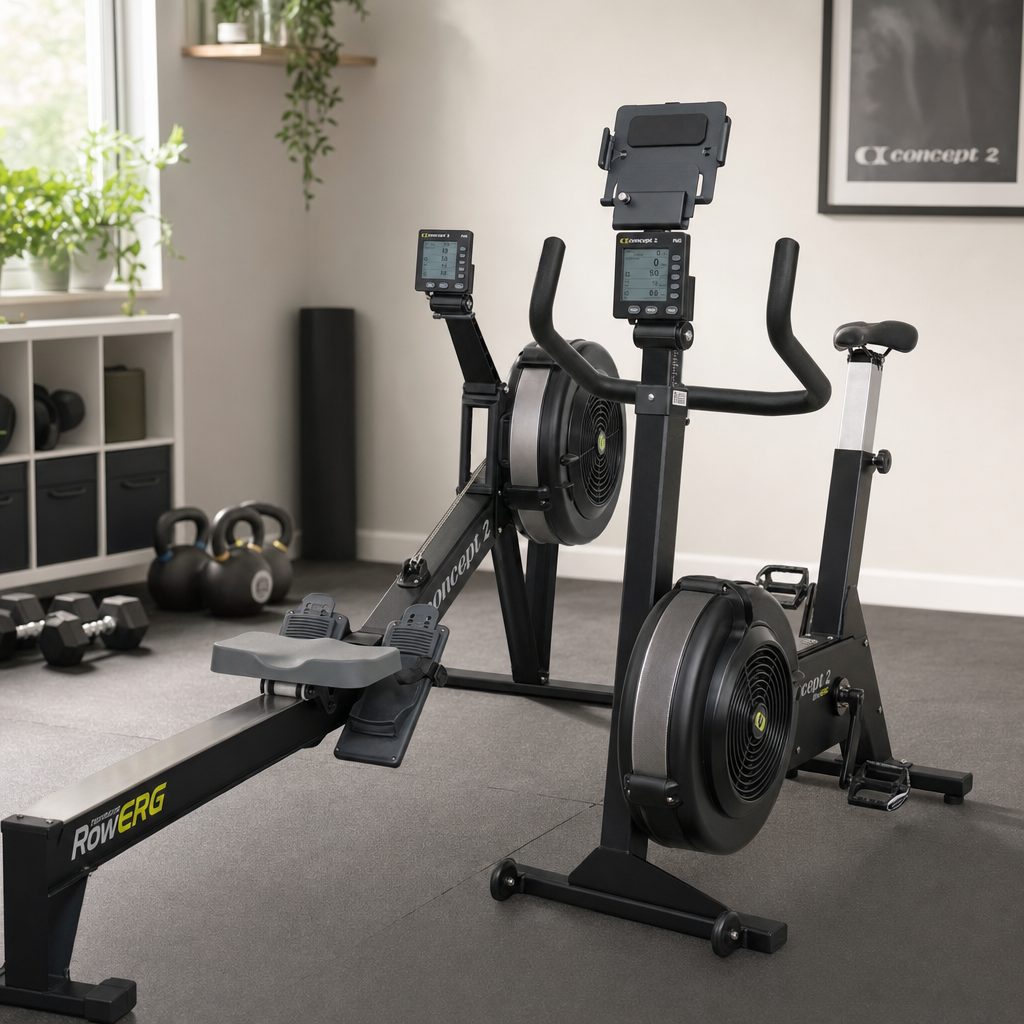
The PM5 gives both machines a shared data-first identity, while the BikeErg adds a device holder for riders who prefer a phone or tablet in front of them.
9. Maintenance, customisation and long-term ownership
One of the most appealing things about Concept2 equipment is that it is not built around novelty. The RowErg lineage began with the Model D Indoor Rower in 2003, and the Model D was renamed the RowErg in April 2021. The BikeErg was released in August 2017. By July 2026, these are not unproven new designs. They are established machines with years of use behind them, and both remained in active production.
That history matters when you are spending a meaningful amount on home equipment. A machine can have impressive features at launch and still become awkward to support or difficult to trust after a couple of years. These Concept2 products take the opposite approach. Their appeal is based on durable, recognisable mechanics, a consistent monitor and a training format that has not depended on a fast-moving screen ecosystem.
The RowErg uses a nickel-plated chain. A chain gives it a direct mechanical feel and is part of the classic Concept2 rowing experience. Some buyers will favour this because it feels robust and familiar. Others will be more attracted to the BikeErg's high-strength polygroove belts, which are self-tensioning to help extend life and reduce maintenance. Neither choice is automatically superior in every sense; they suit the movement and design of each machine. But in a flat, the BikeErg belt is an especially attractive detail because quieter everyday operation and less maintenance are both helpful.
Customisation is another clear BikeErg advantage. It fits most standard bike parts, allowing you to swap saddle, handlebars and pedals. That is a substantial benefit for people who already know what they like from outdoor riding. A favourite saddle, preferred pedal system or handlebar setup can make a static bike feel less generic and more personally usable. If fit is the difference between riding three times a week and avoiding the machine, this adaptability is valuable.
The RowErg approaches fit differently. Its ergonomic seat and handle, together with adjustable footrests, are intended to accommodate the rowing movement. Rather than turning it into a personalised road bike analogue, it gives you the core points of adjustment needed to establish a repeatable rowing position. The tall-leg option also creates a meaningful variation in access height.
For the buyer thinking beyond the first month, the question becomes whether you want a specialised cycling platform you can tune to your preferences or a classic whole-body rowing machine with a long record of broad appeal. The BikeErg is more adaptable in bike-specific contact points. The RowErg is more adaptable in how many parts of your body contribute to each workout.
Ownership perspective
If you already have strong preferences about saddles, handlebars or pedals, the BikeErg's use of most standard bike parts is a compelling reason to choose it. If you want a machine whose core movement stays consistent and uncomplicated, the RowErg's ergonomic rowing setup remains exceptionally direct.
10. Concept2 RowErg vs BikeErg price and value in the UK
Price matters, but value is more than the initial figure. In the UK, the RowErg was listed at £990. The BikeErg was listed at £1,160, while the RowErg with Tall Legs was listed at £1,150. That puts the standard-leg RowErg in the clear value lead if your main goal is to buy into Concept2's air-resistance ecosystem for the lowest of these stated UK prices.
The BikeErg asks more because it is a different machine, not because it includes a radically different monitor. The value argument rests on its compact length, quiet belt-driven character, clutch-equipped cycling feel, included device holder and ability to take most standard bike parts. For the right person, particularly a flat-dwelling cyclist, those advantages can justify the extra outlay very easily.
The tall-leg RowErg is a useful reminder that price should not be separated from usability. It was listed at £1,150, only slightly below the BikeErg's £1,160. If a 51cm seat height is what makes getting on and off the rower comfortable, the higher price is not a luxury upgrade; it may be the version that actually gets used. Conversely, if the standard 36cm seat height feels perfectly natural, the standard-leg RowErg delivers the same essential rowing experience for less.
US listed prices told a similar story. The standard-leg RowErg retailed for $990 and was discounted to $940, the tall-leg RowErg retailed for $1,155 and was discounted to $1,105, and the BikeErg retailed for $1,100 and was discounted to $1,060. These figures are helpful for understanding the hierarchy, though UK buyers should naturally shop according to local pricing and stock arrangements.
Concept2 RowErg
Standard legs, with a 14in / 36cm seat height. The lowest stated UK entry point of these three options.
Concept2 RowErg with Tall Legs
Tall-leg version with a 20in / 51cm seat height for buyers who value easier access.
Concept2 BikeErg
Compact air bike with PM5, device holder, clutch and bike-part compatibility.
Neither option locks you into a subscription for its core purpose. That is an important part of their value proposition. You are paying for the machine, its PM5 training system and the freedom to use compatible devices and apps as you choose. Over years of ownership, that straightforward model can matter as much as the difference between £990 and £1,160.
My value conclusion is deliberately split. The standard RowErg is the better value if you want maximum muscle involvement, enjoy rowing or are willing to learn it, and have enough room to use it. The BikeErg is the better value if the machine needs to fit comfortably into daily life in a smaller flat, if quieter normal training is important, or if cycling fit and customisation are priorities. The tall-leg RowErg is the value choice for a more specific buyer: someone who wants rowing but needs the higher seat position.
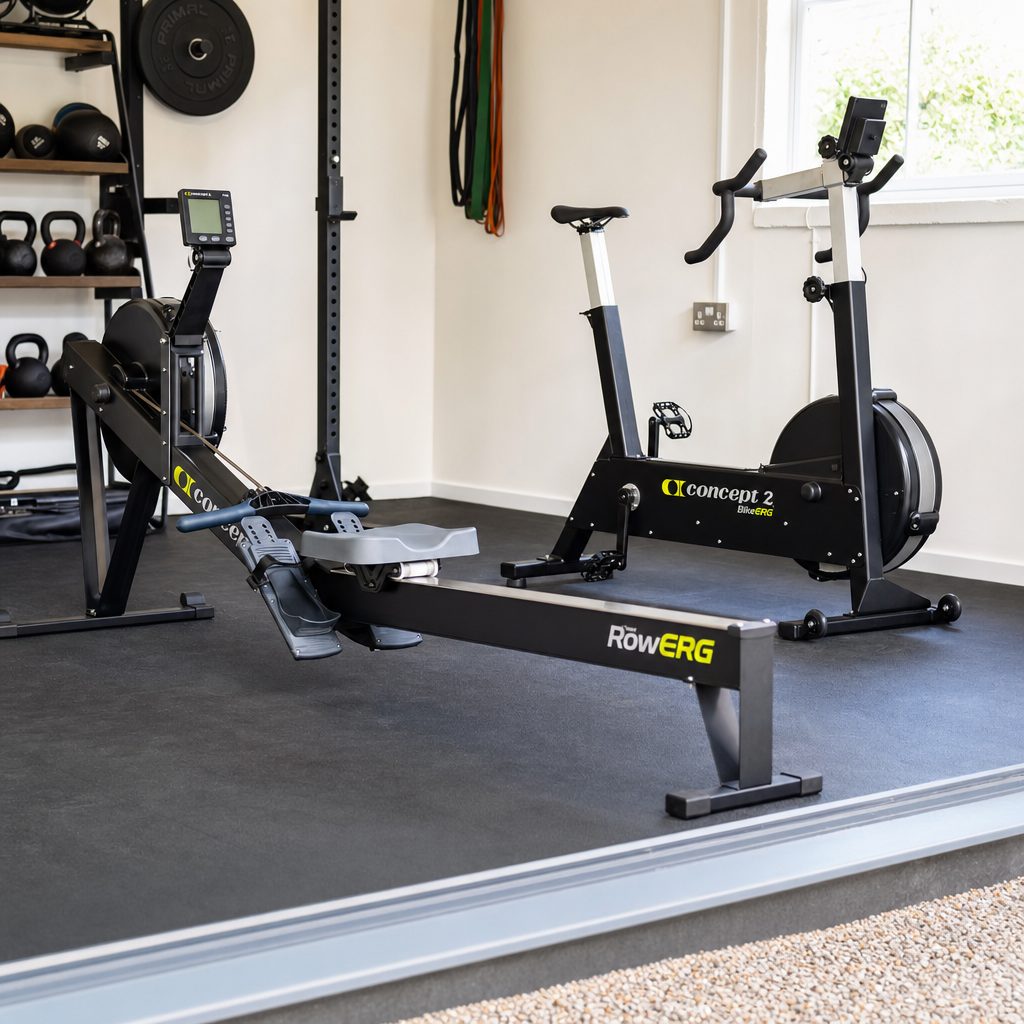
The RowErg offers the lower stated UK starting price, but the BikeErg's compact format, belt drive and customisable bike contact points can make it the better long-term value for the right flat.
11. Best for different buyers: a clear RowErg and BikeErg breakdown
A good comparison should end with useful recommendations rather than pretending every buyer has identical needs. The RowErg and BikeErg are close in quality but far apart in how they fit into a routine. These are the choices I would make for the most common types of home user.
Best all-rounder: Concept2 RowErg
View Concept2 RowErg on Amazon UK
Choose the RowErg if you want the widest spread of muscle involvement from a single machine. It combines legs, core, back and arms and remains the stronger pick for full-body conditioning.
Best for a small flat: Concept2 BikeErg
View Concept2 BikeErg on Amazon UK
At 122cm in stated overall length versus the RowErg's 244cm, the BikeErg is the more straightforward machine to position in a compact room.
Best lower-price choice: Concept2 RowErg
At a stated UK price of £990 for standard legs, the RowErg is the lower-cost route into Concept2's PM5-equipped air-machine range.
Best for neighbour sensitivity: Concept2 BikeErg
The belt system and very quiet character at 200–300 watts give the BikeErg the better case for regular flat-based riding.
Best for cyclists: Concept2 BikeErg
Its clutch creates a real-bike-like flywheel feel, and most standard saddles, handlebars and pedals can be swapped to suit your preferences.
Best for time-efficient hard sessions: Concept2 RowErg
The rowing stroke asks the upper and lower body to contribute together, making it an excellent choice when you want a concentrated whole-body workout.
There is one buyer I would urge to pause before choosing: the person who hates both rowing and cycling but feels they "should" own a serious cardio machine. Neither Concept2 product can solve a dislike of the movement itself. The RowErg is too specialised to buy merely because it is respected, and the BikeErg is too bike-like to buy merely because it is compact. If possible, spend time on both styles first. Your instinctive reaction to the movement may be more useful than a lengthy specification sheet.
For couples or shared households, think about the least experienced user as well as the keenest one. The BikeErg is generally easier for a newcomer to jump on and use sensibly. The RowErg may become the shared favourite if everyone values full-body training and is willing to learn the stroke. If one person needs a higher seat, the tall-leg RowErg deserves close consideration; if another needs a cycling setup tailored to familiar contact points, the BikeErg may win the household vote.
12. Frequently asked questions
They are hard in different ways. The RowErg uses legs, core, back and arms in a coordinated stroke, and research found that at normalised power output it required significantly more work, partly because moving the body back and forth is not included in the RowErg's displayed power. The BikeErg can still be extremely demanding, especially at high wattage, but its cycling-specific movement is easier for many people to settle into.
The BikeErg is the stronger choice for noise-sensitive homes. Its self-tensioning polygroove belts support a quiet ride, and it has been described as very quiet at normal training outputs of 200–300 watts. The RowErg has recorded use figures of around 67–74 dBA, with broader reported figures of around 70–100 dB depending on effort. Both get louder when worked hard because both use air resistance.
It depends on the layout, but its 244cm stated overall length is substantial. You need clear room to row, not merely somewhere to park the frame. The helpful part is that the RowErg can be separated into two pieces without tools and has front caster wheels. If you cannot reliably create a long exercise lane, the BikeErg's 122cm stated length is normally the easier choice.
On the RowErg, the 1–10 spiral damper changes airflow through the flywheel and therefore the feel of the stroke. On the BikeErg, the damper acts like gearing, allowing quick changes in ride feel. It should not be seen as a simple fitness setting where higher is automatically better. A controllable setting that suits your technique and workout is the sensible choice.
Yes. The BikeErg fits most standard bike parts, so you can swap in your own saddle, handlebars and pedals for a more personal cycling setup. This is one of its biggest advantages for experienced cyclists or anyone who already knows that a particular saddle or pedal arrangement improves comfort.
Both use the PM5 Performance Monitor. The RowErg supports accurate data, workout programmes, heart-rate monitoring, ErgData, compatible apps and machine-to-machine racing. The BikeErg PM5 offers Bluetooth and ANT+ connectivity for many heart-rate belts, devices and apps, and the BikeErg includes a device holder.
Choose based on access and comfort rather than status. Standard legs place the seat at 14in or 36cm from the floor. Tall legs raise the seat to 20in or 51cm. If getting down to and up from a lower seat feels awkward, the taller version may be more practical and therefore better value for you despite its higher stated price.
The BikeErg is usually the easier recommendation for long, steady aerobic work because cycling is familiar, the movement is simple to sustain and the machine is notably quiet at ordinary training watts. The RowErg can absolutely be used for steady work, but it is more technique-dependent and delivers a more whole-body sensation that some people prefer to reserve for shorter or more focused sessions.
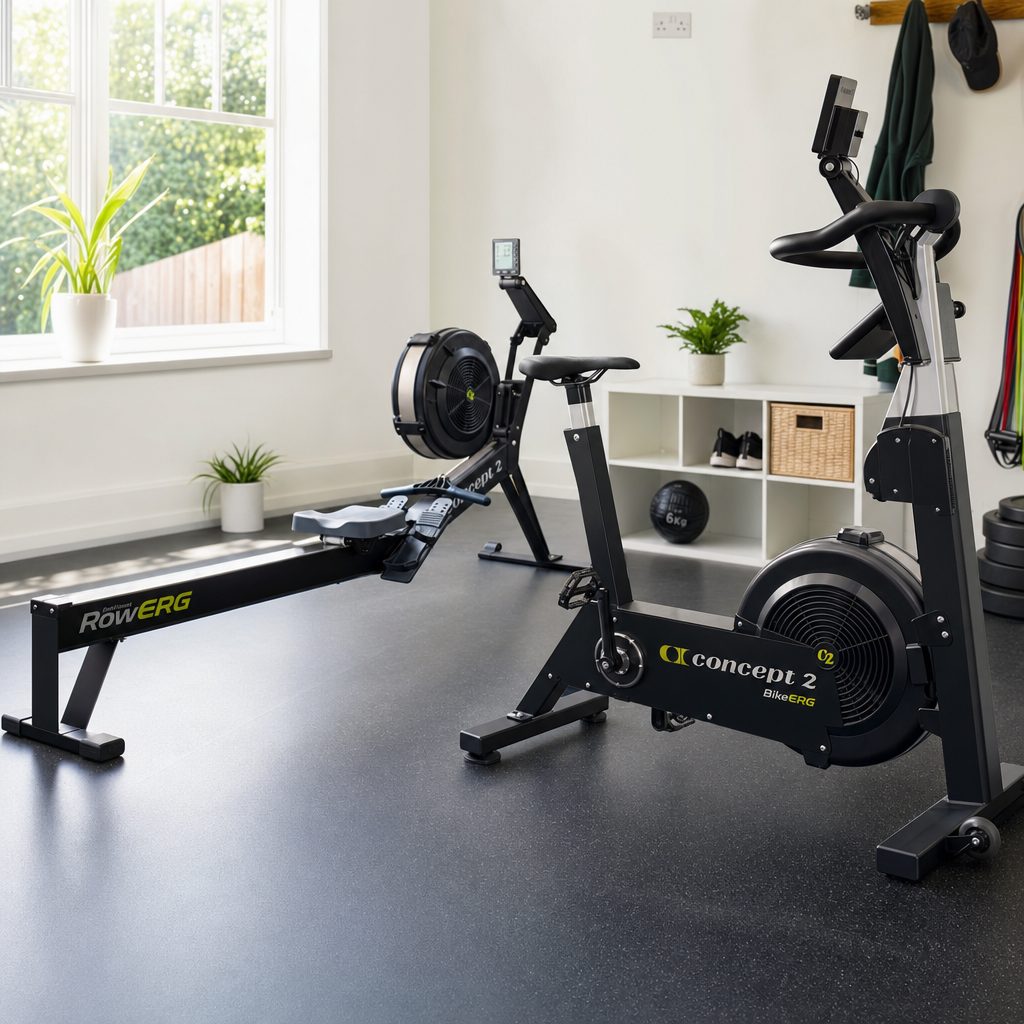
The best choice is not the machine with the most impressive specification list; it is the one whose movement, noise level and footprint make regular training realistic in your home.
Final verdict: Concept2 RowErg for full-body training, BikeErg for easier flat living
Compare our cardio machine reviews
The Concept2 RowErg is the better buy for the person who wants one machine to involve as much of the body as possible. Its coordinated leg, core, back and arm movement makes it a superb all-round conditioning tool, and its £990 stated UK price for standard legs gives it a strong value argument. If you have space for its 244cm operating length, enjoy rowing or are willing to learn the technique, it remains the more complete single-machine workout.
The Concept2 BikeErg is the better buy for many flat dwellers, cyclists and noise-conscious households. Its 122cm stated length is much easier to accommodate, its belt-driven design is very quiet at normal 200–300W training outputs, and its clutch plus standard bike-part compatibility create a more convincing cycling experience. At £1,160, it costs more than the standard RowErg, but it can be worth every extra pound if compact placement and daily usability are what determine whether you train.
Put simply: choose the RowErg for full-body efficiency, rowing satisfaction and the lower starting price. Choose the BikeErg for a quieter, shorter, more familiar machine that is easier to make part of life in a flat. Both are established, active Concept2 machines in July 2026; the winning choice is the one you can fit, enjoy and use week after week.