
Amazfit T-Rex Dual Solar launches in UK at £649.90 with world-first dual solar AMOLED
The T-Rex Dual Solar is the world's first AMOLED smartwatch with front and rear solar charging panels, and it is available to order in the UK right now.
 By James Oduya · Staff Writer & Home Gym Columnist · Updated September 28, 2026
What you need to know
- The Amazfit T-Rex Dual Solar is the world's first AMOLED smartwatch with dual-sided solar charging, combining a front display panel and a rear glass-ceramic panel.
- UK price is £649.90, available via Amazfit.com and Amazon, with shipping expected from mid-October 2026.
- Amazfit claims up to 51 days of typical use with rear solar charging, or up to 180 days in Outdoor Extreme Mode — figures that come with important caveats.
Amazfit launches T-Rex Dual Solar in UK with world-first dual-sided solar AMOLED
Amazfit went on sale in the UK on 22 September 2026 with the T-Rex Dual Solar, a premium expedition smartwatch the brand describes as the world's first AMOLED smartwatch featuring a dual-sided solar charging system. Priced at £649.90, it is available through Amazfit.com and Amazon, though buyers ordering now should be aware that units are not expected to ship until mid-October.
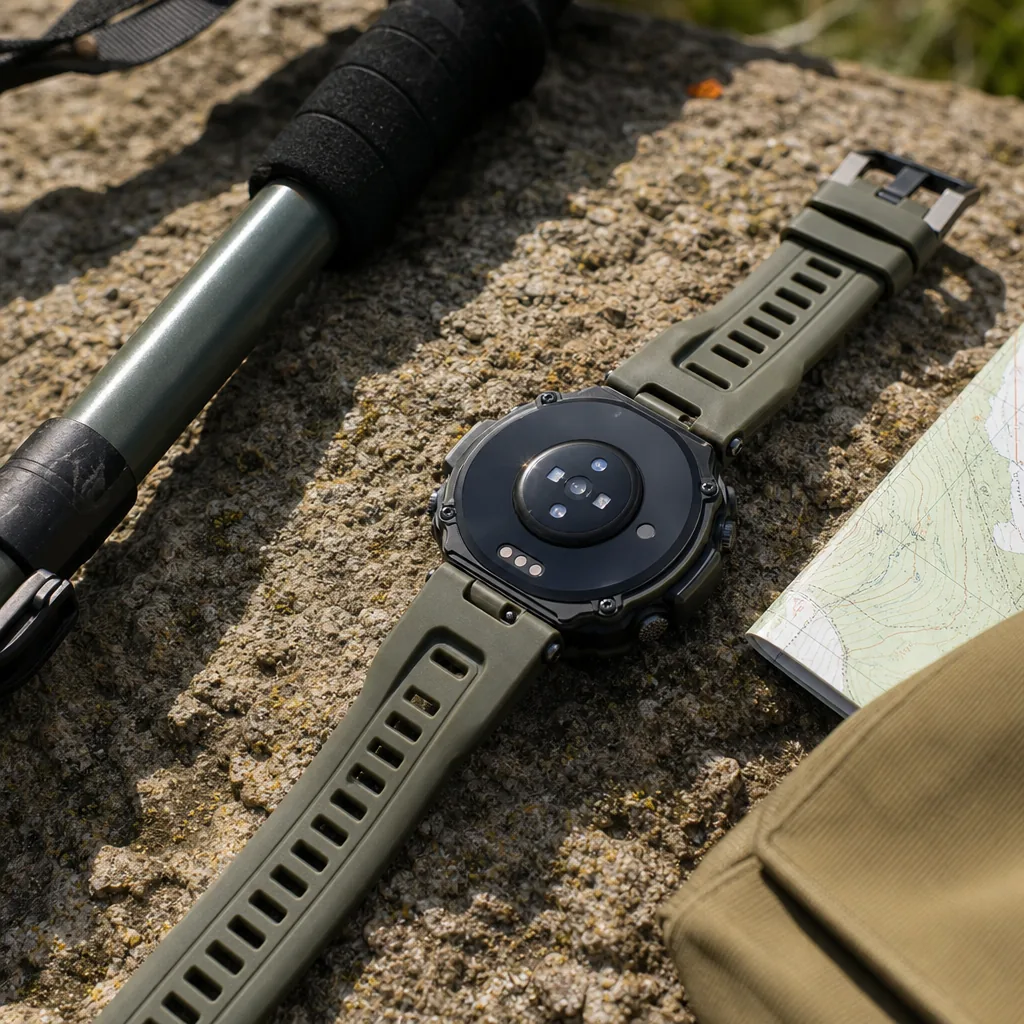
The launch was timed deliberately to coincide with the autumnal equinox — which Amazfit described as "a day defined by the balance of sunlight and darkness." The T-Rex Dual Solar is made by Zepp Health, the Shanghai-listed parent company behind the Amazfit brand.
How the dual solar system works
Previous solar smartwatches — almost all from Garmin — have relied on low-power transflective MIP screens, which consume so little energy that even a small solar panel can meaningfully extend battery life. Amazfit's challenge has been to make solar work alongside a power-hungry AMOLED display. Its solution is a two-panel architecture.
The front panel sits within the display itself and harvests ambient light while the watch is being worn. The rear panel, built into a glass-ceramic caseback, covers more than twice the active area of the front panel and charges at roughly twice the rate — but only when the watch is removed and angled directly at the sun. To make the rear panel practical in the field, Amazfit includes a woven lanyard in the box, allowing users to hang the watch from a backpack or bag strap during breaks, keeping the caseback exposed to sunlight without having to hold it.
Amazfit claims up to 25 days of typical use from the 660 mAh battery alone, rising to 34 days with three hours of daily front solar charging, and up to 51 days with three hours of rear solar charging. Both extended figures assume 50,000 lux of direct light exposure — roughly equivalent to bright midday sun — sustained for three hours a day.
There is also a headline figure of up to 180 days, which Amazfit quotes for Outdoor Extreme Mode combined with rear solar charging at the same 50,000 lux benchmark. That number requires significant context: Outdoor Extreme Mode strips the watch back to its core navigation and outdoor functions, and the 180-day projection assumes sustained high-intensity sun exposure. It is better understood as a theoretical ceiling for emergency endurance rather than a normal operating expectation.
Build, display, and specifications
The case measures 51.4mm and uses a Grade 5 titanium bezel with a glass-ceramic and titanium-alloy caseback. The 1.32-inch AMOLED display runs at 466 x 466 pixels and peaks at 3,000 nits of brightness, protected by sapphire crystal glass. The watch is water resistant to 10 ATM with recreational diving support to 50 metres, and Amazfit says it operates in temperatures from –30°C to +70°C.
Navigation is handled by dual-band GNSS across six satellite systems, with a circularly polarised GPS antenna. Amazfit claims up to 41 hours of continuous use in high-accuracy GPS tracking mode. The watch ships with preloaded full-colour maps, route planning, and slope data for ascents. Users can store up to 100 routes and create new ones directly on the watch without needing a paired phone. A LiveShare feature allows selected contacts to track the wearer's location in real time.
The T-Rex Dual Solar supports more than 180 sports modes, including hiking, mountaineering, recreational diving, golf, and HYROX. Additional features include a built-in flashlight, an SOS emergency signal, and a Solar Priority Mode designed to recover a depleted watch to the point where essential functions — emergency maps and route tracking — become available again.
The watch ships in a single titanium finish with a black band. The box includes a silicone strap and a USB-C charging base. Packaging is fully recyclable and does not include a separate charging cable.
What Amazfit says
"Outdoor watches have to work just as well in everyday life as they do when you're miles from a power source. With T-Rex Dual Solar, we didn't want users to have to choose between the bright, premium display they want every day and the battery endurance they need outdoors. Bringing AMOLED and solar together for the first time lets us deliver both." — Sara Webster Wylie, VP of Global Marketing, Amazfit
"The Amazfit T-Rex Dual Solar pushes the boundaries of what a sports watch can do, not only through its innovative solar charging technology. Advanced features, including Hybrid Training, provide effective support for active lifestyles both during preparation and while exploring new routes." — Jesús Carrero, General Manager, EMEA, Amazfit
How it compares and what it costs
At £649.90, the T-Rex Dual Solar is Amazfit's most expensive watch to date, sitting above the T-Rex Ultra 2, which carried a £549.99 retail price. The Ultra 2 relied on an 870 mAh battery — larger than the Dual Solar's 660 mAh cell — rather than solar charging to achieve its claimed 30 days of typical use and 50-plus hours of GPS tracking. The T-Rex Dual Solar's 1.32-inch screen is also notably smaller than the 1.5-inch display on the 48mm T-Rex 3 Pro, a trade-off that some reviewers have flagged.
Garmin's Fenix 9 Pro Solar quotes up to 291 days in power-saving mode — a larger headline number — but achieves it with a lower-power transflective MIP display rather than AMOLED. The T-Rex Dual Solar's distinction is that it combines solar endurance with a full-colour, high-brightness screen that Garmin's solar lineup currently does not offer.
Pre-orders are open now at £649.90. UK buyers can order via Amazfit.com or Amazon, with shipping expected from mid-October 2026.
Why it matters
For UK adventurers, the T-Rex Dual Solar represents the first serious attempt to bring solar endurance to a watch you would actually want to wear every day. Until now, solar charging on smartwatches has meant accepting a dim, monochrome display — Amazfit has broken that compromise. At £649.90 it enters Garmin territory on price, but offers something Garmin currently cannot match: a high-brightness AMOLED screen combined with genuine solar recovery. In the UK's famously unreliable sunshine, the front panel's ability to harvest light passively while worn is the practically relevant feature — the headline 180-day figure, which requires stripped-back power mode and sustained direct sun, is better understood as an emergency endurance ceiling than an everyday expectation.